
Can you think of other examples where mathematics helps us in our everyday lives?
Answer
Yes, mathematics is used in countless everyday situations. Some examples are:
- Paying for fruits, vegetables and groceries, and calculating the change to be returned.
- Managing money — making a budget, saving, and keeping accounts.
- Measuring ingredients and adjusting quantities while cooking.
- Reading the time from a clock and planning a daily schedule.
- Finding the distance, speed and travel time for a journey.
- Measuring lengths and finding the area of a room, a plot of land or a wall to be painted.
- Noticing designs and patterns in buildings, tiles, rangoli and fabrics.
There are many more such situations. It is a good idea to discuss and list other examples too.
How has mathematics helped propel humanity forward? (You might think of examples involving: carrying out scientific experiments; running our economy and democracy; building bridges, houses or other complex structures; making TVs, mobile phones, computers, bicycles, trains, cars, planes, calendars, clocks, etc.)
Answer
Mathematics is behind almost every major advance made by humankind. A few examples are:
- Science and space: Understanding patterns in the motion of the stars and planets led to the theory of gravitation, which lets us launch satellites and send rockets to the Moon and Mars.
- Health: Studying patterns in genomes has helped in diagnosing and curing diseases.
- Economy and democracy: Mathematics is used to run banks, plan budgets, collect taxes and count votes in elections.
- Construction: Bridges, houses and other large structures are designed using measurements, angles and calculations so that they stay strong and safe.
- Technology: TVs, mobile phones, computers, cars, trains and planes are all designed and built using mathematics.
- Timekeeping: Calendars and clocks are based on mathematical patterns in the motion of the Sun and the Moon.
Can you recognise the pattern in each of the sequences in Table 1?
| 1, 1, 1, 1, 1, 1, 1, ... | (All 1's) |
| 1, 2, 3, 4, 5, 6, 7, ... | (Counting numbers) |
| 1, 3, 5, 7, 9, 11, 13, ... | (Odd numbers) |
| 2, 4, 6, 8, 10, 12, 14, ... | (Even numbers) |
| 1, 3, 6, 10, 15, 21, 28, ... | (Triangular numbers) |
| 1, 4, 9, 16, 25, 36, 49, ... | (Squares) |
| 1, 8, 27, 64, 125, 216, ... | (Cubes) |
| 1, 2, 3, 5, 8, 13, 21, ... | (Virahānka numbers) |
| 1, 2, 4, 8, 16, 32, 64, ... | (Powers of 2) |
| 1, 3, 9, 27, 81, 243, 729, ... | (Powers of 3) |
Answer
Yes, each sequence in Table 1 follows a clear pattern.
1, 1, 1, 1, 1, 1, 1, … (All 1's) : Every term is 1.
1, 2, 3, 4, 5, 6, 7, … (Counting numbers) : Each term is 1 more than the previous term.
1, 3, 5, 7, 9, 11, 13, … (Odd numbers) : Each term is 2 more than the previous term; these are the numbers that are not divisible by 2.
2, 4, 6, 8, 10, 12, 14, … (Even numbers) : Each term is 2 more than the previous term; these are the numbers that are divisible by 2.
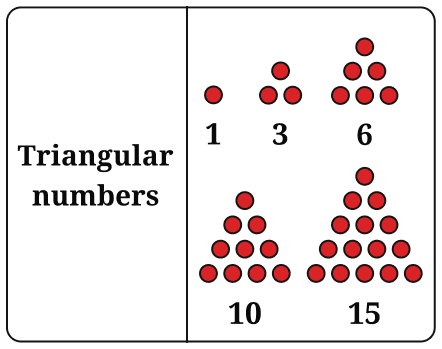
1, 3, 6, 10, 15, 21, 28, … (Triangular numbers) : Each term is the sum of the counting numbers up to that point (1, 1 + 2, 1 + 2 + 3, …); the dots can be arranged to form a triangle.
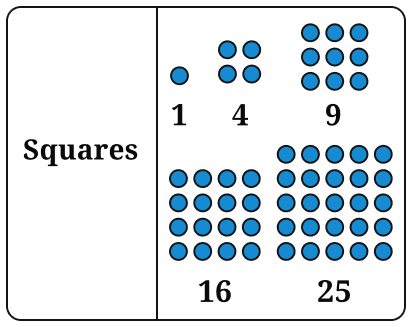
1, 4, 9, 16, 25, 36, 49, … (Squares) : Each term is a counting number multiplied by itself (1 × 1, 2 × 2, 3 × 3, …); the dots can be arranged to form a square.
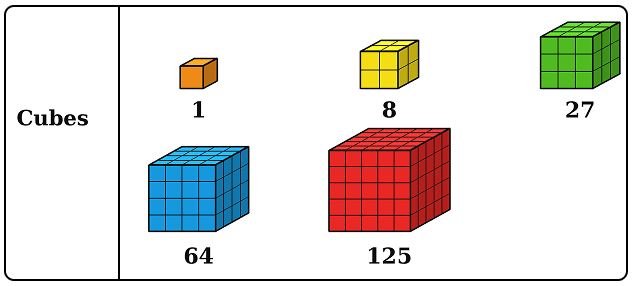
1, 8, 27, 64, 125, 216, … (Cubes) : Each term is a counting number multiplied by itself three times (1 × 1 × 1, 2 × 2 × 2, …); the dots can be arranged to form a cube.
1, 2, 3, 5, 8, 13, 21, … (Virahānka numbers) : Each term (from the third onwards) is the sum of the two terms before it (2 + 3 = 5, 3 + 5 = 8, 5 + 8 = 13, …).
1, 2, 4, 8, 16, 32, 64, … (Powers of 2) : Each term is twice the previous term.
1, 3, 9, 27, 81, 243, 729, … (Powers of 3) : Each term is three times the previous term.
Rewrite each sequence of Table 1 in your notebook, along with the next three numbers in each sequence! After each sequence, write in your own words what is the rule for forming the numbers in the sequence.
Answer
Each sequence is written below with its next three numbers (shown in bold) followed by the rule.
All 1's: 1, 1, 1, 1, 1, 1, 1, 1, 1, 1, …
Rule: Every term is 1.
Counting numbers: 1, 2, 3, 4, 5, 6, 7, 8, 9, 10, …
Rule: Start at 1 and add 1 each time to get the next term.
Odd numbers: 1, 3, 5, 7, 9, 11, 13, 15, 17, 19, …
Rule: Start at 1 and add 2 each time to get the next term.
Even numbers: 2, 4, 6, 8, 10, 12, 14, 16, 18, 20, …
Rule: Start at 2 and add 2 each time to get the next term.
Triangular numbers: 1, 3, 6, 10, 15, 21, 28, 36, 45, 55, …
Rule: Add the next counting number each time. The differences between consecutive terms are 2, 3, 4, 5, 6, 7, 8, 9, … (so 28 + 8 = 36, 36 + 9 = 45, 45 + 10 = 55).
Squares: 1, 4, 9, 16, 25, 36, 49, 64, 81, 100, …
Rule: Multiply each counting number by itself (8 × 8 = 64, 9 × 9 = 81, 10 × 10 = 100).
Cubes: 1, 8, 27, 64, 125, 216, 343, 512, 729, …
Rule: Multiply each counting number by itself three times (7 × 7 × 7 = 343, 8 × 8 × 8 = 512, 9 × 9 × 9 = 729).
Virahānka numbers: 1, 2, 3, 5, 8, 13, 21, 34, 55, 89, …
Rule: Add the two previous terms to get the next term (13 + 21 = 34, 21 + 34 = 55, 34 + 55 = 89).
Powers of 2: 1, 2, 4, 8, 16, 32, 64, 128, 256, 512, …
Rule: Multiply each term by 2 to get the next term.
Powers of 3: 1, 3, 9, 27, 81, 243, 729, 2187, 6561, 19683, …
Rule: Multiply each term by 3 to get the next term.
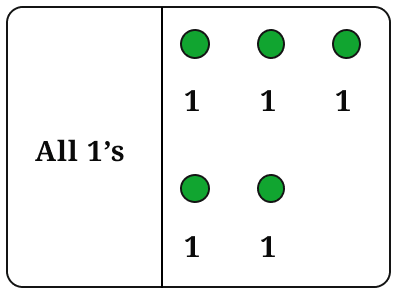
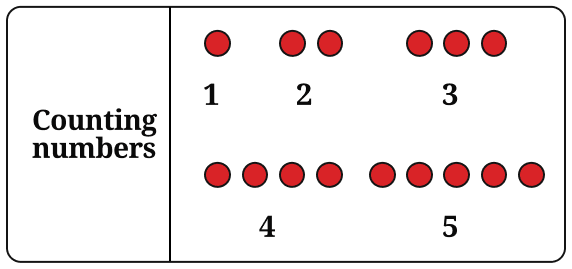
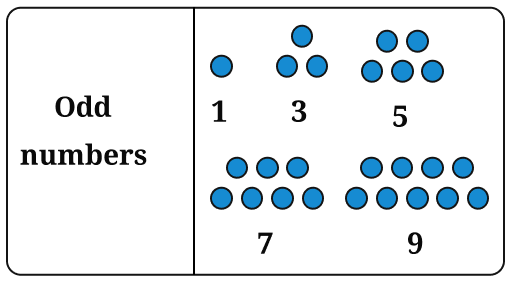
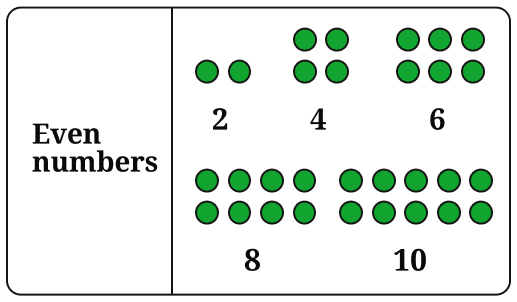
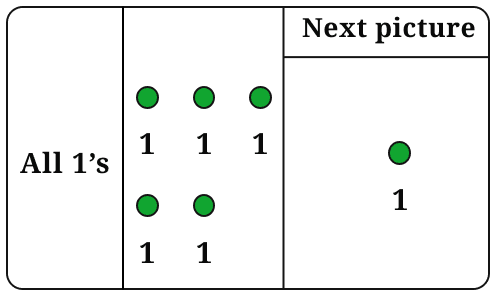
Copy the pictorial representations of the number sequences in Table 2 in your notebook, and draw the next picture for each sequence!
Answer
The next picture for each sequence in Table 2 is drawn by extending its pattern by one more step:
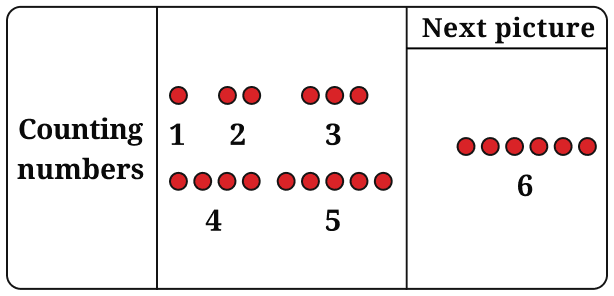
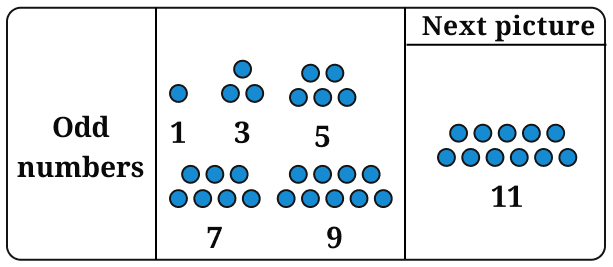
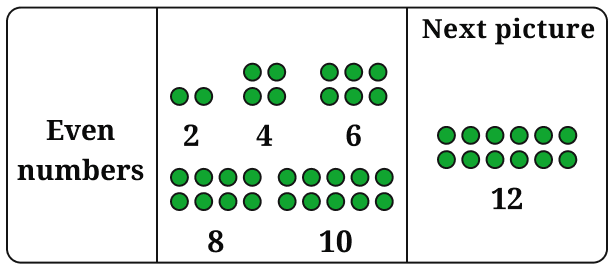
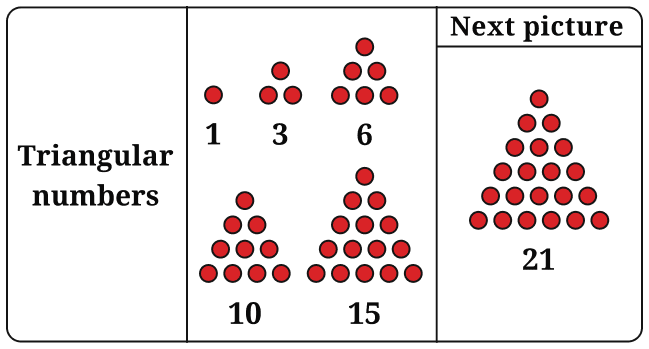
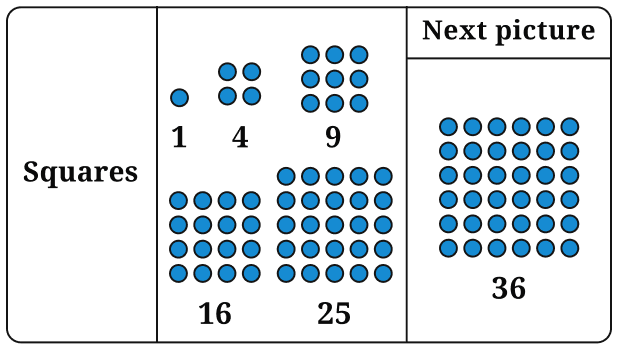
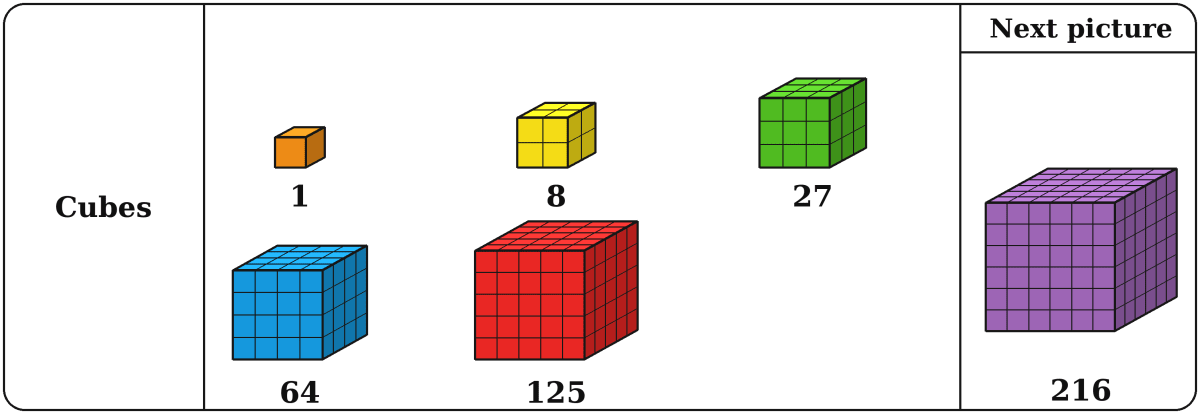
Why are 1, 3, 6, 10, 15, … called triangular numbers? Why are 1, 4, 9, 16, 25, … called square numbers or squares? Why are 1, 8, 27, 64, 125, … called cubes?
Answer
Triangular numbers (1, 3, 6, 10, 15, …) : They are called triangular numbers because the corresponding number of dots can be arranged perfectly in the shape of a triangle. For example, 3 dots form a triangle with 2 dots in the bottom row and 1 on top; 6 dots form a triangle with rows of 3, 2 and 1; and so on.
Square numbers (1, 4, 9, 16, 25, …) : They are called square numbers because the corresponding number of dots can be arranged perfectly in the shape of a square. For example, 4 dots form a 2 × 2 square, 9 dots form a 3 × 3 square, 16 dots form a 4 × 4 square, and so on. Each of these numbers is a counting number multiplied by itself :
1 = 12, 4 = 22, 9 = 32, 16 = 42, 25 = 52, …
Cubes (1, 8, 27, 64, 125, …) : They are called cubes because the corresponding number of small cubes can be stacked perfectly to form a bigger cube. For example, 8 small cubes form a 2 × 2 × 2 cube, 27 form a 3 × 3 × 3 cube, and so on. Each of these numbers is a counting number multiplied by itself three times:
1 = 1 × 1 × 1, 8 = 2 × 2 × 2, 27 = 3 × 3 × 3, 64 = 4 × 4 × 4, …
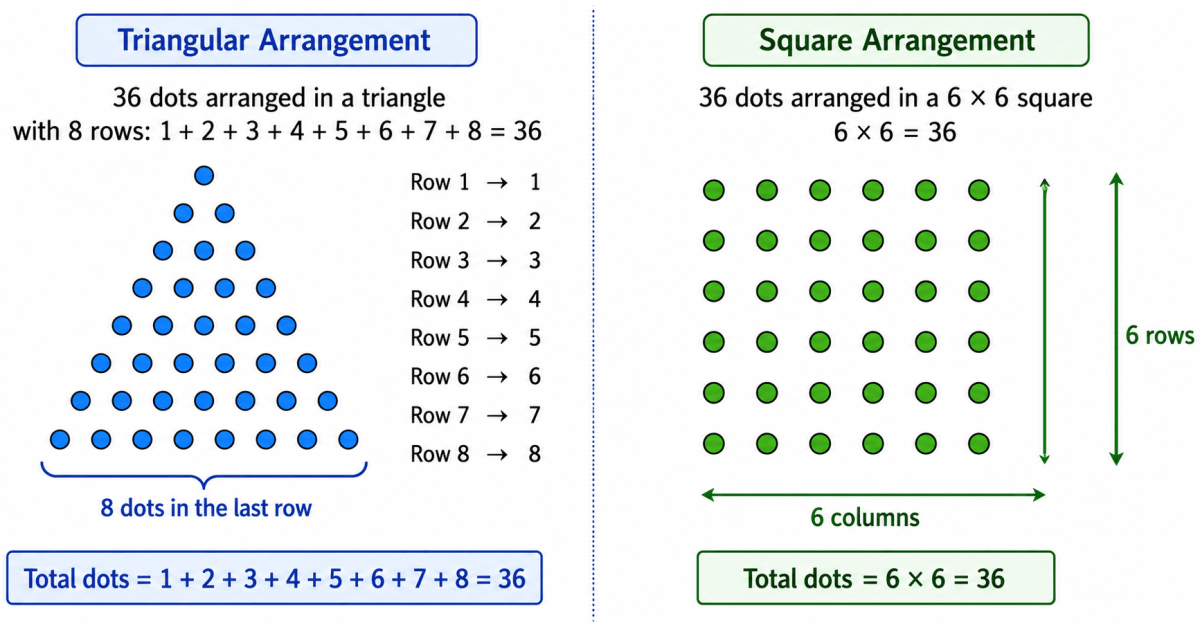
You will have noticed that 36 is both a triangular number and a square number! That is, 36 dots can be arranged perfectly both in a triangle and in a square. Make pictures in your notebook illustrating this!
This shows that the same number can be represented differently, and play different roles, depending on the context. Try representing some other numbers pictorially in different ways!
Answer
36 is a triangular number because 36 dots can be arranged in a triangle with 8 rows containing 1, 2, 3, 4, 5, 6, 7 and 8 dots :
1 + 2 + 3 + 4 + 5 + 6 + 7 + 8 = 36.
36 is also a square number because 36 dots can be arranged in a 6 × 6 square:
6 × 6 = 62 = 36.
So the same number, 36, can be pictured both as a triangle and as a square.
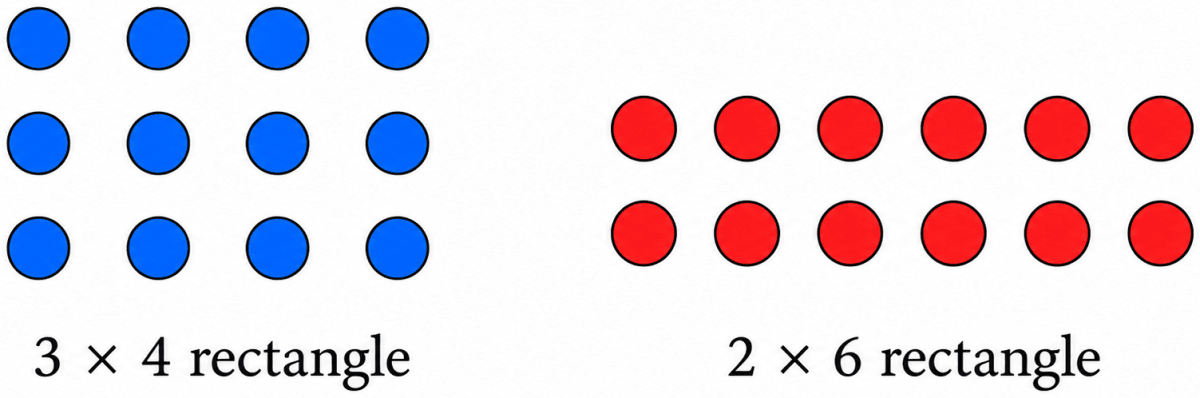
Another example is 12. Twelve dots can be arranged as 3 × 4 rectangle or a 2 × 6 rectangle.
What would you call the following sequence of numbers?
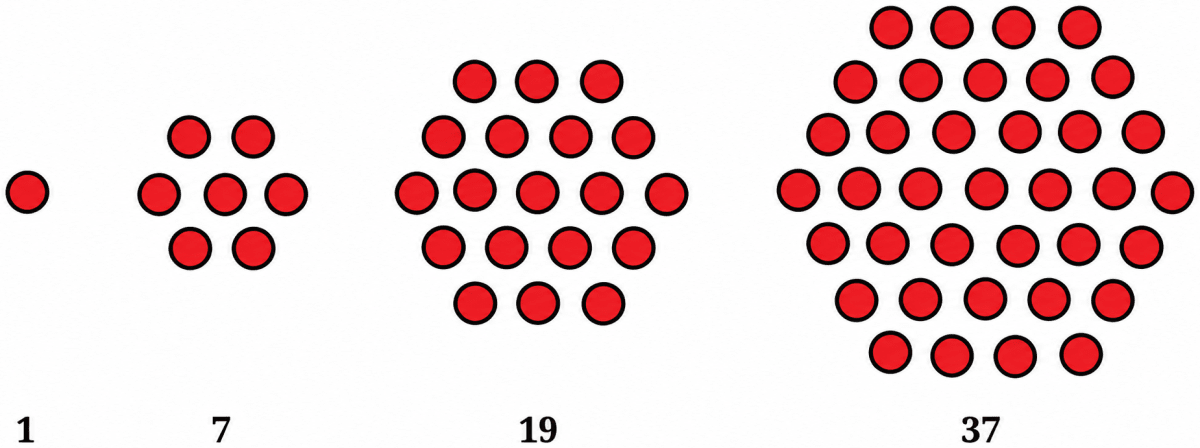
That's right, they are called hexagonal numbers! Draw these in your notebook. What is the next number in the sequence?
Answer
The given sequence is 1, 7, 19, 37, … and these are called hexagonal numbers because the dots can be arranged to form a hexagon.
To find the next number, look at the differences between consecutive terms:
7 − 1 = 6, 19 − 7 = 12, 37 − 19 = 18.
The differences are 6, 12, 18, … which are the multiples of 6. So the next difference is 24, and the next number is 37 + 24 = 61.
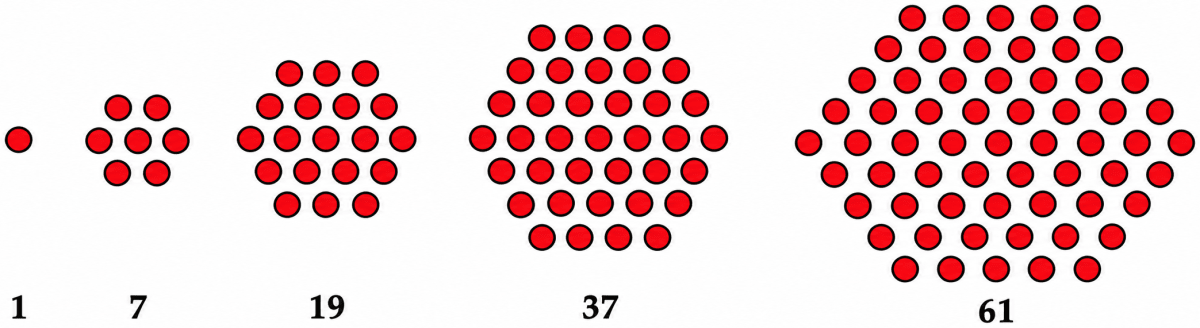
Hence, the next number in the sequence is 61.
Can you think of pictorial ways to visualise the sequence of Powers of 2? Powers of 3?
Answer
Yes, both sequences can be pictured by showing how each term is formed from the previous one.
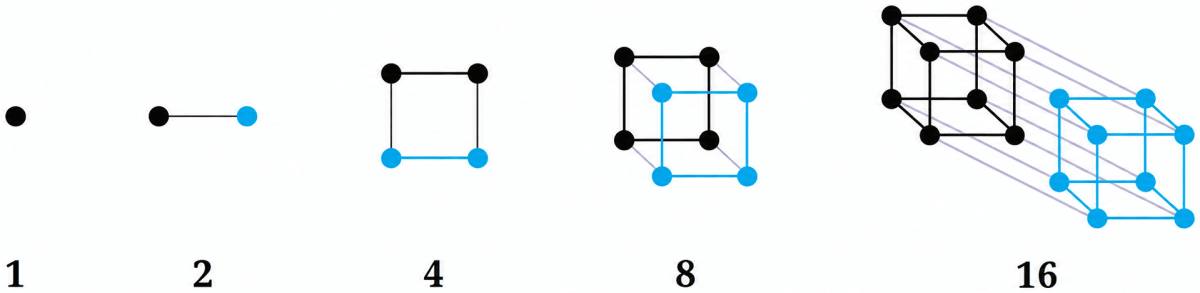
Powers of 2 (1, 2, 4, 8, 16, …) : Start with 1 dot. At each step, make a copy of the whole picture, so the number of dots doubles each time — 1 becomes 2, 2 becomes 4, 4 becomes 8, and so on. One neat way is to picture points forming a line, then a square, then a cube, and then a doubled cube, at each step joining a copy of the earlier figure to itself.
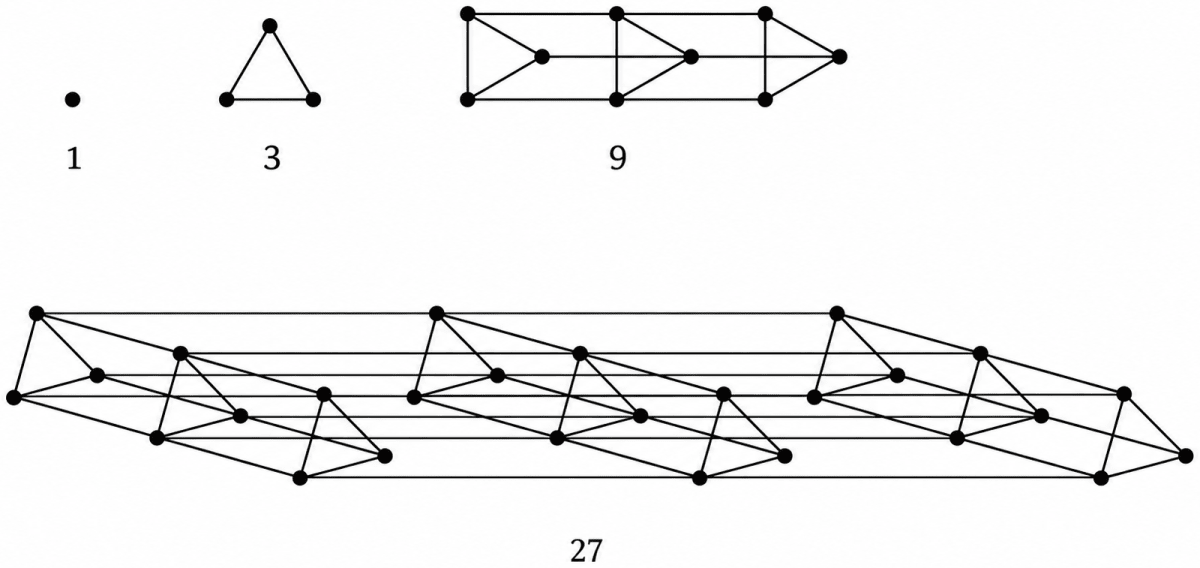
Powers of 3 (1, 3, 9, 27, …) : Start with 1 dot. At each step, make three copies of the whole picture, so the number of dots is tripled each time — 1 becomes 3, 3 becomes 9, 9 becomes 27, and so on. For example, 3 can be shown as a small triangle of dots, 9 as three such triangles joined together, 27 as three of those groups, and so on.
By drawing a similar picture, can you say what is the sum of the first 10 odd numbers?
(i) Now by imagining a similar picture, or by drawing it partially, as needed, can you say what is the sum of the first 100 odd numbers?
Answer
Adding up odd numbers starting from 1 always gives a square number, because the dots can be arranged in a square grid.
1 = 1 = 12
1 + 3 = 4 = 22
1 + 3 + 5 = 9 = 32
1 + 3 + 5 + 7 = 16 = 42
In general, the sum of the first n odd numbers is n2. So the sum of the first 10 odd numbers is
10 × 10 = 102 = 100.
Hence, the sum of the first 10 odd numbers is 100.
(i)
As seen above, the sum of the first n odd numbers is n2. So the sum of the first 100 odd numbers is
100 × 100 = 1002 = 10000.
Hence, the sum of the first 100 odd numbers is 10,000.
Can you find a similar pictorial explanation for why adding counting numbers up and down, i.e., 1, 1 + 2 + 1, 1 + 2 + 3 + 2 + 1, …, gives square numbers?
Answer
Consider a square grid of dots. In an n × n grid, group the dots along the slanting (diagonal) lines.
Starting from one corner, the slanting lines contain 1, 2, 3, …, up to n dots, and then n − 1, …, 3, 2, 1 dots. Adding all the dots gives
1 + 2 + 3 + … + n + … + 3 + 2 + 1.
But these are exactly the dots of a square having n rows and n columns, so their total is n × n = n2.
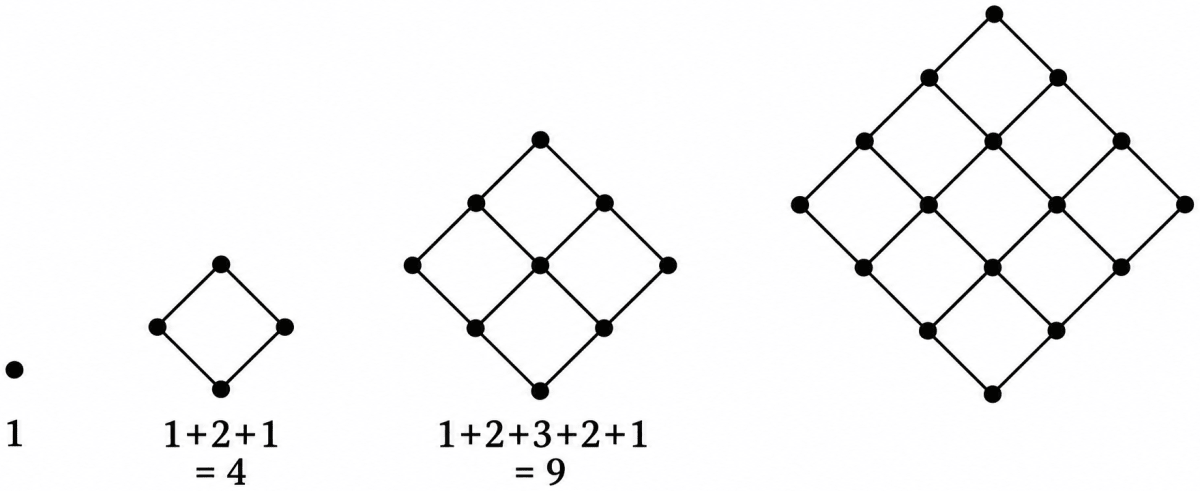
For example, in a 3 × 3 grid the slanting lines have 1, 2, 3, 2, 1 dots, so
1 + 2 + 3 + 2 + 1 = 9 = 32.
Hence, adding the counting numbers up and then down always gives a square number.
By imagining a large version of your picture, or drawing it partially, as needed, can you see what will be the value of 1 + 2 + 3 + ... + 99 + 100 + 99 + ... + 3 + 2 + 1?
Answer
In the sum 1 + 2 + 3 + … + n + … + 3 + 2 + 1, the highest number reached (the peak) is n, and the value of the sum is n2.
Here the peak number is 100, so n = 100.
∴ 1 + 2 + 3 + ... + 99 + 100 + 99 + ... + 3 + 2 + 1 = 1002 = 10,000.
Hence, the required value is 10,000.
Which sequence do you get when you start to add the All 1's sequence up? What sequence do you get when you add the All 1's sequence up and down?
Answer
The All 1's sequence is 1, 1, 1, 1, ...
Adding up:
1 = 1
1 + 1 = 2
1 + 1 + 1 = 3
1 + 1 + 1 + 1 = 4, ...
We get 1, 2, 3, 4, ..., which is the sequence of counting numbers.
Adding up and down:
1 = 1
1 + 1 + 1 = 3
1 + 1 + 1 + 1 + 1 = 5
1 + 1 + 1 + 1 + 1 + 1 + 1 = 7, ...
We get 1, 3, 5, 7, ..., which is the sequence of odd numbers.
Hence, adding the All 1's sequence up gives the counting numbers, and adding it up and down gives the odd numbers.
Which sequence do you get when you start to add the counting numbers up? Can you give a smaller pictorial explanation?
Answer
Adding the counting numbers up:
1 = 1
1 + 2 = 3
1 + 2 + 3 = 6
1 + 2 + 3 + 4 = 10, ...
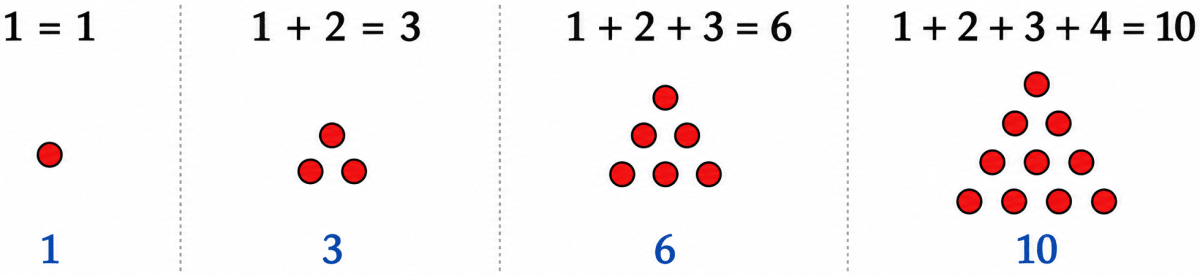
We get 1, 3, 6, 10, ..., which is the sequence of triangular numbers.
Smaller pictorial explanation:
Represent 1 + 2 + 3 + … + n as a staircase of dots (1 dot in the first row, 2 in the second, and so on). Take a second identical staircase, turn it upside down, and fit the two together. They form a rectangle with n rows and (n + 1) columns.
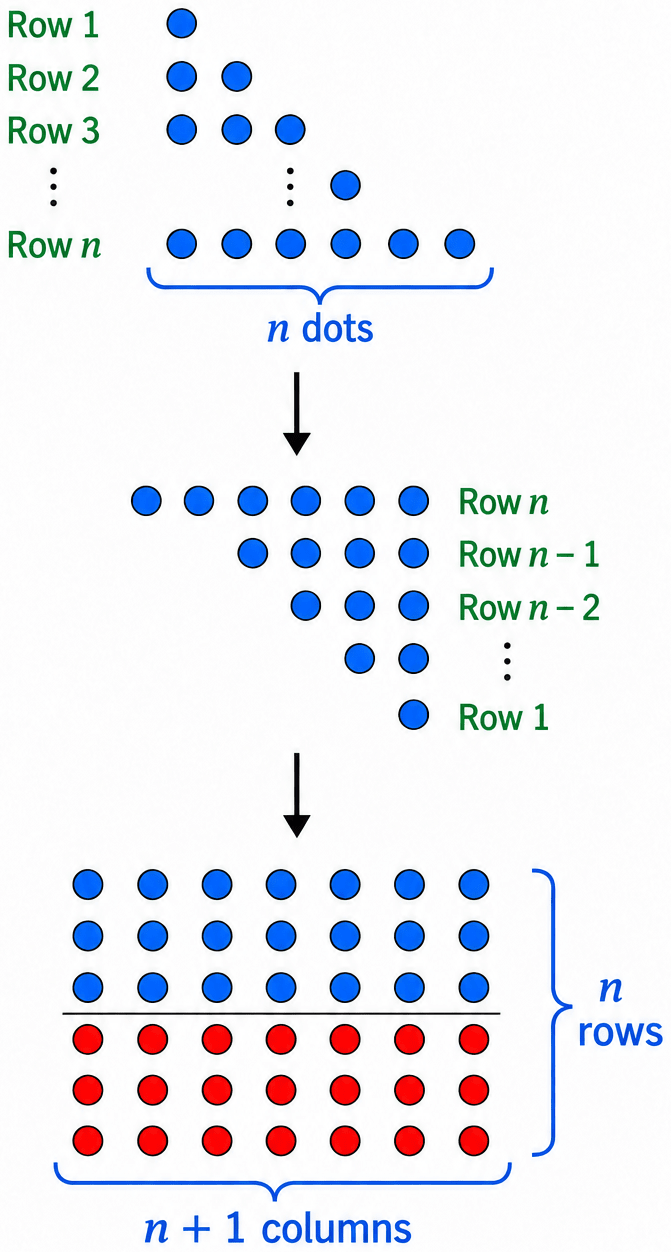
So two copies of the sum make n × (n + 1) dots, which means
Hence, adding the counting numbers gives the triangular numbers, since each is one-half of a rectangle of dots.
What happens when you add up pairs of consecutive triangular numbers? That is, take 1 + 3, 3 + 6, 6 + 10, 10 + 15, … Which sequence do you get? Why? Can you explain it with a picture?
Answer
Adding pairs of consecutive triangular numbers:
1 + 3 = 4
3 + 6 = 9
6 + 10 = 16
10 + 15 = 25, ...
We get 4, 9, 16, 25, ..., which is the sequence of square numbers.
Why this happens: A triangular number can be drawn as a right-angled triangle of dots. Two consecutive triangular arrays — one with n rows and one with (n − 1) rows — fit together along their slanting edges to form a complete n × n square.
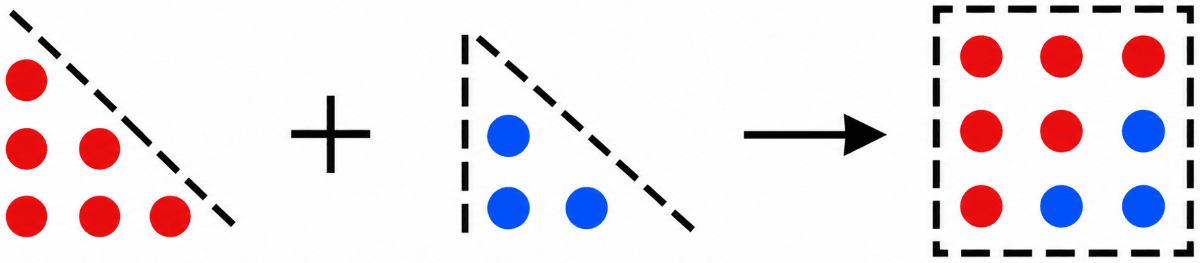
For example, the triangular arrays for 3 and 6 combine to make a 3 × 3 square of 9 dots.
Hence, the sum of two consecutive triangular numbers is always a square number.
What happens when you start to add up powers of 2 starting with 1, i.e., take 1, 1 + 2, 1 + 2 + 4, 1 + 2 + 4 + 8, … ? Now add 1 to each of these numbers—what numbers do you get? Why does this happen?
Answer
Adding up powers of 2:
1 = 1
1 + 2 = 3
1 + 2 + 4 = 7
1 + 2 + 4 + 8 = 15
1 + 2 + 4 + 8 + 16 = 31, ...
We get 1, 3, 7, 15, 31, ...
Adding 1 to each of these:
1 + 1 = 2
3 + 1 = 4
7 + 1 = 8
15 + 1 = 16
31 + 1 = 32, ...
We get 2, 4, 8, 16, 32, ..., which are the powers of 2.
Why this happens: Each sum is one less than the next power of 2:
1 is one less than 2, 3 is one less than 4, 7 is one less than 8, 15 is one less than 16, and 31 is one less than 32.
Therefore, adding 1 to each sum gives 2, 4, 8, 16, 32, … .
Hence, adding 1 to each of these sums gives the powers of 2.
What happens when you multiply the triangular numbers by 6 and add 1? Which sequence do you get? Can you explain it with a picture?
Answer
The triangular numbers are 1, 3, 6, 10, 15, ...
Multiplying each by 6 and adding 1:
(1 × 6) + 1 = 7
(3 × 6) + 1 = 19
(6 × 6) + 1 = 37
(10 × 6) + 1 = 61
(15 × 6) + 1 = 91, ...
We get 7, 19, 37, 61, 91, ..., which are the hexagonal numbers after the first term 1 in the sequence 1, 7, 19, 37, 61, 91, ... .
Why this happens: Start with one central dot and surround it with 6 identical triangular arrays of dots, one around each of the six sides. Each array holds a triangular number of dots, so the whole hexagonal shape holds (6 × triangular number) + 1 dots.
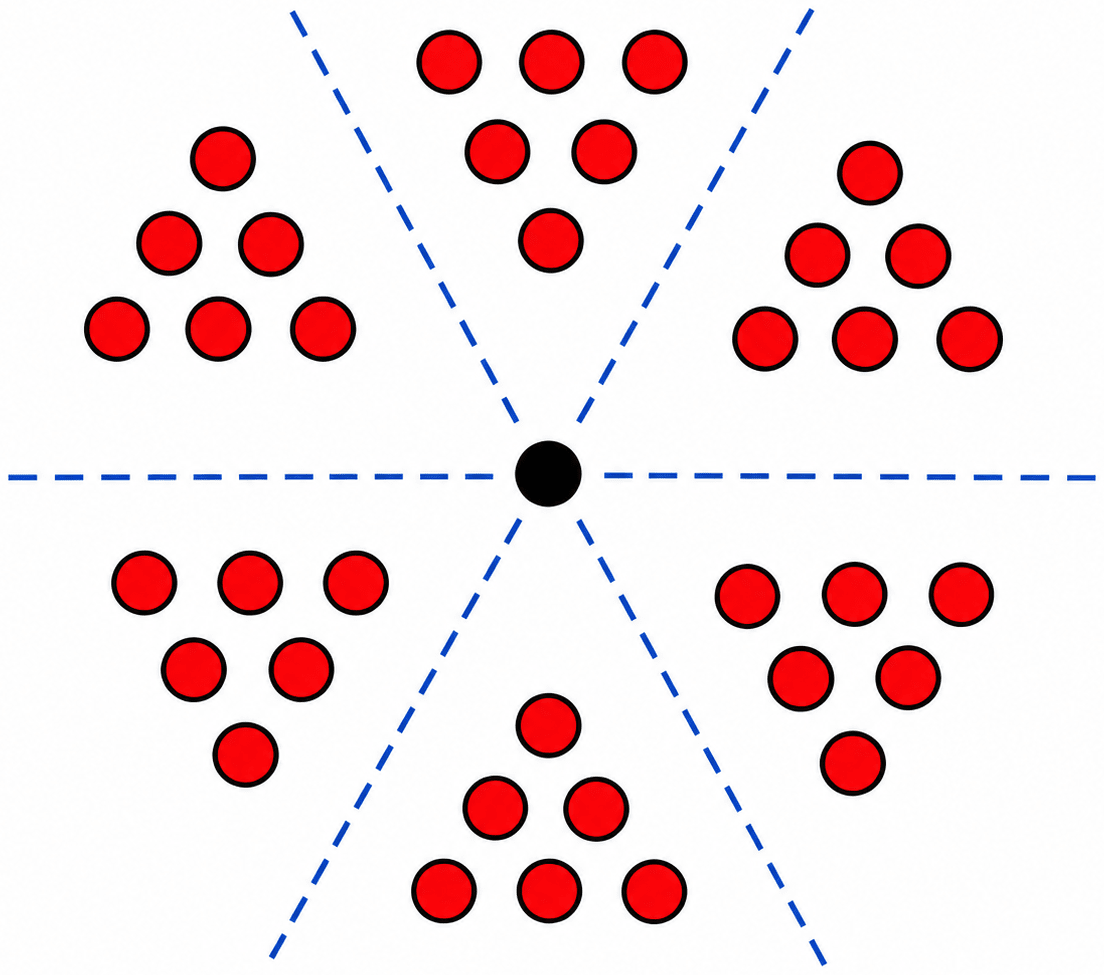
Hence, multiplying a triangular number by 6 and adding 1 gives a hexagonal number.
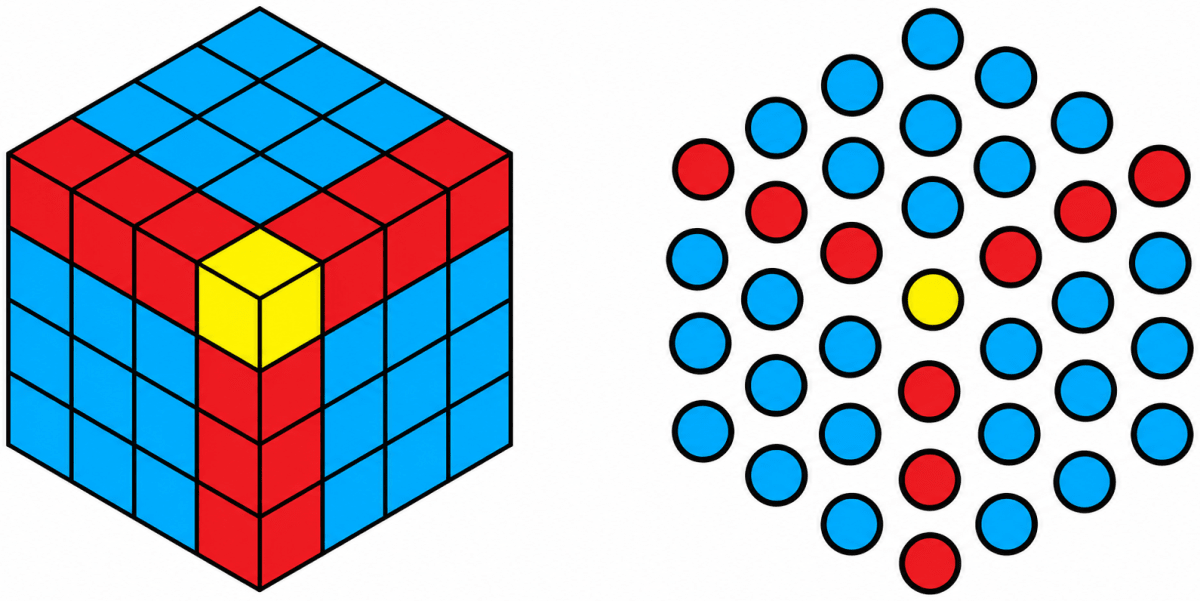
What happens when you start to add up hexagonal numbers, i.e., take 1, 1 + 7, 1 + 7 + 19, 1 + 7 + 19 + 37, … ? Which sequence do you get? Can you explain it using a picture of a cube?
Answer
Adding up the hexagonal numbers:
1 = 1
1 + 7 = 8
1 + 7 + 19 = 27
1 + 7 + 19 + 37 = 64, ...
We get 1, 8, 27, 64, ..., which is the sequence of cube numbers (13, 23, 33, 43, ...).
Why this happens: Think of building a cube layer by layer. A single dot is a 1 × 1 × 1 cube (1 dot). To grow it into a 2 × 2 × 2 cube, we add a hexagonal "shell" of 7 dots (a 2 × 2 × 2 cube has 8 dots). To grow it into a 3 × 3 × 3 cube, we add a shell of 19 dots (making 27), and the next shell of 37 dots makes 64. When such a cube is viewed from a corner, each added shell appears as a hexagonal arrangement of dots.
Hence, adding up the hexagonal numbers gives the cube numbers.
Find your own patterns or relations in and among the sequences in Table 1. Can you explain why they happen with a picture or otherwise?
Answer
One simple relation can be seen between the counting numbers, even numbers and odd numbers.
Counting numbers: 1, 2, 3, 4, 5, …
Even numbers: 2, 4, 6, 8, 10, …
Odd numbers: 1, 3, 5, 7, 9, …
If we multiply each counting number by 2, we get the even numbers:
1 × 2 = 2, 2 × 2 = 4, 3 × 2 = 6, 4 × 2 = 8, …
If we subtract 1 from each of these even numbers, we get the odd numbers:
2 − 1 = 1, 4 − 1 = 3, 6 − 1 = 5, 8 − 1 = 7, …
Hence, doubling the counting numbers gives the even numbers, and subtracting 1 from these gives the odd numbers.
Can you recognise the pattern in each of the sequences in Table 3?
Answer
Yes. The pattern in each sequence of Table 3 is as follows.
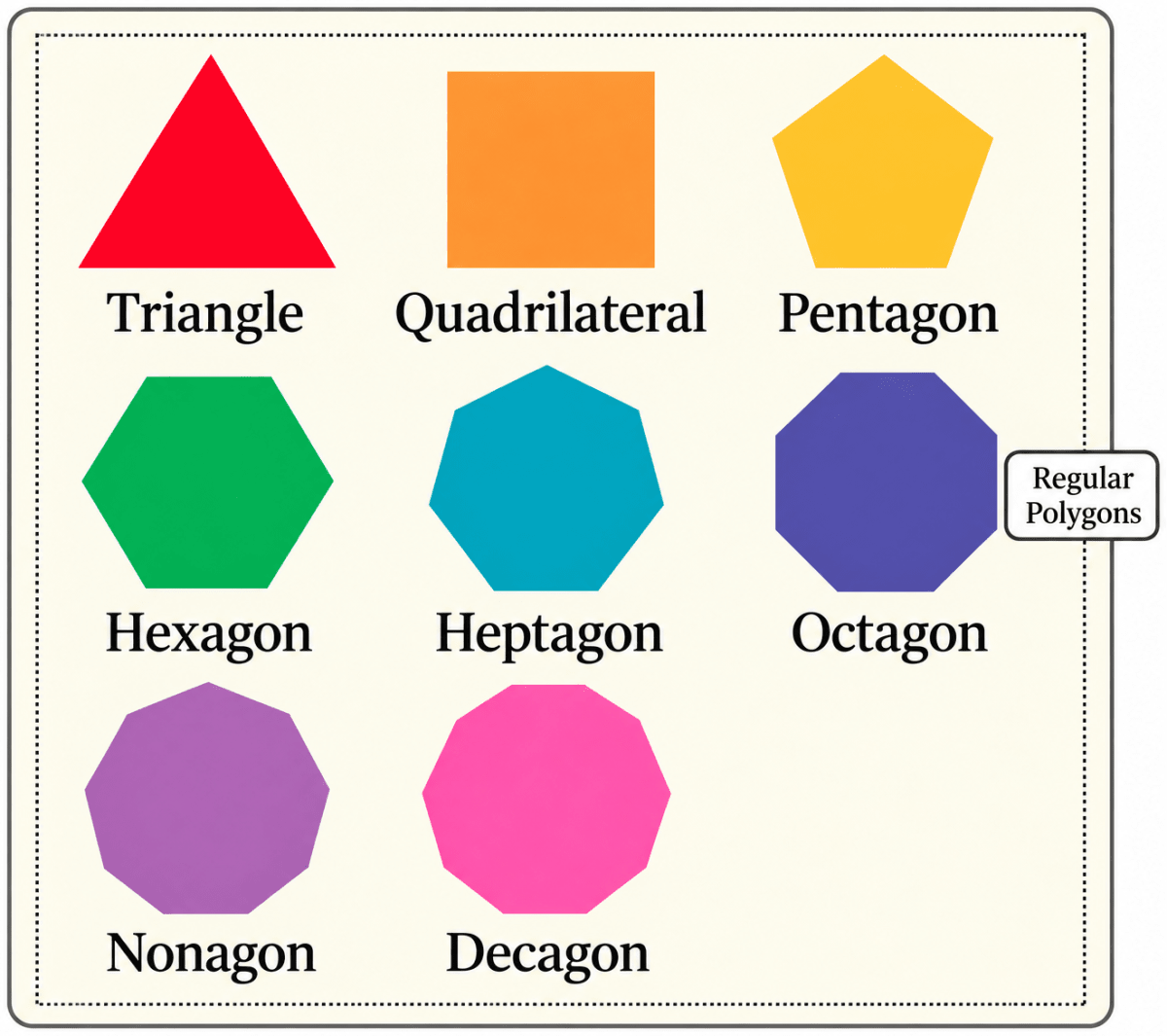
Regular Polygons: The number of sides increases one at a time — 3, 4, 5, 6, 7, 8, 9, 10, ... So each next shape (triangle, quadrilateral, pentagon, hexagon, ...) has exactly one more side than the previous one.
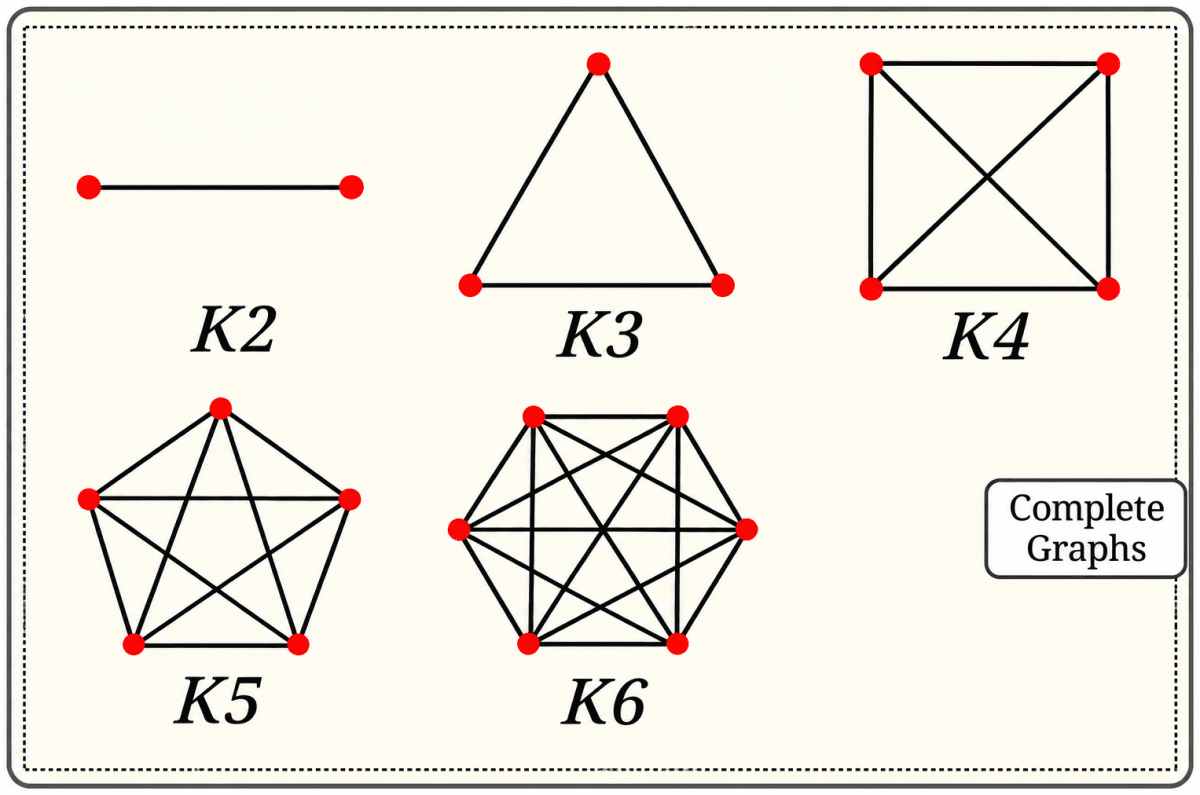
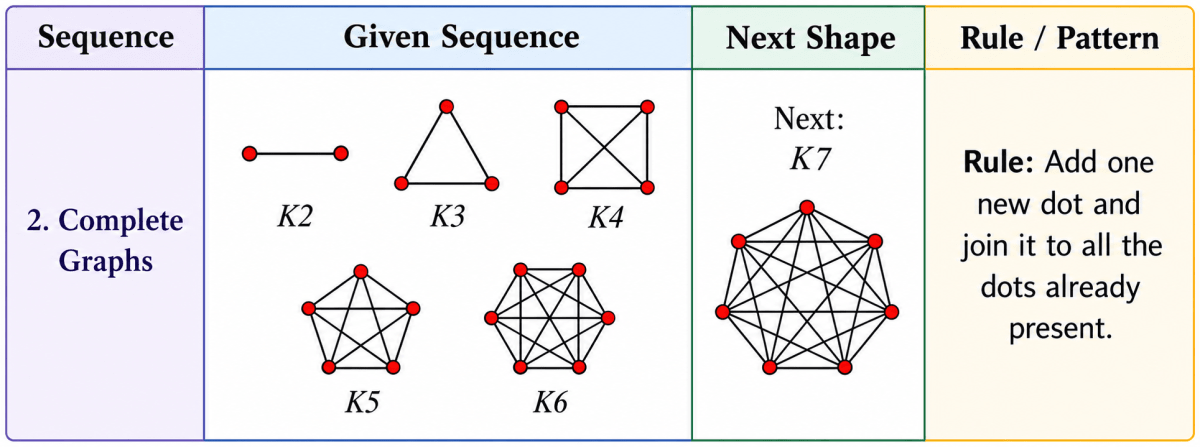
Complete Graphs (K2, K3, K4, K5, K6): Each graph has one more dot (vertex) than the one before, and every dot is joined to every other dot by a line. The numbers of dots are 2, 3, 4, 5, 6, ... and the numbers of lines are 1, 3, 6, 10, 15, ... (triangular numbers).
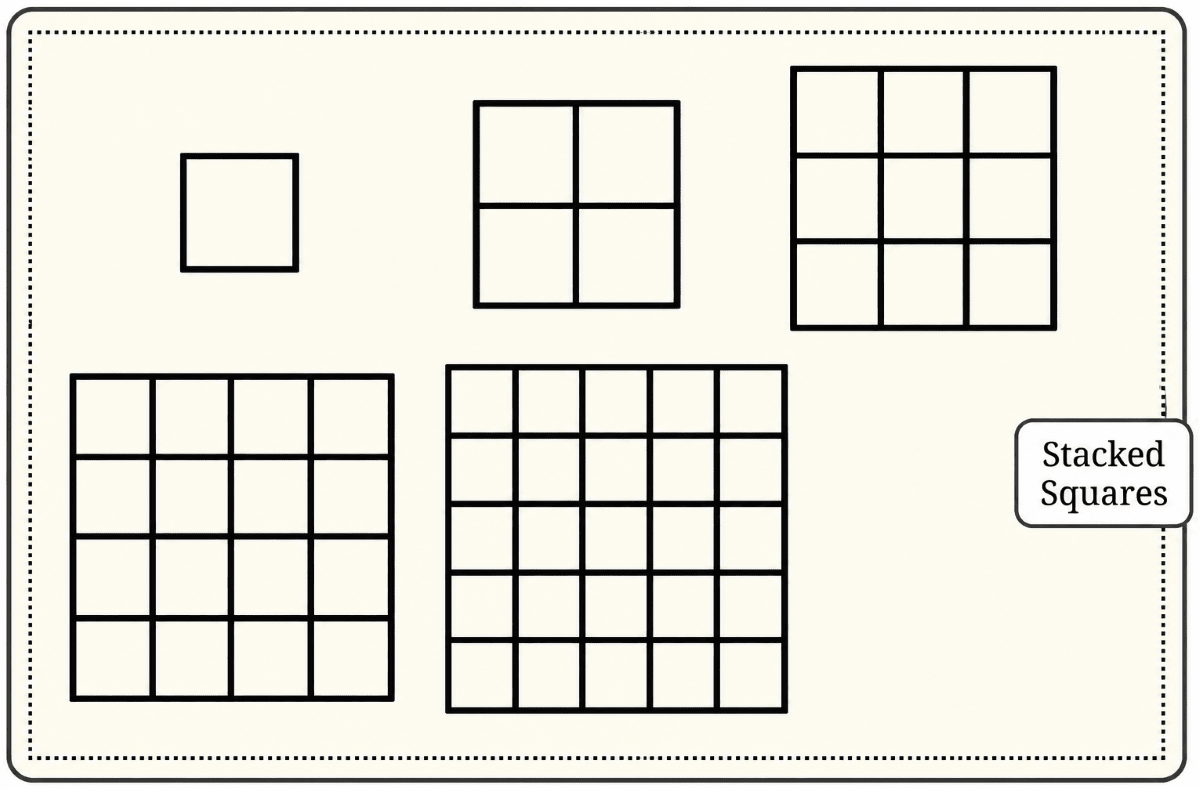
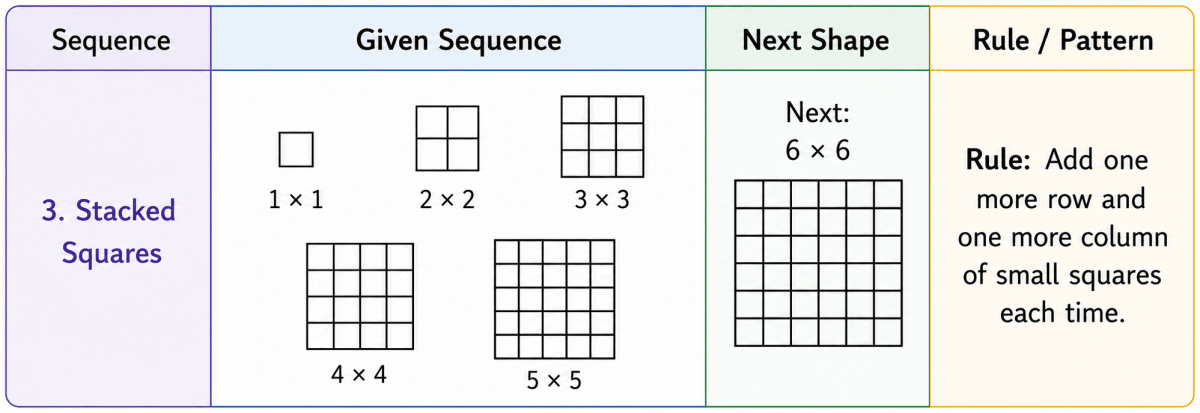
Stacked Squares: The nth shape is a square grid of n rows and n columns, so the numbers of small squares are 1, 4, 9, 16, 25, ... (square numbers).
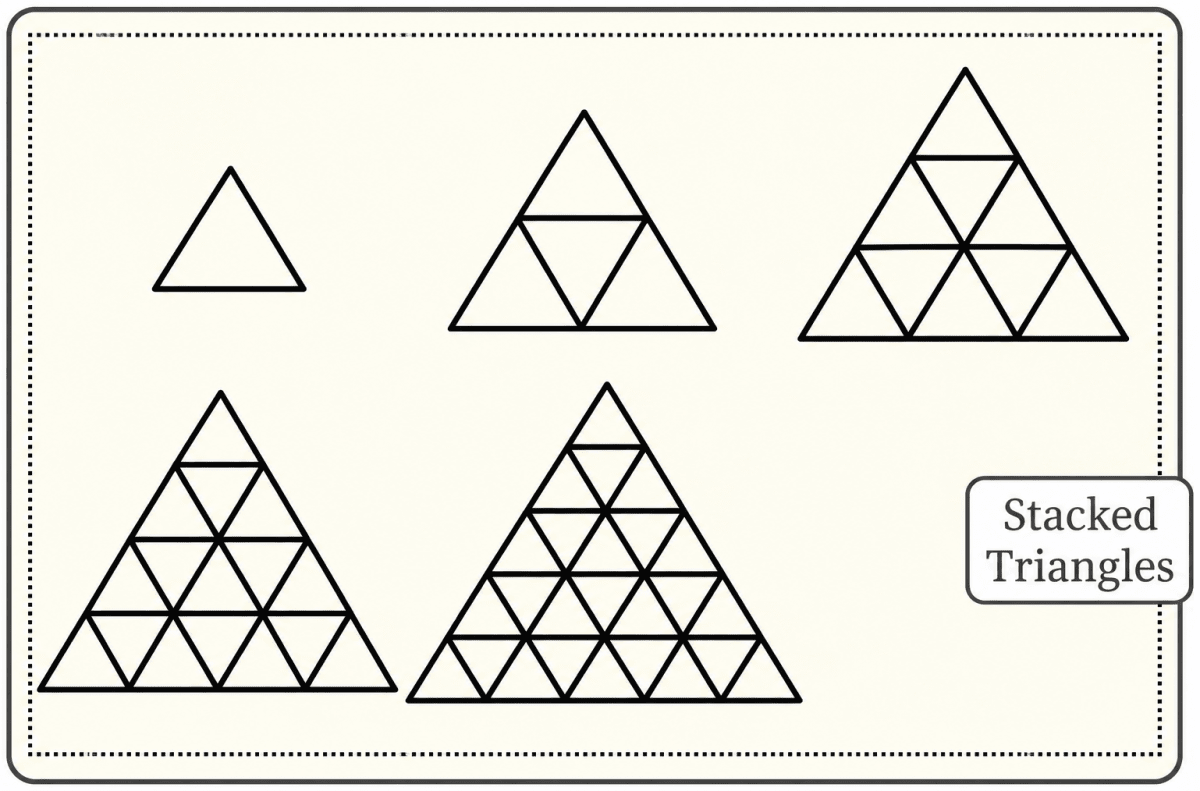
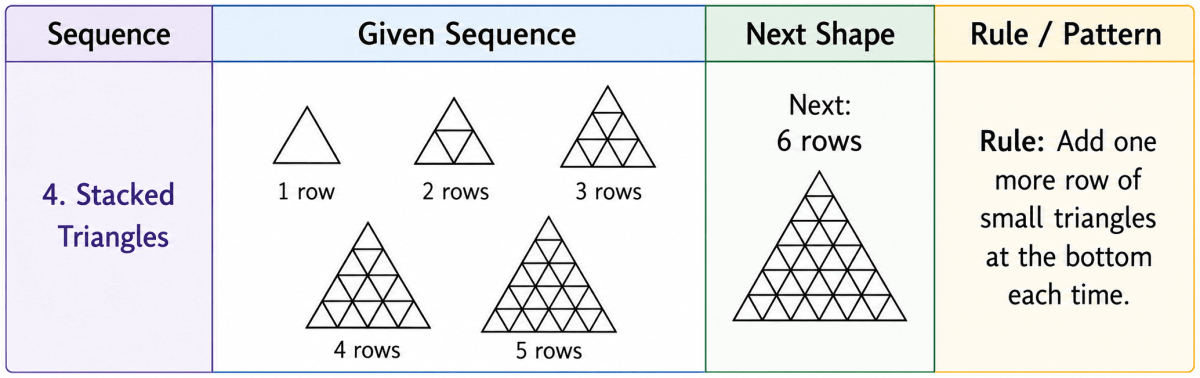
Stacked Triangles: The nth shape is a triangle made up of n rows of small triangles, giving 1, 4, 9, 16, 25, ... small triangles (square numbers).
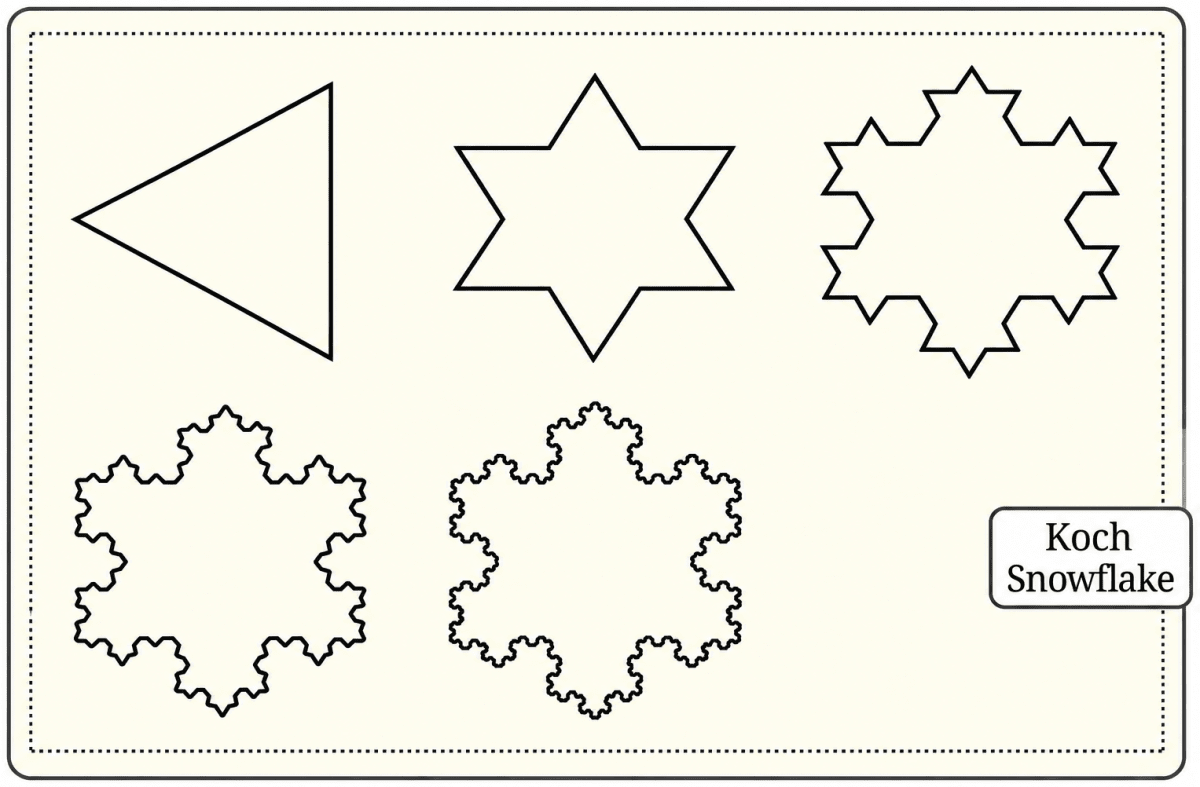
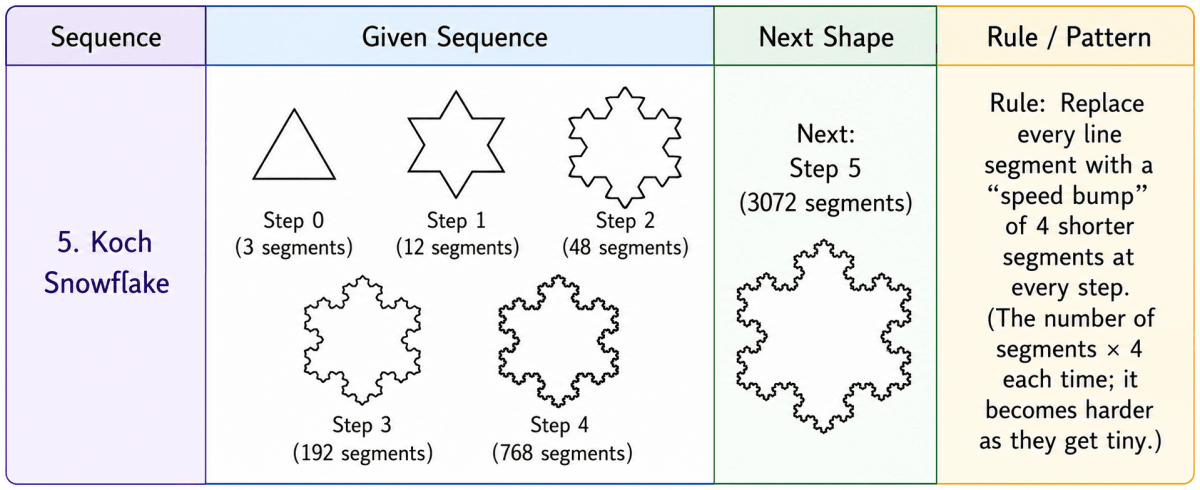
Koch Snowflake: At each step every line segment is replaced by 4 smaller segments, so the numbers of line segments are 3, 12, 48, 192, ... (3 times the powers of 4).
Try and redraw each sequence in Table 3 in your notebook. Can you draw the next shape in each sequence? Why or why not? After each sequence, describe in your own words what is the rule or pattern for forming the shapes in the sequence.
Answer
Yes, the next shape can be drawn in each sequence.
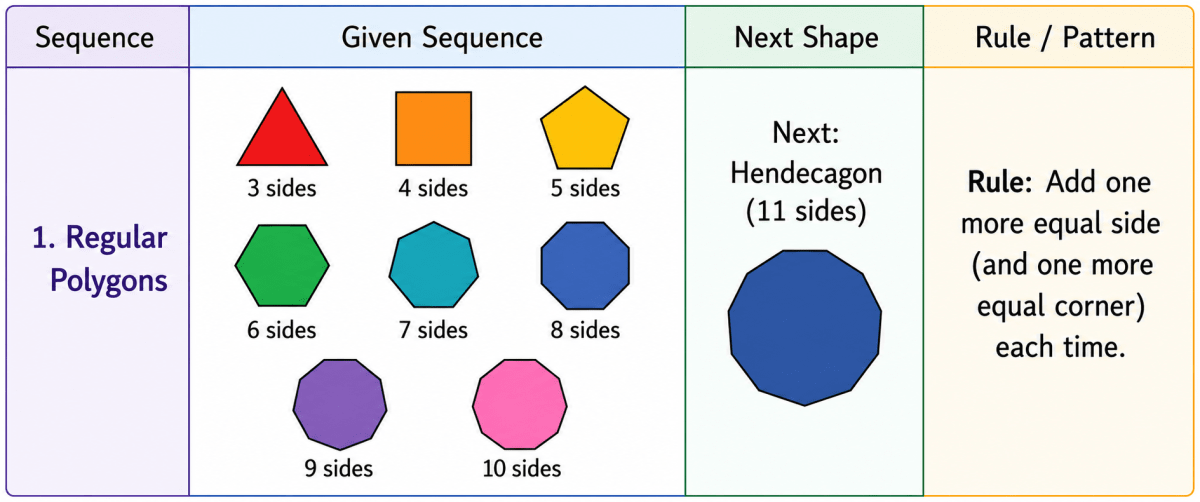
Regular Polygons: The next shape has one more side than the last. After the decagon (10 sides) comes an 11-sided regular polygon (hendecagon). Rule: add one more equal side (and one more equal corner) each time.
Complete Graphs: The next shape is K7, which has 7 dots with every dot joined to every other dot. Rule: add one new dot and join it to all the dots already present.
Stacked Squares: The next shape is a 6 × 6 grid of small squares. Rule: add one more row and one more column of small squares each time.
Stacked Triangles: The next shape is a triangle with 6 rows of small triangles. Rule: add one more row of small triangles at the bottom each time.
Koch Snowflake: The last shape shown has 768 line segments. Replacing each of these by 4 shorter segments gives 768 × 4 = 3072 line segments in the next shape. It can be drawn, but it becomes harder and harder as the segments get very tiny. Rule: replace each straight segment by four smaller segments at every step.
Count the number of sides in each shape in the sequence of Regular Polygons. Which number sequence do you get? What about the number of corners in each shape in the sequence of Regular Polygons? Do you get the same number sequence? Can you explain why this happens?
Answer
Number of sides: 3, 4, 5, 6, 7, 8, 9, 10, ... — the counting numbers starting from 3.
Number of corners: 3, 4, 5, 6, 7, 8, 9, 10, ... — the same sequence, again the counting numbers starting from 3.
Yes, we get the same number sequence in both cases.
Why this happens: In any polygon, each side ends at a corner and each corner is the meeting point of exactly two sides. Going around the closed shape, sides and corners alternate and match up one-to-one.
Hence, in every regular polygon the number of sides equals the number of corners, so both give the same sequence.
Count the number of lines in each shape in the sequence of Complete Graphs. Which number sequence do you get? Can you explain why?
Answer
The numbers of lines are:
K2 → 1, K3 → 3, K4 → 6, K5 → 10, K6 → 15, ...
So we get 1, 3, 6, 10, 15, ..., which is the sequence of triangular numbers.
Why this happens: Start with K2, which has 1 line. When one new dot is added, it is joined to all the dots already present. So we add 2 new lines to get 3, then 3 new lines to get 6, then 4 new lines to get 10, and then 5 new lines to get 15.
Thus, the numbers of lines are formed by adding 2, 3, 4, 5, … successively, which gives the triangular-number sequence.
Hence, the number of lines in the Complete Graphs gives the triangular numbers.
How many little squares are there in each shape of the sequence of Stacked Squares? Which number sequence does this give? Can you explain why?
Answer
The numbers of little squares are 1, 4, 9, 16, 25, ..., which is the sequence of square numbers.
Why this happens: The nth shape is a grid with n rows and n columns of little squares. So the total number of little squares is n × n = n2.
Hence, the Stacked Squares give the square numbers.
How many little triangles are there in each shape of the sequence of Stacked Triangles? Which number sequence does this give? Can you explain why? (Hint: In each shape in the sequence, how many triangles are there in each row?)
Answer
The numbers of little triangles are 1, 4, 9, 16, 25, ..., which is the sequence of square numbers.
Why this happens: In the nth shape, the rows contain 1, 3, 5, 7, ... little triangles — that is, the kth row has (2k − 1) triangles. Adding the triangles row by row gives
1 = 1
1 + 3 = 4
1 + 3 + 5 = 9
1 + 3 + 5 + 7 = 16, ...
Since the sum of the first n odd numbers is n2, the total number of little triangles in the nth shape is n2.
Hence, the Stacked Triangles give the square numbers.
To get from one shape to the next shape in the Koch Snowflake sequence, one replaces each line segment '—' by a 'speed bump'. As one does this more and more times, the changes become tinier and tinier with very very small line segments. How many total line segments are there in each shape of the Koch Snowflake? What is the corresponding number sequence? (The answer is 3, 12, 48, ..., i.e., 3 times Powers of 4; this sequence is not shown in Table 1.)
Answer
The total numbers of line segments are:
3, 12, 48, 192, 768, ...
Why this happens: The first shape is a triangle with 3 line segments. At each step, every line segment is replaced by a "speed bump" made of 4 shorter segments, so the number of segments is multiplied by 4 each time:
3, 3 × 4 = 12, 3 × 4 × 4 = 48, 3 × 4 × 4 × 4 = 192, ...
So the corresponding number sequence is 3 times the powers of 4, and the number of segments in the nth shape is 3 × 4n − 1.
Hence, the numbers of line segments form the sequence 3, 12, 48, 192, 768, ..., i.e., 3 times the powers of 4.