
Think about various situations where we use numbers. List five different situations in which numbers are used. See what your classmates have listed, share, and discuss.
Answer
Numbers are used in many situations in daily life. Five examples are:
- Telling time.
- Reading dates on a calendar.
- Counting objects or marks.
- Measuring height, length, weight or distance.
- Using money while buying and selling.
Hence, numbers help us count, measure, compare and organise information in everyday life.
Some children in a park are standing in a line. Each one says a number.
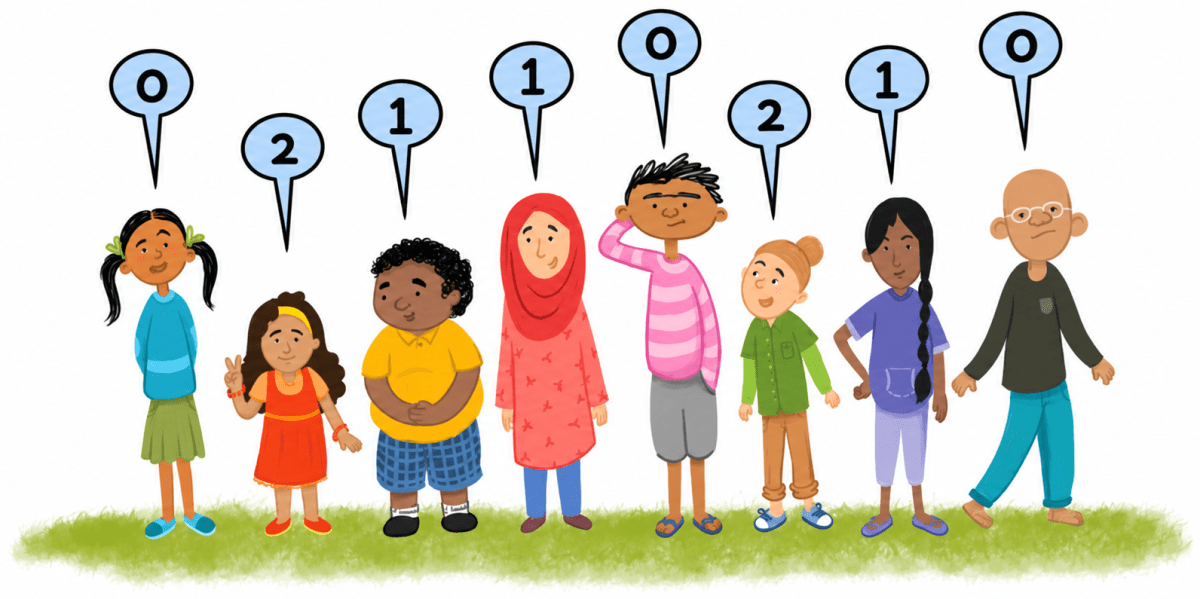
What do you think these numbers mean?
Answer
Look carefully at the two children standing next to each child — that is, the child immediately on the left and the child immediately on the right.
Each number tells how many of these next-door neighbours are taller than the child saying it.
So the rule is:
- A child says ‘1’ if exactly one of the children standing next to them is taller.
- A child says ‘2’ if both the children standing next to them are taller.
- A child says ‘0’ if neither of the children standing next to them is taller.
For the line shown, the children call out 0, 2, 1, 1, 0, 2, 1, 0. For example, the second child says ‘2’ because both neighbours are taller, while a child at an end says ‘0’ or ‘1’ since they have only one neighbour to compare with.
Hence, each number is the count of taller neighbours (the children standing immediately next to that child).
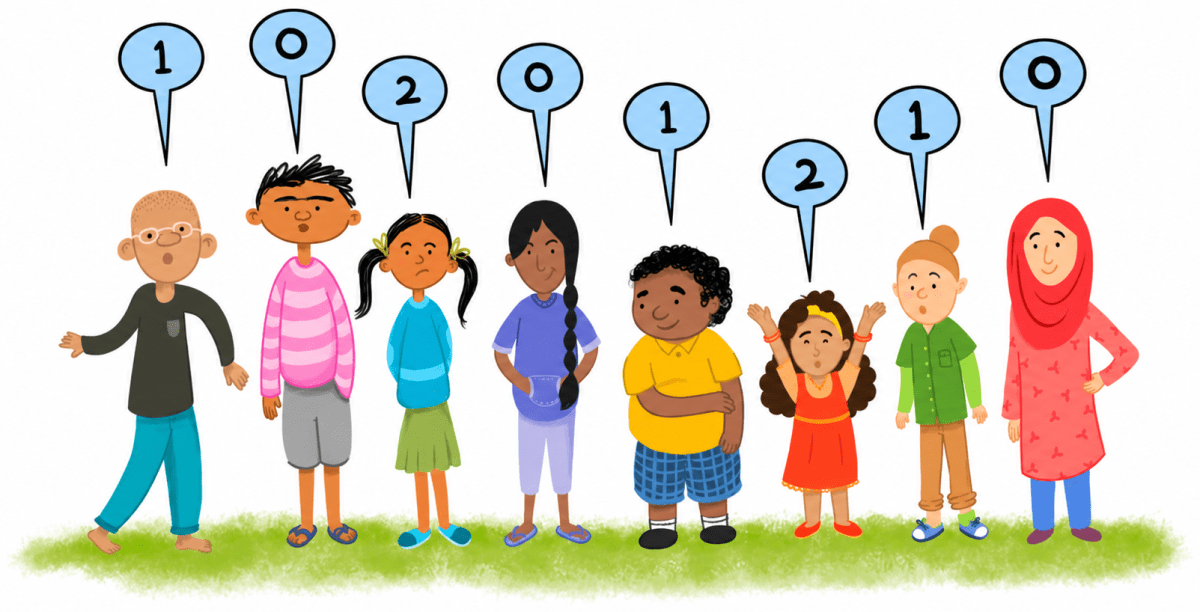
Try answering the questions below and share your reasoning.
(i) Can the children rearrange themselves so that the children standing at the ends say ‘2’?
(ii) Can we arrange the children in a line so that all would say only 0s?
(iii) Can two children standing next to each other say the same number?
(iv) There are 5 children in a group, all of different heights. Can they stand such that four of them say ‘1’ and the last one says ‘0’? Why or why not?
(v) For this group of 5 children, is the sequence 1, 1, 1, 1, 1 possible?
(vi) Is the sequence 0, 1, 2, 1, 0 possible? Why or why not?
(vii) How would you rearrange the five children so that the maximum number of children say ‘2’?
Answer
Recall the rule: each child’s number is the count of taller children standing immediately next to them.
(i) No.
A child standing at either end of the line has only one neighbour, because there is no one on the outer side. To say ‘2’, a child must have two taller neighbours. Since an end child has only one neighbour, the most an end child can ever say is ‘1’.
⇒ The children at the ends can never say ‘2’.
(ii) No
Since all the children have different heights, there is always one shortest child. That child must have at least one taller neighbour, so they will say 1 or 2, not 0.
(iii) Yes.
For example, in an increasing order of heights, the sequence is:
1, 1, 1, 1, 0
Here several adjacent children say 1.
(iv) Yes.
Let the five children stand in ascending order of height, from the shortest to the tallest.
Then the sequence becomes:
1, 1, 1, 1, 0
The tallest child has no taller neighbour and says 0, while every other child has exactly one taller neighbour and says 1.
(v) No.
There is always one tallest child. Since nobody is taller than the tallest child, that child must say 0.
Therefore the sequence 1, 1, 1, 1, 1 is impossible.
(vi) Yes.
Arrange the children as:
Tall – Medium – Shortest – Medium – Tall
Then:
The shortest child has two taller neighbours → 2
The two medium children each have one taller neighbour → 1
The two tallest children at the ends have no taller neighbour → 0
Hence the sequence is:
0, 1, 2, 1, 0
(vii)
Arrange the children by alternating heights — tall, short, tall, short, tall.
Then the sequence becomes:
0, 2, 0, 2, 0
The two short children each have taller neighbours on both sides, so they say 2.
Since a child saying 2 cannot be at an end and two such children cannot stand next to each other, 2 is the maximum possible number of children who can say ‘2’.
Colour or mark the supercells in the table below.
| 6828 | 670 | 9435 | 3780 | 3708 | 7308 | 8000 | 5583 | 52 |
Answer
A cell is a supercell if the number in it is greater than all its adjacent cells. The cells at the two ends have only one neighbour, while every other cell has two neighbours (one on the left and one on the right).
Checking each cell against its neighbours:
- 6828 (left end): only neighbour is 670, and 6828 > 670 ⇒ supercell.
- 9435: neighbours are 670 and 3780, and 9435 > 670 and 9435 > 3780 ⇒ supercell.
- 8000: neighbours are 7308 and 5583, and 8000 > 7308 and 8000 > 5583 ⇒ supercell.
None of the remaining cells is larger than both of its neighbours.
| 6828 | 670 | 9435 | 3780 | 3708 | 7308 | 8000 | 5583 | 52 |
Hence, the supercells are 6828, 9435 and 8000.
Fill the table below with only 4-digit numbers such that the supercells are exactly the coloured cells.
| 5346 | 1258 | 9635 |
Answer
The coloured cells are the 2nd, 4th and 9th cells. We need to fill the table so that only these coloured cells are supercells.
One possible filling is:
| 5346 | 5347 | 1000 | 1258 | 1100 | 1200 | 1300 | 9635 | 9636 |
Here:
5347 > 5346 and 5347 > 1000, so the 2nd cell is a supercell.
1258 > 1000 and 1258 > 1100, so the 4th cell is a supercell.
9636 > 9635, so the 9th cell (at the end) is a supercell.
Every other number has at least one neighbouring number greater than itself, so none of them is a supercell.
Fill the table below such that we get as many supercells as possible. Use numbers between 100 and 1000 without repetitions.
Answer
To get the greatest number of supercells, place the larger numbers in alternate cells so that each of them is surrounded by smaller numbers. Starting from the first cell and taking every alternate cell as a supercell works best.
One such filling using numbers between 100 and 1000, without repetition, is:
| 110 | 100 | 150 | 130 | 280 | 200 | 230 | 210 | 270 |
The supercells are 110, 150, 280, 230 and 270.
Hence, the maximum number of supercells is 5.
Out of the 9 numbers, how many supercells are there in the table above? ...............
Answer
In a row of 9 cells, the supercells can be placed only at alternate positions, and the largest possible count is obtained by taking the 1st, 3rd, 5th, 7th and 9th cells.
This gives 5 supercells, as shown in the table above.
Hence, there are 5 supercells.
Find out how many supercells are possible for different numbers of cells.
Do you notice any pattern? What is the method to fill a given table to get the maximum number of supercells? Explore and share your strategy.
Answer
Filling a row so that supercells sit in alternate cells (1st, 3rd, 5th, … cells) gives the maximum count. Working this out for a few rows:
| Number of cells | Maximum number of supercells |
|---|---|
| 1 | 1 |
| 2 | 1 |
| 3 | 2 |
| 4 | 2 |
| 5 | 3 |
| 6 | 3 |
| 7 | 4 |
| 8 | 4 |
| 9 | 5 |
The pattern is:
- If the number of cells is even, say n, the maximum number of supercells is .
- If the number of cells is odd, say n, the maximum number of supercells is .
Method — make the very first cell a supercell, then fill the rest so that supercells occur in every alternate cell. In other words, put the larger numbers in alternate positions and the smaller numbers in between, so that each larger number stands higher than both of its neighbours.
Hence, the maximum number of supercells is for an even number of cells and for an odd number of cells, obtained by placing supercells in alternate cells starting from the first cell.
Can you fill a supercell table without repeating numbers such that there are no supercells? Why or why not?
Answer
No, this is not possible.
Among any set of numbers with no repetitions, there is always one greatest number. Wherever this greatest number is placed in the table, every neighbouring cell holds a smaller number, so the greatest number is larger than all its neighbours.
⇒ The cell containing the greatest number is always a supercell.
∴ A table filled with different numbers must contain at least one supercell.
Hence, we cannot fill a supercell table with non-repeating numbers so that there are no supercells.
Will the cell having the largest number in a table always be a supercell? Can the cell having the smallest number in a table be a supercell? Why or why not?
Answer
Largest number — Yes.
The largest number in the table is greater than every other number, and in particular greater than all the numbers in its neighbouring cells. So it is always larger than its neighbours.
⇒ The cell with the largest number is always a supercell.
Smallest number — No.
The smallest number in the table is smaller than every other number, so any neighbour it has holds a larger number. A supercell must be greater than all its neighbours, which the smallest number can never be.
⇒ The cell with the smallest number can never be a supercell.
Hence, the largest number is always a supercell, while the smallest number is never a supercell.
Fill a table such that the cell having the second largest number is not a supercell.
Answer
The second largest number will fail to be a supercell if it is placed right next to the largest number, because then it has a neighbour (the largest number) that is greater than itself.
One such filling is:
| 1 | 2 | 3 | 4 | 5 | 6 | 7 | 9 | 8 |
Here, 9 is the largest number and 8 is the second largest number. Since 8 is next to 9, it is not greater than all its neighbours and therefore is not a supercell.
Hence, the cell containing the second largest number is not a supercell.
Fill a table such that the cell having the second largest number is not a supercell but the second smallest number is a supercell. Is it possible?
Answer
Yes, it is possible.
For the second largest number to not be a supercell, place it next to the largest number.
For the second smallest number to be a supercell, it must be greater than all its neighbours. The only number smaller than the second smallest is the smallest number itself. So the second smallest can be a supercell only when it is at an end of the row with its single neighbour being the smallest number.
One such filling is:
| 2 | 1 | 3 | 4 | 5 | 6 | 7 | 9 | 8 |
- The second smallest number 2 sits at the left end with only the smallest number 1 beside it, and 2 > 1 ⇒ it is a supercell.
- The second largest number 8 sits next to the largest number 9, and 8 < 9 ⇒ it is not a supercell.
Hence, it is possible: the second smallest number can be a supercell while the second largest number is not.
Make other variations of this puzzle and challenge your classmates.
Answer
Using the same idea of supercells, one can frame many new puzzles for classmates to try. Some examples are:
- Fill a table of 9 cells so that it has exactly 4 supercells.
- Fill a table of 9 cells so that it has more than 5 supercells (and then explain why this is impossible).
- Fill a table so that the smallest number and the second smallest number are placed at the two ends, and find out how many supercells the table can then have.
- Fill a table so that no two supercells stand next to each other, and check the largest number of supercells you can make.
Students may create and exchange several such variations and discuss their reasoning.
Complete Table 2 with 5-digit numbers whose digits are ‘1’, ‘0’, ‘6’, ‘3’, and ‘9’ in some order. Only a coloured cell should have a number greater than all its neighbours.
Table 2
| 96,301 | 36,109 | ||
| 13,609 | 60,319 | 19,306 | |
| 60,193 | |||
| 10,963 |
(i) The biggest number in the table is ............... .
(ii) The smallest even number in the table is ............... .
(iii) The smallest number greater than 50,000 in the table is ............... .
Once you have filled the table above, put commas appropriately after the thousands digit.
Answer
The only digits allowed are 0, 1, 3, 6 and 9, and each cell must hold a 5-digit number using all these digits in some order. The shaded (coloured) cells must be the only supercells, so each shaded cell has to be greater than all of its neighbours, while every unshaded cell must have at least one neighbour greater than it.
One way to complete the table is:
| 96,310 | 96,301 | 36,109 | 39,160 |
| 96,103 | 13,609 | 60,319 | 19,306 |
| 13,906 | 10,396 | 60,193 | 60,931 |
| 10,369 | 10,963 | 10,936 | 69,031 |
Here the shaded cells are 96,310, 39,160, 60,319, 10,963 and 69,031.
Now reading off the completed table:
(i) The biggest number in the table is 96,310.
(ii) The smallest even number in the table is 10,396.
(iii) The smallest number greater than 50,000 in the table is 60,193.
We are quite familiar with number lines now. Let’s see if we can place some numbers in their appropriate positions on the number line. Here are the numbers: 2180, 2754, 1500, 3600, 9950, 9590, 1050, 3050, 5030, 5300 and 8400.
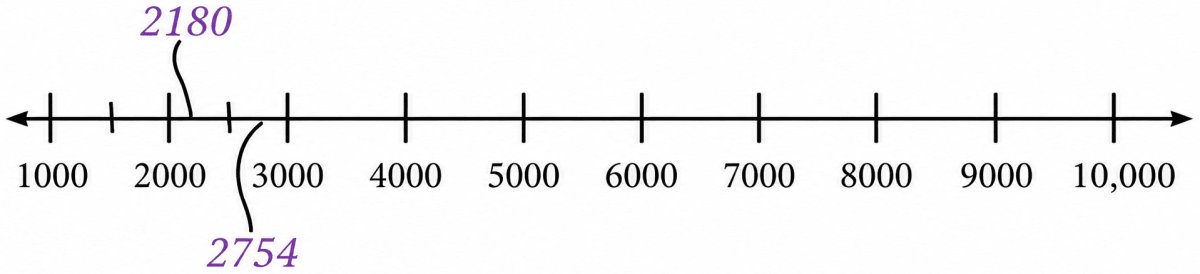
Answer
The number line is marked in thousands from 1000 up to 10,000, with a small mark at the halfway point (the 500) between each pair of consecutive thousands. Each number is placed according to how far it lies between two thousands-marks.

Identify the numbers marked on the number lines below, and label the remaining positions.
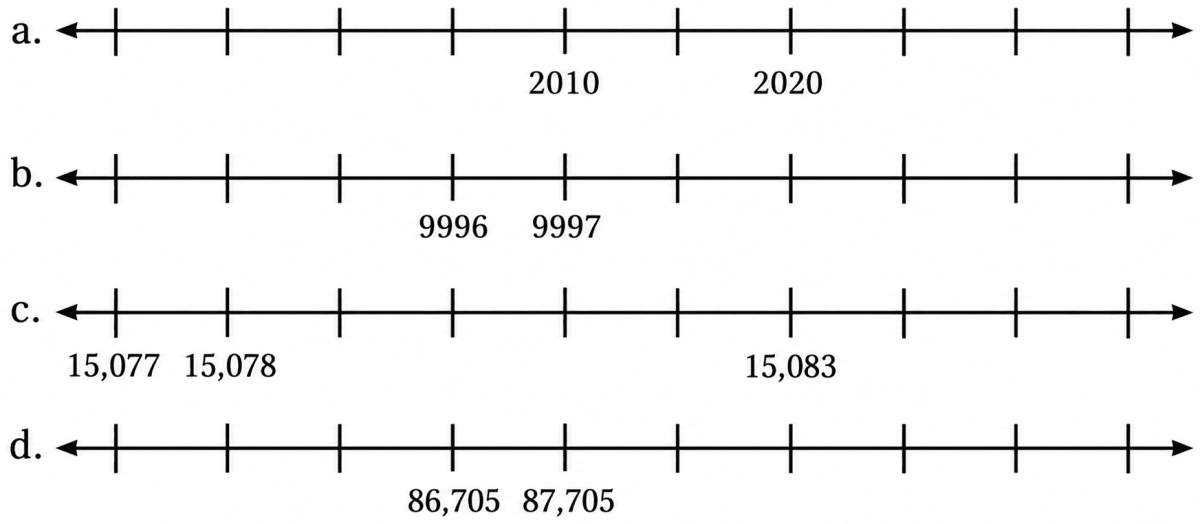
Put a circle around the smallest number and a box around the largest number in each of the sequences above.
Answer
On each line, the gap between two neighbouring marks is found from the two given numbers, and then every position is filled in.
(a) The marked numbers are 2010 and 2020, with one mark between them. So the two given numbers are two steps apart, and each step is .

(b) The marked numbers 9996 and 9997 are on neighbouring marks, so each step is 1.

(c) The marked numbers 15,077 and 15,078 are on neighbouring marks, so each step is 1 (this agrees with 15,083 being five marks further along).

(d) The marked numbers 86,705 and 87,705 are on neighbouring marks, so each step is 87,705 - 86,705 = 1000.

We start writing numbers from 1, 2, 3 … and so on. There are nine 1-digit numbers. Find out how many numbers have two digits, three digits, four digits, and five digits.
| 1-digit numbers From 1–9 | 2-digit numbers | 3-digit numbers | 4-digit numbers | 5-digit numbers |
|---|---|---|---|---|
| 9 |
Answer
For each group, we count from the smallest number in the group to the largest.
1-digit numbers: from 1 to 9 ⇒ 9 numbers
2-digit numbers: from 10 to 99 ⇒ 99 - 10 + 1 = 90 numbers
3-digit numbers: from 100 to 999 ⇒ 999 - 100 + 1 = 900 numbers
4-digit numbers: from 1000 to 9999 ⇒ 9999 - 1000 + 1 = 9000 numbers
5-digit numbers: from 10,000 to 99,999 ⇒ 99,999 - 10,000 + 1 = 90,000 numbers
Completing the table:
| 1-digit numbers From 1–9 | 2-digit numbers | 3-digit numbers | 4-digit numbers | 5-digit numbers |
|---|---|---|---|---|
| 9 | 90 | 900 | 9,000 | 90,000 |
Hence, there are 90 two-digit, 900 three-digit, 9,000 four-digit and 90,000 five-digit numbers.
Digit sum 14
(a) Write other numbers whose digits add up to 14.
(b) What is the smallest number whose digit sum is 14?
(c) What is the largest 5-digit whose digit sum is 14?
(d) How big a number can you form having the digit sum of 14? Can you make an even bigger number?
Answer
The digit sum of a number is obtained by adding all of its digits.
(a) Some numbers whose digits add up to 14 are:
59 (5 + 9 = 14)
95 (9 + 5 = 14)
68 (6 + 8 = 14)
176 (1 + 7 + 6 = 14)
545 (5 + 4 + 5 = 14)
248 (2 + 4 + 8 = 14)
833 (8 + 3 + 3 = 14)
12,335 (1 + 2 + 3 + 3 + 5 = 14)
(b) A 1-digit number can be at most 9, so a digit sum of 14 needs at least two digits. To make the number as small as possible, we keep the tens digit as small as possible: the smallest tens digit that still allows a units digit of at most 9 is 5, giving 5 + 9 = 14.
Hence, the smallest number whose digit sum is 14 is 59.
(c) To make the largest 5-digit number, we put the biggest possible digit in the highest place. The ten-thousands digit can be 9 (using 9 of the 14), and the remaining 5 is placed in the next highest place, the thousands digit, with 0 in the rest.
Hence, the largest 5-digit number whose digit sum is 14 is 95,000.
(d) There is no biggest such number. Starting from 95, we can keep inserting zeros between the 9 and the 5 to make larger and larger numbers, all with digit sum 14:
95, 905, 9005, 90,005, 900,005, 9,000,005, …
Each of these is bigger than the one before it, so we can always make an even bigger number.
Find out the digit sums of all the numbers from 40 to 70. Share your observations with the class.
Answer
The digit sums of the numbers from 40 to 70 are:
| Number | 40 | 41 | 42 | 43 | 44 | 45 | 46 | 47 | 48 | 49 |
|---|---|---|---|---|---|---|---|---|---|---|
| Digit sum | 4 | 5 | 6 | 7 | 8 | 9 | 10 | 11 | 12 | 13 |
| Number | 50 | 51 | 52 | 53 | 54 | 55 | 56 | 57 | 58 | 59 |
|---|---|---|---|---|---|---|---|---|---|---|
| Digit sum | 5 | 6 | 7 | 8 | 9 | 10 | 11 | 12 | 13 | 14 |
| Number | 60 | 61 | 62 | 63 | 64 | 65 | 66 | 67 | 68 | 69 | 70 |
|---|---|---|---|---|---|---|---|---|---|---|---|
| Digit sum | 6 | 7 | 8 | 9 | 10 | 11 | 12 | 13 | 14 | 15 | 7 |
Observations:
Within each set of ten (40–49, 50–59, 60–69), the units digit increases by 1 each time, so the digit sum also increases by 1 at every step.
When we move from the end of one ten to the start of the next (for example 49 → 50, 59 → 60, 69 → 70), the units digit drops from 9 to 0 (a fall of 9) while the tens digit rises by 1 (a rise of 1), so the digit sum drops by 8.
Hence, the digit sum rises by 1 through each block of ten and then falls by 8 as we cross over to the next ten.
Calculate the digit sums of 3-digit numbers whose digits are consecutive (for example, 345). Do you see a pattern? Will this pattern continue?
Answer
The 3-digit numbers with consecutive digits (each digit one more than the previous) and their digit sums are:
123 → 1 + 2 + 3 = 6
234 → 2 + 3 + 4 = 9
345 → 3 + 4 + 5 = 12
456 → 4 + 5 + 6 = 15
567 → 5 + 6 + 7 = 18
678 → 6 + 7 + 8 = 21
789 → 7 + 8 + 9 = 24
Yes, there is a clear pattern: every digit sum is a multiple of 3, and the sums increase by 3 each time (6, 9, 12, 15, 18, 21, 24).
This happens because three consecutive digits are n, n + 1 and n + 2, whose sum is n + (n+1) + (n+2) = 3n + 3 = 3(n + 1), which is always a multiple of 3.
The list, however, stops at 789, because the next set of consecutive digits would have to be 8, 9, 10, and 10 is not a single digit.
Hence, the digit sums are all multiples of 3 increasing by 3, but the pattern ends at 789 since there is no 3-digit number with consecutive digits beyond it.
After writing numbers from 1 to 100, Dinesh wondered how many times he would have written the digit ‘7’!
Among the numbers 1–100, how many times will the digit ‘7’ occur? Among the numbers 1–1000, how many times will the digit ‘7’ occur?
Answer
Among the numbers 1–100:
The digit 7 appears in the units place in 7, 17, 27, 37, 47, 57, 67, 77, 87, 97 ⇒ 10 times.
The digit 7 appears in the tens place in 70, 71, 72, 73, 74, 75, 76, 77, 78, 79 ⇒ 10 times.
∴ The digit 7 occurs 10 + 10 = 20 times from 1 to 100.
Among the numbers 1–1000:
Write every number from 1 to 999 using three places (units, tens, hundreds), padding with zeros where needed (for example, 7 as 007 and 70 as 070). Across all these numbers, each of the three places runs through the digits 0–9 equally often, so each digit appears times. The number 1000 contains no 7.
∴ The digit 7 occurs 300 times from 1 to 1000.
Hence, the digit ‘7’ occurs 20 times among 1–100 and 300 times among 1–1000.
The numbers 121, 313, 222 are some examples of palindromes using the digits ‘1’, ‘2’, 3’. Write all possible 3-digit palindromes using these digits.
Answer
A 3-digit palindrome reads the same forwards and backwards, so its first and last digits must be equal. It therefore has the form where the first and third digits are the same, and the middle digit can be anything chosen.
Using the digits 1, 2 and 3, the first-and-last digit can be chosen in 3 ways and the middle digit in 3 ways, giving 3 × 3 = 9 palindromes:
111, 121, 131
212, 222, 232
313, 323, 333
Hence, there are 9 such palindromes: 111, 121, 131, 212, 222, 232, 313, 323 and 333.
Will reversing and adding numbers repeatedly, starting with a 2-digit number, always give a palindrome? Explore and find out.
Answer
The steps are: start with a 2-digit number, add it to its reverse, and stop if the result is a palindrome; otherwise repeat the reverse-and-add step on the new number.
Some quick examples:
12 + 21 = 33 (a palindrome in 1 step)
47 + 74 = 121 (a palindrome in 1 step)
Some numbers need the step repeated a few times. For example, starting with 59:
59 + 95 = 154
154 + 451 = 605
605 + 506 = 1111 (a palindrome in 3 steps)
A few 2-digit numbers take many steps — 89 (and its reverse 98) need 24 rounds before reaching the palindrome 8813200023188 — but the process does finish for every 2-digit starting number.
∴ Reversing and adding, starting from any 2-digit number, always ends in a palindrome.
Hence, yes — beginning with any 2-digit number, repeated reversing and adding always leads to a palindrome, though the number of steps needed varies.
| tth | th | h | t | u |
|---|---|---|---|---|
Write the number in words:
I am a 5-digit palindrome.
I am an odd number.
My ‘t’ digit is double of my ‘u’ digit.
My ‘h’ digit is double of my ‘t’ digit.
Who am I? ...............
Answer
Let the digits in the places ‘tth’, ‘th’, ‘h’, ‘t’ and ‘u’ be the digits of the required number.
Reading the clues one by one:
Since the number is a 5-digit palindrome, it reads the same both ways, so the ‘tth’ digit equals the ‘u’ digit, and the ‘th’ digit equals the ‘t’ digit.
Since the number is odd, its units digit ‘u’ must be odd.
The ‘t’ digit is double the ‘u’ digit ⇒ t = 2 × u.
The ‘h’ digit is double the ‘t’ digit ⇒ h = 2 × t = 4 × u.
Now every digit must be a single digit from 0 to 9, so the ‘h’ digit satisfies 4 × u ≤ 9.
⇒ u ≤ 2, and since u is odd, u = 1.
This gives:
u = 1, t = 2 × 1 = 2, h = 4 × 1 = 4, th = t = 2, and tth = u = 1.
| tth | th | h | t | u |
|---|---|---|---|---|
| 1 | 2 | 4 | 2 | 1 |
So the number is 12421, which is a palindrome, is odd, and satisfies both doubling conditions.
Write the number in words: Twelve thousand four hundred twenty-one.
Hence, the number is 12421 — twelve thousand four hundred twenty-one.
Carry out these same steps with a few 3-digit numbers. What number will start repeating?
Answer
For a 3-digit number, arrange its digits in descending order to form the largest number and in ascending order to form the smallest number. Subtract and repeat.
For example, starting with 321:
321 − 123 = 198
981 − 189 = 792
972 − 279 = 693
963 − 369 = 594
954 − 459 = 495
Now repeat the process with 495:
954 − 459 = 495
So 495 keeps repeating.
Hence, for the 3-digit Kaprekar routine, the number 495 starts repeating.
On the usual 12-hour clock, there are timings with different patterns. For example, 4:44, 10:10, 12:21. Try and find out all possible times on a 12-hour clock of each of these types.
Answer
We take the three sample timings as three different patterns and list every time of each kind on a 12-hour clock (hours 1 to 12, minutes 00 to 59).
Type 1 — like 4:44 (a single-digit hour followed by that same digit twice)
Here the time looks like d : dd. The minutes ‘dd’ must be a valid value (00–59), so the digit d can only be 1, 2, 3, 4 or 5.
The possible times are: 1:11, 2:22, 3:33, 4:44, 5:55.
Type 2 — like 10:10 (the minutes are the same as the hour, i.e. HH : HH)
Every hour from 01 to 12 is at most 12, which is a valid number of minutes, so each hour works.
The possible times are: 01:01, 02:02, 03:03, 04:04, 05:05, 06:06, 07:07, 08:08, 09:09, 10:10, 11:11, 12:12.
Type 3 — like 12:21 (a palindrome — the time HH:MM reads the same forwards and backwards)
Writing the time as HH:MM, the minutes must be the reverse of the hour. This is possible only when the reversed hour is a valid number of minutes (00–59).
The possible times are: 01:10, 02:20, 03:30, 04:40, 05:50, 10:01, 11:11, 12:21.
Hence, there are 5 times of the 4:44 type, 12 times of the 10:10 type, and 8 palindromic times of the 12:21 type.
Manish has his birthday on 20/12/2012 where the digits ‘2’, ‘0’, ‘1’, and ‘2’ repeat in that order. Find some other dates of this form from the past.
Answer
Writing the date as DD/MM/YYYY, the digits of 20/12/2012 are 2 0 1 2 | 2 0 1 2 — that is, the four digits of the year are exactly the four digits DDMM repeated.
So a date is of this form when the year equals the number DDMM, that is, YYYY = DD followed by MM, with DD a valid day and MM a valid month.
Some such dates from the past are:
20/04/2004 — here DDMM = 2004 = year.
20/06/2006 — here DDMM = 2006 = year.
20/11/2011 — here DDMM = 2011 = year.
19/12/1912 — here DDMM = 1912 = year.
10/10/1010 — here DDMM = 1010 = year.
Each of these reads with the block DDMM repeating as the year, just like 20/12/2012.
Hence, dates such as 20/04/2004, 20/06/2006, 20/11/2011 and 19/12/1912 are of the same form; there are several more.
Manish's sister, Meghana, has her birthday on 11/02/2011 where the digits read the same from left to right and from right to left. Find all possible dates of this form from the past.
Answer
Writing the date as an 8-digit string DDMMYYYY, Meghana’s birthday is 11022011, which reads the same both ways — it is a palindrome.
For DDMMYYYY to be a palindrome, the year must be the reverse of DDMM. Checking which valid dates give a palindrome, and taking those in the recent past (the years 2000 onward, up to 2011), we get:
10/02/2001 → 10022001 (reads the same both ways)
20/02/2002 → 20022002 (reads the same both ways)
01/02/2010 → 01022010 (reads the same both ways)
11/02/2011 → 11022011 (reads the same both ways — Meghana’s birthday)
In each case the month is February (02), because that is the only month for which the reversed digits form a valid date in the 2000s.
Hence, the palindromic dates from the past (in the 2000s) are 10/02/2001, 20/02/2002, 01/02/2010 and 11/02/2011.
Will any year’s calendar repeat again after some years? Will all dates and days in a year match exactly with that of another year?
Answer
Yes. A calendar can be reused when a later year:
- begins on the same day of the week, and
- is of the same type — both years must be ordinary years or both must be leap years.
An ordinary year has 365 days = 52 weeks + 1 day, so the weekdays move forward by 1 day in the next year. A leap year has 366 days = 52 weeks + 2 days, so the weekdays move forward by 2 days.
Because leap years occur in between, there is no single fixed gap for every ordinary year. An ordinary-year calendar commonly repeats after 6 or 11 years, depending on the leap years in between. A leap-year calendar generally repeats after 28 years under the usual Gregorian pattern.
Hence, calendars do repeat, but the gap depends on how the weekdays shift and on whether the years are ordinary or leap years.
Pratibha uses the digits ‘4’, ‘7’, ‘3’ and ‘2’, and makes the smallest and largest 4-digit numbers with them: 2347 and 7432. The difference between these two numbers is 7432 – 2347 = 5085. The sum of these two numbers is 9779. Choose 4-digits to make:
(a) the difference between the largest and smallest numbers greater than 5085.
(b) the difference between the largest and smallest numbers less than 5085.
(c) the sum of the largest and smallest numbers greater than 9779.
(d) the sum of the largest and smallest numbers less than 9779.
Answer
For any chosen 4 digits, the largest number is formed by writing the digits in descending order and the smallest by writing them in ascending order. Here are digit choices that satisfy each condition (there are many other valid answers).
(a) Difference greater than 5085 — choose the digits 7, 4, 3, 1.
Largest - Smallest = 7431 - 1347
= 6084 (> 5085)
(b) Difference less than 5085 — choose the digits 7, 4, 3, 3.
Largest - Smallest = 7433 - 3347
= 4086 (< 5085)
(c) Sum greater than 9779 — choose the digits 7, 4, 3, 3.
Largest + Smallest = 7433 + 3347
= 10780 (> 9779)
(d) Sum less than 9779 — choose the digits 7, 4, 3, 1.
Largest + Smallest = 7431 + 1347
= 8778 (< 9779)
What is the sum of the smallest and largest 5-digit palindrome? What is their difference?
Answer
A 5-digit palindrome has the form (a)(b)(c)(b)(a), where the first digit ‘a’ cannot be 0.
The smallest 5-digit palindrome is obtained by taking the first digit as small as possible (1) and the rest as 0:
Smallest 5-digit palindrome = 10001.
The largest 5-digit palindrome is obtained by taking every digit as large as possible (9):
Largest 5-digit palindrome = 99999.
Now,
Sum = 99999 + 10001 = 110000
Difference = 99999 - 10001 = 89998
Hence, the sum is 110000 and the difference is 89998.
The time now is 10:01. How many minutes until the clock shows the next palindromic time? What about the one after that?
Answer
A palindromic time reads the same forwards and backwards. Starting from 10:01, we look for the next times whose digits form a palindrome.
The next palindromic time is 11:11.
10:01 ⟶ 11:11 = 1 hour 10 minutes = 70 minutes
The palindromic time after that is 12:21.
11:11 ⟶ 12:21 = 1 hour 10 minutes = 70 minutes
So 12:21 comes 70 minutes after 11:11, which is 2 hours 20 minutes = 140 minutes after 10:01.
Hence, the next palindromic time is 11:11 (after 70 minutes), and the one after that is 12:21 (a further 70 minutes later, i.e. 140 minutes after 10:01).
How many rounds does the number 5683 take to reach the Kaprekar constant?
Answer
In each round we arrange the four digits in descending order to make the largest number, then in ascending order to make the smallest number (padding with a leading zero when needed), and subtract. We repeat until we reach the Kaprekar constant 6174.
Starting from 5683:
Round 1: 8653 - 3568 = 5085
Round 2: 8550 - 0558 = 7992
Round 3: 9972 - 2799 = 7173
Round 4: 7731 - 1377 = 6354
Round 5: 6543 - 3456 = 3087
Round 6: 8730 - 0378 = 8352
Round 7: 8532 - 2358 = 6174
The constant 6174 is reached at Round 7.
Hence, the number 5683 takes 7 rounds to reach the Kaprekar constant 6174.
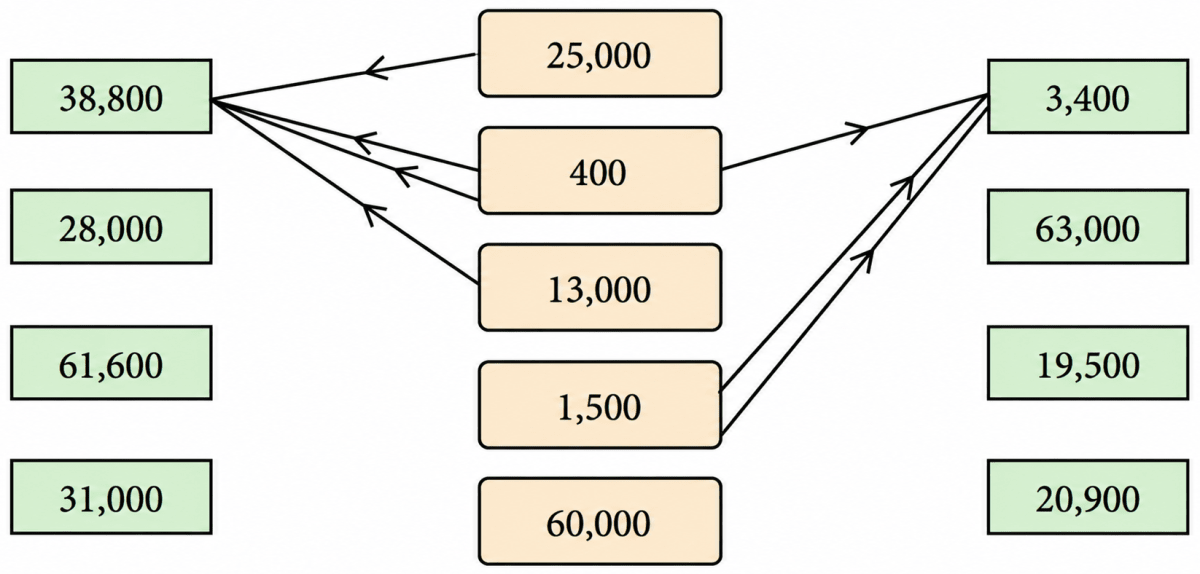
(i) Observe the figure below. What can you say about the numbers and the lines drawn?
(ii) Can we make 1,000 using the numbers in the middle? Why not? What about 14,000, 15,000 and 16,000? Explore how. What thousands cannot be made?
Answer
(i) The numbers in the middle column are the building blocks, and the numbers on the sides are formed by adding these middle numbers. A number in the middle may be used as many times as needed, and the lines (arrows) show which middle numbers are added to make each side number.
The middle numbers are 25,000, 13,000, 1,500, 400 and 60,000.
Two examples are already shown:
38,800 = 25,000 + 13,000 + 400 + 400
3,400 = 1,500 + 1,500 + 400
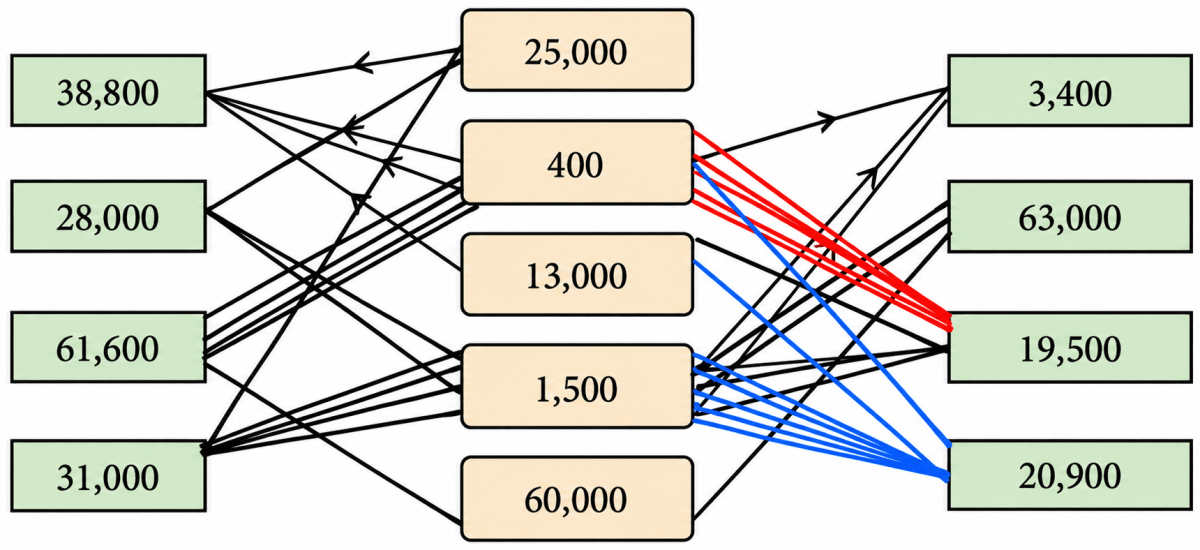
The remaining side numbers can be obtained in the same way:
28,000 = 25,000 + 1,500 + 1,500
63,000 = 60,000 + 1,500 + 1,500
61,600 = 60,000 + 400 + 400 + 400 + 400
31,000 = 25,000 + 1,500 + 1,500 + 1,500 + 1,500
19,500 = 13,000 + 1,500 + 1,500 + 1,500 + 400 + 400 + 400 + 400 + 400
20,900 = 13,000 + 1,500 + 1,500 + 1,500 + 1,500 + 1,500 + 400
(ii)
The middle numbers are 25,000, 13,000, 1,500, 400 and 60,000.
To reach a total as small as 1,000, the only usable number is 400, since every other number is already larger than 1,000. But repeatedly adding 400 gives 400, 800, 1,200, … and 1,000 never appears, because 1,000 is not a multiple of 400.
⇒ 1,000 cannot be made.
Now, 14,000, 15,000 and 16,000 can all be made:
14,000 = 1,500 × 8 + 400 × 5 = 12,000 + 2,000
15,000 = 13,000 + 400 × 5 = 13,000 + 2,000
16,000 = 1,500 × 8 + 400 × 10 = 12,000 + 4,000
Checking every thousand from 1,000 onwards, the numbers 400 and 1,500 together (with 13,000 available) can build every thousand from 2,000 upward. Only 1,000 stays out of reach.
Hence, 1,000 is the only thousand that cannot be made; all higher thousands can be made.
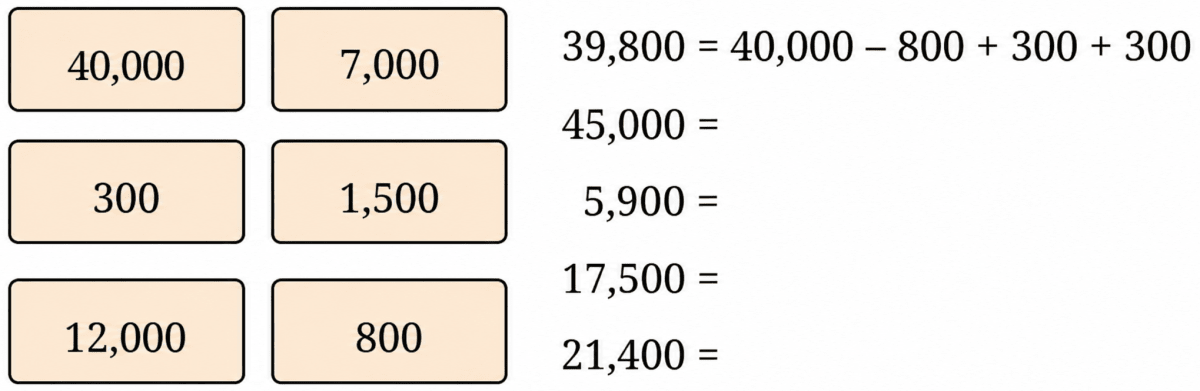
Here, using the numbers in the boxes, we are allowed to use both addition and subtraction to get the required number. An example is shown.
Answer
The numbers in the boxes are 40,000, 12,000, 7,000, 1,500, 800 and 300. Using addition and subtraction (and repeating a number when needed), one possible way for each is:
45,000 = 40,000 + 12,000 – 7,000
5,900 = 7,000 – 800 – 300
17,500 = 12,000 + 7,000 – 1,500
21,400 = 12,000 + 12,000 – 1,500 – 800 – 300
Hence, each required number can be obtained from the box numbers using addition and subtraction.
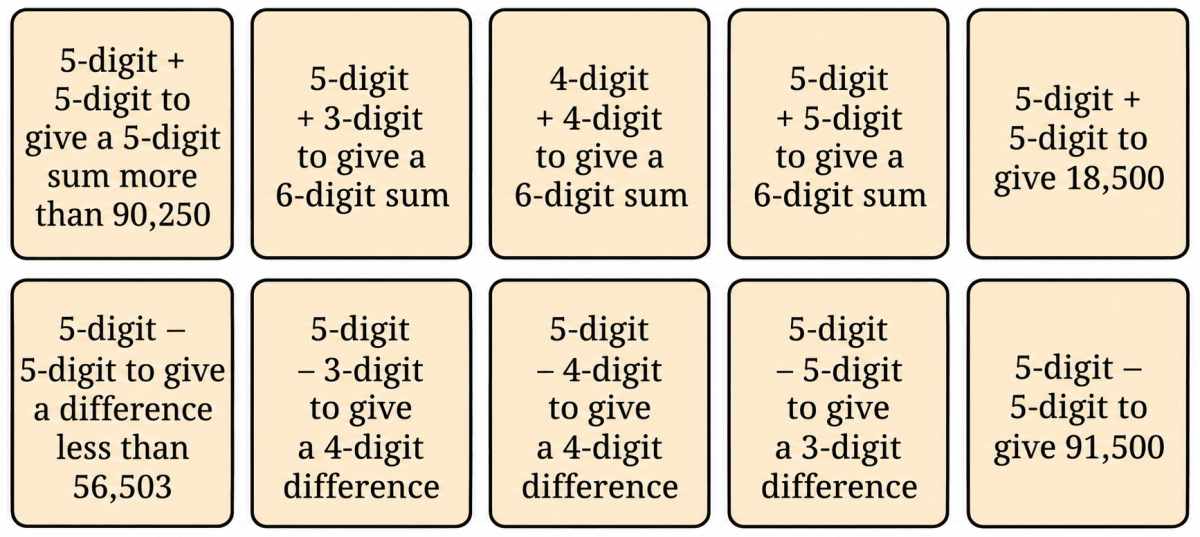
Write an example for each of the below scenarios whenever possible.
Could you find examples for all the cases? If not, think and discuss what could be the reason. Make other such questions and challenge your classmates.
Answer
Taking the cells row by row:
(i) 5-digit + 5-digit to give a 5-digit sum more than 90,250
45,000 + 45,400 = 90,400 > 90,250.
(ii) 5-digit + 3-digit to give a 6-digit sum
99,999 + 999 = 1,00,998, a 6-digit number.
(iii) 4-digit + 4-digit to give a 6-digit sum → Not possible
The greatest possible sum of two 4-digit numbers is 9,999 + 9,999 = 19,998, which has only 5 digits. So a 6-digit sum can never be reached.
(iv) 5-digit + 5-digit to give a 6-digit sum
60,000 + 40,000 = 1,00,000, a 6-digit number.
(v) 5-digit + 5-digit to give 18,500 → Not possible
The smallest 5-digit number is 10,000, so the smallest possible sum of two 5-digit numbers is 10,000 + 10,000 = 20,000, which is already more than 18,500.
(vi) 5-digit – 5-digit to give a difference less than 56,503
80,000 – 50,000 = 30,000 < 56,503.
(vii) 5-digit – 3-digit to give a 4-digit difference
10,000 – 999 = 9,001, a 4-digit number.
(viii) 5-digit – 4-digit to give a 4-digit difference
12,000 – 2,500 = 9,500, a 4-digit number.
(ix) 5-digit – 5-digit to give a 3-digit difference
50,999 – 50,000 = 999, a 3-digit number.
(x) 5-digit – 5-digit to give 91,500 → Not possible
The largest possible difference of two 5-digit numbers is 99,999 – 10,000 = 89,999 < 91,500.
Hence, examples exist for all cases except (iii), (v) and (x), which are impossible for the reasons shown above.
Always, Sometimes, Never?
Below are some statements. Think, explore and find out if each of the statement is ‘Always true’, ‘Only sometimes true’ or ‘Never true’. Why do you think so? Write your reasoning and discuss this with the class.
(a) 5-digit number + 5-digit number gives a 5-digit number
(b) 4-digit number + 2-digit number gives a 4-digit number
(c) 4-digit number + 2-digit number gives a 6-digit number
(d) 5-digit number – 5-digit number gives a 5-digit number
(e) 5-digit number – 2-digit number gives a 3-digit number
Answer
(a) 5-digit number + 5-digit number gives a 5-digit number. → Only Sometimes True
Reason — Sometimes the sum stays a 5-digit number, for example 10,000 + 10,000 = 20,000. But sometimes it becomes a 6-digit number, for example 20,000 + 80,000 = 1,00,000.
(b) 4-digit number + 2-digit number gives a 4-digit number. → Only Sometimes True
Reason — Usually the sum is a 4-digit number, for example 1,000 + 10 = 1,010. But it can also become a 5-digit number, for example 9,999 + 99 = 10,098.
(c) 4-digit number + 2-digit number gives a 6-digit number. → Never True
Reason — The greatest such sum is 9,999 + 99 = 10,098, which has only 5 digits. So a 6-digit number can never be obtained.
(d) 5-digit number – 5-digit number gives a 5-digit number. → Only Sometimes True
Reason — Sometimes the difference is a 5-digit number, for example 99,999 – 10,000 = 89,999. But sometimes it is smaller, for example 12,000 – 10,000 = 2,000, a 4-digit number.
(e) 5-digit number – 2-digit number gives a 3-digit number. → Never True
Reason — The smallest 5-digit number is 10,000, and even subtracting the greatest 2-digit number gives 10,000 – 99 = 9,901, a 4-digit number. The result is always at least a 4-digit number, so it can never be a 3-digit number.
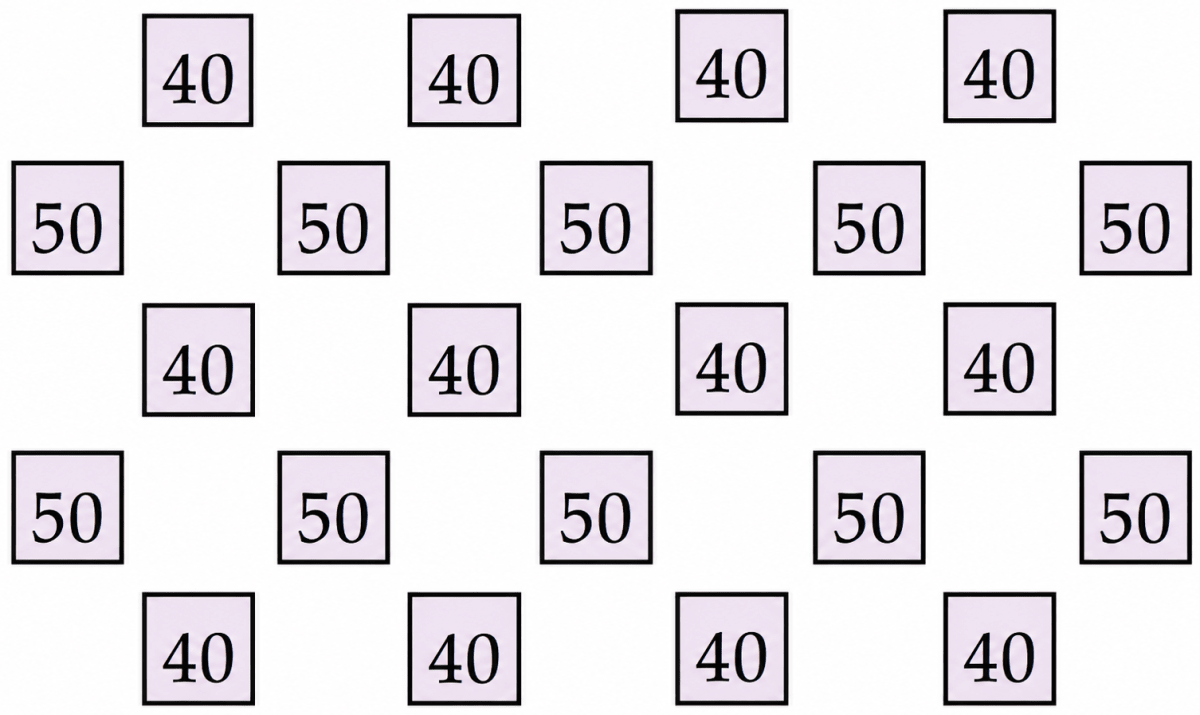
Here are some numbers arranged in a pattern. Find out the sum of the numbers in the below figure. Should we add them one by one or can we use a quicker way?
Answer
Instead of adding one by one, we group the equal numbers together.
Counting the numbers in the figure: there are twelve 40s and ten 50s.
Sum = 12 × 40 + 10 × 50
= 480 + 500
= 980
∴ The sum of the numbers in the figure is 980.
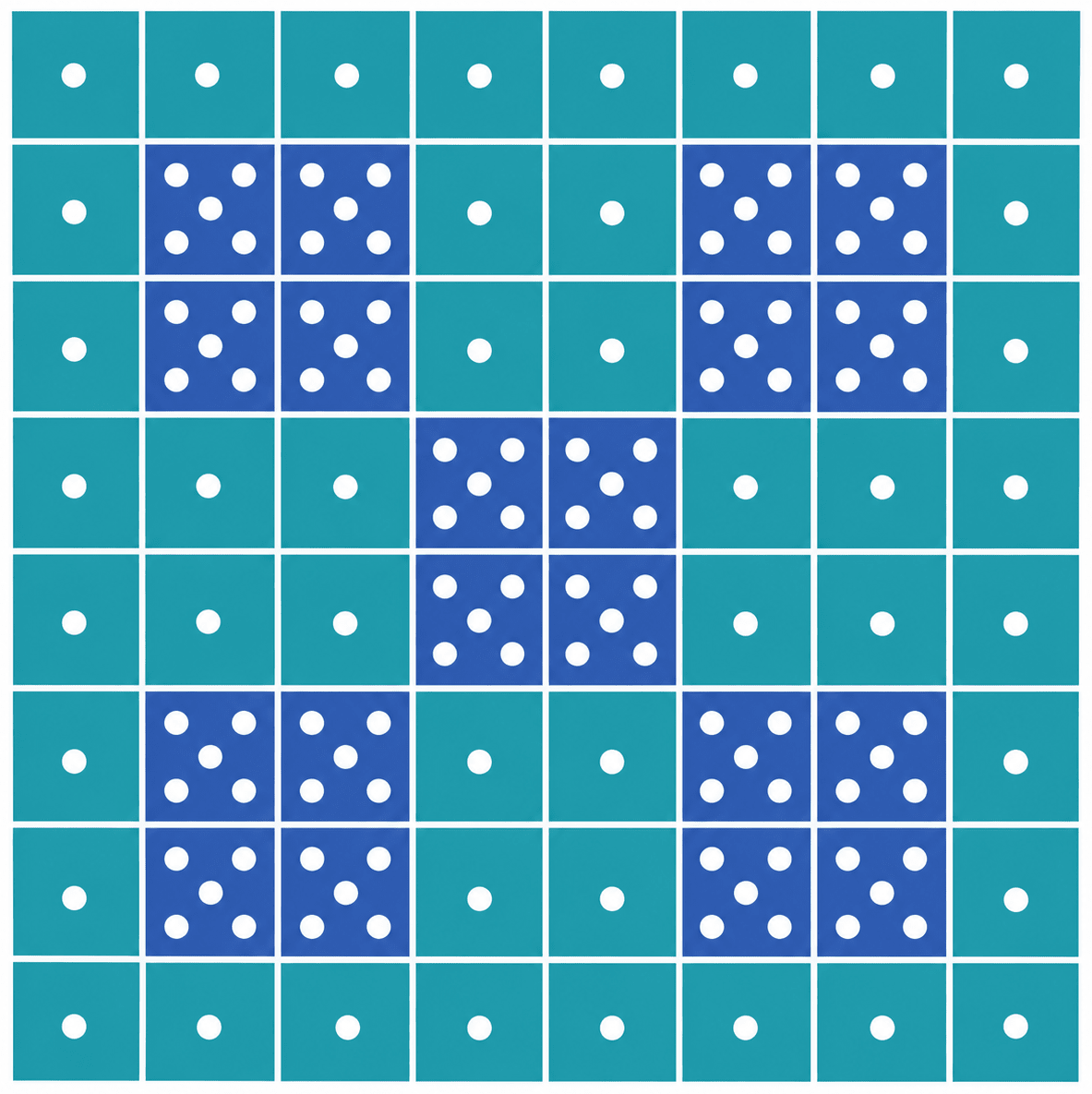
Here are some numbers arranged in a pattern. Find out the sum of the numbers in the below figure. Should we add them one by one or can we use a quicker way?
Answer
The figure is an 8 × 8 grid, so there are 64 cells in all. Each dark cell shows 5 dots and each light cell shows 1 dot.
Counting the dark (5-dot) cells, there are twenty of them, so the remaining 64 – 20 = 44 cells each show 1 dot.
Sum = 20 × 5 + 44 × 1
= 100 + 44
= 144
∴ The sum of the numbers in the figure is 144.
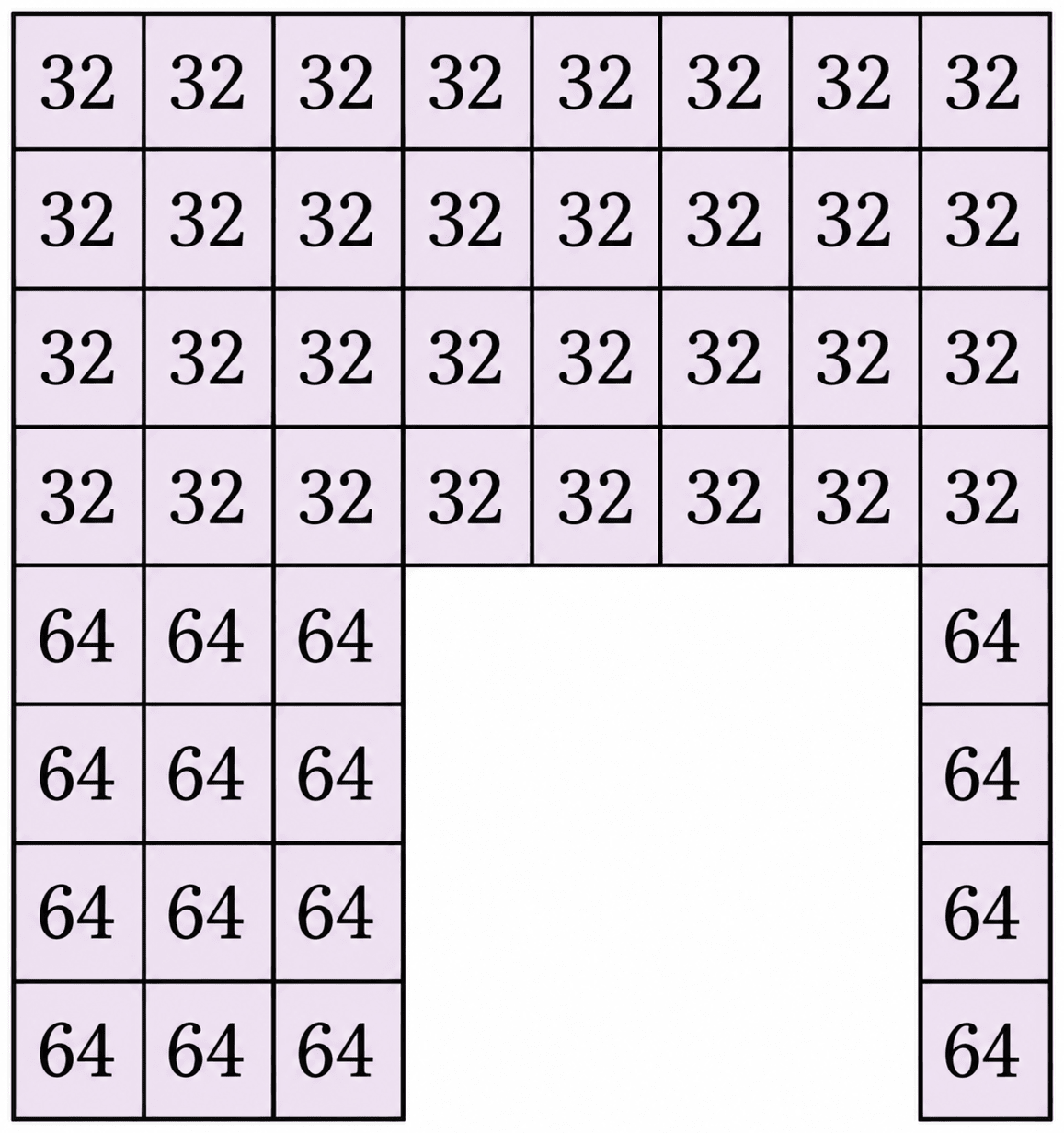
Here are some numbers arranged in a pattern. Find out the sum of the numbers in the below figure. Should we add them one by one or can we use a quicker way?
Answer
We group the equal numbers together.
The upper block is a 4 × 8 arrangement, giving thirty-two 32s. The lower block is made of sixteen 64s.
Sum = 32 × 32 + 16 × 64
= 1024 + 1024
= 2048
∴ The sum of the numbers in the figure is 2048.
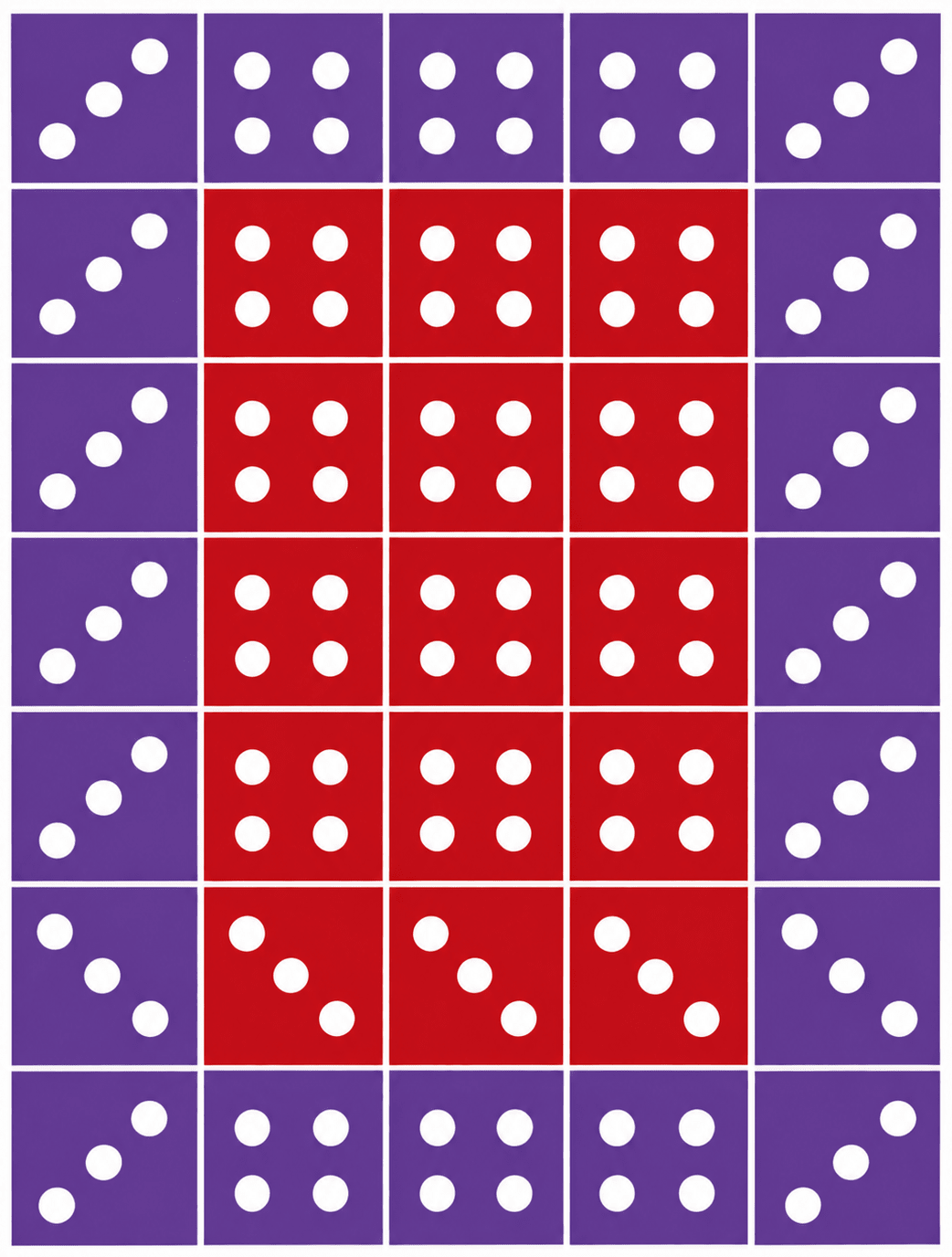
Here are some numbers arranged in a pattern. Find out the sum of the numbers in the below figure. Should we add them one by one or can we use a quicker way?
Answer
The figure is a 7 × 5 grid of 35 cells. We group the cells by the number of dots they show.
Counting them: there are seventeen 3-dot cells and eighteen 4-dot cells.
Sum = 17 × 3 + 18 × 4
= 51 + 72
= 123
∴ The sum of the numbers in the figure is 123.
Here are some numbers arranged in a pattern. Find out the sum of the numbers in the below figure. Should we add them one by one or can we use a quicker way?
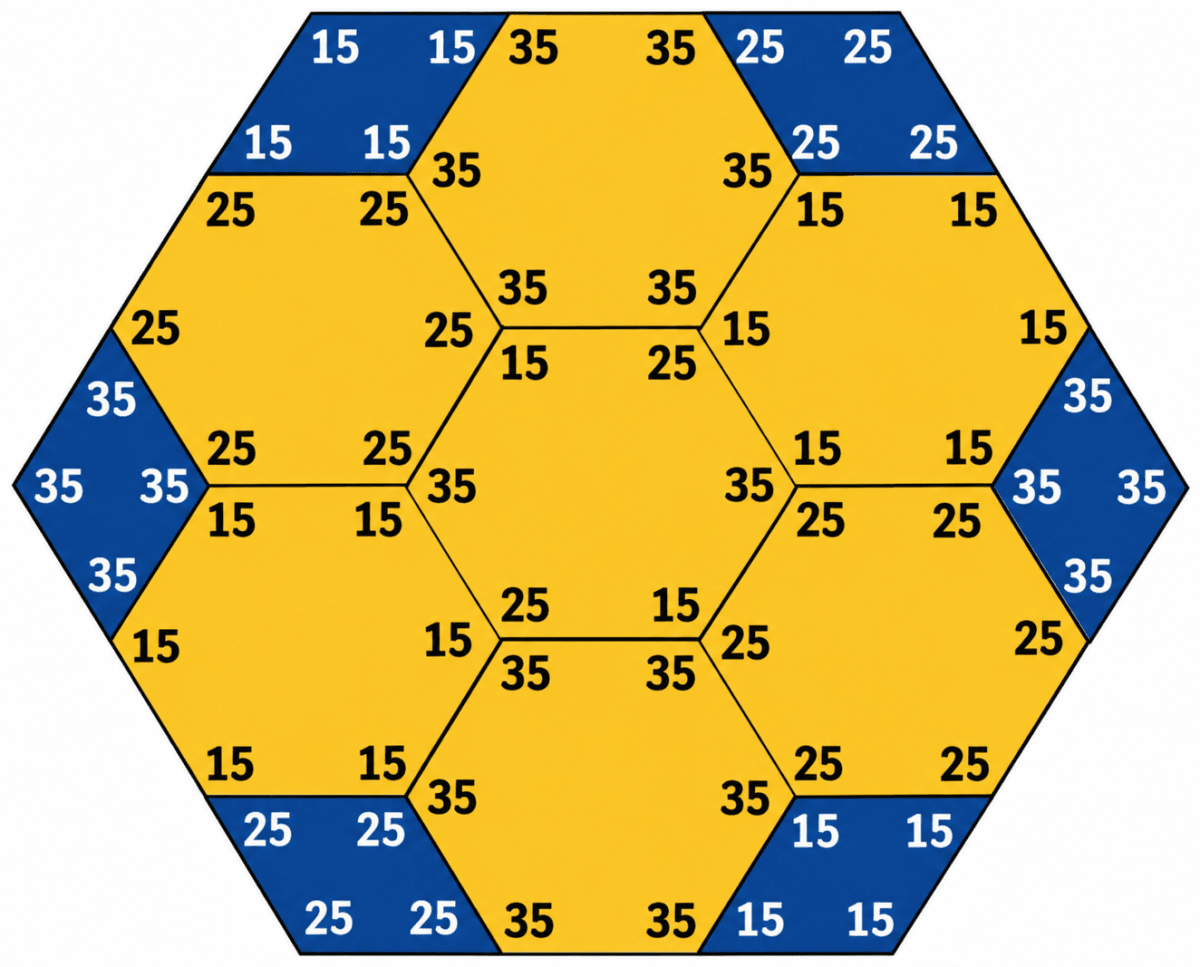
Answer
The figure is built from three kinds of pieces carrying the numbers 15, 25 and 35, and each of these three numbers appears the same number of times. So, rather than adding one by one, we count how many times each number occurs and multiply.
Each of the numbers 15, 25 and 35 appears 22 times.
Sum = 22 × 15 + 22 × 25 + 22 × 35
= 22 × (15 + 25 + 35)
= 22 × 75
= 1,650
∴ The sum of the numbers in the figure is 1,650.
Here are some numbers arranged in a pattern. Find out the sum of the numbers in the below figure. Should we add them one by one or can we use a quicker way?
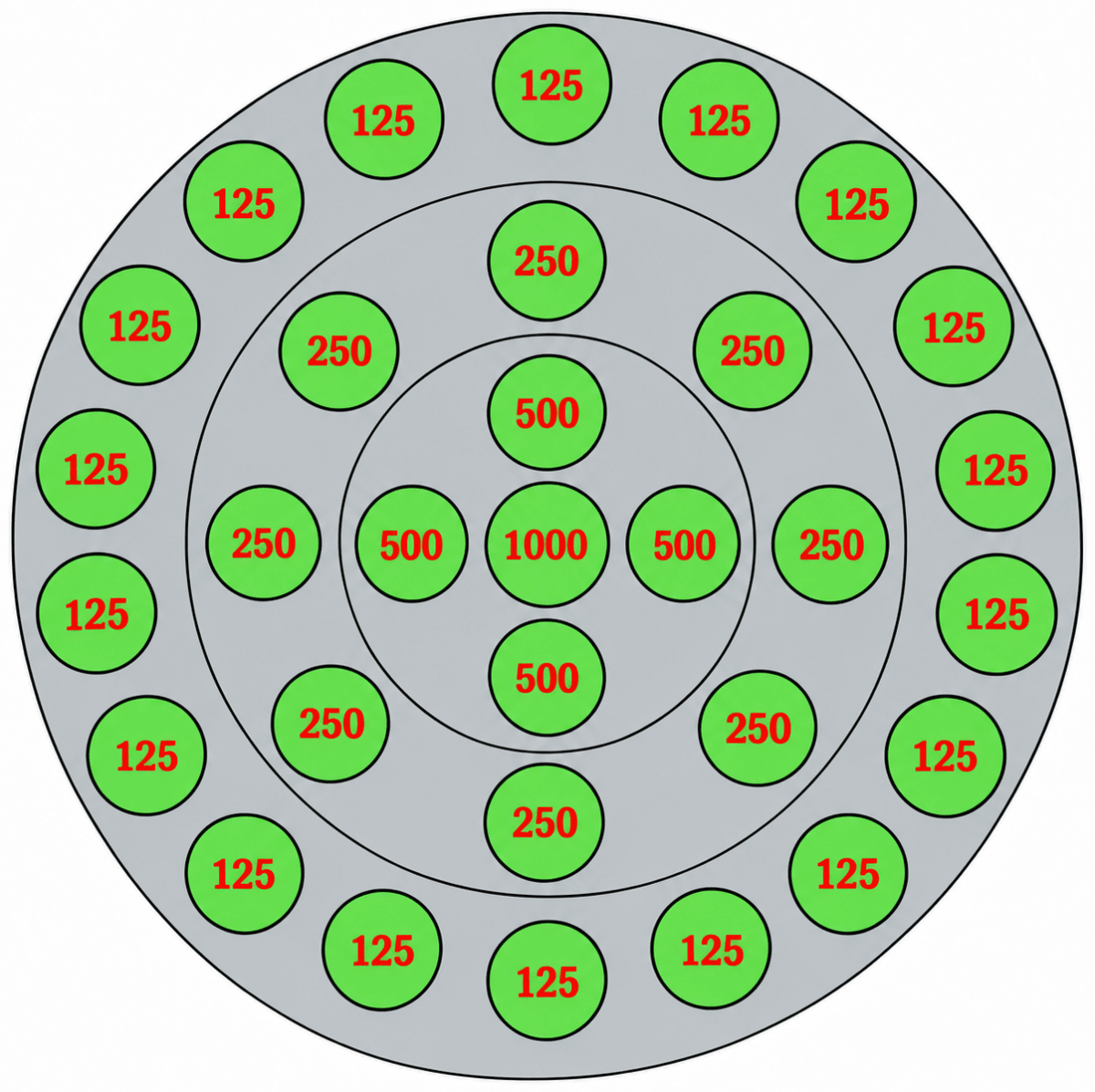
Answer
The numbers are written inside circles arranged as rings around a common centre. Counting the circles in each ring and the number written inside them:
- Centre: one circle containing 1000
- 1st ring: four circles, each containing 500
- 2nd ring: eight circles, each containing 250
- 3rd (outer) ring: eighteen circles, each containing 125
Instead of adding all the circles one by one, it is quicker to group the equal numbers together and multiply, then add the group totals.
Centre: 1 × 1000 = 1000
1st ring: 4 × 500 = 2000
2nd ring: 8 × 250 = 2000
3rd ring: 18 × 125 = 2250
Sum = 1000 + 2000 + 2000 + 2250
⇒ Sum = 7250
Hence, the sum of all the numbers in the figure is 7250, and the quicker way is to multiply each number by how many times it appears and then add.
We shall do some simple estimates. It is a fun exercise, and you may find it amusing to know the various numbers around us. Remember, we are not interested in the exact numbers for the following questions. Share your methods of estimation with the class.
Steps you would take to walk:
(a) From the place you are sitting to the classroom door
(b) Across the school ground from start to end
(c) From your classroom door to the school gate
(d) From your school to your home
Answer
This is an estimation activity, so the exact figures will be different for each student and each school. What matters is a sensible method rather than an exact count.
A useful method is to first find the length of one step. Walk naturally over a distance you can measure (say 10 steps), and see roughly how far one step takes you — for most students, one step is about half a metre. Then estimate the distance to be covered and divide by the length of one step to get the number of steps.
Typical estimates obtained this way are:
(a) Seat to classroom door → a short distance, about 5 to 15 steps.
(b) Across the school ground → a large open distance, about 100 to 300 steps.
(c) Classroom door to school gate → about 50 to 150 steps.
(d) School to home → this varies the most; it may be anywhere from a few hundred to a few thousand steps depending on how far away home is.
Hence, each distance can be estimated by measuring the length of one step and counting how many such steps fit into the distance; the answers will vary from student to student.
Number of times you blink your eyes or number of breaths you take:
(a) In a minute
(b) In an hour
(c) In a day
Answer
Take breaths as an example. Counting quietly for one minute, a person at rest usually takes about 15 to 20 breaths.
Taking about 15 breaths in a minute:
(a) In a minute → about 15 breaths.
(b) In an hour → 15 × 60 = about 900 breaths.
(c) In a day → 900 × 24 = about 21,600 breaths.
Blinking can be estimated in the same way. A person blinks roughly 15 times a minute while awake, which gives about 900 in an hour, and — counting only the roughly 16 hours we are awake — about 14,000 blinks in a day.
Hence, count for one minute and then multiply to estimate the number in an hour or a day. The exact values will vary from person to person.
Name some objects around you that are:
(a) a few thousand in number
(b) more than ten thousand in number
Answer
(a) A few thousand in number:
- The number of words printed on a few pages of a textbook
- The number of bricks in a classroom wall
- The 4-digit code numbers written on vehicle number plates
(b) More than ten thousand in number:
- The number of grains of rice in a large sack
- The strands of hair on a person’s head
- The digits in a long telephone or mobile number list of a locality
Hence, everyday collections such as words on a page or bricks in a wall run into a few thousands, while things like grains in a sack or strands of hair on the head run into more than ten thousand.
There is only one supercell (number greater than all its neighbours) in this grid. If you exchange two digits of one of the numbers, there will be 4 supercells. Figure out which digits to swap.
| 16,200 | 39,344 | 29,765 |
| 23,609 | 62,871 | 45,306 |
| 19,381 | 50,319 | 38,408 |
Answer
Here the neighbours of a cell are the cells immediately above, below, to the left, and to the right of it. A cell is a supercell if its number is greater than all its neighbours.
The given grid is:
| 16,200 | 39,344 | 29,765 |
| 23,609 | 62,871 | 45,306 |
| 19,381 | 50,319 | 38,408 |
Checking each cell, only the centre number 62,871 is greater than all four of its neighbours (23,609, 39,344, 45,306 and 50,319). So there is exactly one supercell.
Now swap the digits ‘1’ and ‘6’ in the centre number 62,871. It becomes 12,876.
The grid now looks like this:
| 16,200 | 39,344 | 29,765 |
| 23,609 | 12,876 | 45,306 |
| 19,381 | 50,319 | 38,408 |
The centre number has become small (12,876), so the four numbers around it — 39,344, 23,609, 45,306 and 50,319 — are each now greater than all of their neighbours. This gives 4 supercells.
Hence, swapping the digits ‘1’ and ‘6’ of 62,871 to make 12,876 produces exactly 4 supercells.
How many rounds does your year of birth take to reach the Kaprekar constant?
Answer
The number of rounds depends on each student’s own year of birth, so the answer will vary. The Kaprekar routine is carried out on the four digits of the birth year:
- Arrange the four digits to make the largest number and the smallest number (using a leading zero if a digit is 0).
- Subtract the smallest from the largest.
- Repeat the steps with the new number until 6174 (the Kaprekar constant) appears.
As an example, take the birth year 2013 (digits 2, 0, 1, 3):
Round 1:  3210 − 0123 = 3087
Round 2:  8730 − 0378 = 8352
Round 3:  8532 − 2358 = 6174
So 2013 reaches the Kaprekar constant in 3 rounds.
Every 4-digit number that does not have all four digits the same reaches 6174, and it always takes at most 7 rounds to get there.
Hence, carrying out the Kaprekar routine on your birth year always reaches 6174 in at most 7 rounds; for example, 2013 takes 3 rounds.
We are the group of 5-digit numbers between 35,000 and 75,000 such that all of our digits are odd. Who is the largest number in our group? Who is the smallest number in our group? Who among us is the closest to 50,000?
Answer
The odd digits are 1, 3, 5, 7 and 9. Every digit of the number must be one of these, and the number must lie between 35,000 and 75,000.
Largest number — Make the number as large as possible while staying below 75,000. The first digit can be 7. Then the number must be less than 75,000, so the second digit must be less than 7 and odd; the largest such digit is 3. Filling the rest with the largest odd digit 9 gives 73,999.
Smallest number — Make the number as small as possible while staying above 35,000. The first digit can be 3. Then the number must be more than 35,000, so the second digit must be at least 5 and odd; the smallest such digit is 5. Filling the rest with the smallest odd digit 1 gives 35,111.
Closest to 50,000 — The digits of a number just above 50,000 would need a 0 in them, but 0 is not odd. The smallest all-odd number beginning with 5 is 51,111, which is 1,111 away from 50,000. Any all-odd number below 50,000 begins with 3 and is at most 39,999, which is more than 10,000 away. So 51,111 is the closest.
Hence, the largest number is 73,999, the smallest is 35,111, and the number closest to 50,000 is 51,111.
Estimate the number of holidays you get in a year including weekends, festivals and vacation. Then, try to get an exact number and see how close your estimate is.
Answer
- Sundays in a year: about 52
- Second Saturdays (or other weekly off days): about 12
- Festival and national holidays: about 15 to 20
- Summer, autumn and winter vacations together: about 50 to 60 days
Adding these gives an estimate of roughly 130 to 150 holidays in a year.
To check, one can look at the actual school calendar and count the marked holidays exactly, then compare that number with the estimate above to see how close the estimate was.
Hence, a reasonable estimate is about 130 to 150 holidays in a year; the exact figure should be counted from the school calendar and will vary from school to school.
Estimate the number of liters a mug, a bucket and an overhead tank can hold.
Answer
These are everyday capacities that can be estimated by comparison with a familiar 1-litre bottle.
- A mug is a little smaller than a large bottle, so it holds roughly 0.5 to 1 litre.
- A bucket holds many mugfuls of water — around 15 to 20 litres.
- An overhead water tank on a house is very large, holding around 500 to 1000 litres.
Hence, a mug holds about 0.5–1 litre, a bucket about 15–20 litres, and an overhead tank about 500–1000 litres; the exact values depend on the actual sizes.
Write one 5-digit number and two 3-digit numbers such that their sum is 18,670.
Answer
We need one 5-digit number and two 3-digit numbers that add up to 18,670. There are many possible answers; one simple way is to start with a round 5-digit number and split the rest into two 3-digit numbers.
Take the 5-digit number as 18,000. The remaining amount is:
18,670 − 18,000 = 670
Now split 670 into two 3-digit numbers, for example 300 and 370.
Check: 18,000 + 300 + 370 = 18,670
Hence, one such choice is 18,000 + 300 + 370 = 18,670. (Many other answers are also possible.)
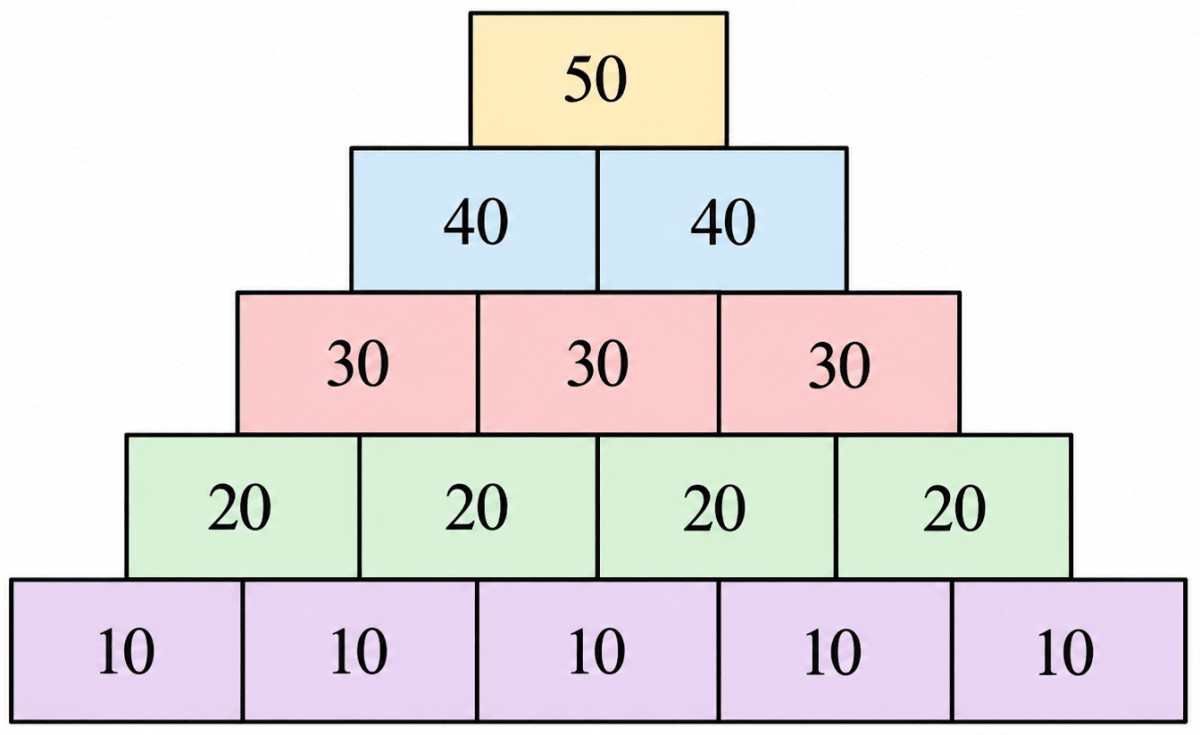
Choose a number between 210 and 390. Create a number pattern similar to those shown in Section 3.9 that will sum up to this number.
Answer
Let us choose the number 350, which lies between 210 and 390.
One neat pattern is to arrange numbers in a pyramid so that equal numbers can be grouped and multiplied.
The pattern consists of four rows:
- The first row has one 50.
- The second row has two 40s.
- The third row has three 30s.
- The fourth row has four 20s.
- The fifth row has five 10s.
The sum of each row is calculated as follows:
1 × 50 + 2 × 40 + 3 × 30 + 4 × 20 + 5 × 10
= 50 + 80 + 90 + 80 + 50
= 350
Recall the sequence of Powers of 2 from Chapter 1, Table 1. Why is the Collatz conjecture correct for all the starting numbers in this sequence?
Answer
The powers of 2 are 2, 4, 8, 16, 32, 64, … . Every one of these numbers is even.
The Collatz rule says that if a number is even, we take half of it. When we halve a power of 2, we get the previous power of 2:
64 → 32 → 16 → 8 → 4 → 2 → 1
So each power of 2 is simply halved again and again, moving down the list of powers of 2, until it reaches 2, which halves to 1. Since the number stays even at every step, we never need the “multiply by 3 and add 1” step, and we are certain to reach 1.
Hence, the Collatz conjecture holds for every power of 2 because repeatedly halving a power of 2 always leads straight down to 1.
Check if the Collatz Conjecture holds for the starting number 100.
Answer
We apply the Collatz rule to 100: if the number is even, take half of it; if it is odd, multiply it by 3 and add 1. We repeat until we reach 1.
100 → 50 → 25 → 76 → 38 → 19 → 58 → 29 → 88 → 44 → 22 → 11 → 34 → 17 → 52 → 26 → 13 → 40 → 20 → 10 → 5 → 16 → 8 → 4 → 2 → 1
The sequence reaches 1.
Hence, the Collatz Conjecture holds for the starting number 100, as the sequence eventually reaches 1.
Starting with 0, players alternate adding numbers between 1 and 3. The first person to reach 22 wins. What is the winning strategy now?
Answer
In this game the two players take turns adding 1, 2 or 3 to the running total, starting from 0, and whoever reaches exactly 22 wins.
The key idea is that after each pair of moves the total can be made to go up by exactly 4, because if one player adds any of 1, 2 or 3, the other can add the amount that makes the pair sum to 4.
Working backwards from 22, the safe totals a player should aim to say are those that are 4 apart from 22:
22, 18, 14, 10, 6, 2
The first of these is 2. So the winning plan is:
⇒ The first player should begin by making the total 2 (by saying 2).
⇒ After that, whatever number (1, 2 or 3) the opponent adds, the first player adds the number that brings the total to the next safe value: 6, then 10, then 14, then 18, and finally 22.
Because the opponent can never jump over a safe total in a single move, the first player can always land on each safe total and will be the one to reach 22.
Hence, the first player can always win by first making the total 2 and then keeping the running total at 2, 6, 10, 14, 18 and 22.