
Can there be a number less than 0? Can you think of any ways to have less than 0 of something?
Answer
Yes, there can be numbers less than 0. Such numbers are called negative numbers.
The counting numbers 1, 2, 3, 4, … tell us 'how many' things there are, and 0 tells us that there is nothing at all. But in many everyday situations we need to describe a quantity that lies below a chosen starting point, and for this we need numbers on the other side of 0.
Here are some ways of having less than 0 of something:
| Situation | What a number less than 0 means |
|---|---|
| Floors of a building | A floor below the ground floor, such as a basement |
| Temperature | A temperature below 0 °C, as in Leh or Siachen in winter |
| Money | Money that is owed, that is, a debt |
| Height and depth | A depth below sea level |
| A game | Points lost, taking the score below zero |
For example, if a person has no money at all and then borrows ₹50, he has ₹50 less than nothing. This is written as –50.
Hence, numbers less than 0 do exist. They are called negative numbers and are written with a '–' sign in front, such as –1, –2, –3, … .
What do you press to go four floors up? What do you press to go three floors down?
Answer
In the lift of the Building of Fun, each press of the '+' button takes you one floor up and each press of the '–' button takes you one floor down.
To go four floors up, the '+' button must be pressed four times:
++++ , which is written as +4
To go three floors down, the '–' button must be pressed three times:
– – – , which is written as –3
Hence, press + + + + (i.e. +4) to go four floors up, and press – – – (i.e. –3) to go three floors down.
You start from Floor +2 and press –3 in the lift. Where will you reach? Write an expression for this movement.
Answer

The movement of the lift in the Building of Fun is described by
Starting Floor + Movement = Target Floor
Here the starting floor is +2 (the Art Centre) and the button press is –3, so the lift moves three floors down from Floor +2.
⇒ (+2) + (–3) = –1 [Three floors down from Floor +2]
Floor –1 is the Toy Store.
∴ (+2) + (–3) = –1, i.e. you will reach Floor –1, the Toy Store.
Evaluate these expressions (you may think of them as Starting Floor + Movement by referring to the Building of Fun).
(a) (+1) + (+4) = ..........
(b) (+4) + (+1) = ..........
(c) (+4) + (–3) = ..........
(d) (–1) + (+2) = ..........
(e) (–1) + (+1) = ..........
(f) 0 + (+2) = ..........
(g) 0 + (–2) = ..........
Answer
In each expression, the first number is the Starting Floor and the second number is the Movement (the button press). Their sum gives the Target Floor.
(a) (+1) + (+4) = +5 [From Floor +1, go 4 floors up]
(b) (+4) + (+1) = +5 [From Floor +4, go 1 floor up]
(c) (+4) + (–3) = +1 [From Floor +4, go 3 floors down]
(d) (–1) + (+2) = +1 [From Floor –1, go 2 floors up]
(e) (–1) + (+1) = 0 [From Floor –1, go 1 floor up]
(f) 0 + (+2) = +2 [From Floor 0, go 2 floors up]
(g) 0 + (–2) = –2 [From Floor 0, go 2 floors down]
Hence, the target floors are +5, +5, +1, +1, 0, +2 and –2 respectively.
Starting from different floors, find the movements required to reach Floor –5. For example, if I start at Floor +2, I must press –7 to reach Floor –5. The expression is (+2) + (–7) = –5.
Find more such starting positions and the movements needed to reach Floor –5 and write the expressions.
Answer
We use the relation
Starting Floor + Movement = Target Floor, where the Target Floor is –5.
So, for every starting floor, the movement needed is the number that must be added to it to give –5.
The Building of Fun has six floors above the ground and five floors below it, that is, Floor –5 to Floor +6. Taking each floor above Floor –5 as a possible starting floor, we get:
| Starting Floor | Place | Movement needed | Expression |
|---|---|---|---|
| +6 | Space | –11 | (+6) + (–11) = –5 |
| +5 | Sports Centre | –10 | (+5) + (–10) = –5 |
| +4 | Ice Cream | –9 | (+4) + (–9) = –5 |
| +3 | Book Store | –8 | (+3) + (–8) = –5 |
| +2 | Art Centre | –7 | (+2) + (–7) = –5 |
| +1 | Food Court | –6 | (+1) + (–6) = –5 |
| 0 | Welcome Hall | –5 | 0 + (–5) = –5 |
| –1 | Toy Store | –4 | (–1) + (–4) = –5 |
| –2 | Video Games | –3 | (–2) + (–3) = –5 |
| –3 | Cinema | –2 | (–3) + (–2) = –5 |
| –4 | Ghost House | –1 | (–4) + (–1) = –5 |
Observe that every starting floor is above Floor –5, so in each case the movement needed is a negative number, i.e. the '–' button has to be pressed.
Hence, from any floor the movement needed to reach Floor –5 is obtained by counting the number of floors to be moved down, as shown in the table above.
Evaluate these expressions by thinking of them as the resulting movement of combining button presses:
(a) (+1) + (+4) = ..........
(b) (+4) + (+1) = ..........
(c) (+4) + (–3) + (–2) = ..........
(d) (–1) + (+2) + (–3) = ..........
Answer
Here each number stands for a button press, and the sum tells us the single movement that has the same effect as all those presses together.
(a) (+1) + (+4) = +5 [1 floor up, then 4 floors up ⇒ 5 floors up]
(b) (+4) + (+1) = +5 [4 floors up, then 1 floor up ⇒ 5 floors up]
(c) (+4) + (–3) + (–2)
⇒ (+4) + (–3) = +1 [4 floors up, then 3 floors down ⇒ 1 floor up]
⇒ (+1) + (–2) = –1 [1 floor up, then 2 floors down ⇒ 1 floor down]
(d) (–1) + (+2) + (–3)
⇒ (–1) + (+2) = +1 [1 floor down, then 2 floors up ⇒ 1 floor up]
⇒ (+1) + (–3) = –2 [1 floor up, then 3 floors down ⇒ 2 floors down]
Hence, the resulting movements are +5, +5, –1 and –2 respectively.
Write the inverses of these numbers:
+4, –4, –3, 0, +2, –1.
Answer
The inverse of a number is the number that cancels it, that is, the number which when added to it gives 0. So, the inverse of a number has the same value but the opposite sign.
| Number | Inverse | Check |
|---|---|---|
| +4 | –4 | (+4) + (–4) = 0 |
| –4 | +4 | (–4) + (+4) = 0 |
| –3 | +3 | (–3) + (+3) = 0 |
| 0 | 0 | 0 + 0 = 0 |
| +2 | –2 | (+2) + (–2) = 0 |
| –1 | +1 | (–1) + (+1) = 0 |
Note that 0 is the only number that is its own inverse, since it is neither positive nor negative.
Hence, the inverses are –4, +4, +3, 0, –2 and +1 respectively.
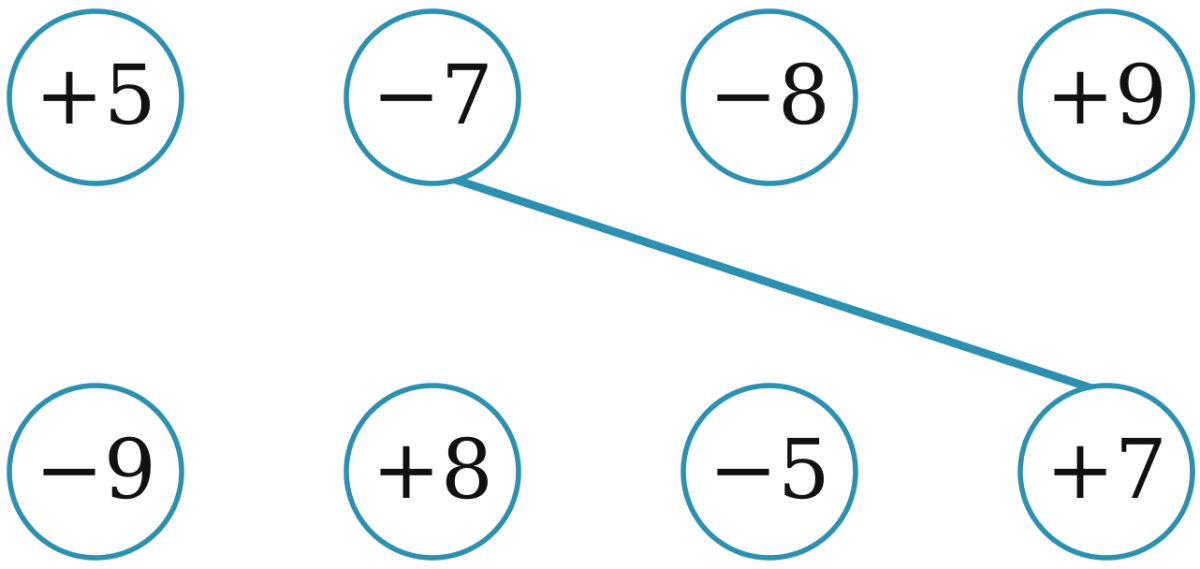
Connect the inverses by drawing lines.
Answer
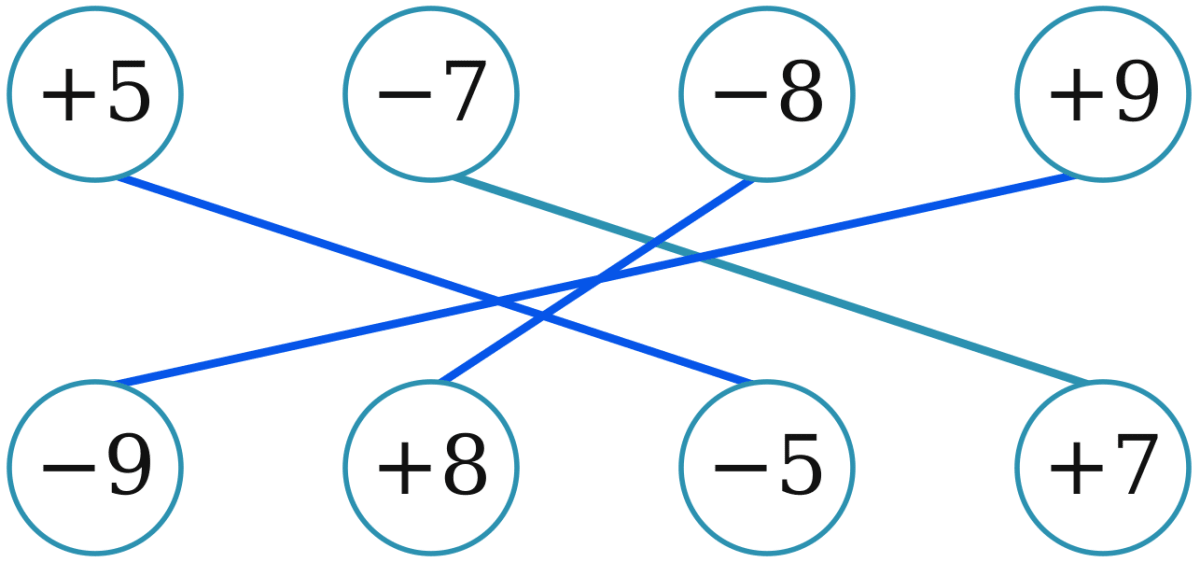
Two numbers are inverses of each other when they have the same value but opposite signs, so that their sum is 0. We therefore join each number in the upper row to the number of the same value with the opposite sign in the lower row.
| Upper row | Joined to | Check |
|---|---|---|
| +5 | –5 | (+5) + (–5) = 0 |
| –7 | +7 | (–7) + (+7) = 0 |
| –8 | +8 | (–8) + (+8) = 0 |
| +9 | –9 | (+9) + (–9) = 0 |
Hence, the lines drawn are +5 ↔ –5, –7 ↔ +7, –8 ↔ +8 and +9 ↔ –9.
Who is on the lowest floor?
- Jay is in the Art Centre. So, he is on Floor +2.
- Asin is in the Sports Centre. So, she is on Floor ..........
- Binnu is in the Cinema Centre. So, she is on Floor ..........
- Aman is in the Toys Store. So, he is on Floor ..........
Answer
Reading the floor numbers from the Building of Fun, we get:
Jay is in the Art Centre. So, he is on Floor +2.
Asin is in the Sports Centre. So, she is on Floor +5.
Binnu is in the Cinema Centre. So, she is on Floor –3.
Aman is in the Toys Store. So, he is on Floor –1.
Now we compare these four floor numbers. The floors +2 and +5 are above the ground floor, while the floors –3 and –1 are below it. So the lowest floor must be one of –3 and –1.
Floor –3 is three floors below the ground and Floor –1 is only one floor below the ground.
⇒ Floor –3 is lower than Floor –1.
Arranging all four floors from the lowest to the highest: –3, –1, +2, +5.
∴ Binnu, who is on Floor –3 (the Cinema Centre), is on the lowest floor.
Compare the following numbers using the Building of Fun and fill in the boxes with < or >.
(a) –2 +5
(b) –5 +4
(c) –5 –3
(d) +6 –6
(e) 0 –4
(f) 0 +4
Answer
In the Building of Fun, a floor that is lower in the building stands for the smaller number. So, of two numbers, the one whose floor lies lower is the smaller one.
Also, every negative floor is below Floor 0 and every positive floor is above Floor 0. So, every negative number is less than 0, and 0 is less than every positive number.
(a) –2 < +5 [Floor –2 is below Floor +5]
(b) –5 < +4 [Floor –5 is below Floor +4]
(c) –5 < –3 [Floor –5 is below Floor –3]
(d) +6 > –6 [Floor +6 is above Floor –6]
(e) 0 > –4 [Floor 0 is above Floor –4]
(f) 0 < +4 [Floor 0 is below Floor +4]
Hence, the signs are <, <, <, >, > and < respectively.
Imagine the Building of Fun with more floors. Compare the numbers and fill in the boxes with < or >:
(a) –10 –12
(b) +17 –10
(c) 0 –20
(d) +9 –9
(e) –25 –7
(f) +15 –17
Answer
In the Building of Fun, a floor that is higher up has the greater number. So, out of two numbers, the number whose floor is higher is the greater one.
Also remember that every negative number floor lies below Floor 0 and every positive number floor lies above Floor 0. So, every negative number is less than 0 and every positive number is greater than 0.
(a) Floor –10 lies above Floor –12, so –10 > –12
(b) Floor +17 lies above Floor –10, so +17 > –10
(c) Floor 0 lies above Floor –20, so 0 > –20
(d) Floor +9 lies above Floor –9, so +9 > –9
(e) Floor –25 lies below Floor –7, so –25 < –7
(f) Floor +15 lies above Floor –17, so +15 > –17
Hence, the boxes are filled as: (a) > (b) > (c) > (d) > (e) < (f) >
If Floor A = –12, Floor D = –1 and Floor E = +1 in the building shown on the right as a line, find the numbers of Floors B, C, F, G, and H.

Answer
On the given line, each small mark stands for one floor.
Floor D = –1 and Floor E = +1, and there is exactly one mark between D and E. That mark is Floor 0. So, two neighbouring marks always differ by 1.
Now we count the marks from the floors that are already known.
Floor B: B is 3 marks above A.
⇒ B = –12 + 3 = –9
Floor C: C is 3 marks above B.
⇒ C = –9 + 3 = –6
Floor F: F is 1 mark above E.
⇒ F = +1 + 1 = +2
Floor G: G is 4 marks above F.
⇒ G = +2 + 4 = +6
Floor H: H is 5 marks above G.
⇒ H = +6 + 5 = +11
Hence, B = –9, C = –6, F = +2, G = +6 and H = +11.
Mark the following floors of the building shown on the right.
(a) –7
(b) –4
(c) +3
(d) –10
Answer
We use Floor 0 as the reference point. To mark a negative number we count that many marks below Floor 0, and to mark a positive number we count that many marks above Floor 0.
(a) –7 is marked 7 marks below Floor 0, that is, one mark below Floor C (–6). Label this point P.
(b) –4 is marked 4 marks below Floor 0, that is, three marks below Floor D (–1). Label this point Q.
(c) +3 is marked 3 marks above Floor 0, that is, one mark above Floor F (+2). Label this point R.
(d) –10 is marked 10 marks below Floor 0, that is, one mark below Floor B (–9). Label this point S.

Hence, the required floors are marked as P = –7, Q = –4, R = +3 and S = –10.
Evaluate 15 – 5, 100 – 10 and 74 – 34 from this perspective.
Answer
Here, subtraction is read as ‘finding the missing number to be added’. That is, for a – b we ask: what must be added to b to get a?
15 – 5
This can be written as 5 + ? = 15
⇒ ? = 15 – 5
∴ ? = 10
100 – 10
This can be written as 10 + ? = 100
⇒ ? = 100 – 10
∴ ? = 90
74 – 34
This can be written as 34 + ? = 74
⇒ ? = 74 – 34
∴ ? = 40
Hence, 15 – 5 = 10, 100 – 10 = 90 and 74 – 34 = 40.
Complete these expressions. You may think of them as finding the movement needed to reach the Target Floor from the Starting Floor.
(a) (+1) – (+4) = ..........
(b) (0) – (+2) = ..........
(c) (+4) – (+1) = ..........
(d) (0) – (–2) = ..........
(e) (+4) – (–3) = ..........
(f) (–4) – (–3) = ..........
(g) (–1) – (+2) = ..........
(h) (–2) – (–2) = ..........
(i) (–1) – (+1) = ..........
(j) (+3) – (–3) = ..........
Answer
We use the rule:
Target Floor – Starting Floor = Movement needed
(a) (+1) – (+4) = ..........
Starting Floor +4, Target Floor +1. We must go 4 floors down and then 1 floor is left below, i.e., 3 floors down.
(+1) – (+4) = –3
(b) (0) – (+2) = ..........
Starting Floor +2, Target Floor 0. We must go 2 floors down.
(0) – (+2) = –2
(c) (+4) – (+1) = ..........
Starting Floor +1, Target Floor +4. We must go 3 floors up.
(+4) – (+1) = +3
(d) (0) – (–2) = ..........
Starting Floor –2, Target Floor 0. We must go 2 floors up.
(0) – (–2) = +2
(e) (+4) – (–3) = ..........
Starting Floor –3, Target Floor +4. We must go 3 floors up to reach 0 and then 4 floors more, i.e., 7 floors up.
(+4) – (–3) = +7
(f) (–4) – (–3) = ..........
Starting Floor –3, Target Floor –4. We must go 1 floor down.
(–4) – (–3) = –1
(g) (–1) – (+2) = ..........
Starting Floor +2, Target Floor –1. We must go 2 floors down to reach 0 and then 1 floor more, i.e., 3 floors down.
(–1) – (+2) = –3
(h) (–2) – (–2) = ..........
Starting Floor –2, Target Floor –2. We are already on the target floor, so no movement is needed.
(–2) – (–2) = 0
(i) (–1) – (+1) = ..........
Starting Floor +1, Target Floor –1. We must go 1 floor down to reach 0 and then 1 floor more, i.e., 2 floors down.
(–1) – (+1) = –2
(j) (+3) – (–3) = ..........
Starting Floor –3, Target Floor +3. We must go 3 floors up to reach 0 and then 3 floors more, i.e., 6 floors up.
(+3) – (–3) = +6
Complete these expressions.
(a) (+40) + .......... = +200
(b) (+40) + .......... = –200
(c) (–50) + .......... = +200
(d) (–50) + .......... = –200
(e) (–200) – (–40) = ..........
(f) (+200) – (+40) = ..........
(g) (–200) – (+40) = ..........
Check your answers by thinking about the movement in the mineshaft.
Answer
For parts a to d we use:
Starting Level + Movement = Target Level, so Movement = Target Level – Starting Level
For parts e to g we use:
Target Level – Starting Level = Movement needed
(a) (+40) + .......... = +200
Starting Level +40, Target Level +200.
We must go up 200 – 40 = 160 metres.
(+40) + (+160) = +200
(b) (+40) + .......... = –200
Starting Level +40, Target Level –200.
We must go down 40 metres to reach 0 and then 200 metres more, i.e., 240 metres down.
(+40) + (–240) = –200
(c) (–50) + .......... = +200
Starting Level –50, Target Level +200.
We must go up 50 metres to reach 0 and then 200 metres more, i.e., 250 metres up.
(–50) + (+250) = +200
(d) (–50) + .......... = –200
Starting Level –50, Target Level –200.
We must go down 200 – 50 = 150 metres.
(–50) + (–150) = –200
(e) (–200) – (–40) = ..........
Starting Level –40, Target Level –200.
We must go down 200 – 40 = 160 metres.
(–200) – (–40) = –160
(f) (+200) – (+40) = ..........
Starting Level +40, Target Level +200.
We must go up 200 – 40 = 160 metres.
(+200) – (+40) = +160
(g) (–200) – (+40) = ..........
Starting Level +40, Target Level –200.
We must go down 40 metres to reach 0 and then 200 metres more, i.e., 240 metres down.
(–200) – (+40) = –240
Try evaluating the following expressions by similarly drawing or imagining a suitable lift:
(a) –125 + (–30)
(b) +105 – (–55)
(c) +105 + (+55)
(d) +80 – (–150)
(e) +80 + (+150)
(f) –99 – (–200)
(g) –99 + (+200)
(h) +1500 – (–1500)
Answer
We imagine an ‘infinite lift’ in each case and use:
Starting Level + Movement = Target Level and Target Level – Starting Level = Movement needed
(a) –125 + (–30)
Start at Level –125 and move 30 levels down.
We reach 125 + 30 = 155 levels below 0.
–125 + (–30) = –155
(b) +105 – (–55)
Start at Level –55 and go to Level +105.
We must press +55 to reach 0 and then +105 more.
+105 – (–55) = +55 + 105 = +160
(c) +105 + (+55)
Start at Level +105 and move 55 levels up.
+105 + (+55) = +160
(d) +80 – (–150)
Start at Level –150 and go to Level +80.
We must press +150 to reach 0 and then +80 more.
+80 – (–150) = +150 + 80 = +230
(e) +80 + (+150)
Start at Level +80 and move 150 levels up.
+80 + (+150) = +230
(f) –99 – (–200)
Start at Level –200 and go to Level –99.
We must press +101 to move up from –200 to –99.
–99 – (–200) = +101
(g) –99 + (+200)
Start at Level –99 and move 200 levels up.
We reach 0 after 99 levels and then 101 levels more.
–99 + (+200) = +101
(h) +1500 – (–1500)
Start at Level –1500 and go to Level +1500.
We must press +1500 to reach 0 and then +1500 more.
+1500 – (–1500) = +3000
In the other exercises that you did above, did you notice that subtracting a negative number was the same as adding the corresponding positive number?
Answer
Yes. In every such expression, the answer obtained by subtracting a negative number is exactly the same as the answer obtained by adding the corresponding positive number.
This can be seen clearly from the pairs of expressions in the previous question:
| Subtracting a negative number | Adding the corresponding positive number |
|---|---|
| +105 – (–55) = +160 | +105 + (+55) = +160 |
| +80 – (–150) = +230 | +80 + (+150) = +230 |
| –99 – (–200) = +101 | –99 + (+200) = +101 |
In each row, both expressions give the same value.
The reason is that the number being subtracted can always be replaced by its inverse and then added instead. The inverse of a negative number is the corresponding positive number.
Hence, subtracting a negative number is the same as adding the corresponding positive number.

Mark 3 positive numbers and 3 negative numbers on the number line above.
Answer
Positive numbers are marked to the right of 0 and negative numbers are marked to the left of 0.
One way of marking them is shown below.
Three positive numbers: A = 2, B = 5, C = 8 (marked to the right of 0)
Three negative numbers: P = –1, Q = –3, R = –7 (marked to the left of 0)

Hence, the three positive numbers marked are 2, 5, 8 and the three negative numbers marked are –1, –3, –7.
Write down the above 3 marked negative numbers in the following boxes:
Answer
The three negative numbers marked in Question 1 are –1, –3 and –7.
Hence, the three boxes are filled as
Is 2 > –3? Why? Is –2 < 3? Why?
Answer
Is 2 > –3?
Yes, 2 > –3.
On the number line, 2 lies to the right of –3. A number lying to the right of another number is always the greater number.
Also, 2 is a positive number and –3 is a negative number. Every positive number is greater than 0 and every negative number is less than 0. So, every positive number is greater than every negative number.
Is –2 < 3?
Yes, –2 < 3.
On the number line, –2 lies to the left of 3. A number lying to the left of another number is always the smaller number.
Also, –2 is a negative number and 3 is a positive number, and every negative number is less than every positive number.
Hence, both the statements 2 > –3 and –2 < 3 are true.
What are
(a) –5 + 0
(b) 7 + (–7)
(c) –10 + 20
(d) 10 – 20
(e) 7 – (–7)
(f) –8 – (–10)?
Answer
We evaluate each expression using the number line, taking movement to the right as positive and movement to the left as negative.
(a) –5 + 0
Start at –5 and make no movement.
–5 + 0 = –5
(b) 7 + (–7)
Start at 7 and move 7 steps to the left. We reach 0. [∵ –7 is the inverse of 7]
7 + (–7) = 0
(c) –10 + 20
Start at –10 and move 20 steps to the right. After 10 steps we reach 0, and 10 steps are still left.
–10 + 20 = 10
(d) 10 – 20
Start at 10 and move 20 steps to the left. After 10 steps we reach 0, and 10 steps are still left.
10 – 20 = –10
(e) 7 – (–7)
Subtracting a negative number is the same as adding the corresponding positive number.
7 – (–7) = 7 + 7
7 – (–7) = 14
(f) –8 – (–10)
Subtracting a negative number is the same as adding the corresponding positive number.
–8 – (–10) = –8 + 10
–8 – (–10) = 2
Hence, (a) –5 (b) 0 (c) 10 (d) –10 (e) 14 (f) 2
Use unmarked number lines to evaluate these expressions:
(a) –125 + (–30) = ..........
(b) +105 – (–55) = ..........
(c) +80 – (–150) = ..........
(d) –99 – (–200) = ..........
Answer
(a) –125 + (–30)
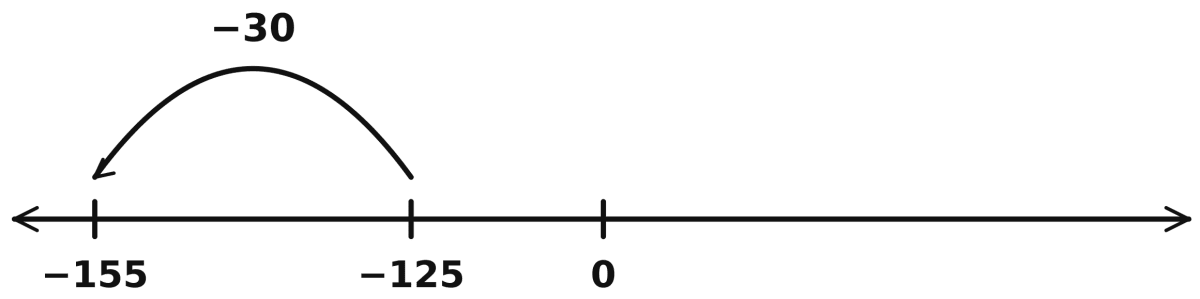
Here the starting number is –125 and the movement is –30, i.e. 30 steps in the backward (left) direction.
Both numbers are negative, so we add them without their signs and place a minus sign before the result.
⇒ –125 + (–30) = –(125 + 30) = –155
∴ –125 + (–30) = –155
(b) +105 – (–55)
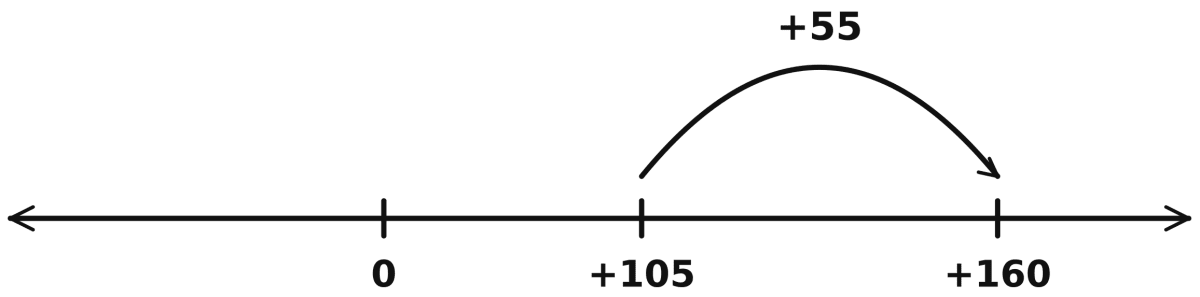
Here the starting number is –55 and the target number is +105.
To go from –55 to +105, we first move +55 to reach 0 and then +105 more.
⇒ Movement needed = (+55) + (+105) = +160
This also shows that subtracting a negative number is the same as adding the corresponding positive number.
⇒ +105 – (–55) = (+105) + (+55) = +160
∴ +105 – (–55) = +160
(c) +80 – (–150)
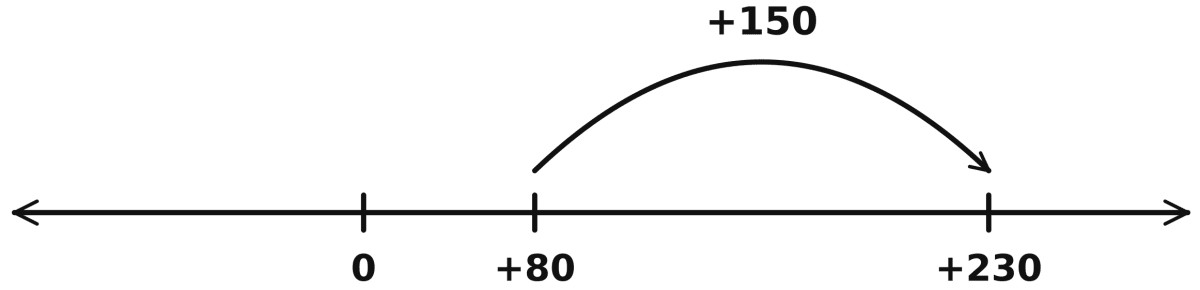
Here the starting number is –150 and the target number is +80.
To go from –150 to +80, we first move +150 to reach 0 and then +80 more.
⇒ +80 – (–150) = (+80) + (+150) = +230
∴ +80 – (–150) = +230
(d) –99 – (–200)
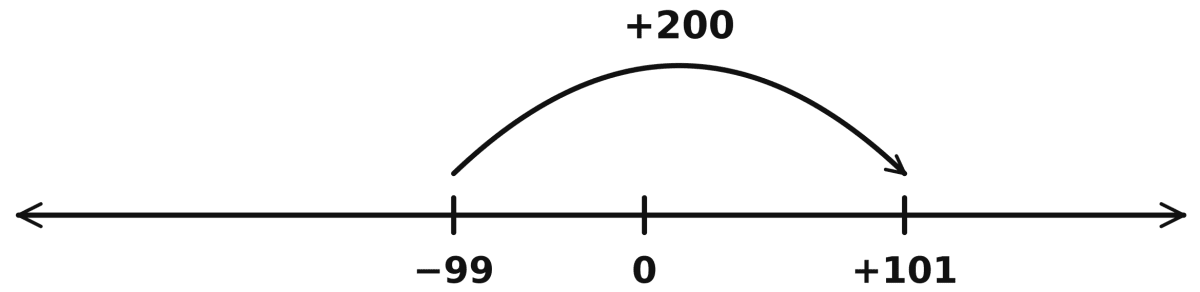
Here the starting number is –200 and the target number is –99.
Both the numbers lie to the left of 0, and –99 lies to the right of –200. So the movement is in the forward direction.
⇒ –99 – (–200) = (–99) + (+200) = 200 – 99 = +101
∴ –99 – (–200) = +101
Complete the additions using tokens.
(a) (+6) + (+4)
(b) (–3) + (–2)
(c) (+5) + (–7)
(d) (–2) + (+6)
Answer
Recall that a positive (green) token and a negative (red) token together form a zero pair, whose value is 0. To add using tokens, we put down the tokens for both numbers, remove all the zero pairs, and read off the tokens that are left.
(a) (+6) + (+4)

We put down 6 positive tokens and 4 more positive tokens. There is no negative token, so there is no zero pair to remove. We are left with 10 positive tokens.
∴ (+6) + (+4) = +10
(b) (–3) + (–2)
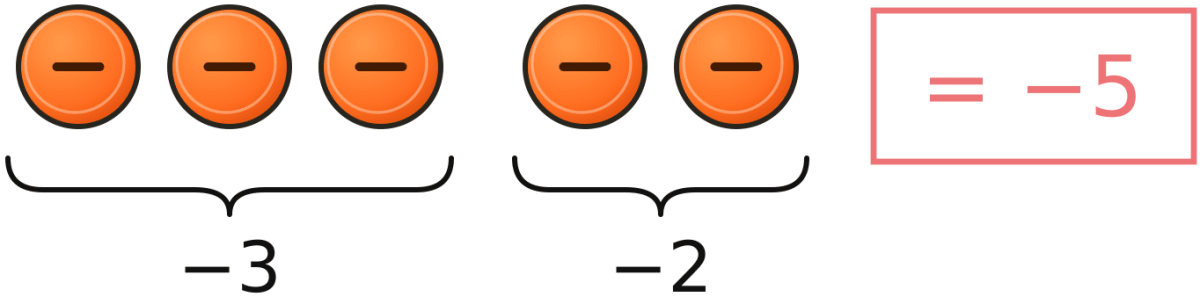
We put down 3 negative tokens and 2 more negative tokens. There is no positive token, so there is no zero pair to remove. We are left with 5 negative tokens.
∴ (–3) + (–2) = –5
(c) (+5) + (–7)
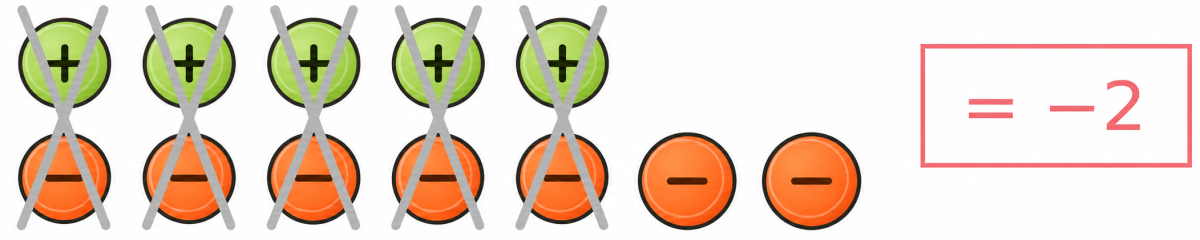
We put down 5 positive tokens and 7 negative tokens. Each positive token pairs with a negative token, so 5 zero pairs can be removed. We are left with 7 – 5 = 2 negative tokens.
∴ (+5) + (–7) = –2
(d) (–2) + (+6)
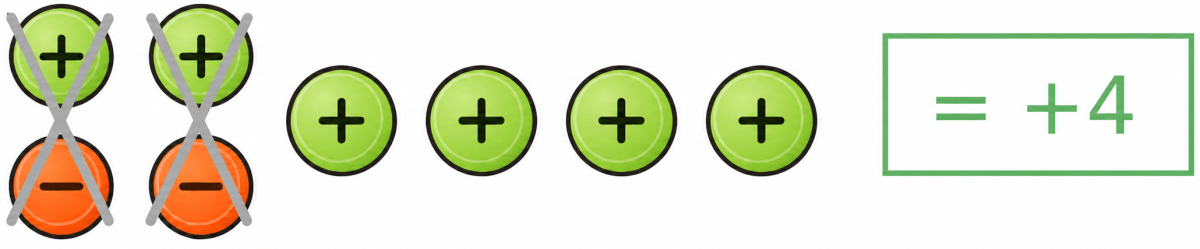
We put down 2 negative tokens and 6 positive tokens. Two zero pairs can be removed. We are left with 6 – 2 = 4 positive tokens.
∴ (–2) + (+6) = +4
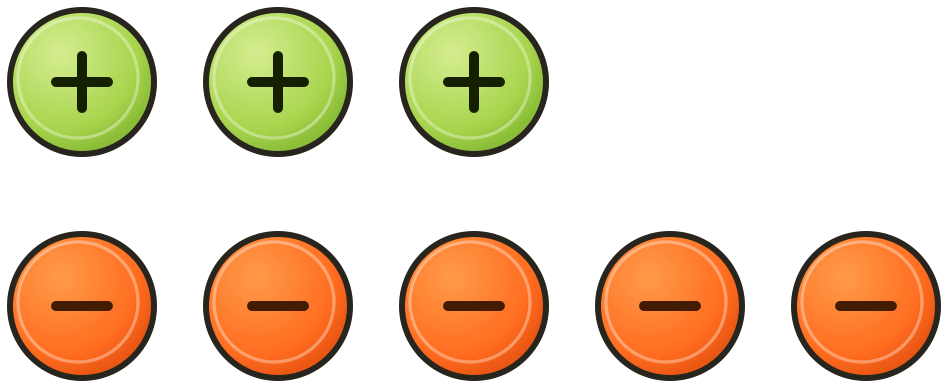
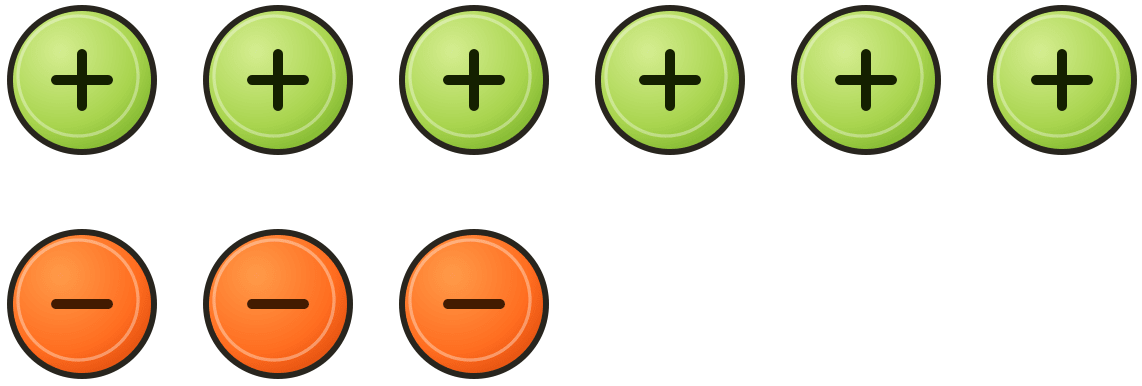
Cancel the zero pairs in the following two sets of tokens. On what floor is the lift attendant in each case? What is the corresponding addition statement in each case?
(a)
(b)
Answer
(a)
The first set has 3 positive tokens and 5 negative tokens.
Pairing each positive token with a negative token, we can cancel 3 zero pairs. The tokens left are 5 – 3 = 2 negative tokens.
⇒ Addition statement: (+3) + (–5) = –2
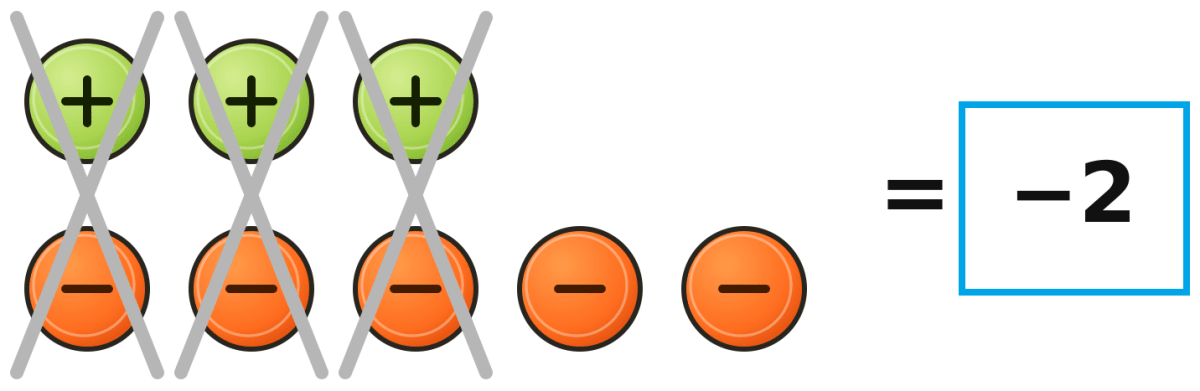
Hence, the lift attendant is on Floor –2 (the Video Games shop), and the addition statement is (+3) + (–5) = –2.
(b)
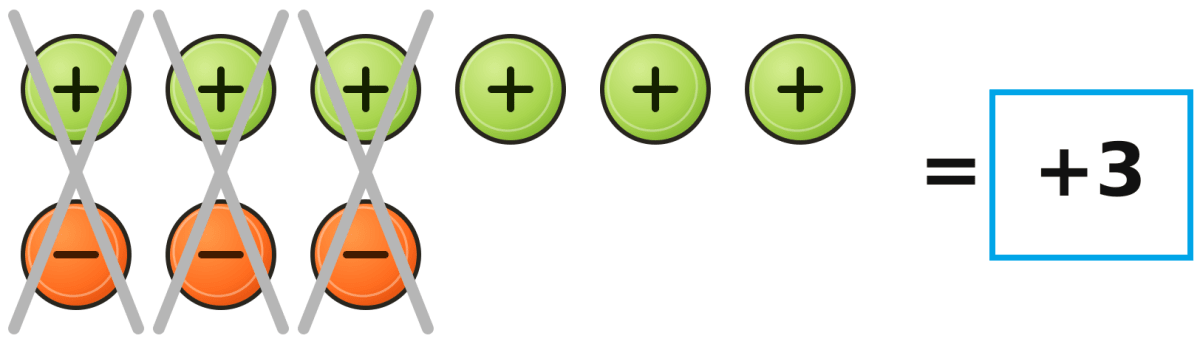
The second set has 6 positive tokens and 3 negative tokens.
Pairing each negative token with a positive token, we can cancel 3 zero pairs. The tokens left are 6 – 3 = 3 positive tokens.
⇒ Addition statement: (+6) + (–3) = +3
Hence, the lift attendant is on Floor +3 (the Book Store), and the addition statement is (+6) + (–3) = +3.
Is (–7) – (–5) the same as (–7)+(+5)?
Answer
Yes, both give the same result.
Using tokens for (–7) – (–5):

We put down 7 negative tokens and then take away 5 negative tokens from them. The tokens left are 7 – 5 = 2 negative tokens.
⇒ (–7) – (–5) = –2
Using tokens for (–7) + (+5):
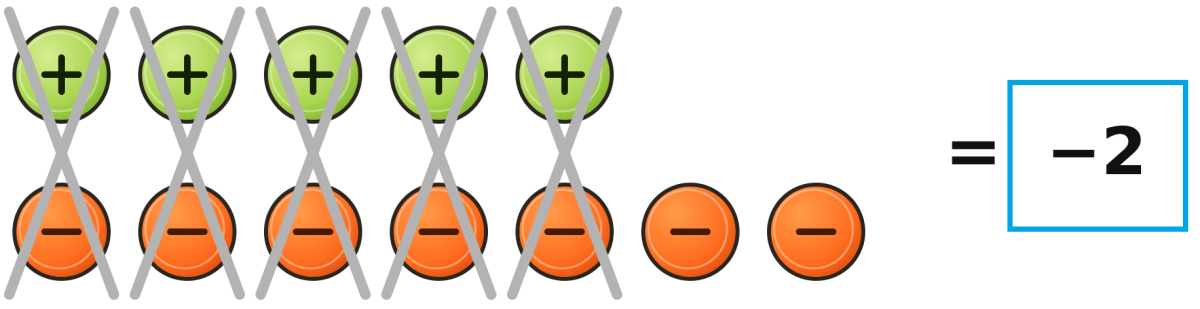
We put down 7 negative tokens and 5 positive tokens. Cancelling the 5 zero pairs, we are left with 7 – 5 = 2 negative tokens.
⇒ (–7) + (+5) = –2
Both the expressions give –2. This illustrates the general rule that subtracting a number is the same as adding its inverse, i.e. subtracting a negative number is the same as adding the corresponding positive number.
Hence, (–7) – (–5) = (–7) + (+5) = –2.
Evaluate the following differences using tokens. Check that you get the same result as with other methods you now know:
(a) (+10) – (+7)
(b) (–8) – (–4)
(c) (–9) – (–4)
(d) (+9) – (+12)
(e) (–5) – (–7)
(f) (–2) – (–6)
Answer
(a) (+10) – (+7)
Put down 10 positive tokens and take away 7 positive tokens. The tokens left are 10 – 7 = 3 positive tokens.

∴ (+10) – (+7) = +3
(b) (–8) – (–4)
Put down 8 negative tokens and take away 4 negative tokens. The tokens left are 8 – 4 = 4 negative tokens.

Checking by converting subtraction into addition: (–8) – (–4) = (–8) + (+4) = –4
∴ (–8) – (–4) = –4
(c) (–9) – (–4)
Put down 9 negative tokens and take away 4 negative tokens. The tokens left are 9 – 4 = 5 negative tokens.

Checking: (–9) – (–4) = (–9) + (+4) = –5
∴ (–9) – (–4) = –5
(d) (+9) – (+12)
Put down 9 positive tokens. We must take away 12 positive tokens, but there are only 9. So we put down 3 zero pairs, which gives 12 positive tokens and 3 negative tokens. Taking away the 12 positive tokens, we are left with 3 negative tokens.
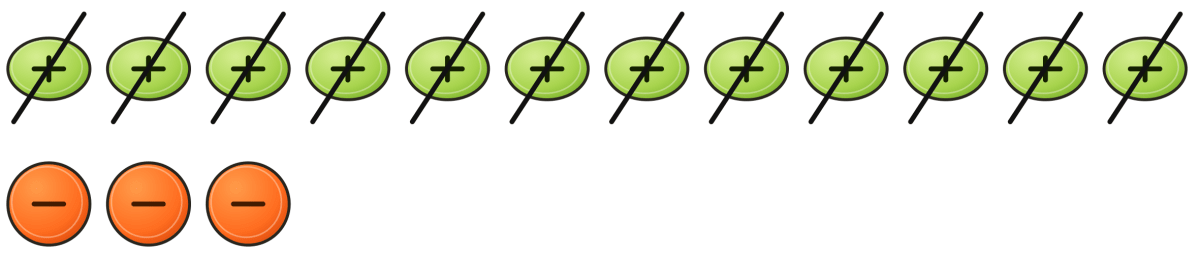
Checking: (+9) – (+12) = (+9) + (–12) = –3
∴ (+9) – (+12) = –3
(e) (–5) – (–7)
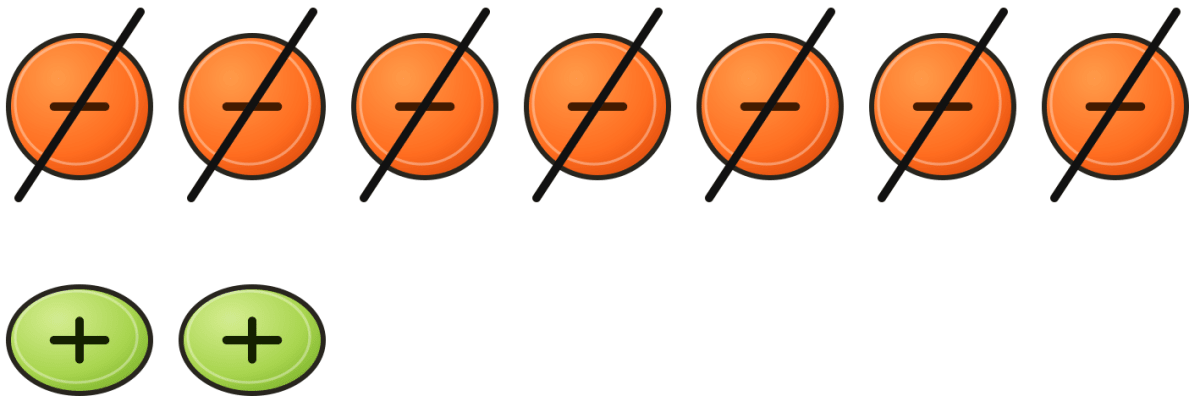
Put down 5 negative tokens. We must take away 7 negative tokens, but there are only 5. So we put down 2 zero pairs, which gives 7 negative tokens and 2 positive tokens. Taking away the 7 negative tokens, we are left with 2 positive tokens.
Checking: (–5) – (–7) = (–5) + (+7) = +2
∴ (–5) – (–7) = +2
(f) (–2) – (–6)
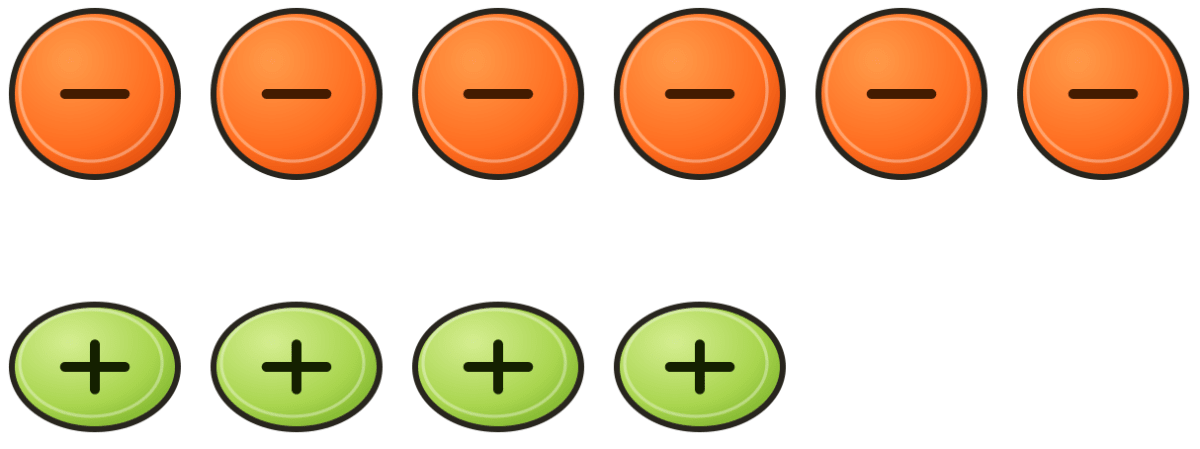
Put down 2 negative tokens. We must take away 6 negative tokens, so we put down 4 zero pairs. This gives 6 negative tokens and 4 positive tokens. Taking away the 6 negative tokens, we are left with 4 positive tokens.
Checking: (–2) – (–6) = (–2) + (+6) = +4
∴ (–2) – (–6) = +4
Complete the subtractions:
(a) (–5) – (–7)
(b) (+10) – (+13)
(c) (–7) – (–9)
(d) (+3) – (+8)
(e) (–2) – (–7)
(f) (+3) – (+15)
Answer
(a) (–5) – (–7)
= (–5) + (+7)
= 7 – 5
= +2
(b) (+10) – (+13)
= (+10) + (–13)
= –(13 – 10)
= –3
(c) (–7) – (–9)
= (–7) + (+9)
= 9 – 7
= +2
(d) (+3) – (+8)
= (+3) + (–8)
= –(8 – 3)
= –5
(e) (–2) – (–7)
= (–2) + (+7)
= 7 – 2
= +5
(f) (+3) – (+15)
= (+3) + (–15)
= –(15 – 3)
= –12
Try to subtract: –3 – (+5).
How many zero pairs will you have to put in? What is the result?
Answer

We put down 3 negative tokens for –3.
Now we have to take away 5 positive tokens, but there is not even one positive token in the set. So we put down zero pairs, which does not change the value of the set.
Since 5 positive tokens are to be taken away, we must put down 5 zero pairs.
The set now has 5 positive tokens and 3 + 5 = 8 negative tokens.
Taking away the 5 positive tokens, we are left with 8 negative tokens.
⇒ –3 – (+5) = (–3) + (–5) = –8
Hence, 5 zero pairs have to be put in, and the result is –8.
Evaluate the following using tokens.
(a) (–3) – (+10)
(b) (+8) – (–7)
(c) (–5) – (+9)
(d) (–9) – (+10)
(e) (+6) – (–4)
(f) (–2) – (+7)
Answer
(a) (–3) – (+10)

Put down 3 negative tokens and 10 zero pairs. Taking away the 10 positive tokens, we are left with 3 + 10 = 13 negative tokens.
⇒ (–3) – (+10) = (–3) + (–10) = –13
(b) (+8) – (–7)

Put down 8 positive tokens and 7 zero pairs. Taking away the 7 negative tokens, we are left with 8 + 7 = 15 positive tokens.
⇒ (+8) – (–7) = (+8) + (+7) = +15
(c) (–5) – (+9)

Put down 5 negative tokens and 9 zero pairs. Taking away the 9 positive tokens, we are left with 5 + 9 = 14 negative tokens.
⇒ (–5) – (+9) = (–5) + (–9) = –14
(d) (–9) – (+10)

Put down 9 negative tokens and 10 zero pairs. Taking away the 10 positive tokens, we are left with 9 + 10 = 19 negative tokens.
⇒ (–9) – (+10) = (–9) + (–10) = –19
(e) (+6) – (–4)

Put down 6 positive tokens and 4 zero pairs. Taking away the 4 negative tokens, we are left with 6 + 4 = 10 positive tokens.
⇒ (+6) – (–4) = (+6) + (+4) = +10
(f) (–2) – (+7)

Put down 2 negative tokens and 7 zero pairs. Taking away the 7 positive tokens, we are left with 2 + 7 = 9 negative tokens.
⇒ (–2) – (+7) = (–2) + (–7) = –9
Suppose you open a bank account at your local bank with the ₹100 that you had been saving over the last month. Your bank balance therefore, starts at ₹100. Then you make ₹60 at your job the next day and you deposit it in your account. This is shown in your bank passbook as a ‘credit’.
(i) Your new bank balance is ..........
(ii) The next day you pay your electric bill of ₹30 using your bank account. This is shown in your bank passbook as a ‘debit’.
Your bank balance is now ..........
(iii) The next day you make a major purchase for your business of ₹150. Again this is shown as a debit.
What is your bank balance now? ..........
(iv) Your strategic large purchase the previous day allows you to make, ₹200 at your business the next day.
What is your balance now? ..........
Answer
A credit is taken as a positive number and a debit is taken as a negative number. The balance at any time is the sum of the opening balance and all the credits and debits till then.
(i) Opening balance = ₹100 and credit = ₹60.
⇒ New balance = (+100) + (+60) = +160
∴ The new bank balance is ₹160.
(ii) Balance = ₹160 and debit = ₹30.
⇒ New balance = (+160) + (–30) = 160 – 30 = +130
∴ The bank balance is now ₹130.
(iii) Balance = ₹130 and debit = ₹150.
⇒ New balance = (+130) + (–150) = –(150 – 130) = –20
∴ The bank balance is now –₹20.
(iv) Balance = –₹20 and credit = ₹200.
⇒ New balance = (–20) + (+200) = 200 – 20 = +180
∴ The balance is now ₹180.
Suppose you start with ₹0 in your bank account, and then you have credits of ₹30, ₹40, and ₹50, and debits of ₹40, ₹50, and ₹60. What is your bank account balance now?
Answer
Credits are written as positive numbers and debits as negative numbers, and the balance is their total.
Balance = 0 + (+30) + (+40) + (+50) + (–40) + (–50) + (–60)
Total of the credits = 30 + 40 + 50 = ₹120
Total of the debits = 40 + 50 + 60 = ₹150
⇒ Balance = (+120) + (–150) = –(150 – 120) = –30
Hence, the bank account balance is –₹30, i.e. the account is overdrawn by ₹30.
Suppose you start with ₹0 in your bank account, and then you have debits of ₹1, 2, 4, 8, 16, 32, 64, and 128, and then a single credit of ₹256. What is your bank account balance now?
Answer
Balance = 0 + (–1) + (–2) + (–4) + (–8) + (–16) + (–32) + (–64) + (–128) + (+256)
Total of the debits = 1 + 2 + 4 + 8 + 16 + 32 + 64 + 128 = ₹255
Credit = ₹256
⇒ Balance = (–255) + (+256) = 256 – 255 = +1
Hence, the bank account balance is ₹1.
Why is it generally better to try and maintain a positive balance in your bank account? What are circumstances under which it may be worthwhile to temporarily have a negative balance?
Answer
Why a positive balance is better:
- A positive balance means the money in the account is your own, and you owe nothing to the bank.
- A negative balance means you have spent more than you had, so you owe that amount to the bank. Banks usually charge extra money on a negative balance in the form of ‘interest’ or a ‘fee’, so you end up paying more than you actually spent.
- A positive balance keeps money ready for sudden or emergency needs, and it also builds a good record with the bank, which helps in getting loans later.
When a temporary negative balance may be worthwhile:
- When an urgent and unavoidable payment has to be made, such as a medical emergency or an urgent repair, and the money will come in shortly afterwards.
- When a purchase will soon earn back more than it costs. For example, in the earlier situation, a purchase of ₹150 took the balance to –₹20, but it made an earning of ₹200 possible the very next day, taking the balance up to ₹180.
- When paying late would cost more than the bank's fee, for example when a delayed payment carries a heavy penalty.
Hence, a positive balance should normally be maintained, and a negative balance is worth having only for a short while when the money to cover it is certain to come in soon.
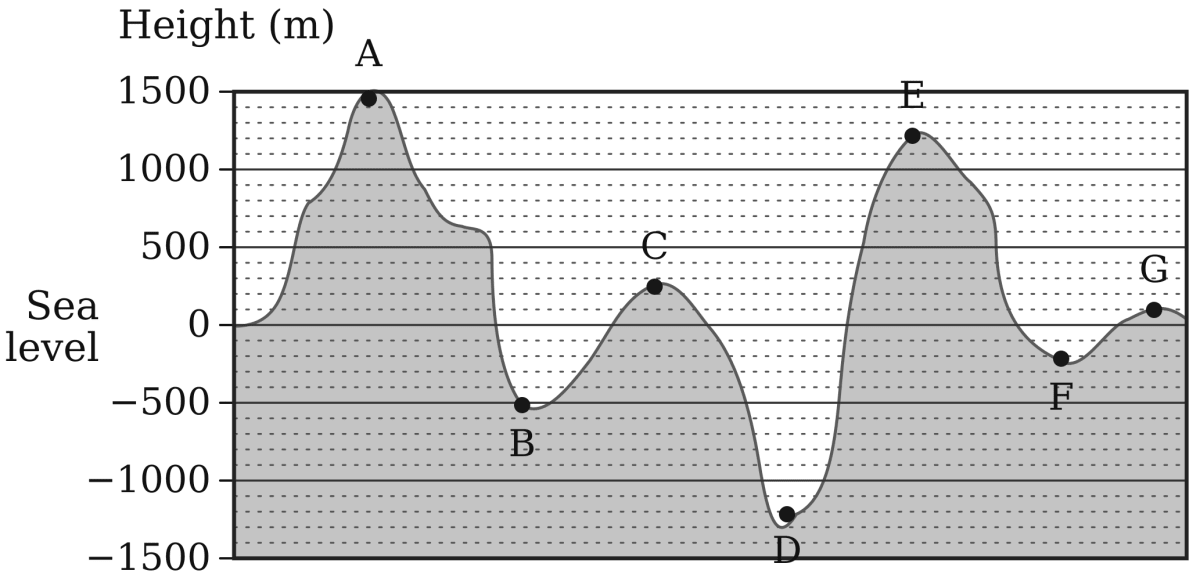
Looking at the geographical cross section, fill in the respective heights:
(a)
(b)
(c)
(d)
(e)
(f)
(g)
Answer
In this cross section, the height at sea level is 0 m. Heights above sea level are written as positive numbers and depths below sea level are written as negative numbers.
The scale on the vertical axis is marked at every 500 m, and the faint dotted lines inside the figure divide each such band into 5 equal parts, so each dotted line stands for 100 m.
Reading the position of each marked point against this scale:
a =
b =
c =
d =
e =
f =
g =
Which is the highest point in this geographical cross section? Which is the lowest point?
Answer
Comparing the seven heights 1500 m, –500 m, 300 m, –1200 m, 1200 m, –200 m and 100 m:
The greatest of these is 1500 m, which is the height of the point A.
The smallest of these is –1200 m, which is the height of the point D.
Hence, A is the highest point (1500 m above sea level) and D is the lowest point (1200 m below sea level).
Can you write the points A, B, …, G in a sequence of decreasing order of heights? Can you write the points in a sequence of increasing order of heights?
Answer
The heights of the seven points are:
A = 1500 m, B = –500 m, C = 300 m, D = –1200 m, E = 1200 m, F = –200 m, G = 100 m
Arranging these integers from the greatest to the smallest, we get
1500 > 1200 > 300 > 100 > –200 > –500 > –1200
∴ The heights in decreasing order are A > E > C > G > F > B > D.
Reversing this arrangement gives the order from the smallest to the greatest:
–1200 < –500 < –200 < 100 < 300 < 1200 < 1500
∴ The heights in increasing order are D < B < F < G < C < E < A.
What is the highest point above sea level on Earth? What is its height?
Answer
The highest point above sea level on Earth is Mount Everest, which lies in the Great Himalayas on the border of Nepal and China.
Its height above the sea level is 8848 m.
What is the lowest point with respect to sea level on land or on the ocean floor? What is its height? (This height should be negative).
Answer
The lowest point on the Earth's surface is the Challenger Deep, a narrow valley at the southern end of the Mariana Trench on the floor of the western Pacific Ocean.
Its depth is -10994 m.
Do you know that there are some places in India where temperatures can go below 0°C? Find out the places in India where temperatures sometimes go below 0°C. What is common among these places? Why does it become colder there and not in other places?
Answer
Places in India where the temperature sometimes goes below 0°C
Some of these places are:
| State / Union Territory | Places |
|---|---|
| Ladakh | Leh, Kargil, Drass, Nubra Valley |
| Jammu and Kashmir | Srinagar, Gulmarg, Pahalgam, Sonamarg |
| Himachal Pradesh | Manali, Keylong, Kalpa, Spiti Valley |
| Uttarakhand | Auli, Badrinath, Kedarnath, Munsiyari |
| Sikkim | Lachen, Lachung, Nathu La |
| Arunachal Pradesh | Tawang, Sela Pass |
What is common among these places
All of them lie in the Himalayan region in the north and north-east of India, and all of them are situated at a great height above sea level. Most of them are more than 2000 m above sea level, and they are also far away from the sea.
Why it becomes colder there
(a) Height above sea level: The air becomes colder as we go higher. On an average, the temperature falls by about 6.5°C for every 1000 m that we climb. So a place 3000 m high is nearly 20°C colder than a place at sea level in the same region.
(b) Thin air: High up, the air is thin and holds very little moisture and dust, so it cannot store the Sun's heat. Whatever heat the ground receives during the day is quickly lost at night.
(c) Snow cover: The white snow and ice on these mountains reflect most of the sunlight back into the sky instead of absorbing it, so the ground does not warm up.
(d) Far from the sea: The sea warms and cools slowly and keeps nearby places mild. These mountain places are far inland, so they miss this moderating effect.
(e) Position in the north: Being in the far north of the country, they receive the Sun's rays more slanting than places in the south, and so receive less heat.
Leh in Ladakh gets very cold during the winter. The following is a table of temperature readings taken during different times of the day and night in Leh on a day in November. Match the temperature with the appropriate time of the day and night.
| Temperature | Time |
|---|---|
| 14°C | 02:00 a.m. |
| 8°C | 11:00 p.m. |
| -2°C | 02:00 p.m. |
| -4°C | 11:00 a.m. |
Answer
Let us first arrange the four temperatures in decreasing order:
14 > 8 > –2 > –4
So 14°C is the warmest reading and –4°C is the coldest reading.
Now let us think about how warm each of the four given times is:
(i) 02:00 p.m. — early afternoon. The Sun has been shining for several hours, so this is the warmest time of the day.
(ii) 11:00 a.m. — late morning. The Sun has risen and the air has begun to warm up, but it is not yet as warm as the afternoon.
(iii) 11:00 p.m. — night. The Sun set long ago and the ground has been losing heat, so the temperature has dropped below 0°C.
(iv) 02:00 a.m. — the middle of the night, close to dawn. The ground has been cooling all night long, so this is the coldest time.
Matching the warmest temperature with the warmest time, and so on down to the coldest, we get:
| Temperature | Time |
|---|---|
| 14°C | 02:00 p.m. |
| 8°C | 11:00 a.m. |
| –2°C | 11:00 p.m. |
| –4°C | 02:00 a.m. |
Grid 1
| 4 | –1 | –3 |
|---|---|---|
| –3 | 1 | |
| –1 | –1 | 2 |
Grid 2
| 5 | –3 | –5 |
|---|---|---|
| 0 | –5 | |
| –8 | –2 | 7 |
Do the calculations for the second grid above and find the border sum.
Answer
In a hollow integer grid, the border sum is the common value of the four sums — the top row, the bottom row, the leftmost column and the rightmost column.
For the second grid, these four sums are:
Top row:
5 + (–3) + (–5)
= 5 - 3 + (–5)
= 2 + (–5)
= –3
Bottom row:
(–8) + (–2) + 7
= -8 - 2 + 7
= (–10) + 7
= –3
Left column:
5 + 0 + (–8)
= 5 + (–8)
= –3
Right column:
(–5) + (–5) + 7
= -5 - 5 + 7
= (–10) + 7
= –3
All four sums come out to be the same number, –3.
Hence, the border sum of the second grid is –3.
Complete the grids to make the required border sum:
| –10 | ||
|---|---|---|
| –5 | ||
| 9 |
Border sum is +4
Answer
Border sum is +4
The left column already has two of its three numbers, so we begin there.
(-10) + + 9 = 4 [left column]
⇒ + (-1) = 4
⇒ = 4 + 1
⇒ = 5 [middle-left cell]
The remaining four cells can be chosen in more than one way. Let us take the top-right cell to be 7. Then
(-10) + + 7 = 4 [top row]
⇒ = 4 + 10 - 7
⇒ = 7 [top-middle cell]
7 + (-5) + = 4 [right column]
⇒ 2 + = 4
⇒ = 4 - 2
⇒ = 2 [bottom-right cell]
9 + + 2 = 4 [bottom row]
⇒ + 11 = 4
⇒ = 4 - 11
⇒ = -7 [bottom-middle cell]
The completed grid is:
| –10 | 7 | 7 |
| 5 | –5 | |
| 9 | –7 | 2 |
Check: top row = (–10) + 7 + 7 = 4; bottom row = 9 + (–7) + 2 = 4; left column = (–10) + 5 + 9 = 4; right column = 7 + (–5) + 2 = 4. ✓
Complete the grids to make the required border sum:
| 6 | 8 | |
|---|---|---|
| –5 | ||
| –2 |
Border sum is –2
Answer
Border sum is –2
Here the top row already has two of its three numbers, so we begin there.
6 + 8 + = -2 [top row]
⇒ 14 + = -2
⇒ = -2 - 14
⇒ = -16 [top-right cell]
(-16) + (-5) + = -2 [right column]
⇒ (-21) + = -2
⇒ = -2 + 21
⇒ = 19 [bottom-right cell]
+ (-2) + 19 = -2 [bottom row]
⇒ + 17 = -2
⇒ = -2 - 17
⇒ = -19 [bottom-left cell]
6 + + (-19) = -2 [left column]
⇒ + (-13) = -2
⇒ = -2 + 13
⇒ = 11 [middle-left cell]
The completed grid is:
| 6 | 8 | –16 |
| 11 | –5 | |
| –19 | –2 | 19 |
Check: top row = 6 + 8 + (–16) = –2; bottom row = (–19) + (–2) + 19 = –2; left column = 6 + 11 + (–19) = –2; right column = (–16) + (–5) + 19 = –2. ✓
Note that in this grid the numbers are forced — there is only one way of completing it.
Complete the grids to make the required border sum:
| 7 | ||
|---|---|---|
| –5 | ||
Border sum is –4
Answer
Border sum is –4
Only two numbers are given here, so this grid can be completed in many different ways. Let us choose the top-right cell to be –6.
7 + + (-6) = -4 [top row]
⇒ + 1 = -4
⇒ = -4 - 1
⇒ = -5 [top-middle cell]
(-6) + (-5) + = -4 [right column]
⇒ (-11) + = -4
⇒ = -4 + 11
⇒ = 7 [bottom-right cell]
Now let us choose the bottom-left cell to be –8.
(-8) + + 7 = -4 [bottom row]
⇒ + (-1) = -4
⇒ = -4 + 1
⇒ = -3 [bottom-middle cell]
7 + + (-8) = -4 [left column]
⇒ + (-1) = -4
⇒ = -4 + 1
⇒ = -3 [middle-left cell]
The completed grid is:
| 7 | –5 | –6 |
| –3 | –5 | |
| –8 | –3 | 7 |
Check: top row = 7 + (–5) + (–6) = –4; bottom row = (–8) + (–3) + 7 = –4; left column = 7 + (–3) + (–8) = –4; right column = (–6) + (–5) + 7 = –4. ✓
Hence, the three grids are completed as shown above, with border sums +4, –2 and –4 respectively.
For the last grid above, find more than one way of filling the numbers to get border sum –4.
| 7 | ||
|---|---|---|
| –5 | ||
Answer
In the last grid, 7 is written in the top-left corner and –5 in the middle of the right column. The centre cell is hollow, so it does not belong to any row or column of the border.
Let the empty border cells be named as shown below.
| 7 | b | c |
| d | –5 | |
| f | g | h |
For the border sum to be –4, the two rows and the two columns of the border must each add up to –4.
7 + b + c = -4
⇒ b + c = -4 - 7
⇒ b + c = -11 [Top row]
7 + d + f = -4
⇒ d + f = -4 - 7
⇒ d + f = -11 [Left column]
c + (-5) + h = -4
⇒ c + h = -4 + 5
⇒ c + h = 1 [Right column]
f + g + h = -4 [Bottom row]
There are 6 empty cells but only 4 conditions. So we may choose any two of the entries freely, and the remaining four are then fixed. Choosing c and f, we get
⇒ b = –11 – c, h = 1 – c, d = –11 – f, g = –4 – f – h
Way 1: Take c = –5 and f = –5. Then b = –6, h = 6, d = –6 and g = –5.
| 7 | –6 | –5 |
| –6 | –5 | |
| –5 | –5 | 6 |
Check: Top row = 7 + (–6) + (–5) = –4; Bottom row = (–5) + (–5) + 6 = –4; Left column = 7 + (–6) + (–5) = –4; Right column = (–5) + (–5) + 6 = –4.
Way 2: Take c = 0 and f = 0. Then b = –11, h = 1, d = –11 and g = –5.
| 7 | –11 | 0 |
| –11 | –5 | |
| 0 | –5 | 1 |
Check: Top row = 7 + (–11) + 0 = –4; Bottom row = 0 + (–5) + 1 = –4; Left column = 7 + (–11) + 0 = –4; Right column = 0 + (–5) + 1 = –4.
Way 3: Take c = 3 and f = 1. Then b = –14, h = –2, d = –12 and g = –3.
| 7 | –14 | 3 |
| –12 | –5 | |
| 1 | –3 | –2 |
Check: Top row = 7 + (–14) + 3 = –4; Bottom row = 1 + (–3) + (–2) = –4; Left column = 7 + (–12) + 1 = –4; Right column = 3 + (–5) + (–2) = –4.
Hence, the last grid can be completed in many different ways, three of which are shown above.
Which other grids can be filled in multiple ways? What could be the reason?
Answer
The first grid (border sum +4) can also be filled in more than one way. The second grid (border sum –2) can be filled in only one way.
The reason:
A border grid has 8 cells on its border, and the border sum gives only 4 conditions — one each for the top row, the bottom row, the left column and the right column. So 4 of the entries can normally be chosen freely. Every number that is already printed in the grid uses up one of these free choices.
First grid (border sum +4): Three numbers are given (–10, –5 and 9), so 5 cells are empty while there are still 4 conditions. This leaves one free choice, and hence many fillings.
| −10 | ||
| −5 | ||
| 9 |
The left column already has two numbers, so the middle-left cell is forced:
–10 + d + 9 = 4 ⇒ d = 5
But the top row has only one number in it, so the top-right corner may be chosen freely. Two different choices are shown below.
| –10 | 9 | 5 |
| 5 | –5 | |
| 9 | –9 | 4 |
| –10 | 14 | 0 |
| 5 | –5 | |
| 9 | –14 | 9 |
Both have border sum +4.
Second grid (border sum –2): Four numbers are given (6, 8, –5 and –2), so only 4 cells are empty and there are 4 conditions. Nothing is left free.
Here the top row itself has two numbers, so the third entry of the top row is forced at once, and then every other cell follows one after another:
6 + 8 + c = -2
⇒ 14 + c = -2
⇒ c = -2 - 14
⇒ c = -16 [Top row]
(-16) + (-5) + h = -2
⇒ -21 + h = -2
⇒ h = -2 + 21
⇒ h = 19 [Right column]
f + (-2) + 19 = -2
⇒ f + 17 = -2
⇒ f = -2 - 17
⇒ f = -19 [Bottom row]
6 + d + (-19) = -2
⇒ d - 13 = -2
⇒ d = -2 + 13
⇒ d = 11 [Left column]
| 6 | 8 | –16 |
| 11 | –5 | |
| –19 | –2 | 19 |
Third grid (border sum –4): Only two numbers are given (7 and –5), leaving 6 empty cells with 4 conditions. Two free choices remain, so it has the greatest number of fillings.
∴ A grid can be filled in many ways whenever the numbers given are too few to force the remaining entries. The moment some row or column has two of its numbers already filled in, the entries begin to get forced one after another, and the puzzle has a single answer.
Try afresh, choose different numbers this time. What sum did you get? Was it different from the first time? Try a few more times!
Answer
We play the game again on the same grid, circling one number and then striking out its row and column each time.
| 3 | 4 | 0 | 9 |
| –2 | –1 | –5 | 4 |
| 1 | 2 | –2 | 7 |
| –7 | –6 | –10 | –1 |
Because a row and a column are struck out every time, we always end up circling exactly one number from each row and exactly one number from each column.
First try: circled numbers 3, –5, 7 and –6.
3 + (–5) + 7 + (–6) = –2 + 7 + (–6) = 5 + (–6) = –1
Second try: circled numbers 0, 4, 2 and –7.
0 + 4 + 2 + (–7) = 6 + (–7) = –1
Third try: circled numbers 9, –2, 2 and –10.
9 + (–2) + 2 + (–10) = 7 + 2 + (–10) = 9 + (–10) = –1
Every time we get the same answer, –1, which is the same as the sum obtained in the worked example.
Hence, the sum is always –1, no matter which numbers are circled.
Play the same game with the grids below. What answer did you get?
| 7 | 10 | 13 | 16 |
| –2 | 1 | 4 | 7 |
| –11 | –8 | –5 | –2 |
| –20 | –7 | –14 | –11 |
| –11 | –10 | –9 | –8 |
| –7 | –6 | –5 | –4 |
| –3 | –2 | –1 | 0 |
| 1 | 2 | 3 | 4 |
Answer
First grid: Here every row goes up in steps of 3, and every column goes down in steps of 9. The entry in the fourth row, second column should therefore be –17.
| 7 | 10 | 13 | 16 |
| –2 | 1 | 4 | 7 |
| –11 | –8 | –5 | –2 |
| –20 | –17 | –14 | –11 |
First try: circled numbers 7, 1, –5 and –11.
7 + 1 + (–5) + (–11) = 8 + (–5) + (–11) = 3 + (–11) = –8
Second try: circled numbers 16, 4, –8 and –20.
16 + 4 + (–8) + (–20) = 20 + (–8) + (–20) = 12 + (–20) = –8
Second grid:
First try: circled numbers –11, –6, –1 and 4.
(–11) + (–6) + (–1) + 4 = (–17) + (–1) + 4 = (–18) + 4 = –14
Second try: circled numbers –8, –5, –2 and 1.
(–8) + (–5) + (–2) + 1 = (–13) + (–2) + 1 = (–15) + 1 = –14
Hence, the first grid always gives the answer –8 and the second grid always gives the answer –14.
What could be so special about these grids? Is the magic in the numbers or the way they are arranged or both? Can you make more such grids?
Answer
The magic lies in the way the numbers are arranged, and not in the numbers themselves.
In each of these grids, a number is attached to every row and a number is attached to every column, and each cell simply holds the sum of its own row number and its own column number.
For the grid in the example:
| 0 | 1 | –3 | 6 | |
| 3 | 3 | 4 | 0 | 9 |
| –2 | –2 | –1 | –5 | 4 |
| 1 | 1 | 2 | –2 | 7 |
| –7 | –7 | –6 | –10 | –1 |
The numbers outside the grid are the row numbers and the column numbers; for example, the cell in the second row and fourth column holds (–2) + 6 = 4.
Now, the rule of the game strikes out a row and a column every time a number is circled. So the four circled numbers come from four different rows and four different columns. This means each row number is used exactly once and each column number is used exactly once, and hence
Sum of circled numbers = (Sum of all row numbers) + (Sum of all column numbers)
This value does not depend at all on which numbers were circled, so the answer is always the same.
For the three grids:
| Grid | Row numbers | Column numbers | Always gives |
| Example grid | 3, –2, 1, –7 (sum = –5) | 0, 1, –3, 6 (sum = 4) | (–5) + 4 = –1 |
| First grid | 7, –2, –11, –20 (sum = –26) | 0, 3, 6, 9 (sum = 18) | (–26) + 18 = –8 |
| Second grid | –11, –7, –3, 1 (sum = –20) | 0, 1, 2, 3 (sum = 6) | (–20) + 6 = –14 |
Yes, more such grids can be made. Pick any four numbers for the rows and any four numbers for the columns, and write in each cell the sum of its row number and its column number.
For example, taking the row numbers 2, –1, 5, 0 and the column numbers –4, 3, 1, –2:
| –4 | 3 | 1 | –2 | |
| 2 | –2 | 5 | 3 | 0 |
| –1 | –5 | 2 | 0 | –3 |
| 5 | 1 | 8 | 6 | 3 |
| 0 | –4 | 3 | 1 | –2 |
Playing the game on this grid always gives 2 + (–1) + 5 + 0 + (–4) + 3 + 1 + (–2) = 6 + (–2) = 4.
∴ The magic is in the arrangement — each entry being a row number plus a column number — and such grids can be made as often as we please.
Write all the integers between the given pairs, in increasing order.
(a) 0 and –7
(b) –4 and 4
(c) –8 and –15
(d) –30 and –23
Answer
The integers lying strictly between the two given numbers, written from the smallest to the greatest, are:
(a) Between 0 and –7:
–6, –5, –4, –3, –2, –1
(b) Between –4 and 4:
–3, –2, –1, 0, 1, 2, 3
(c) Between –8 and –15:
–14, –13, –12, –11, –10, –9
(d) Between –30 and –23:
–29, –28, –27, –26, –25, –24
Give three numbers such that their sum is –8.
Answer
We have to pick three integers that add up to –8.
Taking –3, –4 and –1:
(–3) + (–4) + (–1) = (–7) + (–1) = –8
Hence, –3, –4 and –1 are three numbers whose sum is –8.
Some other sets of three numbers with the same sum are:
| (–10) + 5 + (–3) | = –8 |
| 2 + (–6) + (–4) | = –8 |
| 0 + (–8) + 0 | = –8 |
| 12 + (–15) + (–5) | = –8 |
There are two dice whose faces have these numbers: –1, 2, –3, 4, –5, 6. The smallest possible sum upon rolling these dice is –10 = (–5) + (–5) and the largest possible sum is 12 = (6)+(6). Some numbers between (–10) and (+12) are not possible to get by adding numbers on these two dice. Find those numbers.
Answer
Let us make a table of every possible sum. The first die gives the number at the start of a row and the second die gives the number at the top of a column.
| + | –1 | 2 | –3 | 4 | –5 | 6 |
| –1 | –2 | 1 | –4 | 3 | –6 | 5 |
| 2 | 1 | 4 | –1 | 6 | –3 | 8 |
| –3 | –4 | –1 | –6 | 1 | –8 | 3 |
| 4 | 3 | 6 | 1 | 8 | –1 | 10 |
| –5 | –6 | –3 | –8 | –1 | –10 | 1 |
| 6 | 5 | 8 | 3 | 10 | 1 | 12 |
Collecting the different sums that appear in the table, the sums that can be obtained are:
–10, –8, –6, –4, –3, –2, –1, 1, 3, 4, 5, 6, 8, 10, 12
Now we list all the integers from –10 to 12 and remove the ones above. The ones left over are the sums that cannot be obtained.
| Possible | –10, –8, –6, –4, –3, –2, –1, 1, 3, 4, 5, 6, 8, 10, 12 |
| Not possible | –9, –7, –5, 0, 2, 7, 9, 11 |
Hence, the numbers between (–10) and (+12) that cannot be obtained are –9, –7, –5, 0, 2, 7, 9 and 11.
Solve these:
| 8 – 13 | (–8) – (13) | (–13) – (–8) | (–13) + (–8) |
| 8 + (–13) | (–8) – (–13) | (13) – 8 | 13 – (–8) |
Answer
(i) 8 – 13
Here a larger positive is subtracted from a smaller positive, so the result is negative.
8 – 13 = –(13 – 8) = –5
(ii) (–8) – (13)
Subtracting 13 means moving 13 steps further to the left of –8.
(–8) – (13) = (–8) + (–13) = –(8 + 13) = –21
(iii) (–13) – (–8)
Subtracting a negative number is the same as adding the corresponding positive number.
(–13) – (–8) = (–13) + 8 = –(13 – 8) = –5
(iv) (–13) + (–8)
The sum of two negatives is negative; we add the numbers without their signs and put a minus sign.
(–13) + (–8) = –(13 + 8) = –21
(v) 8 + (–13)
One number is positive and the other negative, so we subtract and keep the sign of the greater number (13).
8 + (–13) = –(13 – 8) = –5
(vi) (–8) – (–13)
(–8) – (–13) = (–8) + 13 = 13 – 8 = 5
(vii) (13) – 8
Here a smaller positive is subtracted from a larger positive, so the result is positive.
(13) – 8 = 5
(viii) 13 – (–8)
13 – (–8) = 13 + 8 = 21
The answers may be arranged in the same pattern as the question:
| –5 | –21 | –5 | -21 |
| –5 | 5 | 5 | 21 |
Find the years below.
(a) From the present year, which year was it 150 years ago? ..........
(b) From the present year, which year was it 2200 years ago? ..........
Hint: Recall that there was no year 0.
(c) What will be the year 320 years after 680 BCE? ..........
Answer
Years of the CE era are counted as positive numbers and years of the BCE era as negative numbers, with one important difference from the number line: there is no year 0. The year 1 BCE is immediately followed by the year 1 CE.
(a) Taking the present year as 2026 CE, we move 150 years backward:
⇒ Required year = 2026 – 150 = 1876
Since 150 is much smaller than 2026, we stay within the CE era.
Hence, 150 years ago it was the year 1876 CE.
(b) Here 2200 is greater than 2026, so moving back 2200 years takes us across 1 CE into the BCE era.
Because there is no year 0, the number of years from a year Y BCE up to a year X CE is X + Y – 1.
Let the required year be Y BCE. Then
⇒ 2026 + Y – 1 = 2200
⇒ Y = 2200 – 2025
⇒ Y = 175
Check: Going back 2025 years from 2026 CE lands on 1 CE; the remaining 2200 – 2025 = 175 years take us to 175 BCE.
Hence, 2200 years ago it was the year 175 BCE.
(c) As time moves forward through the BCE era, the year numbers get smaller (700 BCE comes before 680 BCE). So 320 years after 680 BCE we must subtract:
⇒ Required year = 680 – 320 = 360
Since 320 < 680, we have not yet crossed over into the CE era, so the year is still a BCE year.
∴ 320 years after 680 BCE it will be the year 360 BCE.
Complete the following sequences:
(a) (–40), (–34), (–28), (–22), .........., .........., ..........
(b) 3, 4, 2, 5, 1, 6, 0, 7, .........., .........., ..........
(c) .........., .........., 12, 6, 1, (–3), (–6), .........., .........., ..........
Answer
(a) Let us find the difference between consecutive terms:
⇒ (–34) – (–40) = (–34) + 40 = 6
⇒ (–28) – (–34) = (–28) + 34 = 6
⇒ (–22) – (–28) = (–22) + 28 = 6
The difference is the same each time, so this is a sequence with a constant jump of +6. We keep adding 6:
⇒ (–22) + 6 = –16
⇒ (–16) + 6 = –10
⇒ (–10) + 6 = –4
Hence, the sequence is (–40), (–34), (–28), (–22), (–16), (–10), (–4).
(b) The differences here are not constant, so let us look at alternate terms instead.
| Position | 1 | 2 | 3 | 4 | 5 | 6 | 7 | 8 | 9 | 10 | 11 |
|---|---|---|---|---|---|---|---|---|---|---|---|
| Term | 3 | 4 | 2 | 5 | 1 | 6 | 0 | 7 | ? | ? | ? |
Terms in the odd positions are 3, 2, 1, 0, ... , which decrease by 1 each time.
Terms in the even positions are 4, 5, 6, 7, ... , which increase by 1 each time.
Continuing both patterns:
⇒ 9th term (odd position) = 0 – 1 = –1
⇒ 10th term (even position) = 7 + 1 = 8
⇒ 11th term (odd position) = (–1) – 1 = –2
Hence, the sequence is 3, 4, 2, 5, 1, 6, 0, 7, (–1), 8, (–2).
(c) Let us find the differences between the terms that are given:
⇒ 6 – 12 = –6
⇒ 1 – 6 = –5
⇒ (–3) – 1 = –4
⇒ (–6) – (–3) = –3
So the differences themselves form the pattern –6, –5, –4, –3, ... , increasing by 1 each time.
Going backward, the differences before –6 must be –7 and –8. To move backward we subtract the difference:
⇒ Term before 12 = 12 – (–7) = 12 + 7 = 19
⇒ Term before 19 = 19 – (–8) = 19 + 8 = 27
Going forward, the differences after –3 are –2, –1 and 0:
⇒ (–6) + (–2) = –8
⇒ (–8) + (–1) = –9
⇒ (–9) + 0 = –9
| Term | 27 | 19 | 12 | 6 | 1 | –3 | –6 | –8 | –9 | –9 |
|---|---|---|---|---|---|---|---|---|---|---|
| Difference | –8 | –7 | –6 | –5 | –4 | –3 | –2 | –1 | 0 |
Hence, the sequence is 27, 19, 12, 6, 1, (–3), (–6), (–8), (–9), (–9).
Here are six integer cards: (+1), (+7), (+18), (–5), (–2), (–9).
You can pick any of these and make an expression using addition(s) and subtraction(s).
Here is an expression: (+18)+(+1)–(+7)–(–2) which gives a value (+14). Now, pick cards and make an expression such that its value is closer to (–30).
Answer
To reach a value near (–30) we need the negative contributions to be large. There are two ways a card can contribute a negative amount:
Adding a negative card, e.g. + (–9) contributes –9.
Subtracting a positive card, e.g. – (+18) contributes –18.
The largest positive card is (+18), so subtracting it is the most useful single move. Let us pick the cards (–2), (–9), (+18) and (+1):
⇒ (–2) + (–9) – (+18) – (+1)
Converting each subtraction into the addition of the inverse:
⇒ (–2) + (–9) + (–18) + (–1)
All four numbers are negative, so by Brahmagupta’s rule we add them without the signs and put a minus sign:
⇒ –(2 + 9 + 18 + 1)
⇒ –30
Hence, the expression (–2) + (–9) – (+18) – (+1) has value exactly (–30).
The sum of two positive integers is always positive but a (positive integer) – (positive integer) can be positive or negative. What about
(a) (positive) – (negative)
(b) (positive) + (negative)
(c) (negative) + (negative)
(d) (negative) – (negative)
(e) (negative) – (positive)
(f) (negative) + (positive)
Answer
The key idea is to convert every subtraction into an addition by replacing the number being subtracted with its inverse. After that, only two situations remain: both numbers have the same sign (the answer is forced), or the numbers have opposite signs (the answer depends on which one is bigger).
(a) (positive) – (negative)
⇒ (positive) – (negative) = (positive) + (positive)
Adding two positives always gives a positive.
Hence, (positive) – (negative) is always positive.
(b) (positive) + (negative)
Here the two numbers pull in opposite directions, so we subtract the smaller from the greater and keep the sign of the greater.
Hence, (positive) + (negative) can be positive, negative or zero.
(c) (negative) + (negative)
Both movements are downward, so the result is further down.
Hence, (negative) + (negative) is always negative.
(d) (negative) – (negative)
⇒ (negative) – (negative) = (negative) + (positive)
This is again a case of opposite signs.
Hence, (negative) – (negative) can be positive, negative or zero.
(e) (negative) – (positive)
⇒ (negative) – (positive) = (negative) + (negative)
Both parts are negative, so the result is negative.
Hence, (negative) – (positive) is always negative.
(f) (negative) + (positive)
Once more the signs are opposite.
Hence, (negative) + (positive) can be positive, negative or zero.
This string has a total of 100 tokens arranged in a particular pattern. What is the value of the string?

Answer
Reading the string from the left, the tokens repeat in a fixed block:
3 green (positive) tokens followed by 2 red (negative) tokens
so each repeating block contains 3 + 2 = 5 tokens.
Number of blocks in the string:
⇒ Number of blocks = 100 ÷ 5 = 20
Method 1 — value of one block
In one block, 2 of the 3 positive tokens pair off with the 2 negative tokens to form 2 zero pairs, leaving 1 positive token.
⇒ Value of one block = (+3) + (–2) = +1
⇒ Value of the string = 20 × (+1) = +20
Method 2 — counting all the tokens
⇒ Number of positive tokens = 20 × 3 = 60
⇒ Number of negative tokens = 20 × 2 = 40
The 40 negative tokens cancel 40 of the positive tokens, forming 40 zero pairs.
⇒ Value of the string = (+60) + (–40) = 60 – 40 = +20
∴ The value of the string is +20.
Can you explain each of Brahmagupta’s rules in terms of Bela’s Building of Fun, or in terms of a number line?
Answer
In the Building of Fun the ground floor is Floor 0, floors above it are positive and floors below it are negative. The two ideas we need are:
⇒ Starting Floor + Movement = Target Floor [for addition]
⇒ Target Floor – Starting Floor = Movement needed [for subtraction]
On the number line, 0 is the starting point, moving right is positive and moving left is negative.
Brahmagupta’s Rules for Addition
| Rule | In Bela’s Building of Fun / on the number line |
|---|---|
| 1. The sum of two positives is positive. e.g. 2 + 3 = 5 | Start at Floor +2 (Art Centre) and press +3. You rise 3 more floors and reach Floor +5. You began above the ground floor and moved further up, so you must finish above the ground floor. On the number line: start at 2 and take 3 steps to the right, landing on 5, which is to the right of 0. |
| 2. The sum of two negatives is negative; add the numbers without the signs and put a minus sign. e.g. (–2) + (–3) = –5 | Start at Floor –2 and press –3. You go 3 floors further down and reach Floor –5. Both movements are downward, so the depths add up: 2 + 3 = 5 floors below the ground. On the number line: from –2 take 3 steps to the left, landing on –5. |
| 3. To add a positive and a negative, subtract the smaller number (without the sign) from the greater number (without the sign) and keep the sign of the greater. e.g. (–5) + 3 = –2, 2 + (–3) = –1, (–3) + 5 = 2 | The two movements are in opposite directions, so they partly cancel and only the excess is left. (–5) + 3: from Floor –5 press +3. You were 5 floors below the ground and rose only 3, so you are still 5 – 3 = 2 floors below, at Floor –2. 2 + (–3): from Floor +2 press –3. You were only 2 floors up but went down 3, so you finish 3 – 2 = 1 floor below, at Floor –1. (–3) + 5: from Floor –3 press +5. Going up 3 brings you to Floor 0 and 2 more take you to Floor +2. |
| 4. The sum of a number and its inverse is zero. e.g. 2 + (–2) = 0 | From Floor +2 press –2 and you come back to the Welcome Hall, Floor 0. The two movements are equal in size but opposite in direction, so they cancel exactly. On the number line: from 2 take 2 steps to the left and you are back at 0. |
| 5. The sum of any number and zero is the same number. e.g. (–2) + 0 = –2 and 0 + 0 = 0 | Standing on Floor –2, a movement of 0 means pressing no button at all, so you stay on Floor –2. On the number line: standing at –2 and taking no step leaves you at –2. |
Brahmagupta’s Rules for Subtraction
Here we use Target Floor – Starting Floor = Movement needed, so the answer tells us which button to press.
| Rule | In Bela’s Building of Fun / on the number line |
|---|---|
| 1. A smaller positive subtracted from a larger positive gives a positive. e.g. 3 – 2 = 1 | Target Floor is +3 (Book Store) and Starting Floor is +2 (Art Centre). The target is higher than the start, so you must go up 1 floor, i.e. press +1. On the number line: to get from 2 to 3 you move 1 step to the right. |
| 2. A larger positive subtracted from a smaller positive gives a negative. e.g. 2 – 3 = –1 | Target Floor is +2 and Starting Floor is +3. Now the target is lower than the start, so you must go down 1 floor, i.e. press –1. On the number line: to get from 3 to 2 you move 1 step to the left. |
| 3. Subtracting a negative number is the same as adding the corresponding positive number. e.g. 2 – (–3) = 2 + 3 = 5 | Target Floor is +2 and Starting Floor is –3. Break the journey: pressing +3 lifts you from Floor –3 to Floor 0, and 2 more presses take you to Floor +2. Altogether you press +5. So removing a debt of 3 improves your position by exactly the same amount as receiving a credit of 3. |
| 4. Subtracting a number from itself gives zero. e.g. 2 – 2 = 0 and (–2) – (–2) = 0 | The Target Floor and the Starting Floor are the same floor, so you are already where you want to be and no button need be pressed. The movement is 0. On the number line: the distance from a point to itself is 0. |
| 5. Subtracting zero from a number gives the same number; subtracting a number from zero gives its inverse. e.g. (–2) – 0 = –2 and 0 – (–2) = 2 | (–2) – 0: Target Floor –2, Starting Floor 0. From the Welcome Hall you must go down 2 floors, i.e. press –2. 0 – (–2): Target Floor 0, Starting Floor –2. From 2 floors below the ground you must come up 2 floors to reach the Welcome Hall, i.e. press +2 — exactly the inverse of –2. |
Hence, every one of Brahmagupta’s rules is simply a statement about starting on some floor, moving up or down, and noting where you land — or equivalently, about moving right or left along the number line.
Give your own examples of each rule.
Answer
Examples for the Rules of Addition
| Rule | Example | Working |
|---|---|---|
| 1. Positive + positive is positive | 15 + 24 | 15 + 24 = 39 |
| 2. Negative + negative is negative | (–11) + (–7) | 11 + 7 = 18, then place the minus sign ⇒ –18 |
| 3. Positive + negative: subtract without signs, keep the sign of the greater | (–13) + 6 9 + (–4) (–8) + 20 | 13 – 6 = 7, greater is 13 (negative) ⇒ –7 9 – 4 = 5, greater is 9 (positive) ⇒ 5 20 – 8 = 12, greater is 20 (positive) ⇒ 12 |
| 4. A number + its inverse is zero | 17 + (–17) (–43) + 43 | 17 + (–17) = 0 (–43) + 43 = 0 |
| 5. A number + zero is the same number | (–23) + 0 0 + 0 | (–23) + 0 = –23 0 + 0 = 0 |
Examples for the Rules of Subtraction
| Rule | Example | Working |
|---|---|---|
| 1. Smaller positive from larger positive is positive | 19 – 12 | 19 – 12 = 7 |
| 2. Larger positive from smaller positive is negative | 12 – 19 | 12 – 19 = –7 |
| 3. Subtracting a negative is the same as adding the positive | 14 – (–6) | 14 – (–6) = 14 + 6 = 20 |
| 4. A number subtracted from itself is zero | 25 – 25 (–16) – (–16) | 25 – 25 = 0 (–16) – (–16) = (–16) + 16 = 0 |
| 5. Subtracting zero keeps the number; subtracting a number from zero gives its inverse | (–31) – 0 0 – (–9) 0 – 12 | (–31) – 0 = –31 0 – (–9) = 0 + 9 = 9 0 – 12 = –12 |
Hence, each of Brahmagupta’s ten rules has been illustrated with worked examples of our own.