
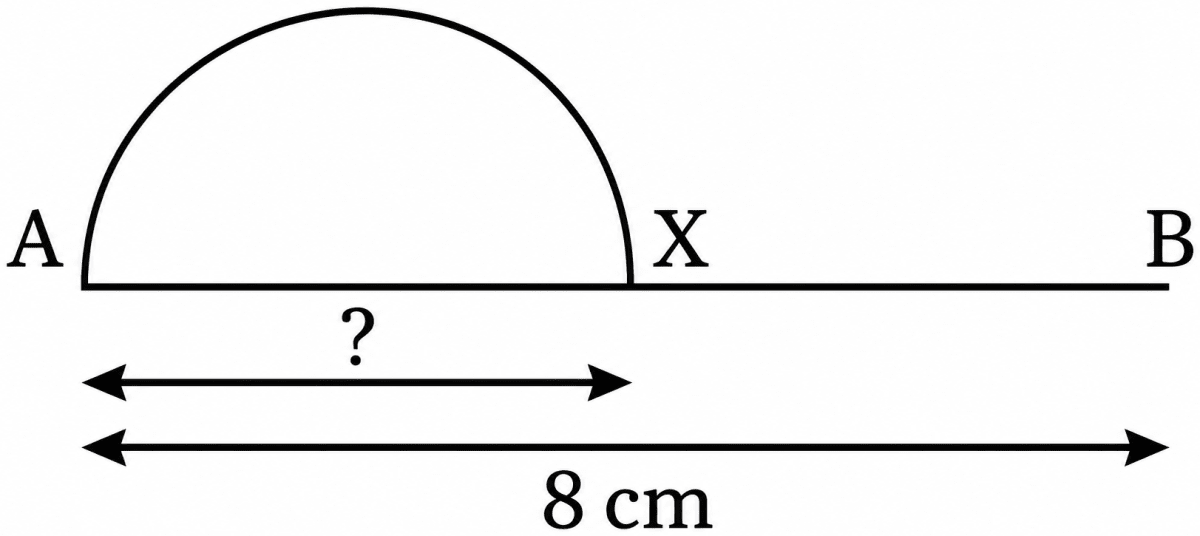
What radius should be taken in the compass to get this half circle? What should be the length of AX?
Answer
Here the central line is AB and AB = 8 cm.
The 'Wavy Wave' is made up of two identical waves — the first wave is a half circle drawn above AB and the second wave is an equal half circle drawn below AB.
Since the two waves are identical, the point X must divide AB into two equal parts.
⇒ AX = XB
⇒ AX = AB
= cm
= 4 cm
The first wave is a half circle drawn on AX, so AX is the diameter of that half circle.
⇒ Diameter = AX = 4 cm
⇒ Radius = cm = 2 cm
The tip of the compass is to be placed at the midpoint of AX, and the pencil is to be swung from A to X to get the half circle.
∴ A radius of 2 cm should be taken in the compass, and AX = 4 cm.
Take a central line of a different length and try to draw the wave on it.
Answer
Let us take the central line PQ = 10 cm.
As the two waves are identical, the midpoint R of PQ divides it into two equal parts.
⇒ PR = RQ = cm = 5 cm
Each wave is a half circle drawn on a diameter of 5 cm.
⇒ Radius = cm = cm = 2.5 cm
Steps of construction:
- Draw a line segment PQ = 10 cm using a ruler.
- Mark the point R on PQ such that PR = 5 cm. Then RQ = 5 cm as well.
- Mark the midpoint M1 of PR, so that PM1 = M1R = 2.5 cm.
- With M1 as centre and radius 2.5 cm, draw a half circle from P to R lying above PQ.
- Mark the midpoint M2 of RQ, so that RM2 = M2Q = 2.5 cm.
- With M2 as centre and the same radius 2.5 cm, draw a half circle from R to Q lying below PQ.
Both half circles are drawn with the same radius, so the two waves are identical.
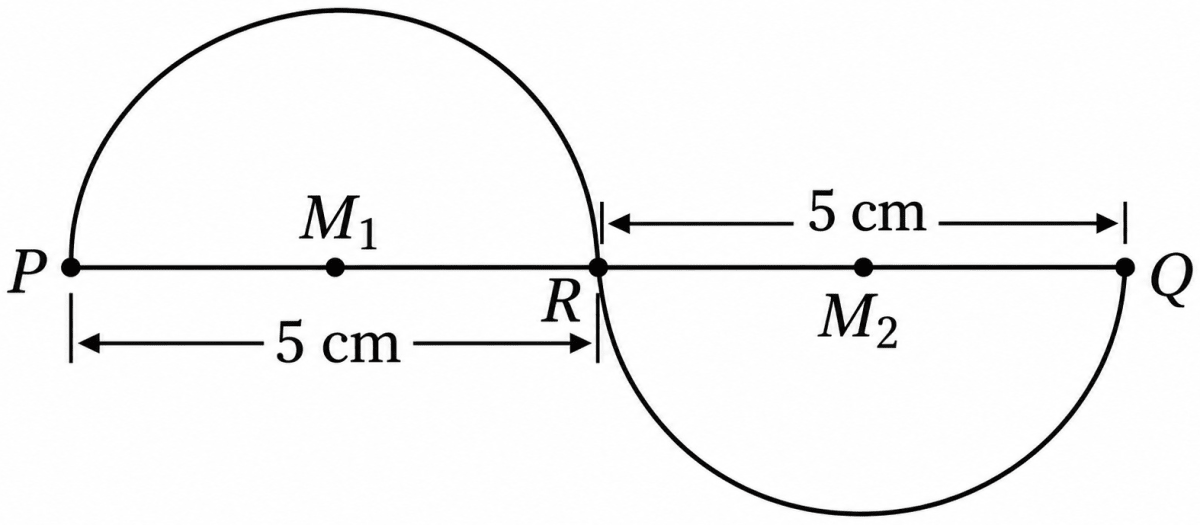
Hence, the wave is obtained on the central line PQ = 10 cm with a compass radius of 2.5 cm.
Try to recreate the figure where the waves are smaller than a half circle (as appearing in the neck of the figure, ‘A Person’). The challenge here is to get both the waves to be identical. This may be tricky!
Answer
If the wave is to be smaller than a half circle, the two ends of the wave must not be the ends of a diameter.
For an arc on the chord AX to be smaller than a half circle, the radius must be more than half of AX, and the centre of the arc must lie on the side of AX opposite to the arc.
Let us take AB = 8 cm with X as its midpoint, so AX = XB = 4 cm.
Here AX cm = 2 cm, so let us choose a radius of 3 cm (any length more than 2 cm will do).
Steps of construction:
- Draw a line segment AB = 8 cm and mark its midpoint X, so that AX = XB = 4 cm.
- Take a radius of 3 cm in the compass. Keep this radius unchanged throughout the construction.
- With A as centre, draw an arc below AB.
- With X as centre and the same radius 3 cm, draw another arc cutting the previous arc at O1.
- With O1 as centre and radius 3 cm, draw the arc joining A and X. This arc lies above AB and is smaller than a half circle.
- With X as centre, draw an arc above AB.
- With B as centre and the same radius 3 cm, draw another arc cutting the previous arc at O2.
- With O2 as centre and radius 3 cm, draw the arc joining X and B. This arc lies below AB and is smaller than a half circle.
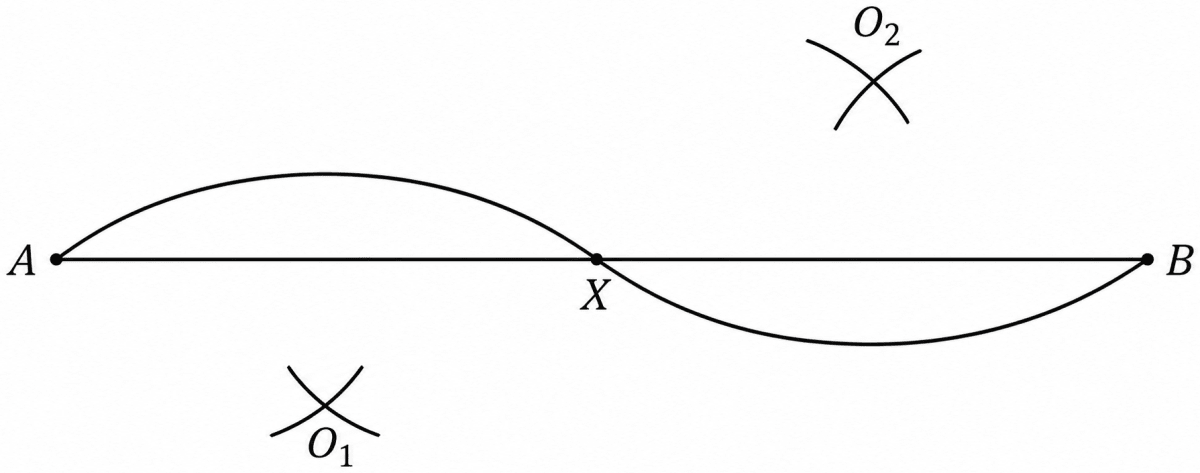
Why both the waves are identical:
O1 is at a distance of 3 cm from both A and X, so O1 lies on the perpendicular bisector of AX.
Similarly, O2 is at a distance of 3 cm from both X and B, so O2 lies on the perpendicular bisector of XB.
⇒ Each arc is drawn on an equal chord of 4 cm with an equal radius of 3 cm.
⇒ The two arcs subtend equal angles at their centres, so they have the same shape and the same size.
∴ The two waves are identical, one turned above AB and the other turned below AB.
Hence, taking the radius more than half the chord (3 cm for a chord of 4 cm) gives waves that are smaller than a half circle, and using the same radius for both makes them identical.
How do you draw these eyes with a compass?

For a hint, go to the end of the chapter.
Answer
Each eye is made of two arcs that meet at the two corners of the eye. Both the arcs are smaller than a half circle, and they are drawn by the same method as the curve in the figure ‘A Person’.
A light horizontal supporting line is first drawn. It is not a part of the final figure, but it fixes the two corners of the eye and helps in placing the tip of the compass.
Let us take the width of one eye as PQ = 4 cm and a compass radius of 2.5 cm. Here PQ = 2 cm, and 2.5 cm is more than 2 cm, so the arcs will be smaller than a half circle.
Steps of construction:
- Draw a long horizontal supporting line lightly. On it mark P and Q such that PQ = 4 cm. These are the two corners of the first eye.
- Take a radius of 2.5 cm in the compass and keep it unchanged throughout.
- With P as centre, draw an arc below the supporting line. With Q as centre and the same radius, draw another arc cutting it at B.
- With B as centre and radius 2.5 cm, draw the arc joining P and Q. This is the upper curve of the eye.
- With P as centre, draw an arc above the supporting line. With Q as centre and the same radius, draw another arc cutting it at A.
- With A as centre and radius 2.5 cm, draw the arc joining P and Q. This is the lower curve of the eye.
- Mark the midpoint M of PQ. With M as centre and radius 0.6 cm, draw a small circle and shade it to get the pupil.
- On the same supporting line, mark R and S such that RS = 4 cm, leaving a gap of about 1 cm from Q. Repeat steps 3 to 7 with R and S to get the second eye.
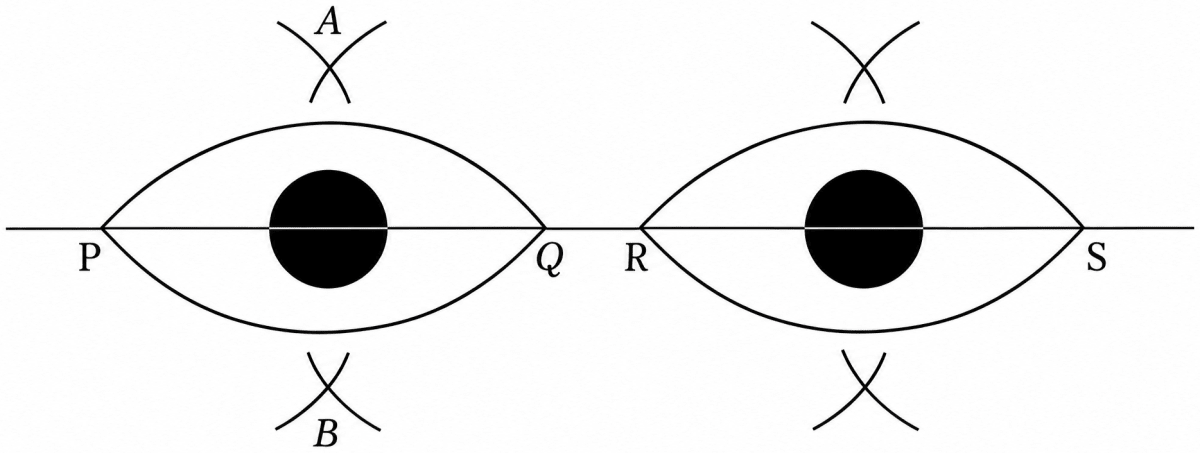
Now erase the supporting line.
Why the eye comes out symmetrical:
AP = AQ = 2.5 cm, so A lies on the perpendicular bisector of PQ. Similarly, BP = BQ = 2.5 cm, so B also lies on the perpendicular bisector of PQ.
⇒ Both A and B lie on the same line, which is perpendicular to PQ through its midpoint M.
Also, both arcs are drawn on the same chord PQ = 4 cm with the same radius 2.5 cm.
⇒ A and B are at equal distances from the supporting line, one above and one below.
∴ The lower curve is the mirror image of the upper curve in the line PQ.
Hence, the two arcs together form a symmetrical eye shape.
Which of the following is not a name for this square?
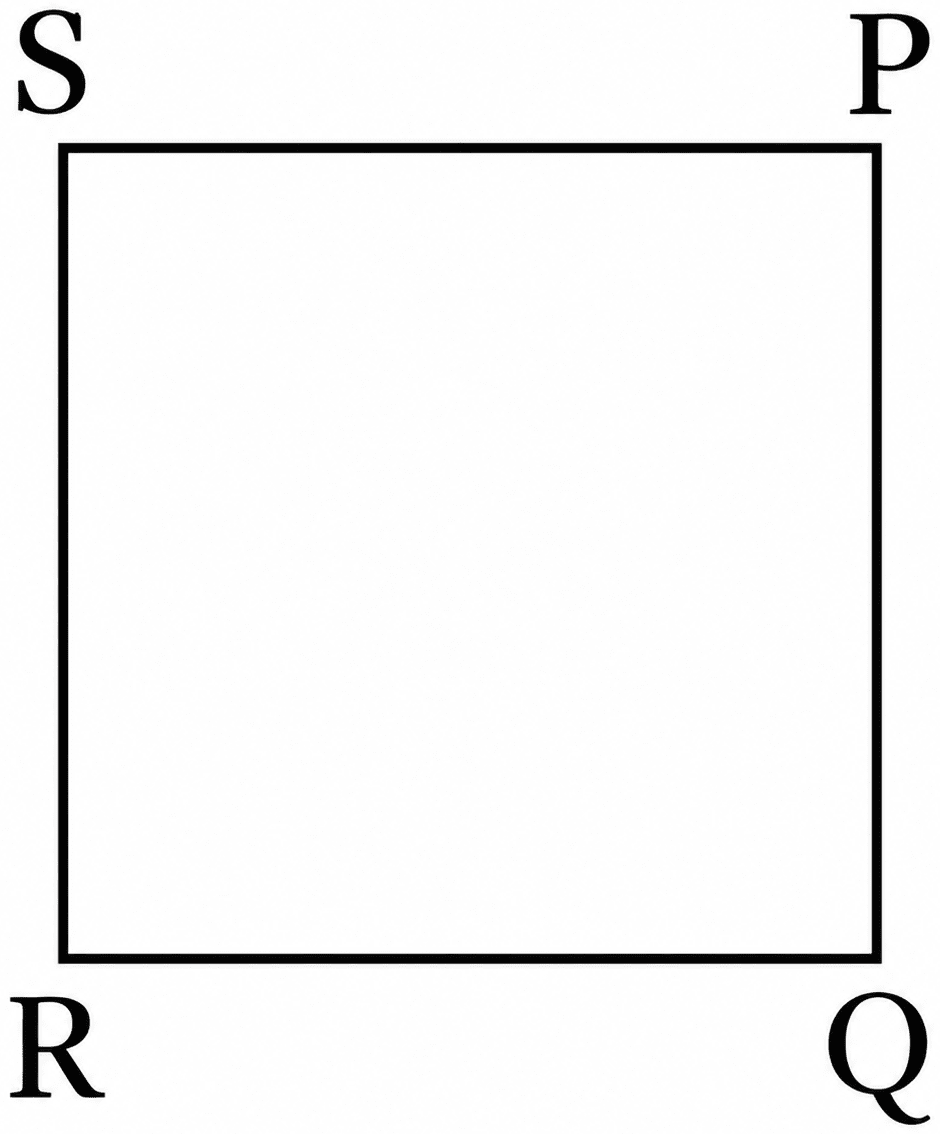
- PQSR
- SPQR
- RSPQ
- QRSP
Answer
In a valid name, the corners must occur in the order in which they are met while travelling around the square, starting from any corner and going either way.
In the given square, the corners occur in the order P, Q, R, S while travelling around it.
So P and R are opposite corners, and Q and S are opposite corners.
⇒ In a valid name, P and R can never be written next to each other, and Q and S can never be written next to each other.
Let us check each of the given names.
| Name | Order of travel | Valid? |
|---|---|---|
| 1. PQSR | P → Q → S → R | No, because Q and S are opposite corners and are not next to each other on the square |
| 2. SPQR | S → P → Q → R | Yes, each pair of consecutive corners is a side of the square |
| 3. RSPQ | R → S → P → Q | Yes, each pair of consecutive corners is a side of the square |
| 4. QRSP | Q → R → S → P | Yes, each pair of consecutive corners is a side of the square |
In PQSR, the step from Q to S is along a diagonal and not along a side, so the corners are not in an order of travel around the square.
∴ Option 1, PQSR, is not a name for the given square.
Draw the rectangle and four squares configuration (shown in Fig. 8.3) on a dot paper.
What did you do to recreate this figure so that the four squares are placed symmetrically around the rectangle? Discuss with your classmates.
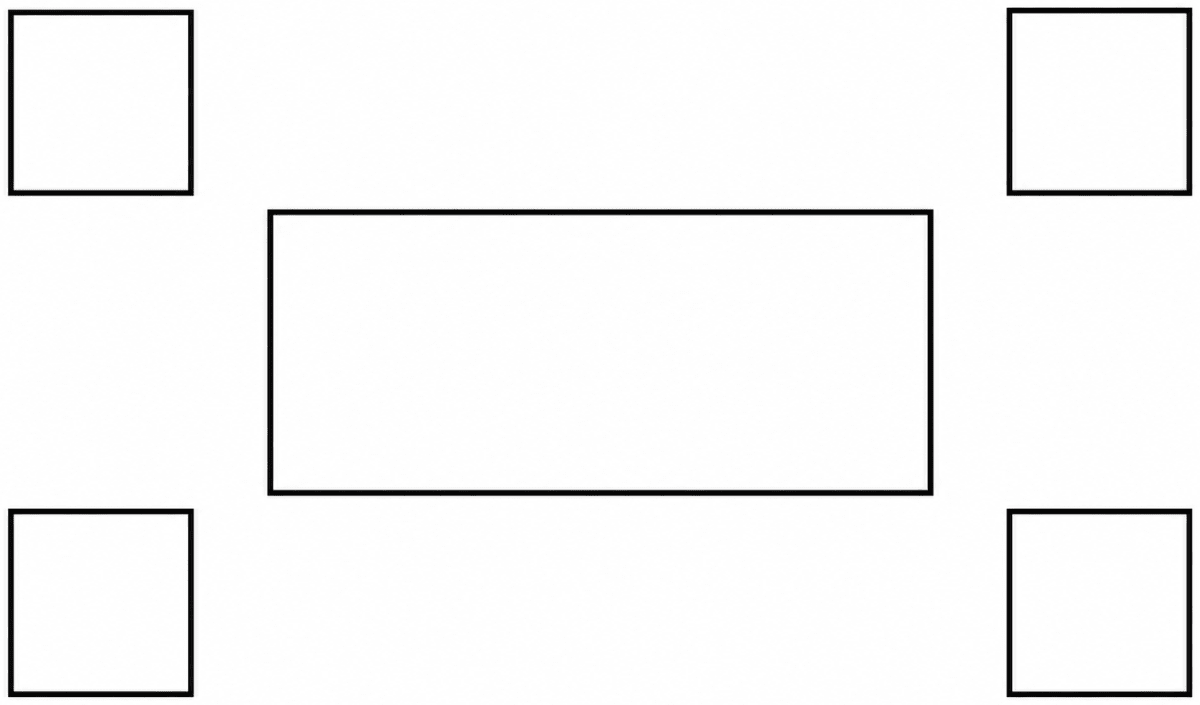
Answer
Steps of construction:
- On the dot paper, draw a rectangle ABCD with all its corners on dots, taking AB = DC = 6 units and BC = AD = 3 units, where 1 unit is the distance between two neighbouring dots.
- Lightly draw the two lines of symmetry of the rectangle by joining the midpoints of the pairs of opposite sides. They cross at the centre O of the rectangle.
- Starting from the corner A, count one dot diagonally outwards, that is one step away from O in both directions, and mark that dot.
- Taking this dot as the nearest corner, draw a square of side 2 units growing away from the rectangle. Its corners will all fall on dots.
- Repeat steps 3 and 4 at the corners B, C and D, using the same side of 2 units and the same one-dot diagonal gap each time.
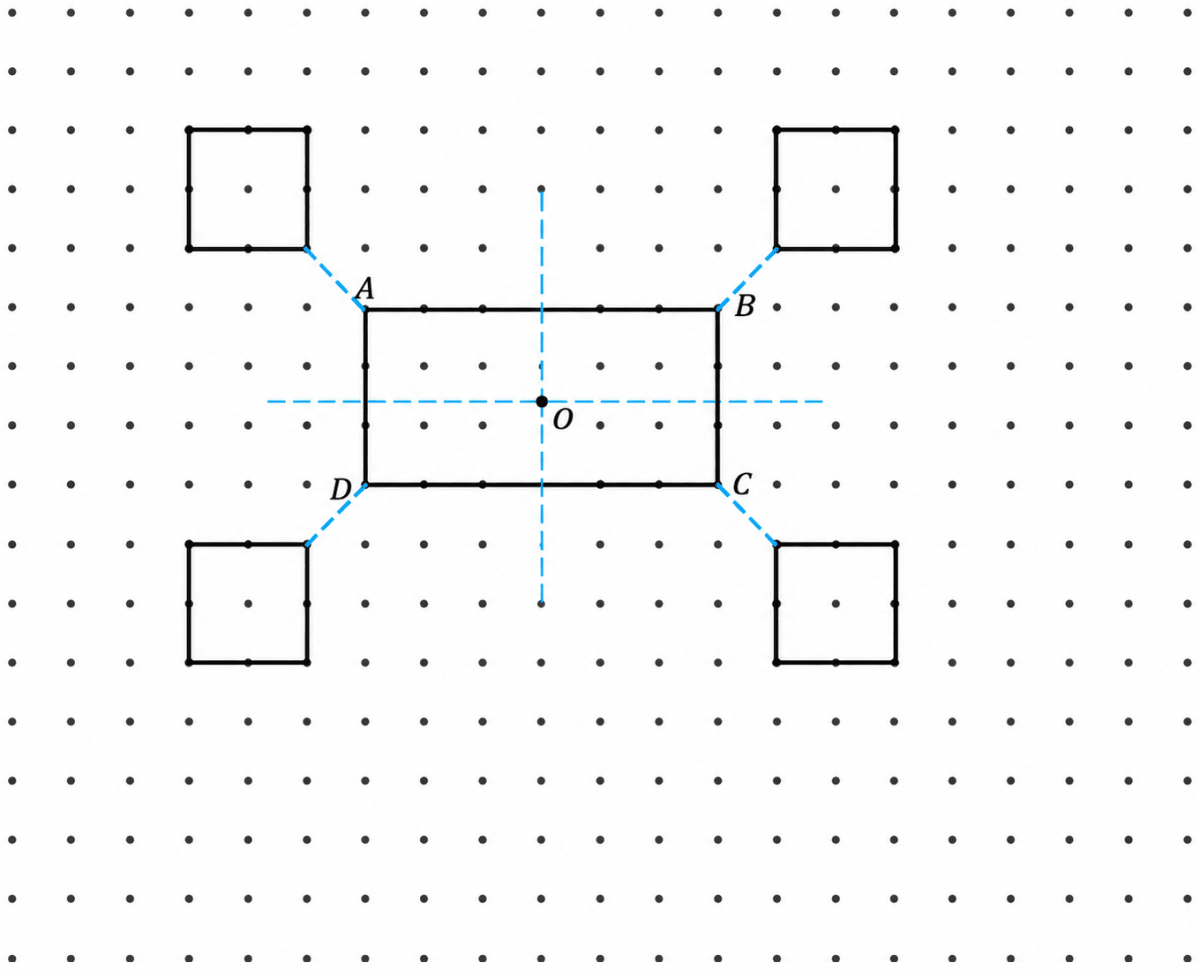
What was done to make the placing symmetrical:
- All four small squares were drawn with the same side of 2 units, so they are of equal size.
- Each small square was placed the same number of dots away, and in the same diagonal direction, from its nearest corner of the rectangle.
- Because the counting is done outwards from the corners, the arrangement is repeated in the same way at all four corners.
⇒ On folding the paper along either line of symmetry of the rectangle, the four squares fall on one another in pairs.
∴ The complete figure has the same two lines of symmetry as the rectangle, and it also looks the same after a half turn about O.
Hence, drawing four equal squares and keeping an equal diagonal gap of one dot at each corner of the rectangle places them symmetrically around it.
Identify if there are any squares in this collection. Use measurements if needed.
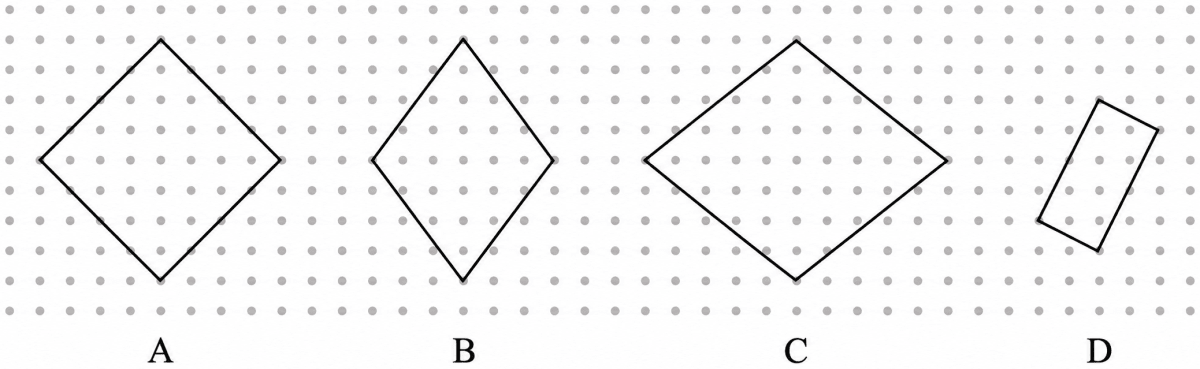
(i) Think: Is it possible to reason out if the sides are equal or not, and if the angles are right or not without using any measuring instruments in the above figure? Can we do this by only looking at the position of corners in the dot grid?
Answer
Since all the corners of the four figures lie on dots, the sides and the angles can be checked by counting the dot-steps. Let 1 unit be the distance between two neighbouring dots.
Figure A
Its two diagonals are horizontal and vertical, and each is 8 units long.
Going around the figure, each side is reached by 4 steps sideways and 4 steps up or down.
⇒ Each side = units ≈ 5.66 units, so all four sides are equal.
The diagonals are equal in length and are perpendicular to each other, so all four angles are 90°.
∴ Figure A satisfies S1 and S2, so it is a square.
Figure B
Its horizontal diagonal is 6 units and its vertical diagonal is 8 units.
Each side is reached by 3 steps sideways and 4 steps up or down.
⇒ Each side units, so all four sides are equal.
But the two diagonals are of unequal length (6 units and 8 units), so the angles are not 90°.
∴ Figure B is a rhombus and not a square.
Figure C
Its horizontal diagonal is 10 units and its vertical diagonal is 8 units.
Each side is reached by 5 steps sideways and 4 steps up or down.
⇒ Each side = units ≈ 6.40 units, so all four sides are equal.
Again the diagonals are unequal (10 units and 8 units), so the angles are not 90°.
∴ Figure C is a rhombus and not a square.
Figure D
Going around this figure, one side is reached by 2 steps sideways and 4 steps up or down, and the next side by 2 steps sideways and 1 step up or down.
⇒ One side = units ≈ 4.47 units
⇒ The next side = units ≈ 2.24 units
All the angles here are 90°, but the adjacent sides are not equal.
∴ Figure D is a rectangle and not a square.
∴ Out of the four figures, only Figure A is a square.
(i)
Yes, both are possible. Since every corner of the figures sits on a dot, the position of the corners on the dot grid is enough, and no ruler or protractor is needed.
Checking whether the sides are equal:
For each side, count the number of steps taken sideways and the number of steps taken up or down while going from one corner to the next. This gives a pair of numbers for every side.
Two sides are equal in length exactly when their pairs of numbers are made up of the same two counts, because the length of a side with counts a and b is .
For example, in Figure B every side has the counts 3 and 4, so all four sides are equal without any measuring.
Checking whether the angles are right:
Turning a direction through 90° on a dot grid interchanges the two counts and reverses one of them. So if one side has counts a sideways and b downwards, then the side next to it makes a right angle with it only when its counts are b sideways and a upwards, in that order.
- In Figure A, the sides go 4 across and 4 down, then 4 back and 4 down. Interchanging 4 and 4 and reversing one count gives exactly the next side, so the angle is 90°.
- In Figure B, the sides go 3 across and 4 down, then 3 back and 4 down. A right angle would need 4 back and 3 down, which is not what happens, so the angle is not 90°.
A quicker check for these figures:
In Figures A, B and C the diagonals lie along the grid lines, one horizontal and one vertical, so the diagonals are already perpendicular and each one cuts the other into two equal parts. Such a figure is a square only when the two diagonals are also equal in length. Simply counting the diagonals gives 8 and 8 for A, 6 and 8 for B, and 10 and 8 for C, which tells us at once that only A is a square.
Hence, the position of the corners on the dot grid is enough to reason out both the equality of the sides and the right angles, without using any measuring instrument.
Draw at least 3 rotated squares and rectangles on a dot grid. Draw them such that their corners are on the dots. Verify if the squares and rectangles that you have drawn satisfy their respective properties.
Answer
Method used: Choose a first side by counting steps sideways and steps down. Then take the next side by counting steps sideways in the opposite direction and steps down, which turns the direction through 90°. Repeating this gives a rotated square. For a rotated rectangle, take the second side along the same turned direction but of a different length.
Steps of construction:
- On the dot paper, mark a starting dot as the first corner.
- Count the steps of the first side and mark the second corner on a dot.
- Turn through 90° by interchanging the two counts and reversing one of them, and mark the third corner.
- Repeat once more to get the fourth corner, and join the four corners in order with a ruler.
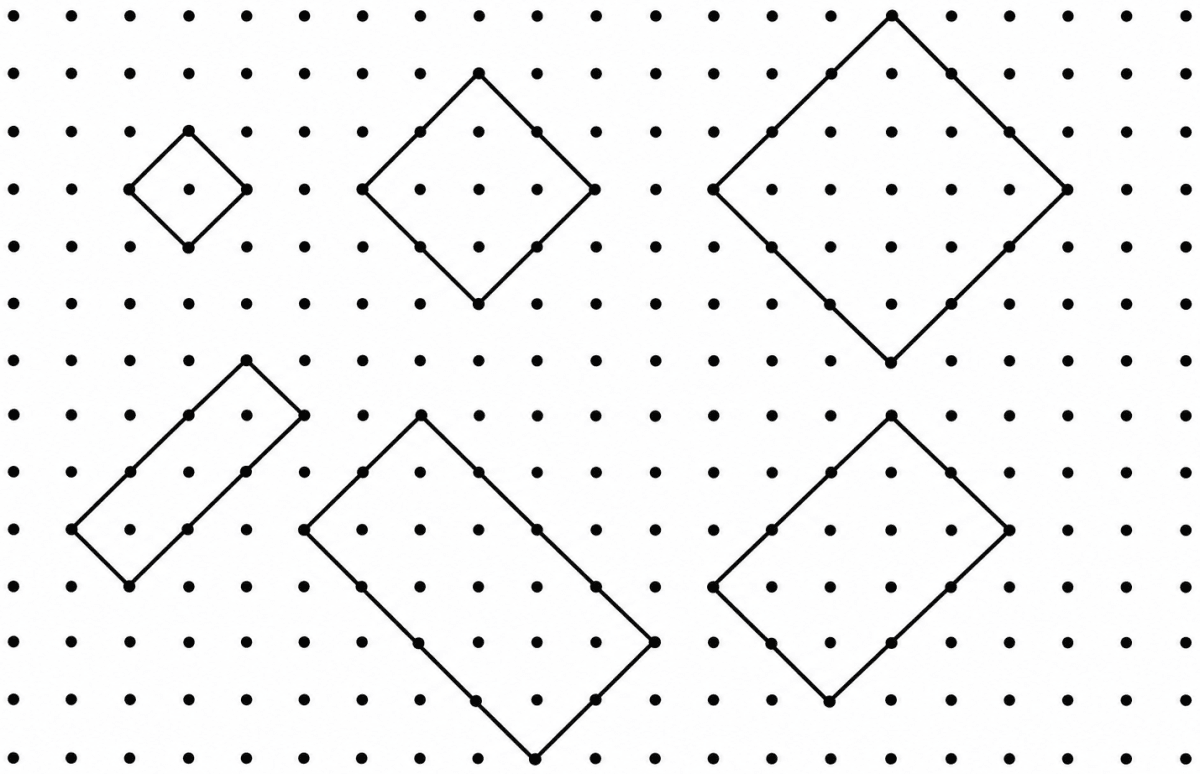
Figure 1 — Small rotated square
The square is formed by moving 1 step across and 1 step down between adjacent vertices.
⇒ Each side = units
All four sides are equal and each angle is 90°.
∴ Figure 1 is a square.
Figure 2 — Medium rotated square
The square is formed by moving 2 steps across and 2 steps down between adjacent vertices.
⇒ Each side = units.
All four sides are equal and each angle is 90°.
∴ Figure 2 is a square.
Figure 3 — Large rotated square
The square is formed by moving 3 steps across and 3 steps down between adjacent vertices.
⇒ Each side = units.
All four sides are equal and each angle is 90°.
∴ Figure 3 is a square.
Figure 4 — Small rotated rectangle
The longer sides are formed by moving 3 steps across and 3 steps down, while the shorter sides are formed by moving 1 step across and 1 step down in the perpendicular direction.
⇒ The longer sides = units
⇒ The shorter sides = units
Opposite sides are equal and all angles are 90°.
∴ Figure 4 is a rectangle, not a square because adjacent sides are unequal.
Figure 5 — Large rotated rectangle
The longer sides are formed by moving 4 steps across and 4 steps down, while the shorter sides are formed by moving 2 steps across and 2 steps down in the perpendicular direction.
⇒ The longer sides = units.
⇒ The shorter sides = units.
Opposite sides are equal and all angles are 90°.
∴ Figure 5 is a rectangle, not a square because adjacent sides are unequal.
Figure 6 — Rotated rectangle
The longer sides are formed by moving 3 steps across and 3 steps down, while the shorter sides are formed by moving 2 steps across and 2 steps up in the perpendicular direction.
Opposite sides are equal and all angles are 90°.
∴ Figure 6 is a rectangle.
Hence, the first three figures are squares and the last three figures are rectangles. In every case, the corners lie on the dots, all square properties hold for the squares, and all rectangle properties hold for the rectangles, even though the figures are drawn in rotated positions.
Draw a rectangle with sides of length 4 cm and 6 cm. After drawing, check if it satisfies both the rectangle properties.
Answer
Steps of construction:
- Draw a line segment AB = 4 cm using a ruler.
- At A, construct a perpendicular to AB and mark the point D on it such that AD = 6 cm.
- At B, construct a perpendicular to AB and mark the point C on it such that BC = 6 cm.
- Join D and C.
ABCD is the required rectangle.
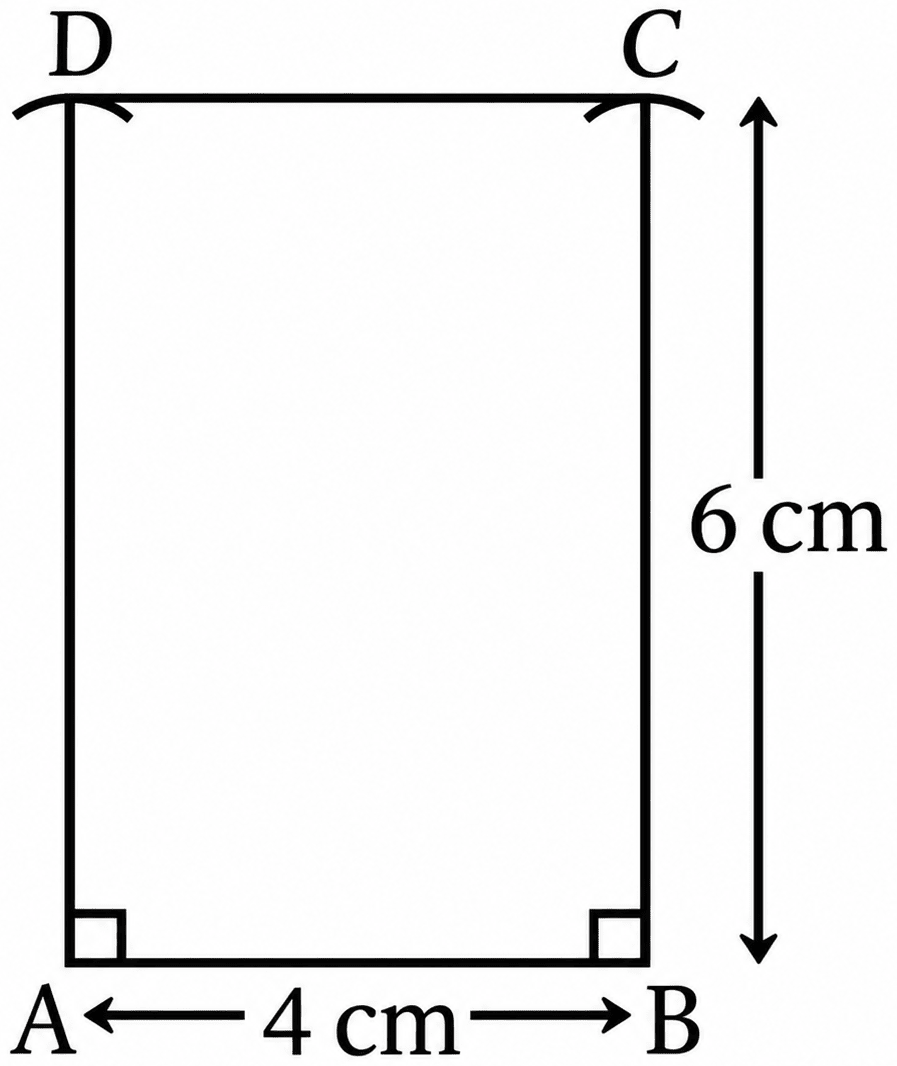
Checking the two properties by measurement:
| Property | Measurement | Satisfied? |
|---|---|---|
| (R1) Opposite sides are equal | AB = DC = 4 cm and AD = BC = 6 cm | Yes |
| (R2) All the angles are 90° | ∠A = ∠B = ∠C = ∠D = 90° | Yes |
Hence, the figure drawn satisfies both the properties R1 and R2, and so ABCD is a rectangle.
Draw a rectangle of sides 2 cm and 10 cm. After drawing, check if it satisfies both the rectangle properties.
Answer
Steps of construction:
- Draw a line segment PQ = 10 cm using a ruler.
- At P, construct a perpendicular to PQ and mark the point S on it such that PS = 2 cm.
- At Q, construct a perpendicular to PQ and mark the point R on it such that QR = 2 cm.
- Join S and R.
PQRS is the required rectangle.
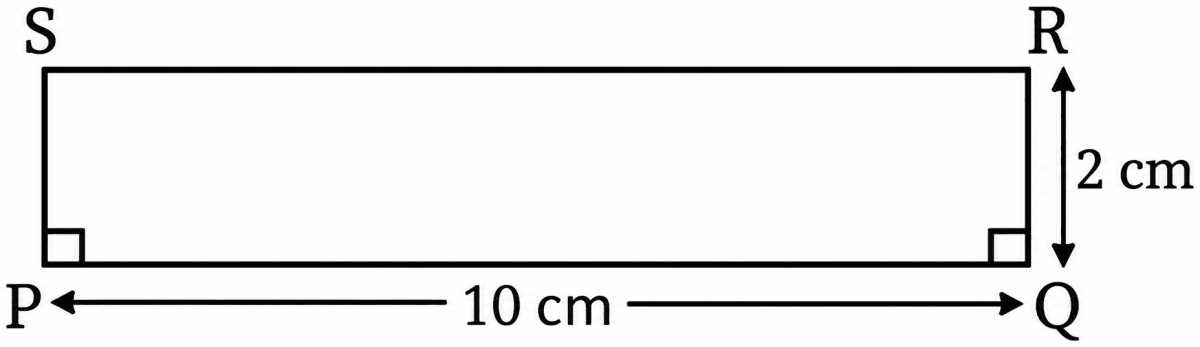
Checking the two properties by measurement:
| Property | Measurement | Satisfied? |
|---|---|---|
| (R1) Opposite sides are equal | PQ = SR = 10 cm and PS = QR = 2 cm | Yes |
| (R2) All the angles are 90° | ∠P = ∠Q = ∠R = ∠S = 90° | Yes |
Hence, the figure drawn satisfies both the properties R1 and R2, and so PQRS is a rectangle.
Is it possible to construct a 4-sided figure in which—
- all the angles are equal to 90° but
- opposite sides are not equal?
Answer
No, such a 4-sided figure cannot be constructed.
Let us try to draw a 4-sided figure ABCD in which ∠A = ∠B = ∠C = ∠D = 90°.
Steps of the attempt:
- Draw a side AB of any length.
- At A, draw a perpendicular to AB, and at B, draw a perpendicular to AB on the same side. The point D lies on the first perpendicular and the point C lies on the second one.
- Now the fourth side DC has to be drawn so that ∠D = 90° and ∠C = 90° as well.
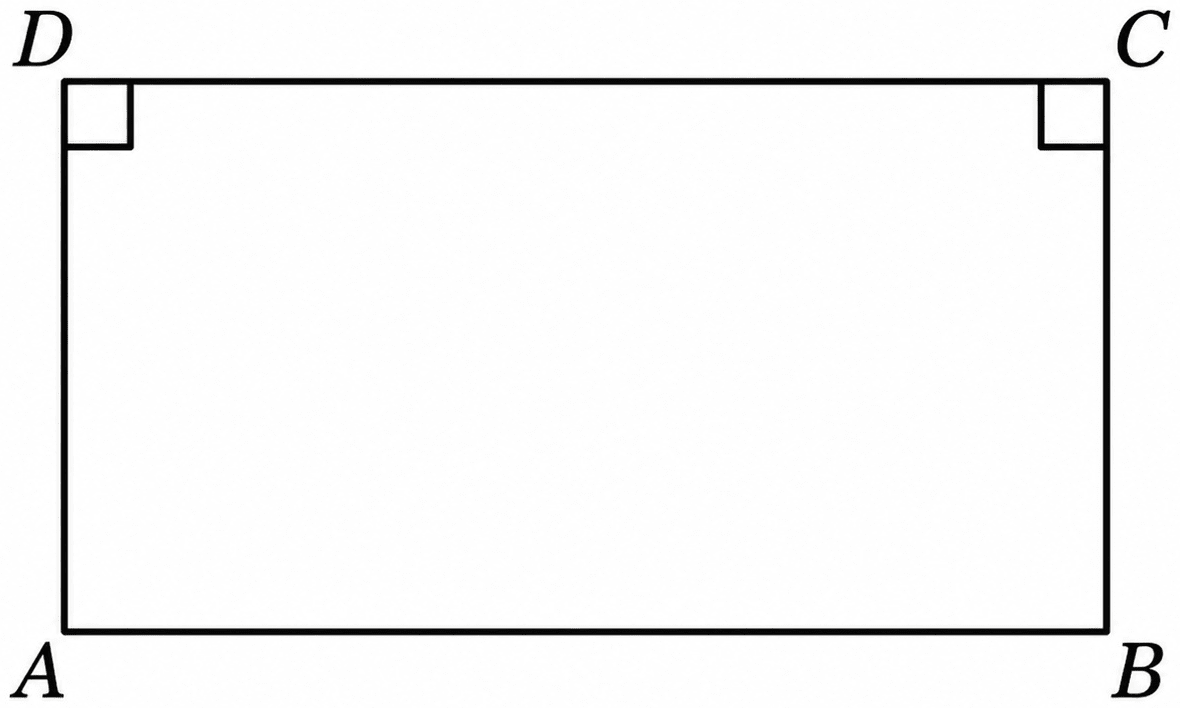
Since AD and BC are both perpendicular to AB, they are two parallel lines and both of them run in the same direction.
Suppose the opposite sides AD and BC are taken to be unequal, say AD > BC.
⇒ The point D is farther away from AB than the point C is.
⇒ The line joining D and C slants, so it cannot be perpendicular to AD and to BC at the same time.
∴ ∠D and ∠C cannot both be 90°.
So, the moment we insist that all four angles are 90°, we are forced to take AD = BC, and in the same way AB = DC.
Hence, in any 4-sided figure whose angles are all 90°, the opposite sides are automatically equal; such a figure is always a rectangle, and a 4-sided figure with all angles 90° but unequal opposite sides is not possible.
How will you keep track of the lengths XY for different positions of X and Y? Here is one way of doing it. Suppose here are some of the positions of X and Y that you have considered:
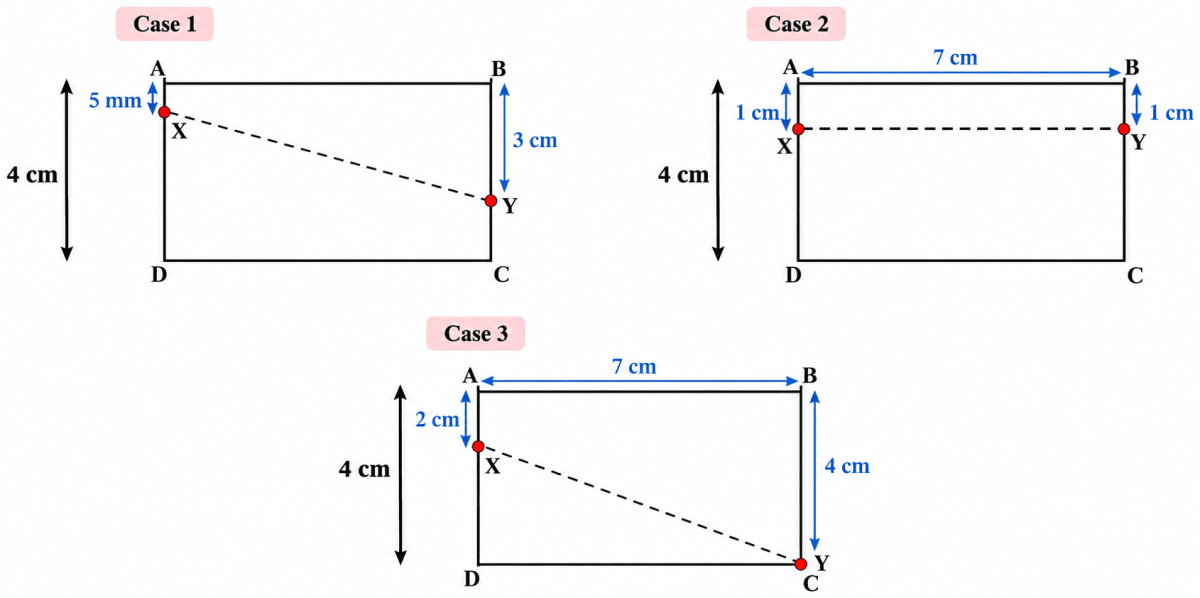
- When X is 5 mm away from A and Y is 3 cm away from B, XY = .......... cm .......... mm
- When X is 1 cm away from A and Y is 1 cm away from B, XY = .......... cm .......... mm
- When X is 2 cm away from A and Y is 4 cm away from B, XY = .......... cm .......... mm and so on.
Answer
Each position of X and Y is constructed on a copy of the rectangle ABCD and the length XY is then measured with a ruler. The measurements are:
- When X is 5 mm away from A and Y is 3 cm away from B, XY = 7 cm 4 mm
- When X is 1 cm away from A and Y is 1 cm away from B, XY = 7 cm 0 mm
- When X is 2 cm away from A and Y is 4 cm away from B, XY = 7 cm 3 mm
Instead of writing such a long sentence every time, only three things change in them — the position of X, the position of Y and the length XY. So all the readings can be recorded in a short form in a table:
| Distance of X from A | Distance of Y from B | Length of XY |
|---|---|---|
| 5 mm | 3 cm | 7 cm 4 mm |
| 1 cm | 1 cm | 7 cm 0 mm |
| 2 cm | 4 cm | 7 cm 3 mm |
Hence, a table with the three columns — distance of X from A, distance of Y from B and the length of XY — is a convenient shorthand way of keeping track of all the different positions.
Is there a shorthand way of writing it down? In all the sentences, only the position of X, Y and the length XY changes. So we could write this as:
| Distance of X from A | Distance of Y from B | Length of XY |
|---|---|---|
Answer
| Distance of X from A | Distance of Y from B | Length of XY |
|---|---|---|
| 5 mm | 3 cm | 7 cm 4 mm |
| 1 cm | 1 cm | 7 cm 0 mm |
| 2 cm | 4 cm | 7 cm 3 mm |
Have you checked what happens to the length XY when X and Y are placed at the same distance away from A and B, respectively? For example, as in the cases like these:
| Distance of X from A | Distance of Y from B | Length of XY |
|---|---|---|
| 5 mm | 5 mm | |
| 1 cm | 1 cm | |
| 1 cm 5 mm | 1 cm 5 mm |
and so on.
Answer
| Distance of X from A | Distance of Y from B | Length of XY |
|---|---|---|
| 5 mm | 5 mm | 7 cm |
| 1 cm | 1 cm | 7 cm |
| 1 cm 5 mm | 1 cm 5 mm | 7 cm |
In each case, X and Y are at the same level on opposite sides of the rectangle. Therefore, XY = AB = 7 cm, and ABYX is a rectangle.
Hence, XY remains 7 cm when AX = BY.
How does the farthest distance between X and Y compare with the length of AC? BD?
Answer
X and Y are farthest apart when they are placed at the opposite ends of the two sides AD and BC, that is:
- when X is at A and Y is at C, and
- when X is at D and Y is at B.
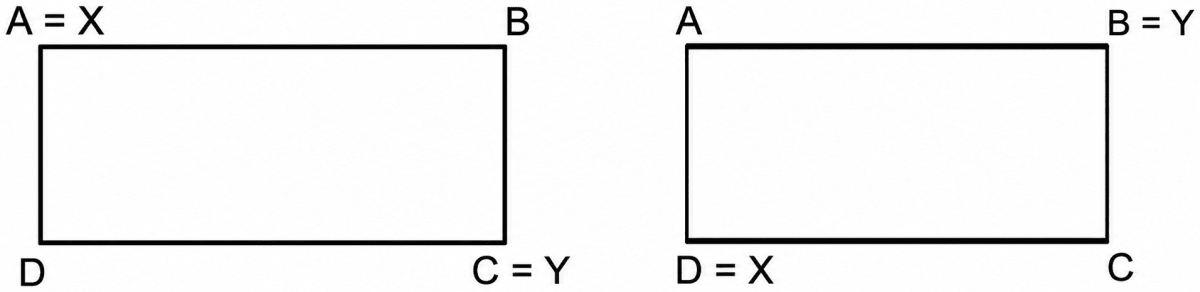
In the first case, the line XY is exactly the line joining A and C, so XY = AC.
In the second case, the line XY is exactly the line joining D and B, so XY = BD.
Also, AC and BD are the two diagonals of the rectangle ABCD, and on measuring we find that they are equal, each of length about 8.1 cm.
⇒ Farthest XY = AC = BD
∴ The farthest distance between X and Y is equal to the length of the diagonal AC, and it is also equal to the length of the diagonal BD.
Breaking Rectangles
Construct a rectangle that can be divided into 3 identical squares as shown in the figure.
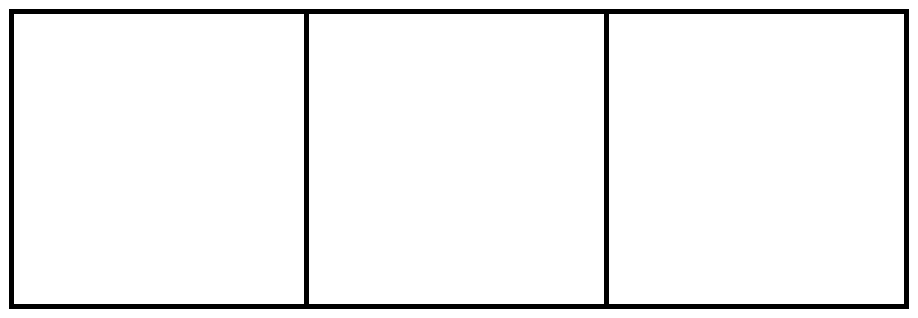
Answer
Planning through a rough diagram:
Let the rectangle be PQRS and let it be divided into three identical squares.
Since the three squares are identical, each of them has the same side length. Let this side be the breadth of the rectangle.
⇒ Breadth of the rectangle = side of one square
⇒ Length of the rectangle = side + side + side = 3 × (side of one square)
∴ Length of the rectangle = 3 × breadth of the rectangle
So we may take, for example, breadth = 3 cm and length = 3 × 3 cm = 9 cm.
Steps of construction:
- Draw a line segment PQ = 9 cm.
- At P, construct a perpendicular to PQ and mark S on it such that PS = 3 cm.
- At Q, construct a perpendicular to PQ and mark R on it such that QR = 3 cm.
- Join S and R. Then PQRS is a rectangle of length 9 cm and breadth 3 cm.
- On PQ, mark the points A and B such that PA = 3 cm and AB = 3 cm.
- On SR, mark the points C and D such that SD = 3 cm and DC = 3 cm.
- Join AD and BC.
Now each of the three parts PADS, ABCD and BQRC has all its sides 3 cm and all its angles 90°.
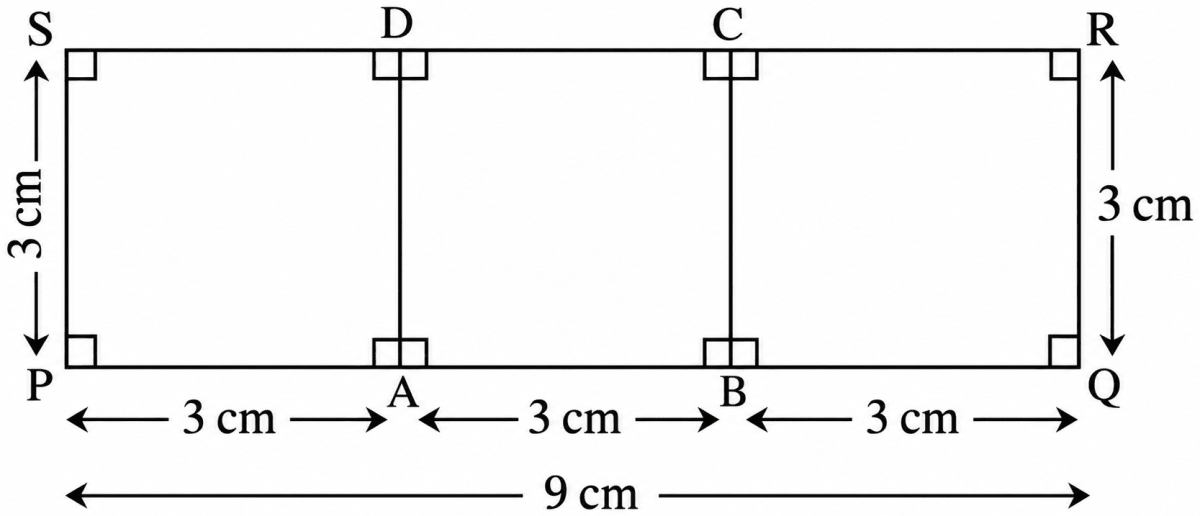
Hence, the rectangle PQRS of sides 9 cm and 3 cm gets divided into 3 identical squares, each of side 3 cm.
Try constructing a rectangle that can be divided into three identical squares.
Answer
Here the length of the rectangle has to be three times its breadth. Using a compass, the breadth can be transferred along the length three times, so the rectangle can be constructed without measuring anything with a ruler.
Steps of construction:
- Draw a line segment PS of any convenient length. This will be the breadth of the rectangle.
- At P, draw a ray perpendicular to PS.
- Open the compass so that its width is exactly equal to PS.
- With P as centre and this radius, draw an arc cutting the perpendicular ray at A.
- With A as centre and the same radius, draw an arc cutting the ray at B; then with B as centre and the same radius, draw an arc cutting the ray at Q.
Now PA = AB = BQ = PS, so PQ = 3 × PS. - At Q, construct a perpendicular to PQ and, with the same compass width, mark R on it such that QR = PS.
- Join S and R. Then PQRS is a rectangle whose length is three times its breadth.
- With the same compass width, mark the points D and C on SR such that SD = DC = PS, and join AD and BC.
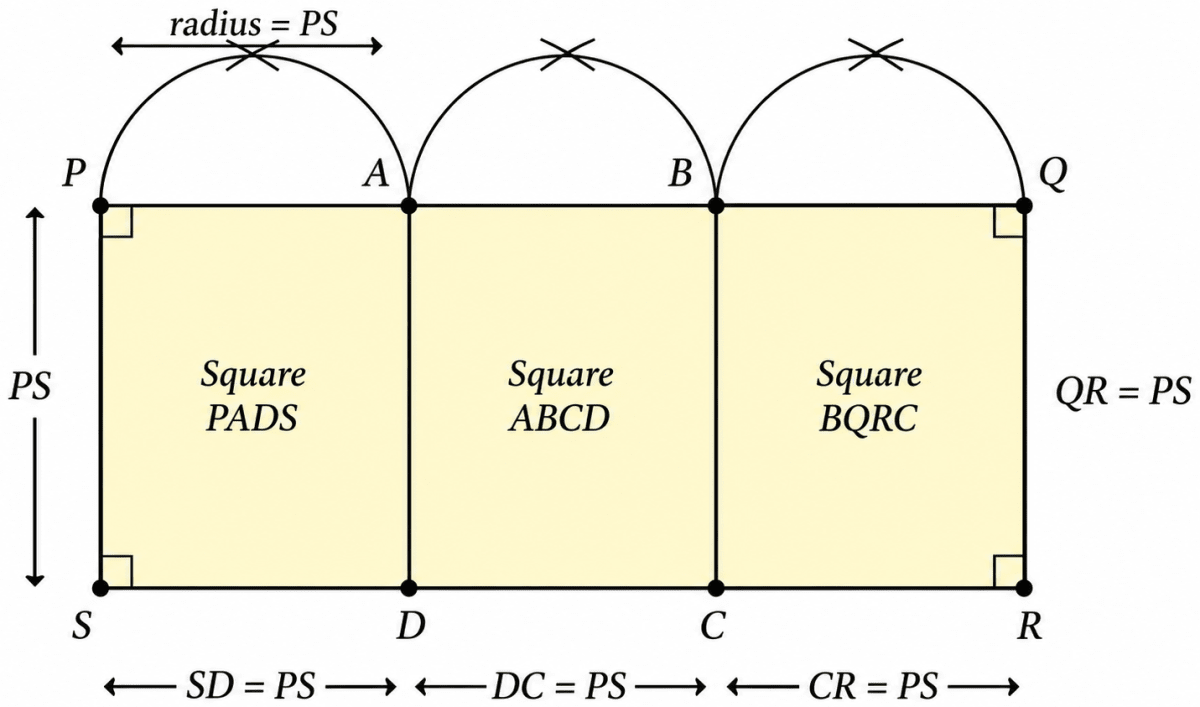
Each of the three parts PADS, ABCD and BQRC has all four sides equal to PS and all four angles equal to 90°.
Hence, the rectangle PQRS so constructed is divided into three identical squares.
Give the lengths of the sides of a rectangle that cannot be divided into—
- two identical squares;
- three identical squares.
Answer
A rectangle can be divided into two identical squares only when its length is exactly 2 times its breadth, and it can be divided into three identical squares only when its length is exactly 3 times its breadth.
So it is enough to choose sides that do not satisfy these conditions.
(i) A rectangle that cannot be divided into two identical squares
Take length = 4 cm and breadth = 2.5 cm.
Here, 2 × breadth = 2 × 2.5 cm = 5 cm, but the length is only 4 cm.
⇒ 2 × breadth ≠ length
∴ This rectangle cannot be divided into two identical squares.
(ii) A rectangle that cannot be divided into three identical squares
Take length = 7 cm and breadth = 2 cm.
Here, 3 × breadth = 3 × 2 cm = 6 cm, but the length is 7 cm.
⇒ 3 × breadth ≠ length
∴ This rectangle cannot be divided into three identical squares.
Hence, a rectangle of sides 4 cm and 2.5 cm cannot be divided into two identical squares, and a rectangle of sides 7 cm and 2 cm cannot be divided into three identical squares.
A Square within a Rectangle
Construct a rectangle of sides 8 cm and 4 cm. How will you construct a square inside, as shown in the figure, such that the centre of the square is the same as the centre of the rectangle?
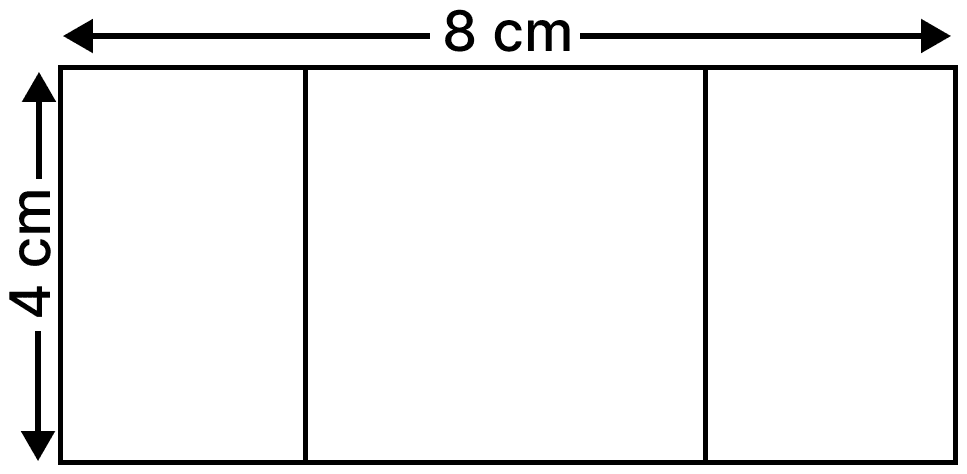
Hint: Draw a rough figure. What will be the sidelength of the square? What will be the distance between the corners of the square and the outer rectangle?
Answer
Planning from the rough figure:
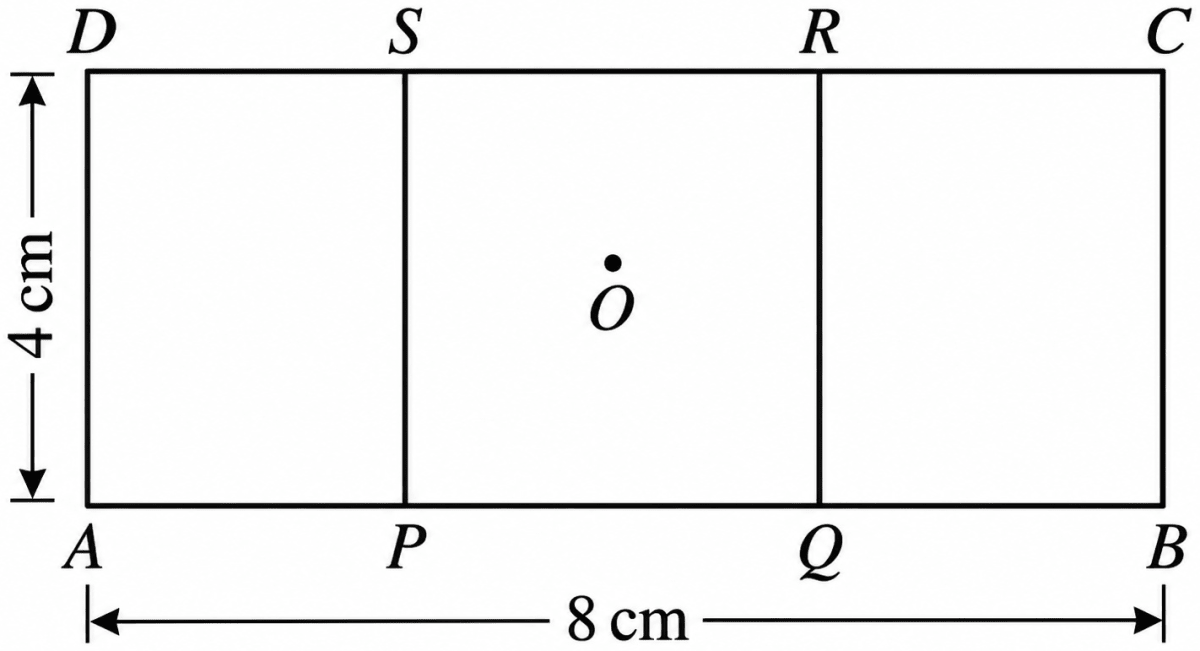
In the given figure the square touches both the longer sides of the rectangle, that is, the corners of the square lie on the longer sides.
⇒ Sidelength of the square = shorter side of the rectangle = 4 cm
The part of the longer side that is left over is 8 cm − 4 cm = 4 cm, and it is shared equally on the two sides of the square.
⇒ Distance of each corner of the square from the nearer shorter side of the rectangle = = 2 cm
Steps of construction:
- Draw AB = 8 cm.
- At A and at B, draw perpendiculars to AB using ruler and compasses.
- On these perpendiculars, and on the same side of AB, mark AD = 4 cm and BC = 4 cm.
- Join DC. Then ABCD is the required rectangle of sides 8 cm and 4 cm.
- On AB, mark the point P such that AP = 2 cm, and the point Q such that BQ = 2 cm. Then PQ = 8 − 2 − 2 = 4 cm.
- At P and at Q, draw perpendiculars to AB meeting DC at S and R respectively.
- Join the points to get the 4-sided figure PQRS.
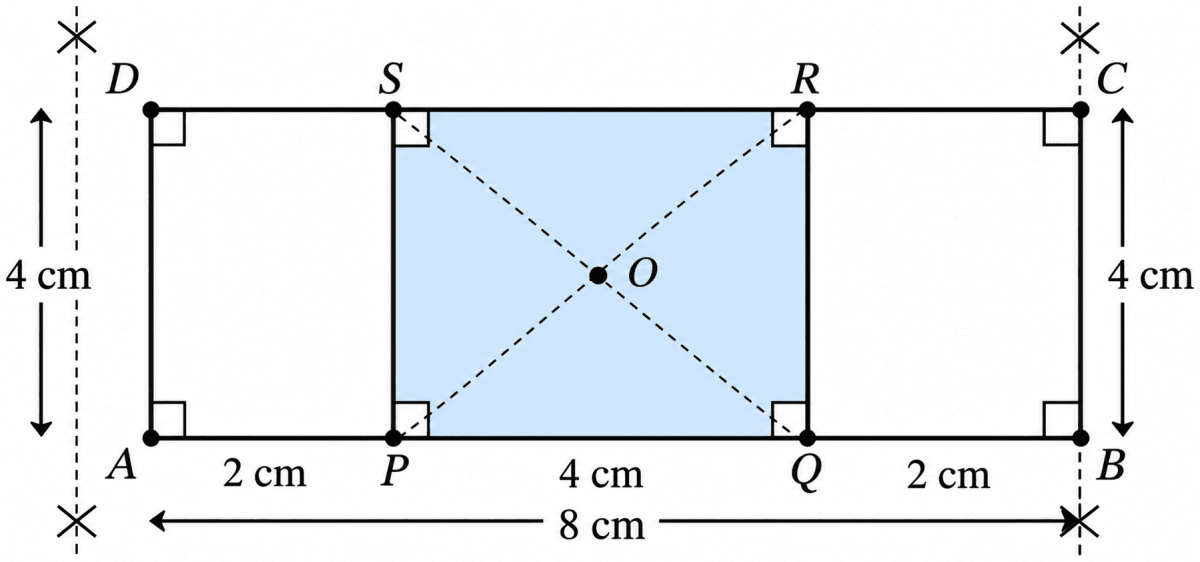
Check:
PQ = QR = RS = SP = 4 cm and ∠P = ∠Q = ∠R = ∠S = 90°, so PQRS is a square of side 4 cm.
Centre of the rectangle ABCD lies at a distance of = 4 cm from AD and = 2 cm from AB.
Centre of the square PQRS is the midpoint of PR. It lies at a distance of 2 + = 4 cm from AD and = 2 cm from AB.
∴ Both centres are the same point.
Hence, the required square has side 4 cm and its corners are placed 2 cm away from the shorter sides of the rectangle.
Shadings
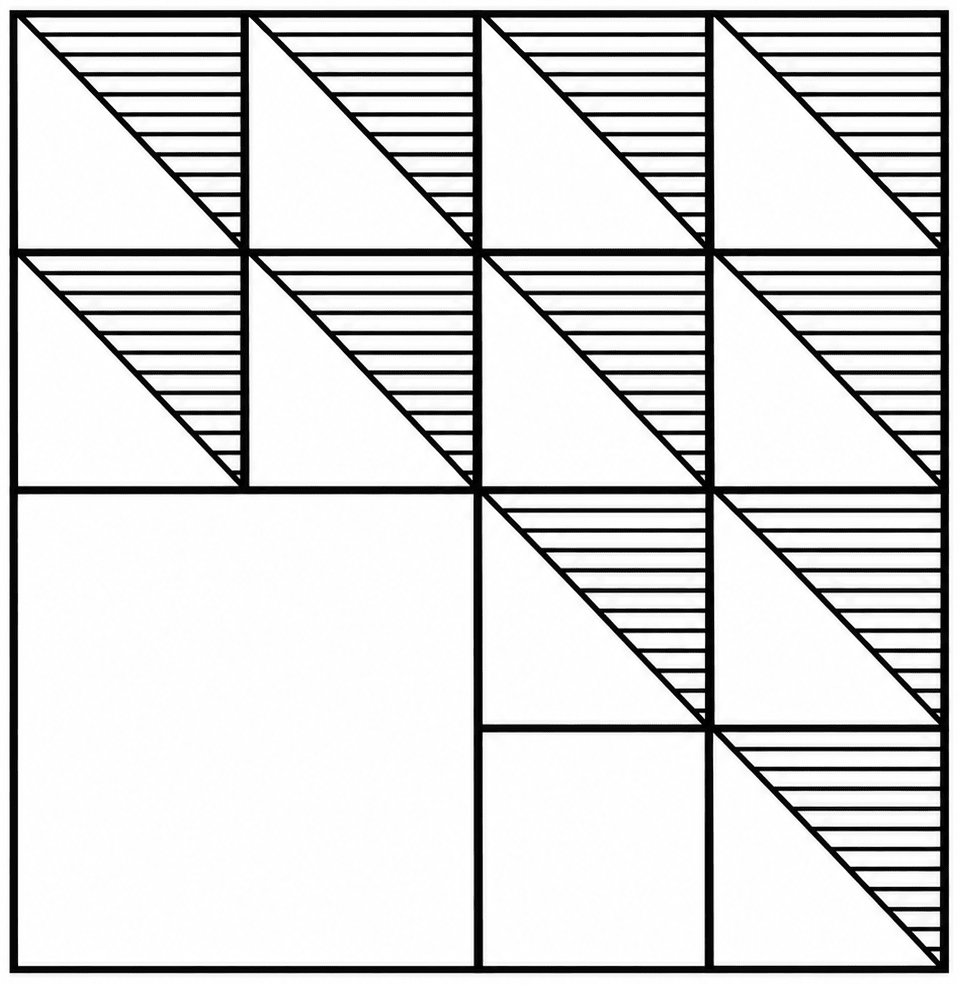
Construct this. Choose measurements of your choice. Note that the larger 4-sided figure is a square and so are the smaller ones.
Answer
Since the measurements are of our own choice, let us take the larger square to be of side 8 cm, so that it can be divided into small squares of side 2 cm each.
Reading the figure:
The larger square is divided into a grid of 4 × 4 small squares of side 2 cm.
In the bottom-left corner, four of these small squares together are kept as a single square of side 4 cm (no lines are drawn inside it).
In each of the remaining small squares, except the one in the bottom row next to the corner square, the diagonal from the bottom-left corner to the top-right corner is drawn and the triangle above this diagonal is shaded.
Steps of construction:
- Construct a square ABCD of side 8 cm.
- Divide each side into 4 equal parts of 2 cm each and mark the points of division.
- Join the corresponding points of division on opposite sides. This gives a grid of 16 small squares, each of side 2 cm.
- In the bottom-left corner, rub out the two grid lines lying inside the block of 4 small squares, so that this block remains a single square of side 4 cm.
- In each of the 8 small squares of the top two rows, draw the diagonal from its bottom-left corner to its top-right corner.
- Draw the same diagonal in the two small squares of the third row that lie to the right of the middle vertical line, and in the small square at the bottom-right corner.
- Shade the triangle lying above the diagonal in each of these 11 small squares.
- Leave the square of side 4 cm and the remaining small square of the bottom row unshaded.
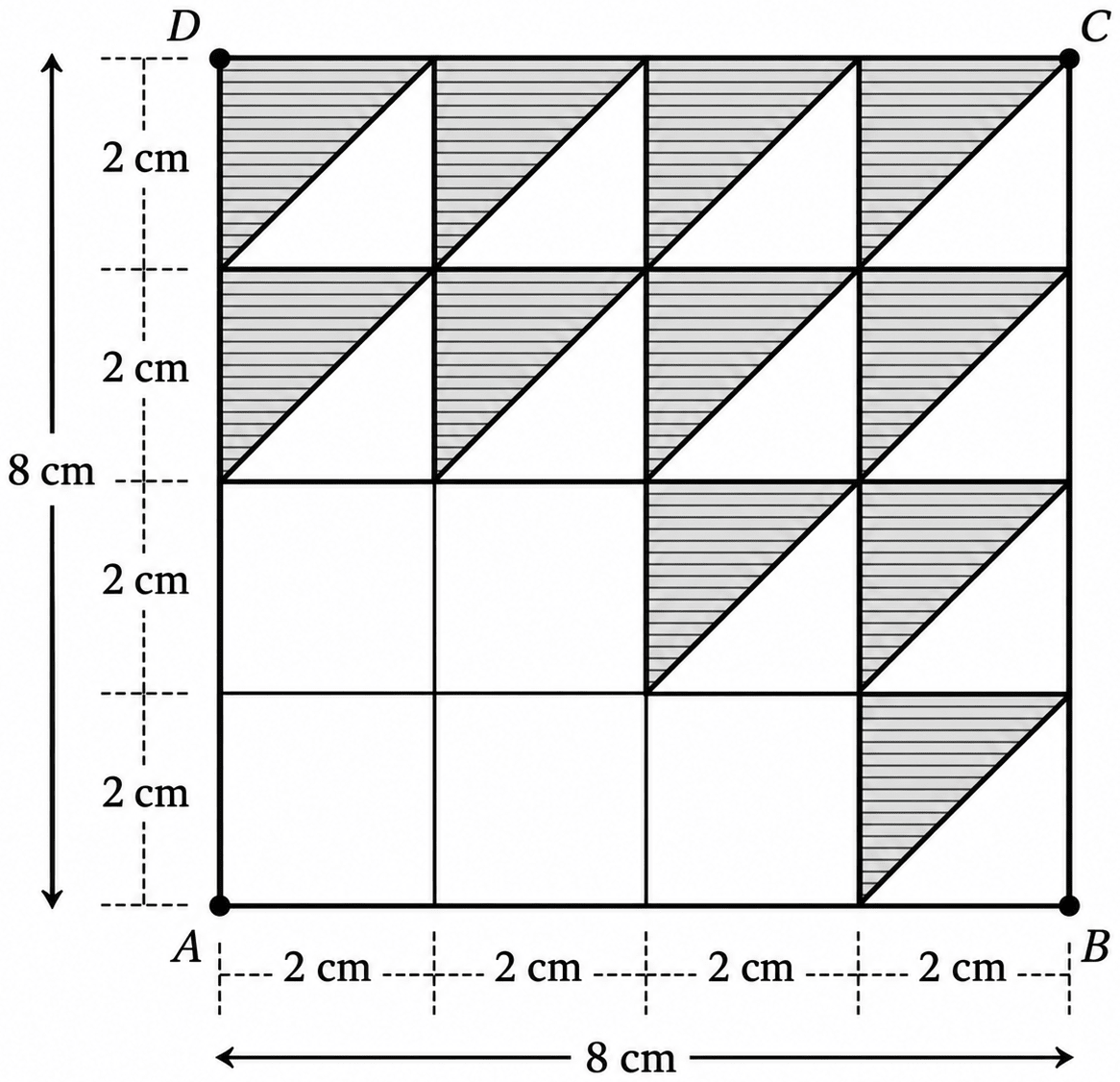
Hence, the required shading pattern is obtained.
Square with a Hole
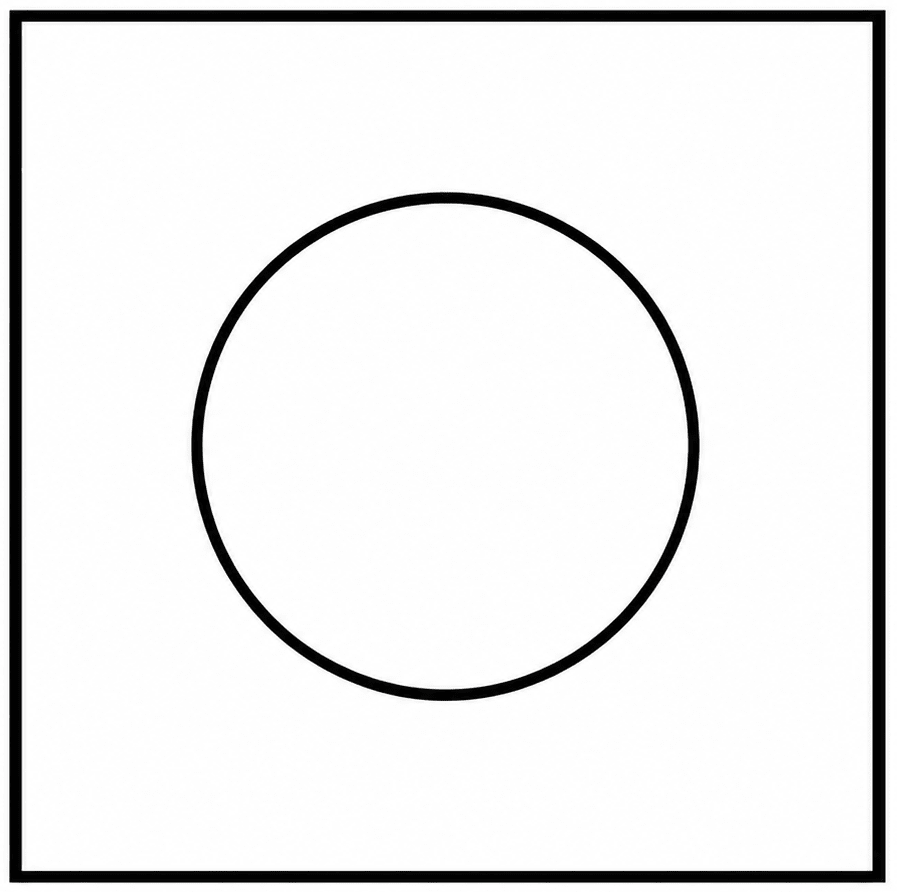
Observe that the circular hole is the same as the centre of the square.
Hint: Think where the centre of the circle should be.
Answer
The centre of the circle must be the centre of the square, that is, the point where the two line segments joining the opposite corners of the square meet.
Let us construct a square of side 6 cm with a circular hole of radius 2 cm.
Steps of construction:
- Draw AB = 6 cm.
- At A and at B, draw perpendiculars to AB and mark AD = 6 cm and BC = 6 cm on them, on the same side of AB.
- Join DC. Then ABCD is a square of side 6 cm.
- Join the opposite corners A to C and B to D. Let these two line segments meet at O.
- With O as centre and radius 2 cm, draw a circle.
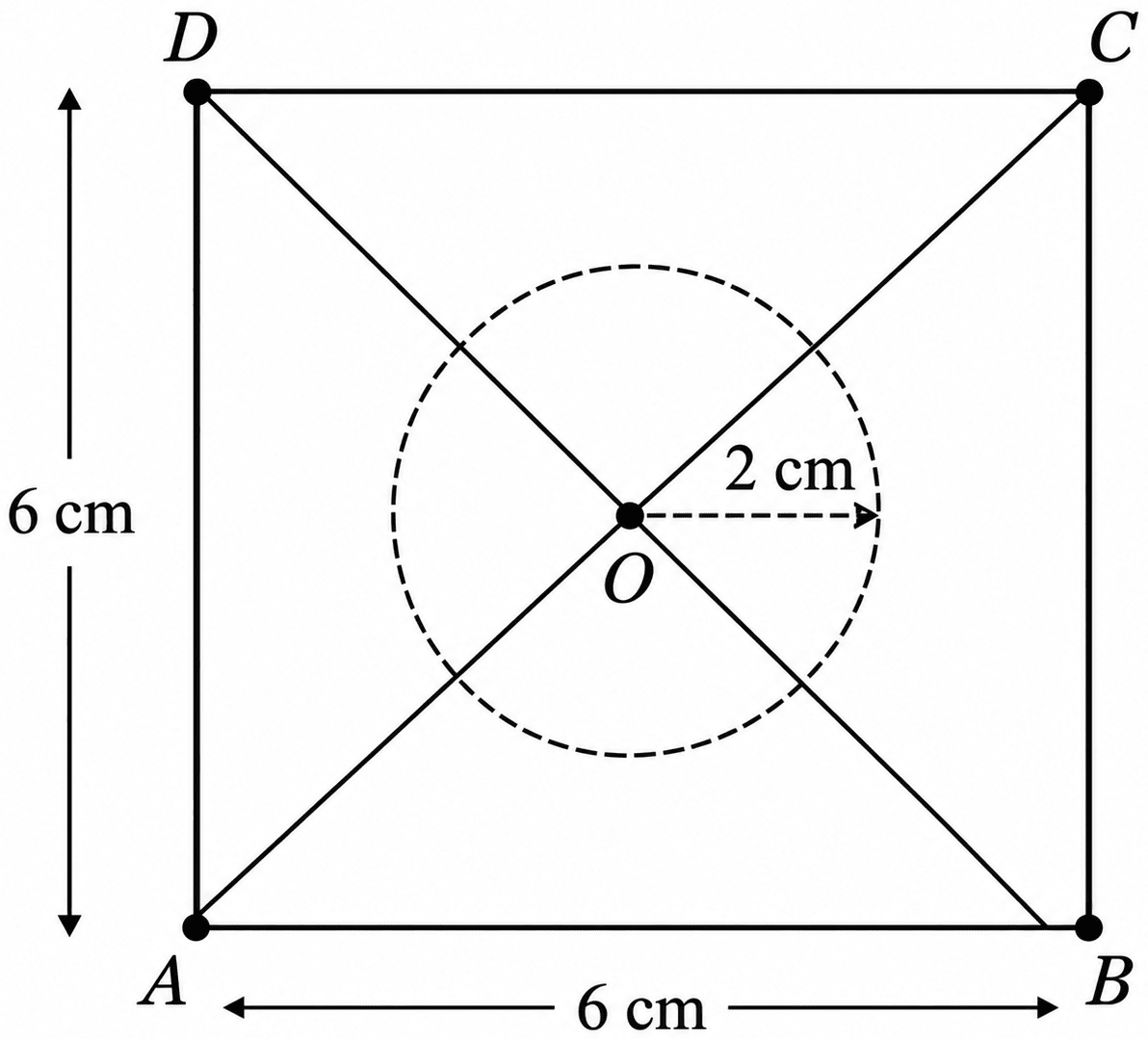
Why O is the correct point:
O is the point of intersection of the two line segments joining opposite corners, so it is at the same distance from all the four sides of the square.
⇒ The circle drawn with centre O stays at the same distance from every side.
∴ The hole looks equally placed with respect to all the four sides.
Hence, the centre of the circle should be taken at the meeting point of the two line segments joining the opposite corners of the square.
Square with more Holes
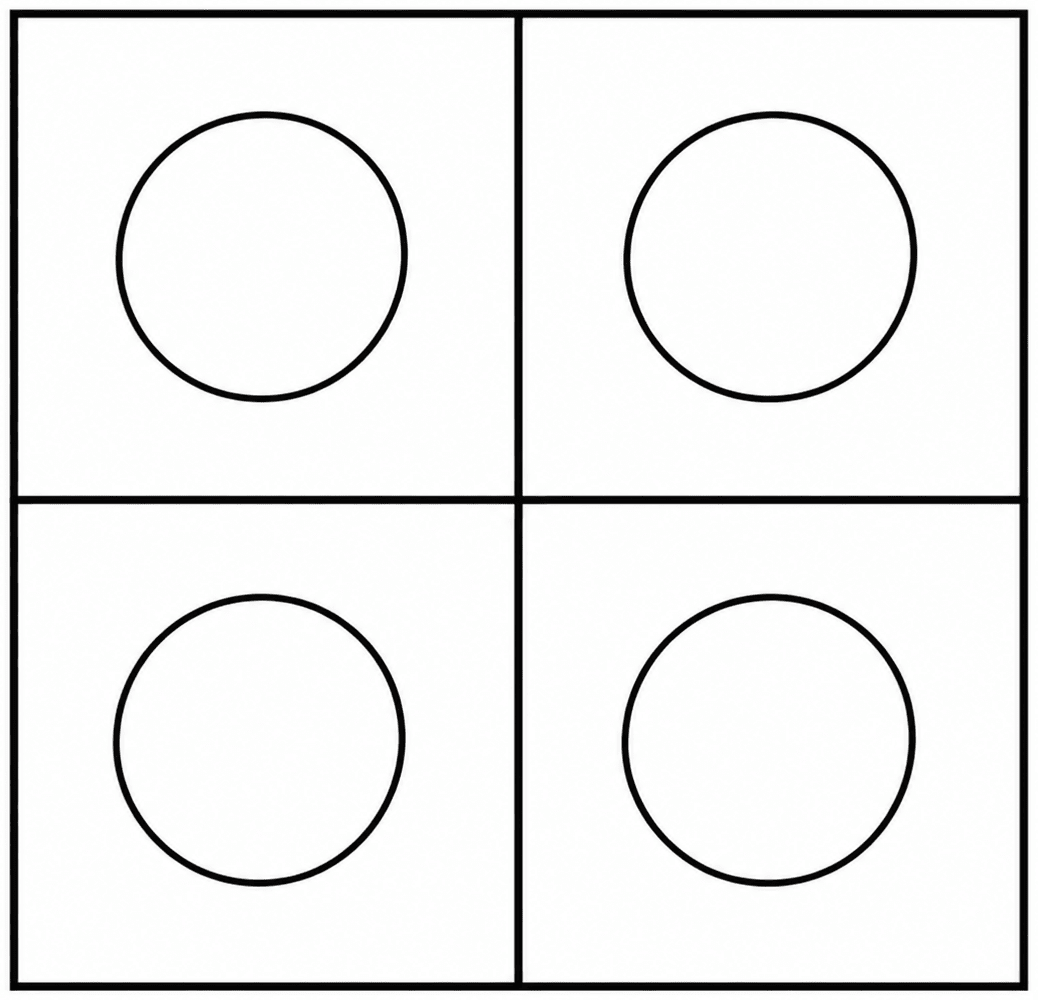
Answer
Here the larger square is divided into 4 equal smaller squares, and each smaller square has a circular hole at its own centre.
Let us take the larger square of side 8 cm, so that each smaller square is of side 4 cm, and let each hole be of radius 1.5 cm.
Steps of construction:
- Construct a square ABCD of side 8 cm.
- Mark the midpoints P, Q, R and S of the sides AB, BC, CD and DA respectively.
- Join PR and QS. These two line segments divide ABCD into 4 smaller squares, each of side 4 cm.
- In each smaller square, join its opposite corners. The point where they meet is the centre of that smaller square.
- With each of these 4 centres and radius 1.5 cm, draw a circle.
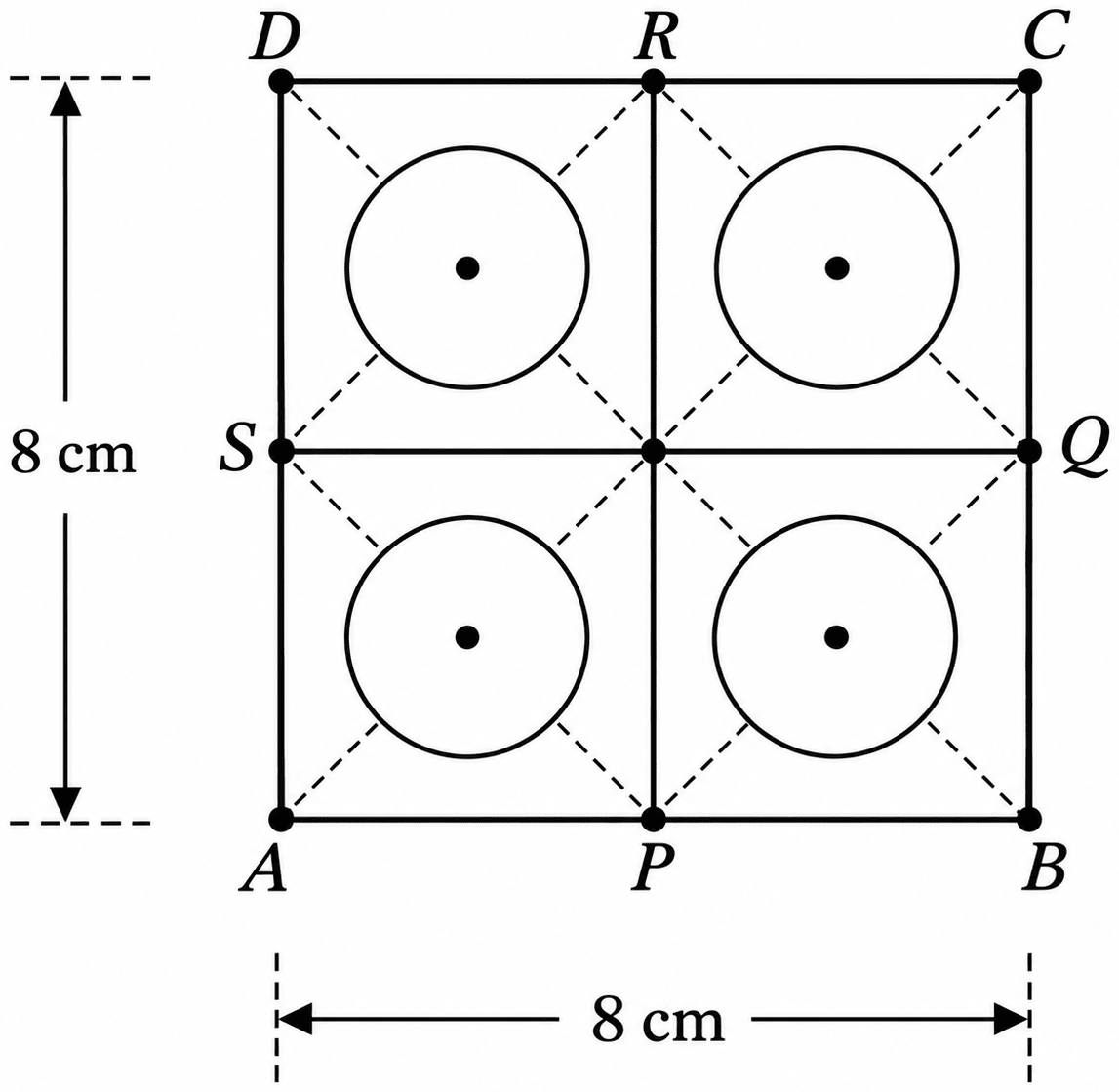
Each hole is now at the centre of its own square, and all the four holes are of the same size.
Hence, the required figure with four equal circular holes is obtained.
Square with Curves
This is a square with 8 cm sidelengths.
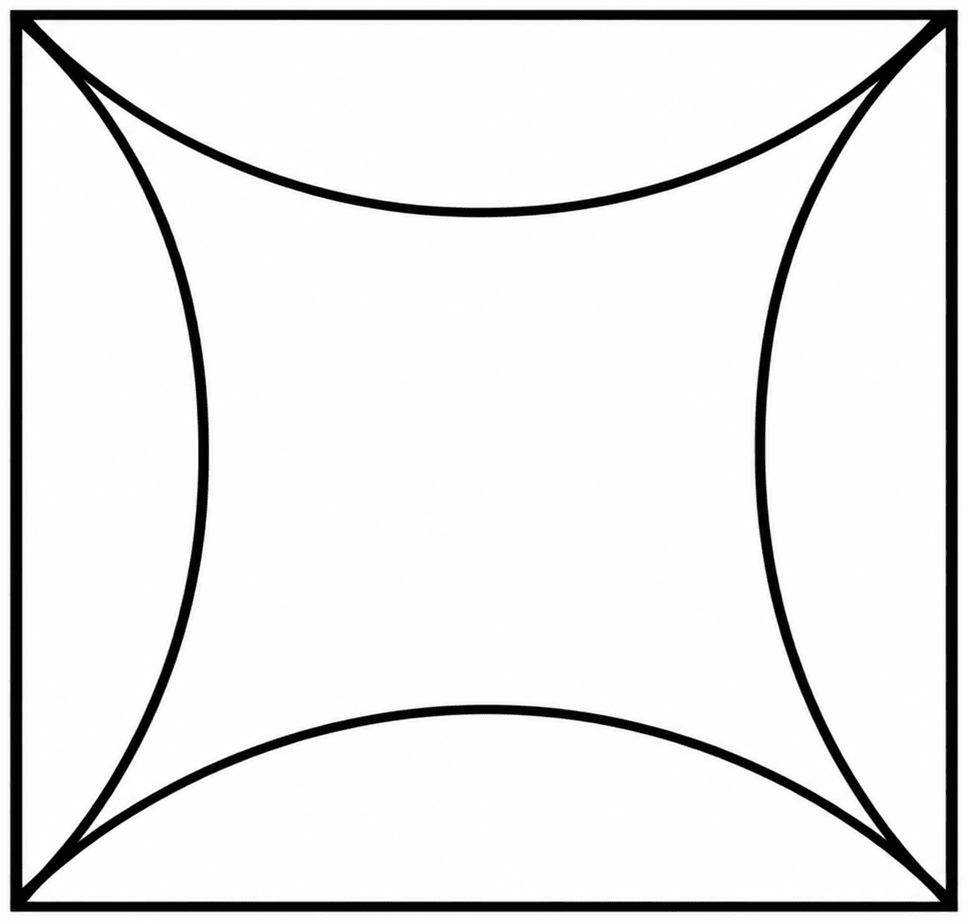
Hint: Think where the tip of the compass can be placed to get all the 4 arcs to bulge uniformly from each of the sides. Try it out!
Answer
Each arc starts at one corner of the square and ends at the next corner, and it bulges inwards, towards the centre of the square.
Since the two ends of an arc are the two corners of a side, the tip of the compass must be at a point which is at the same distance from both these corners. Such points lie on the perpendicular bisector of that side, that is, on the line joining the midpoints of the two opposite sides.
Also, the arc has to bulge into the square. So the tip of the compass must be placed on this line outside the square, beyond that side.
For all the 4 arcs to bulge uniformly, the same distance must be used for all four sides.
Steps of construction:
- Construct a square ABCD of side 8 cm.
- Mark the midpoints P, Q, R and S of AB, BC, CD and DA respectively. Join PR and QS. They meet at the centre O of the square.
- Extend PR beyond P and mark P′ outside the square such that PP′ = 3 cm. In the same way mark R′ beyond R with RR′ = 3 cm, Q′ beyond Q with QQ′ = 3 cm, and S′ beyond S with SS′ = 3 cm.
- With P′ as centre and radius P′A, draw the arc from A to B.
- With Q′ as centre and radius Q′B, draw the arc from B to C.
- With R′ as centre and radius R′C, draw the arc from C to D.
- With S′ as centre and radius S′D, draw the arc from D to A.
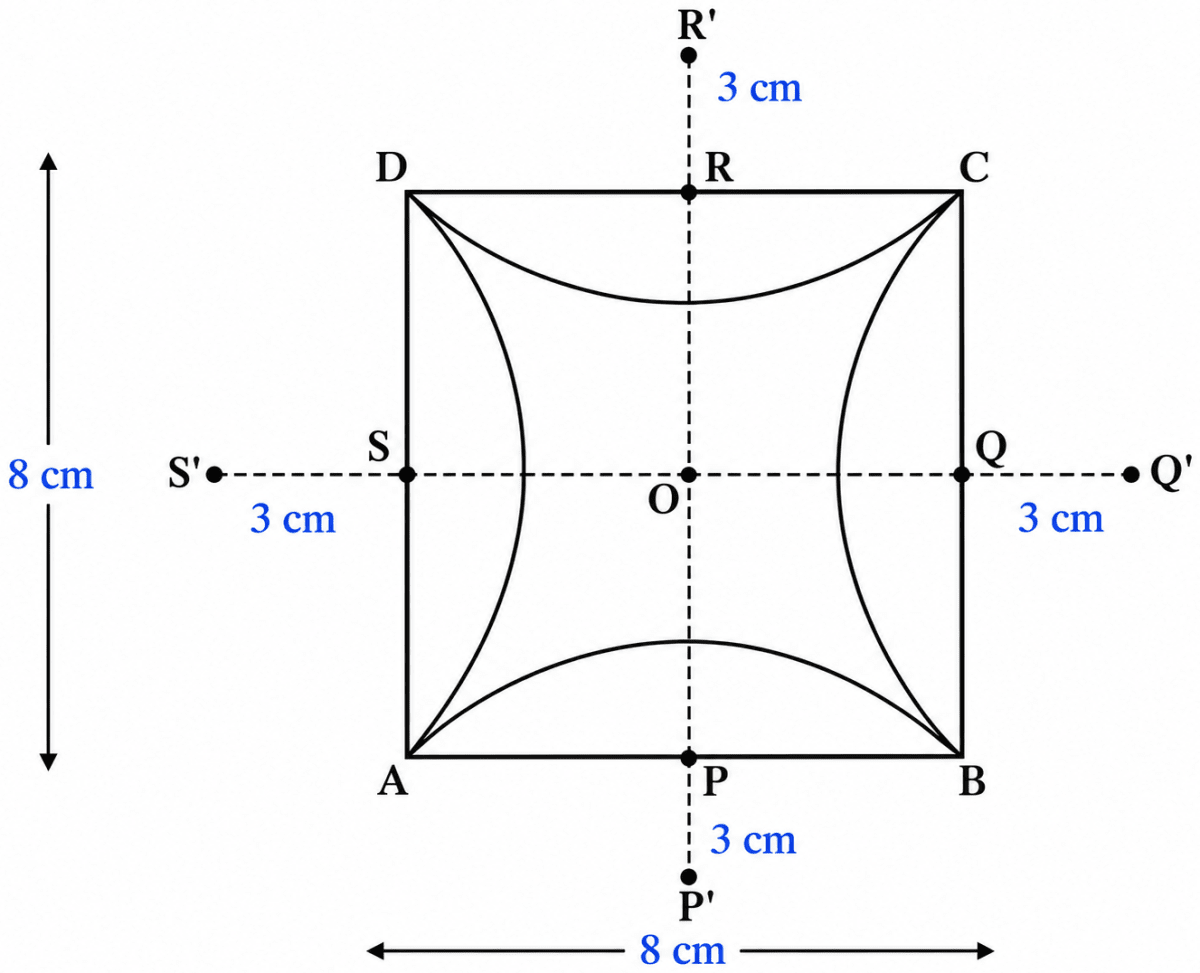
Radius to be taken in the compass:
P is the midpoint of AB, so PA = = 4 cm, and PP′ = 3 cm with P′P ⟂ AB.
The same value is obtained at the other three sides, so all the four arcs are drawn with the radius 5 cm.
The deepest point of each arc is at a distance of 5 − 3 = 2 cm inside the corresponding side, and this is the same for all four sides.
Hence, the tip of the compass should be placed outside the square, on the line joining the midpoints of the opposite sides, at the same distance (here 3 cm) from each side; the radius then works out to 5 cm.
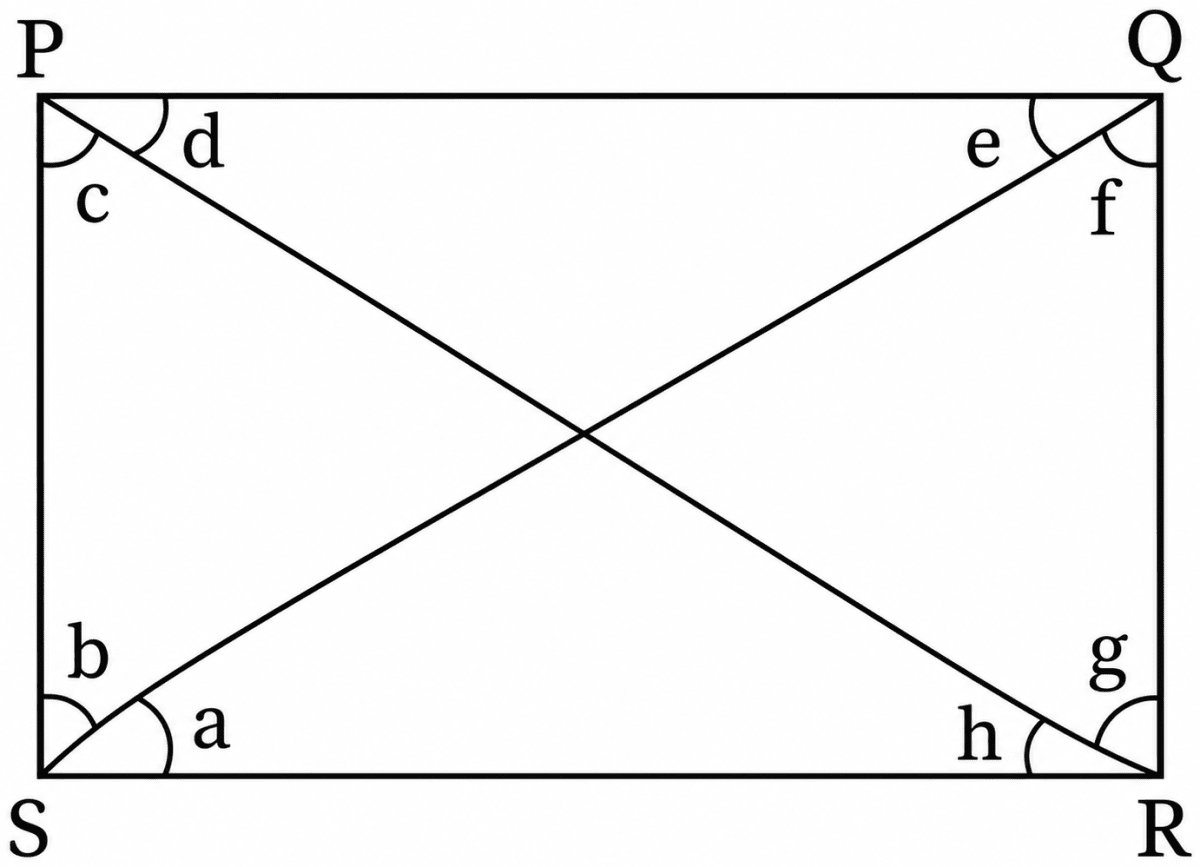
Compare the lengths of the diagonals. First predict the answer. Then construct a rectangle marking the points as shown and measure the diagonals.
Answer
Prediction: The two diagonals appear to be of the same length.
Construction and measurement:
Let us construct a rectangle PQRS with PQ = 6 cm and QR = 4 cm, and join PR and QS.
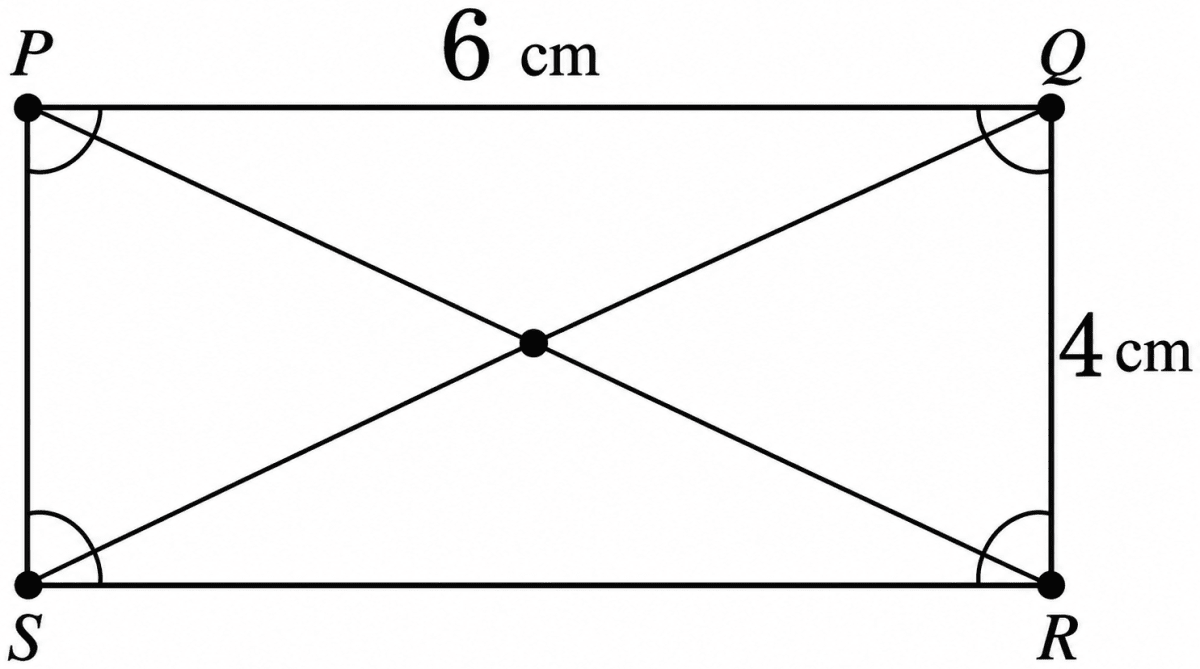
On measuring with a ruler:
PR = 7.2 cm and QS = 7.2 cm
⇒ PR = QS
The same is found for every rectangle that is tried, for example, for a rectangle of sides 8 cm and 3 cm both diagonals measure about 8.5 cm.
∴ The two diagonals of a rectangle are equal in length.
Observe that a diagonal divides each of the pair of opposite angles into two smaller angles. In the figure, the diagonal PR divides angle R into two smaller angles which we simply call g and h. The diagonal also divides angle P into c and d. Are g and h equal? Are c and d equal?
First predict the answers, and then measure the angles. What do you observe? Identify pairs of angles that are equal.
Answer
Prediction: Since PQ is longer than QR, the diagonal does not look like it cuts the corner into two equal halves, so g and h should not be equal, and c and d should not be equal.
Measurement:
For the rectangle PQRS with PQ = 6 cm and QR = 4 cm, the eight angles measure:
| Angle | a | b | c | d | e | f | g | h |
|---|---|---|---|---|---|---|---|---|
| Measure | 34° | 56° | 56° | 34° | 34° | 56° | 56° | 34° |
Observations:
g = 56° and h = 34°, so g ≠ h.
c = 56° and d = 34°, so c ≠ d.
But g + h = 56° + 34° = 90° and c + d = 56° + 34° = 90°, which is as expected, since each angle of a rectangle is 90°.
Pairs of equal angles:
a = d = e = h = 34°
b = c = f = g = 56°
Reason:
PQ and SR are opposite sides of the rectangle, so PQ ∥ SR. Taking PR as the transversal, the alternate angles are equal.
⇒ d = h
PS and QR are opposite sides, so PS ∥ QR. Taking PR as the transversal,
⇒ c = g
Let the diagonals meet at O. The diagonals of a rectangle are equal and they cut each other into two equal parts, so OP = OQ = OR = OS.
In △OPQ, OP = OQ ⇒ d = e, and in △OPS, OP = OS ⇒ c = b.
∴ a = d = e = h and b = c = f = g, while g ≠ h and c ≠ d.
How should the rectangle be constructed so that the diagonal divides the opposite angles into equal parts?
Answer
The diagonal will divide the opposite angles into equal parts only when c = d, that is, when each part measures = 45°.
In the rectangle PQRS, the angle c depends on how long PQ is compared with PS. As PQ is made shorter, c becomes smaller and d becomes larger. The two become equal exactly when PQ = PS, that is, when the two adjacent sides are equal.
If the two adjacent sides are equal, then by property R1 all the four sides become equal, and by property R2 all the angles are already 90°.
⇒ The rectangle becomes a square.
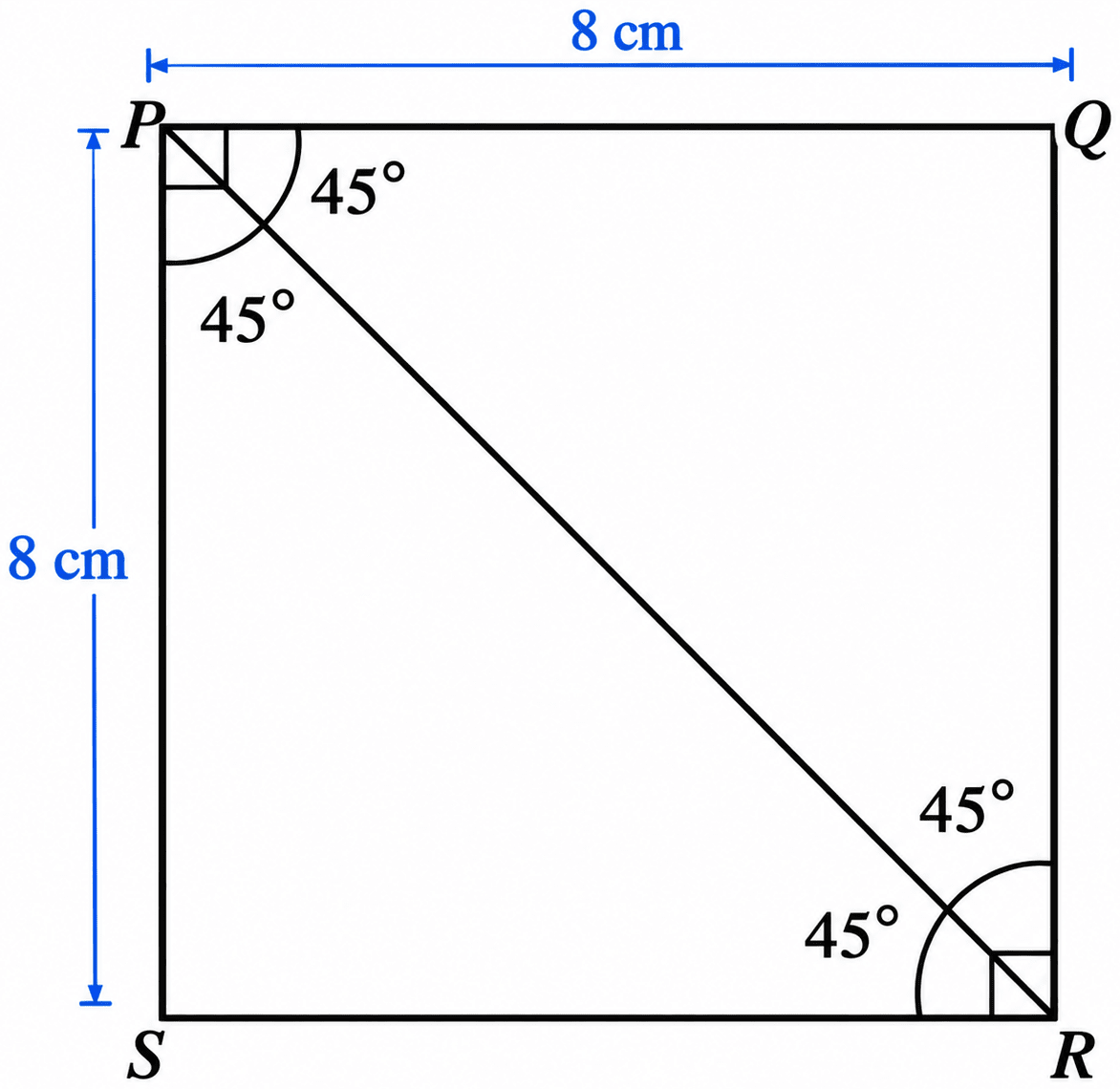
Hence, the rectangle should be constructed with its adjacent sides equal, that is, it should be constructed as a square; then each diagonal divides the opposite angles into two equal parts of 45° each.
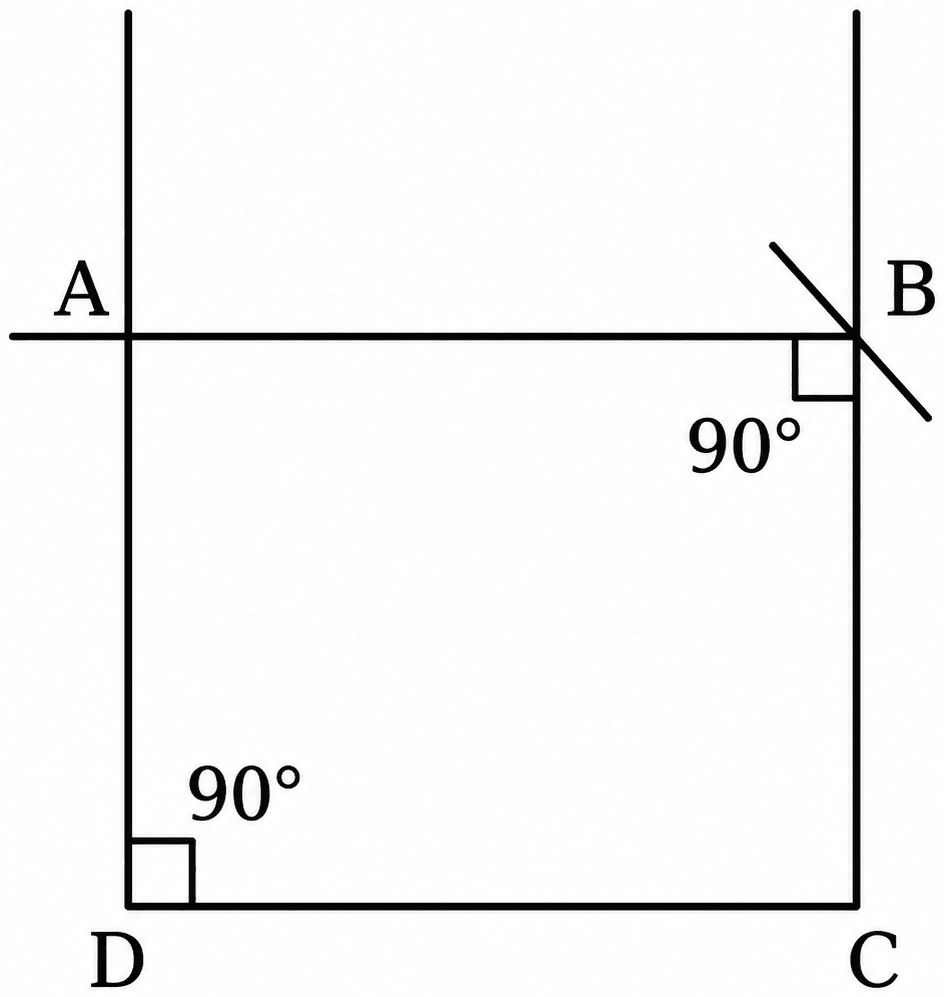
Check if ABCD is indeed a rectangle satisfying properties R1 and R2.
Answer
Property R1: The opposite sides are equal in length.
On measuring the sides of the figure obtained, we get:
| Pair of opposite sides | Measurements | Conclusion |
|---|---|---|
| AB and DC | AB = 5 cm, DC = 5 cm | AB = DC |
| AD and BC | AD ≈ 4.9 cm, BC ≈ 4.9 cm | AD = BC |
⇒ Both pairs of opposite sides are equal, so R1 is satisfied.
Property R2: All the angles are 90°.
| Angle | Reason it is 90° |
|---|---|
| ∠C | The line l was drawn perpendicular to DC at C |
| ∠D | A lies on the perpendicular drawn to DC at D |
| ∠B | A lies on the perpendicular drawn to BC at B |
| ∠A | Measured and found to be 90° |
⇒ All four angles are right angles, so R2 is satisfied.
∴ ABCD satisfies both R1 and R2, and hence it is indeed a rectangle.
Construct a rectangle in which one of the diagonals divides the opposite angles into 50° and 40°.
Answer
Let ABCD be the required rectangle in which the diagonal AC divides ∠A into 50° and 40°.
Since ∠A = 90°, if ∠BAC = 50°, then ∠DAC = 90° − 50° = 40°.
Steps of construction:
- Draw a line segment AB of any convenient length (here AB = 5 cm is taken).
- At B, construct BX ⟂ AB.
- At A, draw a ray AY making ∠BAY = 50° with AB, using a protractor.
- Let the ray AY meet BX at C. Join AC.
- At A, draw AZ ⟂ AB.
- With A as centre and radius equal to BC, draw an arc cutting AZ at D.
- Join CD.
Then, ABCD is the required rectangle.
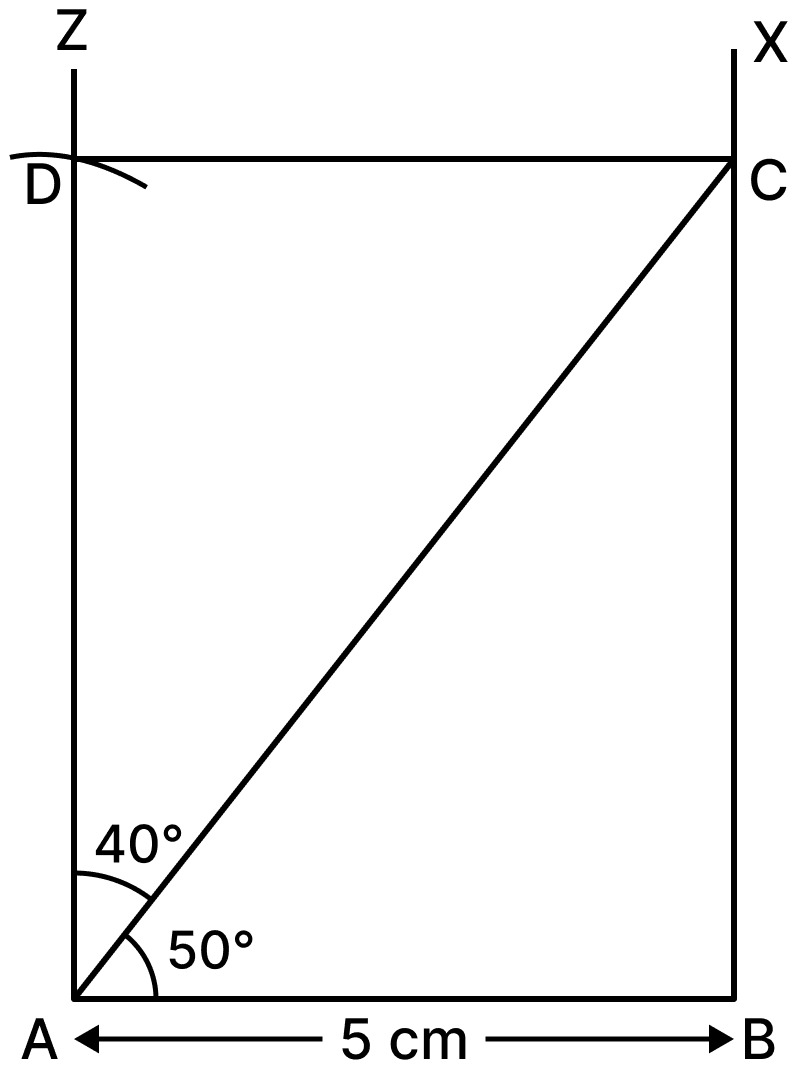
Verification:
In △ABC, ∠ABC = 90° and ∠BAC = 50°.
⇒ ∠BCA = 180° − 90° − 50° = 40°
Also, ∠DAC = 90° − 50° = 40° and ∠DCA = 90° − 40° = 50°.
∴ The diagonal AC divides the opposite angles ∠A and ∠C into 50° and 40°.
Construct a rectangle in which one of the diagonals divides the opposite angles into 45° and 45°. What do you observe about the sides?
Answer
Let ABCD be the required rectangle in which the diagonal AC divides ∠A into 45° and 45°.
Steps of construction:
- Draw a line segment AB of any convenient length (here AB = 5 cm is taken).
- At B, construct BX ⟂ AB.
- At A, construct AZ ⟂ AB.
- Bisect the right angle ∠BAZ. For this, with A as centre and any convenient radius, draw an arc cutting AB at P and AZ at Q; then with P and Q as centres and radius more than half of PQ, draw two arcs cutting each other at R. Join AR and produce it.
- Let the ray AR meet BX at C. Then ∠BAC = 45°. Join AC.
- With A as centre and radius equal to BC, draw an arc cutting AZ at D.
- Join CD.
Then, ABCD is the required rectangle.
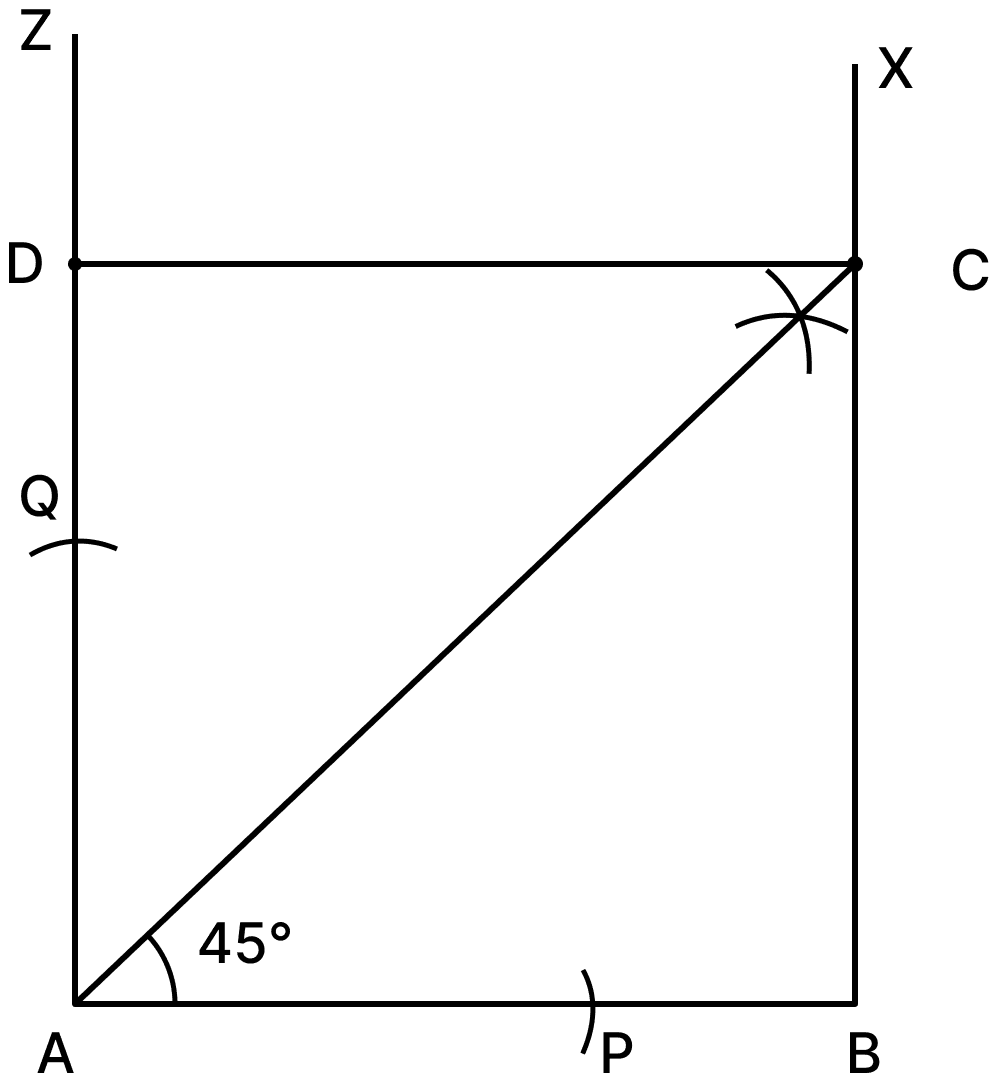
Observation about the sides:
In △ABC, ∠ABC = 90° and ∠BAC = 45°.
⇒ ∠BCA = 180° − 90° − 45° = 45°
⇒ ∠BAC = ∠BCA
⇒ △ABC is an isosceles triangle, so the sides opposite these equal angles are equal.
⇒ AB = BC
So two adjacent sides of the rectangle are equal. Since the opposite sides of a rectangle are also equal, we get:
AB = BC = CD = DA
⇒ All four sides are equal and all four angles are 90°.
∴ When a diagonal divides the opposite angles into 45° and 45°, all the sides of the rectangle are equal, that is, the rectangle is a square.
Construct a rectangle one of whose sides is 4 cm and the diagonal is of length 8 cm.
Answer
Let ABCD be the required rectangle with DC = 4 cm and diagonal DB = 8 cm.
Steps of construction:
- Draw a line segment DC = 4 cm.
- At C, construct a line l perpendicular to DC. The point B lies on this line.
- With D as centre and radius 8 cm, draw an arc cutting the line l at B.
- Join DB. This is the required diagonal of length 8 cm.
- At B, draw a perpendicular to BC and at D, draw a perpendicular to DC. Let these perpendiculars meet at A.
- ABCD is the required rectangle.
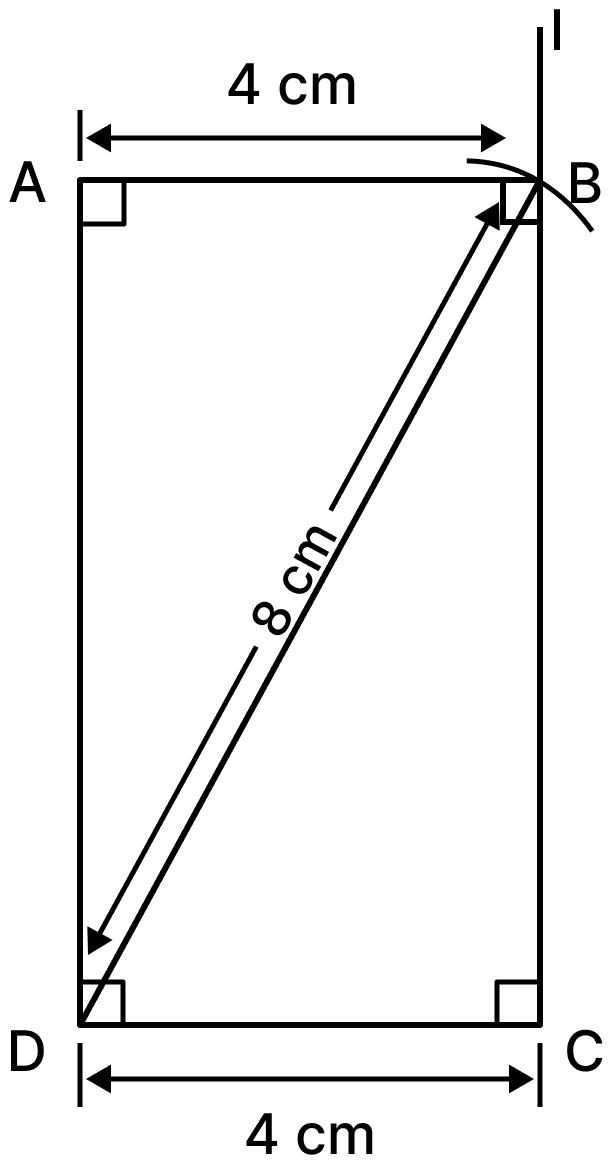
Verification:
On measuring, DC = AB = 4 cm, BC = AD ≈ 6.9 cm, DB = 8 cm and each angle is 90°.
∴ ABCD is the required rectangle with one side 4 cm and diagonal 8 cm.
Construct a rectangle one of whose sides is 3 cm and the diagonal is of length 7 cm.
Answer
Let ABCD be the required rectangle with DC = 3 cm and diagonal DB = 7 cm.
Steps of construction:
- Draw a line segment DC = 3 cm.
- At C, construct a line l perpendicular to DC. The point B lies on this line.
- With D as centre and radius 7 cm, draw an arc cutting the line l at B.
- Join DB. This is the required diagonal of length 7 cm.
- At B, draw a perpendicular to BC and at D, draw a perpendicular to DC. Let these perpendiculars meet at A.
- ABCD is the required rectangle.
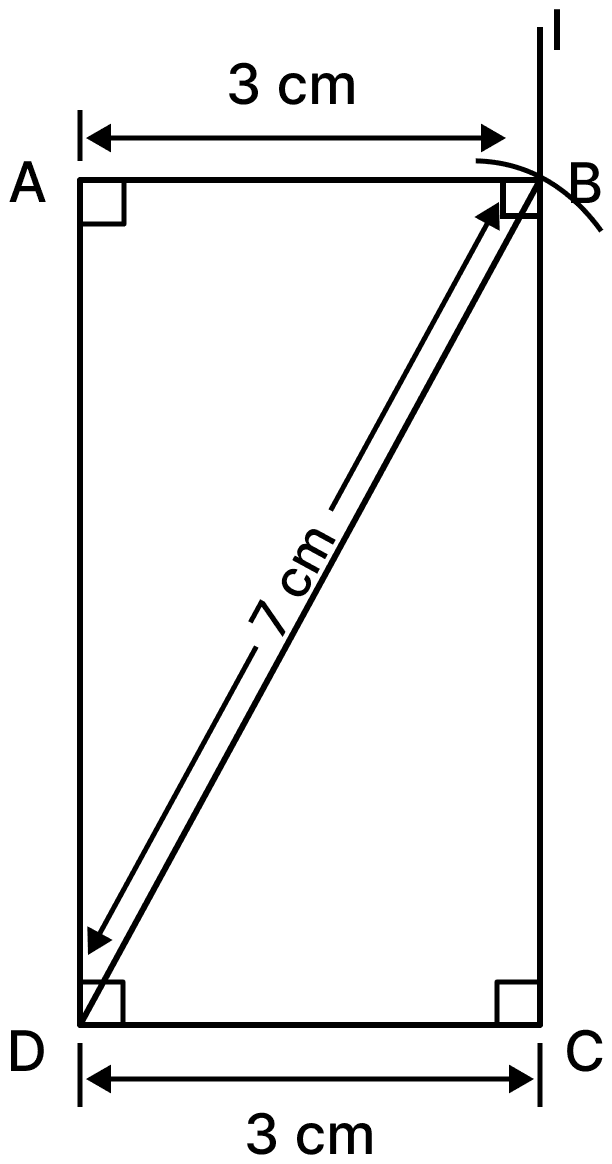
Verification:
On measuring, DC = AB = 3 cm, BC = AD ≈ 6.3 cm, DB = 7 cm and each angle is 90°.
∴ ABCD is the required rectangle with one side 3 cm and diagonal 7 cm.
Construct a bigger house in which all the sides are of length 7 cm.
Answer
The boundary segments of the larger house are 7 cm each. The door dimensions may be chosen separately; here a width of 1.4 cm and height of 2.8 cm are used, as in the supplied construction drawing.
Steps of construction:
- Draw a line segment DE = 7 cm.
- At D, construct a perpendicular to DE and mark the point B on it such that DB = 7 cm.
- At E, construct a perpendicular to DE and mark the point C on it such that EC = 7 cm.
- On DE, mark a point P at a distance of 2.8 cm from D, and then mark a point Q on DE such that PQ = 1.4 cm.
- At P and Q, construct perpendiculars to DE of length 2.8 cm each, meeting at R and S respectively. Join RS to complete the door PQSR.
- With B as centre and radius 7 cm, draw an arc above BC.
- With C as centre and the same radius 7 cm, draw another arc cutting the previous arc at A.
- Join AB and AC.
- With A as centre and radius 7 cm, draw an arc from B to C.
Here DB = EC = 7 cm and both are perpendicular to DE = 7 cm.
⇒ BC = DE = 7 cm
⇒ AB = AC = BC = 7 cm
∴ Every line forming the border of the house is of length 7 cm, and △ABC is an equilateral triangle of side 7 cm.
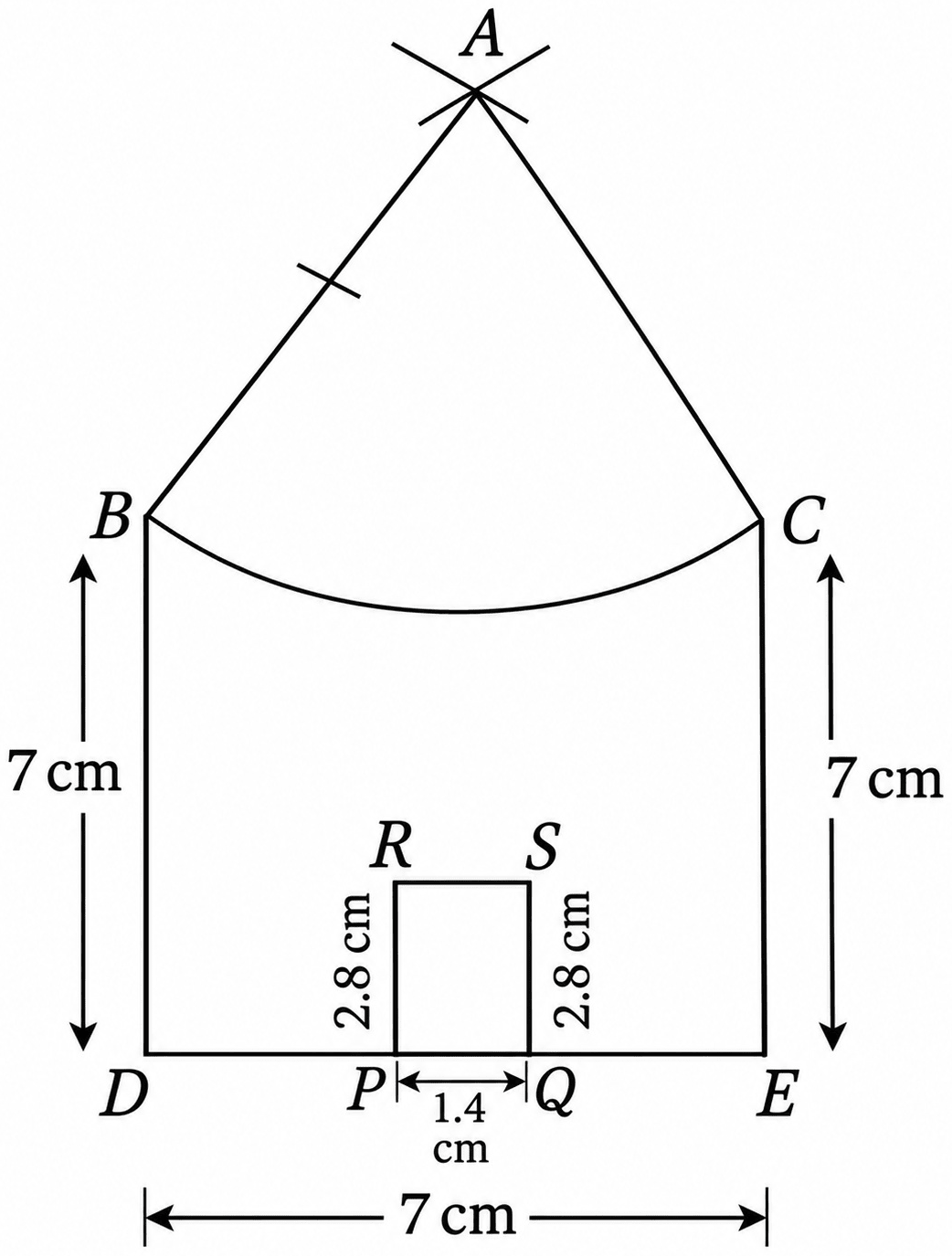
Hence, the bigger house of side 7 cm is constructed.
Try to recreate ‘A Person’, ‘Wavy Wave’, and ‘Eyes’ from the section ‘Artwork’, using ideas involved in the ‘House’ construction.
Answer
To draw a curve through two given points, first fix the centre of that curve as the point which is at an equal chosen distance from both the given points, by cutting two arcs of that same radius drawn from the two points.
Method notes:
1. A Person
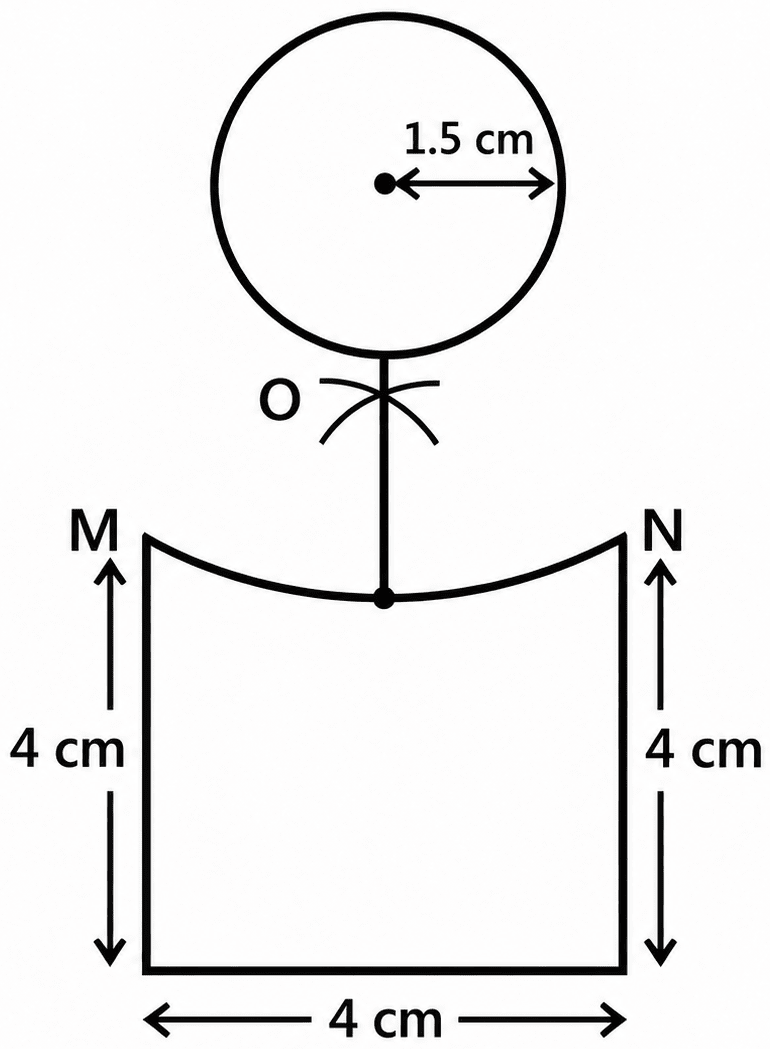
- Draw a circle of any convenient radius (say 1.5 cm) for the head.
- From the lowest point of this circle, draw a short vertical line segment downwards for the neck.
- Below the neck, draw a square of any convenient side (say 4 cm) for the body, but do not draw its top side; mark its two upper corners as M and N.
- Choose a convenient radius greater than half of MN (say 3 cm). With M as centre draw an arc above MN, and with N as centre and the same radius draw another arc cutting it at O.
- With O as centre and the same radius 3 cm, draw the arc from M to N. As OM = ON = 3 cm, this arc passes through M and N and dips downwards, giving the curved shoulders.
2. Wavy Wave
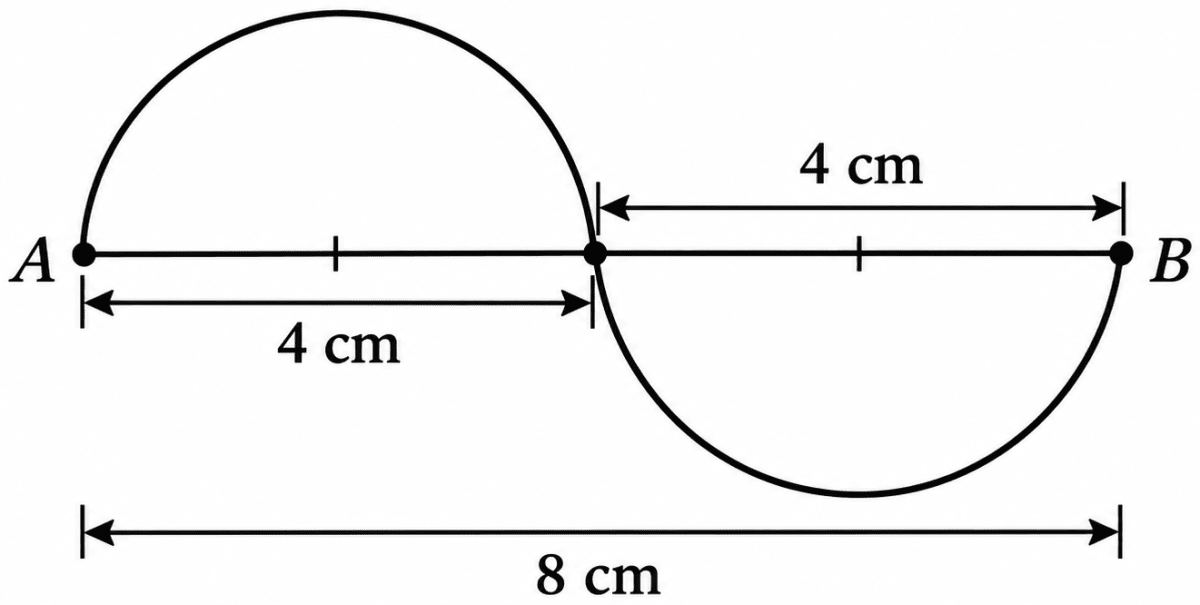
- Draw the central line AB = 8 cm and mark its mid-point X, so that AX = XB = 4 cm.
- Mark the mid-point of AX. With this mid-point as centre and radius cm, draw a semicircle above AX.
- Mark the mid-point of XB. With this mid-point as centre and the same radius 2 cm, draw a semicircle below XB.
- The two semicircles together give the wavy wave. Since the same radius is used for both, the two waves come out identical.
3. Eyes
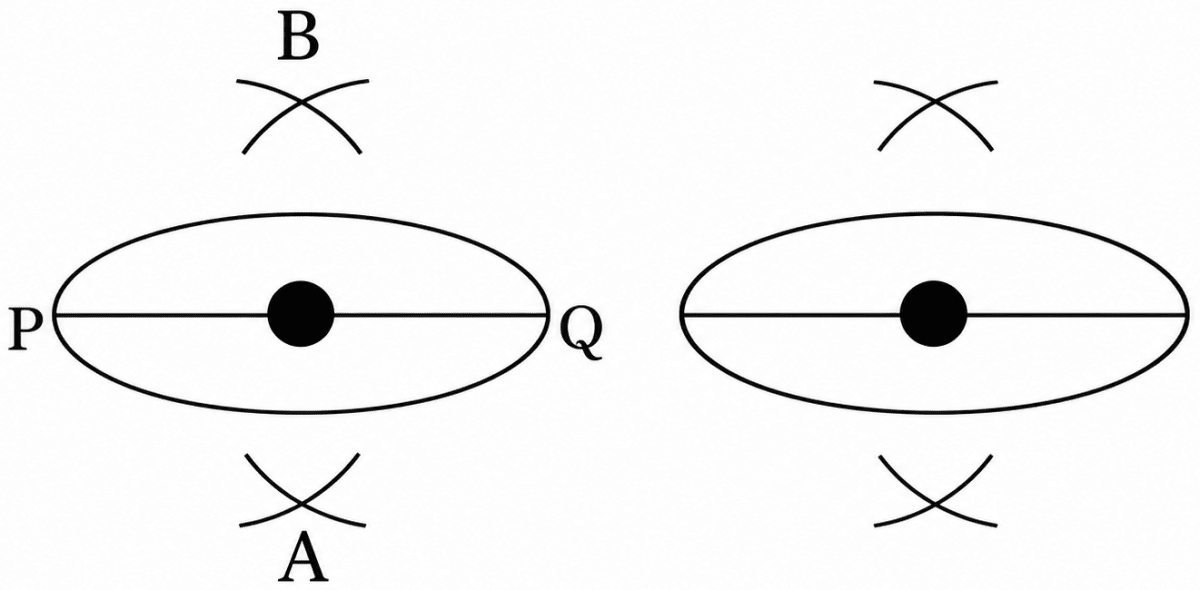
- Draw a line segment PQ of any convenient length (say 3 cm). P and Q are the two pointed corners of the eye.
- Choose a convenient radius greater than half of PQ (say 2.5 cm). With P as centre draw arcs above and below PQ, and with Q as centre and the same radius draw arcs cutting them at A (below PQ) and B (above PQ).
- With A as centre and radius 2.5 cm, draw the arc from P to Q. This is the upper curve of the eye.
- With B as centre and the same radius 2.5 cm, draw the arc from P to Q. This is the lower curve of the eye.
- Since the same radius has been used for both arcs, A and B lie at equal distances on either side of PQ, and so the two curves together form a symmetrical eye shape.
- Mark the mid-point of PQ and, with it as centre, draw a small circle of radius about 0.5 cm and shade it to make the pupil.
- Repeat the same steps beside it, using the same lengths and the same radii, to get the second identical eye.
Is there a 4-sided figure in which all the sides are equal in length but is not a square? If such a figure exists, can you construct it?
Answer
Yes, such a figure exists.
A square needs two properties:
(S1) All the sides are equal, and
(S2) All the angles are 90°.
If a 4-sided figure satisfies S1 but not S2, then it has all its sides equal and yet it is not a square. Such a figure is called a rhombus.
Let us construct one in which each side is 5 cm, using the idea of the ‘House’ construction.
Steps of construction:
- Draw a line segment AB = 5 cm.
- At A, draw a ray AC making an angle other than 90° with AB (say 60°), and mark the point C on it such that AC = 5 cm.
- With B as centre and radius 5 cm, draw an arc on the side of BC away from A.
- With C as centre and the same radius 5 cm, draw another arc cutting the previous arc at D.
- Join BD and CD.
Then ABDC is the required figure.
Here AB = AC = 5 cm by construction, and BD = CD = 5 cm as they are radii of the two arcs of radius 5 cm.
⇒ AB = BD = DC = CA = 5 cm
But ∠BAC = 60° ≠ 90°.
∴ ABDC has all its four sides equal, yet it is not a square.
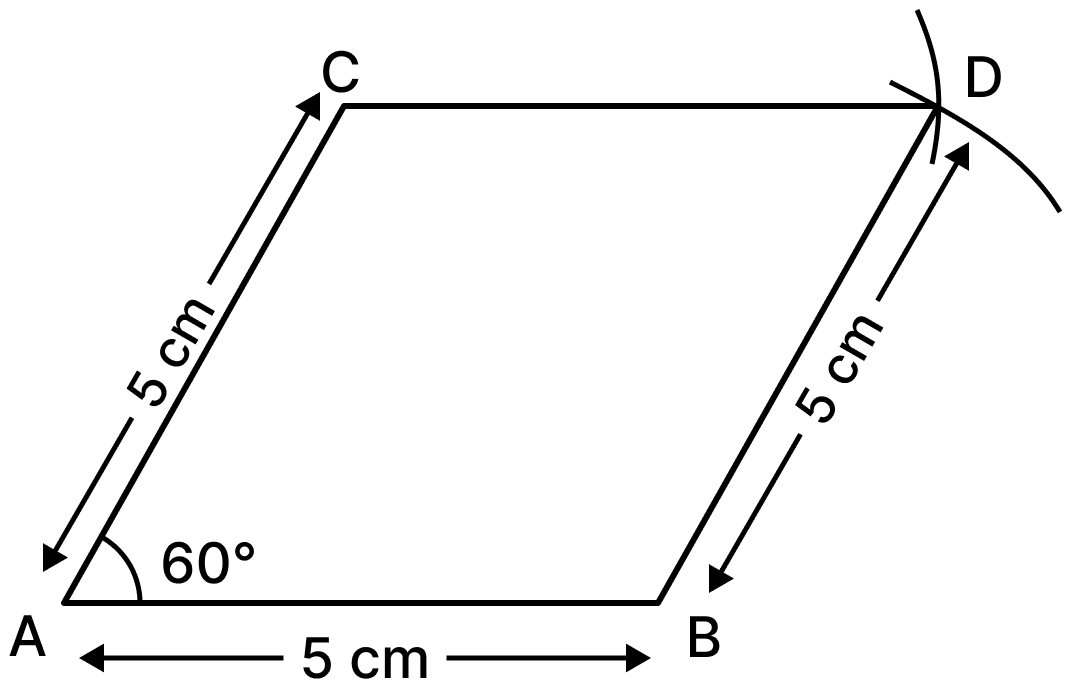
Hence, a 4-sided figure with all sides equal which is not a square does exist, and it is the rhombus ABDC constructed above.