
Find the missing terms:
(a) Perimeter of a rectangle = 14 cm; breadth = 2 cm; length = ?.
(b) Perimeter of a square = 20 cm; side of a length = ?.
(c) Perimeter of a rectangle = 12 m; length = 3 m; breadth = ?.
Answer
(a)
Given:
Perimeter of rectangle = 14 cm
breadth = 2 cm
Perimeter of rectangle = 2(length + breadth)
14 cm = 2(length + 2 cm) [Substituting the values]
14 cm = (2 × length + 2 × 2 cm)
14 cm = 2 × length + 4 cm
14 cm - 4 cm = 2 × length
10 cm = 2 × length
⇒ length = cm
⇒ length = 5 cm
Length of the rectangle = 5 cm
(b)
Given:
Perimeter of square = 20 cm
Perimeter of square = 4 × side
20 cm = 4 × side [Substituting the value]
⇒ side = cm
⇒ side = 5 cm
Length of a side of the square = 5 cm
(c)
Given:
Perimeter of rectangle = 12 m
length = 3 m
Perimeter of rectangle = 2(length + breadth)
12 m = 2(3 m + breadth) [Substituting the values]
12 m = (2 × 3 m + 2 × breadth)
12 m = 6 m + 2 × breadth
12 m - 6 m = 2 × breadth
6 m = 2 × breadth
⇒ breadth = m
⇒ breadth = 3 m
Breadth of the rectangle = 3 m
A rectangle having sidelengths 5 cm and 3 cm is made using a piece of wire. If the wire is straightened and then bent to form a square, what will be the length of a side of the square?
Answer
Given:
length of the rectangle = 5 cm
breadth of the rectangle = 3 cm
When a wire is reshaped, its total length (perimeter) remains the same.
Perimeter of rectangle = 2(length + breadth)
= 2(5 cm + 3 cm) [Substituting the values]
= 2(8 cm)
= 16 cm
So, the length of the wire = 16 cm.
Now this same wire is bent to form a square, so the perimeter of the square is also 16 cm.
Perimeter of a square = 4 × side
16 cm = 4 × side [Substituting the value]
⇒ side = cm
⇒ side = 4 cm
Length of a side of the square = 4 cm
Find the length of the third side of a triangle having a perimeter of 55 cm and having two sides of length 20 cm and 14 cm, respectively.
Answer
Given:
Perimeter of the triangle = 55 cm
First side = 20 cm
Second side = 14 cm
Perimeter of a triangle = sum of the lengths of its three sides
55 cm = 20 cm + 14 cm + third side [Substituting the values]
55 cm = 34 cm + third side
⇒ third side = 55 cm - 34 cm
⇒ third side = 21 cm
Length of the third side of the triangle = 21 cm
What would be the cost of fencing a rectangular park whose length is 150 m and breadth is 120 m, if the fence costs ₹40 per metre?
Answer
Given:
length = 150 m
breadth = 120 m
Rate = ₹40 per metre
Fencing is done along the boundary, so we first need to find the perimeter.
Perimeter of rectangle = 2(length + breadth)
= 2(150 m + 120 m) [Substituting the values]
= 2(270 m)
= 540 m
Total cost = Perimeter × Rate
= 540 m × ₹40
= ₹21,600
Total cost of fencing a rectangular park = ₹21,600.
A piece of string is 36 cm long. What will be the length of each side, if it is used to form:
(a) A square,
(b) A triangle with all sides of equal length, and
(c) A hexagon (a six sided closed figure) with sides of equal length?
Answer
Given:
Length of the string = 36 cm
The whole string is used to form each figure, so the perimeter of each figure = 36 cm.
(a) A square
A square has 4 equal sides.
Perimeter of a square = 4 × side
36 cm = 4 × side [Substituting the value]
⇒ side = cm
⇒ side = 9 cm
Length of each side of the square = 9 cm
(b) A triangle with all sides of equal length
An equilateral triangle has 3 equal sides.
Perimeter of an equilateral triangle = 3 × side
36 cm = 3 × side [Substituting the value]
⇒ side = cm
⇒ side = 12 cm
Length of each side of the triangle = 12 cm
(c) A hexagon with sides of equal length
A regular hexagon has 6 equal sides.
Perimeter of a regular hexagon = 6 × side
36 cm = 6 × side [Substituting the value]
⇒ side = cm
⇒ side = 6 cm
Length of each side of the hexagon = 6 cm
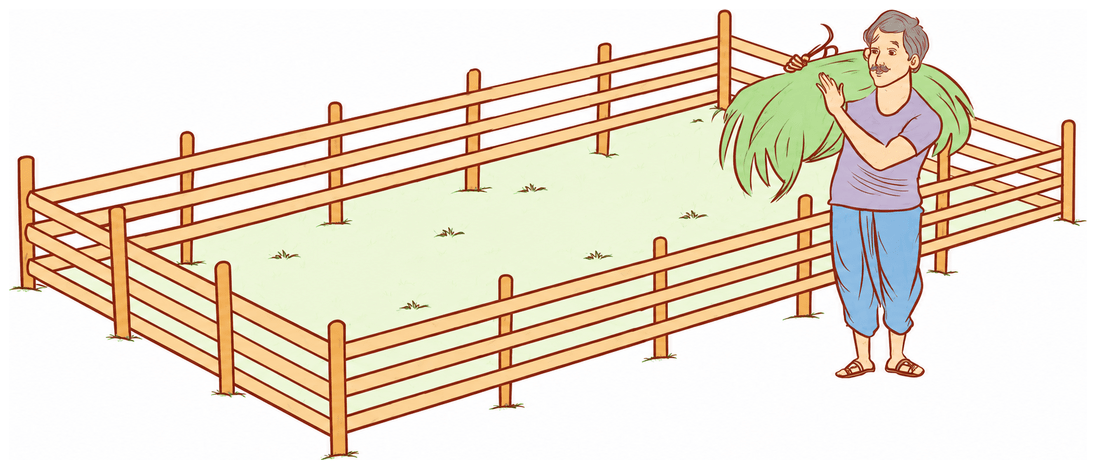
A farmer has a rectangular field having length 230 m and breadth 160 m. He wants to fence it with 3 rounds of rope as shown. What is the total length of rope needed?
Answer
Given:
length of the field = 230 m
breadth of the field = 160 m
Number of rounds of rope = 3
The rope goes along the boundary of the field, so the rope needed for one round is equal to the perimeter of the field.
Perimeter of rectangle = 2(length + breadth)
= 2(230 m + 160 m) [Substituting the values]
= 2(390 m)
= 780 m
Length of rope needed for 1 round = 780 m
Length of rope needed for 3 rounds = 3 × 780 m
= 2340 m
Total length of rope needed = 2340 m
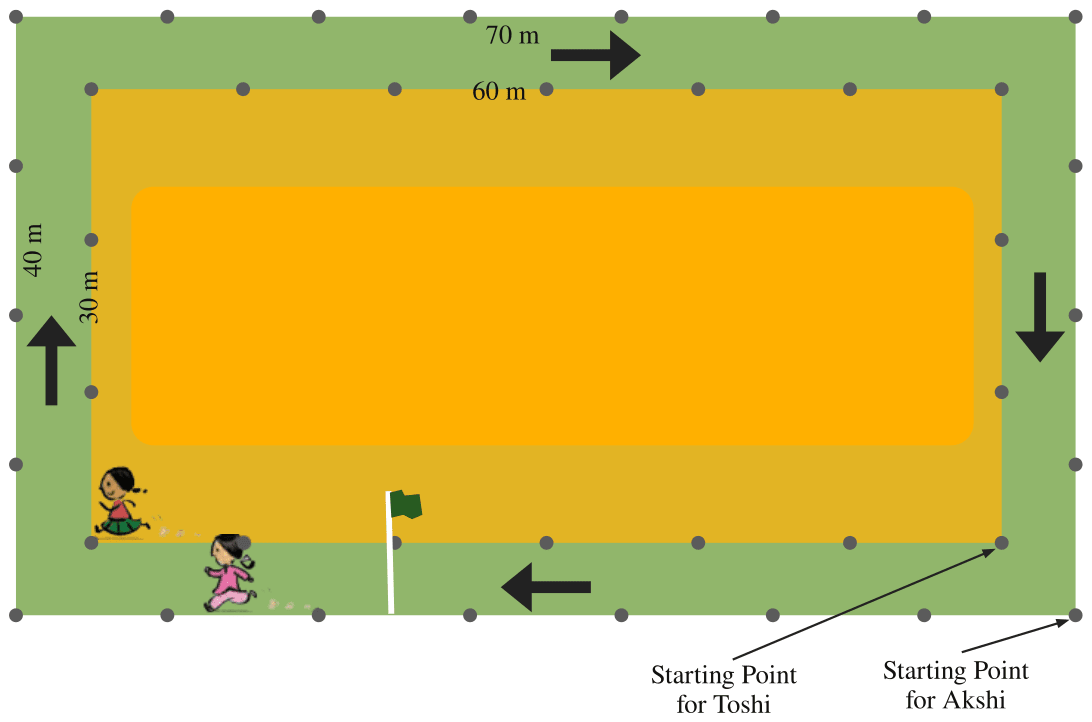
Akshi and Toshi start running along the rectangular tracks as shown in the figure. Akshi runs along the outer track and completes 5 rounds. Toshi runs along the inner track and completes 7 rounds. Now, they are wondering who ran more. Find out who ran the longer distance.
Answer
From the figure:
Akshi runs on the outer track, whose length = 70 m and breadth = 40 m.
Toshi runs on the inner track, whose length = 60 m and breadth = 30 m.
Distance covered in one round = perimeter of that track.
For Akshi (outer track):
Perimeter of rectangle = 2(length + breadth)
= 2(70 m + 40 m) [Substituting the values]
= 2(110 m)
= 220 m
Distance covered by Akshi in 5 rounds = 5 × 220 m
= 1100 m
For Toshi (inner track):
Perimeter of rectangle = 2(length + breadth)
= 2(60 m + 30 m) [Substituting the values]
= 2(90 m)
= 180 m
Distance covered by Toshi in 7 rounds = 7 × 180 m
= 1260 m
On comparing, 1260 m > 1100 m
Difference = 1260 m - 1100 m = 160 m
Toshi ran the longer distance. She ran 1260 m while Akshi ran 1100 m, i.e., Toshi ran 160 m more than Akshi.
Find out the total distance Akshi has covered in 5 rounds.
Answer
Given:
Akshi's track is a rectangle of length 70 m and breadth 40 m.
Distance covered in one round = Perimeter of the track
Perimeter of rectangle = 2(length + breadth)
= 2(70 m + 40 m) [Substituting the values]
= 2(110 m)
= 220 m
Total distance covered in 5 rounds = 5 × 220 m
= 1100 m
Total distance covered by Akshi in 5 rounds = 1100 m
Find out the total distance Toshi has covered in 7 rounds. Who ran a longer distance?
Answer
Given:
Toshi's track is a rectangle of length 60 m and breadth 30 m.
Distance covered in one round = Perimeter of the track
Perimeter of rectangle = 2(length + breadth)
= 2(60 m + 30 m) [Substituting the values]
= 2(90 m)
= 180 m
Total distance covered in 7 rounds = 7 × 180 m
= 1260 m
Distance covered by Akshi in 5 rounds = 1100 m
On comparing, 1260 m > 1100 m
Total distance covered by Toshi in 7 rounds = 1260 m, and Toshi ran the longer distance.
Think and mark the positions as directed—
(a) Mark 'A' at the point where Akshi will be after she ran 250 m.
(b) Mark 'B' at the point where Akshi will be after she ran 500 m.
(c) Now, Akshi ran 1000 m. How many full rounds has she finished running around her track? Mark her position as 'C'.
(d) Mark 'X' at the point where Toshi will be after she ran 250 m.
(e) Mark 'Y' at the point where Toshi will be after she ran 500 m.
(f) Now, Toshi ran 1000 m. How many full rounds has she finished running around her track? Mark her position as 'Z'.
Answer
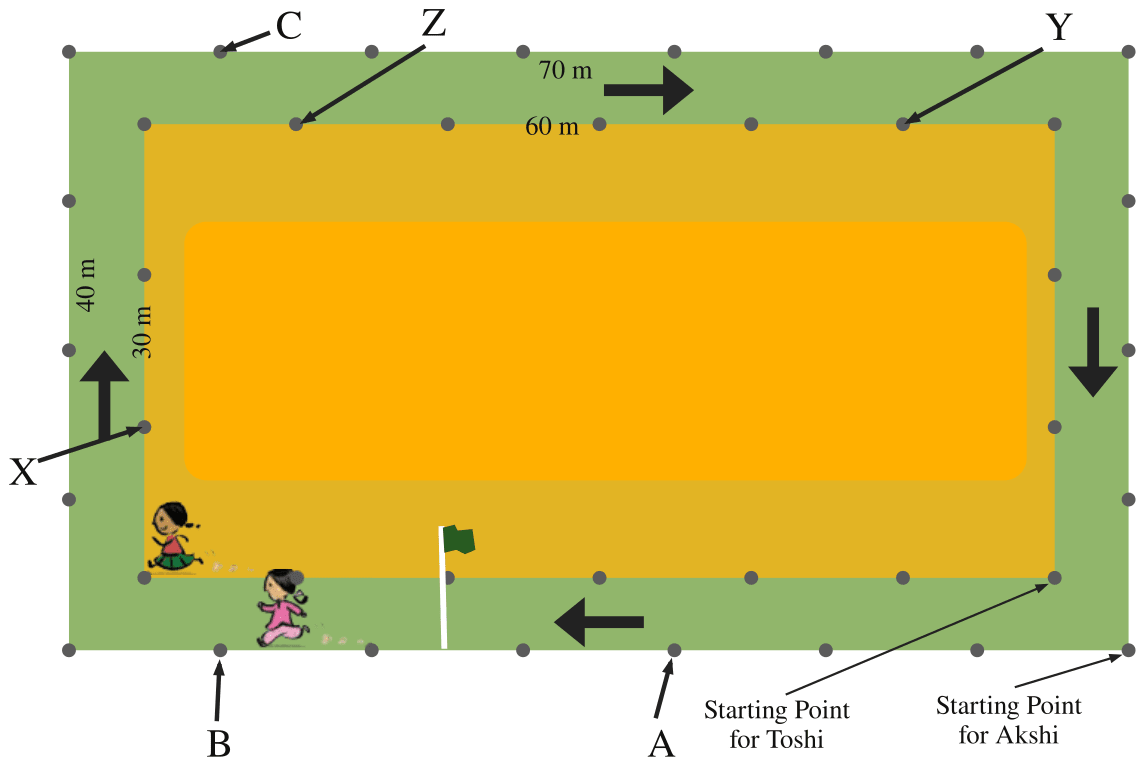
Akshi's track is a rectangle of length 70 m and breadth 40 m, so one round = 220 m.
Toshi's track is a rectangle of length 60 m and breadth 30 m, so one round = 180 m.
Both start from the right-hand corner of the lower side of their track and run along the lower side towards the left, as shown by the arrows.
(a) Akshi ran 250 m
250 m = 220 m + 30 m [220 m is one complete round]
So, Akshi completes 1 full round and then runs 30 m more.
These 30 m are covered along the lower side (which is 70 m long).
'A' is marked on the lower side of the outer track, 30 m from the starting point.
(b) Akshi ran 500 m
500 m = 2 × 220 m + 60 m
= 440 m + 60 m
So, Akshi completes 2 full rounds and then runs 60 m more.
These 60 m are covered along the lower side (which is 70 m long).
'B' is marked on the lower side of the outer track, 60 m from the starting point, i.e., 10 m before the left-hand corner.
(c) Akshi ran 1000 m
1000 m = 4 × 220 m + 120 m
= 880 m + 120 m
So, Akshi completes 4 full rounds and then runs 120 m more.
Out of these 120 m:
70 m are covered along the lower side, and she reaches the left-hand corner.
The next 40 m are covered along the left side, and she reaches the upper-left corner.
70 m + 40 m = 110 m, so 120 m - 110 m = 10 m are still left, which are covered along the upper side.
Akshi has finished 4 full rounds, and 'C' is marked on the upper side of the outer track, 10 m from the upper-left corner.
(d) Toshi ran 250 m
250 m = 180 m + 70 m [180 m is one complete round]
So, Toshi completes 1 full round and then runs 70 m more.
Out of these 70 m:
60 m are covered along the lower side, and she reaches the left-hand corner.
70 m - 60 m = 10 m are still left, which are covered along the left side.
'X' is marked on the left side of the inner track, 10 m above the lower-left corner.
(e) Toshi ran 500 m
500 m = 2 × 180 m + 140 m
= 360 m + 140 m
So, Toshi completes 2 full rounds and then runs 140 m more.
Out of these 140 m:
60 m are covered along the lower side and 30 m along the left side, and she reaches the upper-left corner.
60 m + 30 m = 90 m, so 140 m - 90 m = 50 m are still left, which are covered along the upper side.
'Y' is marked on the upper side of the inner track, 50 m from the upper-left corner, i.e., 10 m before the upper-right corner.
(f) Toshi ran 1000 m
1000 m = 5 × 180 m + 100 m
= 900 m + 100 m
So, Toshi completes 5 full rounds and then runs 100 m more.
Out of these 100 m:
60 m are covered along the lower side and 30 m along the left side, and she reaches the upper-left corner.
60 m + 30 m = 90 m, so 100 m - 90 m = 10 m are still left, which are covered along the upper side.
Toshi has finished 5 full rounds, and 'Z' is marked on the upper side of the inner track, 10 m from the upper-left corner.
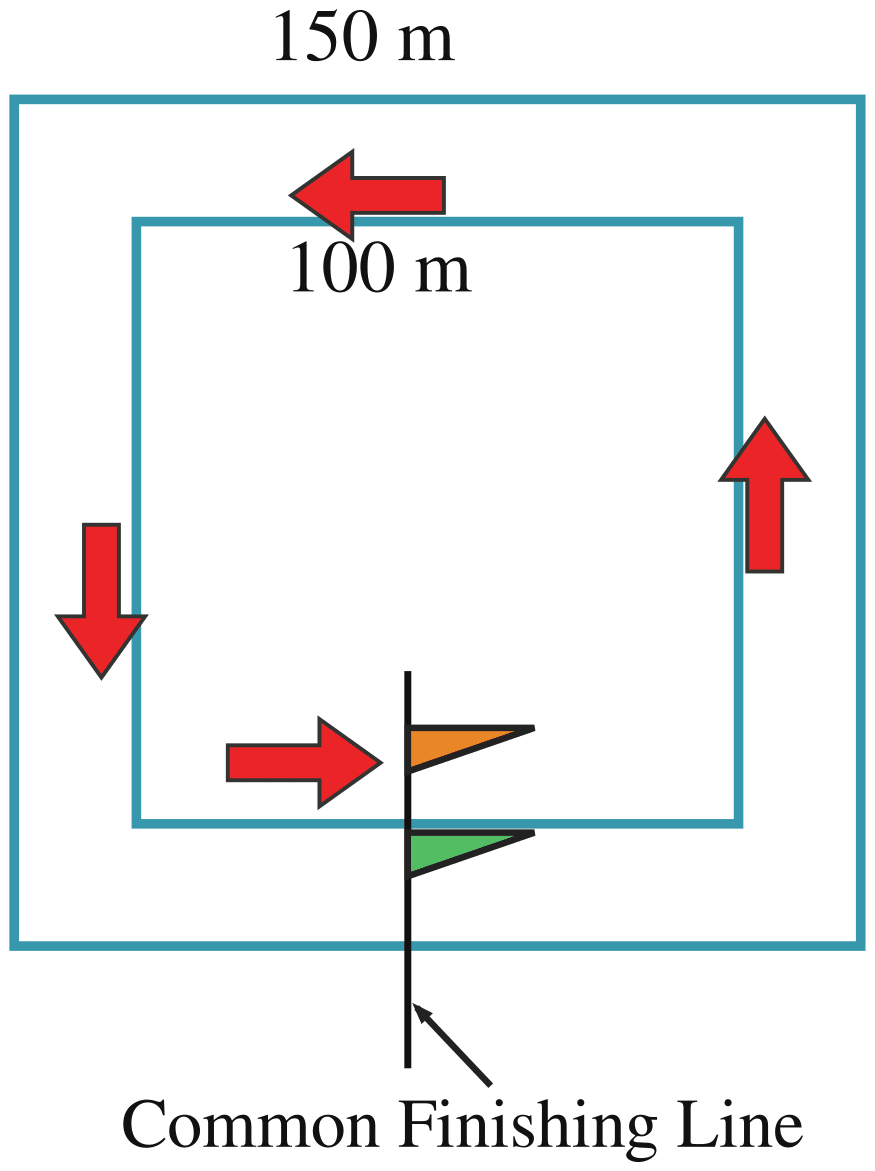
In races, usually there is a common finish line for all the runners. Here are two square running tracks with the inner track of 100 m each side and outer track of 150 m each side. The common finishing line for both runners is shown by the flags in the figure which are in the center of one of the sides of the tracks.
If the total race is of 350 m, then we have to find out where the starting positions of the two runners should be on these two tracks so that they both have a common finishing line after they run for 350 m. Mark the starting points of the runner on the inner track as 'A' and the runner on the outer track as 'B'.
Answer
To find a starting point, we move backwards from the common finishing line, against the direction of running, through a distance of 350 m.
For the runner on the inner track:
Side of the inner square track = 100 m
Perimeter of a square = 4 × side
= 4 × 100 m [Substituting the value]
= 400 m
The flag is at the middle of the lower side, so it is at a distance of m = 50 m from each corner of that side.
Moving backwards from the finishing line:
50 m are covered along the lower side, and we reach the lower-left corner.
350 m - 50 m = 300 m are still left.
300 m = 100 m + 100 m + 100 m, which are covered along the left side, the upper side and the right side.
So, we reach the lower-right corner of the inner track.
'A' is marked at the lower-right corner of the inner track, i.e., 50 m ahead of the finishing line in the direction of running.
For the runner on the outer track:
Side of the outer square track = 150 m
Perimeter of a square = 4 × side
= 4 × 150 m [Substituting the value]
= 600 m
The flag is at the middle of the lower side, so it is at a distance of m = 75 m from each corner of that side.
Moving backwards from the finishing line:
75 m are covered along the lower side, and we reach the lower-left corner.
350 m - 75 m = 275 m are still left.
The next 150 m are covered along the left side, and we reach the upper-left corner.
275 m - 150 m = 125 m are still left, which are covered along the upper side.
'B' is marked on the upper side of the outer track, at a distance of 125 m from the upper-left corner, i.e., 25 m from the upper-right corner.
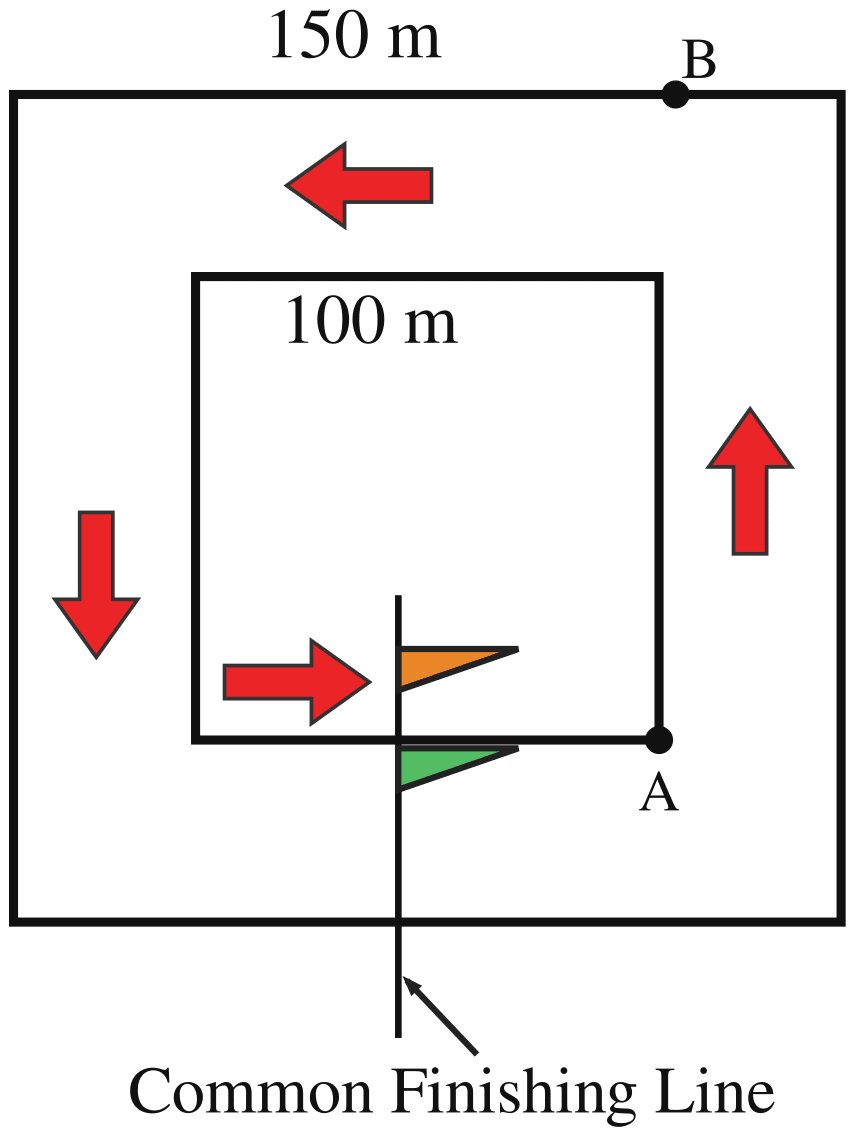
Check: From 'B', the runner covers 125 m along the upper side, 150 m along the left side and 75 m along the lower side, which is 125 m + 150 m + 75 m = 350 m, and reaches the finishing line.
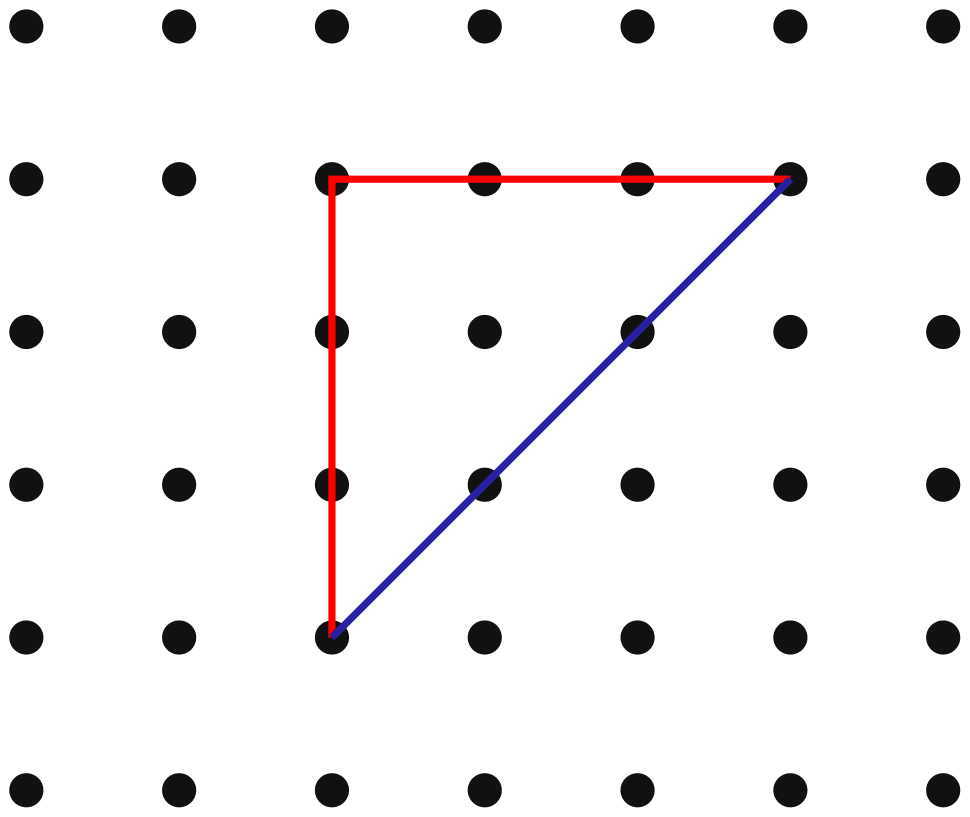
Akshi says that the perimeter of this triangle shape is 9 units. Toshi says it can't be 9 units and the perimeter will be more than 9 units. What do you think?
Answer
The given triangle is drawn on a dot grid.
Along its boundary there are two kinds of unit lengths:
Straight units (the red lines) — each is the side of a unit square.
Diagonal units (the blue lines) — each is the diagonal of a unit square.
Counting the segments along the boundary:
Vertical side = 3 straight units
Horizontal side = 3 straight units
Slanting side = 3 diagonal units
Total number of segments = 3 + 3 + 3 = 9
Akshi has counted these 9 segments and taken the perimeter as 9 units. But all the 9 segments are not equal in length.
In a square, the diagonal is always longer than the side. So one diagonal unit is longer than one straight unit.
Hence, the 3 diagonal segments are each longer than 1 unit.
Perimeter of the triangle = 6 straight units + 3 diagonal units = 6s + 3d
Since 3 of these 9 segments are longer than a unit, the total boundary length must be greater than 9 units.
Toshi is correct. The perimeter of the triangle is 6s + 3d, which is more than 9 units.
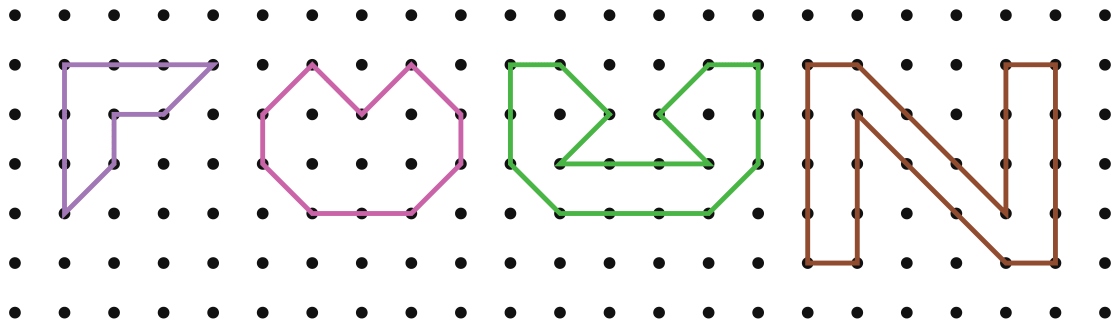
Write the perimeters of the figures below in terms of straight and diagonal units.
Answer
Straight unit written as s and a diagonal unit written as d. We move once around the boundary of each figure and count the two kinds of segments separately.
(i) First figure
Number of straight segments = 8
Number of diagonal segments = 2
Perimeter = 8 straight units + 2 diagonal units
Perimeter = 8s + 2d
(ii) Second figure
Number of straight segments = 4
Number of diagonal segments = 6
Perimeter = 4 straight units + 6 diagonal units
Perimeter = 4s + 6d
(iii) Third figure
Number of straight segments = 12
Number of diagonal segments = 6
Perimeter = 12 straight units + 6 diagonal units
Perimeter = 12s + 6d
(iv) Fourth figure
Number of straight segments = 18
Number of diagonal segments = 6
Perimeter = 18 straight units + 6 diagonal units
Perimeter = 18s + 6d
What is a similarity between a square and an equilateral triangle?
Answer
In a square, all four sides are equal in length and all four angles are equal.
In an equilateral triangle, all three sides are equal in length and all three angles are equal.
So, in both the figures all the sides are equal and all the angles are equal. A closed figure having all sides equal and all angles equal is called a regular polygon.
∴ A square and an equilateral triangle are both regular polygons.
Because of this, the perimeter of each of them is found in the same way, i.e., by multiplying the length of one side by the number of sides.
Perimeter of a square = 4 × length of a side
Perimeter of an equilateral triangle = 3 × length of a side
Both a square and an equilateral triangle are regular polygons, as each has all its sides equal and all its angles equal. Hence, the perimeter of each is (number of sides) × (length of a side).
Find various objects from your surroundings that have regular shapes and find their perimeters. Also, generalise your understanding for the perimeter of other regular polygons.
Answer
A sample table of observations is shown below.
| Object | Regular Shape | Number of Sides | Length of One Side | Perimeter |
|---|---|---|---|---|
| Carrom board | Square | 4 | 74 cm | 4 × 74 cm = 296 cm |
| Floor tile | Square | 4 | 60 cm | 4 × 60 cm = 240 cm |
| Equilateral triangular tile | Equilateral triangle | 3 | 15 cm | 3 × 15 cm = 45 cm |
| Warning road sign | Equilateral triangle | 3 | 90 cm | 3 × 90 cm = 270 cm |
| Cross-section of a pencil | Regular hexagon | 6 | 4 mm | 6 × 4 mm = 24 mm |
| Wall clock | Regular octagon | 8 | 12 cm | 8 × 12 cm = 96 cm |
In every case, the same side length is added as many times as there are sides. So the addition can be replaced by multiplication.
For a regular polygon having n sides, each of length a:
Perimeter = a + a + a + ... (n times)
⇒ Perimeter = n × a
Using this general rule:
Perimeter of an equilateral triangle = 3 × side
Perimeter of a square = 4 × side
Perimeter of a regular pentagon = 5 × side
Perimeter of a regular hexagon = 6 × side
Perimeter of a regular polygon = Number of sides × Length of one side.
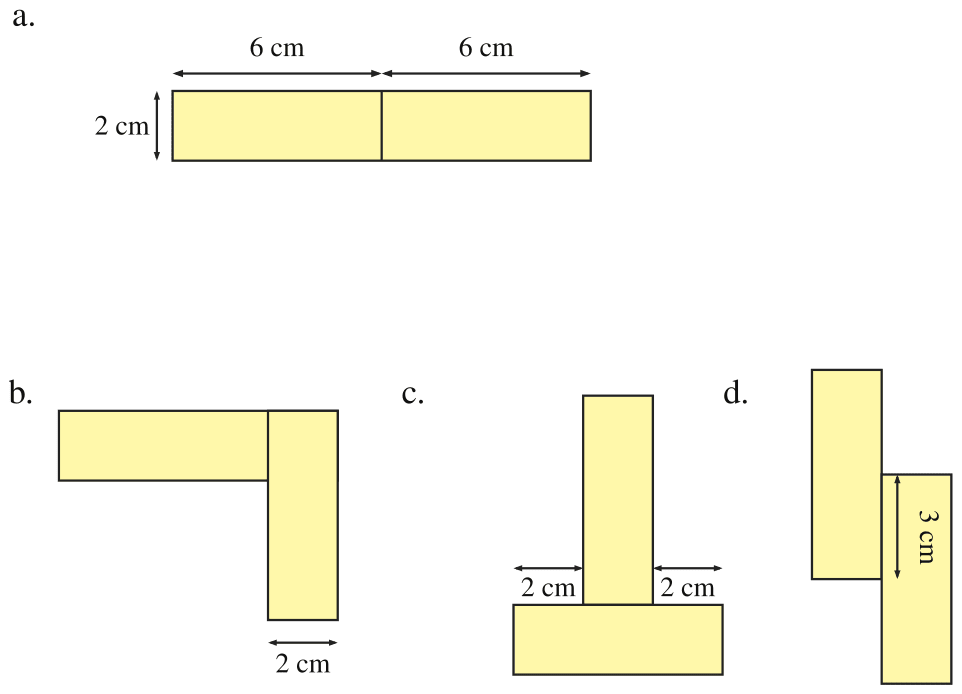
(i) Find out the length of the boundary (i.e., the perimeter) of each arrangements below.
(ii) Arrange the two pieces to form a figure with a perimeter of 22 cm.
Answer
(i)
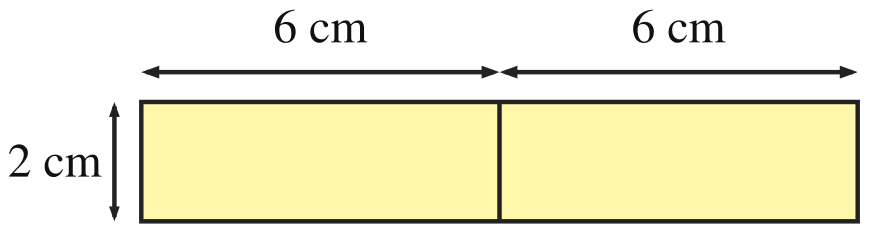
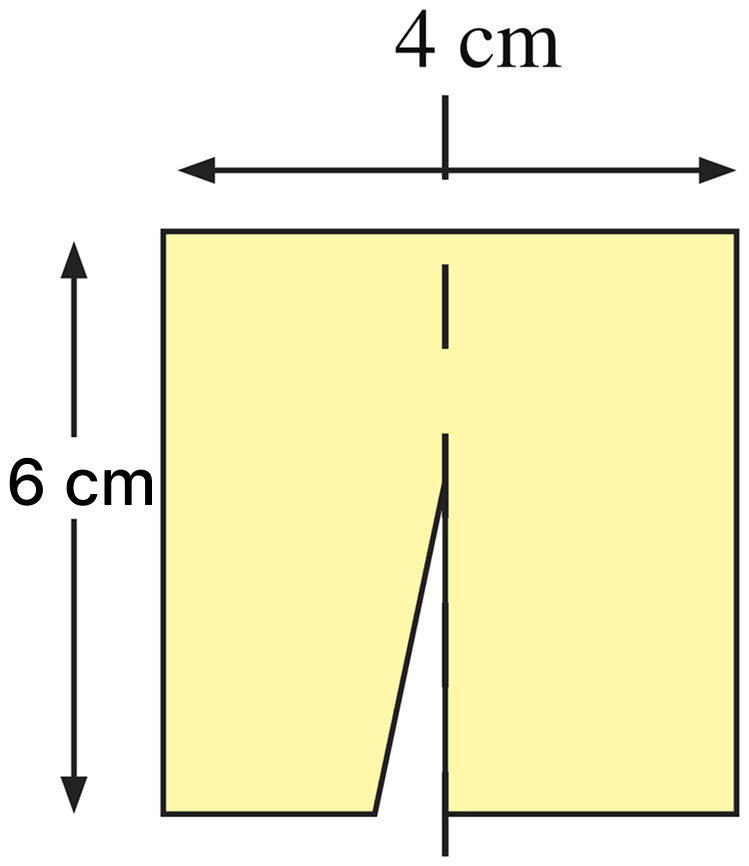
The paper chit is a rectangle of dimension 6 cm × 4 cm. It is cut along the dotted line into two equal pieces.
So each piece is a rectangle of length 6 cm and breadth 2 cm.
Perimeter of each piece = 2(length + breadth)
= 2(6 cm + 2 cm)
= 2(8 cm)
= 16 cm
When the two pieces are joined, the portions of the edges that are stuck together lie inside the new figure and no longer form a part of its boundary. Such a joined edge is lost twice, once from each piece.
∴ Perimeter of an arrangement = 16 cm + 16 cm - 2 × (length of the joined edge)
(a)
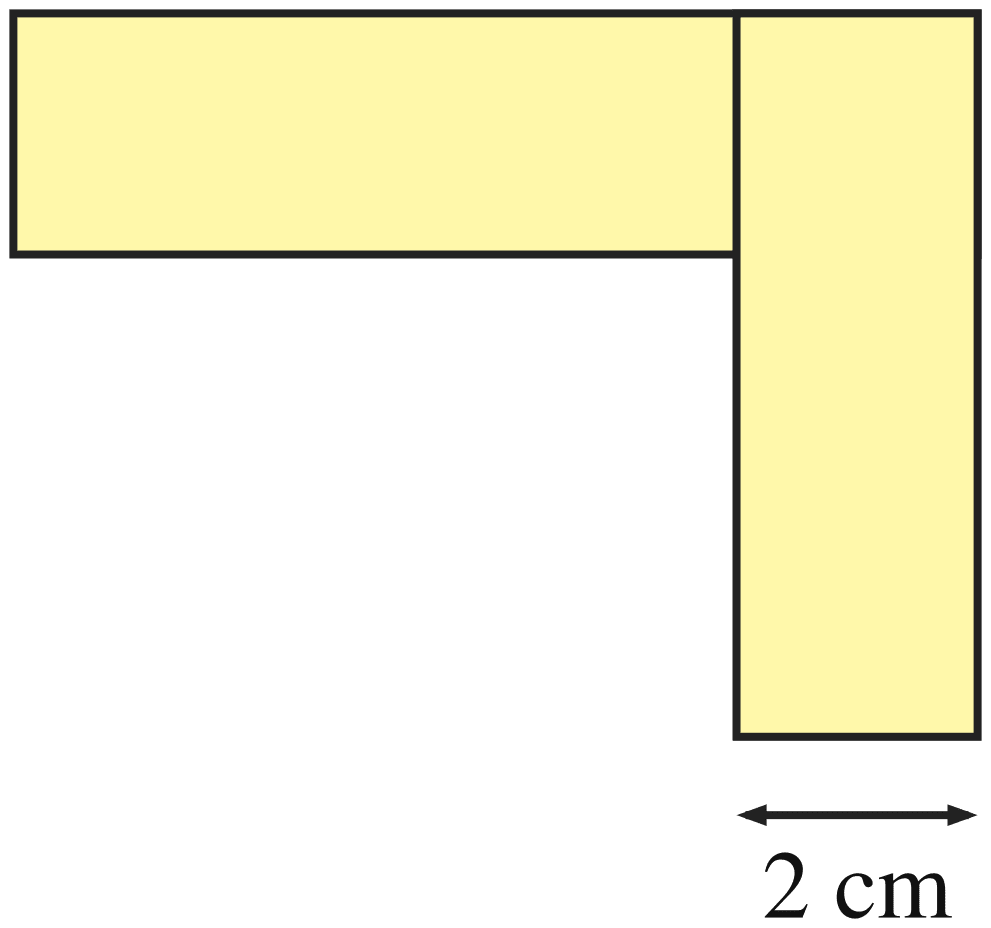
Here the two pieces are joined along a 2 cm edge.
Perimeter = 16 cm + 16 cm - 2 × 2 cm [Substituting the values]
= 32 cm - 4 cm
= 28 cm
This agrees with the perimeter of 28 cm given for arrangement a, so the method is correct.
(b)
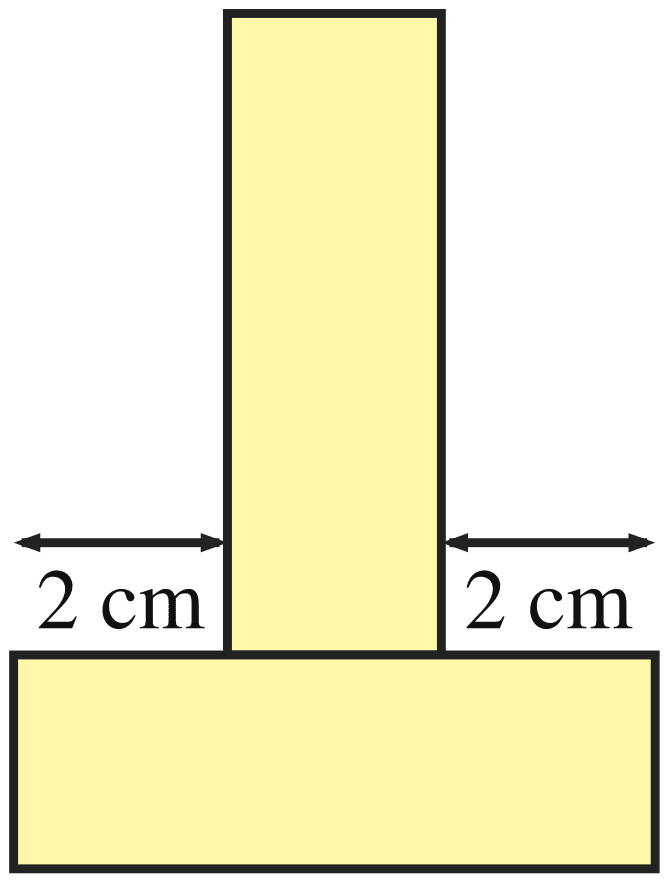
Here the two pieces form the shape of the letter L. The vertical piece is joined to the right end of the horizontal piece along its breadth, i.e., along an edge of length 2 cm.
Perimeter = 16 cm + 16 cm - 2 × 2 cm [Substituting the values]
= 32 cm - 4 cm
= 28 cm
Verifying by going once around the boundary:
Perimeter = 8 cm + 6 cm + 2 cm + 4 cm + 6 cm + 2 cm = 28 cm
Perimeter of arrangement b = 28 cm
(c)
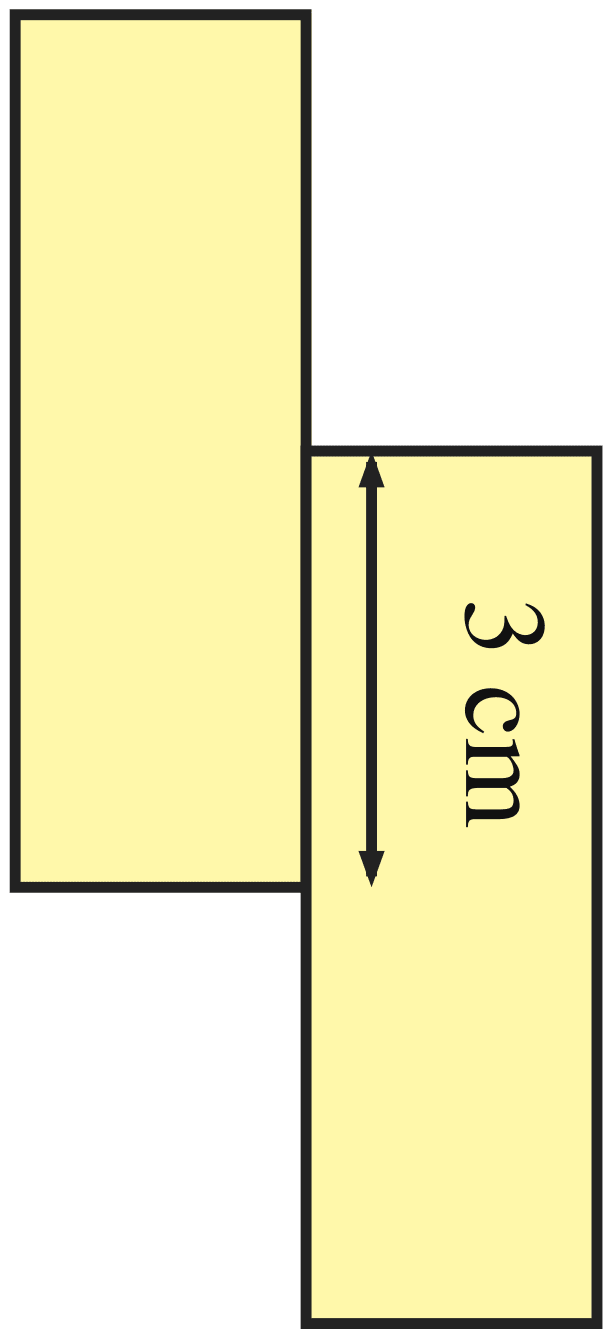
Here the two pieces form the shape of the letter T. The vertical piece stands on the middle of the horizontal piece, with 2 cm of the horizontal piece on either side of it. So they are joined along an edge of length 2 cm.
Perimeter = 16 cm + 16 cm - 2 × 2 cm [Substituting the values]
= 32 cm - 4 cm
= 28 cm
Verifying by going once around the boundary:
Perimeter = 6 cm + 2 cm + 2 cm + 6 cm + 2 cm + 6 cm + 2 cm + 2 cm = 28 cm
Perimeter of arrangement c = 28 cm
(d)
Here both the pieces stand upright side by side, one slipped down with respect to the other. They touch each other along a common edge of length 3 cm, as marked in the figure.
Perimeter = 16 cm + 16 cm - 2 × 3 cm [Substituting the values]
= 32 cm - 6 cm
= 26 cm
Verifying by going once around the boundary:
Perimeter = 2 cm + 3 cm + 2 cm + 6 cm + 2 cm + 3 cm + 2 cm + 6 cm = 26 cm
Perimeter of arrangement d = 26 cm
Hence, the perimeters are: b = 28 cm, c = 28 cm and d = 26 cm.
(ii)
Each piece is a rectangle of length 6 cm and breadth 2 cm.
Perimeter of each piece = 2(6 cm + 2 cm)
= 16 cm
If the two pieces are joined along a common edge of length l cm, then that common edge is removed twice from the total boundary.
Required perimeter = 16 cm + 16 cm - 2 × l cm
22 cm = 32 cm - 2 × l cm
⇒ 2 × l cm = 10 cm
⇒ l = cm
⇒ l = 5 cm
So, place the two 6 cm × 2 cm rectangles parallel to each other so that they share 5 cm of a 6 cm side, with one rectangle shifted by 1 cm.
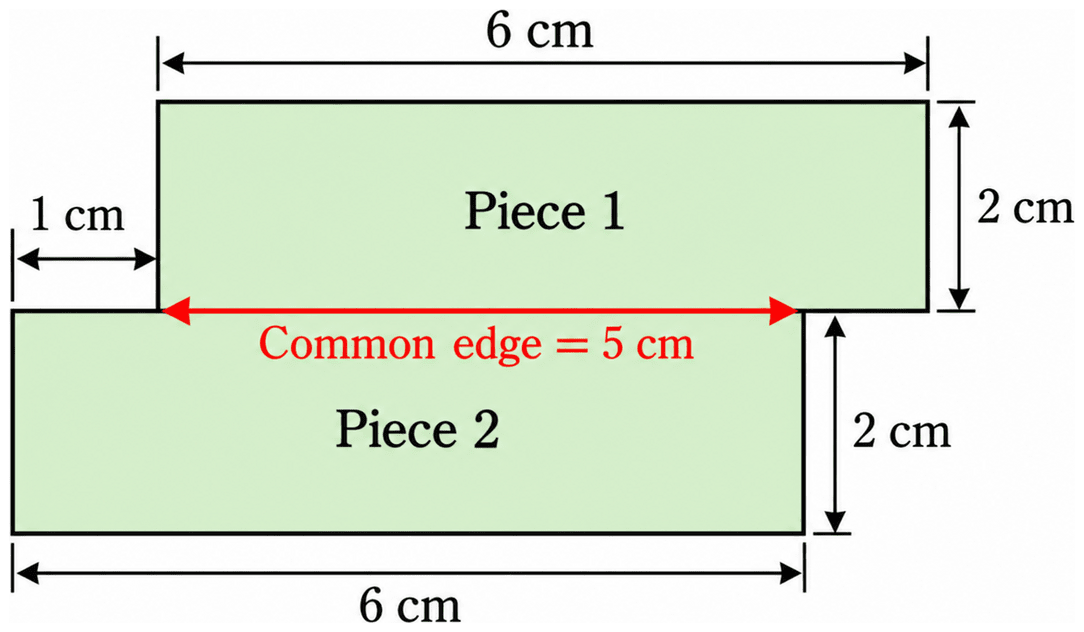
Hence, one possible arrangement is obtained by joining the two pieces along 5 cm of their longer sides; its perimeter is 22 cm.
In previous grades, we arrived at the formula for the area of a rectangle and a square using square grid paper. Do you remember?
Area of a square = .......... .
Area of a rectangle = .......... .
Answer
The area of a closed figure is the amount of region enclosed by it. On square grid paper, the area is the number of unit squares that fit inside the figure.
For a rectangle, the unit squares fit in rows. The number of unit squares in one row is the same as the length, and the number of such rows is the same as the breadth.
Area of a rectangle = (number of squares in a row) × (number of rows)
⇒ Area of a rectangle = length × breadth
A square is a rectangle whose length and breadth are equal, each being the side of the square.
Area of a square = side × side
⇒ Area of a square = (side)2
Area of a square = side × side = (side)2
Area of a rectangle = length × breadth
The area of a rectangular garden 25 m long is 300 sq m. What is the width of the garden?
Answer
Given:
Length of the rectangular garden = 25 m
Area of the rectangular garden = 300 sq m
Area of a rectangle = length × width
300 sq m = 25 m × width [Substituting the values]
⇒ width = m
⇒ width = 12 m
Width of the garden = 12 m
What is the cost of tiling a rectangular plot of land 500 m long and 200 m wide at the rate of ₹ 8 per hundred sq m?
Answer
Given:
Length of the rectangular plot = 500 m
Width of the rectangular plot = 200 m
Rate = ₹8 per hundred sq m
Tiling is done over the whole surface of the plot, so we first need to find its area.
Area of the plot = length × width
= 500 m × 200 m [Substituting the values]
= 1,00,000 sq m
The rate is given for every hundred sq m, so we find how many hundreds of sq m the plot contains.
Number of hundreds of sq m =
= 1000
Total cost = Number of hundreds of sq m × Rate
= 1000 × ₹8
= ₹8,000
Cost of tiling the rectangular plot = ₹8,000
A rectangular coconut grove is 100 m long and 50 m wide. If each coconut tree requires 25 sq m, what is the maximum number of trees that can be planted in this grove?
Answer
Given:
Length of the rectangular grove = 100 m
Width of the rectangular grove = 50 m
Area required by one coconut tree = 25 sq m
Area of the grove = length × width
= 100 m × 50 m [Substituting the values]
= 5000 sq m
Maximum number of trees =
=
= 200
Maximum number of coconut trees that can be planted = 200
By splitting the following figure into rectangles, find its area (all measures are given in metres).
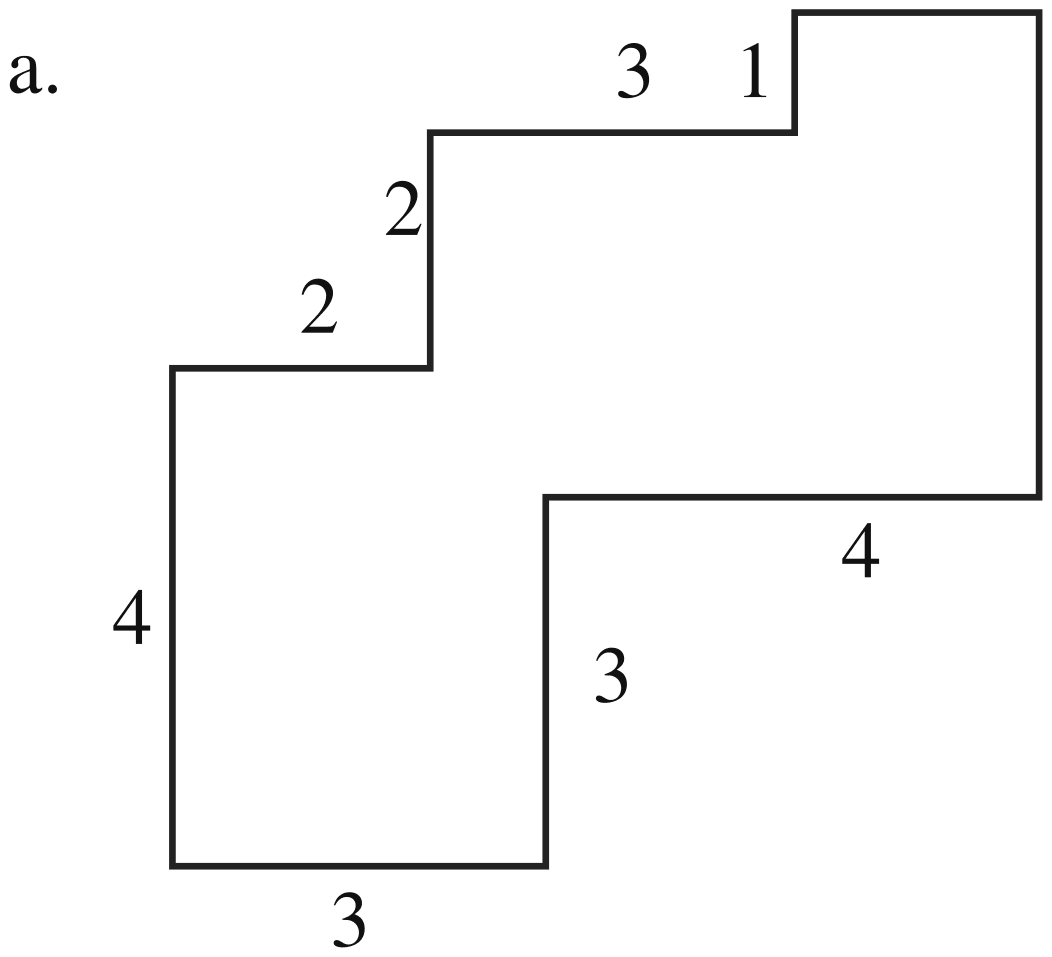
Answer
First, let us find the two measures that are not marked.
Total width of the figure at the bottom = 3 m + 4 m = 7 m
Total height of the figure along the left and the upper boundary = 4 m + 2 m + 1 m = 7 m
∴ Length of the top side = 7 m - (2 m + 3 m) = 7 m - 5 m = 2 m
∴ Height of the right side = 7 m - 3 m = 4 m
Now we split the figure into rectangles by drawing horizontal lines through the corners, at heights of 3 m, 4 m and 6 m from the bottom. This gives four rectangles, one above the other.
Rectangle I (the lowest one):
Length = 3 m, Breadth = 3 m
Area = 3 m × 3 m = 9 sq m
Rectangle II:
Length = 7 m, Breadth = 1 m
Area = 7 m × 1 m = 7 sq m
Rectangle III:
Length = 5 m, Breadth = 2 m
Area = 5 m × 2 m = 10 sq m
Rectangle IV (the topmost one):
Length = 2 m, Breadth = 1 m
Area = 2 m × 1 m = 2 sq m
Area of the figure = Area of I + Area of II + Area of III + Area of IV
= 9 sq m + 7 sq m + 10 sq m + 2 sq m
= 28 sq m
Area of figure (a) = 28 sq m
By splitting the following figure into rectangles, find its area (all measures are given in metres).
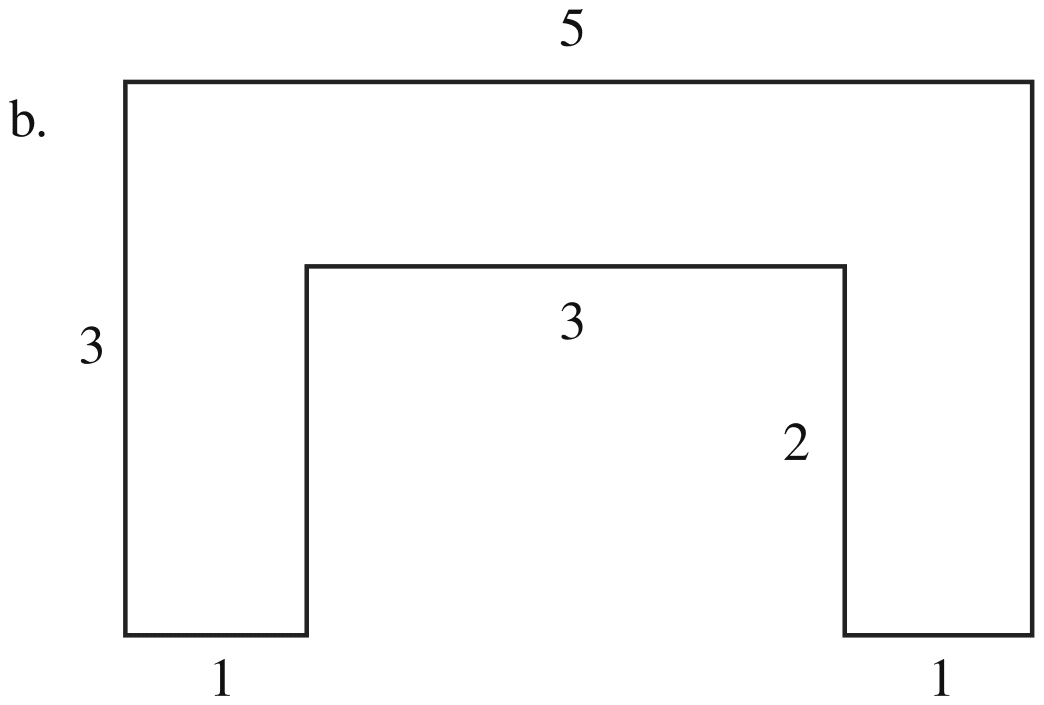
Answer
This figure is like an arch. Its outer boundary is a rectangle of length 5 m and height 3 m, and a rectangular piece of length 3 m and height 2 m has been removed from the middle of the bottom.
We split the remaining figure into three rectangles — the left leg, the right leg and the bar across the top.
Left leg:
Length = 1 m, Breadth = 3 m
Area = 1 m × 3 m = 3 sq m
Right leg:
Length = 1 m, Breadth = 3 m
Area = 1 m × 3 m = 3 sq m
Top bar:
Its length = 5 m - (1 m + 1 m) = 3 m
Its breadth = 3 m - 2 m = 1 m
Area = 3 m × 1 m = 3 sq m
Area of the figure = 3 sq m + 3 sq m + 3 sq m
= 9 sq m
The same answer can be checked by subtraction:
Area of the complete rectangle = 5 m × 3 m = 15 sq m
Area of the removed rectangle = 3 m × 2 m = 6 sq m
Area of the figure = 15 sq m - 6 sq m = 9 sq m
Area of figure (b) = 9 sq m
Explore and figure out how many pieces have the same area.
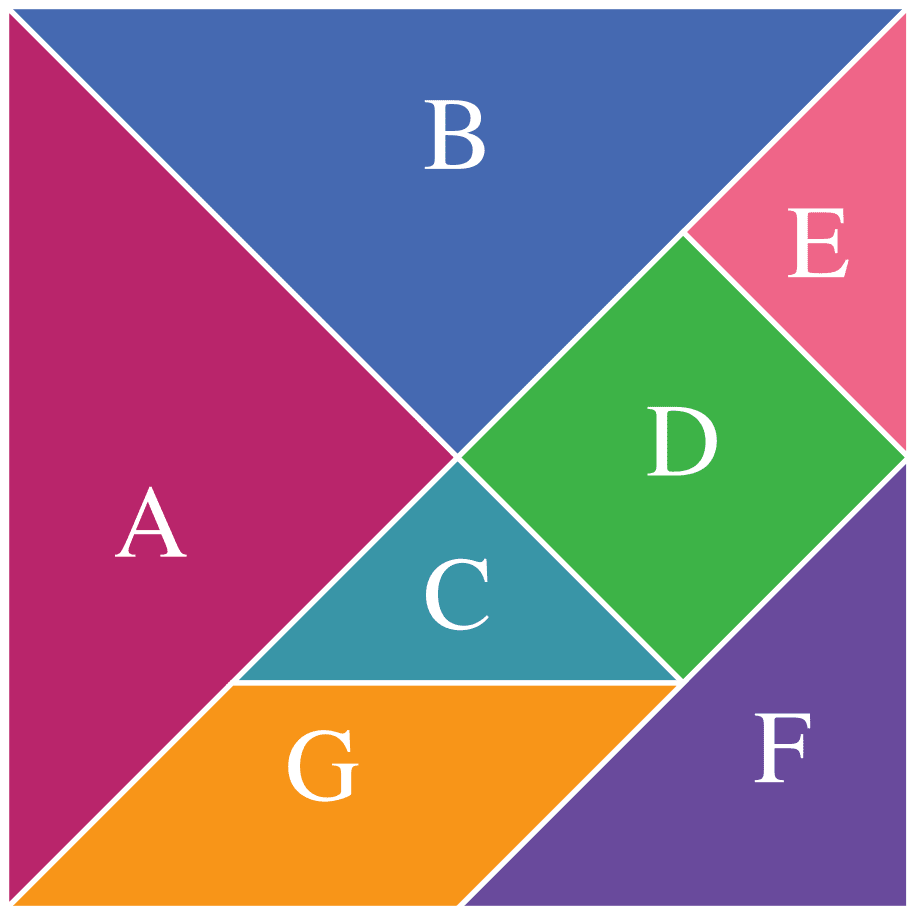
Answer
Place the pieces one over the other and compare them.
Shape A covers Shape B exactly. So, Shapes A and B have the same area.
Shape C covers Shape E exactly. So, Shapes C and E have the same area.
Shapes C and E placed side by side cover Shape D exactly, Shape F exactly and Shape G exactly.
So, each of the Shapes D, F and G has the same area, which is twice the area of Shape C.
Let the area of Shape C be 1 unit.
Then, area of Shape E = 1 unit
Area of Shape D = area of Shape F = area of Shape G = 2 units
Also, Shapes C, E and F together cover Shape A exactly.
∴ Area of Shape A = area of Shape B = (1 + 1 + 2) units = 4 units
| Shape | A | B | C | D | E | F | G |
|---|---|---|---|---|---|---|---|
| Area (in units) | 4 | 4 | 1 | 2 | 1 | 2 | 2 |
Thus, the seven pieces fall into three groups of equal area:
Group 1 : Shapes A and B (2 pieces of 4 units each)
Group 2 : Shapes C and E (2 pieces of 1 unit each)
Group 3 : Shapes D, F and G (3 pieces of 2 units each)
Shapes A and B have the same area, Shapes C and E have the same area, and Shapes D, F and G have the same area.
How many times bigger is Shape D as compared to Shape C? What is the relationship between Shapes C, D and E?
Answer
Place Shapes C and E over Shape D.
Shapes C and E together cover Shape D exactly, leaving no gap and no overlap.
∴ Area of Shape D = area of Shape C + area of Shape E
Also, Shape C covers Shape E exactly.
∴ Area of Shape C = area of Shape E
So, area of Shape D = area of Shape C + area of Shape C
⇒ Area of Shape D = 2 × area of Shape C
Hence, Shape D is 2 times bigger than Shape C.
The relationship between Shapes C, D and E is:
Area of Shape C = area of Shape E = × area of Shape D
Shape D is twice as big as Shape C. Shapes C and E are equal in area, and each of them is half of Shape D.
Which shape has more area: Shape D or F? Give reasons for your answer.
Answer
Neither of them has more area. Both have the same area.
Reason:
Place Shapes C and E over Shape D. They cover Shape D exactly.
∴ Area of Shape D = area of Shape C + area of Shape E = 2 × area of Shape C
Now place the same two Shapes C and E over Shape F. They cover Shape F exactly as well.
∴ Area of Shape F = area of Shape C + area of Shape E = 2 × area of Shape C
Since both areas are equal to 2 × area of Shape C,
∴ Area of Shape D = area of Shape F
Note that Shape D is a square and Shape F is a triangle. They look quite different, yet they enclose the same amount of region.
Shapes D and F have the same area, each being twice the area of Shape C.
Which shape has more area: Shape F or G? Give reasons for your answer.
Answer
Neither of them has more area. Both have the same area.
Reason:
Shapes C and E together cover Shape F exactly.
∴ Area of Shape F = area of Shape C + area of Shape E = 2 × area of Shape C
Shapes C and E together also cover Shape G exactly.
∴ Area of Shape G = area of Shape C + area of Shape E = 2 × area of Shape C
Since both areas are equal to 2 × area of Shape C,
∴ Area of Shape F = area of Shape G
Here Shape F is a triangle and Shape G is a parallelogram. Again, two shapes of different appearance have equal areas.
Shapes F and G have the same area, each being twice the area of Shape C.
What is the area of Shape A as compared to Shape G? Is it twice as big? Four times as big?
Hint: In the tangram pieces, by placing the shapes over each other, we can find out that Shapes A and B have the same area, Shapes C and E have the same area. You would have also figured out that Shape D can be exactly covered using Shapes C and E, which means Shape D has twice the area of Shape C or shape E, etc.
Answer
Let the area of Shape C be 1 unit.
Area of Shape A:
Shapes C, E and F placed together cover Shape A exactly.
Area of Shape A = area of Shape C + area of Shape E + area of Shape F
= (1 + 1 + 2) units [Since area of F = 2 × area of C]
= 4 units
Area of Shape G:
Shapes C and E placed together cover Shape G exactly.
Area of Shape G = area of Shape C + area of Shape E
= (1 + 1) units
= 2 units
Now, comparing the two areas:
⇒ Area of Shape A = 2 × area of Shape G
So, Shape A is twice as big as Shape G, and not four times as big.
Shape A is four times as big as Shape C, but only twice as big as Shape G.
Area of Shape A = 2 × area of Shape G, i.e., Shape A is twice as big as Shape G.
Can you now figure out the area of the big square formed with all seven pieces in terms of the area of Shape C?
Answer
The big square is made up of all the seven pieces placed together with no gaps and no overlaps.
∴ Area of the big square = sum of the areas of all the seven pieces
Let the area of Shape C be 1 unit. From the earlier questions:
| Shape | A | B | C | D | E | F | G | Total |
|---|---|---|---|---|---|---|---|---|
| Area (in units) | 4 | 4 | 1 | 2 | 1 | 2 | 2 | 16 |
Area of the big square = area of A + area of B + area of C + area of D + area of E + area of F + area of G
= (4 + 4 + 1 + 2 + 1 + 2 + 2) units
= 16 units
Area of the big square = 16 × area of Shape C.
Arrange these 7 pieces to form a rectangle. What will be the area of this rectangle in terms of the area of Shape C now? Give reasons for your answer.
Answer
All the seven pieces can be rearranged to form a rectangle as shown.
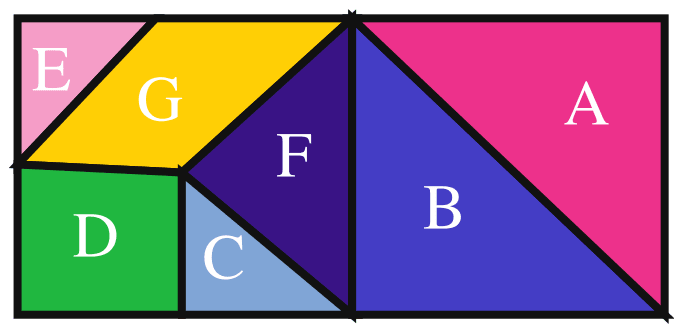
Area of the rectangle = 16 × area of Shape C
Reason:
The rectangle is made using the very same seven pieces that formed the big square.
No piece is left out, no piece is added, and the pieces are placed without any gap and without any overlap.
Rearranging the pieces only changes the shape of the figure; it does not change the amount of region covered.
∴ Area of the rectangle = sum of the areas of all the seven pieces
= (4 + 4 + 1 + 2 + 1 + 2 + 2) units
= 16 units
= area of the big square
Area of the rectangle = 16 × area of Shape C, which is the same as the area of the big square, because the same seven pieces are used to make both figures.
Are the perimeters of the square and the rectangle formed from these 7 pieces different or the same? Give an explanation for your answer.
Answer
The perimeters are different. The perimeter of the rectangle is more than the perimeter of the square.
Explanation:
The area of a figure depends only on the pieces used, so both figures have the same area, i.e., 16 × area of Shape C.
But the perimeter depends on the boundary of the figure, not on the pieces used.
When the pieces are rearranged, some edges which were hidden inside the square (shared between two pieces) come out on to the boundary of the rectangle, and some edges which were on the boundary of the square go inside the rectangle. So the length of the boundary changes.
Therefore, two figures having the same area need not have the same perimeter.
In the given rearrangement, the rectangle has a longer outer boundary than the square.
The perimeters are different. Both figures have the same area because the same seven pieces are used, but the rectangle has the greater perimeter because rearranging the pieces changes the outer boundary.
Look at the figures below and guess which one of them has a larger area.
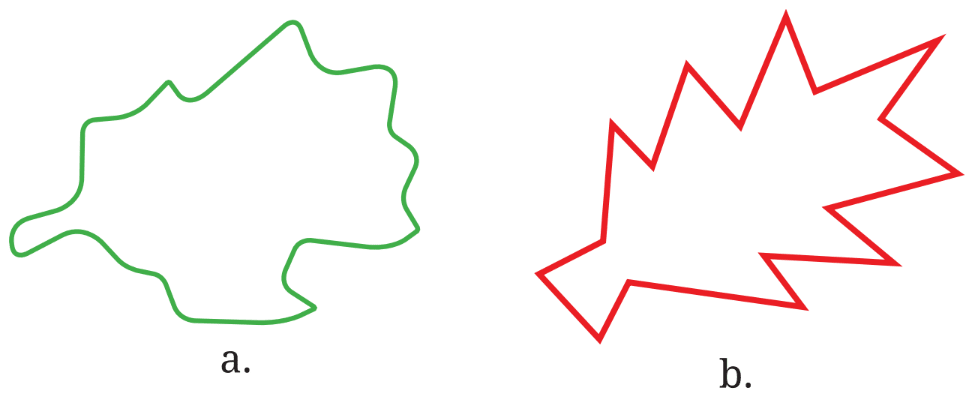
Answer
By simply looking at the two figures, it is difficult to decide accurately which one has a larger area. A long or spiky boundary does not necessarily mean a larger area.
To verify the guess, trace each figure on transparent paper, place it on squared paper in which every square measures 1 unit × 1 unit, and estimate the area using these rules:
- Count every full small square as 1 sq unit.
- Ignore portions that are less than half a square.
- Count a portion greater than half a square as 1 sq unit.
- Count exactly half a square as sq unit.
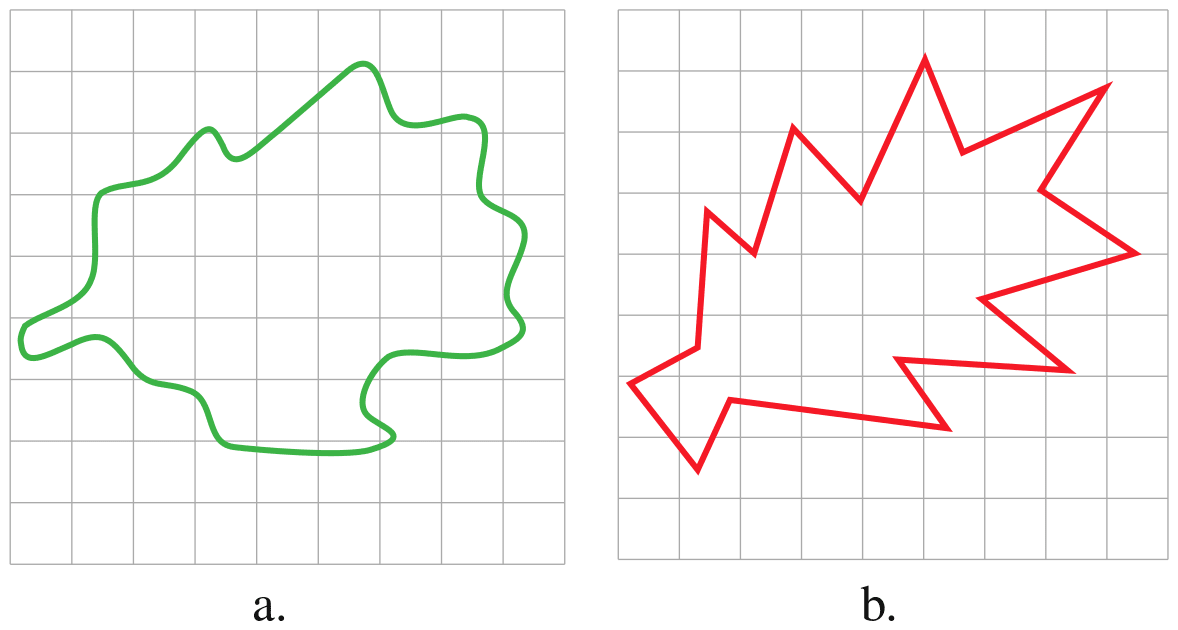
On counting the squares in this way, Figure (a) is found to cover a few more squares than Figure (b), although the two areas are fairly close to each other.
Figure (a) has the larger area. Figure (b) only looks bigger because of its long, spiky boundary; the area of a figure cannot be judged from the shape of its boundary alone.
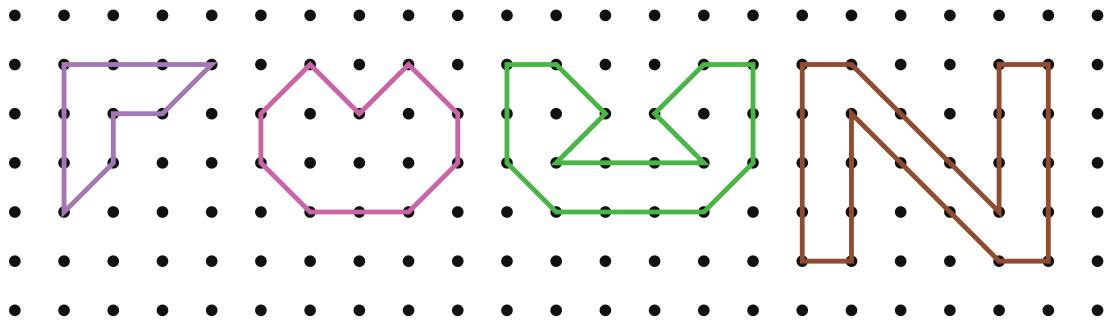
Find the area of the following figures.
Answer
Each of these figures is drawn on a dot grid in which the smallest square measures 1 unit × 1 unit.
Area of one full square = 1 sq unit
Area of one half square = sq unit
We count the number of full squares and the number of half squares in each figure. The figures are taken in order from left to right.
(i)
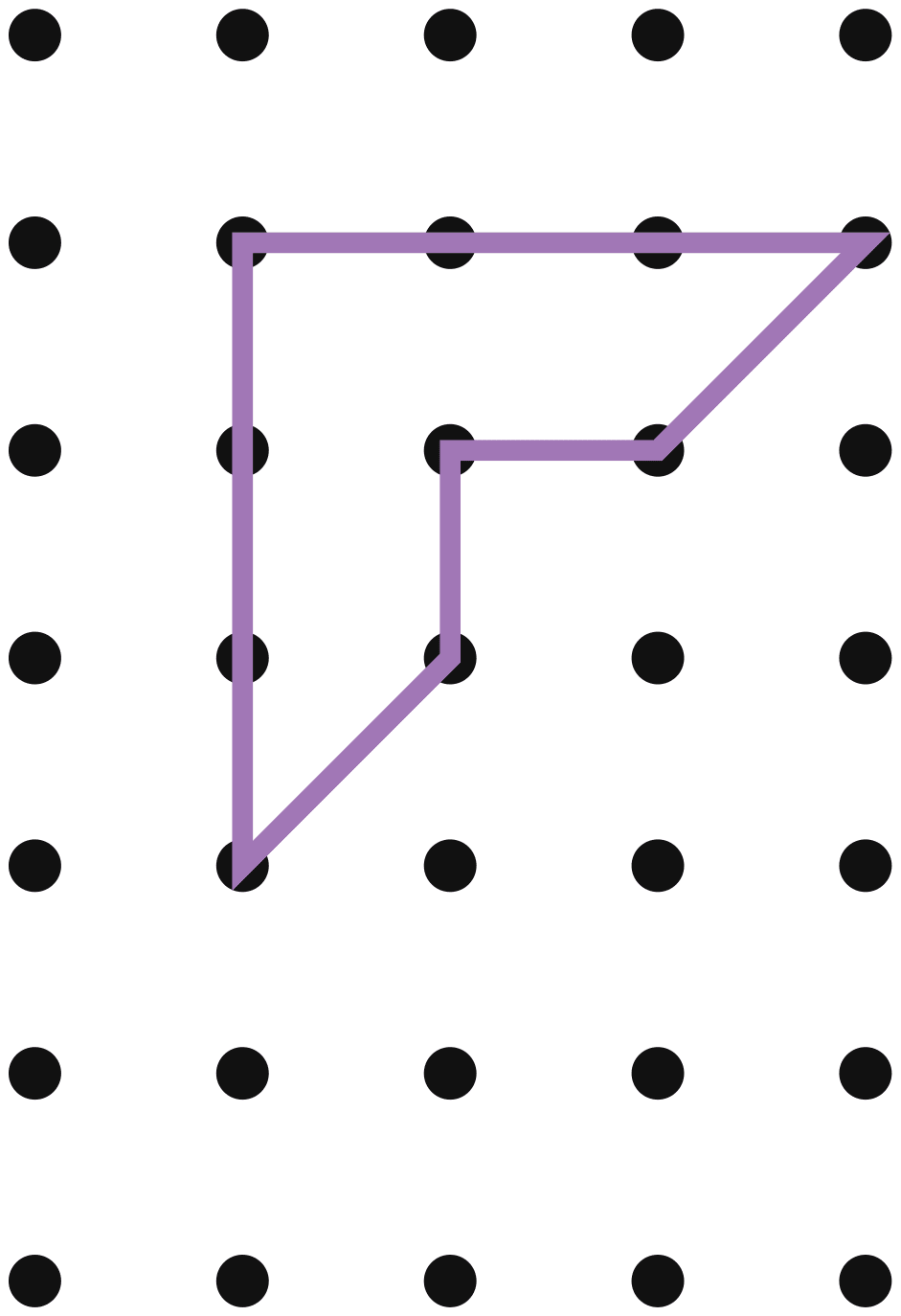
Number of full squares = 3
Number of half squares = 2
Area of the figure = (Number of full squares × 1 sq unit) + (Number of half squares × sq unit)
= sq units + sq units
= 3 sq units + 1 sq unit
= 4 sq units
Area of the first figure = 4 sq units.
(ii)
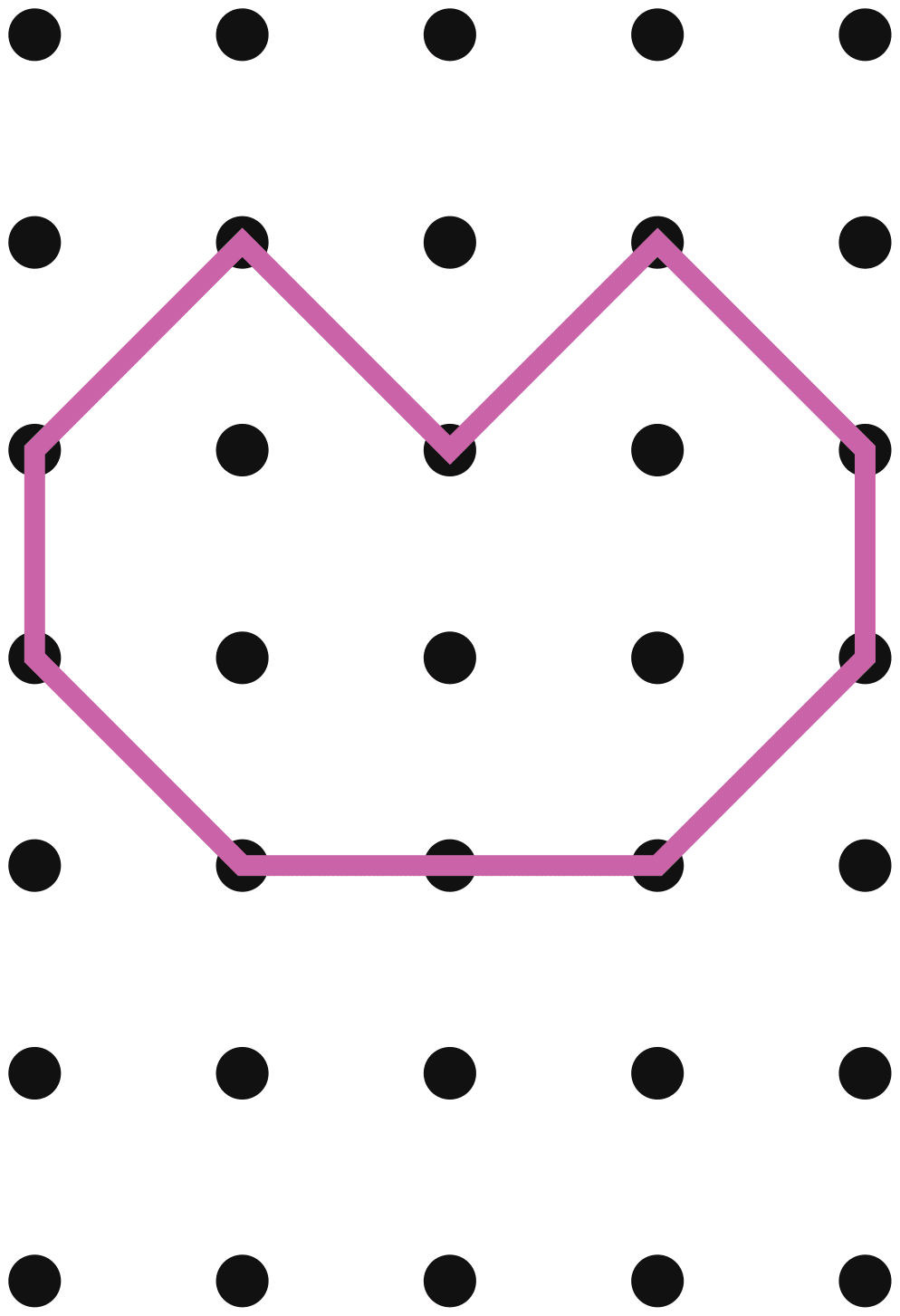
Number of full squares = 6
Number of half squares = 6
Area of the figure = (Number of full squares × 1 sq unit) + (Number of half squares × sq unit)
= sq units + sq units
= 6 sq units + 3 sq units
= 9 sq units
Area of the second figure = 9 sq units.
(iii)
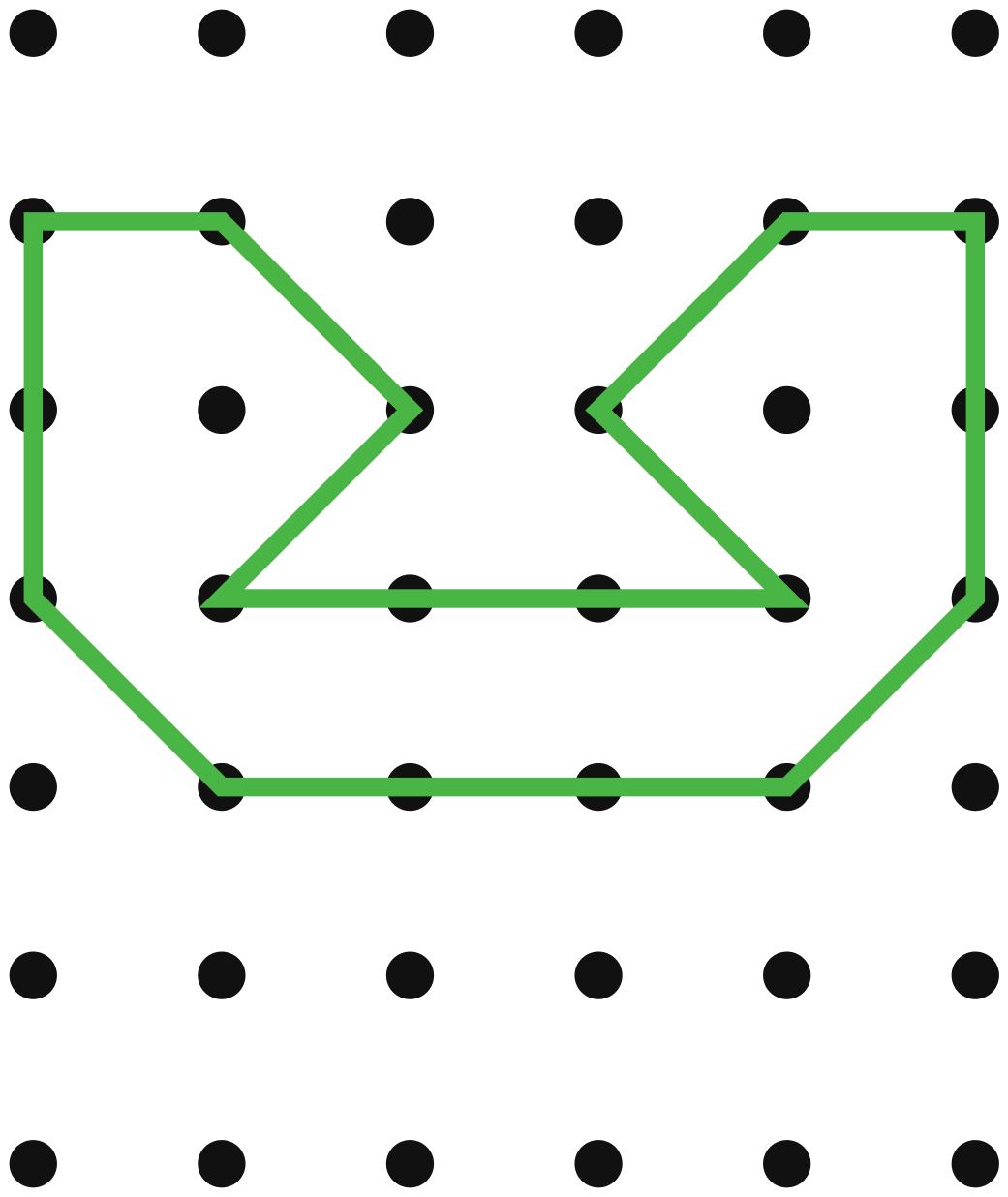
Number of full squares = 7
Number of half squares = 6
Area of the figure = (Number of full squares × 1 sq unit) + (Number of half squares × sq unit)
= sq units + sq units
= 7 sq units + 3 sq units
= 10 sq units
Area of the third figure = 10 sq units.
(iv)
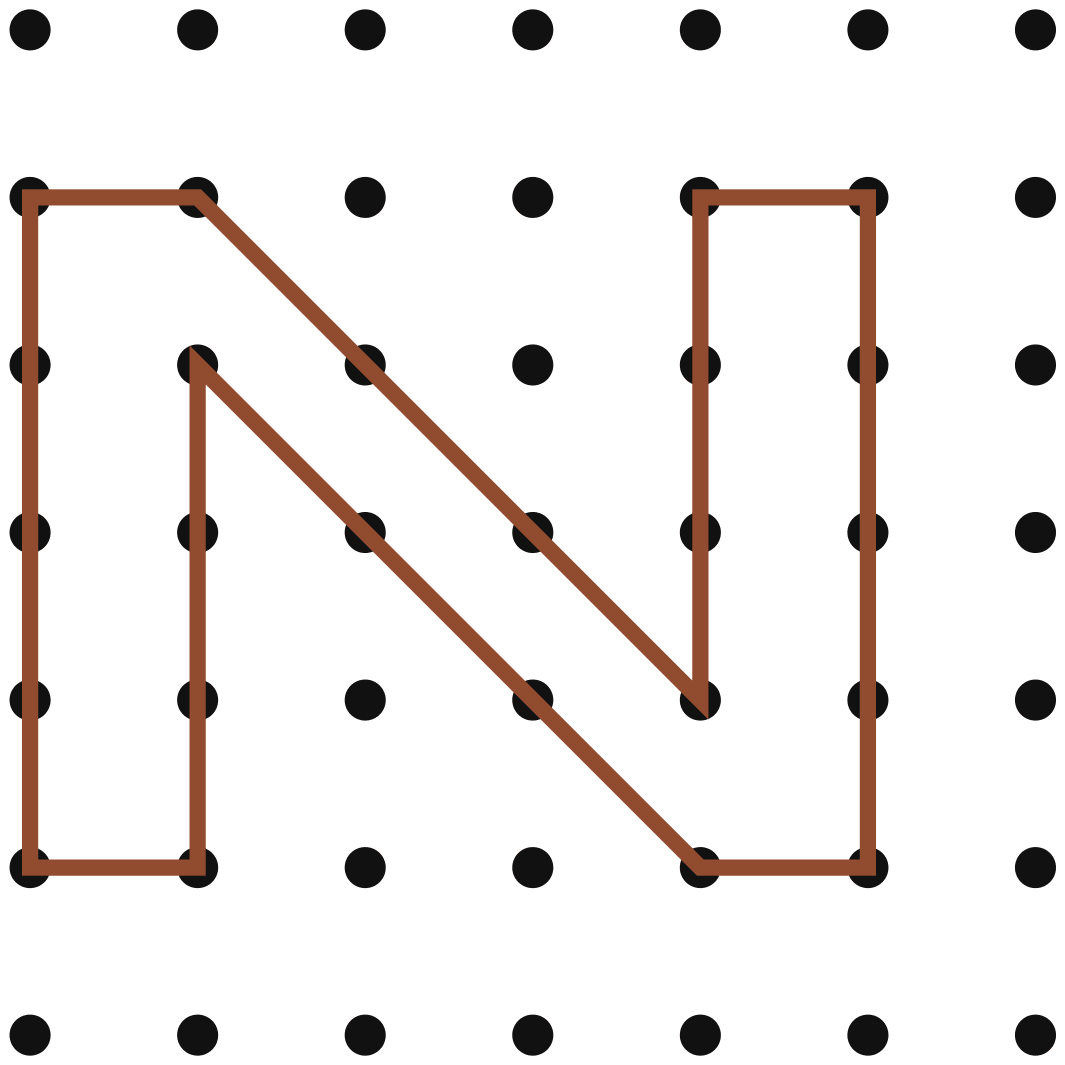
Number of full squares = 8
Number of half squares = 6
Area of the figure = (Number of full squares × 1 sq unit) + (Number of half squares × sq unit)
= sq units + sq units
= 8 sq units + 3 sq units
= 11 sq units
Area of the fourth figure = 11 sq units.
Hence, the areas of the four figures are 4 sq units, 9 sq units, 10 sq units and 11 sq units respectively.
Why is area generally measured using squares? Try using circles, triangles and rectangles to cover a region without gaps or overlaps. Why is a square a convenient unit for measuring area?
Answer
Squares are convenient units for measuring area because equal squares can be placed next to one another without leaving gaps or overlapping. They form neat rows and columns and are easy to count.
Circles cannot cover a flat region completely without leaving gaps. Some triangles and rectangles can cover a region, but square units are especially convenient because their equal length and breadth make counting and comparing areas simple.
Therefore, area is generally measured in square units.
On a squared grid paper (1 square = 1 square unit), make as many rectangles as you can whose lengths and widths are a whole number of units such that the area of the rectangle is 24 square units.
(a) Which rectangle has the greatest perimeter?
(b) Which rectangle has the least perimeter?
(c) If you take a rectangle of area 32 sq cm, what will your answers be? Given any area, is it possible to predict the shape of the rectangle with the greatest perimeter as well as the least perimeter? Give examples and reasons for your answer.
Answer
Given:
Area of the rectangle = 24 square units
Area of a rectangle = length × breadth
So we need all the pairs of whole numbers whose product is 24, i.e., all the factor pairs of 24.
24 = 1 × 24 = 2 × 12 = 3 × 8 = 4 × 6
Therefore four different rectangles can be drawn on the grid paper.
Perimeter of a rectangle = 2(length + breadth)
| Rectangle | Length (units) | Breadth (units) | Area (square units) | Perimeter (units) |
|---|---|---|---|---|
| 1 | 24 | 1 | 24 × 1 = 24 | 2(24 + 1) = 50 |
| 2 | 12 | 2 | 12 × 2 = 24 | 2(12 + 2) = 28 |
| 3 | 8 | 3 | 8 × 3 = 24 | 2(8 + 3) = 22 |
| 4 | 6 | 4 | 6 × 4 = 24 | 2(6 + 4) = 20 |
(a) Comparing the perimeters, 50 units > 28 units > 22 units > 20 units.
The greatest perimeter is 50 units, which belongs to the rectangle of length 24 units and breadth 1 unit.
The rectangle of size 24 units × 1 unit has the greatest perimeter, which is 50 units.
(b) From the same comparison, the least perimeter is 20 units, which belongs to the rectangle of length 6 units and breadth 4 units.
The rectangle of size 6 units × 4 units has the least perimeter, which is 20 units.
(c) Now the area of the rectangle = 32 sq cm.
All the factor pairs of 32 are:
32 = 1 × 32 = 2 × 16 = 4 × 8
Therefore three different rectangles can be drawn.
| Rectangle | Length (cm) | Breadth (cm) | Area (sq cm) | Perimeter (cm) |
|---|---|---|---|---|
| 1 | 32 | 1 | 32 × 1 = 32 | 2(32 + 1) = 66 |
| 2 | 16 | 2 | 16 × 2 = 32 | 2(16 + 2) = 36 |
| 3 | 8 | 4 | 8 × 4 = 32 | 2(8 + 4) = 24 |
Comparing the perimeters, 66 cm > 36 cm > 24 cm.
The rectangle of size 32 cm × 1 cm has the greatest perimeter, which is 66 cm.
The rectangle of size 8 cm × 4 cm has the least perimeter, which is 24 cm.
For this activity, where the side lengths are whole numbers, the rectangles with the greatest and least perimeters can be predicted by comparing the factor pairs of the given area.
Reason:
For a fixed whole-number area and whole-number side lengths, the perimeter depends on the factor pair chosen for the length and breadth.
The rectangle with the greatest perimeter is obtained from the factor pair that is farthest apart; for these examples, this is 1 and the given area.
The rectangle with the least perimeter is obtained from the factor pair whose two numbers are closest to each other, i.e., the rectangle that is most nearly a square.
Let us see this in the two examples above:
For area 24 square units, the factor pair farthest apart is 24 and 1, giving the greatest perimeter of 50 units, and the factor pair closest together is 6 and 4, giving the least perimeter of 20 units.
For area 32 sq cm, the factor pair farthest apart is 32 and 1, giving the greatest perimeter of 66 cm, and the factor pair closest together is 8 and 4, giving the least perimeter of 24 cm.
If the area happens to be a perfect square, say 36 square units, then the closest factor pair is 6 and 6, so the rectangle with the least perimeter is exactly a square of side 6 units, with perimeter 24 units, while the greatest perimeter is that of the 36 units × 1 unit rectangle, which is 74 units.
Hence, among rectangles with whole-number side lengths and the same area, the factor pair farther apart gives a larger perimeter, while the factor pair closer together gives a smaller perimeter.
Draw a rectangle on a piece of paper and draw one of its diagonals. Cut the rectangle along that diagonal and get two triangles.
Check! whether the two triangles overlap each other exactly. Do they have the same area?
Answer
Method:
Draw a rectangle ABCD on a sheet of paper. Join the vertices A and C to draw the diagonal AC. Cut the rectangle along the diagonal AC. Two triangles, △ABC and △ACD, are obtained.
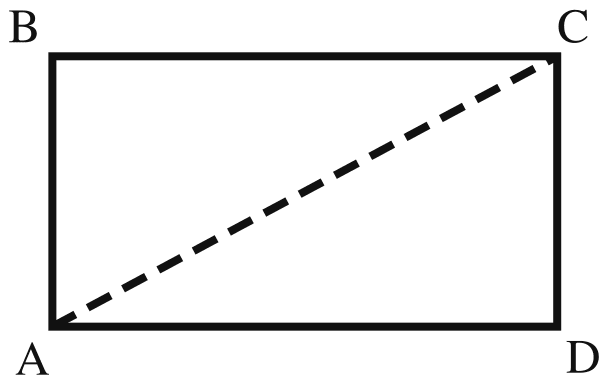
Now place one triangle exactly over the other, turning one of them around if needed.
Observation:
The two triangles cover each other completely. Every side of one triangle falls exactly on a side of the other, and every corner of one falls exactly on a corner of the other.
Reason:
In △ABC and △ACD,
AB = DC [Opposite sides of a rectangle are equal]
BC = AD [Opposite sides of a rectangle are equal]
AC = AC [The diagonal is common to both triangles]
∴ △ABC ≅ △ACD
Since the two triangles overlap each other exactly, they enclose exactly the same amount of region.
On repeating this activity with rectangles of different lengths and breadths, and also with a square, the same result is obtained every time.
Hence, the two triangles overlap each other exactly and they have the same area.
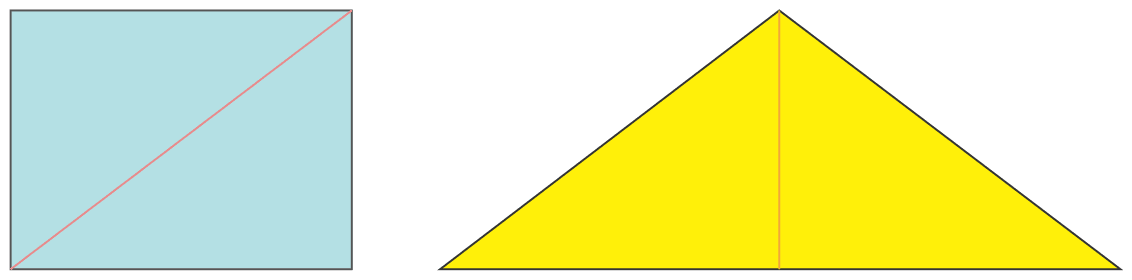
Now, see the figures below. Is the area of the blue rectangle more or less than the area of the yellow triangle? Or is it the same? Why?
Answer
On observing the two figures, we see that:
The yellow triangle stands on a base that is twice the length of the blue rectangle.
The height of the yellow triangle is the same as the breadth of the blue rectangle.
Let the length of the blue rectangle be l and its breadth be b.
Then, for the yellow triangle:
base = 2l and height = b
Area of the blue rectangle = length × breadth
= l × b
= lb
Now, the dotted line drawn from the top vertex of the yellow triangle to its base divides the triangle into two right triangles. Each of these right triangles is half of a rectangle of length l and breadth b.
Area of the yellow triangle = 2 ×
= l × b
= lb
So, Area of the yellow triangle = Area of the blue rectangle.
Hence, the area of the blue rectangle is neither more nor less; it is the same as the area of the yellow triangle, because the triangle stands on twice the base but has the same height as the rectangle.
Can you see some relationship between the blue rectangle and the yellow triangle and their areas? Write the relationship here.
Answer
Yes, there is a clear relationship between the two figures.
Relationship between the figures:
The altitude of the yellow triangle splits it into two right triangles. Each right triangle is exactly half of the blue rectangle, since each is obtained by cutting a rectangle of the same length and breadth along its diagonal.
So the two halves of the yellow triangle together make up two halves of the blue rectangle, which is one whole blue rectangle.
Relationship between the areas:
Area of the yellow triangle = Area of the blue rectangle
Writing this using the measurements of the triangle, with base = 2l and height = b,
Area of the triangle = l × b
= × 2l × b
= × base × height
Hence, the yellow triangle and the blue rectangle have equal areas, and in general the area of a triangle = × base × height, i.e., half the area of a rectangle having the same base and the same height.
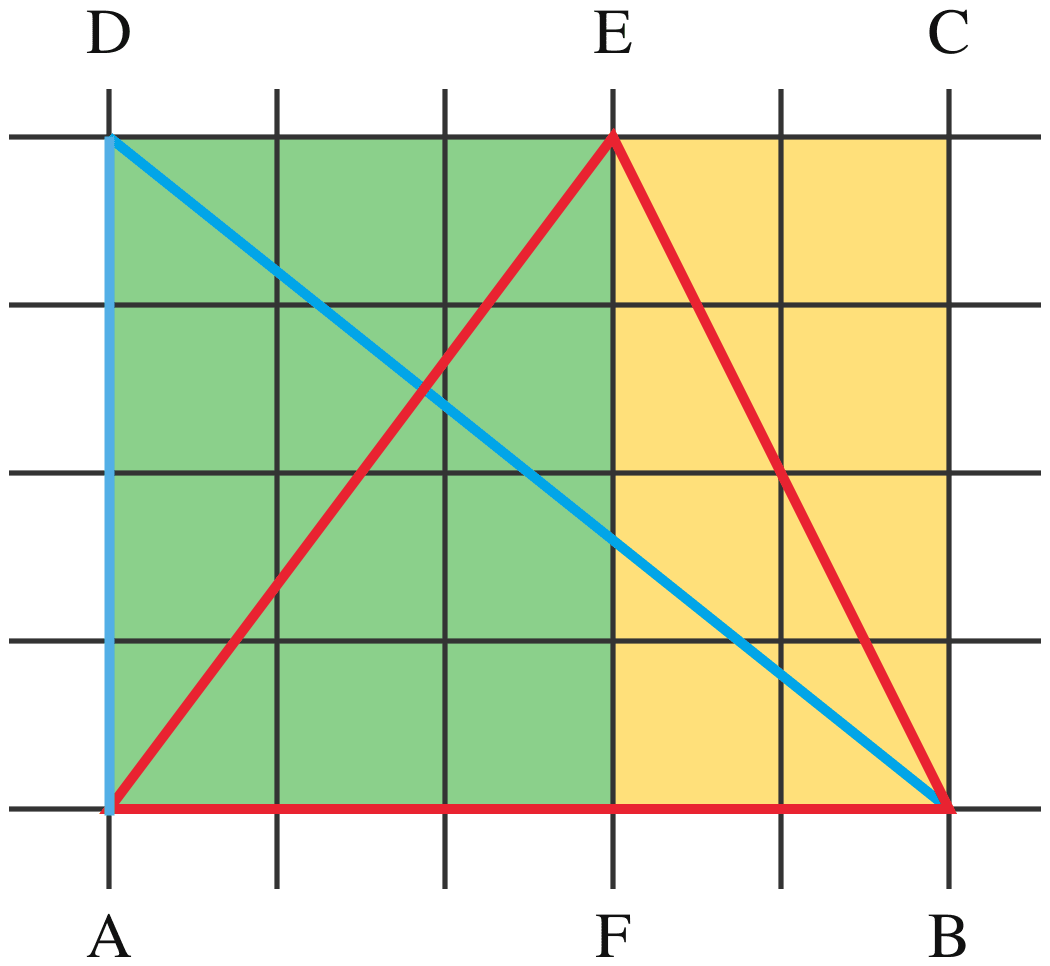
Use your understanding from previous grades to calculate the area of any closed figure using grid paper and—
(i) Find the area of blue triangle BAD. ..........
(ii) Find the area of red triangle ABE. ..........
(iii) Area of rectangle ABCD = ..........
Answer
From the given grid figure:
Each small square of the grid measures 1 unit × 1 unit, so the area of one small square = 1 square unit.
ABCD is a rectangle in which
AB = DC = 5 units [Counting the squares along AB]
AD = BC = 4 units [Counting the squares along AD]
E is a point on DC and F is a point on AB such that EF is perpendicular to AB, with
AF = 3 units and FB = 2 units, and EF = 4 units
(i) Area of blue triangle BAD
△BAD is formed by the diagonal DB of rectangle ABCD.
The diagonal DB divides rectangle ABCD into two congruent triangles, △BAD and △BCD.
In △BAD,
base AB = 5 units and height AD = 4 units
Area of △BAD = × base × height
= × 5 units × 4 units [Substituting the values]
= square units
= 10 square units
Area of blue triangle BAD = 10 square units.
(ii) Area of red triangle ABE
The perpendicular EF divides △ABE into two right triangles, △AEF and △BEF.
Area of △ABE = Area of △AEF + Area of △BEF
Now, △AEF is half of rectangle AFED.
Area of rectangle AFED = AF × EF
= 3 units × 4 units
= 12 square units
⇒ Area of △AEF = × 12 square units
⇒ Area of △AEF = 6 square units
Similarly, △BEF is half of rectangle BFEC.
Area of rectangle BFEC = FB × EF
= 2 units × 4 units
= 8 square units
⇒ Area of △BEF = × 8 square units
⇒ Area of △BEF = 4 square units
∴ Area of △ABE = Area of △AEF + Area of △BEF
= 6 square units + 4 square units
= 10 square units
Area of red triangle ABE = 10 square units.
We notice that both the blue triangle BAD and the red triangle ABE have the same area of 10 square units, even though they look very different. This is because both stand on the same base AB = 5 units and both have the same height 4 units.
(iii)
From the given grid figure,
Length of rectangle ABCD = AB = 5 units
Breadth of rectangle ABCD = AD = 4 units
Area of a rectangle = length × breadth
= 5 units × 4 units [Substituting the values]
= 20 square units
On counting the small squares of the grid enclosed by rectangle ABCD, we also get 20 squares, each of area 1 square unit, which confirms the result.
Comparing this with the areas found above,
Area of △BAD = 10 square units = × 20 square units = × Area of rectangle ABCD
Area of △ABE = 10 square units = × 20 square units = × Area of rectangle ABCD
Area of rectangle ABCD = 20 square units, and the area of each of the triangles BAD and ABE is half of it.
Find the areas of the figures below by dividing them into rectangles and triangles.
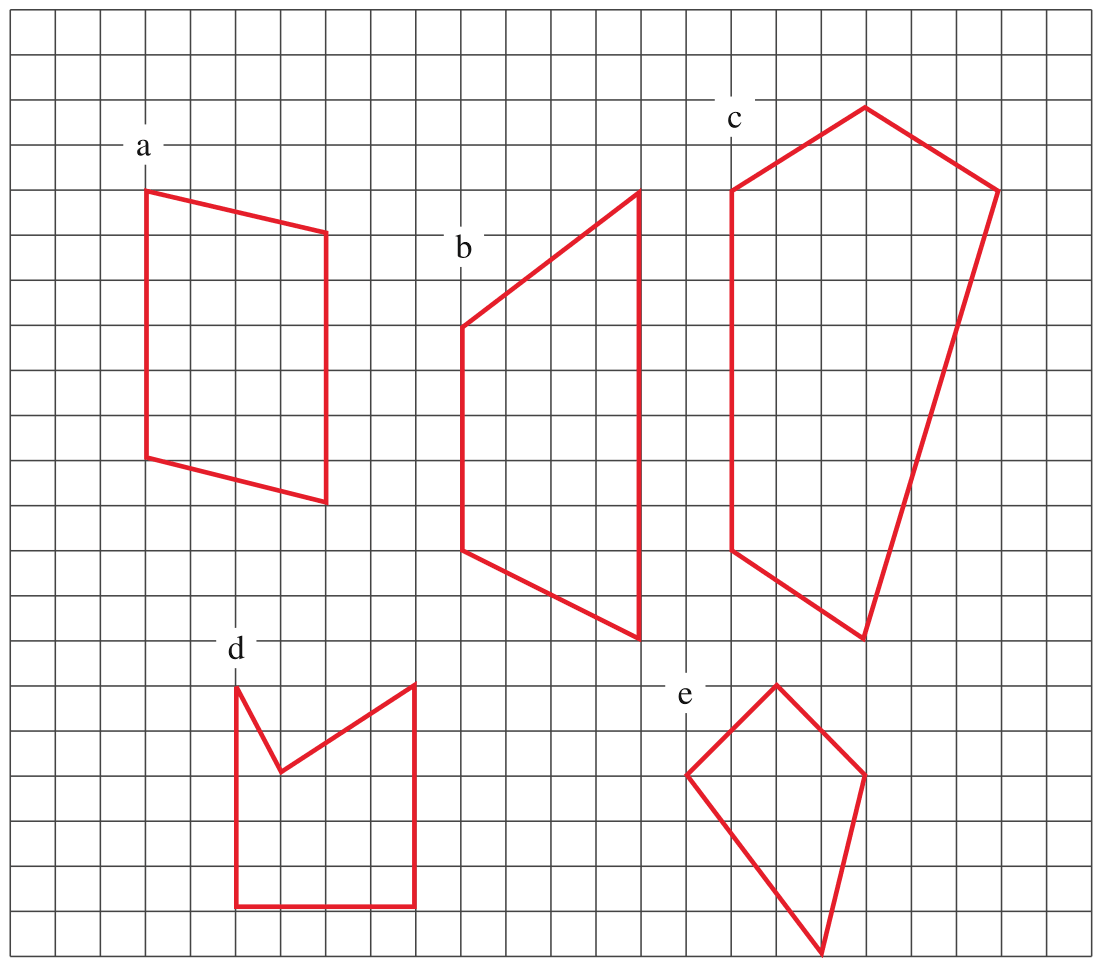
Answer
Each small square of the grid has an area of 1 sq unit.
We know that a triangle drawn inside a rectangle along its diagonal covers exactly half of that rectangle.
∴ Area of a triangle = × base × height
(a)
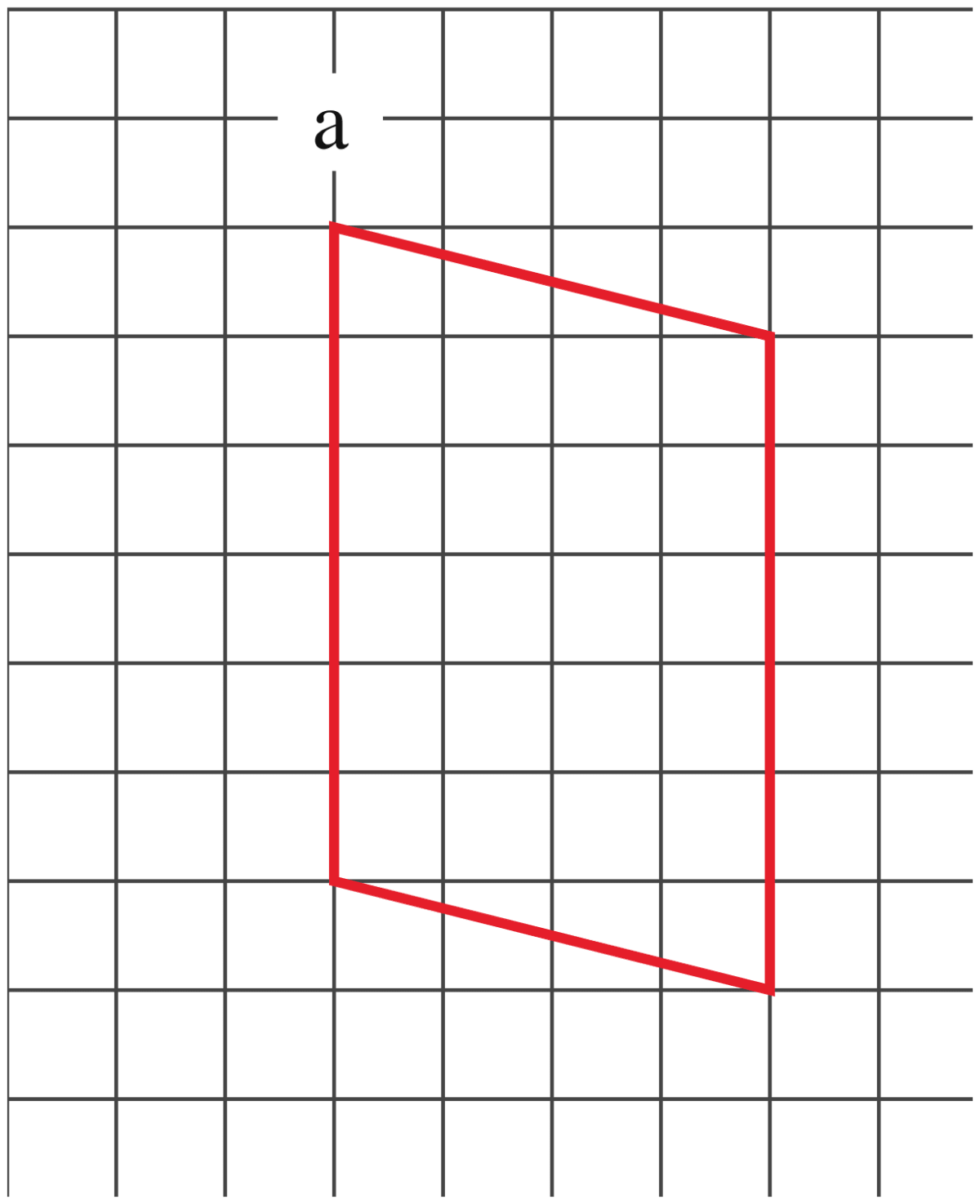
Draw two horizontal lines through the grid, one along the lower end of the slanting top side and the other along the higher end of the slanting bottom side.
The figure now splits into a rectangle and two triangles.
Area of the rectangle = length × breadth
= 5 units × 4 units
= 20 sq units
Area of the upper triangle = × base × height
= × 4 units × 1 unit
= 2 sq units
Area of the lower triangle = × base × height
= × 4 units × 1 unit
= 2 sq units
Total area = (20 + 2 + 2) sq units
= 24 sq units
Area of figure (a) = 24 sq units.
(b)
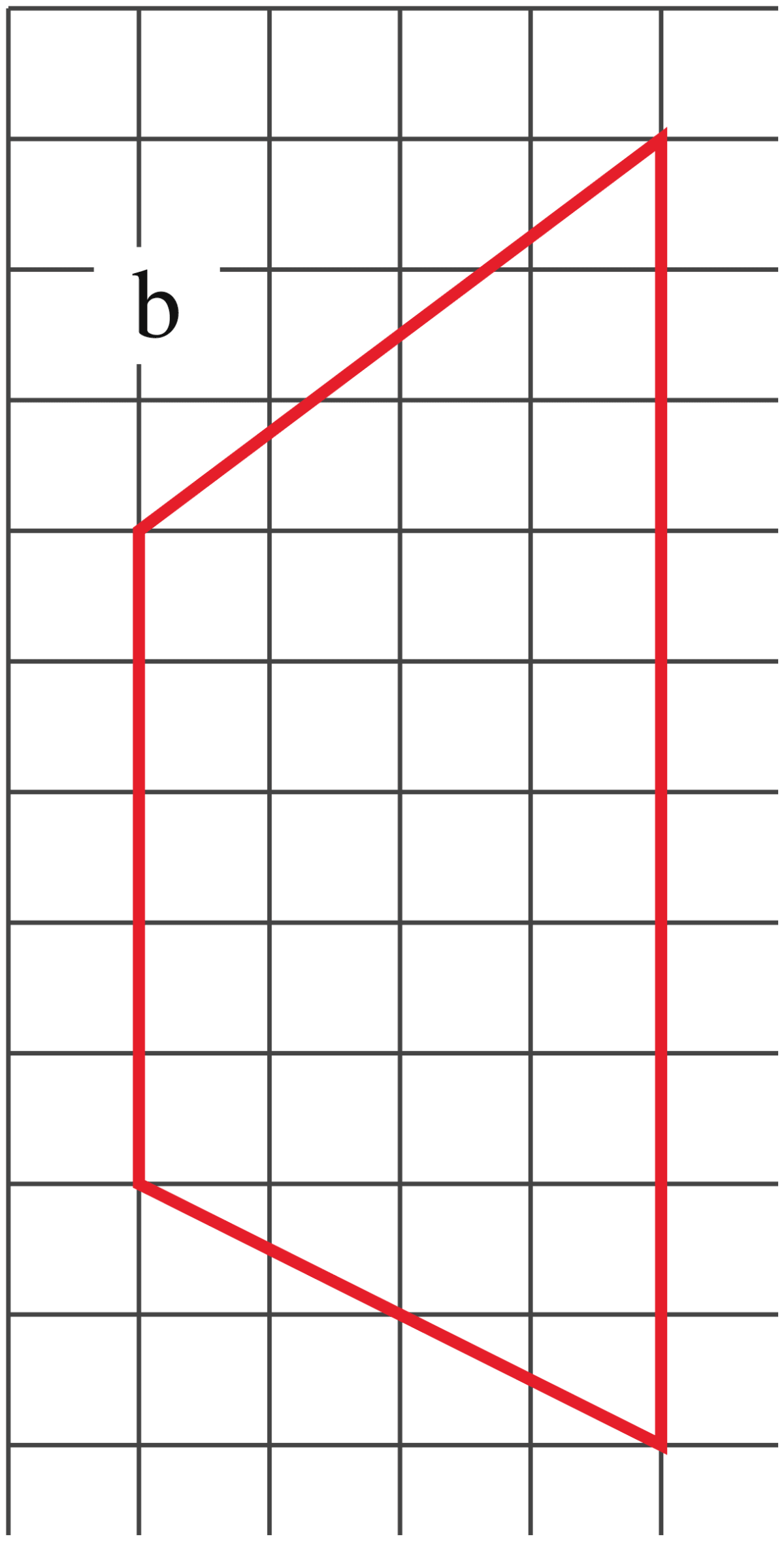
Draw two horizontal lines through the two ends of the shorter vertical side. The figure splits into a rectangle and two triangles.
Area of the rectangle = length × breadth
= 5 units × 4 units
= 20 sq units
Area of the upper triangle = × base × height
= × 4 units × 3 units
= 6 sq units
Area of the lower triangle = × base × height
= × 4 units × 2 units
= 4 sq units
Total area = (20 + 6 + 4) sq units
= 30 sq units
Area of figure (b) = 30 sq units.
(c)
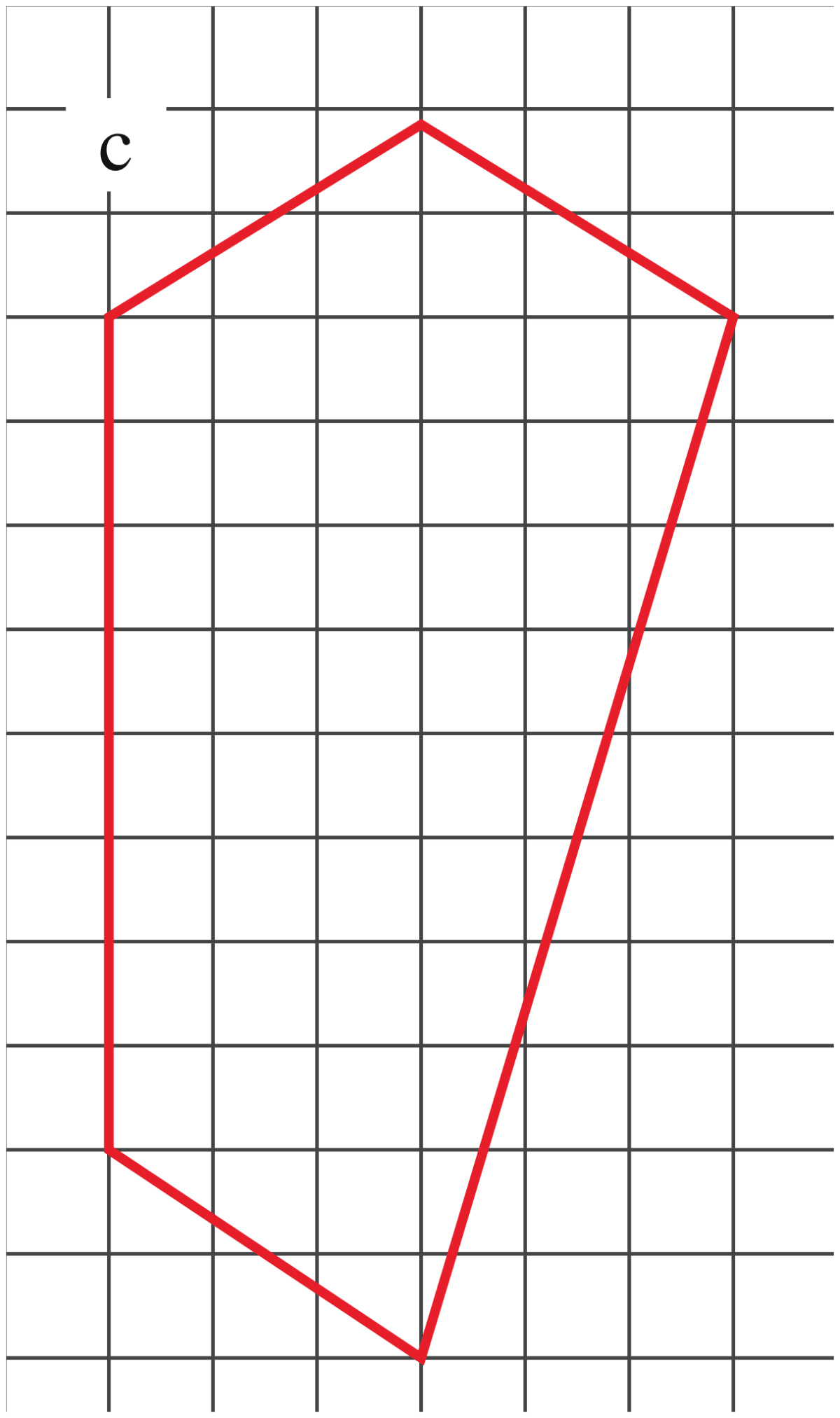
Draw a vertical line through the topmost and the bottommost corners of the figure, and two horizontal lines through the two ends of the left vertical side. The figure splits into one rectangle and three triangles.
Area of the rectangle = length × breadth
= 8 units × 3 units
= 24 sq units
Area of the top triangle = × base × height
= × 3 units × 2 units
= 3 sq units
Area of the bottom triangle = × base × height
= × 3 units × 2 units
= 3 sq units
Area of the right triangle = × base × height
= × 12 units × 3 units
= 18 sq units
Total area = (24 + 3 + 3 + 18) sq units
= 48 sq units
Area of figure (c) = 48 sq units.
(d)
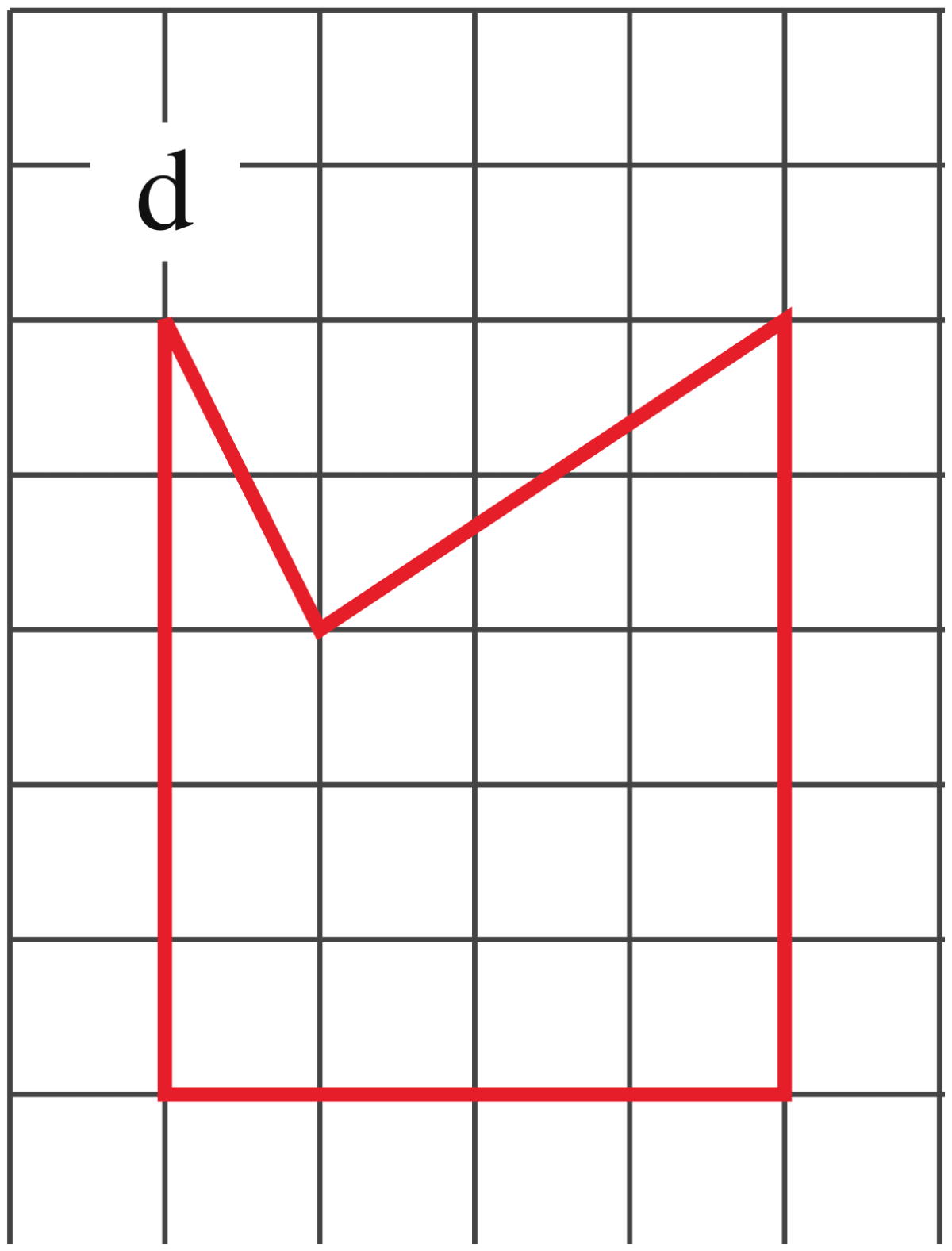
Draw a horizontal line through the bottom of the notch. The figure splits into a rectangle and two triangles.
Area of the rectangle = length × breadth
= 4 units × 3 units
= 12 sq units
Area of the left triangle = × base × height
= × 1 unit × 2 units
= 1 sq unit
Area of the right triangle = × base × height
= × 3 units × 2 units
= 3 sq units
Total area = (12 + 1 + 3) sq units
= 16 sq units
Area of figure (d) = 16 sq units.
(e)
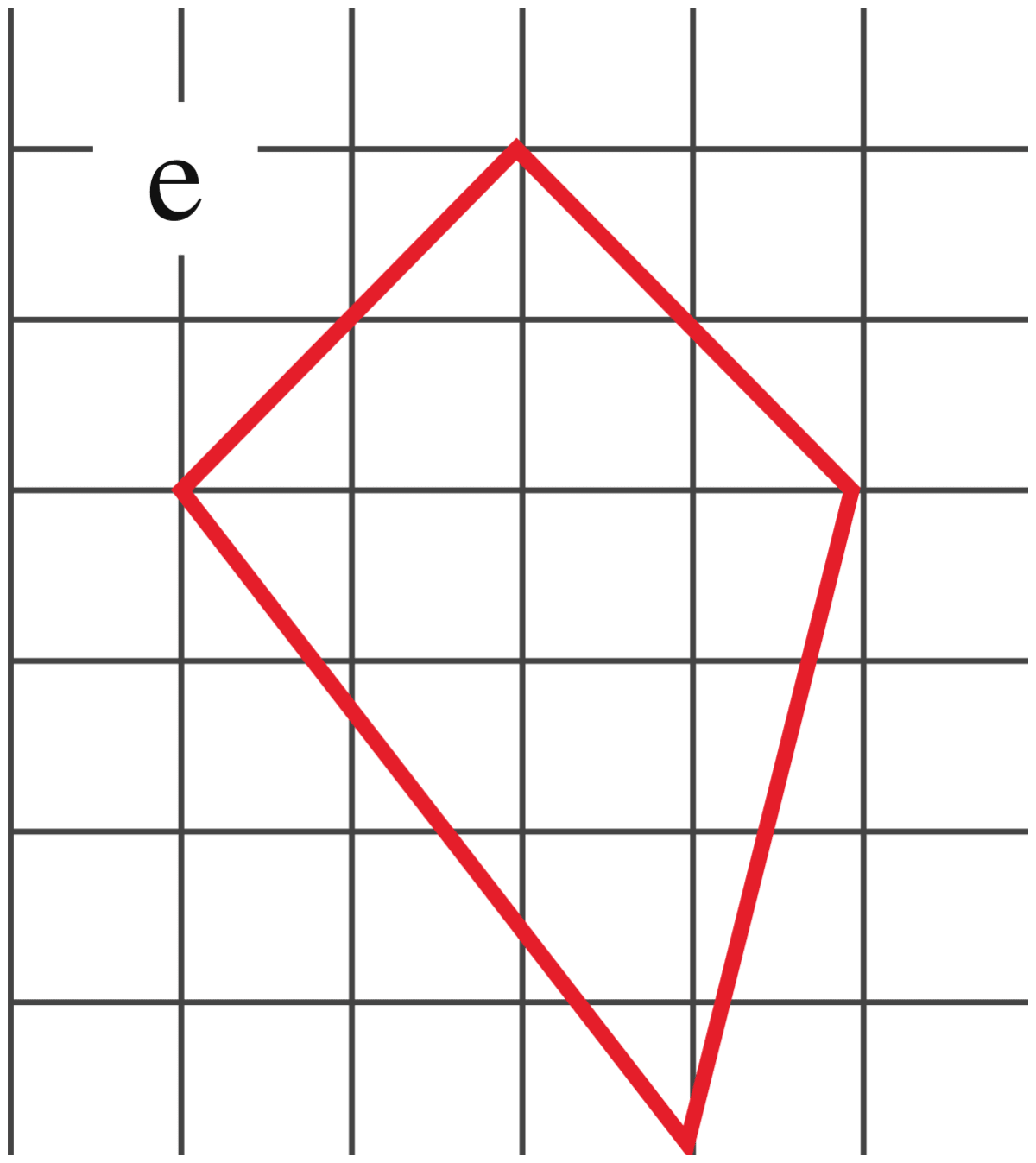
Join the left corner and the right corner of the figure by a horizontal line. The figure splits into two triangles having the same base.
Length of the common base = 4 units
Area of the upper triangle = × base × height
= × 4 units × 2 units
= 4 sq units
Area of the lower triangle = × base × height
= × 4 units × 4 units
= 8 sq units
Total area = (4 + 8) sq units
= 12 sq units
Area of figure (e) = 12 sq units.
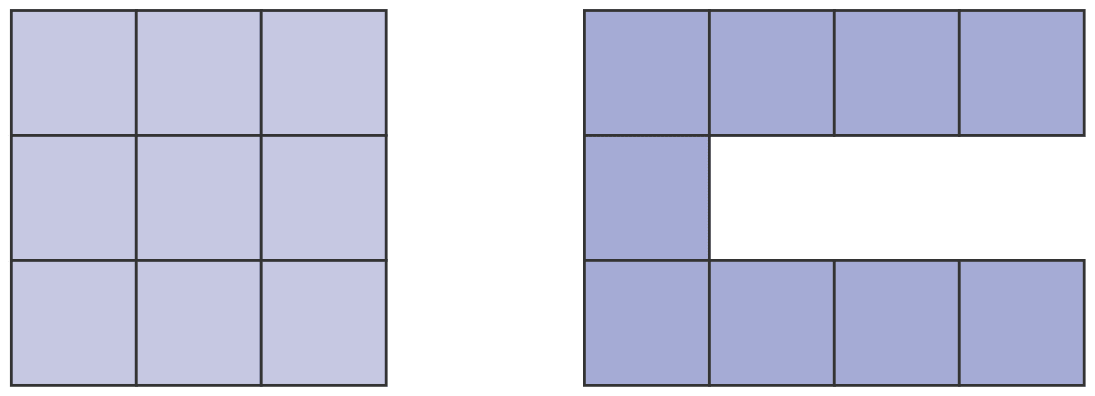
Observe these two figures. Is there any similarity or difference between the two?
Answer
Similarity:
Both the figures are made using 9 unit squares.
Area of the first figure = 9 × 1 sq unit = 9 sq units
Area of the second figure = 9 × 1 sq unit = 9 sq units
∴ Both the figures have the same area, i.e., 9 sq units.
Difference:
The two figures have different shapes, so the lengths of their boundaries are different.
The first figure is a square of side 3 units.
Perimeter of the first figure = 4 × side
= 4 × 3 units
= 12 units
The second figure is C-shaped. Its boundary is made of 20 unit lengths.
Perimeter of the second figure = 20 units
Both the figures have the same area of 9 sq units, but their perimeters are different — 12 units and 20 units respectively.
Using 9 unit squares, solve the following.
(i) What is the smallest perimeter possible?
(ii) What is the largest perimeter possible?
(iii) Make a figure with a perimeter of 18 units.
(iv) Can you make other shaped figures for each of the above three perimeters, or is there only one shape with that perimeter? What is your reasoning?
Answer
Every unit square has 4 sides, so 9 unit squares have (9 × 4) = 36 unit sides in all.
Whenever two squares are joined along a complete side, that side is hidden inside the figure and 2 unit lengths are lost from the boundary.
∴ Perimeter = 36 units - 2 × (number of joined sides)
So, the perimeter becomes smallest when the number of joined sides is the largest, and the perimeter becomes largest when the number of joined sides is the smallest.
(i) To keep all 9 squares connected, at least 8 joins are needed. The largest number of joins possible with 9 squares is 12, and this happens only in the 3 × 3 square.
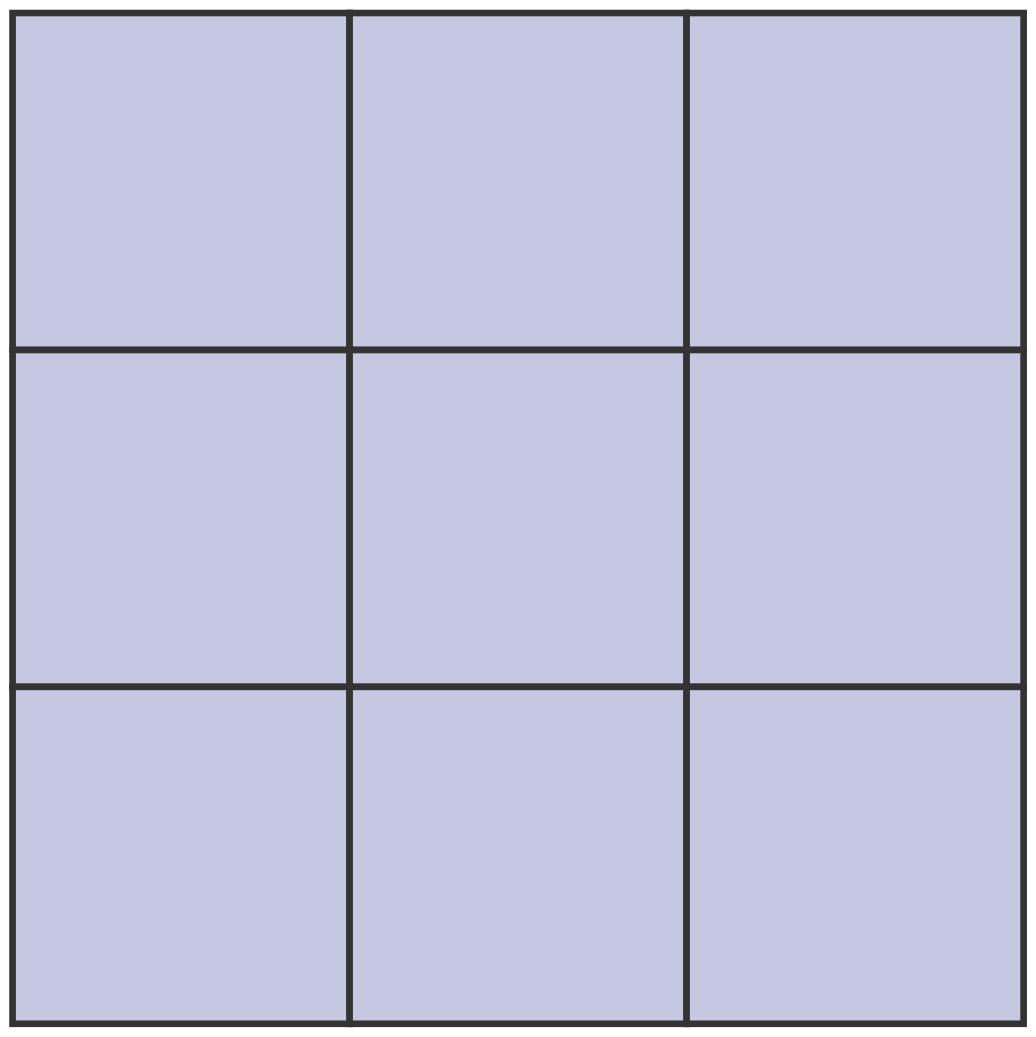
Perimeter of the 3 × 3 square = 4 × side
= 4 × 3 units
= 12 units
The smallest perimeter possible is 12 units.
(ii) The number of joins is the smallest, i.e., 8, when the squares are placed one after another without forming any block, for example in a single row of 9 squares.

Perimeter of the 1 × 9 rectangle = 2(length + breadth)
= 2(9 units + 1 unit)
= 2(10 units)
= 20 units
The largest perimeter possible is 20 units.
(iii) For a perimeter of 18 units,
18 units = 36 units - 2 × (number of joined sides)
⇒ 2 × (number of joined sides) = 36 units - 18 units
⇒ 2 × (number of joined sides) = 18 units
⇒ number of joined sides = 9
One such figure is a row of 7 unit squares with 2 more unit squares placed below the first two squares of that row.
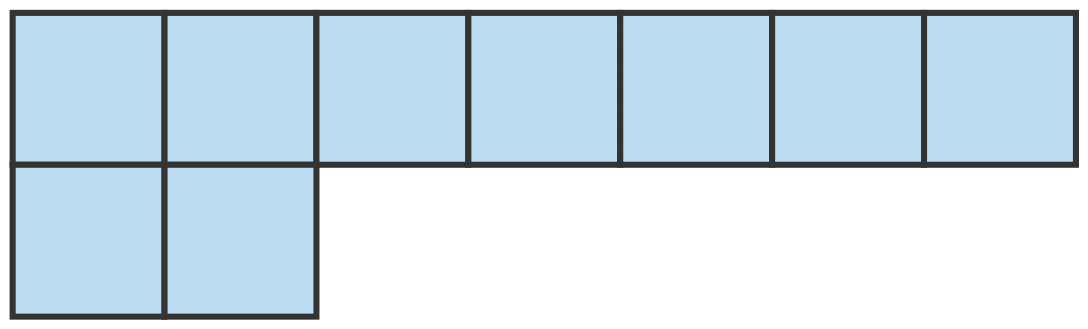
Here the joins are 6 (in the top row) + 1 (in the bottom row) + 2 (between the rows) = 9.
Perimeter = 36 units - 2 × 9 units = 18 units
The figure drawn above has a perimeter of 18 units.
(iv) For a perimeter of 12 units, all 12 joins are needed, and the only figure of 9 unit squares having 12 joins is the 3 × 3 square. So, only one shape is possible for the perimeter of 12 units.
For the perimeters of 18 units and 20 units, many different shapes are possible, because the required number of joins (9 for 18 units and 8 for 20 units) can be arranged in many different ways, for example as an L-shape, a T-shape, a Z-shape and so on.
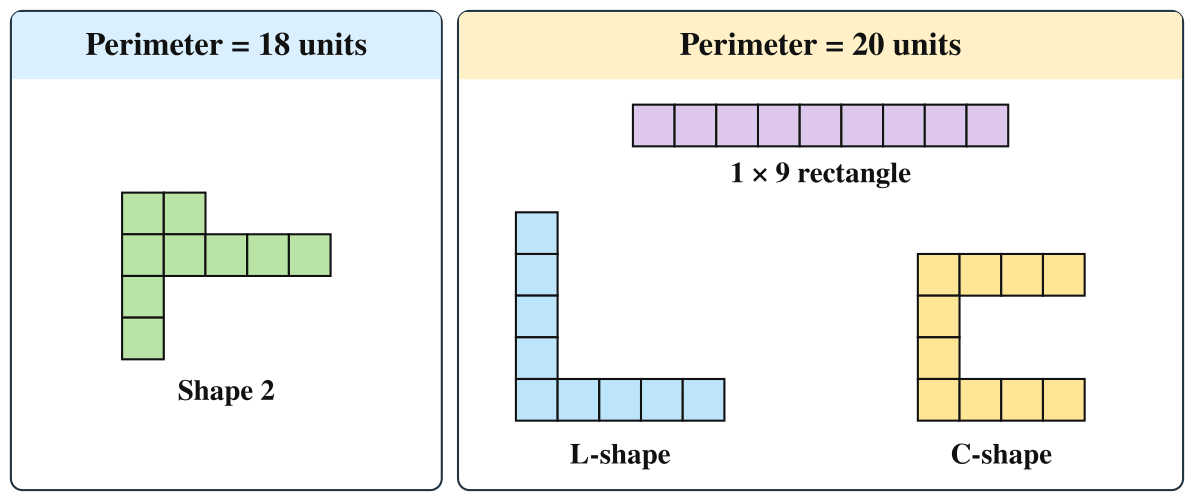
Only the smallest perimeter of 12 units has a single shape; the perimeters of 18 units and 20 units can be obtained from many different shapes.
Let's do something tricky now! We have a figure below having perimeter 24 units.
Without calculating all over again, observe, think and find out what will be the change in the perimeter if a new square is attached as shown on the right.
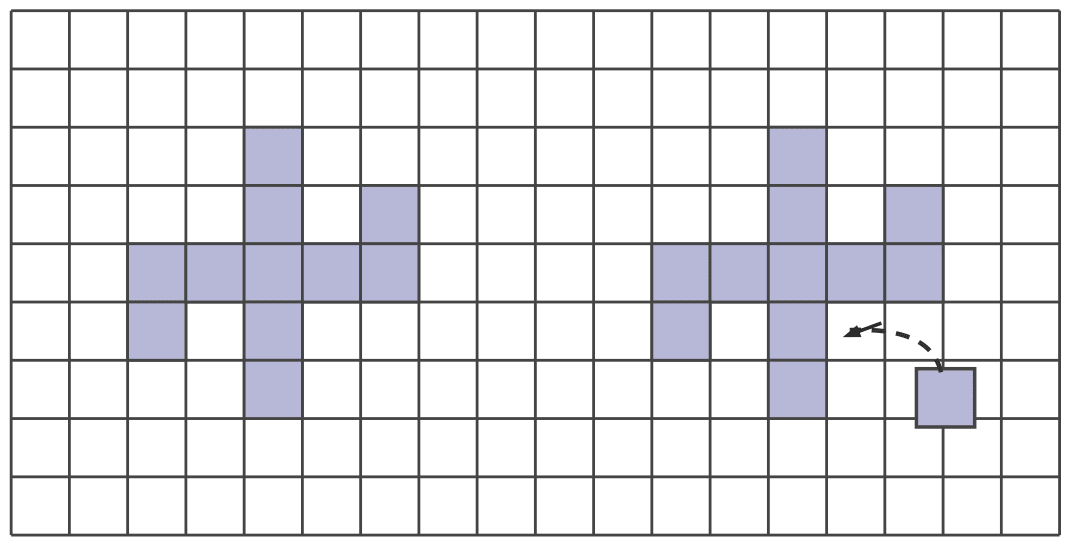
Answer
Look carefully at the place where the new square is attached.
The new square fits into a corner of the figure, so it touches the figure along two of its sides.
These 2 unit lengths of the boundary of the figure are now hidden inside, so 2 units are removed from the perimeter.
The other 2 sides of the new square become part of the boundary, so 2 units are added to the perimeter.
Change in perimeter = (4 units - 2 units) - 2 units
= 2 units - 2 units
= 0 units
New perimeter = 24 units + 0 units = 24 units
There is no change in the perimeter; it remains 24 units.
Experiment placing this new square at different places and think what the change in perimeter will be. Can you place the square so that the perimeter:
(a) increases
(b) decreases
(c) stays the same?
Answer
When the new square is attached, the sides along which it touches the figure get hidden from both the figures. So,
Change in perimeter = 4 units - 2 × (number of touching sides)
(a) Increases
Attach the new square so that it touches the figure along only one side, for example at the tip of any arm of the figure.
Change in perimeter = 4 units - 2 × 1 unit = 2 units
New perimeter = 24 units + 2 units = 26 units
(b) Decreases
Attach the new square in a dent where it touches the figure along three sides, for example the empty square lying between the tip of an arm and the row next to it.
Change in perimeter = 4 units - 2 × 3 units = -2 units
New perimeter = 24 units - 2 units = 22 units
(c) Stays the same
Attach the new square in a corner where it touches the figure along two sides.
Change in perimeter = 4 units - 2 × 2 units = 0 units
New perimeter = 24 units + 0 units = 24 units
Yes, all three are possible — the perimeter increases by 2 units for one touching side, stays 24 units for two touching sides, and decreases by 2 units for three touching sides.
Below is the house plan of Charan. It is in a rectangular plot. Look at the plan. What do you notice?
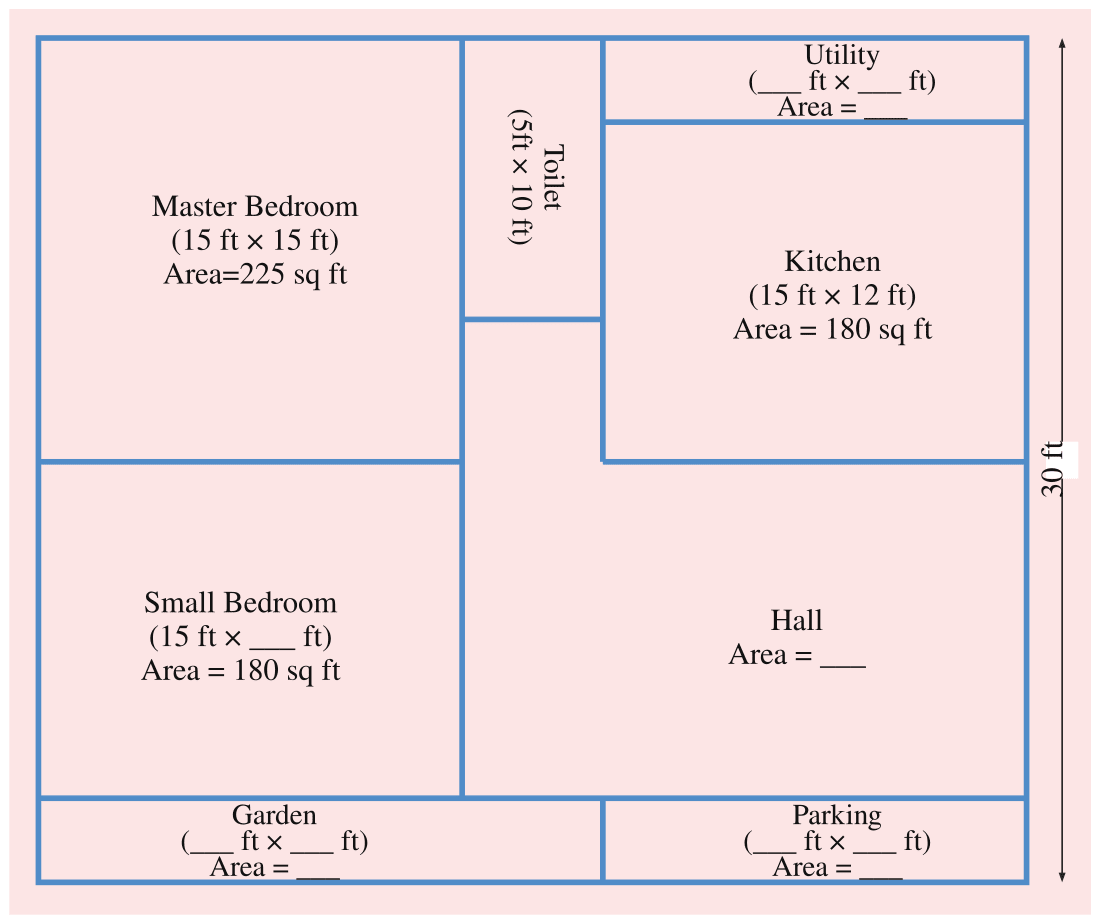
Some of the measurements are given.
(a) Find the missing measurements.
(b) Find out the area of his house.
Answer
On looking at the plan, we notice that the whole plot is a rectangle and every room in it is also a rectangle. Rooms standing side by side have the same height, and rooms standing one below the other have the same width. Using this, all the missing measurements can be found.
Height of the plot = 30 ft [given]
a. Missing measurements
Small Bedroom:
Area = 180 sq ft and length = 15 ft
Area of a rectangle = length × breadth
180 sq ft = 15 ft × breadth [Substituting the values]
⇒ breadth = ft
⇒ breadth = 12 ft
∴ Small Bedroom = 15 ft × 12 ft, Area = 180 sq ft
Width of the plot:
Across the width of the plot, the Master Bedroom column is 15 ft wide, the Toilet column is 5 ft wide, and the Kitchen/Utility column is 15 ft wide.
Width of the plot = 15 ft + 5 ft + 15 ft
= 35 ft
Garden and Parking:
The Master Bedroom, the Small Bedroom and the Garden lie one below the other along the left side of the plot.
Height of Garden = 30 ft - (15 ft + 12 ft)
= 30 ft - 27 ft
= 3 ft
The Garden runs below the Master Bedroom and the Toilet.
Length of Garden = 15 ft + 5 ft = 20 ft
Area of Garden = 20 ft × 3 ft = 60 sq ft
The Parking covers the rest of the bottom strip.
Length of Parking = 35 ft - 20 ft = 15 ft
Area of Parking = 15 ft × 3 ft = 45 sq ft
Utility:
The Utility and the Kitchen lie one below the other and together they are as tall as the Master Bedroom.
Height of Utility = 15 ft - 12 ft = 3 ft
Length of Utility = 15 ft [same as the Kitchen]
Area of Utility = 15 ft × 3 ft = 45 sq ft
Hall:
The Hall lies to the right of the Small Bedroom and below the Kitchen.
Length of Hall = 35 ft - 15 ft = 20 ft
Breadth of Hall = 30 ft - 15 ft - 3 ft = 12 ft
Area of Hall = 20 ft × 12 ft = 240 sq ft
Toilet:
Toilet = 5 ft × 10 ft [given]
Area of Toilet = 5 ft × 10 ft = 50 sq ft
The missing measurements are:
| Room | Dimensions | Area |
|---|---|---|
| Toilet | 5 ft × 10 ft | 50 sq ft |
| Utility | 15 ft × 3 ft | 45 sq ft |
| Small Bedroom | 15 ft × 12 ft | 180 sq ft |
| Hall | 20 ft × 12 ft | 240 sq ft |
| Garden | 20 ft × 3 ft | 60 sq ft |
| Parking | 15 ft × 3 ft | 45 sq ft |
b. Area of the house
The house stands on a rectangular plot of length 35 ft and breadth 30 ft.
Area of the house = length × breadth
= 35 ft × 30 ft
= 1050 sq ft
Area of Charan's house = 1050 sq ft.
Now, find out the missing dimensions and area of Sharan's home. Below is the plan:
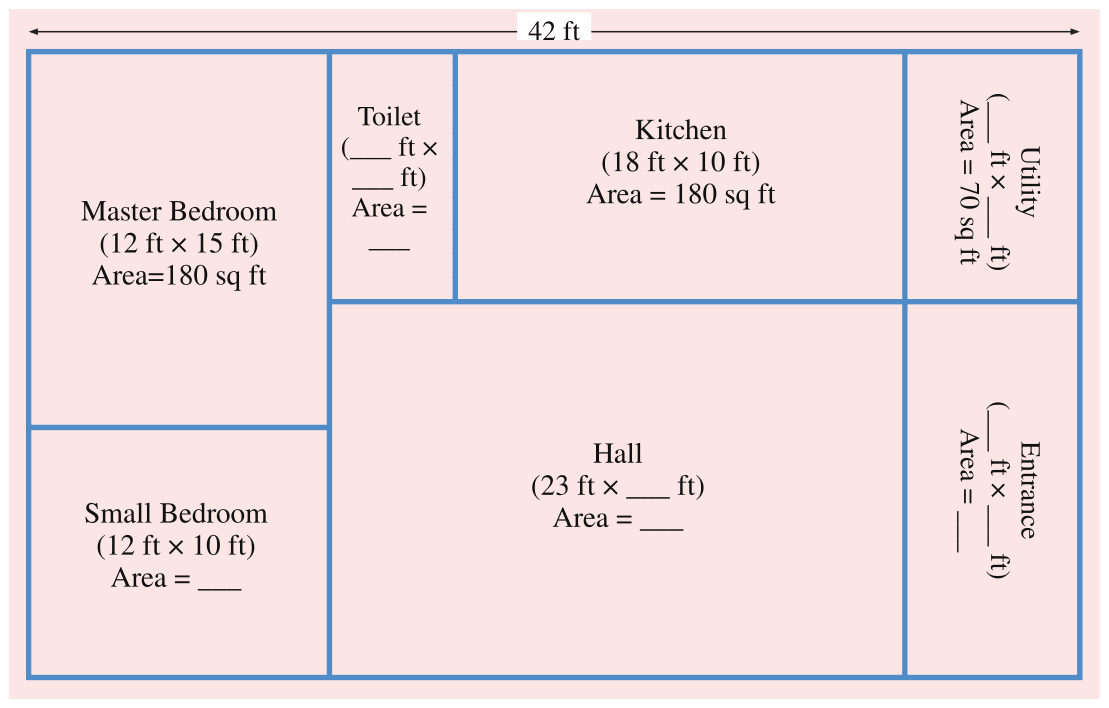
Some of the measurements are given.
(a) Find the missing measurements.
(b) Find out the area of his house.
Answer
Width of the plot = 42 ft [given]
a. Missing measurements
Height of the plot:
The Master Bedroom and the Small Bedroom lie one below the other along the left side of the plot.
Height of the plot = 15 ft + 10 ft
= 25 ft
Small Bedroom:
Small Bedroom = 12 ft × 10 ft [given]
Area of Small Bedroom = 12 ft × 10 ft = 120 sq ft
Toilet:
The Toilet, the Kitchen and the Utility stand side by side in the top strip, so each of them is 10 ft high, like the Kitchen.
The Master Bedroom, the Toilet, the Kitchen and the Utility together cover the full width of the plot.
Length of Toilet = 42 ft - (12 ft + 18 ft + 7 ft)
= 42 ft - 37 ft
= 5 ft
∴ Toilet = 5 ft × 10 ft
Area of Toilet = 5 ft × 10 ft = 50 sq ft
Utility:
Area = 70 sq ft and breadth = 10 ft
Area of a rectangle = length × breadth
70 sq ft = length × 10 ft [Substituting the values]
⇒ length = ft
⇒ length = 7 ft
∴ Utility = 7 ft × 10 ft, Area = 70 sq ft
Hall:
The Hall lies below the Toilet and the Kitchen, and to the right of the two bedrooms.
Breadth of Hall = 25 ft - 10 ft = 15 ft
Length of Hall = 23 ft [given]
Area of Hall = 23 ft × 15 ft = 345 sq ft
Entrance:
The Entrance covers the rest of the lower strip, to the right of the Hall.
Length of Entrance = 42 ft - (12 ft + 23 ft)
= 42 ft - 35 ft
= 7 ft
Breadth of Entrance = 15 ft [same as the Hall]
Area of Entrance = 7 ft × 15 ft = 105 sq ft
The missing measurements are:
| Room | Dimensions | Area |
|---|---|---|
| Master Bedroom | 12 ft × 15 ft | 180 sq ft |
| Toilet | 5 ft × 10 ft | 50 sq ft |
| Kitchen | 18 ft × 10 ft | 180 sq ft |
| Utility | 7 ft × 10 ft | 70 sq ft |
| Small Bedroom | 12 ft × 10 ft | 120 sq ft |
| Hall | 23 ft × 15 ft | 345 sq ft |
| Entrance | 7 ft × 15 ft | 105 sq ft |
b. Area of the house
The house stands on a rectangular plot of length 42 ft and breadth 25 ft.
Area of the house = length × breadth
= 42 ft × 25 ft
= 1050 sq ft
Check: 180 + 50 + 180 + 70 + 120 + 345 + 105 = 1050 sq ft
Area of Sharan's house = 1050 sq ft.
What are the dimensions of all the different rooms in Sharan's house? Compare the areas and perimeters of Sharan's house and Charan's house.
Answer
Dimensions of the rooms in Sharan's house:
| Room | Dimensions | Area |
|---|---|---|
| Master Bedroom | 12 ft × 15 ft | 180 sq ft |
| Small Bedroom | 12 ft × 10 ft | 120 sq ft |
| Toilet | 5 ft × 10 ft | 50 sq ft |
| Kitchen | 18 ft × 10 ft | 180 sq ft |
| Utility | 7 ft × 10 ft | 70 sq ft |
| Hall | 23 ft × 15 ft | 345 sq ft |
| Entrance | 7 ft × 15 ft | 105 sq ft |
Comparison of areas:
Charan's house is a rectangle of 35 ft × 30 ft.
Area of Charan's house = 35 ft × 30 ft = 1050 sq ft
Sharan's house is a rectangle of 42 ft × 25 ft.
Area of Sharan's house = 42 ft × 25 ft = 1050 sq ft
∴ The areas of both the houses are equal.
Comparison of perimeters:
Perimeter of a rectangle = 2(length + breadth)
Perimeter of Charan's house = 2(35 ft + 30 ft)
= 2(65 ft)
= 130 ft
Perimeter of Sharan's house = 2(42 ft + 25 ft)
= 2(67 ft)
= 134 ft
Difference = 134 ft - 130 ft = 4 ft
∴ The perimeter of Sharan's house is greater than the perimeter of Charan's house by 4 ft.
Both the houses have the same area of 1050 sq ft, but the perimeter of Sharan's house (134 ft) is 4 ft more than the perimeter of Charan's house (130 ft).
In the figure below, find the missing value of either the length of a side or the area of a region.
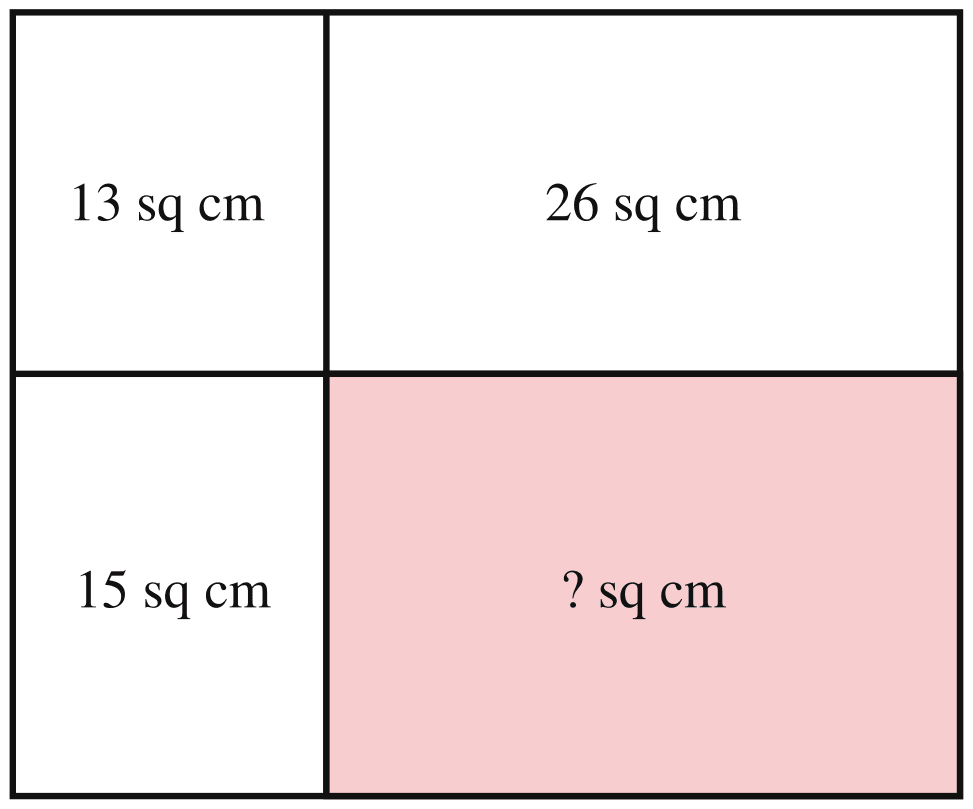
Answer
The big rectangle is divided into four rectangles by one horizontal line and one vertical line.
The two rectangles in the top row have the same height.
Area of the top-right rectangle = 26 sq cm
Area of the top-left rectangle = 13 sq cm
= 2
Since their heights are equal, the width of the right column is 2 times the width of the left column.
The two rectangles in the bottom row also have the same height.
∴ Area of the bottom-right rectangle = 2 × Area of the bottom-left rectangle
= 2 × 15 sq cm
= 30 sq cm
The missing area = 30 sq cm.
In the figure below, find the missing value of either the length of a side or the area of a region.
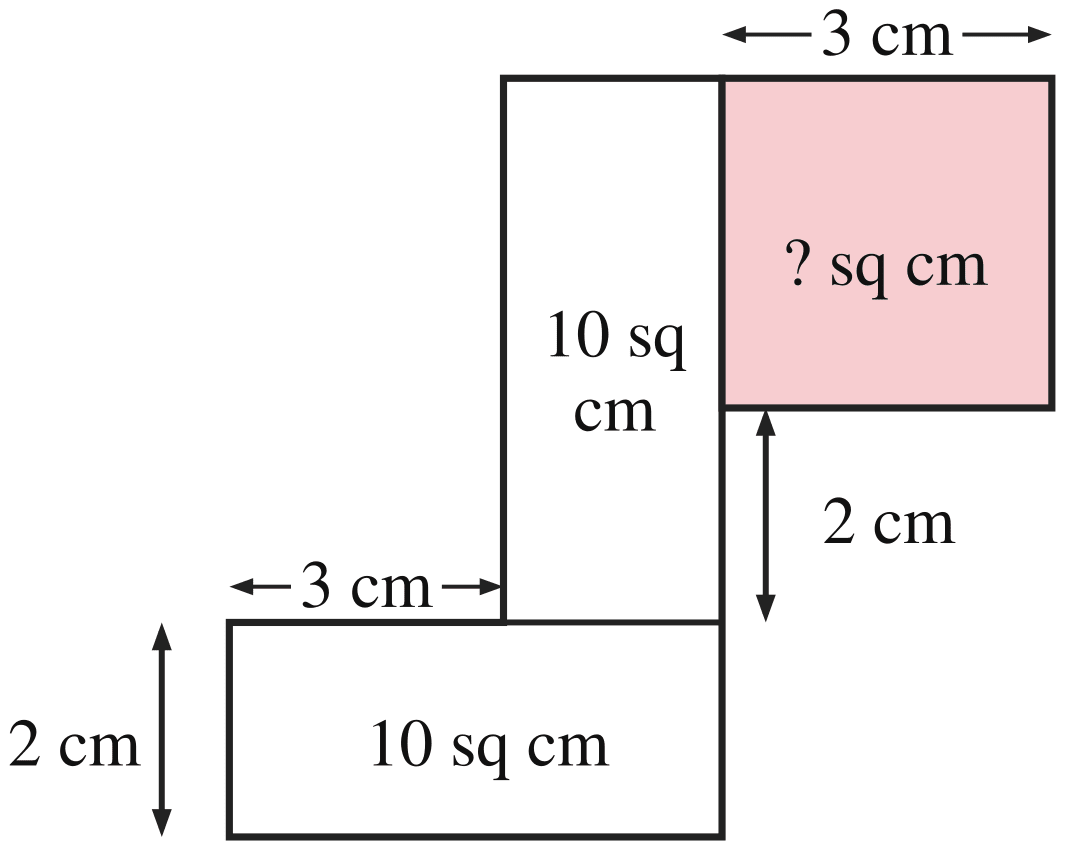
Answer
Bottom rectangle:
Area = 10 sq cm and breadth = 2 cm
Area of a rectangle = length × breadth
10 sq cm = length × 2 cm [Substituting the values]
⇒ length = cm
⇒ length = 5 cm
Tall rectangle:
Its left side is 3 cm from the left edge of the bottom rectangle and its right side lies along the right edge of the bottom rectangle.
Width of the tall rectangle = 5 cm - 3 cm = 2 cm
Area = 10 sq cm
10 sq cm = 2 cm × height [Substituting the values]
⇒ height = cm
⇒ height = 5 cm
Shaded rectangle:
Its top lies along the top of the tall rectangle and its bottom is 2 cm above the base of the tall rectangle.
Height of the shaded rectangle = 5 cm - 2 cm = 3 cm
Width of the shaded rectangle = 3 cm [given]
Area of the shaded rectangle = 3 cm × 3 cm
= 9 sq cm
The missing area = 9 sq cm.
In the figure below, find the missing value of either the length of a side or the area of a region.
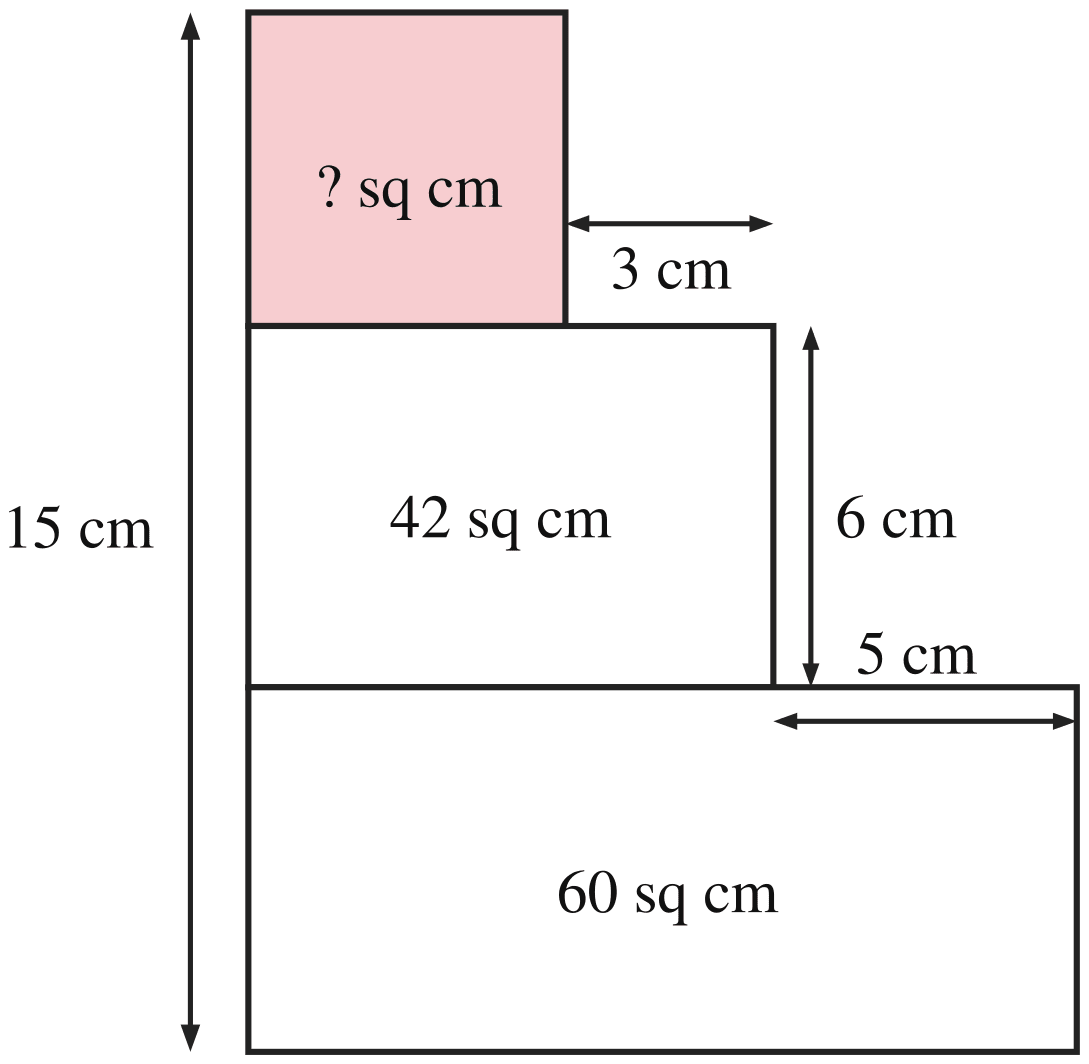
Answer
Middle rectangle:
Area = 42 sq cm and breadth = 6 cm
42 sq cm = length × 6 cm [Substituting the values]
⇒ length = cm
⇒ length = 7 cm
Bottom rectangle:
It is 5 cm longer than the middle rectangle.
Length of the bottom rectangle = 7 cm + 5 cm = 12 cm
Area = 60 sq cm
60 sq cm = 12 cm × breadth [Substituting the values]
⇒ breadth = cm
⇒ breadth = 5 cm
Shaded rectangle:
The three rectangles stand one below the other and their total height is 15 cm.
Height of the shaded rectangle = 15 cm - 6 cm - 5 cm
= 4 cm
Its right side is 3 cm short of the right side of the middle rectangle.
Width of the shaded rectangle = 7 cm - 3 cm = 4 cm
Area of the shaded rectangle = 4 cm × 4 cm
= 16 sq cm
The missing area = 16 sq cm.
In the figure below, find the missing value of either the length of a side or the area of a region.
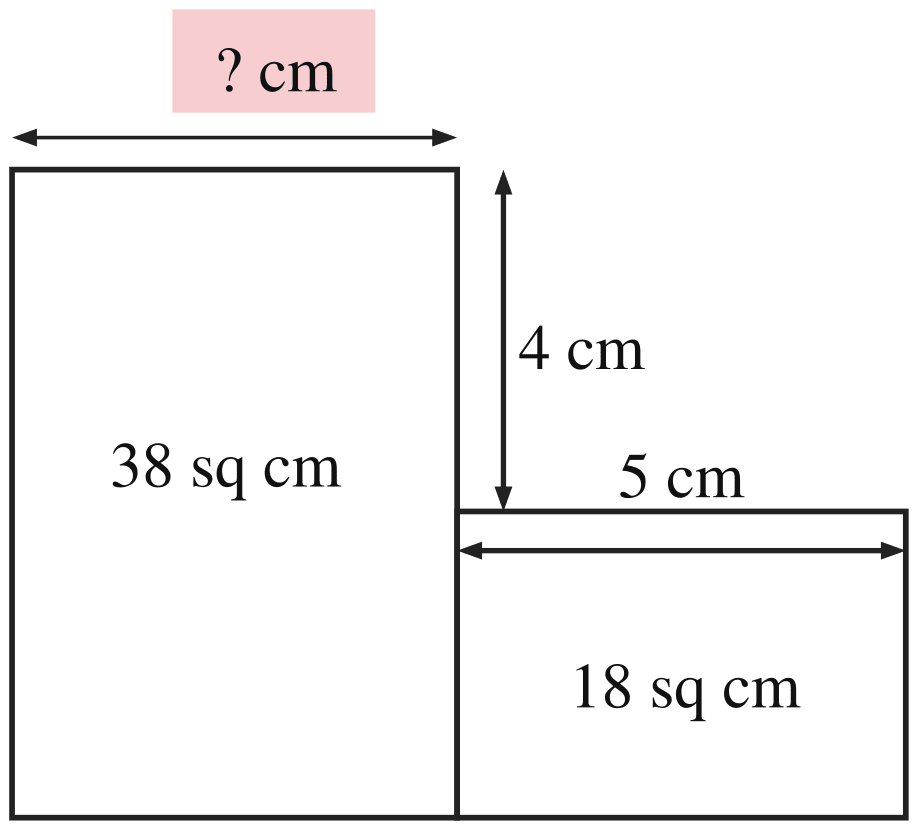
Answer
Right rectangle:
Area = 18 sq cm and length = 5 cm
18 sq cm = 5 cm × height [Substituting the values]
⇒ height = cm
⇒ height = 3.6 cm
Left rectangle:
Both the rectangles rest on the same base line, and the top of the left rectangle is 4 cm above the top of the right rectangle.
Height of the left rectangle = 4 cm + 3.6 cm
= 7.6 cm
Area = 38 sq cm
38 sq cm = length × 7.6 cm [Substituting the values]
⇒ length = cm
⇒ length = 5 cm
The missing length = 5 cm.
Give the dimensions of a rectangle whose area is the sum of the areas of these two rectangles having measurements: 5 m × 10 m and 2 m × 7 m.
Answer
Given:
Measurements of the first rectangle = 5 m × 10 m
Measurements of the second rectangle = 2 m × 7 m
Area of a rectangle = (Length × Breadth)
Area of the first rectangle = 5 m × 10 m [Substituting the values]
= 50 m2
Area of the second rectangle = 2 m × 7 m [Substituting the values]
= 14 m2
Sum of the areas of the two rectangles = 50 m2 + 14 m2
= 64 m2
So, we need a rectangle whose area is 64 m2.
Length × Breadth = 64 m2
Now, 64 = 16 × 4
So, we may take Length = 16 m and Breadth = 4 m.
Check: Area = 16 m × 4 m = 64 m2
One possible set of dimensions of the required rectangle is 16 m × 4 m.
The area of a rectangular garden that is 50 m long is 1000 sq m. Find the width of the garden.
Answer
Given:
Length of the garden = 50 m
Area of the garden = 1000 m2
Area of a rectangle = (Length × Width)
1000 m2 = 50 m × Width [Substituting the values]
⇒ Width = m
⇒ Width = 20 m
Width of the garden = 20 m.
The floor of a room is 5 m long and 4 m wide. A square carpet whose sides are 3 m in length is laid on the floor. Find the area that is not carpeted.
Answer
Given:
Length of the floor = 5 m
Width of the floor = 4 m
Side of the square carpet = 3 m
Area of the floor = (Length × Width)
= 5 m × 4 m [Substituting the values]
= 20 m2
Area of the carpet = (side)2
= (3 m)2 [Substituting the value]
= 9 m2
The carpet covers a part of the floor, so:
Area not carpeted = Area of the floor - Area of the carpet
= 20 m2 - 9 m2
= 11 m2
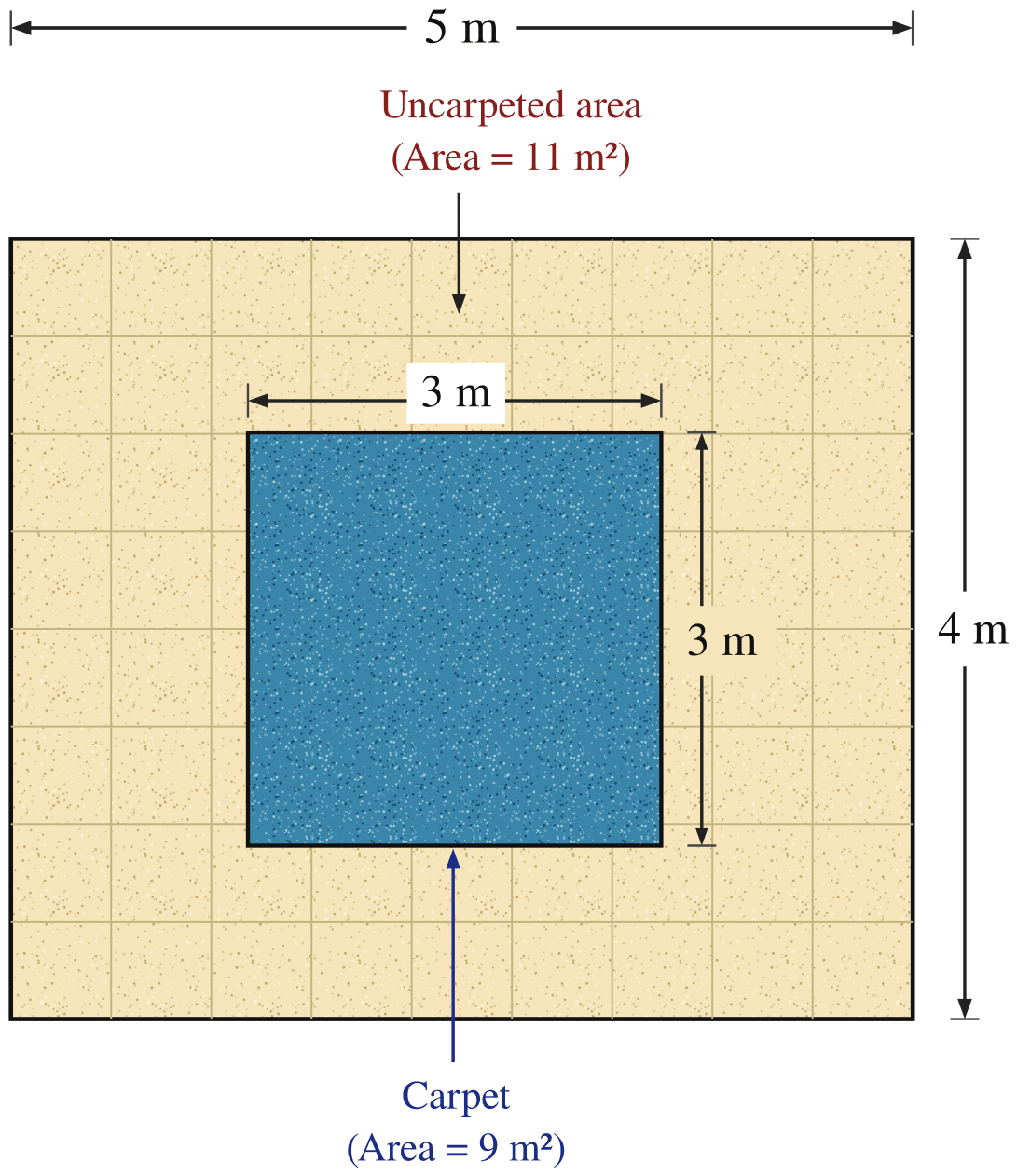
Area of the floor that is not carpeted = 11 m2.
Four flower beds having sides 2 m long and 1 m wide are dug at the four corners of a garden that is 15 m long and 12 m wide. How much area is now available for laying down a lawn?
Answer
Given:
Length of the garden = 15 m
Width of the garden = 12 m
Each flower bed is 2 m long and 1 m wide
Number of flower beds = 4
Area of the garden = (Length × Width)
= 15 m × 12 m [Substituting the values]
= 180 m2
Area of one flower bed = (Length × Width)
= 2 m × 1 m [Substituting the values]
= 2 m2
Area of 4 flower beds = 4 × 2 m2
= 8 m2
The four flower beds are dug at the four corners, so this area is no longer free.
Area available for the lawn = Area of the garden - Area of 4 flower beds
= 180 m2 - 8 m2
= 172 m2
Area available for laying down a lawn = 172 m2.
Shape A has an area of 18 square units and Shape B has an area of 20 square units. Shape A has a longer perimeter than Shape B. Draw two such shapes satisfying the given conditions.
Answer
Given:
Area of Shape A = 18 sq units
Area of Shape B = 20 sq units
Perimeter of Shape A > Perimeter of Shape B
Let us take both the shapes as rectangles and list the rectangles possible for each area.
For Shape A (Area = 18 sq units):
| Length (units) | Breadth (units) | Perimeter = 2(Length + Breadth) |
|---|---|---|
| 18 | 1 | 38 units |
| 9 | 2 | 22 units |
| 6 | 3 | 18 units |
For Shape B (Area = 20 sq units):
| Length (units) | Breadth (units) | Perimeter = 2(Length + Breadth) |
|---|---|---|
| 20 | 1 | 42 units |
| 10 | 2 | 24 units |
| 5 | 4 | 18 units |
We now choose one rectangle from each list so that the perimeter of Shape A is greater than the perimeter of Shape B.
Let Shape A be a rectangle of 9 units × 2 units.
Area of Shape A = 9 units × 2 units = 18 sq units
Perimeter of Shape A = 2(9 units + 2 units) = 2(11 units) = 22 units
Let Shape B be a rectangle of 5 units × 4 units.
Area of Shape B = 5 units × 4 units = 20 sq units
Perimeter of Shape B = 2(5 units + 4 units) = 2(9 units) = 18 units
Here, 22 units > 18 units, so Perimeter of Shape A > Perimeter of Shape B.
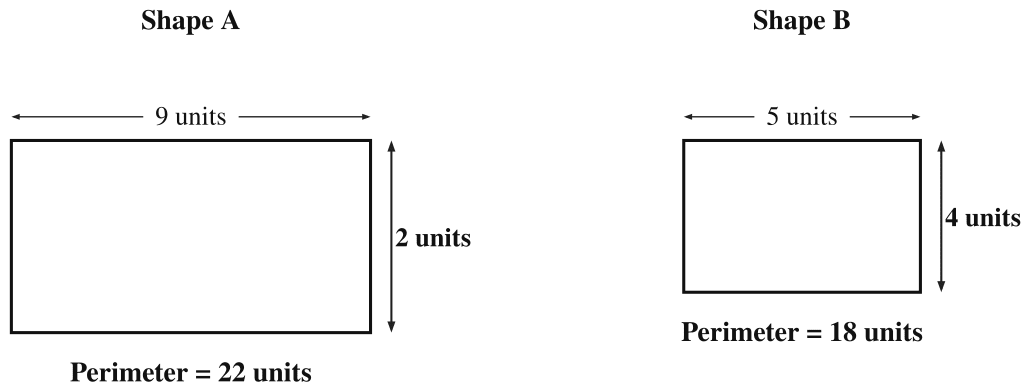
Shape A is a rectangle of 9 units × 2 units (perimeter 22 units) and Shape B is a rectangle of 5 units × 4 units (perimeter 18 units).
On a page in your book, draw a rectangular border that is 1 cm from the top and bottom and 1.5 cm from the left and right sides. What is the perimeter of the border?
Answer
Let the length of the page = l cm and the width of the page = w cm.
The border is 1 cm away from the top edge as well as from the bottom edge.
∴ Length of the border = l cm - 1 cm - 1 cm = (l - 2) cm
The border is 1.5 cm away from the left edge as well as from the right edge.
∴ Width of the border = w cm - 1.5 cm - 1.5 cm = (w - 3) cm
Perimeter of the border = 2(Length + Width)
= 2[(l - 2) + (w - 3)] cm [Substituting the values]
= 2(l + w - 5) cm
= [2(l + w) - 10] cm
So, Perimeter of the border = Perimeter of the page - 10 cm.
For example, if the page is 25 cm long and 18 cm wide, then:
Length of the border = 25 cm - 2 cm = 23 cm
Width of the border = 18 cm - 3 cm = 15 cm
Perimeter of the border = 2(23 cm + 15 cm)
= 2(38 cm)
= 76 cm
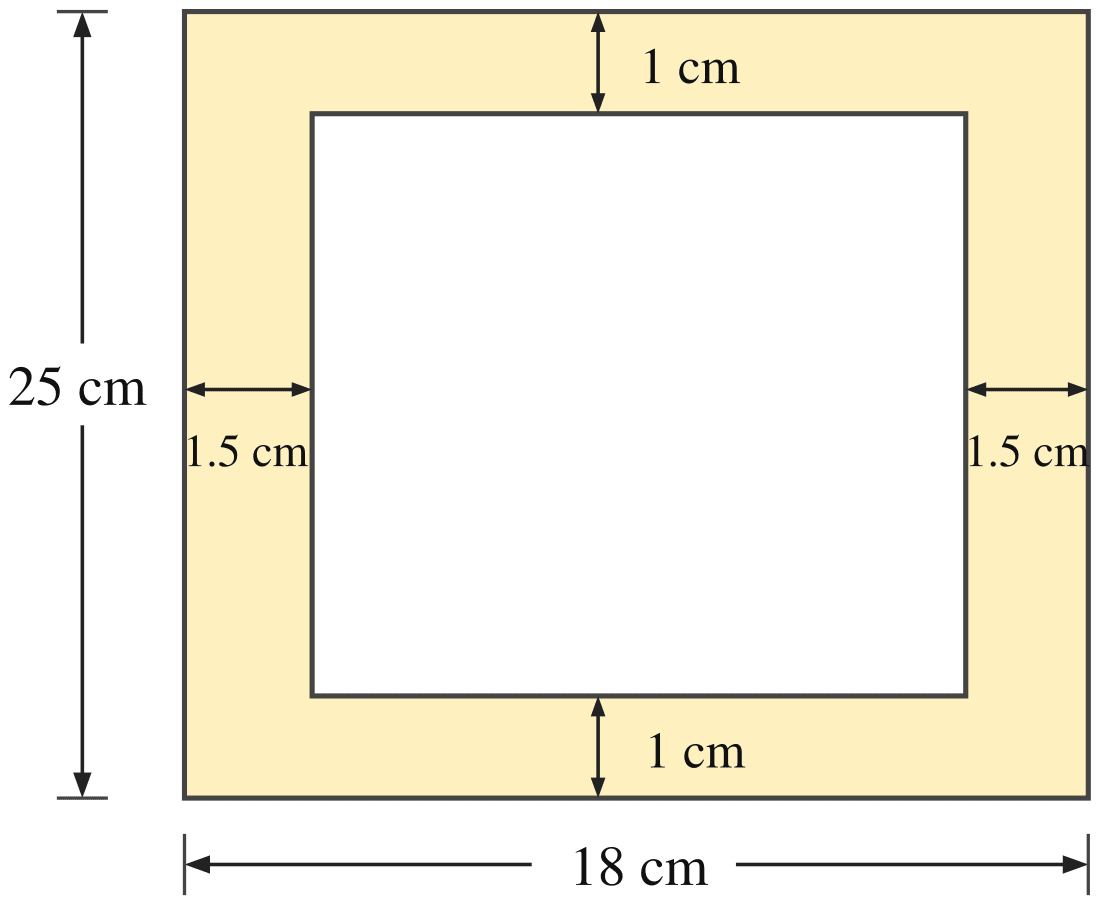
Perimeter of the border = Perimeter of the page - 10 cm. For a page measuring 25 cm × 18 cm, the perimeter of the border = 76 cm.
Draw a rectangle of size 12 units × 8 units. Draw another rectangle inside it, without touching the outer rectangle that occupies exactly half the area.
Answer
Given:
Size of the outer rectangle = 12 units × 8 units
Area of a rectangle = (Length × Breadth)
Area of the outer rectangle = 12 units × 8 units [Substituting the values]
= 96 sq units
The inner rectangle occupies exactly half of this area.
Area of the inner rectangle = × 96 sq units
= 48 sq units
The inner rectangle must not touch the outer rectangle.
∴ Its length must be less than 12 units and its breadth must be less than 8 units.
Let us write 48 as a product of two whole numbers:
48 = 48 × 1 = 24 × 2 = 16 × 3 = 12 × 4 = 8 × 6
Out of these, only 8 × 6 has both the numbers less than 12 and less than 8 respectively.
∴ The inner rectangle is of size 8 units × 6 units.
Check: Area = 8 units × 6 units = 48 sq units, which is half of 96 sq units.
Draw the 8 units × 6 units rectangle so that a gap is left on all four sides of the outer rectangle.
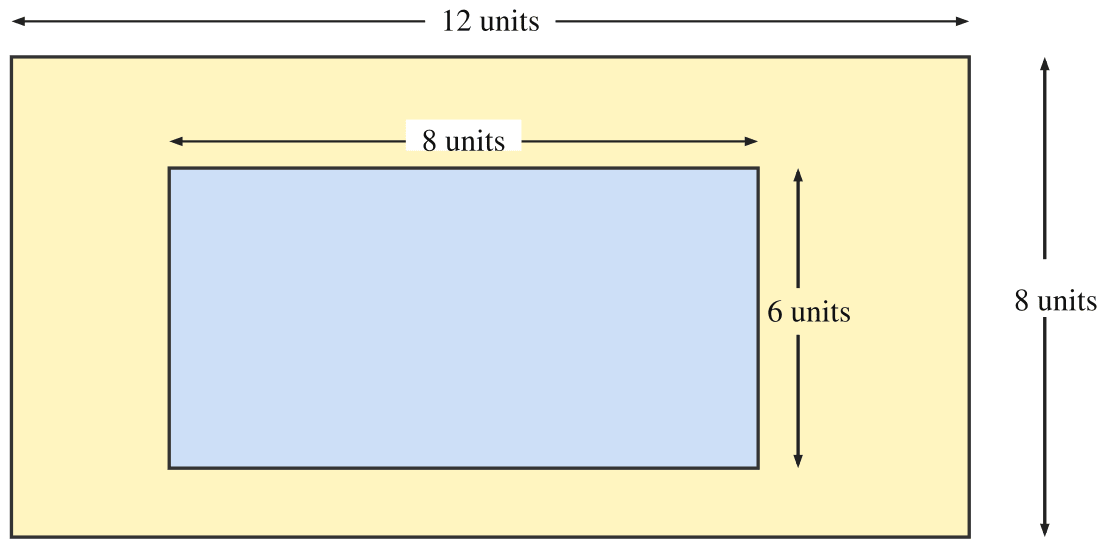
The inner rectangle is of size 8 units × 6 units and its area is 48 sq units, which is half the area of the outer rectangle.
A square piece of paper is folded in half. The square is then cut into two rectangles along the fold. Regardless of the size of the square, one of the following statements is always true. Which statement is true here?
(a) The area of each rectangle is larger than the area of the square.
(b) The perimeter of the square is greater than the perimeters of both the rectangles added together.
(c) The perimeters of both the rectangles added together are always times the perimeter of the square.
(d) The area of the square is always three times as large as the areas of both rectangles added together.
Answer
Let the side of the square piece of paper = a units.
Area of the square = (side)2 = a2 sq units
Perimeter of the square = 4 × side = 4a units
The square is folded in half and then cut along the fold.
So, we get two equal rectangles, each having:
Length = a units and Breadth = units
Area of each rectangle = (Length × Breadth)
= a × sq units
= sq units
Sum of the areas of both the rectangles = 2 × sq units = a2 sq units
Perimeter of each rectangle = 2(Length + Breadth)
= 2 units
= 2 units
= 3a units
Sum of the perimeters of both the rectangles = 2 × 3a units = 6a units
Now, let us check each statement:
(a) Area of each rectangle = sq units, which is less than a2 sq units.
∴ Statement a is false.
(b) Perimeter of the square = 4a units and the sum of the perimeters of both the rectangles = 6a units.
Here, 4a < 6a, so the perimeter of the square is smaller, not greater.
∴ Statement b is false.
(c)
∴ Sum of the perimeters of both the rectangles = × Perimeter of the square.
∴ Statement c is true.
(d) Sum of the areas of both the rectangles = a2 sq units, which is equal to the area of the square and not one-third of it.
∴ Statement d is false.
Hence, statement (c) is always true.