
The teeth which help in tearing the food are the:
- Incisors
- Canines
- Premolars
- Molars
Answer
Canines
Reason — Canines are one on either side of the incisors in each jaw. They are pointed for tearing the food.
Incisors are used for cutting. Premolars & Molars are used for grinding.
Last molar tooth in human beings is called:
- Adult tooth
- Wisdom tooth
- Child tooth
- Elder's tooth
Answer
Wisdom tooth
Reason — The last molar in each side in each jaw is called the wisdom tooth. It is the last tooth to erupt. The wisdom tooth appears at the age of 17-20 years. Adult tooth is not a scientific name for any tooth. Child tooth is not a type of tooth. Elder's tooth is not a biological term.
The hardest substance in your body is:
- Dentine
- Bone
- Cement
- Enamel
Answer
Enamel
Reason — Enamel is the hardest substance of the human body. It is the white visible part of the tooth and serves as the first line of defense against plaque and cavities. It forms the outer covering of the crown of a tooth and protects the inner parts of the tooth from wear and damage during chewing.
Dentine lies beneath the enamel. Bone is strong and rigid, but softer than tooth enamel. Cement covers the root of the tooth.
Saliva converts starch into:
- Glucose
- Sucrose
- Maltose
- Lactose
Answer
Maltose
Reason — The saliva in our mouth contains an enzyme called salivary amylase (ptyalin). Saliva contains enzymes (amylase) which helps in the break down of starch to simple sugars (maltose). Starch is a complex carbohydrate, and salivary amylase breaks it down into maltose, a simpler sugar.
Glucose is formed later after further digestion of maltose. Sucrose is table sugar and is not a product of starch digestion. Lactose is the sugar naturally present in milk.
Proteins of the milk are converted into curd in human stomach by the enzyme:
- Trypsin
- Rennin
- Pepsin
- Erepsin
Answer
Rennin
Reason — The protein casein present in the milk is converted into curd by the help of another enzyme, the rennin. Rennin is an enzyme present in the stomach. Trypsin is produced by the pancreas and acts in the small intestine. Pepsin is present in the stomach and acts on proteins. Erepsin converts peptides into amino acids.
Bile juice is produced by:
- Stomach
- Liver
- Pancreas
- Gall bladder
Answer
Liver
Reason — Bile juice is produced by the liver and stored in the gall Bladder. Stomach produces gastric juice, not bile. Pancreas produces pancreatic juice containing digestive enzymes. Gall bladder stores and concentrates bile produced by the liver.
Which of the following enzymes is contained in the saliva ?
- Sucrase
- Maltase
- Amylase
- Erepsin
Answer
Amylase
Reason — Saliva contains an enzyme amylase which helps in the breakdown of starch to simple sugars (maltose). Its function is to begin the digestion of starch in the mouth by converting it into maltose. Sucrase breaks down sucrose into glucose and fructose. It is found in the small intestine. Maltase breaks down maltose into glucose. It is found in the small intestine. Erepsin helps digest peptides into amino acids. It is found in intestinal juice.
Bile juice is stored in :
- Gall bladder
- Liver
- Duodenum
- Stomach
Answer
Gall bladder
Reason — The liver produces a greenish yellow fluid - the bile which is stored in the gall bladder, an organ found just below the liver. Bile juice is produced by the liver but stored and concentrated in the gall bladder. When fatty food enters the small intestine, the gall bladder releases bile into the duodenum to aid in fat digestion. Liver produces bile but does not store it. Duodenum receives bile during digestion but does not store it. Stomach stores food and secretes gastric juice, not bile.
The end product of protein is :
- Fatty acids
- Amino acids
- Glycerols
- Peptones
Answer
Amino acids
Reason — The end product of protein digestion is amino acids. Fatty acids and glycerol are end products of fat digestion, not protein. Peptones are intermediate products formed during protein digestion, not the final product.
In which of the following parts of the alimentary canal, does digestion not take place ?
- Stomach
- Duodenum
- Jejunum
- Ileum
Answer
Jejunum
Reason — No digestion takes place in the second part of the small intestine called the jejunum.
Digestion does take place in the stomach, the duodenum and the ileum — in fact, the food is completely digested by the time it reaches the end of the ileum. Hence, of the given parts, the jejunum is the one where digestion does not occur.
Assertion: Food provides us with energy to do work and nutrients for the growth and repair of the body.
Reason: Food is a complex substance and is broken down into simpler substances with the help of digestive juices or enzymes.
- Both A and R are true and R is the correct explanation of A.
- Both A and R are true but R is not the correct explanation of A.
- A is true but R is false.
- A is false but R is true.
Answer
Both A and R are true and R is the correct explanation of A.
Reason — A is true as food supplies energy and essential nutrients needed for growth, repair, and maintenance of the body.
R is true as during digestion, complex food substances are broken into simpler forms that can be absorbed and used by the body.
Therefore, Both A and R are true and R is the correct explanation of A is the correct option.
Assertion: Digestion is the process by which complex food materials are broken down into simpler, smaller substances that can be readily absorbed and utilized by the body.
Reason: The bigger and complex food components cannot be easily passed down the narrow alimentary canal and so digestion is required.
- Both A and R are true and R is the correct explanation of A.
- Both A and R are true but R is not the correct explanation of A.
- A is true but R is false.
- A is false but R is true.
Answer
A is true but R is false.
Reason — A is true as digestion is the process by which complex food materials are broken down into simpler, smaller substances that can be readily absorbed and utilized by the body.
R is false as digestion is not required because food cannot pass through the alimentary canal. Food can move through the canal, but complex substances cannot be absorbed by the body cells directly. They must first be broken into simpler soluble forms.
Therefore, A is true but R is false is the correct option.
Assertion: Humans have two sets of teeth- milk teeth (20 in number) during childhood and permanent teeth (28/32 in number) in adulthood.
Reason: The first set of teeth is smaller and suited for a child's jaw, while the second set is larger and stronger to fit the adult jaw and support long-term chewing needs.
- Both A and R are true and R is the correct explanation of A.
- Both A and R are true but R is not the correct explanation of A.
- A is true but R is false.
- A is false but R is true.
Answer
Both A and R are true and R is the correct explanation of A.
Reason — A is true as humans are diphyodont, meaning they develop 20 milk teeth in childhood and 32 permanent teeth in adults.
R is true as milk teeth are temporary and smaller to fit the child’s jaw. Permanent teeth are larger, stronger, and meant for lifelong use.
Therefore, Both A and R are true and R is the correct explanation of A is the correct option.
Assertion: Liver is a reddish brown gland in the body which produces bile juice. Bile juice is a greenish yellow fluid which breaks down fats into tiny droplets.
Reason: Bile juice is stored in the gall bladder and it does not contain any digestive enzymes.
- Both A and R are true and R is the correct explanation of A.
- Both A and R are true but R is not the correct explanation of A.
- A is true but R is false.
- A is false but R is true.
Answer
Both A and R are true but R is not the correct explanation of A.
Reason — A is true as the liver produces bile juice, which helps in the emulsification of fats (breaking large fat globules into tiny droplets).
R is true as bile is stored in the gall bladder and contains bile salts but no digestive enzymes.
Therefore, Both A and R are true but R is not the correct explanation of A is the correct option.
Assertion: The small intestine and large intestine are named based on their overall size when measured along their length.
Reason: Small intestine is narrower but its surface area is much larger hence digestion and absorption of digested food happens here, whereas large intestine mainly absorbs water from the undigested food.
- Both A and R are true and R is the correct explanation of A.
- Both A and R are true but R is not the correct explanation of A.
- A is true but R is false.
- A is false but R is true.
Answer
A is false but R is true.
Reason — A is false as the small intestine is actually longer than the large intestine.
R is true as the small intestine has a large surface area due to villi and is the main site of digestion and absorption. The large intestine mainly absorbs water.
Therefore, A is false but R is true is the correct option.
Fill in the blanks:
(i) The teeth called ............... are a total of four in number on the sides of incisors.
(ii) ............... is a common opening of food pipe and wind pipe.
(iii) Molars are meant for ............... the food.
(iv) Incisors are used for ............... and ............... the food.
(v) The ............... are used for tearing the food.
(vi) The ............... and ............... are used for crushing and grinding the food.
(vii) In an adult human, there are a total of ............... teeth.
(viii) The human teeth appears in two sets, the first set is called ............... which consists of only ............... teeth.
Answer
(i) Canines
(ii) Pharynx
(iii) finer crushing and grinding
(iv) biting, cutting
(v) Canines
(vi) Premolars, Molars
(vii) 32
(viii) temporary teeth, 20
Write True or False in the following statements.
(i) Molars help in cutting and tearing food.
(ii) Carbohydrates are digested into glucose.
(iii) Proteins are digested into fatty acids.
(iv) Wisdom tooth appears at the age of 5-6 years when the child starts going to school.
(v) The temporary set of teeth includes incisors, canines and premolars only.
(vi) The ducts from the salivary glands open into the duodenum.
(vii) Saliva changes starch into maltose.
Answer
(i) False
Reason — Molars help in finer crushing and grinding the food.
(ii) True
Reason — The end products of carbohydrate digestion are simple sugars (glucose & fructose) which can easily be absorbed in our blood system.
(iii) False
Reason — Proteins are digested into amino acid.
(iv) False
Reason — The wisdom tooth appears at the age of 17-20 years. In some people, however, wisdom teeth may not come out of the gums at all.
(v) False
Reason — The temporary teeth consist of 20 teeth (8 incisors, 4 canines and 8 molars only).
(vi) False
Reason — The ducts from the salivary glands open into the mouth.
(vii) True
Reason — Saliva contains an enzyme called amylase which converts starch into maltose.
Fill in the blanks in the table (1-5) by selecting the suitable names of substances from the list given below :
[lipase, peptones, fatty acids, proteoses, protein]
| Digestive enzymes | acts on | to form |
|---|---|---|
| (i) Pepsin | .......(2)....... | .......(3)....... and .......(4)....... |
| (ii) .......(1)....... | fats | .......(5)....... |
Answer
| Digestive enzymes | acts on | to form |
|---|---|---|
| (i) Pepsin | protein | peptones and proteoses |
| (ii) lipase | fats | fatty acids |
Given below are the set of four terms. Choose the odd one and write the category of the remaining terms :
(i) Maltose, Sucrose, Lipase, Lactose.
(ii) Gall bladder, Pancreas, Salivary Glands, Liver.
(iii) Carbohydrates, Fats, Bile, Proteins.
(iv) Ileum, Colon, Jejunum, Duodenum.
(v) Albumen, Pepsin, Trypsin, Rennin.
Answer
(i) Odd one — Lipase
Category of remaining — Sugars
(ii) Odd one — Gall bladder
Category of remaining — Digestive glands
(iii) Odd one — Bile
Category of remaining — Macronutrients
(iv) Odd one — Colon
Category of remaining — Parts of the Small intestine
(v) Odd one — Albumen
Category of remaining — Digestive Enzymes
Match the terms given in column A with those of column B:
| Column A | Column B |
|---|---|
| (i) Incisors | (a) Crushing and grinding |
| (ii) Canines | (b) Emulsification |
| (iii) Molars | (c) Tearing |
| (iv) Bile | (d) Absorption |
| (v) Villus | (e) Biting and cutting |
Answer
| Column A | Column B |
|---|---|
| (i) Incisors | (e) Biting and cutting |
| (ii) Canines | (c) Tearing |
| (iii) Molars | (a) Crushing and grinding |
| (iv) Bile | (b) Emulsification |
| (v) Villus | (d) Absorption |
Name the following:
(i) End product of starch after digestion.
(ii) The organ where protein digestion begins.
(iii) The organ into which the pancreatic juice and the bile juice are poured.
(iv) The enzyme which digests fat in ileum.
(v) The simplest form of carbohydrates.
(vi) The part of alimentary canal where water from the undigested food is absorbed.
(vii) The end-product of protein digestion
(viii) Five major groups of nutrients.
(ix) Five steps involved in the entire process of nutrition.
(x) Three digestive glands.
(xi) Four kinds of teeth.
(xii) Three parts of the small intestine.
(xiii) Three parts of the large intestine.
(xiv) Three enzymes responsible for the breakdown of carbohydrates.
(xv) Three enzymes responsible for the breakdown of proteins.
Answer
(i) Glucose
(ii) Stomach
(iii) Duodenum
(iv) Lipase
(v) Glucose
(vi) Large intestine
(vii) Amino acid
(viii) Carbohydrates, Proteins, Fats, Minerals, and Vitamins
(ix) Ingestion, Digestion, Absorption, Assimilation, and Egestion
(x) Salivary glands, Liver, and Pancreas
(xi) Incisors, Canines, Premolars, and Molars
(xii) Duodenum, Jejunum, and Ileum
(xiii) Caecum, Colon, and Rectum
(xiv) Amylase, Maltase, and Lactase
(xv) Pepsin, Trypsin, and Rennin
Identify and name the "four" types of teeth shown below and state their functions.

Answer
The four types of teeth shown in the figure are listed below along with their functions:
- A → Incisors
Function — Incisors are used for biting and cutting. - B → Canines
Function — Canines are used for tearing the food. - C → Premolars
Function — Premolars help in crushing and grinding the food. - D → Molars
Function — Molars help in finer crushing and grinding of food.
(i) Name the juice secreted by the liver.
(ii) Name the organ where this juice is temporarily stored.
(iii) What is the main function of this juice?
Answer
(i) Bile juice.
(ii) Gall Bladder
(iii) Bile juice breaks down the fats into tiny droplets and this process is called emulsification.
Name the three enzymes found in the pancreatic juice and mention their functions.
Answer
Three enzymes found in the pancreatic juice and their functions are given below:
- Amylase — It acts on the starch converting it into maltose.
- Trypsin — It converts proteins and peptones into peptides.
- Lipase — It converts emulsified fats into fatty acids and glycerol.
Name the three regions of the large intestine.
Answer
The three regions of the large intestine are:
- Caecum
- Colon
- Rectum
Given alongside is the diagram of the human alimentary canal.

(i) Name the parts 1-11 indicated by guidelines.
(ii) State the function of the juice secreted by part 1.
(iii) State the function of the three enzymes found in the juice secreted by part 3.
Answer
(i) The parts are
- Stomach
- Bile duct
- Pancreas
- Large intestine
- Small intestine
- Rectum
- Appendix
- Duodenum
- Gall bladder
- Liver
- Anus
(ii) The juice secreted by part (1) is the Gastric juice. Gastric juice being acidic in nature kills the germs and activates pepsin.
(iii) The function of the three enzymes found in the pancreatic juice are
- Amylase enzyme digests starch into maltose.
- Trypsin enzyme digests proteins into peptides.
- Lipase enzyme digests emulsified fats into fatty acids and glycerol.
Define the terms given below :
(i) Nutrients
(ii) Nutrition
(iii) Wisdom teeth
(iv) Emulsification
(v) Egestion
Answer
(i) Nutrients — A nutrient can be defined as "a constituent of food that helps one way or the other in the body's functions".
(ii) Nutrition — The process by which all organisms obtain or synthesize their food and convert it into simpler substances, so that it can be absorbed and utilized by the cells of the body is called nutrition.
(iii) Wisdom teeth — The last molar on each side in each jaw is called the Wisdom Tooth. The wisdom tooth appears at the age of 17-20 years. In some people, however, wisdom teeth may not come out of the gums at all.
(iv) Emulsification — The bile juice breaks down fats into tiny droplets and this process is called emulsification.
(v) Egestion — The process of eliminating the undigested food through the anus is called egestion.
Define the term nutrition.
Answer
The process by which all organisms obtain or synthesize their food and convert it into simpler substances, so that it can be absorbed and utilized by the cells of the body is called nutrition.
What is the role of liver and pancreas respectively in the digestion of food?
Answer
Liver — The role of liver in the digestion of food is to produce a greenish yellow fluid called the bile that helps in emulsification (breaking down fats into tiny droplets).
Pancreas — It secretes the pancreatic juice that contains enzymes namely amylase, trypsin and lipase. This pancreatic juice acts on carbohydrates, proteins and fats and converts them into simpler units called glucose, amino acids and fatty acids respectively.
Name the digestive juice secreted by the stomach and give its function.
Answer
Digestive juice secreted by the stomach is the Gastric juice. The gastric juice contains water, hydrochloric acid and an enzyme pepsin. Its functions are:
- Hydrochloric acid kills the germs preventing rotting of food during its long stay in stomach. It activates the enzyme pepsin.
- Pepsin converts proteins into a simpler compound called peptones.
Answer the following questions:
(i) Name the types of teeth present in humans.
(ii) How is the small intestine best suited for the digestion and absorption of food?
(iii) What do you mean by absorption of food?
Answer
(i) Four types of teeth present in humans are:
- Incisors
- Canines
- Premolars
- Molars
(ii) Small intestine is a long coiled tube of about 7 metres. The food remains in it for about 3-5 hours for digestion and absorption. Small intestine has Duodenum and Ileum. Duodenum receives bile from liver and pancreatic juice from pancreas that help in the digestion of carbohydrates, proteins and fats. Semi-digested food is completely digested in the Ileum by the intestinal juices secreted by the intestinal glands present in the inner lining of Ileum. Villi are tiny finger-like projections present in the inner lining of the small intestine that greatly increase the inner surface area for absorption of the digested food. They absorb the amino acids and glucose. Vitamins and minerals salts are mostly soluble in water and are directly absorbed through the walls of the intestine.
(iii) Absorption of food means passing the digested food into the blood system and lymph vessels to be supplied to the rest of the body. Major portion of the digested food is absorbed by the villi present in the small intestine. It absorbs the amino acids and glucose to pass them into the blood system, whereas the fatty acids pass into the lymph vessels. Vitamins and minerals are soluble in water and are mostly absorbed through the walls of the intestine.
Define the following terms : Egestion, Digestion, Assimilation.
Answer
Egestion — The process of eliminating the undigested food through the anus is called Egestion.
Digestion — The process by which the complex chemical compounds present in the food are broken down into simpler substances that are readily absorbed and utilized by the body is called Digestion.
Assimilation — The utilization of the digested food and nutrients by the body cells is called Assimilation.
Rewrite the following parts of human alimentary canal in their correct sequences:
Stomach, Oesophagus, Large intestine, Small intestine.
Answer
Oesophagus, Stomach, Small intestine, Large intestine.
What is the fate of excess glucose in our body?
Answer
Our body stores excess glucose as glycogen. During fasting or vigorous exercise, glycogen is rapidly broken down again to form a glucose unit.
Define the term "digestion".
Answer
The process by which the complex chemical compounds present in the food are broken down into simpler substances that are readily absorbed and utilized by the body is called digestion.
State the four ways in which saliva is useful to us.
Answer
The four ways in which saliva is useful to us are:
- It moistens and lubricates the mouth cavity and the tongue to make speaking and swallowing easy.
- It cleans the mouth and destroys germs.
- The saliva binds the food particles and makes it into a mass called the bolus.
- Digestion begins in the mouth. Saliva contains an enzyme (amylase) which helps in the breakdown of starch to simple sugars (maltose).
Foods are classified into three groups on the basis of the functions they perform in our body. Name these three groups, and briefly state their functions. Also give two sources of each.
Answer
The three groups into which the foods are classified are:
- Energy-giving foods — They are made up of carbohydrates and fats. Carbohydrates provide us with instant energy, while fats are stored as energy resources. Its sources are:
- Rice
- Potato
- Fats
- Body-Building foods — Proteins are considered to be body building food. Such foods help in the growth and repair of damaged cells and tissues. Its sources are:
- Pulses
- Milk
- Protective foods — They are mainly vitamins and minerals. Minerals are needed for their specific roles in the body. Vitamins are needed for the normal functioning of various body processes. Its sources are
- Fruits and Vegetables
- Dairy products
Distinguish between bolus and chyme on the basis of occurrence in the part of alimentary canal.
Answer
| Bolus | Chyme |
|---|---|
| Bolus is the term for chewed food mixed with saliva in the mouth and oesophagus. | Chyme is the semi-liquid mixture of partially digested food and gastric juices formed in the stomach and small intestine. |
Distinguish between saliva and bile on the basis of source of secretion.
Answer
| Saliva | Bile |
|---|---|
| The saliva is secreted by three pairs of salivary glands (one below the tongue, second at the base of the ear, and third on the inner side of the angles of the lower jaws). | Bile is secreted by the liver. |
Distinguish between milk teeth and permanent teeth on the basis of number.
Answer
| Milk Teeth | Permanent Teeth |
|---|---|
| Milk teeth are 20 in number. | Permanent Teeth are 32 in number. |
Distinguish between lactase and lipase on the basis of substrate on which they act.
Answer
| Lactase | Lipase |
|---|---|
| Lactase acts on Lactose. | Lipase acts on emulsified fats. |
Distinguish between small intestine and large intestine on the basis of the absorbed materials.
Answer
| Small intestine | Large intestine |
|---|---|
| The small intestine absorbs nutrients from digested food like amino acids, glucose, fatty acids, vitamins and minerals. | The large intestine mainly absorbs water from undigested food. |
Draw a neat diagram of the "vertical section of a grinding tooth" and label all its important parts. Answer the following questions :
(i) Name the substance which covers the visible portion of the tooth.
(ii) Which of the above labelled parts of the tooth is hard like a bone ?
(iii) Name the substance which covers the embedded part of the tooth.
(iv) What are caries ?
(v) Define plaque.
Answer
Diagram of "vertical section of a grinding tooth"
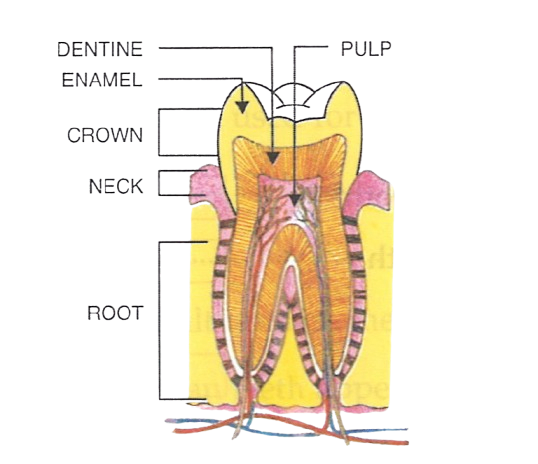
(i) Enamel
(ii) Dentine
(iii) Cement
(iv) The acid produced by the bacteria slowly corrodes the enamel of the teeth and forms cavities known as caries
(v) Sometimes the sugary or starchy foods that we eat get stuck to the teeth. This along with bacteria on the teeth's surface form a yellow coloured film called plaque.
During a school health camp, students examined a model of the human digestive system. They noticed that different glands release specific digestive juices at different stages of digestion. Based on their observations, answer the following:
(i) Which digestive gland starts the process of digestion and what does it release?
(ii) Name one enzyme present in the above secretion answered by you in (i). What role does it play in digestion?
(iii) A piece of bread or boiled rice tastes sweet after being chewed thoroughly. Give a reason.
(iv) Mention the digestive juice secreted by the largest gland in the body. Where is this juice stored in the human body?
(v) In which part of the small intestine is pancreatic juice released?
Answer
(i) The salivary glands start the process of digestion. They release saliva into the mouth.
(ii) The enzyme present in saliva is salivary amylase (ptyalin). It helps in the digestion of starch into simpler sugars (maltose).
(iii) A piece of bread or boiled rice when chewed thoroughly starts tasting sweet because the tasteless starch changes into sweet maltose (sugar).
Starch Sugar (maltose)
(iv) The liver produces a greenish yellow fluid - the bile, which is stored in the gall bladder.
(v) Pancreas secretes pancreatic juice which is poured into the duodenum through the pancreatic duct.