
The water content in human body is:
- 70%
- 75%
- 80%
- 90%
Answer
70%
Reason — The human body as a whole has 70% of water.
The purest form of natural water is:
- sea water
- river water
- rain water
- lake water
Answer
rain water
Reason — Rain water is the purest form of water, formed by the evaporation of water from water bodies on the earth's surfaces, followed by condensation of its vapour. The only impurities present in rain water are dust and dissolved, non-poisonous gases of air.
Sea water contains a large amount of dissolved salts and impurities. River water contains suspended particles, microorganisms, and dissolved substances. Lake water contains impurities like mud, algae, and microorganisms.
When the water vapour changes into tiny droplets of water near the ground, it is called:
- mist
- dew
- fog
- frost
Answer
fog
Reason — Fog is formed when the water vapour changes into tiny droplets of water near the ground. When the tiny droplets of water remain suspended in air, it is called mist. When the water vapour condenses on cold objects, it forms tiny droplets of water called dew. When the dew freezes, it is called frost.
Water is a:
- compound
- element
- mixture
- none of the above
Answer
compound
Reason — One molecule of water is composed of two atoms of hydrogen and one atom of oxygen. Hydrogen and oxygen are present in a fixed proportion in a water molecule, therefore it is a compound. An element contains only one type of atom, but water has two different elements. In a mixture, substances are not chemically combined. Water is chemically formed.
Which of the following is a source of underground water?
- Rivers
- Lakes
- Ponds
- Springs
Answer
Springs
Reason — The natural source of underground water is springs. Ground water can also be obtained by digging wells, tube wells and hand pumps. Rivers are surface water bodies, not underground sources. Lakes are large surface water bodies. Ponds are small surface water bodies.
Under normal conditions, water exists as a:
- solid
- liquid
- gas
- all of the above
Answer
liquid
Reason — Water under normal conditions is in liquid state. If it is heated up to 100°C, it boils and turns into its gaseous state called steam. On cooling to 0°C, water changes to its solid form called ice. Water becomes solid (ice) only at temperatures below 0°C. Water becomes gas (steam/water vapour) only at higher temperatures (above 100°C).
The most suitable source of water for domestic and industrial uses is :
- sea water
- river water
- spring water
- rain water
Answer
river water
Reason — River water is the most suitable source for domestic and industrial use because it is readily available in large quantities.
Sea water is not suitable directly because it contains high amounts of salt and needs expensive desalination. Spring water is limited in quantity and not sufficient for large-scale industrial use. Rain water is seasonal and not continuously available in required amounts.
What are the three states of water?
Answer
The three states of water are
- Solid — ice
- Liquid — water
- Gas — water vapour or steam
Name:
(a) Two major sources of natural water
(b) Two sources of surface water
(c) Two underground sources of water.
Answer
(a) Two major sources of natural water are :
- Surface water
- Underground water
(b) Two sources of surface water are :
- River and land water
- Ocean water
(c) Two underground sources of water are :
- Well water
- Spring water
List three major impurities present in river water.
Answer
- Clay
- Sand particles
- Harmful bacteria
Answer the following questions in brief:
(a) In which form is water present in the atmosphere?
(b) Which source of water contains the highest concentration of salt in it ?
(c) What possible impurities does rain water contain?
(d) What is water table?
Answer
(a) Water is present in liquid form under normal conditions.
(b) Ocean and sea water contains the highest concentration of salt in it.
(c) The impurities present in rain water are dust and dissolved, non-poisonous gases of air.
(d) The level of ground water is known as water table.
Find the percentage of water in the following:
(a) Rice and wheat grains
(b) Eggs
(c) Tomatoes
(d) Bread
(e) Watermelon
Answer
(a) Rice and wheat grains — 3% to 4%
(b) Eggs — 75%
(c) Tomatoes — 95%
(d) Bread — 25%
(e) Watermelon — 97%
What is water cycle? State two important roles of water cycle in nature.
Answer
The change of water from one form to another in nature, which results in its continuous circulation from earth's surface to the atmosphere and from the atmosphere back to the earth's surface is called water cycle.
Two important roles of water cycle in nature :
- Water cycle helps in restoring the lost water from the earth's surface and maintaining the balance of underground water.
- The rain water is very important because agricultural production depends mainly on rains in many parts of the world.
Give reason:
Rain water is considered the purest form of natural water.
Answer
Rain water is the purest form of water, formed by the evaporation of water from water bodies on the earth's surfaces, followed by condensation of its vapour. The only impurities present in rain water are dust and dissolved, non-poisonous gases of air.
Give reason:
Spring water is pure enough for drinking but unsuitable for laboratory use.
Answer
Well water and spring water are considerably pure as they contain dissolved impurities but no suspended impurities or germs. However, it still contains dissolved minerals and salts, which may interfere with chemical reactions in laboratories.
Give reason:
The taste of spring water differs at different places.
Answer
The dissolved impurities in well water and spring water depend on the nature of the soil surrounding the spring or well. Therefore, the taste of spring water differs at different places.
Give reason:
Ice, water and steam are considered to have the same chemical composition.
Answer
Ice, water and steam seem to be different substances, because they have different physical properties. However, chemically, they are identical. Therefore, ice, water and steam are said to be the same chemical substance in different physical states.
How are the following formed ?
(a) fog
(b) mist
(c) dew
(d) frost.
Answer
(a) Fog — When the water vapour changes into tiny droplets of water near the ground, it is known as fog.
(b) Mist — When the tiny droplets of water remain suspended in air, it is called mist.
(c) Dew — When the water vapour condenses on cold objects, it forms tiny droplets of water called dew. It is often seen on grass, leaves and flowers in winter mornings.
(d) Frost — When the dew freezes, it is called frost.
Common salt is obtained from sea water by:
- distillation
- crystallisation
- evaporation
- sublimation
Answer
evaporation
Reason — Common salt is obtained from sea water through the process of evaporation. When a solution is heated, the solvent evaporates, leaving the solute as a residue.
Distillation is used to obtain pure water from a solution, not to collect salt. Crystallisation can be used to purify salts further, but the basic method of obtaining salt from seawater is evaporation. Sublimation is used for solids that directly change into gas (like camphor), not for salt.
The substance which is insoluble in water :
- sugar
- salt
- chalk
- sodium carbonate
Answer
chalk
Reason — Chalk is a substances which do not dissolve in water and is said to be water insoluble substance.
Sugar, sodium carbonate and salt is soluble in water and dissolves easily.
A substance in which another substance is dissolved to form a solution is called:
- solute
- solvent
- precipitate
- none of the above
Answer
solvent
Reason — A solvent is a medium in which a substance is dissolved to form a solution.
A solute is the substance that gets dissolved (e.g., salt in saltwater). A precipitate is an insoluble solid that separates out from a solution.
The most frequently used solvent is:
- water
- alcohol
- vinegar
- carbon disulphide
Answer
water
Reason — Water is the most frequently used solvent because water has the ability to dissolve most of the solid, liquid and gaseous substances.
Alcohol is used as a solvent in some cases, but not as common as water. Vinegar is a solution itself (acetic acid in water), not a general solvent. Carbon disulphide is a specialized solvent used in limited industrial applications.
The substance which gets dissolved in a solvent to form a solution is called :
- solute
- residue
- sediment
- sublimate
Answer
solute
Reason — A solute is a substance that dissolves in a solvent to form a solution. It is in a smaller quantity in a solution.
Residue is the solid left behind after filtration or evaporation. Sediment is the solid that settles at the bottom of a liquid. Sublimate is a substance that directly changes from solid to gas on heating.
The solubility of a solute in a solvent:
- increases by stirring
- increases by heating
- depends upon the size of the solute particles
- all of the above
Answer
all of the above
Reason — The solubility of a solute in a solvent depends upon the size of the solute particles, increases by stirring and heating the solution.
Identify the solute and solvent in the following solutions:
(a) Salt and water
(b) Iodine and alcohol
(c) Air and water
Answer
(a) Salt and water :
- Solute — Salt
- Solvent — Water
(b) Iodine and alcohol :
- Solute — Iodine
- Solvent — Alcohol
(c) Air and water :
- Solute — Air
- Solvent — Water
Define:
(a) Solute
(b) Solvent
(c) Solution
(d) Saturated solution
(e) Unsaturated solution
Answer
(a) A solute is a substance that dissolves in a solvent to form a solution. It is in a smaller quantity in a solution.
(b) A solvent is a medium in which a substance is dissolved to form a solution. It is usually a liquid and is present in a large quantity in a solution.
(c) A solution is a uniform homogeneous mixture formed by dissolving a solute in a solvent. A solution can be of two types, namely saturated and unsaturated.
(d) A solution is said to be saturated when it cannot dissolve any more of the solute at a given temperature.
(e) A solution that can dissolve more of the solute at a given temperature, is said to be an unsaturated solution.
Why is water called a universal solvent ?
Answer
Water has the ability to dissolve most of the solid, liquid and gaseous substances in itself, therefore it is often termed as the universal solvent.
(a) Define solubility.
(b) State two factors by which the solubility of a solute in a solvent can be increased.
Answer
(a) The amount of solute that dissolves in a given quantity of solvent at a given temperature to form a saturated solution is called the solubility of the solute.
(b) Solubility of solute is increased by :
- Heating — Heating increases the capacity of a solvent to dissolve more solute in the same volume.
- Stirring — Stirring the solute in the solvent helps in quick dissolution.
Chlorination of water is done to :
- kill germs
- remove the suspended impurities
- remove the dissolved impurities
- none of the above
Answer
kill germs
Reason — Chlorination of water is done to kill germs, Water is passed into a chlorination tank to kill all the germs present in it.
Suspended impurities are removed by filtration or sedimentation, not chlorination. Dissolved impurities are removed by processes like distillation, not chlorination.
A method used to kill harmful germs present in water is:
- sedimentation
- decantation
- boiling
- filtration
Answer
boiling
Reason — The method to kill harmful germs present in water is boiling, whereas, sedimentation, decantation and filtration can be used to remove suspended impurities from the water.
The settling of suspended solid matter at the bottom of a liquid is called sedimentation. Germs cannot exist at the temperature of boiling water. Filtration suspends particles but does not kill germs.
Sea water is not fit for drinking because it contains a large amount of:
- suspended impurities
- sugar
- dissolved salts
- none of the above
Answer
dissolved salts
Reason — Sea water is not fit for drinking, cooking and washing because it contains a high concentration of dissolved salts. It induces vomiting.
Sea water may contain some, but this is not the main reason it is unfit to drink. Sea water does not contain sugar in significant amounts.
The gas which adds taste to water is:
- oxygen
- nitrogen
- hydrogen
- carbon dioxide
Answer
carbon dioxide
Reason — Dissolved gases like carbon dioxide adds taste to water.
Dissolved oxygen is important for aquatic life but does not affect the taste of water. Nitrogen is mostly inert and does not change the taste of water. Hydrogen does not exist freely in water in a way that affects taste.
Distilled water is:
- salty
- sweet
- sour
- tasteless
Answer
tasteless
Reason — Distilled water is tasteless, because it does not contain any salt or mineral in it.
Saltiness comes from dissolved salts, which are absent in distilled water. Sugar is not present in water naturally. Sour taste comes from acids, which are not present in distilled water.
Which of the following is a water-borne disease?
- Influenza
- Typhoid
- COVID-19
- Malaria
Answer
Typhoid
Reason — Typhoid is a water-borne disease. It spreads through contaminated drinking water.
Influenza is a air-borne disease spread through droplets in the air. COVID-19 is an air-borne disease, spread through respiratory droplets. Malaria spreads by the bite of infected mosquitoes, not water.
Name:
(a) Two chemicals used to destroy germs present in water.
(b) Two diseases which spread through impure water.
(c) A chemical used for loading.
(d) Two substances which add taste to water.
(e) Two household methods to get safe drinking water.
Answer
(a) Chlorine and ozone
(b) Gastroenteritis and cholera
(c) Potash alum
(d) Minerals and carbon dioxide
(e) Boiling and Filtration
Define:
(a) Sterilisation
(b) Sedimentation
(c) Loading
(d) Aeration
Answer
(a) The process of removal of germs from water to avoid water borne diseases is known as sterilisation.
(b) The settling of suspended solid matter at the bottom of a liquid is called sedimentation.
(c) The process of adding a chemical to an impure liquid in order to increase the rate of sedimentation of suspended particles is called loading.
(d) Air under pressure is blown into the filtered water. This process is called aeration. It kills harmful micro-organisms present in the filtered water.
What is the taste of distilled water? Why is it not potable ?
Answer
Distilled water is tasteless. Potable water should contain some minerals and salts, necessary for our body, but distilled water does not contain any salt or mineral that adds taste to water.
Answer in brief:
(a) Why is river water unfit for drinking ?
(b) Why is tap water a mixture ?
(c) What is mineral water?
(d) What is the purpose of adding bleaching powder to water supplied to the town?
(e) How is chemically pure water obtained in the laboratory?
(f) How is water in a swimming pool kept free from germs?
(g) Why is water important for plants and animals?
Answer
(a) River water is absolutely unfit for drinking directly due to the presence of the impurities like clay, sand particles, organic matter, harmful bacteria, etc.
(b) Tap water is a mixture because it contains dissolved impurities like salts, gases and sometimes chlorine.
(c) Mineral water is purified water that contains dissolved minerals like calcium, magnesium, and potassium, and is safe for drinking.
(d) Bleaching powder as a source of chlorine, is added to kill harmful germs and disinfect the water before it reaches homes.
(e) Chemically pure water is obtained by distillation, where water is boiled, and the steam is condensed, leaving impurities behind.
(f) Swimming pools are usually chlorinated to kill the germs in the pool water.
(g) Water is essential for many life processes in plants and animals like digestion, transport of nutrients, temperature regulation, and photosynthesis (in plants only).
Name the steps involved in the purification of drinking water supplied in cities and towns.
Answer
Steps involved in the purification of drinking water are:
- Loading and sedimentation — Running river water is permitted to flow into basins, tanks or reservoirs. Most of the suspended matter settles to the bottom as sediment. They are made to settle down more quickly by loading with the addition of a chemical known as potash alum.
- Filtration — The water after sedimentation still contains some lighter suspended impurities which are removed by filtration through beds of sand and gravel. This leaves a perfectly clear water but it still contains germs.
- Aeration — Air under pressure is then blown into the filtered water. This process is called aeration. It kills harmful micro-organisms present in the filtered water.
- Chlorination — Water is then passed into a chlorination tank where it is treated with chlorine to kill all the germs present in it. Water is now potable or safe for drinking.
- Storage — The potable water is then stored in a storage tank from where it is supplied to homes through pipes.
Give reason:
Ice floats on water.
Answer
Water has anomalous property i.e. in its solid state (ice), it is lighter compared to liquid state (water). Therefore ice floats on water.
Give reason:
Marine life is able to survive in colder regions.
Answer
The anomalous property of ice to float on water enables aquatic plants and animals to survive in colder regions of the world because even when the water of ponds, lakes and rivers freezes, it freezes on the top but remains liquid below the ice layer.
Give reason:
Water droplets can be seen outside a chilled water bottle.
Answer
Fine water droplets get deposited on the outer wall of the water bottle. Due to the cold surface of the chilled water bottle, the water vapour present in the air condenses into water droplets.
What is potable water? List four characteristics of potable water.
Answer
Water fit for drinking purposes is called potable water.
Drinking water should have the following characteristics:
- It should be colourless and odourless.
- It should be transparent.
- It should be free from harmful micro-organisms or germs which cause infections and diseases.
- It should be free from suspended impurities and other harmful substances.
What are the three methods of removing germs from natural water? Explain.
Answer
The process of removing germs from water is called sterilization.
It can be done by following three methods :
- Boiling — Germs cannot exist at the temperature of boiling water. Therefore, prolonged boiling of water destroys them.
- Exposure to air and sunlight — Ozone present in air and sunlight kills the germs present in water.
- Chemical treatment — Chemicals like chlorine and ozone can kill the germs. Use of ozone to sterilise water is called ozonisation.
Water pollution is caused due to the addition of:
- domestic sewage
- pesticides
- effluents
- all of the above
Answer
all of the above
Reason — Water pollution is caused due to the release of the domestic sewage, use of pesticides and release of effluents from the factories in to river bodies.
One of the methods to control water pollution is:
- using synthetic detergents
- passing wastewater through effluent and sewage treatment plants
- washing clothes and utensils near water bodies
- using more fertilizers, pesticides, etc.
Answer
passing wastewater through effluent and sewage treatment plants
Reason — Effluent and sewage treatment plants clean wastewater by removing harmful chemicals, solids, and germs. Using synthetic detergents, washing clothes and utensils near water bodies and using more fertilizers, pesticides, etc. causes more water pollution.
Excess rainfall may cause:
- floods
- droughts
- soil erosion
- both (1) and (3)
Answer
both (1) and (3)
Reason — Excess rainfall causes floods and soil erosion. In contrast, drought is caused by lack of rainfall.
Conservation of water can be done by :
- rainwater harvesting
- planting trees and plants
- avoiding misuse of water
- all of the above
Answer
all of the above
Reason — Conservation of water can be done by rainwater harvesting, planting trees and avoiding misuse of water.
Rainwater harvesting collects and stores rainwater for future use. Planting trees and plants. Plants help in maintaining the water cycle and increasing groundwater recharge. Prevent unnecessary wastage of water.
Assertion: The sea water is saline.
Reason: The sea water contains many dissolved salts and minerals.
- Both A and R are true and R is the correct explanation of A.
- Both A and R are true and R is not the correct explanation of A.
- A is true and R is false.
- A is false and R is true.
Answer
Both A and R are true and R is the correct explanation of A.
Reason — A is true as sea water is salty.
R is true as sea water contains many dissolved salts and minerals.
Therefore, Both A and R are true and R is the correct explanation of A is the correct option.
Assertion: Water is a universal solvent.
Reason: Water has the ability to dissolve most of the solid, liquid and gaseous substances in it.
- Both A and R are true and R is the correct explanation of A.
- Both A and R are true and R is not the correct explanation of A.
- A is true and R is false.
- A is false and R is true.
Answer
Both A and R are true and R is the correct explanation of A.
Reason — A is true as water is called a universal solvent.
R is true as water can dissolve a large number of substances.
Therefore, Both A and R are true and R is the correct explanation of A is the correct option.
Assertion: Water is a mixture.
Reason: Water is made up of hydrogen and oxygen combined together in a 2 : 1 ratio by volume.
- Both A and R are true and R is the correct explanation of A.
- Both A and R are true and R is not the correct explanation of A.
- A is true and R is false.
- A is false and R is true.
Answer
A is false and R is true.
Reason — A is false as water is not a mixture; it is a compound. R is true as water is made of hydrogen and oxygen combined in a fixed ratio (2:1 by volume), which is a property of compounds.
Therefore, A is false and R is true is the correct option.
Assertion: Seeds need water to germinate and grow into plants.
Reason: Ice, liquid water and steam have different physical and chemical properties.
- Both A and R are true and R is the correct explanation of A.
- Both A and R are true and R is not the correct explanation of A.
- A is true and R is false.
- A is false and R is true.
Answer
Both A and R are true and R is not the correct explanation of A.
Reason — A is true as seeds need water for germination because water activates enzymes and helps in growth.
R is true as ice, liquid water, and steam have different physical properties (though chemically they are the same substance).
Therefore, Both A and R are true and R is not the correct explanation of A is the correct option.
Fill in the blanks:
(a) Water is a ............... solvent.
(b) ............... is the purest form of natural water.
(c) Sand and dust are ............... impurities in water.
(d) Sea water has a high concentration of ...............
(e) Water covers nearly ............... of the surface of the earth.
(f) Evaporation of rain water leaves ............... residue.
(g) ............... is the chemical added to water to remove the tiny suspended particles.
(h) A ............... is a uniform mixture of a solute and a solvent.
(i) Ice, water and steam have different physical states but are chemically ...............
(j) Boiling kills most of the ............... in water.
(k) The elements present in the molecules of water are ............... and ...............
Answer
(a) Water is a universal solvent.
(b) Rain water is the purest form of natural water.
(c) Sand and dust are insoluble impurities in water.
(d) Sea water has a high concentration of dissolved salts.
(e) Water covers nearly 70 % of the surface of the earth.
(f) Evaporation of rain water leaves no residue.
(g) Alum is the chemical added to water to remove the tiny suspended particles.
(h) A solution is a uniform mixture of a solute and a solvent.
(i) Ice, water and steam have different physical states but are chemically identical.
(j) Boiling kills most of the germs in water.
(k) The elements present in the molecules of water are hydrogen and oxygen.
Write true or false for the following statements:
(a) Water is an element. ...............
(b) Alum is commonly used for removing suspended impurities. ...............
(c) Tap water does not contain dissolved impurities. ...............
(d) Distillation is a good method for purifying water for town supply. ...............
Answer
(a) False
Correct Statement — Water is a compound. Hydrogen and Oxygen are present in a fixed proportion in a water molecule.
(b) True
(c) False
Correct Statement — Tap water usually contains some dissolved salts, minerals, and chlorine.
(d) False
Correct Statement — Distillation is good method to get water for medicinal purposes and in laboratories.
Match the following:
| Column A | Column B |
|---|---|
| (a) A solution in which more solute can be dissolved. | (1) Solution |
| (b) A medium in in which a substance dissolves. | (2) Unsaturated solution |
| (c) A homogeneous mixture. | (3) Solvent |
Answer
| Column A | Column B |
|---|---|
| (a) A solution in which more solute can be dissolved. | (2) Unsaturated solution |
| (b) A medium in in which a substance dissolves. | (3) Solvent |
| (c) A homogeneous mixture. | (1) Solution |
Name two water-borne diseases.
Answer
Two water-borne diseases are:
- Typhoid
- Cholera
What are effluents?
Answer
The waste chemicals from industries are called effluents. They get dissolved in water bodies and are toxic to aquatic plant and animal life. They make water unfit for human consumption as well.
What is rainwater harvesting?
Answer
It is a process where rainwater is collected from the roofs of buildings and then carried with the help of pipes to underground tanks for storage.
What causes
(a) floods
(b) soil erosion
(c) droughts?
Answer
(a) An overflow of a huge amount of water on land due to heavy rains or an increase in the water level of rivers causes a flood.
(b) Soil erosion by water is the process where water removes the top layer of soil, especially during rainfall, runoff, or flooding.
(c) Drought is the condition of usually dry weather within a geographical region which does not receive rain for a long duration continuously or receives very low rainfall.
What are the three main causes of water pollution ?
Answer
The three main causes of water pollution are :
- Domestic sewage — Water discharged from our homes contains dirt from excreta of the toilet, washing of clothes, utensils and food and vegetable waste. It is called sewage. It is drained off into the lakes, rivers and seas. It contains microorganisms which spread jaundice, cholera, typhoid, etc.
- Agricultural waste — Pesticides, insecticides and fungicides used in the fields are washed away by rain water into rivers. These chemicals harm aquatic life and spoil the human food.
- Industrial waste — The waste chemicals from industry, called effluents, get dissolved in water bodies and are toxic to aquatic plant and animal life. They make water unfit for human consumption as well.
State four steps to be taken to prevent water pollution.
Answer
Steps to be taken to prevent water pollution :
- The polluted water from industries should be passed through effluent treatment plants so that all the harmful chemicals present are removed from it.
- Sources of underground water, like wells, should be covered properly to keep them clean.
- Washing and cleaning of utensils and clothes should not be done near sources of water.
- Bathing and cleaning of animals in or near sources of water like rivers, lakes and ponds should not be done.
(a) State three reasons to conserve water.
(b) State four ways in which you as an individual can conserve water.
Answer
(a) It is necessary for us to conserve water because —
- The amount of water needed for all the living organisms is not available on earth in abundance.
- In agriculture, water is needed in large quantities.
- A large amount of water is required in industries.
(b) The ways by which we can conserve water are :
- Wastage of water should be avoided, for example, taps should never be left open.
- Do not allow water to drip from defective taps.
- More plantations should be done as plants help in bringing rain.
- We should use drip irrigation or spray-irrigation system for crops.
Siya kept two healthy potted plants A and B in sunlight. She watered plant A with tap water and plant B with saline water for a few days regularly. She observed that one of the plants grew well, the other could not.
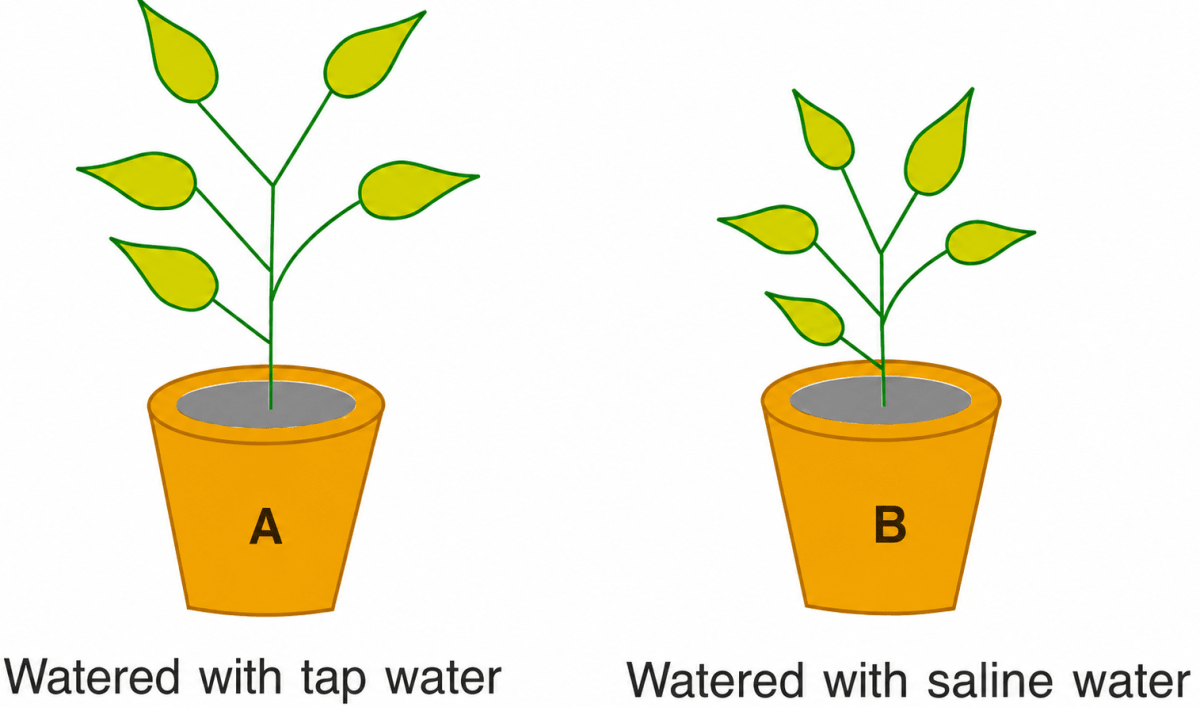
(a) Which potted plant did not grow well ? Why ?
(b) What is saline water ?
(c) What conclusion can you draw from Siya's experiment ?
Answer
(a) Plant B did not grow well.
This is because it was watered with saline water, which contains excess salts. High salt concentration makes it difficult for roots to absorb water (due to osmosis), leading to poor growth or even damage to the plant.
(b) Saline water is water that contains a high amount of dissolved salts.
(c) Plants grow well with normal (fresh) water, but excess salt in water is harmful to plants and affects their growth.
During summer, Radha noticed that the ponds near her house became dry. But in the rainy season, those same ponds overflow with water. Curious, she asked her teacher why this happens. Her teacher explained that heat from the sun changes water from rivers, lakes and ponds into water vapour. Water vapour then rises up and forms clouds. When clouds become heavy, they release water back to the earth as rain. This natural process keeps water circulating on the earth.
(a) What is this continuous circulation of water called?
(b) What is the process by which water vapour turns back into tiny droplets of water?
(c) In which season is the evaporation of water the fastest?
(d) Write two uses of water in your daily life, apart from drinking.
Answer
(a) This continuous circulation of water is called the water cycle.
(b) The process by which water vapour turns into tiny droplets of water is called condensation.
(c) Evaporation of water is fastest in the summer season because of higher temperature.
(d) Two uses of water in daily life, apart from drinking are cooking food and washing clothes.