
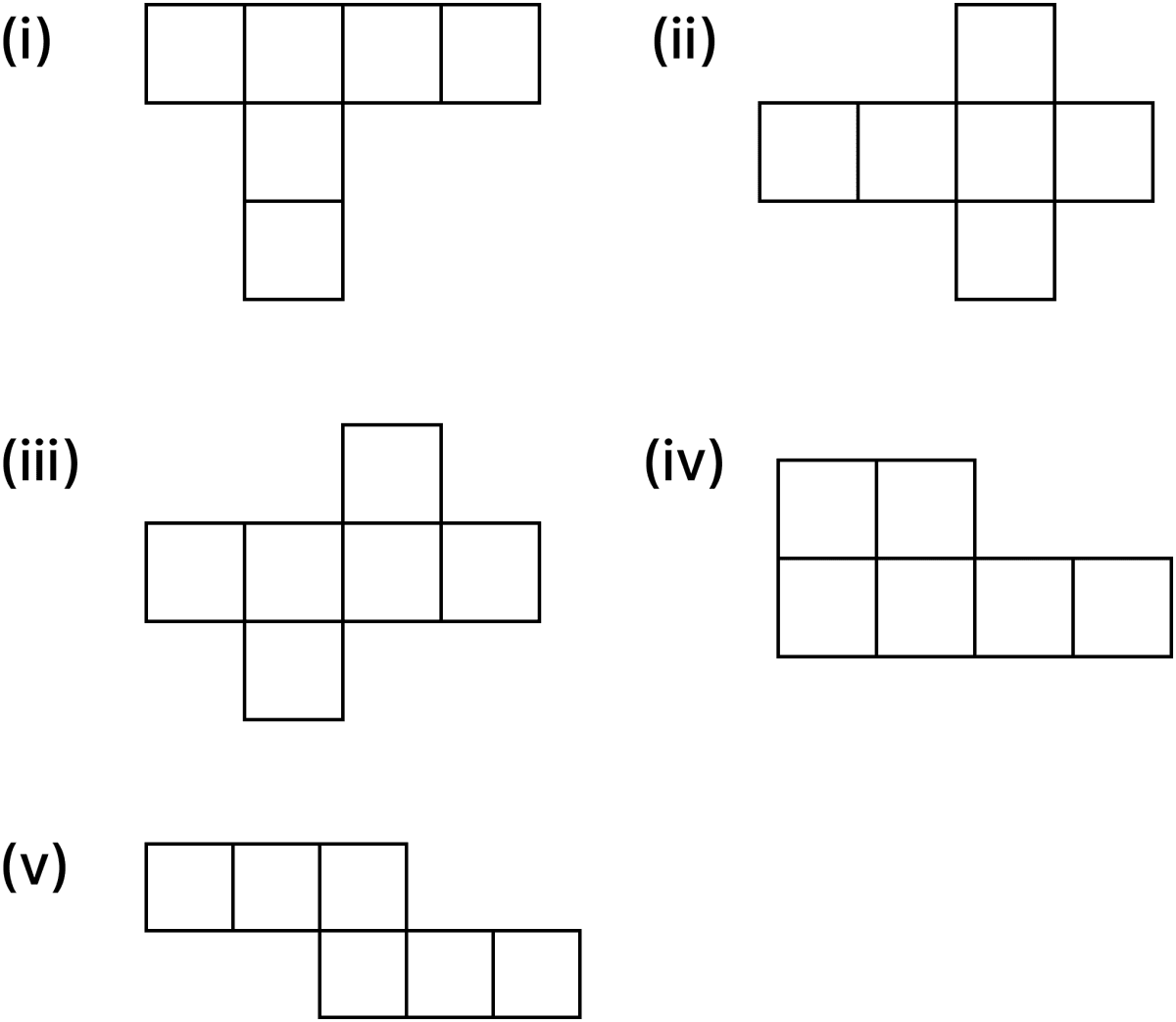
Identify the nets which can be used to form cubes :
Answer
A net of a cube is made up of six equal squares, which on folding form the six faces of the cube in such a way that no two squares overlap and no face of the cube is left open.
On folding the nets (ii), (iii) and (v), each of the six squares forms a different face of the cube and a cube is obtained.
On folding the nets (i) and (iv), two of the squares overlap each other and one face of the cube is left open. So, a cube cannot be formed from them.
Hence, the nets (ii), (iii) and (v) can be used to form cubes.
Draw at least three different nets for making a cube.
Answer
A pattern, that can be cut and folded to make a model of a solid shape, is called a net.
Three different nets for making a cube are shown below:
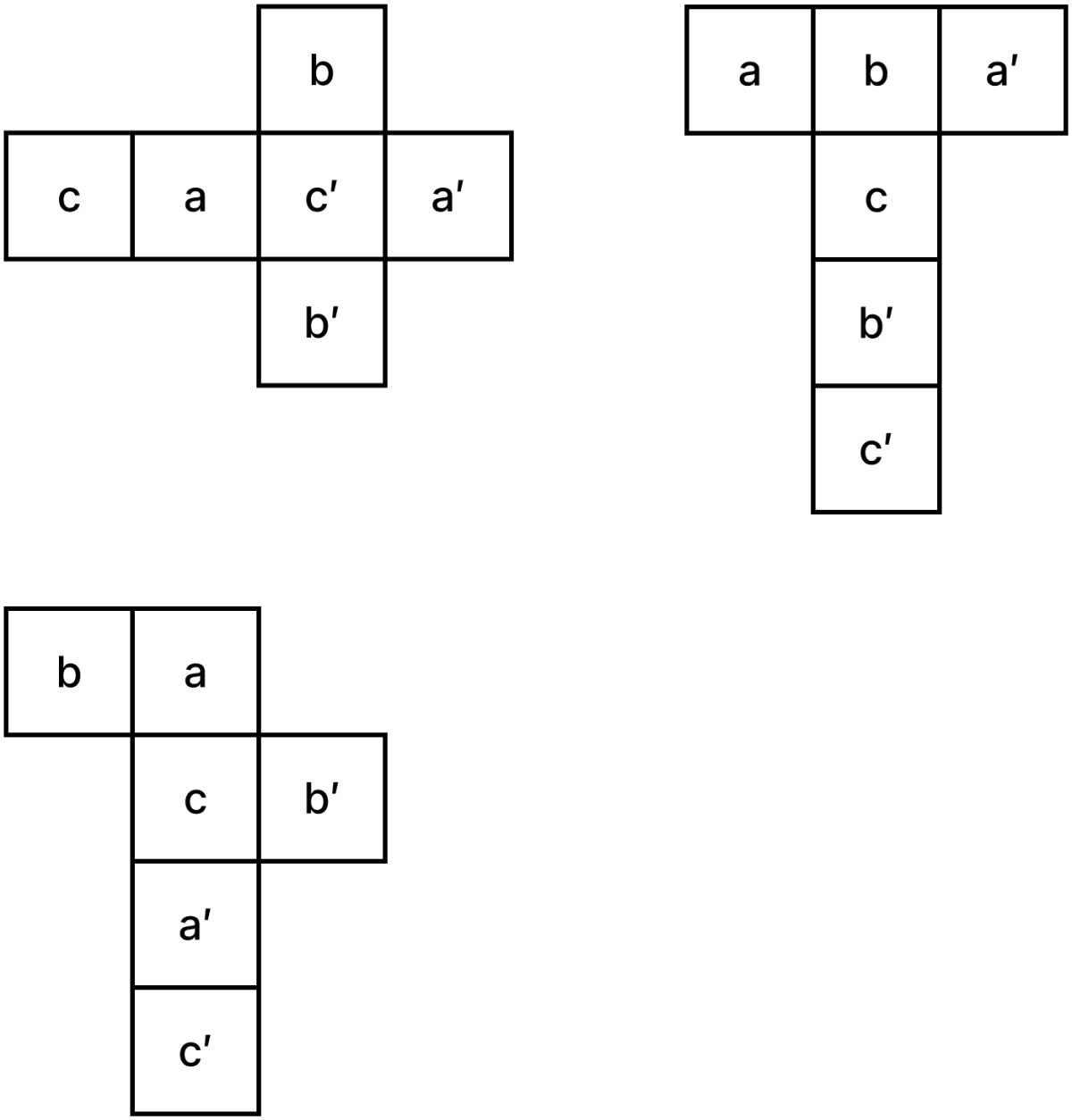
On folding each of these patterns to get the model of a cube, in the cube formed:
(i) face a comes opposite to face a′.
(ii) face b comes opposite to face b′.
(iii) face c comes opposite to face c′.
The dimensions of a cuboid are 6 cm, 4 cm and 3 cm. Draw two different types of oblique sketches for this cuboid.
Answer
Given, the dimensions of the cuboid are 6 cm, 4 cm and 3 cm.
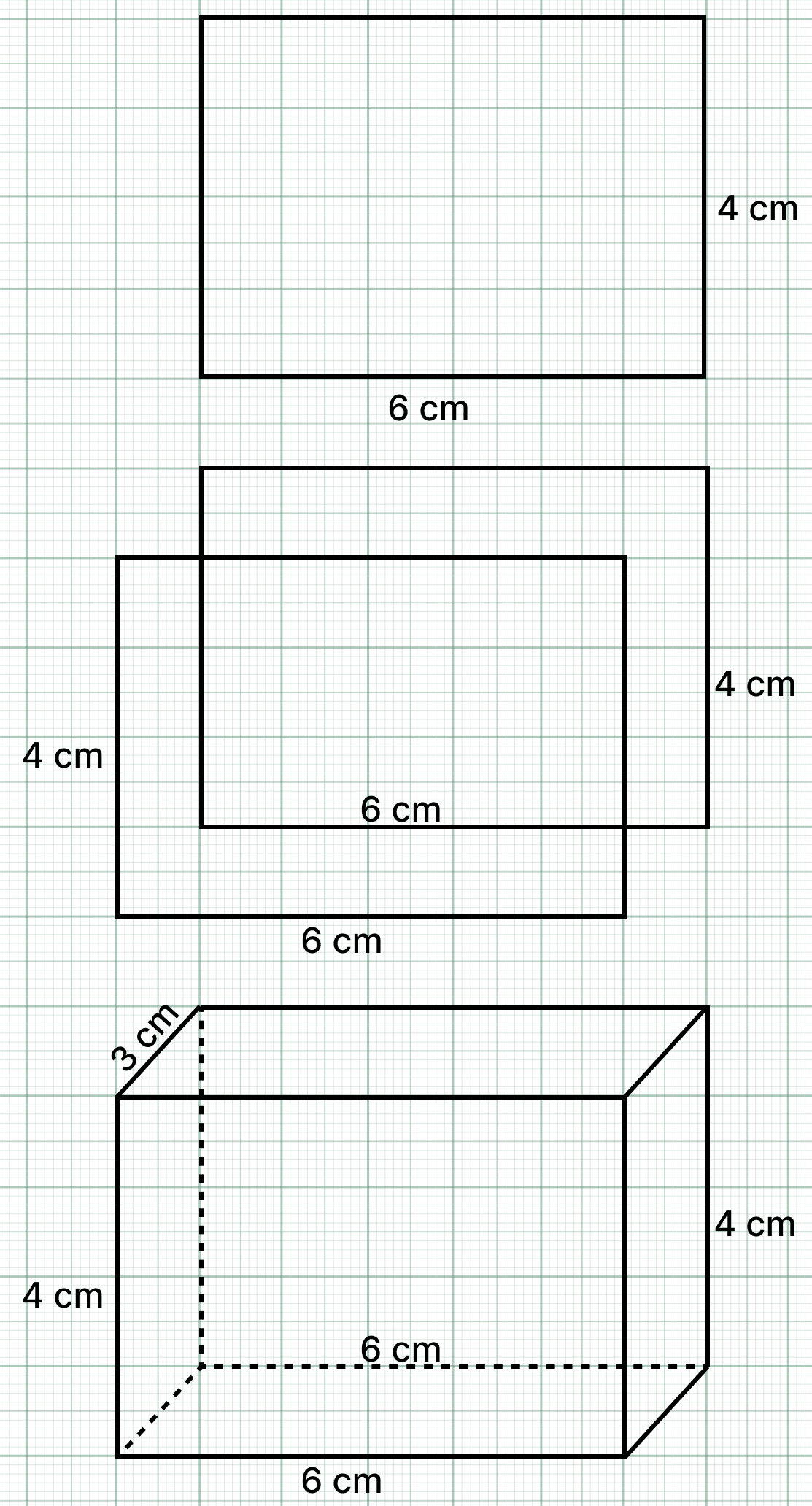
First type (front face 6 cm × 4 cm) :
Steps:
Take a squared (graph) paper.
Draw the front face, a rectangle of length 6 cm and breadth 4 cm.
Draw the opposite face of the same size as that of the front face, shifted slightly upwards and to the right.
Join the corresponding corners.
Draw the figure again with hidden edges dotted.
Second type (front face 6 cm × 3 cm) :
Steps:
Take a squared (graph) paper.
Draw the front face, a rectangle of length 6 cm and breadth 3 cm.
Draw the opposite face of the same size as that of the front face, shifted slightly upwards and to the right.
Join the corresponding corners.
Draw the figure again with hidden edges dotted.
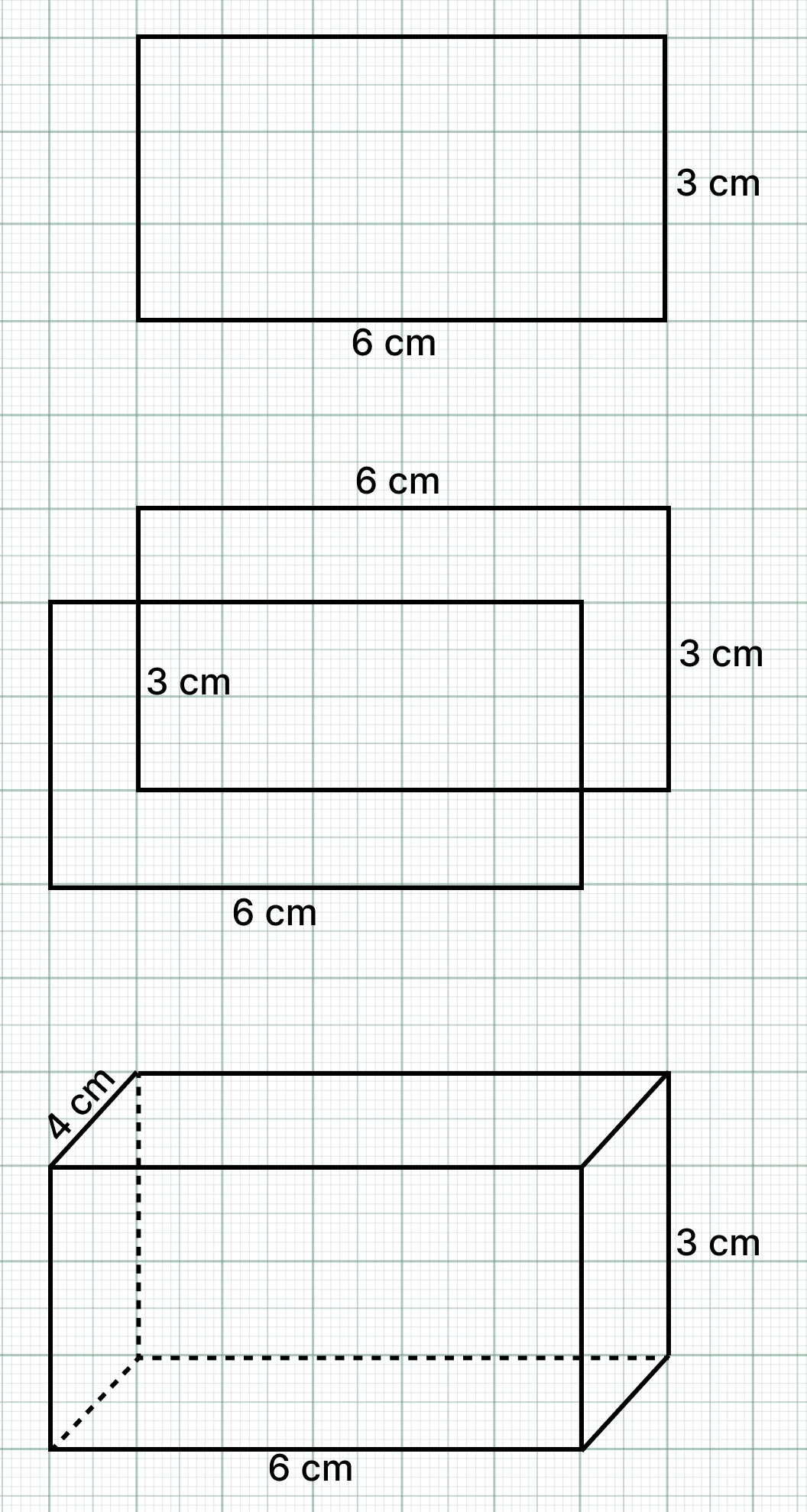
Hence, the two figures so drawn are the required oblique sketches of the cuboid.
Two cubes, each with 3 cm edge, are placed side by side to form a cuboid. For this cuboid, draw an oblique sketch.
Answer
When two cubes of edge 3 cm are placed side by side, the resulting cuboid has:
Length = 3 cm + 3 cm = 6 cm
Breadth = 3 cm
Height = 3 cm
Steps:
Take a squared (graph) paper.
Draw the front face, a rectangle of length 6 cm and breadth 3 cm.
Draw the opposite face of the same size as that of the front face, shifted slightly upwards and to the right.
Join the corresponding corners.
Draw the figure again with hidden edges dotted.
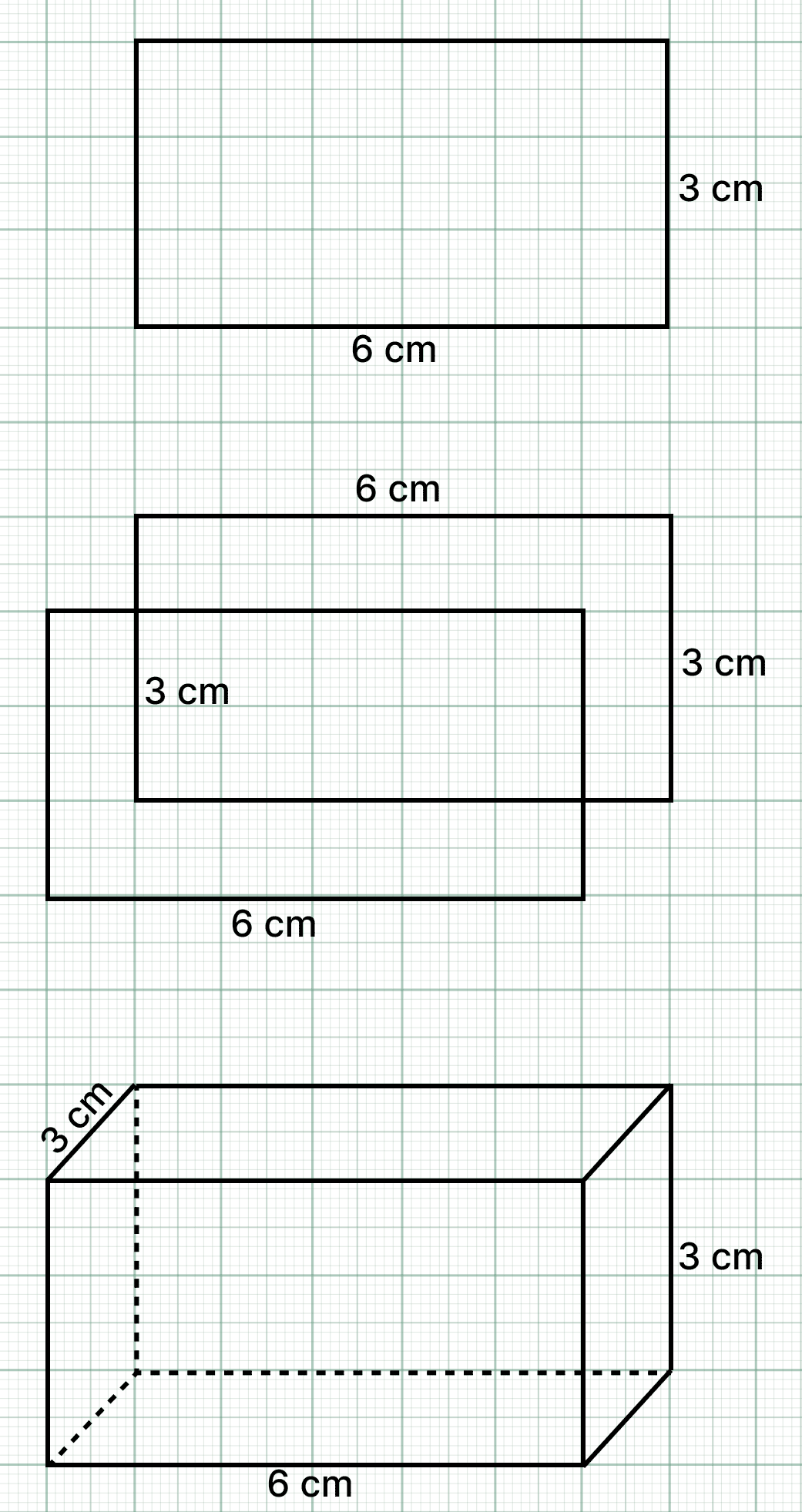
Hence, the figure so drawn is the required oblique sketch of the cuboid of dimensions 6 cm × 3 cm × 3 cm.
The figure, given below, show shadow of some 3D object when seen under the lamp of an overhead projector. Name the object.

Answer
The shadow is a square. Each face of a cube is a square, so the shadow of a cube is a square.
Hence, the object is a cube.
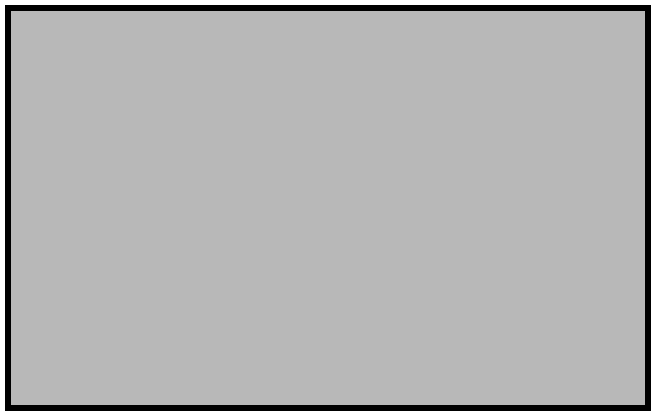
The figure, given below, show shadow of some 3D object when seen under the lamp of an overhead projector. Name the object.
Answer
The shadow is a rectangle. Each face of a cuboid is a rectangle, so the shadow of a cuboid is a rectangle.
Hence, the object is a cuboid.
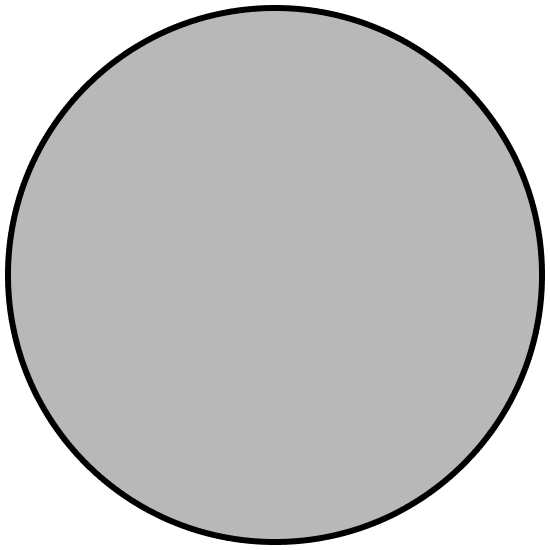
The figure, given below, show shadow of some 3D object when seen under the lamp of an overhead projector. Name the object.
Answer
The shadow is a circle. A sphere is round, with every point on its surface equidistant from its centre, so the shadow of a sphere, when seen from any side, is a circle.
Hence, the object is a sphere.
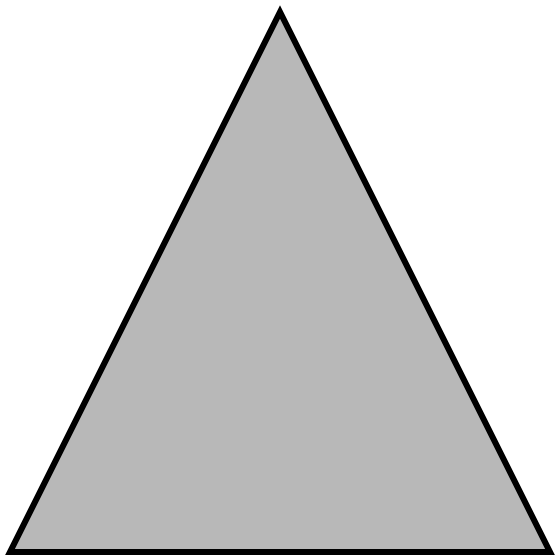
The figure, given below, show shadow of some 3D object when seen under the lamp of an overhead projector. Name the object.
Answer
The shadow is a triangle. The end faces of a triangular prism are triangles, so the shadow of a triangular prism, when seen from its end, is a triangle.
Hence, the object is a prism.
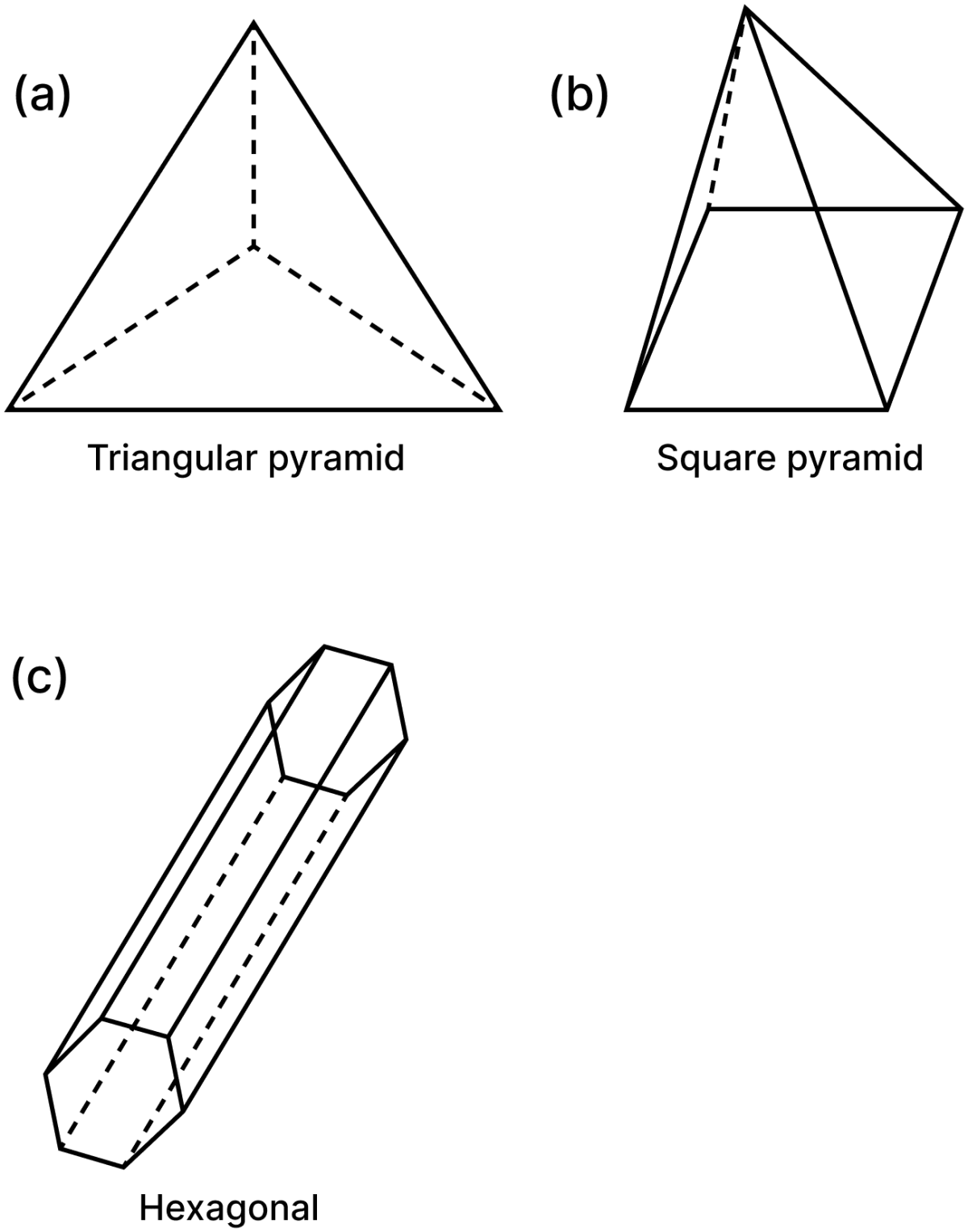
Look at the solids, drawn below, and fill the given chart.
| Polyhedon | Faces (F) | Vertices (V) | Edges (E) | F - E + V |
|---|---|---|---|---|
| (a) Triangular pyramid | ||||
| (b) Square pyramid | ||||
| (c) Hexagonal prism |
Answer
(a) A triangular pyramid has 1 triangular base and 3 triangular side faces.
Number of faces (F) = 1 + 3 = 4
It has 3 vertices at the corners of the base and 1 vertex at the top.
Number of vertices (V) = 3 + 1 = 4
It has 3 edges of the base and 3 slant edges meeting at the top vertex.
Number of edges (E) = 3 + 3 = 6
F - E + V = 4 - 6 + 4 = 2
(b) A square pyramid has 1 square base and 4 triangular side faces.
Number of faces (F) = 1 + 4 = 5
It has 4 vertices at the corners of the base and 1 vertex at the top.
Number of vertices (V) = 4 + 1 = 5
It has 4 edges of the base and 4 slant edges meeting at the top vertex.
Number of edges (E) = 4 + 4 = 8
F - E + V = 5 - 8 + 5 = 2
(c) A hexagonal prism has 2 hexagonal end-faces and 6 rectangular side-faces.
Number of faces (F) = 2 + 6 = 8
It has 6 vertices on each of the two end-faces.
Number of vertices (V) = 6 + 6 = 12
It has 6 edges on each of the two end-faces and 6 edges joining the corresponding vertices of the end-faces.
Number of edges (E) = 6 + 6 + 6 = 18
F - E + V = 8 - 18 + 12 = 2
The completed chart is shown below:
| Polyhedron | Faces (F) | Vertices (V) | Edges (E) | F - E + V |
|---|---|---|---|---|
| (a) Triangular pyramid | 4 | 4 | 6 | 2 |
| (b) Square pyramid | 5 | 5 | 8 | 2 |
| (c) Hexagonal prism | 8 | 12 | 18 | 2 |
Dice are cubes with dot or dots on each face. Opposite faces of a die always have a total of seven on them.
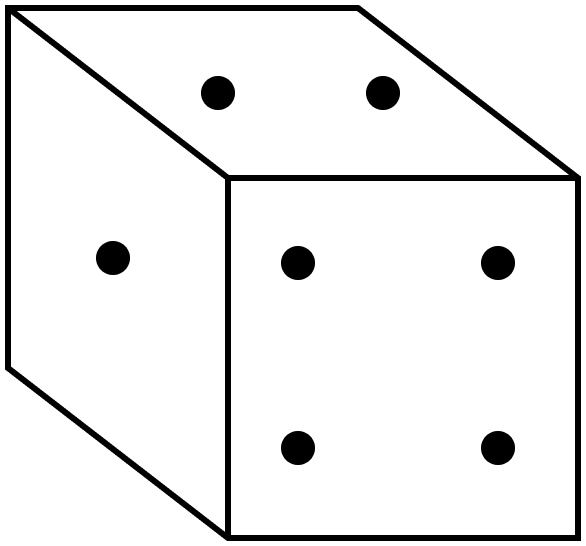
Below are given two nets to make a die (cube), the numbers inserted in each square indicate the number of dots in it.
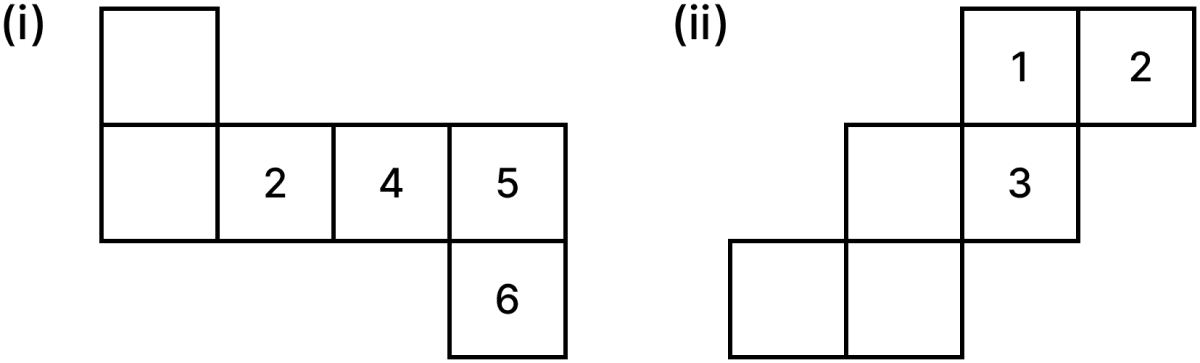
Insert suitable numbers in each blank so that the numbers in the opposite faces of the die have a total of seven dots.
Answer
Opposite faces of a die have a total of seven dots, so the pairs of numbers on opposite faces are 1 and 6, 2 and 5, and 3 and 4.
(i) On folding the net, in the row of four squares, the first square comes opposite to the third square and the second square comes opposite to the fourth square. Also, the square above the row comes opposite to the square below the row.
The second and the fourth squares have 2 and 5 dots, and 2 + 5 = 7.
The third square has 4 dots, so the first square must have 7 - 4 = 3 dots.
The square below the row has 6 dots, so the square above the row must have 7 - 6 = 1 dot.
The completed net is shown below:
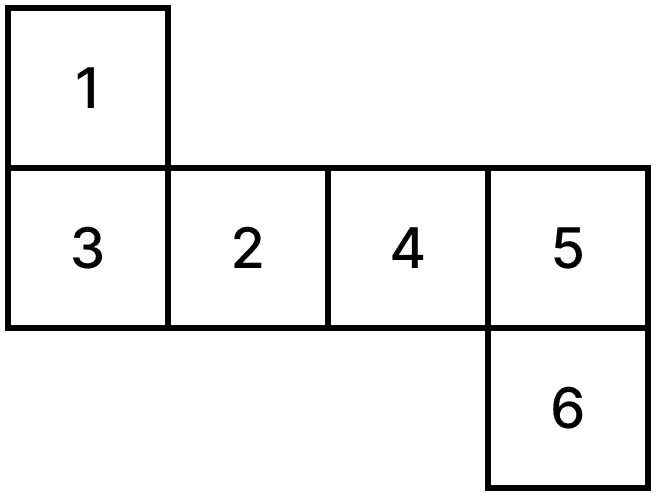
Hence, the blanks are filled with 1 and 3.
(ii) On folding the net, the face with 1 dot comes opposite to the face at the right end of the bottom row, the face with 2 dots comes opposite to the face at the left of the face with 3 dots, and the face with 3 dots comes opposite to the face at the left end of the bottom row.
Number on the face opposite to the face with 1 dot = 7 - 1 = 6
Number on the face opposite to the face with 2 dots = 7 - 2 = 5
Number on the face opposite to the face with 3 dots = 7 - 3 = 4
The completed net is shown below:
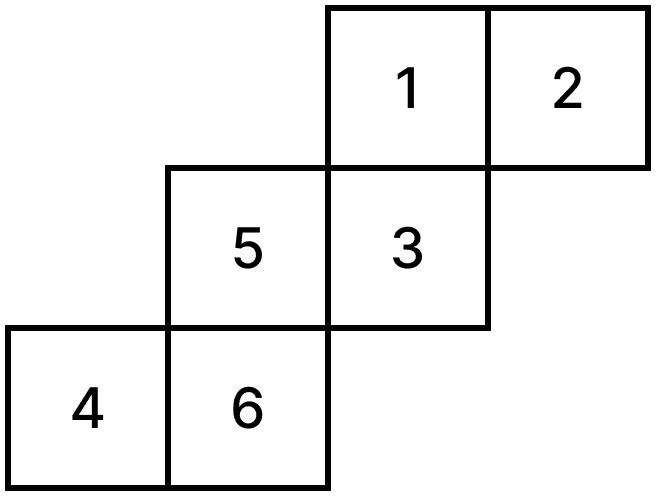
Hence, the blanks are filled with 5, 4 and 6.
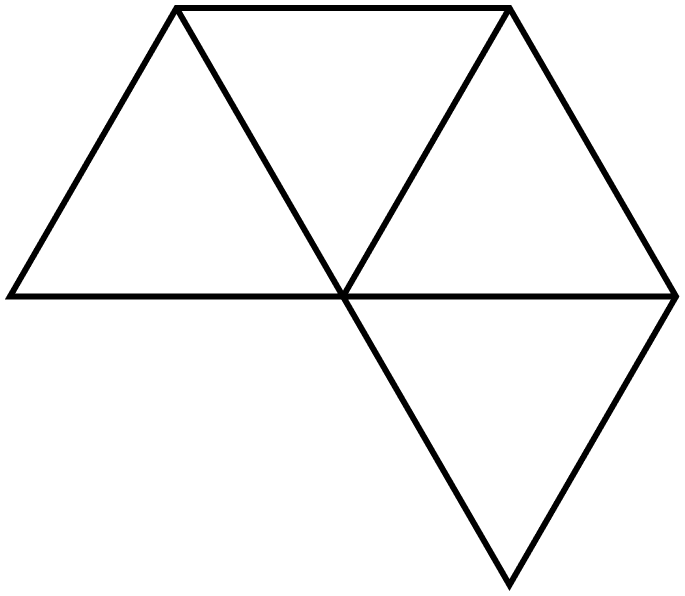
The following figure represent net of some solid. Name the solid.
Answer
The given net is made up of four equal triangles, which on folding form four triangular faces, with the three outer triangles meeting at a common vertex above the middle triangle.
A triangular pyramid (tetrahedron) has a triangular base and three triangular side-faces with a common vertex.
Hence, the solid is a tetrahedron (triangular pyramid).
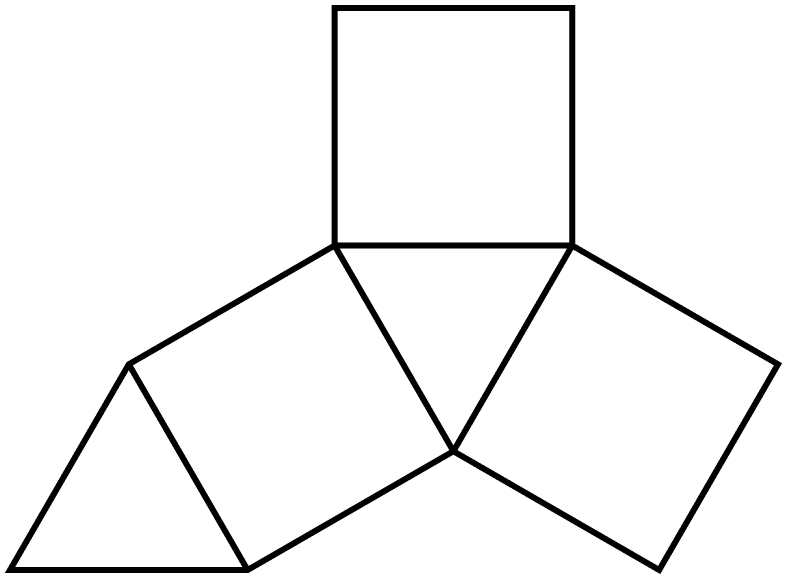
The following figure represent net of some solid. Name the solid.
Answer
The given net is made up of three rectangles and two triangles, which on folding form three rectangular side-faces and two triangular end-faces.
A triangular prism has two congruent and parallel triangular end-faces and three rectangular side-faces.
Hence, the solid is a triangular prism.
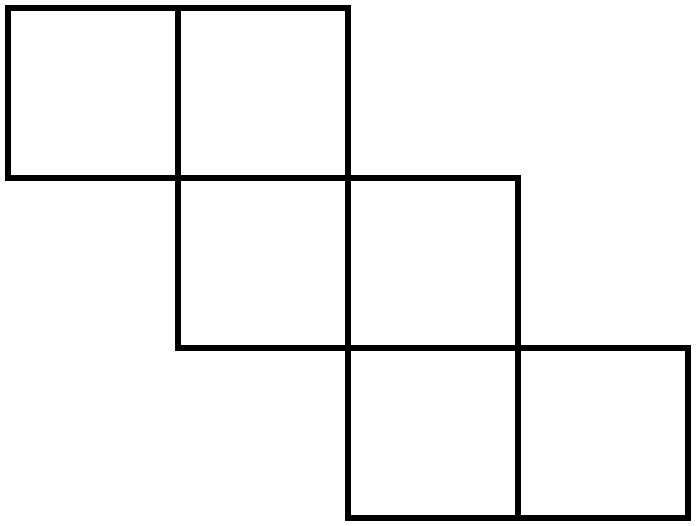
The following figure represent net of some solid. Name the solid.
Answer
The given net is made up of six equal squares, which on folding form six square faces of equal size.
A cube is contained by six equal squares.
Hence, the solid is a cube.
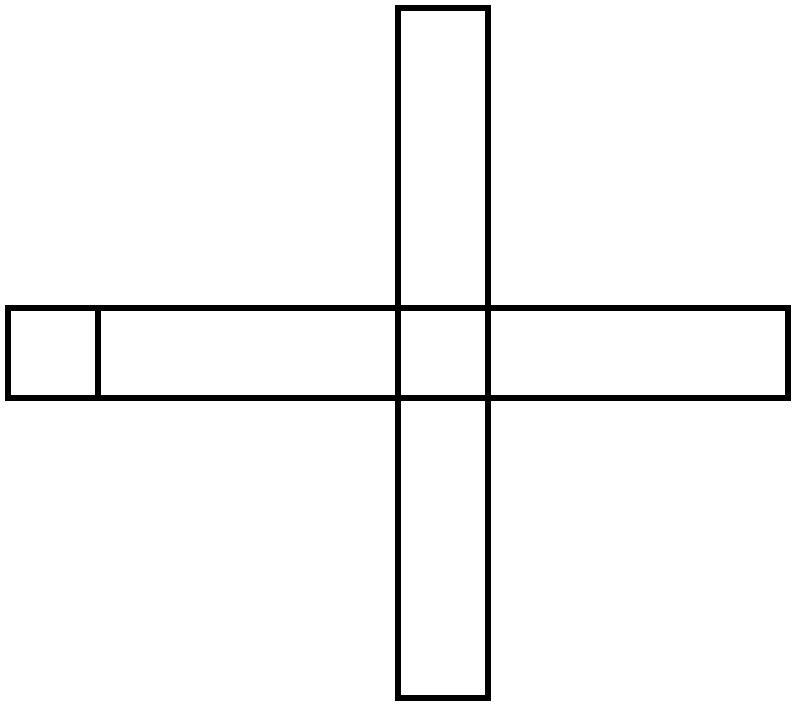
The following figure represent net of some solid. Name the solid.
Answer
The given net is made up of six rectangles, which on folding form six rectangular faces at right angles to each other, with the opposite faces being equal.
A cuboid has six rectangular faces at right angles to each other.
Hence, the solid is a cuboid.