
Representation of raw data in tabular form is:
using tally marks
making frequency distribution
writing data
writing frequency
Answer
Raw data is represented in a tabular form by making a frequency distribution, in which each observation is written along with its frequency.
Hence, option 2 is the correct option.
Arranging the known numbers in ascending or descending order is called:
raw data
frequency distribution
array
grouping data
Answer
Arranging the given numbers in ascending or descending order of their magnitudes is called an array.
Hence, option 3 is the correct option.
The number of times a particular observation occurs in a set of data is called its:
frequency
frequency distribution
position in the given data
mean
Answer
The number of times a particular observation occurs in a set of data is called its frequency.
Hence, option 1 is the correct option.
Given below is the data showing the number of children in certain families:
2, 1, 3, 1, 2, 3, 4, 5, 3, 2, 1 and 4.
Which of these has the lowest frequency?
5
1
2
4
Answer
Counting the number of times each observation occurs, we get :
1 occurs 3 times, 2 occurs 3 times, 3 occurs 3 times, 4 occurs 2 times and 5 occurs 1 time.
So, the observation 5 has the lowest frequency, i.e. 1.
Hence, option 1 is the correct option.
Mean of first six even natural numbers is:
6
7
8
9
Answer
First six even natural numbers are 2, 4, 6, 8, 10 and 12.
Sum of all observations = 2 + 4 + 6 + 8 + 10 + 12
= 42
and, number of observations = 6
By formula,
Mean =
Substituting the values, we get :
Required mean =
= 7
Hence, option 2 is the correct option.
The mean of 1000, 2000, 4000, 5000 and 6000 is:
1000
2000
3600
4000
Answer
Sum of all observations = 1000 + 2000 + 4000 + 5000 + 6000
= 18000
and, number of observations = 5
By formula,
Mean =
Substituting the values, we get :
Required mean =
= 3600
Hence, option 3 is the correct option.
The mean of 10 observations is 15, the sum of all these observations is:
10
15
15 ÷ 10
10 × 15
Answer
By formula,
Mean =
⇒ Sum of all observations = Mean × Number of observations
= 15 × 10
= 10 × 15
Hence, option 4 is the correct option.
If one represents 100 houses, then 250 houses will be represented by:
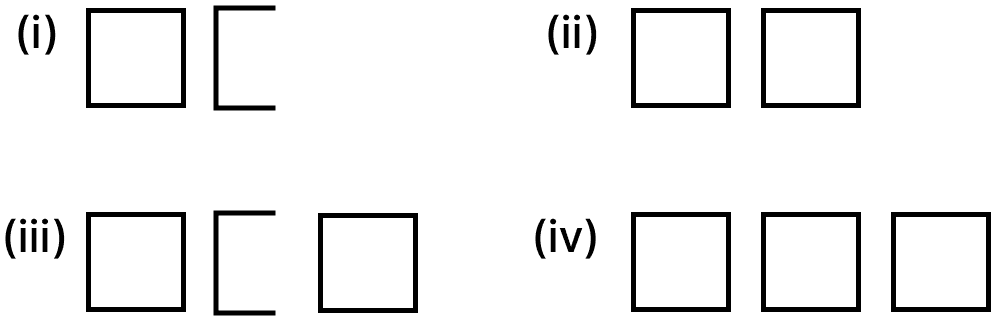
Answer
Since one symbol represents 100 houses,
Number of symbols for 250 houses =
=
So, 250 houses are represented by two and a half symbols.
Hence, option 3 is the correct option.
The median of 5, 7, 9, 6 and 2 is:
9
7
6
none of these
Answer
On arranging the given data in ascending order of their magnitudes, we get :
2, 5, 6, 7, 9
Since, the number of terms () is 5 and 5 is odd :
Hence, option 3 is the correct option.
For, given set of data, if each data is increased by 15 then median and mean both will also increase by 15.
true
false
nothing can be said
Answer
If each observation of a data is increased by a fixed number, then the mean and the median of the data also increase by the same number.
So, if each data is increased by 15, then both the mean and the median will also increase by 15.
Hence, option 1 is the correct option.