
Use number lines to evaluate each of the following:
(i) (+7) + (+4)
(ii) 0 + (+6)
(iii) (+5) + 0
Answer
For addition on a number line, the right side of zero is for positive integers and the left side of zero is for negative integers. We first mark the first integer by counting from zero, and then, for the second integer, we move from the position of the first integer.
(i) (+7) + (+4)
For +7, count 7 units to the right of zero. Then, for +4, move 4 units to the right of +7. You reach +11.

Hence, (+7) + (+4) = +11.
(ii) 0 + (+6)
Start at zero. Then, for +6, move 6 units to the right of 0. You reach +6.
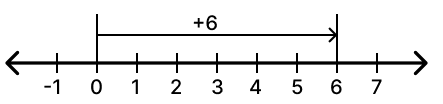
Hence, 0 + (+6) = +6.
(iii) (+5) + 0
For +5, count 5 units to the right of zero. Then, adding 0 means there is no further movement, so you stay at +5.

Hence, (+5) + 0 = +5.
Use number lines to evaluate each of the following:
(i) (-4) + (+5)
(ii) 0 + (-2)
(iii) (-1) + (+4)
Answer
For addition on a number line, we move to the right of zero for a positive integer and to the left of zero for a negative integer. We mark the first integer by counting from zero, and then, for the second integer, we move from the position of the first integer.
(i) (-4) + (+5)
For -4, move 4 units to the left of zero. Then, for +5, move 5 units to the right of -4. You reach +1.
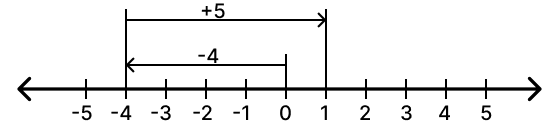
Hence, (-4) + (+5) = +1.
(ii) 0 + (-2)
Start at zero. Then, for -2, move 2 units to the left of 0. You reach -2.
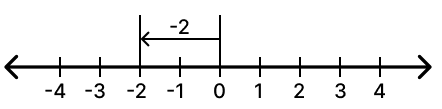
Hence, 0 + (-2) = -2.
(iii) (-1) + (+4)
For -1, move 1 unit to the left of zero. Then, for +4, move 4 units to the right of -1. You reach +3.
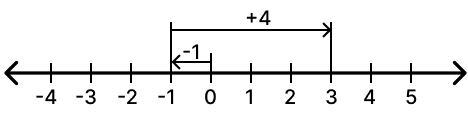
Hence, (-1) + (+4) = +3.
Use number lines to evaluate each of the following:
(i) (+4) + (-2)
(ii) (+3) + (-6)
(iii) 3 + (-7)
Answer
For addition on a number line, we move to the right of zero for a positive integer and to the left of zero for a negative integer. We mark the first integer by counting from zero, and then, for the second integer, we move from the position of the first integer.
(i) (+4) + (-2)
For +4, count 4 units to the right of zero. Then, for -2, move 2 units to the left of +4. You reach +2.
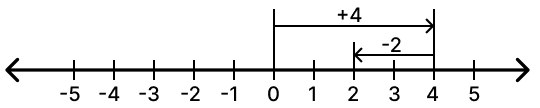
Hence, (+4) + (-2) = +2.
(ii) (+3) + (-6)
For +3, count 3 units to the right of zero. Then, for -6, move 6 units to the left of +3. You reach -3.
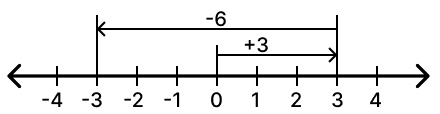
Hence, (+3) + (-6) = -3.
(iii) 3 + (-7)
For +3, count 3 units to the right of zero. Then, for -7, move 7 units to the left of +3. You reach -4.
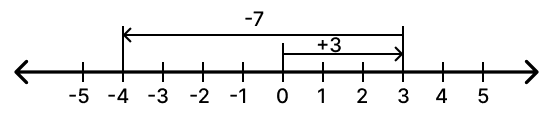
Hence, 3 + (-7) = -4.
Use number lines to evaluate each of the following:
(i) (-1) + (-2)
(ii) (-3) + (-4)
(iii) (-2) + (-5)
Answer
For addition on a number line, we move to the left of zero for a negative integer. When both integers are negative, both moves are to the left. We mark the first integer by counting from zero, and then, for the second integer, we move from the position of the first integer.
(i) (-1) + (-2)
For -1, start from zero and move 1 unit to the left. Then, for -2, move 2 units to the left of -1. You reach -3.
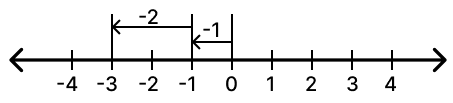
Hence, (-1) + (-2) = -3.
(ii) (-3) + (-4)
For -3, start from zero and move 3 units to the left. Then, for -4, move 4 units to the left of -3. You reach -7.

Hence, (-3) + (-4) = -7.
(iii) (-2) + (-5)
For -2, start from zero and move 2 units to the left. Then, for -5, move 5 units to the left of -2. You reach -7.

Hence, (-2) + (-5) = -7.
Use number lines to evaluate each of the following:
(i) (+10) - (+2)
(ii) (+8) - (-5)
(iii) (-6) - (+2)
(iv) (-7) - (+5)
(v) (+4) - (-2)
(vi) (-8) - (-4)
Answer
To subtract using a number line, mark the positions of both the given numbers on the same number line. Then, starting from the position of the number to be subtracted, count the number of steps and the direction needed to reach the first number. If the steps are towards the right, the answer is positive; if towards the left, the answer is negative.
(i) (+10) - (+2)
Mark the positions of +10 and +2 on the same number line. Starting from +2, count the steps needed to reach +10. We find that 8 steps are needed towards the right.

Hence, (+10) - (+2) = +8.
(ii) (+8) - (-5)
Mark the positions of +8 and -5 on the same number line. Starting from -5, count the steps needed to reach +8. We find that 13 steps are needed towards the right.

Hence, (+8) - (-5) = +13.
(iii) (-6) - (+2)
Mark the positions of -6 and +2 on the same number line. Starting from +2, count the steps needed to reach -6. We find that 8 steps are needed towards the left.

Hence, (-6) - (+2) = -8.
(iv) (-7) - (+5)
Mark the positions of -7 and +5 on the same number line. Starting from +5, count the steps needed to reach -7. We find that 12 steps are needed towards the left.

Hence, (-7) - (+5) = -12.
(v) (+4) - (-2)
Mark the positions of +4 and -2 on the same number line. Starting from -2, count the steps needed to reach +4. We find that 6 steps are needed towards the right.
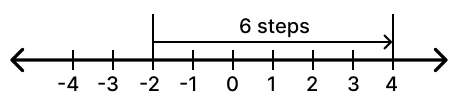
Hence, (+4) - (-2) = +6.
(vi) (-8) - (-4)
Mark the positions of -8 and -4 on the same number line. Starting from -4, count the steps needed to reach -8. We find that 4 steps are needed towards the left.
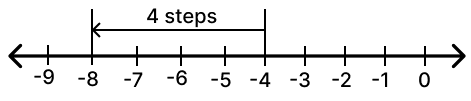
Hence, (-8) - (-4) = -4.
Using a number line, find the integer which is:
(i) 3 more than -1
(ii) 5 less than 2
(iii) 5 more than -9
(iv) 4 less than -4
(v) 7 more than 0
(vi) 7 less than -8
Answer
To find an integer "more than" a given integer, we move to the right on the number line. To find an integer "less than" a given integer, we move to the left on the number line.
(i) Start at -1 and move 3 units to the right of -1. We reach 2.

Hence, the integer which is 3 more than -1 is 2.
(ii) Start at 2 and move 5 units to the left of 2. We reach -3.
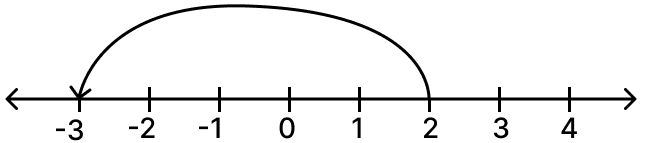
Hence, the integer which is 5 less than 2 is -3.
(iii) Start at -9 and move 5 units to the right of -9. We reach -4.
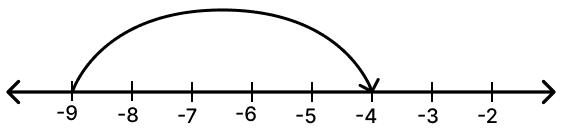
Hence, the integer which is 5 more than -9 is -4.
(iv) Start at -4 and move 4 units to the left of -4. We reach -8.
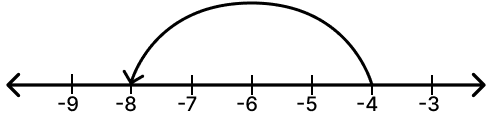
Hence, the integer which is 4 less than -4 is -8.
(v) Start at 0 and move 7 units to the right of 0. We reach 7.

Hence, the integer which is 7 more than 0 is 7.
(vi) Start at -8 and move 7 units to the left of -8. We reach -15.
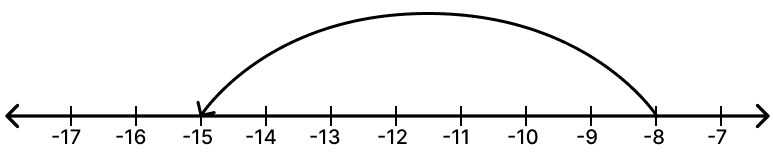
Hence, the integer which is 7 less than -8 is -15.
Add using a number line:
(i) 13 and 15
(ii) -13 and 15
(iii) 13 and -15
(iv) -13 and -15
Answer
For addition on a number line, we move to the right of zero for a positive integer and to the left of zero for a negative integer. We mark the first integer by counting from zero, and then, for the second integer, we move from the position of the first integer.
(i) 13 and 15
For +13, count 13 units to the right of zero. Then, for +15, move 15 units to the right of +13. You reach +28.

Hence, 13 + 15 = 28.
(ii) -13 and 15
For -13, move 13 units to the left of zero. Then, for +15, move 15 units to the right of -13. You reach +2.

Hence, -13 + 15 = 2.
(iii) 13 and -15
For +13, count 13 units to the right of zero. Then, for -15, move 15 units to the left of +13. You reach -2.

Hence, 13 + (-15) = -2.
(iv) -13 and -15
For -13, move 13 units to the left of zero. Then, for -15, move 15 units to the left of -13. You reach -28.

Hence, -13 + (-15) = -28.
Subtract using a number line:
(i) 5 from 8
(ii) -5 from 8
(iii) 4 from -7
(iv) -8 from -2
(v) -3 from 12
(vi) -6 from -3
Answer
To subtract using a number line, mark the positions of both the given numbers on the same number line. Then, starting from the position of the number to be subtracted, count the number of steps and the direction needed to reach the first number. If the steps are towards the right, the answer is positive; if towards the left, the answer is negative.
(i) 8 - 5
Mark the positions of 8 and 5 on the same number line. Starting from 5, count the steps needed to reach 8. We find that 3 steps are needed towards the right.

Hence, 5 subtracted from 8 gives 3.
(ii) 8 - (-5)
Mark the positions of 8 and -5 on the same number line. Starting from -5, count the steps needed to reach 8. We find that 13 steps are needed towards the right.
Hence, -5 subtracted from 8 gives 13.
(iii) -7 - 4
Mark the positions of -7 and 4 on the same number line. Starting from 4, count the steps needed to reach -7. We find that 11 steps are needed towards the left.

Hence, 4 subtracted from -7 gives -11.
(iv) -2 - (-8)
Mark the positions of -2 and -8 on the same number line. Starting from -8, count the steps needed to reach -2. We find that 6 steps are needed towards the right.

Hence, -8 subtracted from -2 gives 6.
(v) 12 - (-3)
Mark the positions of 12 and -3 on the same number line. Starting from -3, count the steps needed to reach 12. We find that 15 steps are needed towards the right.

Hence, -3 subtracted from 12 gives 15.
(vi) -3 - (-6)
Mark the positions of -3 and -6 on the same number line. Starting from -6, count the steps needed to reach -3. We find that 3 steps are needed towards the right.

Hence, -6 subtracted from -3 gives 3.