
What do you understand by a plane closed figure?
Answer
A plane closed figure is a geometrical figure that lies in a plane and is bounded by line segments (straight lines) or curved lines.
Hence, a figure that lies in a plane and is bounded by straight or curved lines is called a plane closed figure.
The interior of a figure is called the region of the figure. Is this statement true?
Answer
No, the given statement is not true.
The interior of a figure, together with its boundary, is called the region of the figure.
Hence, the given statement is false.
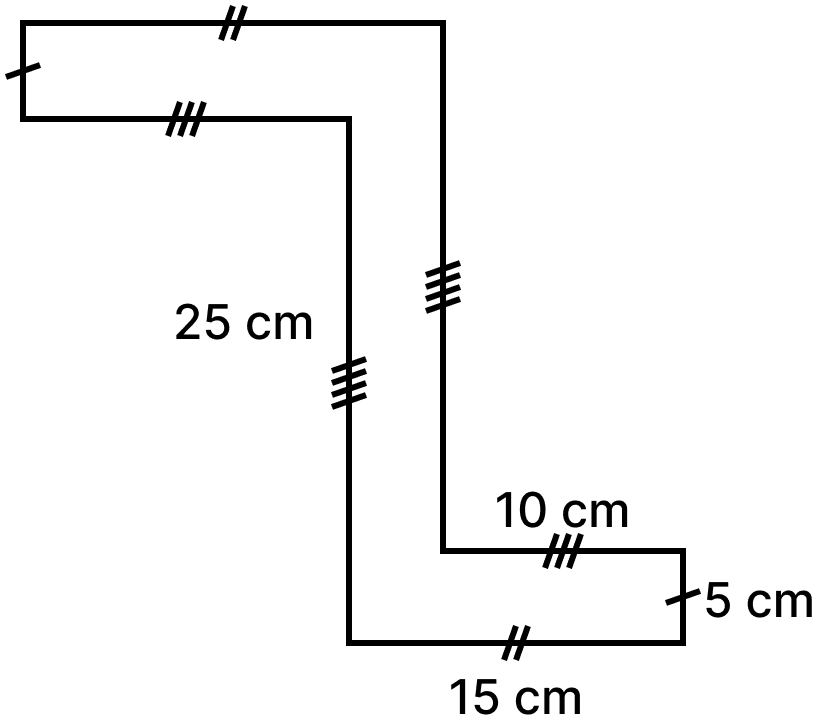
Find the perimeter of the following closed figure:
Answer
In the given figure, the sides marked with the same number of dashes are equal to each other.
∴ The sides of the figure are 25 cm, 15 cm, 10 cm, 5 cm, 25 cm, 15 cm, 10 cm and 5 cm.
Perimeter of the figure = sum of the lengths of all its sides
= (25 + 15 + 10 + 5 + 25 + 15 + 10 + 5) cm
= 110 cm
Hence, the perimeter of the figure is 110 cm.
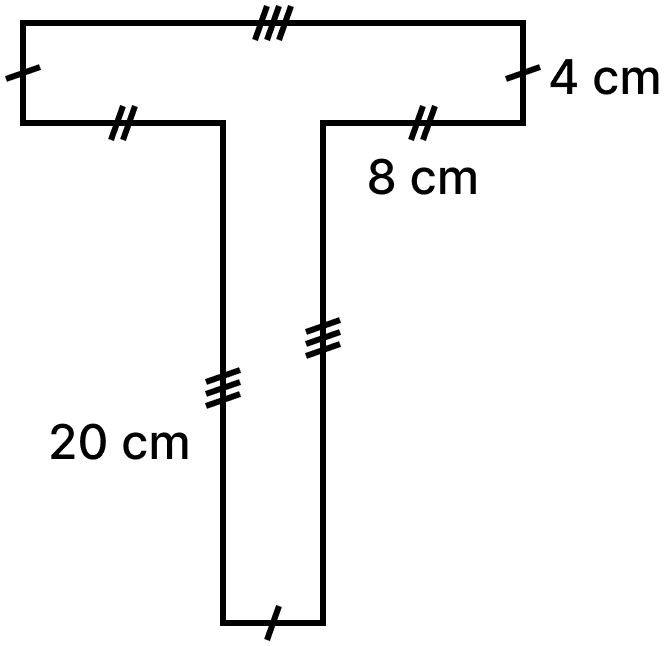
Find the perimeter of the following closed figure:
Answer
In the given figure, the sides marked alike are equal to each other.
∴ The sides of the figure are 20 cm, 4 cm, 8 cm, 20 cm, 4 cm, 20 cm, 8 cm and 4 cm.
Perimeter of the figure = sum of the lengths of all its sides
= (20 + 4 + 8 + 20 + 4 + 20 + 8 + 4) cm
= 88 cm
Hence, the perimeter of the figure is 88 cm.
Find the perimeter of a rectangle whose length = 40 cm and breadth = 35 cm
Answer
By formula,
Perimeter of a rectangle = 2 (l + b)
Given,
l = 40 cm and b = 35 cm
Perimeter = 2 (l + b)
= 2 (40 + 35) cm
= 2 × 75 cm
= 150 cm
Hence, the perimeter of the rectangle is 150 cm.
Find the perimeter of a rectangle whose length = 10 m and breadth = 8 m
Answer
By formula,
Perimeter of a rectangle = 2 (l + b)
Given,
l = 10 m and b = 8 m
Perimeter = 2 (l + b)
= 2 (10 + 8) m
= 2 × 18 m
= 36 m
Hence, the perimeter of the rectangle is 36 m.
Find the perimeter of a rectangle whose length = 8 m and breadth = 80 cm
Answer
By formula,
Perimeter of a rectangle = 2 (l + b)
Given,
l = 8 m and b = 80 cm
As we know, 1 m = 100 cm
⇒ b = 80 cm = m = 0.8 m
Perimeter = 2 (l + b)
= 2 (8 + 0.8) m
= 2 × 8.8 m
= 17.6 m = 1760 cm
Hence, the perimeter of the rectangle is 17.6 m = 1760 cm.
Find the perimeter of a rectangle whose length = 3.6 m and breadth = 2.4 m
Answer
By formula,
Perimeter of a rectangle = 2 (l + b)
Given,
l = 3.6 m and b = 2.4 m
Perimeter = 2 (l + b)
= 2 (3.6 + 2.4) m
= 2 × 6 m
= 12 m
Hence, the perimeter of the rectangle is 12 m.
If P denotes perimeter of a rectangle, l denotes its length and b denotes its breadth, find l, if P = 38 cm and b = 7 cm
Answer
Given,
P = 38 cm and b = 7 cm
By formula,
P = 2 (l + b)
⇒ l + b =
⇒ l = - b
= cm - 7 cm
= 19 cm - 7 cm
= 12 cm
Hence, l = 12 cm.
If P denotes perimeter of a rectangle, l denotes its length and b denotes its breadth, find b, if P = 3.2 m and l = 100 cm
Answer
Given,
P = 3.2 m and l = 100 cm
As we know, 1 m = 100 cm
⇒ P = 3.2 m = 3.2 × 100 cm = 320 cm
By formula,
P = 2 (l + b)
⇒ l + b =
⇒ b = - l
= cm - 100 cm
= 160 cm - 100 cm
= 60 cm = 0.6 m
Hence, b = 60 cm = 0.6 m.
If P denotes perimeter of a rectangle, l denotes its length and b denotes its breadth, find P, if l = 2 m and b = 75 cm
Answer
Given,
l = 2 m and b = 75 cm
As we know, 1 m = 100 cm
⇒ l = 2 m = 2 × 100 cm = 200 cm
By formula,
P = 2 (l + b)
= 2 (200 + 75) cm
= 2 × 275 cm
= 550 cm = 5.50 m
Hence, P = 550 cm = 5.50 m.
Find the perimeter of a square whose each side is 1.6 m.
Answer
Given,
Each side of the square = 1.6 m
By formula, perimeter of a square = 4 × side
= 4 × 1.6 m
= 6.4 m
Hence, the perimeter of the square is 6.4 m.
Find the side of the square whose perimeter is 5 m.
Answer
Given,
Perimeter of the square = 5 m
Since, perimeter of a square = 4 × side
⇒ side of the square =
= m
= 1.25 m
Hence, the side of the square is 1.25 m.
A square field has each side 70 m whereas a rectangular field has length = 50 m and breadth = 40 m. Which of the two fields has a greater perimeter and by how much?
Answer
Given,
Each side of the square field = 70 m
Length of the rectangular field (l) = 50 m and breadth (b) = 40 m
Perimeter of the square field = 4 × side
= 4 × 70 m
= 280 m
Perimeter of the rectangular field = 2 (l + b)
= 2 (50 + 40) m
= 2 × 90 m
= 180 m
Since 280 m > 180 m, the square field has the greater perimeter.
Difference = 280 m - 180 m = 100 m
Hence, the square field has the greater perimeter, by 100 m.
A rectangular field has length = 160 m and breadth = 120 m. Find:
(i) the perimeter of the field.
(ii) the length of the fence required to enclose the field.
(iii) the cost of fencing the field at the rate of ₹ 80 per metre.
Answer
Given,
Length of the field (l) = 160 m
Breadth of the field (b) = 120 m
(i) Perimeter of the field = 2 (l + b)
= 2 (160 + 120) m
= 2 × 280 m
= 560 m
Hence, the perimeter of the field is 560 m.
(ii) Length of the fence required = perimeter of the field
= 560 m
Hence, the length of the fence required is 560 m.
(iii) Cost of fencing the field = length of the fence × rate of fencing
= 560 × ₹ 80
= ₹ 44,800
Hence, the cost of fencing the field is ₹ 44,800.
Each side of a square plot of land is 55 m. Find the cost of fencing the plot at the rate of ₹ 32 per metre.
Answer
Given,
Each side of the square plot = 55 m
Perimeter of the square plot = 4 × side
= 4 × 55 m
= 220 m
Cost of fencing the plot = Perimeter × rate of fencing
= 220 × ₹ 32
= ₹ 7,040
Hence, the cost of fencing the plot is ₹ 7,040.
Each side of a square field is 70 m. How much distance will a boy walk in order to make:
(i) one complete round of this field?
(ii) 8 complete rounds of this field?
Answer
Given,
Each side of the square field = 70 m
(i) Distance covered in one complete round = perimeter of the field
= 4 × side
= 4 × 70 m
= 280 m
Hence, the boy will walk 280 m in one complete round.
(ii) Distance covered in 8 complete rounds = 8 × distance covered in one round
= 8 × 280 m
= 2240 m
Hence, the boy will walk 2240 m in 8 complete rounds.
A school playground is rectangular in shape with length = 120 m and breadth = 90 m. Some school boys run along the boundary of the playground and make 15 complete rounds in 45 minutes. How much distance did they run during this period?
Answer
Given,
Length of the playground (l) = 120 m
Breadth of the playground (b) = 90 m
Distance covered in one round = perimeter of the playground
= 2 (l + b)
= 2 (120 + 90) m
= 2 × 210 m
= 420 m
∴ Distance covered in 15 rounds = 15 × 420 m
= 6300 m
Hence, the boys ran a distance of 6300 m during this period.
Mohit makes 8 full rounds of a rectangular field with length = 120 m and breadth = 75 m. John makes 10 full rounds of a square field with each side 100 m. Find who covers a larger distance and by how much?
Answer
Given,
For Mohit's rectangular field, length (l) = 120 m and breadth (b) = 75 m
For John's square field, each side = 100 m
Perimeter of the rectangular field = 2 (l + b)
= 2 (120 + 75) m
= 2 × 195 m
= 390 m
∴ Distance covered by Mohit = 8 × 390 m = 3120 m
Perimeter of the square field = 4 × side
= 4 × 100 m
= 400 m
∴ Distance covered by John = 10 × 400 m = 4000 m
Since 4000 m > 3120 m, John covers the larger distance.
Difference = 4000 m - 3120 m = 880 m
Hence, John covers the larger distance, by 880 m.
The length of a rectangle is twice its breadth. If its perimeter is 60 cm, find its length.
Answer
Given,
Perimeter of the rectangle = 60 cm
Let the breadth of the rectangle = x cm
∴ Its length = 2x cm
By formula, 2 (l + b) = perimeter
⇒ 2 (2x + x) = 60
⇒ 2 × 3x = 60
⇒ 6x = 60
⇒ x = = 10
∴ Length = 2x = 2 × 10 cm = 20 cm
Hence, the length of the rectangle is 20 cm.
Find the perimeter of an equilateral triangle of side 9.8 cm.
Answer
Perimeter of an equilateral triangle = 3 × side
= 3 × 9.8 cm
= 29.4 cm
Hence, the perimeter of the equilateral triangle is 29.4 cm.
Find the perimeter of an isosceles triangle with each equal side = 13 cm and the third side = 10 cm.
Answer
Perimeter of the isosceles triangle = sum of its sides
= 13 cm + 13 cm + 10 cm
= 36 cm
Hence, the perimeter of the isosceles triangle is 36 cm.
Find the perimeter of a regular pentagon of side 8.2 cm.
Answer
Perimeter of a regular pentagon = 5 × side
= 5 × 8.2 cm
= 41 cm
Hence, the perimeter of the regular pentagon is 41 cm.
Find the perimeter of a regular hexagon of side 6.5 cm.
Answer
Perimeter of a regular hexagon = 6 × side
= 6 × 6.5 cm
= 39 cm
Hence, the perimeter of the regular hexagon is 39 cm.
An equilateral triangle and a square have equal perimeters. If the side of the triangle is 9.6 cm; what is the length of the side of the square?
Answer
Given,
Side of the equilateral triangle = 9.6 cm
Perimeter of the equilateral triangle = 3 × side
= 3 × 9.6 cm
= 28.8 cm
Given,
Perimeter of the square = perimeter of the equilateral triangle = 28.8 cm
∴ Side of the square =
= cm
= 7.2 cm
Hence, the side of the square is 7.2 cm.
A rectangle with length = 18 cm and breadth = 12 cm has the same perimeter as that of a regular pentagon. Find the side of the pentagon.
Answer
Given,
Length of the rectangle (l) = 18 cm
Breadth of the rectangle (b) = 12 cm
Perimeter of the rectangle = 2 (l + b)
= 2 (18 + 12) cm
= 2 × 30 cm
= 60 cm
Given,
Perimeter of the regular pentagon = perimeter of the rectangle = 60 cm
Since, perimeter of a regular pentagon = 5 × side
⇒ side of the pentagon =
= cm
= 12 cm
Hence, the side of the pentagon is 12 cm.
A regular pentagon of each side 12 cm has the same perimeter as that of a regular hexagon. Find the length of each side of the hexagon.
Answer
Given,
Each side of the regular pentagon = 12 cm
Perimeter of the regular pentagon = 5 × side
= 5 × 12 cm
= 60 cm
Given,
Perimeter of the regular hexagon = perimeter of the regular pentagon = 60 cm
Since, perimeter of a regular hexagon = 6 × side
⇒ side of the hexagon =
= cm
= 10 cm
Hence, the length of each side of the hexagon is 10 cm.
Each side of a square is 45 cm and a rectangle has length 50 cm. If the perimeters of both (square and rectangle) are the same, find the breadth of the rectangle.
Answer
Given,
Each side of the square = 45 cm
Length of the rectangle (l) = 50 cm
Perimeter of the square = 4 × side
= 4 × 45 cm
= 180 cm
Given,
Perimeter of the rectangle (P) = perimeter of the square = 180 cm
By formula, P = 2 (l + b)
⇒ l + b =
⇒ breadth (b) = - l
= cm - 50 cm
= 90 cm - 50 cm
= 40 cm
Hence, the breadth of the rectangle is 40 cm.
A wire is bent in the form of an equilateral triangle of each side 20 cm. If the same wire is bent in the form of a square, find the side of the square.
Answer
Given,
Each side of the equilateral triangle = 20 cm
Length of the wire = perimeter of the equilateral triangle
= 3 × side
= 3 × 20 cm
= 60 cm
Since the same wire is bent in the form of a square,
Perimeter of the square = length of the wire = 60 cm
∴ Side of the square =
= cm
= 15 cm
Hence, the side of the square is 15 cm.