
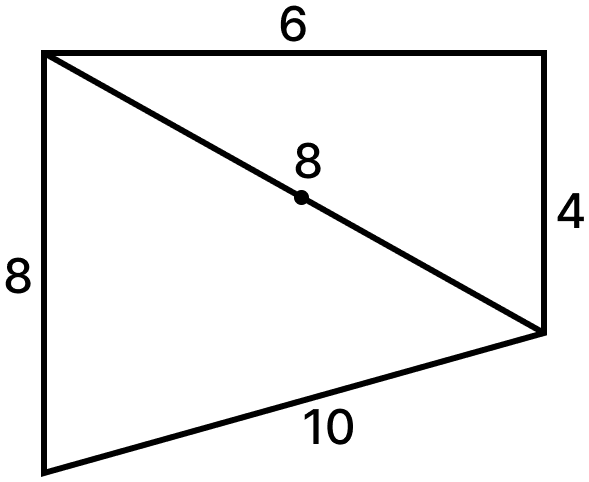
The perimeter of the given figure is:
36
28
20
18
Answer
From the figure, the boundary of the closed figure is made up of the sides of length 6, 4, 10 and 8 units. (The segment of length 8 units drawn inside the figure is a diagonal and is not a part of the boundary.)
Perimeter of the figure = sum of the lengths of its sides
= 6 + 4 + 10 + 8
= 28 units
Hence, option 2 is the correct option.
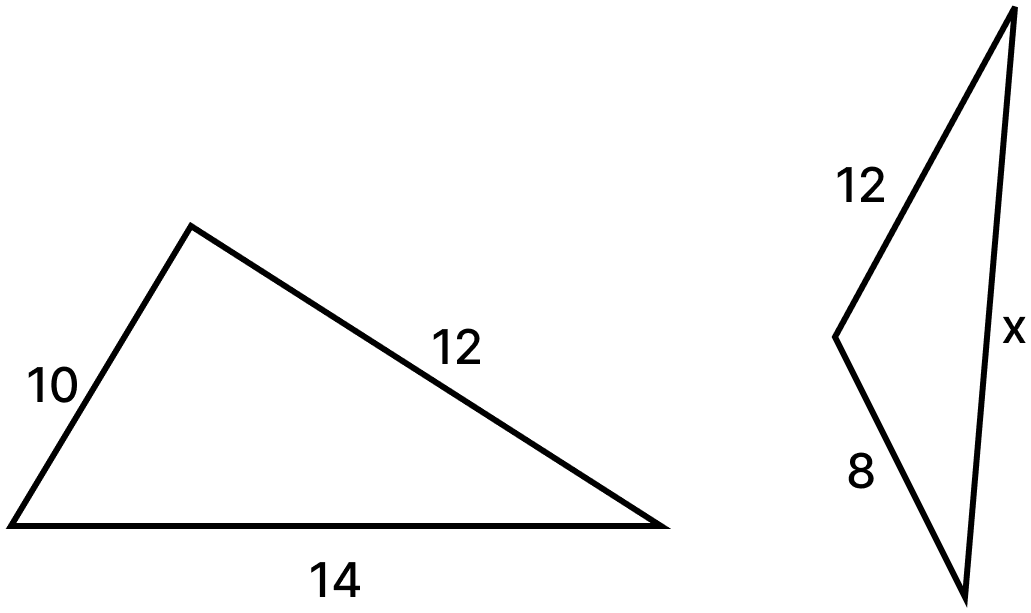
In the given figure, the perimeters of both the triangles are same. Then the value of x is:
14
16
18
none of these
Answer
From the figure, the sides of the first triangle are 10, 12 and 14, and the sides of the second triangle are 12, 8 and x.
Perimeter of the first triangle = 10 + 12 + 14 = 36
Perimeter of the second triangle = 12 + 8 + x = 20 + x
Given,
The perimeters of both the triangles are the same.
⇒ 20 + x = 36
⇒ x = 36 - 20
⇒ x = 16
Hence, option 2 is the correct option.
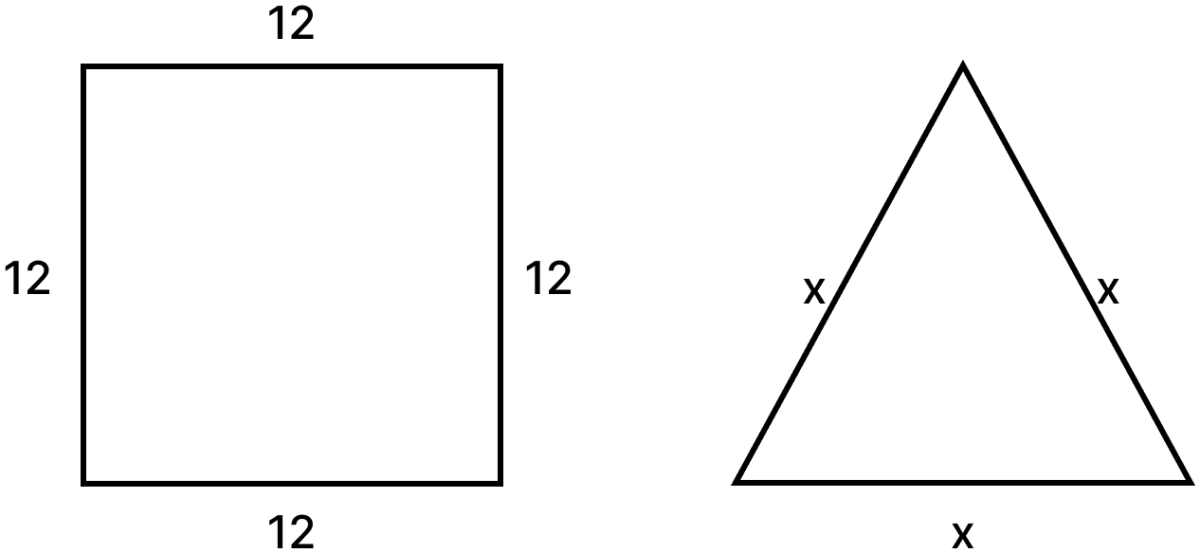
If the perimeter of the given square is same as perimeter of the given triangle, the value of x is:
12
16
14
20
Answer
From the figure, each side of the square is 12 and the triangle has each of its three sides equal to x.
Perimeter of the square = 4 × side = 4 × 12 = 48
Perimeter of the triangle = x + x + x = 3x
Given,
Perimeter of the square = perimeter of the triangle
⇒ 3x = 48
⇒ x =
⇒ x = 16
Hence, option 2 is the correct option.
If one side of a regular pentagon is 20 cm, its perimeter is:
40 cm
80 cm
120 cm
100 cm
Answer
Given,
One side of the regular pentagon = 20 cm
Perimeter of a regular pentagon = 5 × side
= 5 × 20 cm
= 100 cm
Hence, option 4 is the correct option.
The perimeter of a regular hexagon is 120 cm, its each side is:
30 cm
40 cm
20 cm
120 cm
Answer
Given,
Perimeter of the regular hexagon = 120 cm
Since, perimeter of a regular hexagon = 6 × side
⇒ each side =
= cm
= 20 cm
Hence, option 3 is the correct option.
Area of a square = 16 cm2 and its perimeter is 16 cm. Each side of the square is:
4 cm
8 cm
12 cm
16 cm
Answer
Given,
Area of the square = 16 cm2
Since, area of a square = (side)2
⇒ (side)2 = 16 cm2
⇒ side = cm = 4 cm
Hence, option 1 is the correct option.
Area of a rectangle is 400 cm2 and its length is 80 cm, then its width is:
80 cm
40 cm
10 cm
5 cm
Answer
Given,
Area of the rectangle (A) = 400 cm2 and length (l) = 80 cm
By formula, width (b) =
= cm
= 5 cm
Hence, option 4 is the correct option.
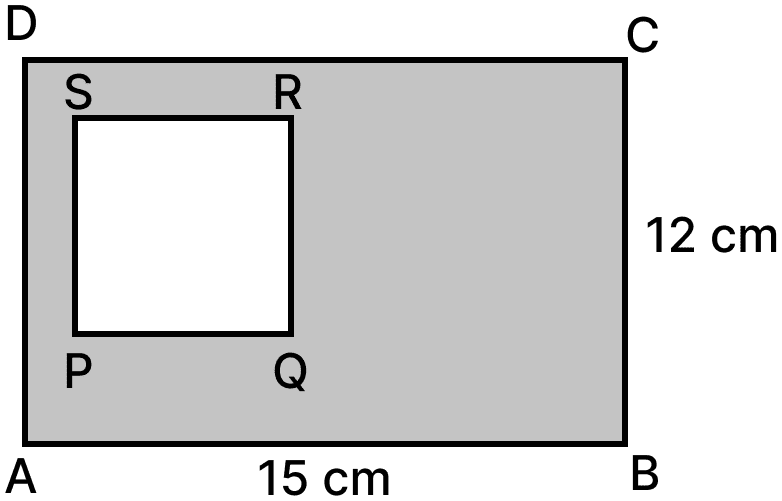
In the given figure, ABCD is a rectangle with sides 15 cm and 12 cm, whereas PQRS is a square with side 5 cm; area of the shaded portion is:
(15 - 5) × (12 - 5) cm2
15 × 12 - 5 × 5 cm2
(15 - 5) × 12 cm2
15 × (12 - 5) cm2
Answer
Area of the shaded portion = Area of rectangle ABCD - area of square PQRS
= (15 × 12 - 5 × 5) cm2
Hence, option 2 is the correct option.
Sides of a triangle are 17 cm, 10 cm and 13 cm, its semi-perimeter is:
40 cm
20 cm
30 cm
none of these
Answer
Given,
The sides of the triangle are 17 cm, 10 cm and 13 cm.
Semi-perimeter (s) =
= cm
= cm
= 20 cm
Hence, option 2 is the correct option.
The area of a rectangle is 100 m2 and its one side is 20 m, then its perimeter is:
28 m
48 m
36 m
50 m
Answer
Given,
Area of the rectangle (A) = 100 m2 and one side (l) = 20 m
By formula, other side (b) =
= m
= 5 m
∴ Perimeter of the rectangle = 2 (l + b)
= 2 (20 + 5) m
= 2 × 25 m
= 50 m
Hence, option 4 is the correct option.