
In each of the following, find the marked unknown angles :
Answer
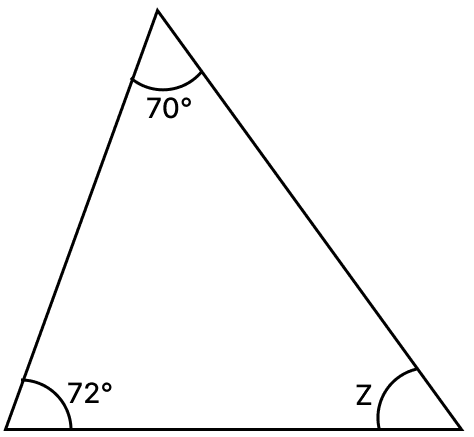
From the figure, the three angles of the triangle are 70°, 72° and z.
By the angle sum property of a triangle,
⇒ 70° + 72° + z = 180°
⇒ 142° + z = 180°
⇒ z = 180° − 142°
⇒ z = 38°
Hence, z = 38°.
In each of the following, find the marked unknown angles :
Answer
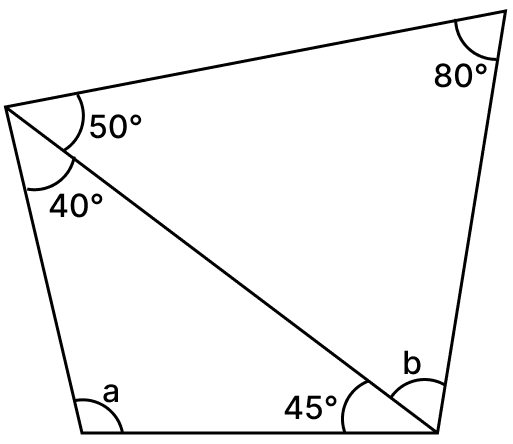
From the figure, the upper triangle has angles 80°, 50° and b.
By the angle sum property of a triangle,
⇒ 80° + 50° + b = 180°
⇒ 130° + b = 180°
⇒ b = 180° − 130°
⇒ b = 50°
In the lower triangle, the angles are 40°, 45° and a.
By the angle sum property of a triangle,
⇒ 40° + 45° + a = 180°
⇒ 85° + a = 180°
⇒ a = 180° − 85°
⇒ a = 95°
Hence, a = 95° and b = 50°.
In each of the following, find the marked unknown angles :
Answer
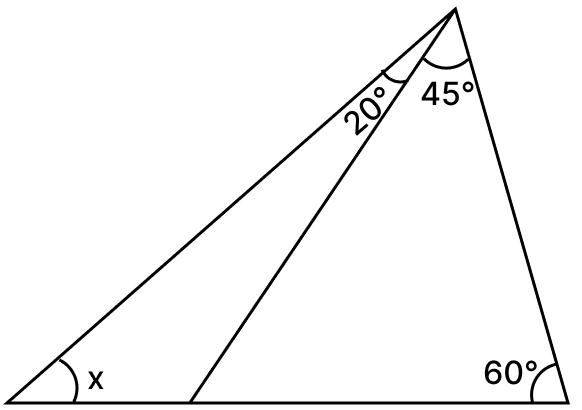
From the figure,
The angle at the top vertex is made up of 20° and 45°, so the top angle is (20° + 45°) = 65°. The other two angles of the triangle are x and 60°.
By the angle sum property of a triangle,
⇒ 65° + x + 60° = 180°
⇒ 125° + x = 180°
⇒ x = 180° − 125°
⇒ x = 55°
Hence, x = 55°.
Can a triangle have the following angles?
55°, 55° and 80°
Answer
A triangle is possible only if the sum of its three angles is 180°.
Solving,
⇒ 55° + 55° + 80° = 190° ≠ 180°.
Since the sum is not 180°, such a triangle is not possible.
Hence, a triangle with angles 55°, 55° and 80° cannot be formed.
Can a triangle have the following angles?
33°, 74° and 73°
Answer
A triangle is possible only if the sum of its three angles is 180°.
Solving,
⇒ 33° + 74° + 73° = 180°.
Since the sum is 180°, such a triangle is possible.
Hence, a triangle with angles 33°, 74° and 73° can be formed.
Can a triangle have the following angles?
85°, 95° and 22°
Answer
A triangle is possible only if the sum of its three angles is 180°.
Solving,
⇒ 85° + 95° + 22° = 202° ≠ 180°.
Since the sum is not 180°, such a triangle is not possible.
Hence, a triangle with angles 85°, 95° and 22° cannot be formed.
Find x, if the angles of a triangle are :
x°, x°, x°
Answer
By the angle sum property of a triangle,
⇒ x° + x° + x° = 180°
⇒ 3x° = 180°
⇒ x° =
⇒ x° = 60°
⇒ x = 60
Hence, x = 60.
Find x, if the angles of a triangle are :
x°, 2x°, 2x°
Answer
By the angle sum property of a triangle,
⇒ x° + 2x° + 2x° = 180°
⇒ 5x° = 180°
⇒ x° =
⇒ x° = 36°
⇒ x = 36
Hence, x = 36.
Find x, if the angles of a triangle are :
2x°, 4x°, 6x°
Answer
By the angle sum property of a triangle,
⇒ 2x° + 4x° + 6x° = 180°
⇒ 12x° = 180°
⇒ x° =
⇒ x° = 15°
⇒ x = 15
Hence, x = 15.
One angle of a right-angled triangle is 70°. Find the other acute angle.
Answer
In a right-angled triangle, one angle is 90°. Let the other acute angle be x.
By the angle sum property of a triangle,
⇒ 90° + 70° + x = 180°
⇒ 160° + x = 180°
⇒ x = 180° − 160°
⇒ x = 20°
Hence, the other acute angle is 20°.
In △ABC, ∠A = ∠B = 62°; find ∠C.
Answer
By the angle sum property of a triangle,
⇒ ∠A + ∠B + ∠C = 180°
⇒ 62° + 62° + ∠C = 180°
⇒ 124° + ∠C = 180°
⇒ ∠C = 180° − 124°
⇒ ∠C = 56°
Hence, ∠C = 56°.
In △ABC, ∠B = ∠C and ∠A = 100°; find ∠B.
Answer
Given,
∠A = 100° and ∠B = ∠C. Let ∠B = ∠C = x.
By the angle sum property of a triangle,
⇒ ∠A + ∠B + ∠C = 180°
⇒ 100° + x + x = 180°
⇒ 100° + 2x = 180°
⇒ 2x = 180° − 100°
⇒ 2x = 80°
⇒ x =
⇒ x = 40°
⇒ ∠B = x = 40°
Hence, ∠B = 40°.
Find, giving reasons, the unknown marked angles in the triangle drawn below :
Answer
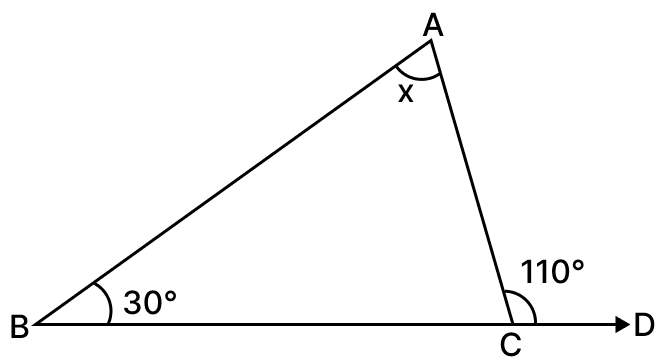
From the figure, in triangle ABC, ∠B = 30° and the side BC is produced to D, so ∠ACD = 110° is the exterior angle at C.
By the exterior angle property, an exterior angle of a triangle is equal to the sum of its two interior opposite angles.
⇒ ∠ACD = ∠A + ∠B
⇒ 110° = x + 30°
⇒ x = 110° − 30°
⇒ x = 80°
Hence, x = 80°.
Find, giving reasons, the unknown marked angles in the triangle drawn below :
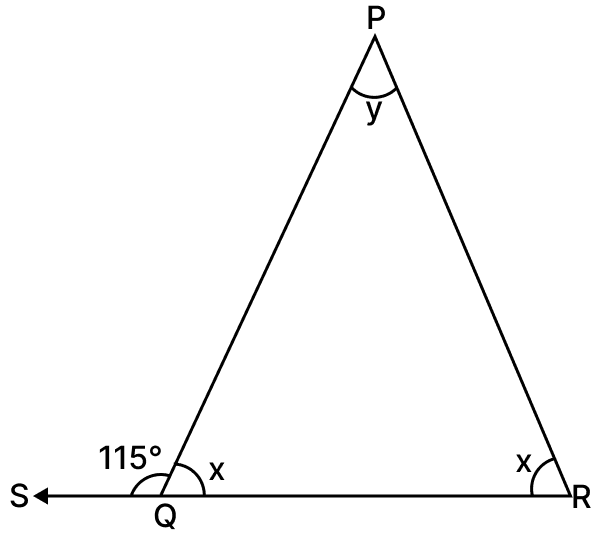
Answer
From the figure, SQ is a straight line and ∠PQS = 115° is the exterior angle at Q, while the base angles ∠PQR and ∠PRQ are each equal to x.
Since ∠PQS and ∠PQR form a linear pair,
⇒ ∠PQS + ∠PQR = 180°
⇒ 115° + x = 180°
⇒ x = 180° − 115°
⇒ x = 65°
So the base angles ∠PQR = ∠PRQ = x = 65°.
By the angle sum property of a triangle,
In triangle PQR,
⇒ y + x + x = 180°
⇒ y + 65° + 65° = 180°
⇒ y + 130° = 180°
⇒ y = 180° − 130°
⇒ y = 50°
Hence, x = 65° and y = 50°.
Find, giving reasons, the unknown marked angles in the given figure :
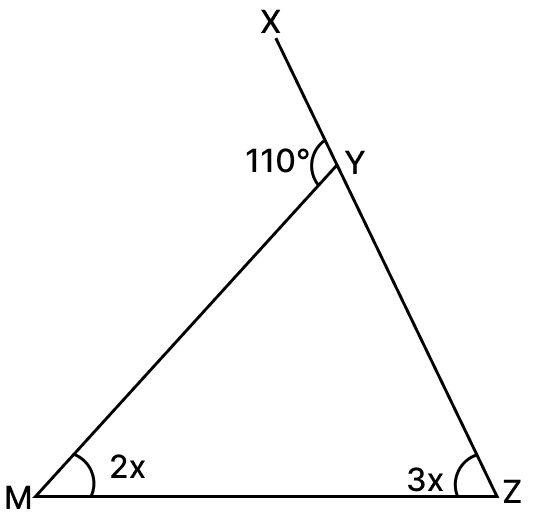
Answer
From the figure,
∠XYM is an exterior angle of triangle and the two opposite interior angles are ∠YMZ and ∠YZM
Thus, 110° is the exterior angle of the triangle and the two interior opposite angles are 2x and 3x.
By the exterior angle property, an exterior angle of a triangle is equal to the sum of its two interior opposite angles.
⇒ 110° = 2x + 3x
⇒ 110° = 5x
⇒ x =
⇒ x = 22°
So, 2x = 44° and 3x = 66°.
Hence, the marked angles are 2x = 44° and 3x = 66°.
Classify the following triangle according to the measures of its angles :
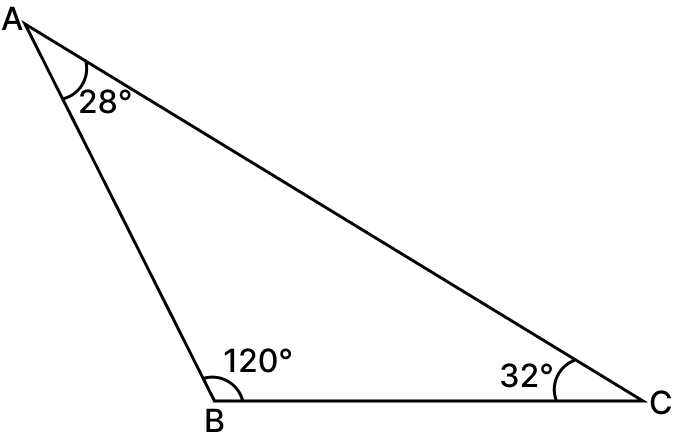
Answer
From the figure, the angles of the triangle are 28°, 120° and 32°.
Since one of the angles, 120°, is more than 90°, it is an obtuse angle.
Hence, the given triangle is an obtuse-angled triangle.
Classify the following triangle according to the measures of its angles :
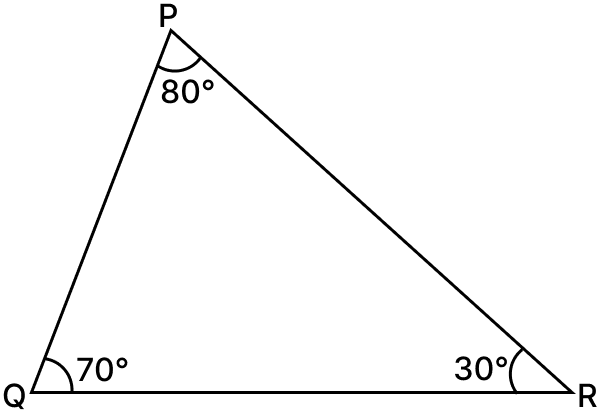
Answer
From the figure, the angles of the triangle are 80°, 70° and 30°.
Since each of the three angles is less than 90°, all the angles are acute.
Hence, the given triangle is an acute-angled triangle.
Classify the following triangle according to the measures of its angles :
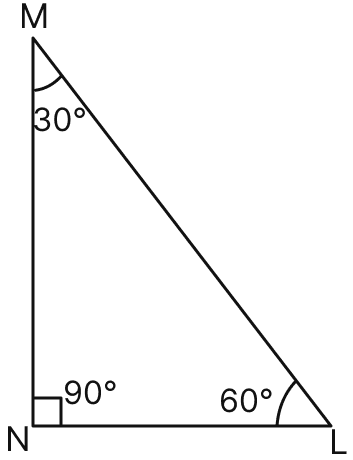
Answer
From the figure, the angles of the triangle are 30°, 90° and 60°.
Since one of the angles is exactly 90°, it is a right angle.
Hence, the given triangle is a right-angled triangle.
Classify the following triangle according to the lengths of its sides :
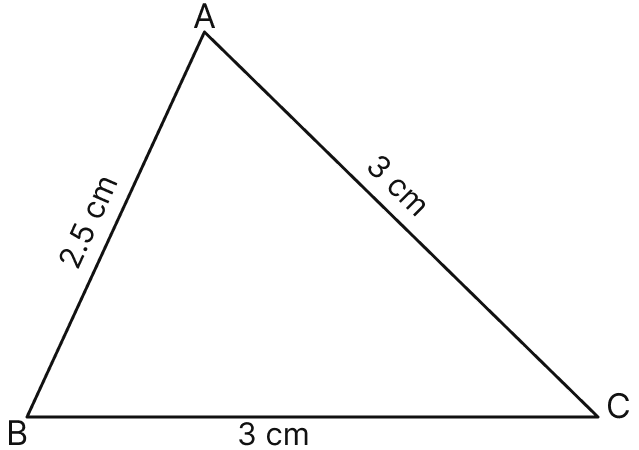
Answer
From the figure, the sides of the triangle are 2.5 cm, 3 cm and 3 cm.
Two sides AC and BC are equal.
Hence, the given triangle is an isosceles triangle.
Classify the following triangle according to the lengths of its sides :
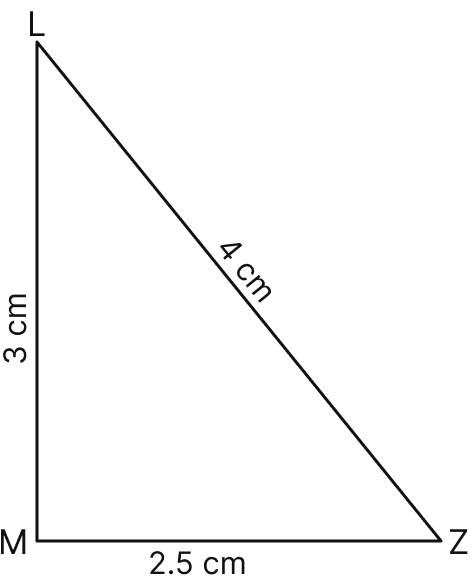
Answer
From the figure, the sides of the triangle are 3 cm, 4 cm and 2.5 cm.
Since all three sides are of different lengths, the given triangle is a scalene triangle.
Hence, the given triangle is a scalene triangle.
Classify the following triangle according to the lengths of its sides :
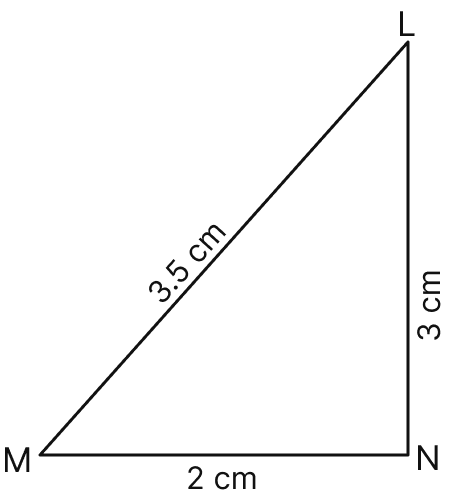
Answer
From the figure, the sides of the triangle are 3.5 cm, 3 cm and 2 cm.
Since all three sides are of different lengths, the given triangle is a scalene triangle.
Hence, the given triangle is a scalene triangle.
Classify the following triangle according to the lengths of its sides :
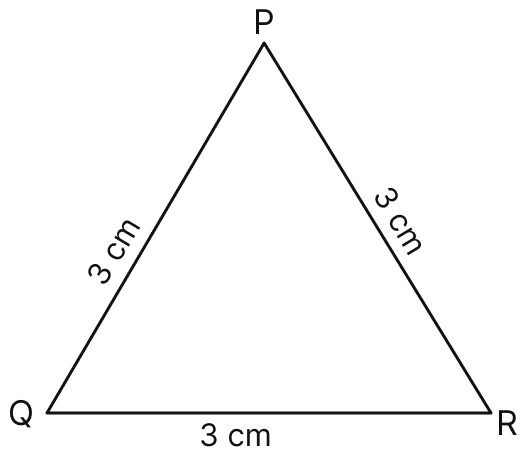
Answer
From the figure, the sides of the triangle are 3 cm, 3 cm and 3 cm.
Since all three sides are equal, the given triangle is an equilateral triangle.
Hence, the given triangle is an equilateral triangle.