
Assertion (A): As shown in the given figure, sides AB, BC and CA are extended to get the exterior angles x, y and z then ∠x + ∠y + ∠z = 360°
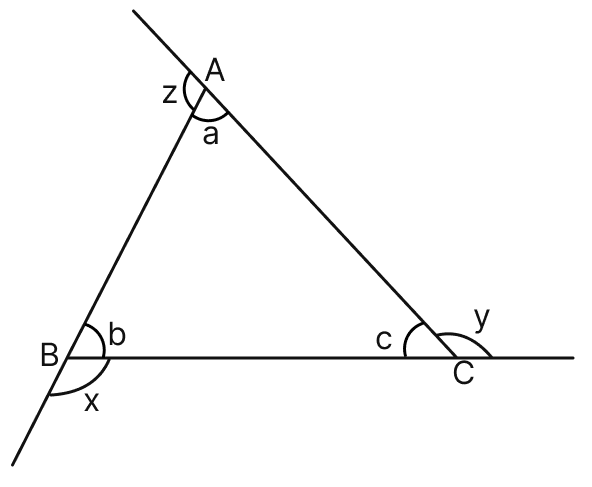
Reason (R): ∠x + ∠y + ∠z = (a + c) + (a + b) + (b + c) = 2(a + b + c) = 2 × 180°
A is true, R is false.
A is false, R is true.
Both A and R are true.
Both A and R are false.
Answer
Let the interior angles of the triangle be a, b and c, so a + b + c = 180°.
By the exterior angle property, each exterior angle equals the sum of the two interior opposite angles:
⇒ ∠x + ∠y + ∠z = (b + c) + (a + c) + (a + b)
⇒ ∠x + ∠y + ∠z = 2(a + b + c)
⇒ ∠x + ∠y + ∠z = 2 × 180° = 360°
So the sum of the three exterior angles is 360°, which makes the Assertion (A) true.
The Reason (R) gives the correct derivation of this result, so the Reason (R) is also true, and it correctly explains the Assertion.
Hence, option 3 is the correct option.
Assertion (A): Every isosceles triangle is equilateral but every equilateral triangle is not necessarily isosceles.
Reason (R): A triangle with atleast two sides equal is an isosceles triangle.
A is true, R is false.
A is false, R is true.
Both A and R are true.
Both A and R are false.
Answer
An isosceles triangle has at least two sides equal, whereas an equilateral triangle has all three sides equal. So every equilateral triangle is isosceles, but an isosceles triangle need not be equilateral. The Assertion states this the wrong way round, so the Assertion (A) is false.
A triangle with at least two sides equal is indeed called an isosceles triangle, so the Reason (R) is true.
Hence, option 2 is the correct option.