
The whole number that does not have its predecessor is:
1
0
2
100
Answer
The predecessor of a whole number is obtained by subtracting 1 from it.
The predecessor of 0 would be 0 - 1 = -1, which is not a whole number.
So, 0 is the only whole number that does not have a predecessor.
Hence, option 2 is the correct option.
The predecessor of ten thousand is:
10001
9999
1001
999
Answer
Ten thousand = 10000.
Predecessor of 10000 = 10000 - 1 = 9999.
Hence, option 2 is the correct option.
The value of 43 × 27 + 43 × 73 is equal to:
4300
43000
3166
1234
Answer
Using the Distributive Law of Multiplication over Addition:
43 × 27 + 43 × 73 = 43 × (27 + 73)
= 43 × 100 = 4300.
Hence, option 1 is the correct option.
484 × 101 is equal to:
48848
44888
48884
48404
Answer
484 × 101 = 484 × (100 + 1)
Using the Distributive Law of Multiplication over Addition:
= 484 × 100 + 484 × 1
= 48400 + 484 = 48884.
Hence, option 3 is the correct option.
57 × 13 - 57 × 3 is equal to:
57 × 16
57 × 10
none of these
Answer
Using the Distributive Law of Multiplication over Subtraction:
57 × 13 - 57 × 3 = 57 × (13 - 3) = 57 × 10.
Hence, option 2 is the correct option.
(17 ÷ 17) - (97 ÷ 97) is equal to:
1
2
0
Can't be determined.
Answer
Every non-zero whole number divided by itself gives 1.
(17 ÷ 17) - (97 ÷ 97) = 1 - 1 = 0.
Hence, option 3 is the correct option.
The number line for the whole numbers between 3 and 7 is:
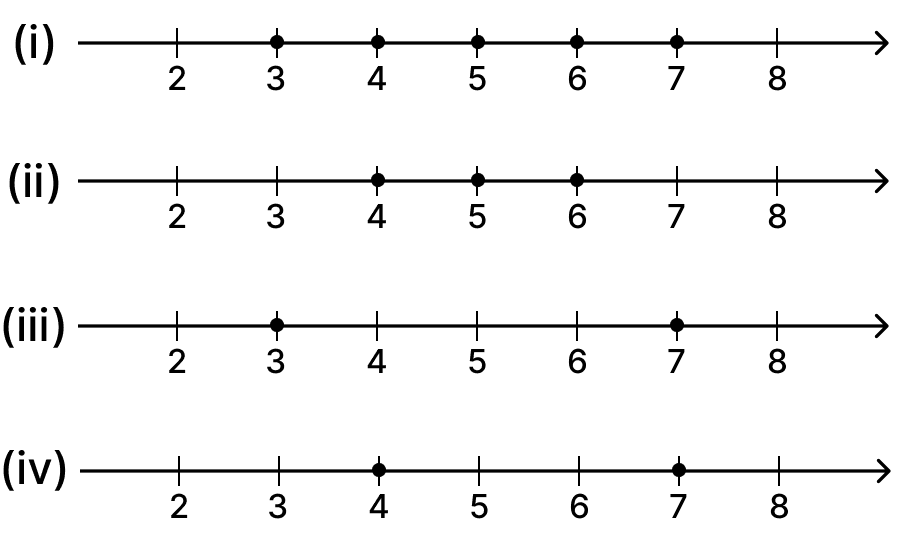
Answer
The whole numbers between 3 and 7 are 4, 5 and 6.
The correct number line is the one in which only the points 4, 5 and 6 are marked between 3 and 7.
Hence, option 2 is the correct option.
The product of the greatest number of two digits and the smallest two digit number is:
999
990
900
980
Answer
The greatest number of two digits = 99.
The smallest number of two digits = 10.
Product = 99 × 10 = 990.
Hence, option 2 is the correct option.
If a ÷ a = a, then a is:
10
0
1
none of these
Answer
For every non-zero whole number, a ÷ a = 1.
So, a ÷ a = a means a = 1.
Hence, option 3 is the correct option.
If 8 - (a - 7) = 8 + (4 - b), then:
a = 4, b = 7
a = -4, b = -7
a = 4, b = -7
a = -4, b = 7
Answer
L.H.S. = 8 - (a - 7) = 8 - a + 7 = 15 - a.
R.H.S. = 8 + (4 - b) = 8 + 4 - b = 12 - b.
So, 15 - a = 12 - b, which gives b - a = -3.
Substituting values from option 2:
⇒ a = -4 and b = -7 gives b - a = -7 - (-4) = -3.
Hence, option 2 is the correct option.