
Two linear adjacent angles are bisected. The angle between these two bisectors is :
90°
60°
120°
180°
Answer
Let ∠AOC and ∠COB be two linear adjacent angles and let OP and OQ be their bisectors respectively.
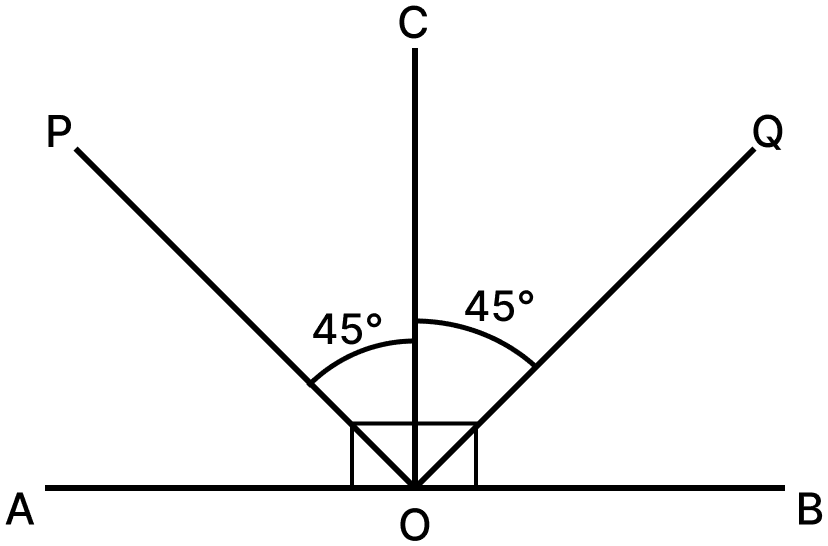
Since, ∠AOC and ∠COB form a linear pair,
⇒ ∠AOC + ∠COB = 180°
∠POQ = ∠POC + ∠COQ
= ∠AOC + ∠COB
= (∠AOC + ∠COB)
= × 180°
= 90°
Hence, option 1 is the correct option.
Is it possible to construct a triangle ABC, if BC = 8 cm, ∠A = 90° and ∠C = 90° ?
yes
no
none of these
Answer
Sum of the three angles of a triangle is 180°.
Here, ∠A + ∠C = 90° + 90° = 180°
⇒ ∠B = 180° − 180° = 0°
Since, no angle of a triangle can be 0°, it is not possible to construct a triangle with two right angles.
Hence, option 2 is the correct option.
Is it possible to construct a triangle with vertex angles 70°, 60° and 40° ?
yes
no
none of these
Answer
Sum of the three angles of a triangle is 180°.
Here, 70° + 60° + 40° = 170° ≠ 180°
∴ It is not possible to construct a triangle with vertex angles 70°, 60° and 40°.
Hence, option 2 is the correct option.
An angle of 70° is bisected. Each smaller angle is :
70°
35°
90°
180°-70°
Answer
The bisector of an angle divides it into two equal angles.
∴ Each smaller angle = × 70° = 35°
Hence, option 2 is the correct option.