
If we suspend a magnet freely, it will settle in:
- east-west direction
- north-south direction
- north-east direction
- east-south direction
Answer
north-south direction
Reason — A freely suspended magnet rests in the north-south direction because its poles align with Earth’s magnetic field, which has a magnetic south near the geographic north and vice versa.
Making a magnetic substance a magnet by bringing it closer to another magnet without touching it, is :
- magnetic induction method
- single touch method
- double touch method
- electrical method
Answer
magnetic induction method
Reason — When a magnetic substance is placed nearby (or brought near) a magnet, it acts as a magnet i.e., it acquires the properties of a magnet temporarily but as soon as the magnet is removed, the substance no longer remains a magnet and this process is called magnetic induction.
An example of natural magnet is :
- iron
- steel
- lodestone
- none of above
Answer
lodestone
Reason — The ore of lodestone found in nature are called natural magnets.
The artificial magnet used to detect direction in the laboratory is :
- U-shaped magnet
- horse shoe magnet
- electromagnet
- magnetic compass
Answer
magnetic compass
Reason — Magnetic compass is used to find the directions in the laboratory because its needle rests in geographic north-south direction.
A ............... is used to find the geographic direction at a place because its needle rests in geographic north south direction.
- Magnetic compass
- Bar magnet
- U-shaped magnet
- None of these
Answer
Magnetic compass
Reason — Magnetic compass is used to find the geographic directions at a place because its needle rests in geographic north-south direction.
The attraction property of a magnet is maximum at its:
- centre
- north pole
- south pole
- both (2) and (3)
Answer
both (2) and (3)
Reason — The ends of the magnet where the attraction property is maximum are called the magnetic poles of the magnet.
Assertion (A): The magnetic field of electromagnet can be adjusted as per requirement.
Reason (R): This can be achieved by varying the electric current in the coil.
- Both A and R are true and R is the correct explanation of A
- Both A and R are true and R is not the correct explanation of A
- A is true but R is false
- A is false but R is true
Answer
Both A and R are true and R is the correct explanation of A
Explanation
Assertion (A) is true because the strength of the magnetic field of an electromagnet can be adjusted as required.
Reason (R) is also true because the strength of an electromagnet depends on the electric current flowing through its coil. Increasing the current increases the magnetic field strength, while decreasing the current reduces it.
Thus, the Reason correctly explains the Assertion.
Therefore, both A and R are true and R is the correct explanation of A.
Assertion (A): A bar magnet when split in two parts will have only one pole.
Reason (R): Magnetic poles always exist in pairs.
- Both A and R are true and R is the correct explanation of A
- Both A and R are true and R is not the correct explanation of A
- A is true but R is false
- A is false but R is true
Answer
A is false but R is true
Explanation
Assertion (A) is false because when a bar magnet is split into two parts, each part becomes a smaller magnet having both a north pole and a south pole.
Reason (R) is true because magnetic poles always exist in pairs.
Therefore, A is false but R is true.
Fill in the blanks :
(a) Temporary magnets are usually made up of ............... .
(b) Rough handling destroys the ............... properties of a magnet.
(c) Like poles ............... each other.
(d) A freely suspended magnet points in the ............... direction.
(e) In a magnet, ............... have the maximum attractive property.
(f) A magnet has ............... poles.
Answer
(a) Temporary magnets are usually made up of soft iron.
(b) Rough handling destroys the magnetic properties of a magnet.
(c) Like poles repel each other.
(d) A freely suspended magnet points in the north-south direction.
(e) In a magnet, ends have the maximum attractive property.
(f) A magnet has two poles.
Write true or false for each statement.
(a) Artificial magnets are weaker than natural magnets.
(b) Poles of a magnet cannot be separated.
(c) A magnet can attract only a magnetic substance.
(d) A magnet has no effect when it is heated to a high temperature.
(e) Permanent magnets get easily demagnetised.
(f) Magnetic poles occur in pairs.
(g) Single touch method is better than the electrical method for making a magnet.
(h) Magnetic keeper is a wooden piece.
(i) Copper cannot be magnetised.
Answer
(a) False because artificial magnets are stronger than natural magnets.
(b) True as magnetic poles always exist in pairs so it is not possible to separate the two poles of a magnet.
(c) True because the substances that get attracted by a magnet are called magnetic substances.
(d) False since a magnet can be demagnetised i.e., the magnetic properties of a magnet can be destroyed by heating the magnet to a high temperature.
(e) False as permanent magnets do not get easily demagnetised.
(f) True since magnetic poles always exist in pairs.
(g) False because the electrical method is actually better than the single touch method for making a magnet as it produces stronger and more uniform magnets, can magnetize objects more quickly and allows control over the strength of the magnet by varying current or number of coil turns.
(h) False since the magnetic keepers are pieces of soft iron.
(i) True because copper is a non-magnetic substance which does not get attracted by a magnet and hence cannot be magnetised.
Match the following columns :
| Column A | Column B | ||
|---|---|---|---|
| (a) | Steel | (i) | to store magnets |
| (b) | Soft iron | (ii) | temporary magnet |
| (c) | Used in electric bell | (iii) | permanent magnet |
| (d) | Magnetic keepers | (iv) | electromagnet |
Answer
| Column A | Column B | ||
|---|---|---|---|
| (a) | Steel | (iii) | permanent magnet |
| (b) | Soft iron | (ii) | temporary magnet |
| (c) | Used in electric bell | (iv) | electromagnet |
| (d) | Magnetic keepers | (i) | to store magnets |
What is a magnet?
Answer
The substances which have the property of attracting iron, are called magnets.
What are magnetic and non-magnetic substances? Give two examples of each.
Answer
Magnetic Substances : The substances that get attracted by a magnet are called magnetic substances, e.g., Iron, steel.
Non-Magnetic Substances : The substances that do not get attracted by a magnet are called non-magnetic substances, e.g., wood, plastic.
What are natural and artificial magnets?
Answer
Natural Magnets : Natural magnets are naturally occurring substances that have magnetic properties like lodestone.
Artificial Magnets : Artificial magnets are man-made magnets that are created by magnetizing magnetic materials like iron, steel, or nickel.
How is an artificial magnet prepared from a natural magnet?
Answer
Artificial magnets are prepared from natural magnets by single touch method in the following manner :
Place the iron or steel bar on a table and take the natural magnet and stroke it along the length of the bar in one direction only from one end to the other. Now, Repeat this stroking motion 20–30 times to magnetize the bar. Bring a few iron pins near the bar. If they stick, the bar has become an artificial magnet.
State two ways of magnetising an iron piece.
Answer
A given piece of iron can be magnetised by the following methods :
- By magnetic induction method
- By single touch method
How can magnetic properties of a magnet be destroyed?
Answer
The magnetic properties of a magnet can be destroyed by the following five ways :
- By rough handling.
- By hammering the magnet repeatedly.
- By dropping the magnet repeatedly on a hard surface.
- By heating the magnet to a high temperature.
- By passing alternating current through a coil around the magnet keeping it in east-west direction.
Why does a freely suspended magnet always rest in north-south direction?
Answer
A freely suspended magnet rests in the north-south direction because its poles align with Earth’s magnetic field, which has a magnetic south near the geographic north and vice versa.
Why are artificial magnets preferred over the natural magnets?
Answer
Artificial magnets are preferred over the natural magnets due to the following reasons :
- Artificial magnets can be made much stronger than natural magnets.
- Their magnetic strength can be controlled and increased as needed.
- They can be made in different shapes: bar, U-shaped, horseshoe, ring, etc. which makes them suitable for specific applications in machines, tools, and devices.
- Artificial magnets can be easily made in large numbers in factories.
- Artificial magnets are stronger and more stable over time while natural magnets (like lodestone) are brittle and weaker.
State four important properties of a bar magnet.
Answer
Important properties of a bar magnet are following :
- A bar magnet attracts materials like iron, nickel, cobalt, and some alloys.
- A bar magnet has two poles (i.e., a north pole and a south pole) which are located near the ends of the magnet.
- In a bar magnet, like poles repel and unlike poles attract.
- When a bar magnet is suspended freely, it always points in the north–south direction, which is the principle behind the magnetic compass.
How are the magnets kept safely ? What is the role of keepers in storing magnets?
Answer
Magnets are kept safely by storing them in magnetic keepers.
Magnetic keepers has following role in storing magnets :
- It provides a closed path for magnetic field lines, preventing the loss of magnetism.
- Stops magnetic field lines from spreading into the air, which helps maintain the magnet’s strength.
- Keeps the magnet stable and safe from environmental effects like opposing magnetic fields.
State two ways of increasing the strength of an electromagnet.
Answer
The strength of the electromagnet can be increased :
- by increasing the current in the coil, and
- by increasing the total number of turns of the coil.
State three important uses of a magnet.
Answer
Important uses of a magnet are :
- Permanent magnets are used in electrical measuring instruments such as galvanometer, ammeter, voltmeter, etc.
- Magnets are used in electric motors, dynamo, speaker, computer, etc.
- Magnetic compass is used to find the geographic direction at a place by sailors or pilots.
In which direction does a suspended bar magnet come to rest ? Give reason.
Answer
A suspended bar magnet always comes to rest in the north-south direction. This happens because Earth acts like a giant magnet with its magnetic south near the geographic north, which attracts the north pole of the magnet, and its magnetic north near the geographic south, which attracts the south pole of the magnet.
State three differences between temporary and permanent magnets.
Answer
| Temporary Magnet | Permanent Magnet | |
|---|---|---|
| (i) | It is made of soft iron. | It is made of steel. |
| (ii) | It is easily demagnetised. | It is not easily demagnetised. |
| (iii) | Its magnetic strength can be changed. | Its magnetic strength cannot be changed. |
State three ways of demagnetising a magnet.
Answer
Ways of demagnetising a magent are :
- By rough handling.
- By hammering the magnet repeatedly.
- By dropping the magnet repeatedly on a hard surface.
Suggest one way to recognise the magnetic field of the earth.
Answer
We can recognise Earth's magnetic field by suspending a bar magnet freely with a thread. The magnet always comes to rest in the north-south direction because its poles align with Earth’s magnetic field. This shows that Earth behaves like a giant magnet with its own magnetic field.
Name the material of core of an electromagnet for
(a) temporary magnet
(b) permanent magnet.
Answer
(a) Temporary magnet : Soft iron
(b) Permanent magnet : Steel
What are magnetic keepers ? Name its material.
Answer
Magnetic keepers are soft iron pieces placed across the poles of a magnet during storage to preserve its magnetism. It uses soft iron as its material.
How are the north and south poles of a magnet located? Explain.
Answer
To locate the north and south poles of a magnet, suspend it freely with a thread. It will come to rest in the north-south direction. The end that points towards the geographic north is the magnet’s north pole, and the end pointing south is its south pole. This happens because Earth’s magnetic field attracts the opposite poles of the magnet.
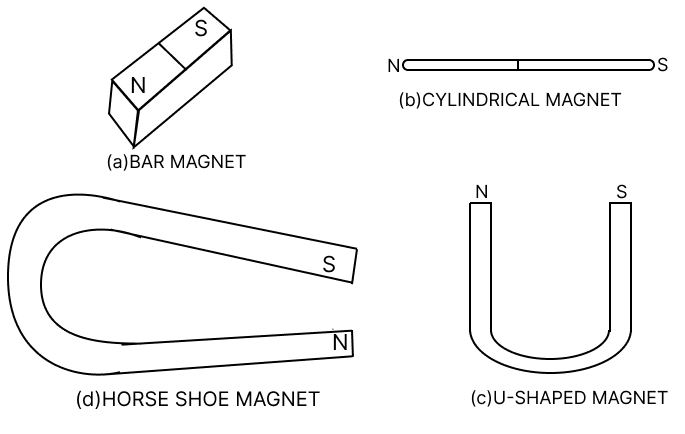
Draw diagrams of artificial magnets of four different shapes.
Answer
The diagrams of artificial magnets of four different shapes are given below :
Describe an experiment to show that the maximum attractive property is at the poles of a magnet.
Answer
Experiment :
Bring a bar magnet near small iron nails, it is observed that most of the nails cling near the ends of the magnet and very few nails cling near the middle as shown in below figure.
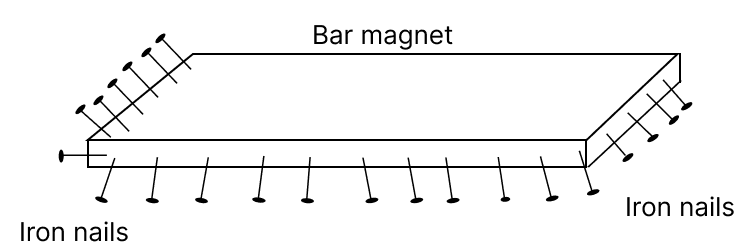
This shows that the property of attraction is not same every where along the length of the magnet, but it is maximum near the ends and very little in the middle of the magnet.
Explain the attractive property of a magnet with the help of an experiment.
Answer
The attractive property of a magnet refers to its ability to pull certain materials, like iron, nickel, and cobalt, towards itself.
Experiment to show this property:
Place some small iron nails on a table and slowly bring a bar magnet close to them. You will observe that the nails are attracted to the magnet and mostly stick to its ends. Very few, if any, cling to the middle part of the magnet.
This experiment shows that magnets attract magnetic materials and that the attractive force is strongest at the two ends (called poles) of the magnet.
Describe a method by which an iron bar can be made a magnet.
Answer
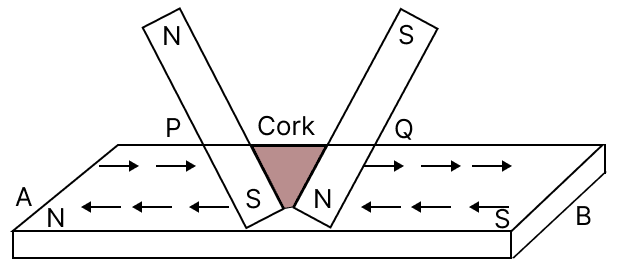
We can use the double touch method to make an iron bar into a magnet.
Double Touch Method :
- Take two magnets, P and Q, and an iron bar AB.
- Place the magnets vertically at the centre of the bar with their opposite poles on the same side.
- Keep a cork between the poles of the two magnets.
- Move the magnets together with the cork from the centre towards the end B of the bar.
- Without lifting the magnets, slide them back to the end A.
- Repeat this forward and backward movement about 20 times.
- Turn the bar upside down and repeat the same process another 20 times.
- The iron bar becomes a magnet:
- End A becomes the north pole.
- End B becomes the south pole.
Define the term magnetic field of a magnet. How will you recognise it experimentally?
Answer
The space around a magnet in which if a magnetic substance such as small pieces of iron, are placed, they get attracted towards the magnet, is called a magnetic field.
Magnetic field of a magnet can be recognised by following experiment :
If a magnet is placed below a sheet of stiff paper and some iron filings are spread on it, then on tapping the sheet gently, the iron filings are found to arrange themselves in a definite pattern as shown in below figure.
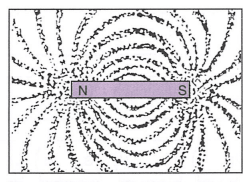
The pattern of iron filings represent the magnetic field of the magnet where its direction is from north pole of magnet to its south pole and the magnetic field is not uniform as It is strong near the magnet while weak at a distance from the magnet.
How will you make a bar of iron an electromagnet ? Draw a diagram showing the polarities of an electromagnet.
Answer
A bar magnet can be made electromagnet with the following method :
Electrical Method :
Take the given iron bar AB. Wound several turns of insulated copper wire over the bar. Connect the ends of the wire to a battery through a switch as shown in below figure.
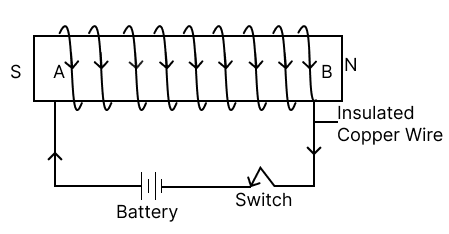
Press the switch to pass current. After some time, the bar AB becomes a magnet. The end A of the bar at which the current enters the coil in clockwise direction becomes the south pole (S) and the end B of the bar becomes the north pole (N). The polarity at the ends of the bar can be reversed by reversing the direction of current in the coil.
Suppose you are given a long bar magnet and you are asked to break it into four small magnets. Draw diagrams showing the polarities of each broken part.
Answer
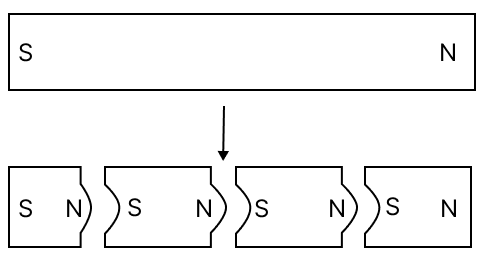
Magnetic poles always exist in pairs. If a long bar magnet is broken into four pieces, each part will behave like a magnet with its north and south poles as shown in the diagram below:
What is magnetic induction ? Explain with the help of a diagram.
Answer
When a piece of iron is placed nearby (or brought near) a magnet, it acts as a magnet i.e., it acquires the properties of a magnet temporarily. But as soon as the magnet is removed, the iron piece no longer remains a magnet. This process is called magnetic induction.
Magnetic induction Method :
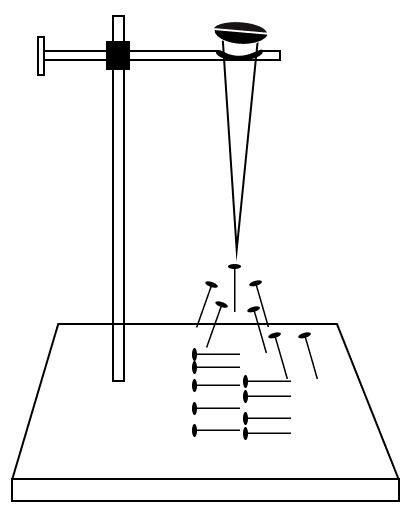
To make an iron nail a magnet by magnetic induction, we proceed as follows :
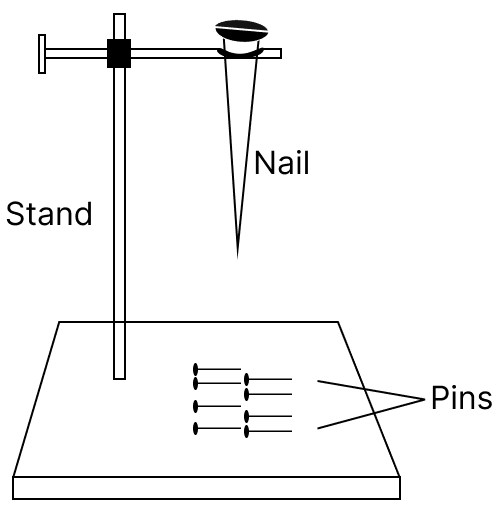
(i) Take a long nail. Put it on the arm of a stand passing through a cork as shown in figure (a). Spread some iron pins on the base of the stand. You will find that the pins do not move towards the nail.
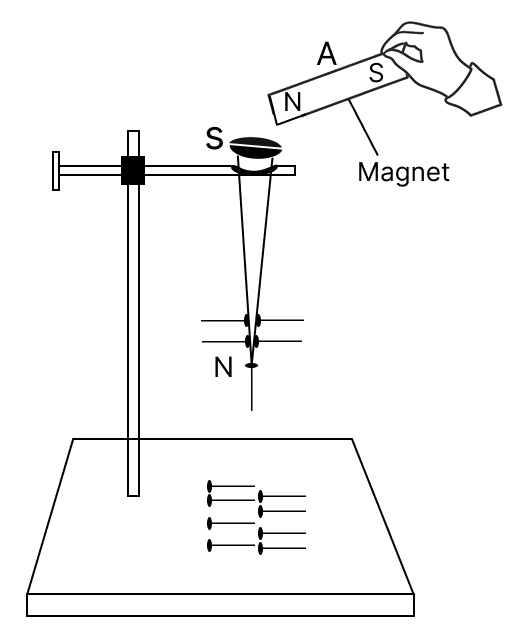
(ii) Now bring one pole (say north pole) of a magnet A near the head of the nail as shown in figure (b). You will notice that now some pins begin to cling to the nail. This shows that in the presence of the magnet, the nail has become a magnet. Actually the head of the nail near the north pole N of the magnet A acquires the south (S) polarity and its tip acquires the north (N) polarity.
(iii) Then remove the magnet A as shown in figure (c). You will see that all the pins fall down. This shows that on removing the magnet A, the nail loses its magnetic property. Thus by magnetic induction, the nail or bar becomes a temporary magnet only in the presence of an external magnet.
You are given an iron nail, a torch cell and a long piece of insulated copper wire. With the help of a labelled neat diagram, describe in steps how you will make the nail, an electromagnet.
Answer
Procedure of making of electromagnet :
Take a long piece of insulated copper wire. Wrap it around the nail as shown in figure below.
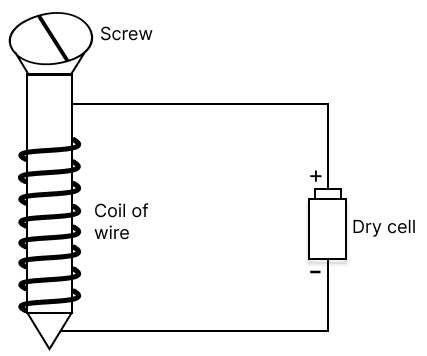
Attach the free ends of the wire to the terminals of the torch cell. Now we have an electromagnet with which we can pick up small pieces of iron such as paper clips or allpins of iron.
Describe an experiment to illustrate that like poles repel while unlike poles attract.
Answer
Experiment :
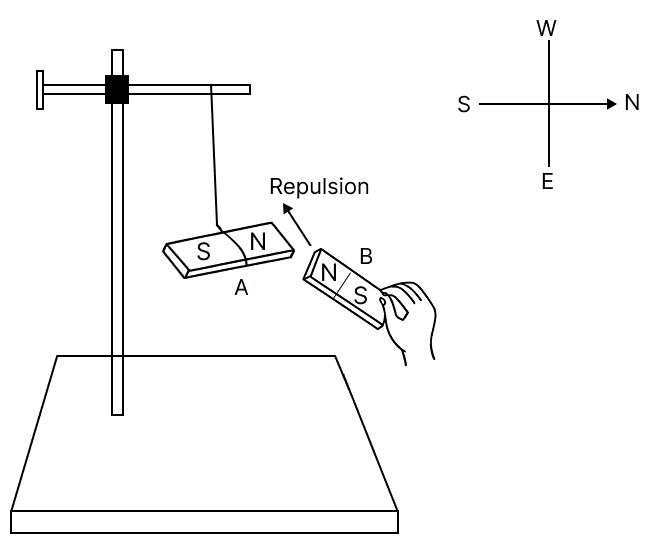
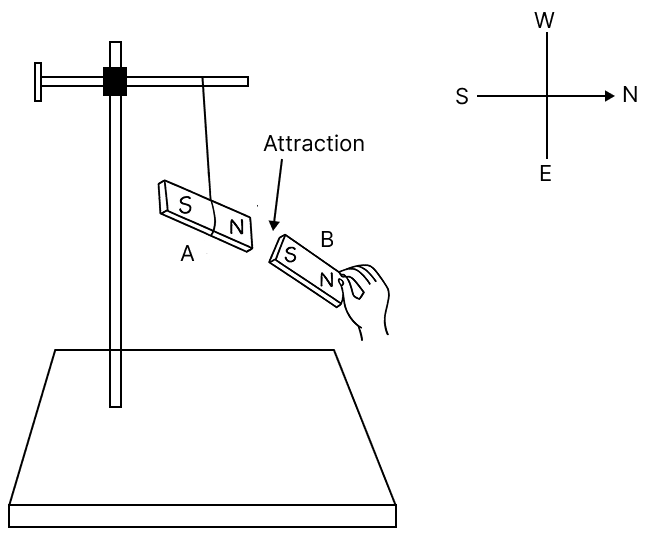
Take two bar magnets A and B. Suspend one magnet A with a silk thread from a support so that it is free to swing. The magnet will come to rest in the north-south direction. The north pole of the magnet is in the north direction and the south pole of the magnet is in the south direction.
Now holding the other magnet B in your hand, bring its north pole near the north pole of the suspended magnet A (such that the two magnets do not touch each other) as shown in below figure (a). It is observed that the suspended magnet A moves away from the magnet B. This shows that like poles repel each other.
- Now bring the south pole of the magnet B near the north pole of the suspended magnet A as shown in below figure (b), without touching it. It is observed that the magnet A moves towards the magnet B. This shows that unlike poles attract each other.
In the figures given below, state whether the pair of magnets would attract each other or repel each other.
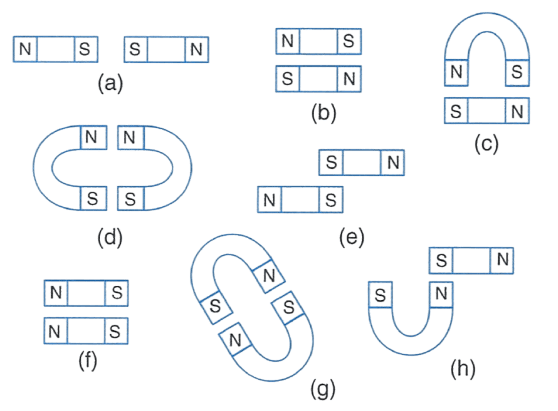
Answer
(a) Here like poles are adjacent so the pair of magnets will repel.
(b) As opposite poles are near so the pair of magnets will attract.
(c) Opposite poles are facing each other hence, the pair of magnets will attract.
(d) Like poles are facing each other so the pair of magnets will repel.
(e) Like poles are near to each other so the pair of magnets will repel.
(f) Like poles are facing each other so the pair of magnets will repel.
(g) Opposite poles are facing each other hence, the pair of magnets will attract.
(h) Opposite poles are facing each other hence, the pair of magnets will attract.
During a school excursion to a scrap-metal recycling yard, Rahman notices two cranes being used to sort metal. One crane lifts only small iron pieces and often struggles to drop them exactly where needed. The other crane easily picks up large steel plates and can release them precisely at the correct spot.
Answer the following :
(i) Which crane is most likely using an electromagnet according to you?
(ii) Why can one crane release metal objects more easily than the other?
(iii) If aluminium and copper pieces are mixed in the scrap, will the electromagnet crane be able to lift them? Give a reason.
(iv) What would happen to the lifting strength of the electromagnet crane if the operator doubles the current flowing through its coil?
Answer
(i) The crane that can easily lift large steel plates and release them precisely is most likely using an electromagnet. An electromagnet can be switched on and off as required.
(ii) The electromagnet crane can release metal objects easily because when the electric current is switched off, the electromagnet loses its magnetic effect and releases the objects. A permanent magnet cannot be switched off in this way.
(iii) No. The electromagnet will not lift aluminium and copper pieces because they are non-magnetic materials and are not attracted by a magnet.
(iv) If the current flowing through the coil is doubled, the strength of the electromagnet will increase. Therefore, it will be able to attract and lift heavier magnetic objects.