
Mechanical advantage of a machine is defined as :
Answer
Reason — The factor by which a machine multiplies the force applied (i.e. effort) is called the mechanical advantage of that machine and it is the ratio of the load to the effort. In other words,
For an ideal machine, the efficiency is :
- greater than unity
- less than unity
- equal to unity
- depends on the value of load
Answer
equal to unity
Reason — For an ideal machine, the work output is equal to the work input, i.e., the efficiency of an ideal machine is 1 or equal to unity.
The mechanical advantage of a lever is equal to :
Answer
Reason — According to the principle of a lever the mechanical advantage of a lever is equal to the ratio of the effort arm to the load arm and is given by :
A pulley is used because it :
- has the mechanical advantage greater than one
- has 100% efficiency
- helps to apply the force in a convenient direction
- requires more effort to raise a less load.
Answer
helps to apply the force in a convenient direction
Reason — A pulley is a simple machine by which the direction of effort is changed to raise up a load.
Wheel is used with axle because :
- sliding friction is less than the rolling friction
- rolling friction is less than the sliding friction
- they work as the inclined plane
- they help us to change the direction of force.
Answer
rolling friction is less than the sliding friction
Reason — When a wheel rotates on its axle, the contact surfaces roll instead of slide. Rolling friction is much smaller than sliding friction, so using a wheel-and-axle arrangement greatly reduces the resistive force and makes it easier to move loads.
Assertion (A): Mechanical advantage of a lever can be less than 1.
Reason (R): If the effort arm is shorter than the load arm, more effort is required than the load.
- Both A and R are true and R is the correct explanation of A
- Both A and R are true and R is not the correct explanation of A
- A is true but R is false
- A is false but R is true
Answer
Both A and R are true and R is the correct explanation of A
Explanation
Assertion (A) is true because the mechanical advantage (MA) of a lever is given by,
So, when the effort required is greater than the load then the mechanical advantage of such type of lever is less than one.
Reason (R) is true because mechanical advantage of a lever is also given by,
By using Equation 1,
So, if the effort arm is shorter than the load arm, a larger effort is needed to balance the load.
The Reason justifies the Assertion because when the effort arm is shorter, the effort becomes greater than the load, making the mechanical advantage less than 1.
Therefore, both A and R are true and R is the correct explanation of A.
Assertion (A): A forearm holding a load is an example of class II lever.
Reason (R): The levers in which the load is in between the fulcrum and the effort belong to class II.
- Both A and R are true and R is the correct explanation of A
- Both A and R are true and R is not the correct explanation of A
- A is true but R is false
- A is false but R is true
Answer
A is false but R is true
Explanation
Assertion (A) is false because a forearm holding a load is an example of a class III lever, not class II. In this case, the effort (applied by muscles) lies between the fulcrum (elbow joint) and the load (held in the hand).
Reason (R) is true because in a class II lever, the load is positioned between the fulcrum and the effort.
Therefore, A is false but R is true.
Fill in the blanks :
(a) The useful work done by an actual machine is always ............... than the work done on the machine.
(b) In class II levers, the ............... is in between fulcrum and ............... .
(c) The mechanical advantage of class ............... lever is always less than 1.
(d) A pulley is used to change ............... .
(e) Mechanical advantage of an inclined plane is always ............... .
Answer
(a) The useful work done by an actual machine is always less than the work done on the machine.
(b) In class II levers, the load is in between fulcrum and effort .
(c) The mechanical advantage of class III lever is always less than 1.
(d) A pulley is used to change the direction of effort.
(e) Mechanical advantage of an inclined plane is always greater than 1.
State whether the following statements are true or false:
(a) A boy does work while pushing a wall.
(b) A machine performs work by itself.
(c) In an ideal machine, work done on load is equal to the work done by effort.
(d) All levers are force multipliers.
(e) A pulley changes the direction of force.
(f) An inclined plane always has the mechanical advantage more than 1.
Answer
(a) False because work is said to be done if the force applied on the body moves it. If no motion or change in position takes place, no work is said to be done so when a boy pushes a wall, no work is done by him since wall remains stationary.
(b) False because a machine can do useful work only when energy is supplied to it; it cannot work by itself.
(c) True because a machine in which no part of the work done on the machine is wasted, is called an ideal or perfect machine. Thus, for an ideal machine, the work done on load is equal to the work done by effort.
(d) False as Class I and Class II levers can act as force multipliers when the effort arm is longer than the load arm, but Class III levers have the effort applied closer to the fulcrum and thus do not multiply force.
(e) True because a pulley is a simple machine by which the direction of effort is changed to raise up a load.
(f) True because the effort required to push a load up an inclined plane is less than the load. Thus, the mechanical advantage of an inclined plane is always greater than 1.
Match the following columns :
| Column A | Column B | ||
|---|---|---|---|
| (a) | Needle | (i) | class II lever |
| (b) | Door knob | (ii) | inclined plane |
| (c) | Ramp | (iii) | class I lever |
| (d) | Lemon crusher | (iv) | wheel and axle |
| (e) | See-saw | (v) | wedge |
Answer
| Column A | Column B | ||
|---|---|---|---|
| (a) | Needle | (v) | wedge |
| (b) | Door knob | (iv) | wheel and axle |
| (c) | Ramp | (ii) | inclined plane |
| (d) | Lemon crusher | (i) | class II lever |
| (e) | See-saw | (iii) | class I lever |
When is work said to be done by a force ?
Answer
Work is said to be done if the force applied on the body moves it. If no motion or change in position takes place, no work is said to be done.
What is energy?
Answer
The energy of a body is its capacity (or ability) to do work.
What do you understand by a machine?
Answer
A machine is a device which helps us to do work more easily by applying less force and spending less energy.
What is the principle on which a machine works?
Answer
A machine does not work by itself. When energy is supplied to it (or work is done on it), it does some useful work. Hence, the machine works on the principle of conservation of energy.
State two functions of a machine.
Answer
A machine has the following functions :
- It decreases the magnitude of the force required, i.e., the effort is less than the load.
- It changes the direction of effort in a convenient direction.
Define the term 'work input' and 'work output' in relation to a machine.
Answer
Work Input : The work done on a machine by the effort (input force) is called work input.
Work Output : The work done by the machine on the load is called work output.
Explain the term mechanical advantage of a machine.
Answer
The factor by which a machine multiplies the force applied (i.e. effort) is called the mechanical advantage of that machine. It is the ratio of the load to the effort.
Define the term efficiency of a machine.
Answer
The efficiency of a machine is the ratio of the useful work done by the machine to the work put into the machine by the effort. Thus,
What is an ideal machine ?
Answer
A machine in which no part of the work done on the machine is wasted i.e., the efficiency of the machine is 1 or 100 per cent, is called an ideal or perfect machine.
Can a machine have an efficiency of 100% ? Give a reason to support your answer.
Answer
In practice, no machine has an efficiency of 100% because some part of the work done on a machine is always used up (or wasted) in overcoming the friction between the moving parts of the machine. Therefore, the work output of a machine is always less than the work input.
'A machine is 75% efficient'. What do you understand by this statement?
Answer
If a machine is 75% efficient, it means that 75% of the work input to the machine is obtained as the useful work output and the remaining 25% of the work input has been wasted in overcoming friction.
What is a lever?
Answer
A lever is a simple machine which in its simplest form is made up of a rod which can turn about a fixed point called the fulcrum.
What do you mean by the mechanical advantage of a lever ?
Answer
The mechanical advantage of a lever is equal to the ratio of the effort arm to the load arm and is given by :
Which class of lever has the mechanical advantage always more than 1 ? Give an example.
Answer
The mechanical advantage of class II levers is always more than 1. Example : nut cracker.
Which class of lever has the mechanical advantage always less than 1 ? Give an example.
Answer
The mechanical advantage of class III levers is always less than 1. Example : knife.
Give one example of class I lever in each case where the mechanical advantage is
(i) more than 1
(ii) equal to 1
(iii) less than 1.
Answer
(i) A pair of pliers
(ii) Beam balance
(iii) Pair of scissors
Name the class to which the following levers belong :
(a) A pair of scissors,
(b) a lemon squeezer,
(c) a nut cracker,
(d) a pair of sugar tongs,
(e) a beam balance,
(f) an oar rowing a boat,
(g) a wheel barrow,
(h) a see-saw,
(i) a pair of pliers,
(j) a crowbar.
Answer
(a) A pair of scissors → Class I lever
(b) A lemon squeezer → Class II lever
(c) A nutcracker → Class II lever
(d) A pair of sugar tongs → Class III lever
(e) A beam balance → Class I lever
(f) An oar oar rowing a boat → Class I lever
(g) A wheelbarrow → Class II lever
(h) A seesaw → Class I lever
(i) A pair of pliers → Class I lever
(j) A crowbar → Class I lever
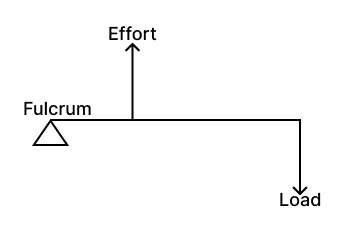
The diagram given below shows the three kinds of levers. Name the class of each lever and give one example of each class.
(a)
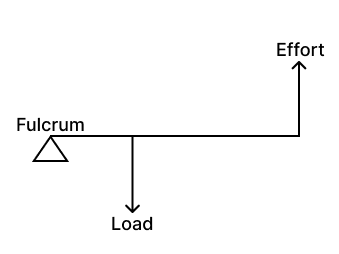
(b)
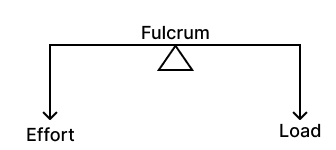
(c)
Answer
Three kinds of friction are as follow :
(a) Class II lever
Example: Wheel barrow
(b) Class I lever
Example: Pair of scissors
(c) Class III lever
Example: Knife
How can you increase the mechanical advantage of a lever?
Answer
The mechanical advantage of a lever can be increased by increasing the effort arm or reducing the load arm.
How does the friction at the fulcrum affect the mechanical advantage of a lever ?
Answer
Friction at the fulcrum uses up part of the effort applied to the lever, so the lever delivers less output force than it would ideally. As a result, the mechanical advantage is reduced.
State three differences between the three classes of levers.
Answer
| S. No. | Class I lever | Class II lever | Class III lever |
|---|---|---|---|
| 1. | It has the fulcrum between the load and the effort. | It has the load between the fulcrum and the effort. | It has the effort between the fulcrum and the load. |
| 2. | The effort arm can be shorter, equal to or longer than the load arm. | The effort arm is always longer than the load arm. | The effort arm is always shorter than the load arm. |
| 3. | The mechanical advantage can be less than, equal to or greater than 1. | The mechanical advantage is always greater than 1. | The mechanical advantage is always less than 1. |
What is a pulley?
Answer
A pulley is a simple machine by which the direction of effort is changed to raise up a load.
What is the mechanical advantage of an ideal pulley?
Answer
In an ideal pulley, the effort applied is equal to the load to be lifted so it's mechanical advantage is 1.
What is a screw? Give two examples.
Answer
A screw is a simple machine which appears like an inclined plane wound around a rod with a pointed tip. Hence, it appears like a nail with grooves on its circular curved surface. Examples : Car jack screw, bottle cap etc.
What is wheel and axle ? Give two examples.
Answer
A wheel and axle is a simple machine made up of a wheel attached to a central rod (axle), where both rotate together. It helps in multiplying force to make work easier. Example : Steering wheel of a car, door knob.
How does a wheel help in moving the axle?
Answer
The wheel acts as a force multiplier. When the wheel rotates, it turns the axle with it, resulting in linear motion. In a wheel-and-axle system, effort is usually applied to the larger wheel, while the smaller axle carries the load, making movement easier. The linear motion of the axle is obtained by rotating the wheel so as to reduce friction.
What is a wedge? Give two examples.
Answer
A wedge is a simple machine having a sharp edge which is formed by putting two inclined planes together. Example : Knife, axe etc.
Name the machine to which the following belong :
(a) Beam balance
(b) Lemon crusher
(c) Sugar tongs
(d) Ramp
(e) Door knob
(f) Needle
Answer
(a) Beam balance : Class I lever
(b) Lemon crusher : Class II lever
(c) Sugar tongs : Class III lever
(d) Ramp : Inclined plane
(e) Door knob : Wheel and axle
(f) Needle : Wedge
What care would you take to increase the life span of a machine which you use?
Answer
To increase the life span of a machine following precautions must be followed :
- We should keep the machines clean and free from dust.
- If the parts of the machine are made of iron, they can rust. To prevent them from rusting, such parts must be painted.
- Friction causes wear and tear of the moving parts of a machine. To reduce friction, these parts must be properly lubricated from time to time.
Select the correct statement :
(a) A wheel barrow is a lever of class I.
(b) The efficiency of a machine is always 100%.
(c) Friction in moving parts of a machine reduces its efficiency.
(d) No lever has the mechanical advantage greater than 1.
(e) It is easier to lift a load vertically up than to push it along an inclined plane.
(f) A screw is made by two inclined planes placed together.
Answer
(a) Incorrect : A wheel barrow is a Class II lever.
(b) Incorrect : The efficiency of a machine is always less than 100%.
(c) Correct
(d) Incorrect : Class II levers have mechanical advantage greater than 1.
(e) Incorrect : It is easier to push a load along an inclined plane than to lift it vertically up.
(f) Incorrect : A wedge is made by two inclined planes placed together.
Name six simple machines. Give an example of each machine.
Answer
- Lever → beam balance
- Pulley → well pulley
- Wheel and axle → steering wheel
- Inclined plane → ramp
- Wedge → nail
- Screw → bottle cap
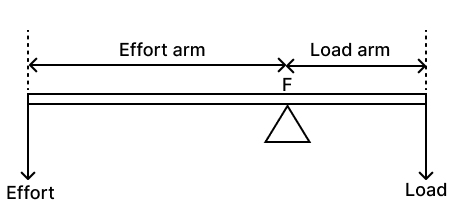
Describe three orders of levers giving an example of each. Draw neat diagrams showing the positions of fulcrum, load and effort in each kind of lever.
Answer
- Lever of Class I : The lever in which the fulcrum is in between the load and the effort are called lever of class I. Generally, the effort arm of lever of class I is longer than the load arm, therefore, the mechanical advantage of a class I lever is greater than 1. However, if the effort arm is equal to the load arm, the mechanical advantage is equal to 1. But if the effort arm is shorter than the load arm, its mechanical advantage is less than 1. Thus, the mechanical advantage of a lever of class I can be greater than 1, equal to 1 or less than 1. Example : see-saw.
- Lever of Class II : The lever in which the load is in between the fulcrum and the effort are called lever of class II. In class II lever, the fulcrum is at one end and the load is closer to the fulcrum. Thus, the effort arm is always longer than the load arm. Hence, the mechanical advantage of a class II lever is always more than 1. Example : nut cracker.
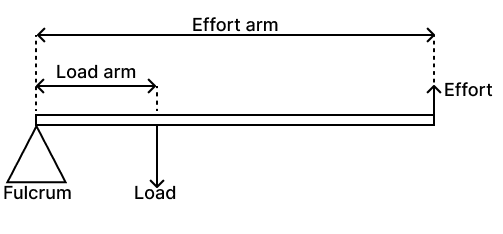
- Lever of Class III : The lever in which the effort is in between the fulcrum and the load are called lever of class III. In class III lever, the fulcrum is at one end and the effort is close to the fulcrum, thus the effort arm is always shorter than the load arm. Hence, the mechanical advantage of a class III lever is always less than 1. Example : knife.
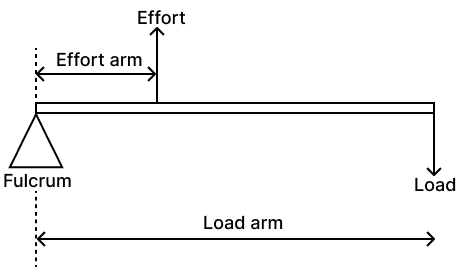
Draw diagrams to illustrate the positions of fulcrum, load and effort, in each of the following :
(a) a see-saw
(b) a beam balance
(c) a nut cracker
(d) a pair of forceps
Answer
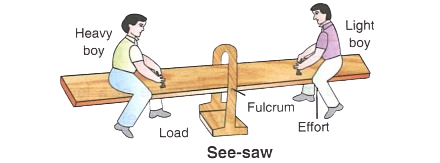
(a) See-saw is an example of class I lever in which the fulcrum is in between the load and the effort so that the effort arm is equal to the load arm.
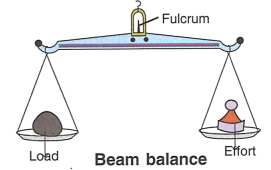
(b) Beam balance is a type of class I lever in which the fulcrum is in between the load and the effort so that the effort arm is equal to the load arm.
(c) Nut cracker is an example of class II lever in which the fulcrum is at one end and the load is closer to the fulcrum. Thus, the effort arm is always longer than the load arm.
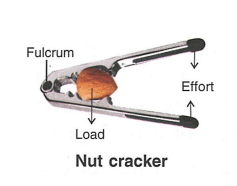
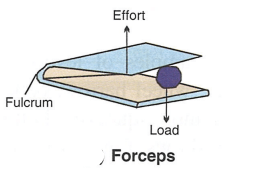
(d) Pair of forceps is a type of class III lever in which the effort is in between the fulcrum and the load so that the fulcrum is at one end and the effort is close to the fulcrum, thus the effort arm is always shorter than the load arm.
The mechanical advantage of an actual pulley is less than 1. Give a reason. What is the justification for using the pulley then?
Answer
The mechanical advantage of an actual pulley is less than 1 due to friction present in pulley. The reason why we use the pulley when its mechanical advantage is equal to 1 or less than 1 is that the pulley allows us to apply the effort downwards i.e., in a convenient direction to raise the load.
Draw a neat labelled diagram showing a pulley being used to lift a load. How are load and effort related in an ideal situation ?
Answer
The labelled diagram of a pulley being used to lift a load is given below :
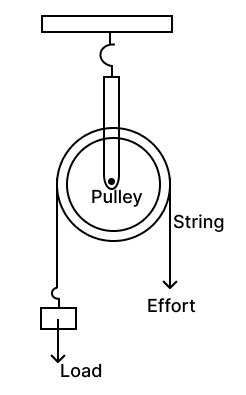
In an ideal pulley, the effort applied is equal to the load to be lifted.
What is an inclined plane? What is its mechanical advantage? Give two examples where it is used.
Answer
An inclined plane is a slanting wooden plank or a sloping surface. It is a simple machine which is used to move a load up with a less effort.
The effort required to push a load up an inclined plane is less than the load. Thus, the mechanical advantage of an inclined plane is always greater than 1.
Example :
Hospitals and huge buildings are provided with ramps which help nurses to move up the patients on a stretcher or to carry heavy equipments.
A coolie while loading a heavy drum on a truck uses a wooden plank. One end of the plank is kept on the edge of the truck and the other end on the ground. He then pushes the drum along the sloping surface and places it on the truck.
Given below is a crossword puzzle based on this lesson. Read the clues across and clues downwards and fill up the blank squares.
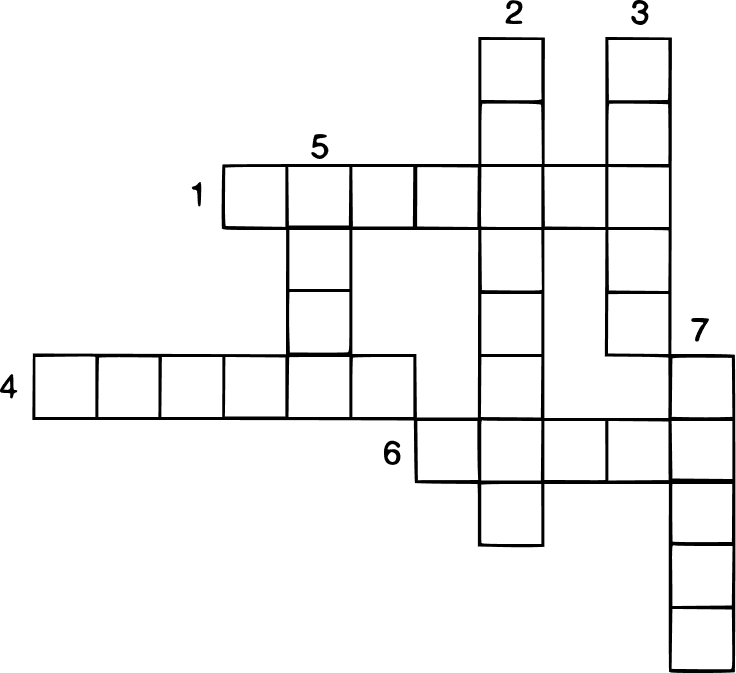
Across:
1. It makes work easier ............... . 4. A ............... is a simple machine which is used for raising a load up by applying the effort downwards. 6. Work is said to be done when a ............... applied on a body moves it.
Down:
2. ............... force at the fulcrum reduces the mechanical advantage. 3. A ............... and axle is also a simple machine. 5. Screw driver is an example of wheel and ............... . 7. ............... is a rod which can turn about a fixed point (fulcrum)
Answer
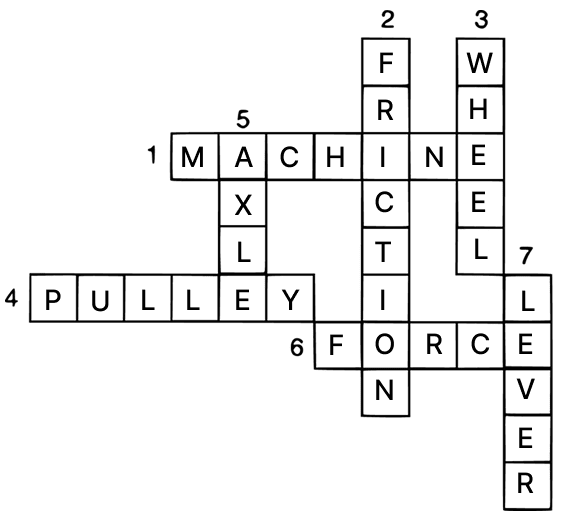
- Machine makes work easier.
- Friction force at the fulcrum reduces the mechanical advantage.
- A wheel and axle is also a simple machine.
- A pulley is a simple machine which is used for raising a load up by applying the effort downwards.
- Screw driver is an example of wheel and axle.
- Work is said to be done when a force applied on a body moves it.
- Lever is a rod which can turn about a fixed point (fulcrum)
In a machine an effort of 10 kgf is applied to lift a load of 100 kgf. What is its mechanical advantage?
Answer
Given,
Effort = 10 kgf
Load = 100 kgf
Mechanical advantage of a machine is given by :
So, the mechanical advantage of the machine is 10.
The mechanical advantage of a machine is 5. How much load it can exert for the effort of 2 kgf?
Answer
Given,
Mechanical advantage of the machine = 5
Effort = 2 kgf
As,
Thus, the load can exert 10 kgf force for the effort of 2 kgf.
The mechanical advantage of a machine is 2. It is used to raise a load of 15 kgf. What effort is needed?
Answer
Given,
Mechanical advantage of the machine = 2
Load = 15 kgf
As,
Hence, to raise a load of 15 kgf, an effort of 7.5 kgf is needed.
A lever of length 100 cm has effort of 15 kgf at a distance of 40 cm from the fulcrum at one end. What load can be applied at its other end?
Answer
Given,
Lever length = 100 cm
Effort = 15 kgf
Effort arm = 40 cm
Load arm = Lever length = 100 cm
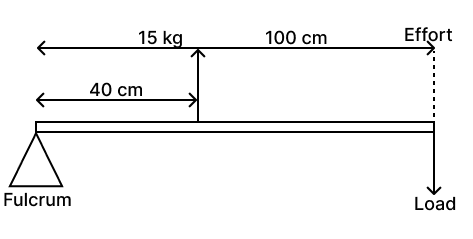
Mechanical advantage of a lever is :
Thus, a load of 6 kgf should be applied for the effort of 15 kgf.
In a lever, fulcrum is at one end at a distance of 30 cm from the load and effort is at the other end at a distance of 90 cm from the load. Find :
(a) the length of load arm,
(b) the length of effort arm, and
(c) the mechanical advantage of the lever.
Answer
Given,
Distance of fulcrum from the load = 30 cm
Distance between load and effort = 90 cm
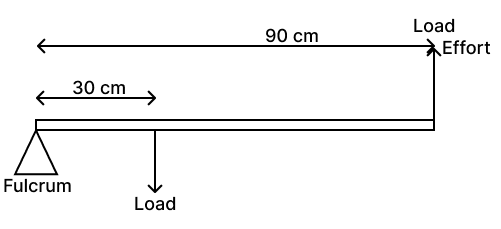
(a) Length of load arm = Distance of fulcrum from the load = 30 cm
(b) Length of effort arm = Distance between load and effort + Length of load arm
= 90 + 30
= 120 cm
(c) Mechanical advantage of a lever is :
Atul goes to the market with his uncle to buy a fishing rod. On the way, they see some godown workers loading heavy wooden trays onto a truck. The workers are using a long and strong ramp from the ground to the truck, forming a gentle slope. The trays are pushed up the ramp, but Atul wonders why they are taking this sloping path instead of directly lifting the trays straight up. A little later upon reaching the hardware shop, his uncle asks for a long, flexible wooden fishing rod to buy.
Answer the following :
(i) What type of simple machine is the loading ramp, and what is its main use?
(ii) Why do the workers prefer using a gentle sloping ramp instead of lifting the trays straight up?
(iii) Does the loading ramp provide any mechanical advantage? Explain.
(iv) According to you, what kind of a simple machine is a fishing rod ?
(v) Fishing rods come in different lengths. Does the length of a fishing rod make any difference?
Answer
(i) The loading ramp is an inclined plane. It is used to raise heavy objects to a height with less effort.
(ii) The workers use a gentle sloping ramp because it requires less force to move the trays upwards. The smaller force has to be applied over a longer distance.
(iii) Yes. The loading ramp provides mechanical advantage because the effort required to raise the load is less than the load itself. A gentler and longer slope requires less effort.
(iv) A fishing rod is a Class III lever because the effort is applied between the fulcrum and the load.
(v) Yes. The length of a fishing rod makes a difference. If the position of the hands remains the same, a longer fishing rod has a longer load arm. Therefore, its mechanical advantage decreases and greater effort is required to handle the same load. However, the longer rod provides a greater reach.