
State what do you understand by the term 'air'. Explain its importance to mankind.
Answer
Air is a mixture of gases that is present everywhere around us. It is a colourless, odourless mixture consisting mainly of nitrogen (about four-fifths) and oxygen (about one-fifth), along with small amounts of carbon dioxide, water vapour, traces of rare (inert) gases and impurities such as dust and smoke.
Importance of air to mankind:
- Man cannot survive without air. The oxygen of the air is essential for respiration in living organisms.
- Oxygen of the air supports combustion, i.e. the burning of fuels to produce heat and light.
- The carbon dioxide of the air is used by green plants for photosynthesis to prepare their food.
- Nitrogen of the air is essential for the growth of plants, as it is converted into plant proteins.
- Air helps in many physical and chemical processes such as evaporation, changes in weather, dispersal of seeds and pollination.
Give a brief account of the discovery of air & the scientists involved.
Answer
The discovery of air was carried out in stages by three scientists:
- John Mayow (1674) — proved that air is a mixture and contains an active component and an inactive component.
- Joseph Priestley (1774) — discovered the gas present in the active component of air. This gas was later found to be oxygen.
- Antoine Lavoisier (1789) — named the active component as oxygen gas and the inactive component as nitrogen gas.
What is meant by the term 'atmosphere'. State the role played by the atmosphere for the survival of mankind.
Answer
The atmosphere of the earth is a layer of gases, commonly called air, which surrounds the planet earth and is retained above the earth by the force of gravity.
Role played by the atmosphere for the survival of mankind:
- It absorbs the harmful U.V. radiations of the sun and warms the earth's surface by retention of heat.
- It reduces the temperature extremes between day and night.
- It provides the air which is essential for respiration and other life-supporting physical and chemical processes.
Explain in brief the different layers of the atmosphere & the basic functions of the main layers.
Answer
The atmosphere mainly consists of three layers:
| Layer of atmosphere | Distance from earth (approx.) | Basic function |
|---|---|---|
| Troposphere | 0 to 10 kilometres | Contains most of the air and oxygen; this air is fit for respiration and survival of living organisms. Weather conditions are formed in this layer. |
| Stratosphere | 10 to 50 kilometres | Contains the ozone layer, which prevents the harmful effects of the sun's U.V. rays from reaching the earth. |
| Mesosphere | 50 to 80 kilometres | A very cold layer. Most meteors burn up in this layer and are thus prevented from entering the earth's atmosphere. |
Describe a simple experiment with the help of a diagram to show that -
(a) Air occupies space
(b) Air has mass
(c) Air exerts pressure
(d) Air is highly compressible
Answer
(a) Air occupies space
Experiment: An empty (inverted) glass tumbler is pressed straight down over the surface of water in a beaker, and then tilted to one side.
Observation: On tilting the tumbler, bubbles of air are seen coming out, and water slowly enters the tumbler and takes the place of the trapped air.
Conclusion: Air occupies space, since the space inside the tumbler was earlier occupied by air.
(b) Air has mass
Experiment: An inflated balloon is placed on one side (pan) of a balance.
Observation: The scale is seen to move towards the side on which the inflated balloon was placed.
Conclusion: Air has mass.
(c) Air exerts pressure
Experiment: A can is filled with water and heated. On the formation of steam, the cap is placed on tightly and the can is kept aside.
Observation: On condensation of the steam, the pressure inside the can reduces. The air outside exerts pressure on the can, which crumples slowly.
Conclusion: Air exerts pressure.
(d) Air is highly compressible
Experiment: A leak-proof syringe filled completely with air only (i.e. empty) is taken and the piston is pressed.
Observation: On pressing the piston, the piston moves inwards because the air (gas) inside the syringe has inter-molecular space and is highly compressible.
Conclusion: Air is highly compressible.
Name the components of air with their approximate percentage by volume in air. Does the percentage by volume of each component remain the same, in the atmosphere of different parts of the world. Explain with reasons.
Answer
The components of air with their approximate percentage by volume are:
| Component | Percentage by volume |
|---|---|
| Nitrogen (N2) | 78 — 79% |
| Oxygen (O2) | 21% |
| Carbon dioxide (CO2) | 0.02 — 0.04% |
| Water vapour (H2O) | Variable (about 1% at sea level) |
| Rare gases (argon, helium, radon, krypton, xenon, neon) | Less than 1% (argon about 0.9%) |
| Impurities (carbon monoxide, sulphur dioxide, oxides of nitrogen, hydrogen sulphide, dust particles) | Variable |
No, the percentage by volume of each component does not remain the same in the atmosphere of different parts of the world.
Reasons:
- The amount of oxygen is more in the lower plains but less at higher altitudes and in deep seas.
- The amount of impurities is more in industrial areas because of the release of polluting gases.
- The amount of water vapour also varies from place to place and from time to time.
Air is thus a mixture whose composition varies at different intervals of time and at different places.
With the help of a labeled diagram, describe a simple experiment to show the presence of oxygen & nitrogen in air using a piece of white phosphorus.
Answer
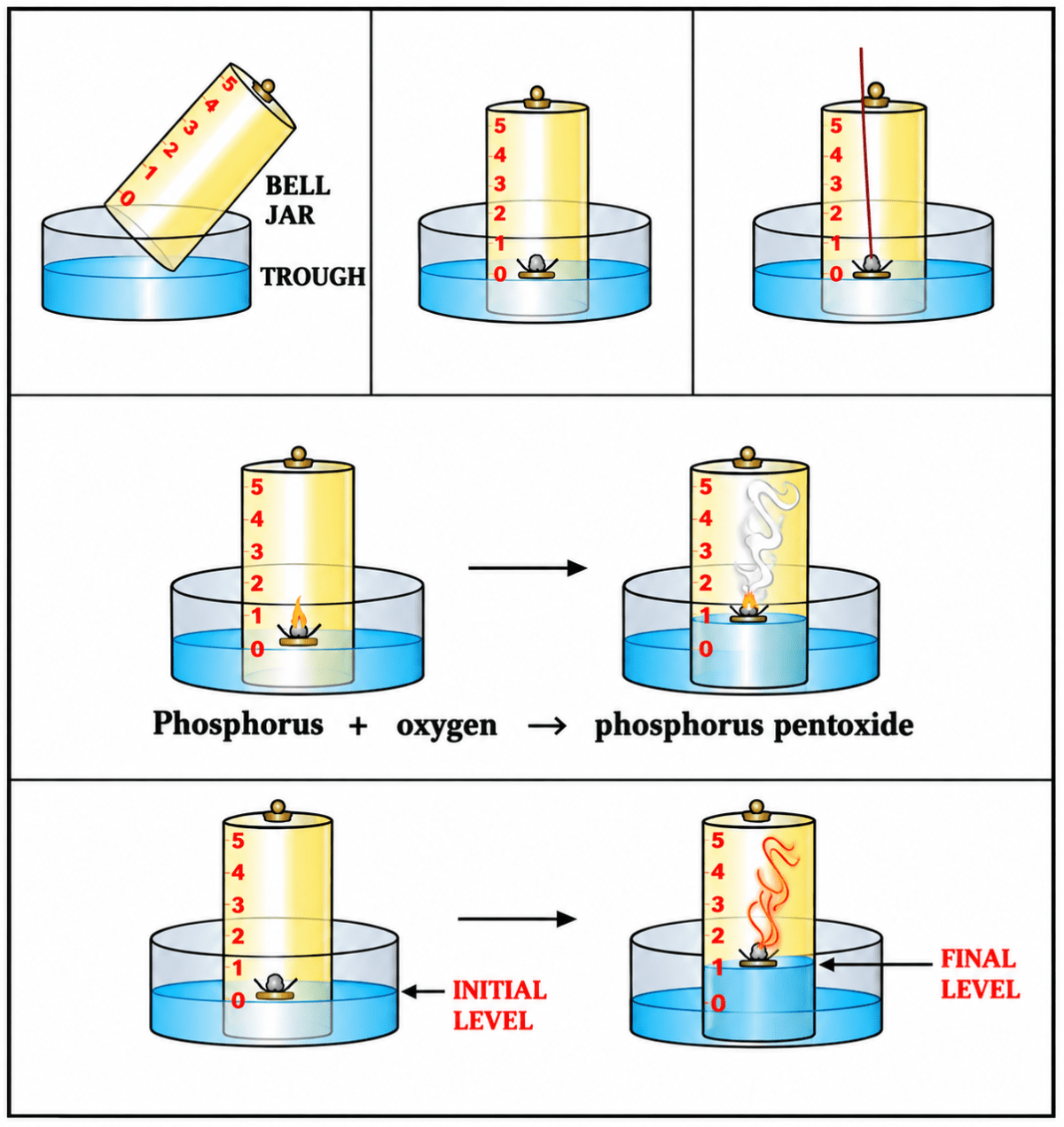
Experiment: A trough is taken and filled with water. Over it is placed a bell-jar marked with five equal parts. A crucible containing white phosphorus is placed on a cork which is made to float on the water. The phosphorus is then ignited with a heated iron rod.
Observation: Dense white fumes of phosphorus pentoxide (P2O5) are formed when the phosphorus burns in the active component of air (oxygen).
Phosphorus + Oxygen → Phosphorus pentoxide
The rise in the level of water in the bell-jar is by 1/5th.
Conclusion:
| Component | Approx. volume | Property |
|---|---|---|
| Oxygen (active component) | 1/5 | Supports combustion; used up in burning |
| Nitrogen (inactive component) | 4/5 | Does not support combustion; remains behind in the bell-jar |
This proves that about 1/5th of air is the active component, oxygen, and about 4/5th is the inactive component, nitrogen.
You are given a test tube with two outlets and a bottle of lime water. Using the same, how would you demonstrate experimentally the presence of carbon dioxide in air.
Answer
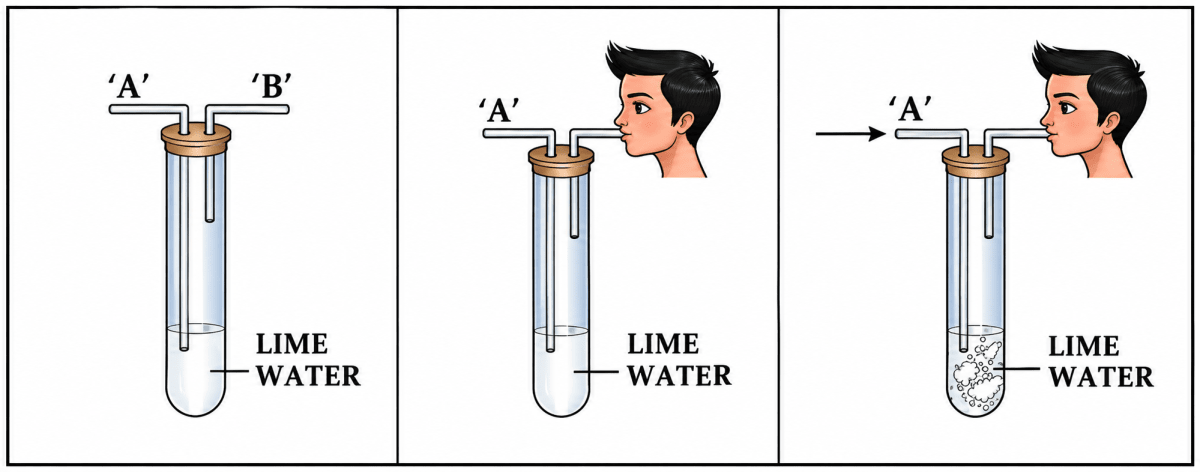
Experiment: Lime water is taken in a test tube fitted with two outlets 'A' and 'B'. Air is sucked slowly through the outlet 'B' (by mouth). As a result, fresh air moves in through end 'A' and passes through the lime water.
Observation: The lime water in the test tube turns milky.
Conclusion: The air which is sucked in from end 'A' contains carbon dioxide, which turns the lime water milky (turning of lime water milky is a test for carbon dioxide gas). Hence, air contains carbon dioxide.
Give a reason why water droplets appear on the outer surface of a tumbler containing ice.
Answer
The air contains water vapour. When a tumbler contains ice, the outer surface of the tumbler becomes very cold. The water vapour present in the surrounding air condenses on this cooler surface of the tumbler and appears as water droplets. This shows that air contains water vapour.
Explain the importance of nitrogen of the air for plant growth.
Answer
Nitrogen is utilised by plants for their growth and development. The free nitrogen of the air cannot be used directly by plants; it is first converted into nitrogen compounds (soluble nitrates), which are absorbed by the plants and converted into plant proteins. This conversion takes place in two ways:
During lightning discharge — Nitrogen and oxygen of the air combine to form nitric oxide, which is further changed to nitrogen dioxide and then to nitric acid. The nitric acid comes down with the rain, combines with the carbonates in the soil and forms soluble nitrates. These soluble nitrates are absorbed by the plants and converted into plant proteins.
By symbiotic bacteria — The nodules of leguminous plants (e.g. peas) contain symbiotic bacteria which directly absorb nitrogen from the air and convert it into soluble nitrates in the soil. These nitrates are absorbed by the plants and converted into plant proteins.
Give a reason why nitrogen is filled in food packets & not oxygen.
Answer
Nitrogen is inert (unreactive), so it is filled into food packets to drive out oxygen and reduce bacterial growth. This keeps the food well preserved for a longer time. Oxygen is not used because it is reactive and promotes oxidation, which can cause food to spoil more quickly.
State what would happen, if the air above the earth contained mainly oxygen & no nitrogen.
Answer
If the air above the earth contained mainly oxygen and no nitrogen, then:
- Combustion (burning) would become very rapid and uncontrolled, since nitrogen normally dilutes the activity of oxygen and controls combustion. Objects would catch fire very easily and burn violently.
- Plants would not get nitrogen, which is essential for their growth and for the formation of plant proteins.
- Food could not be preserved, as nitrogen is used to drive out oxygen from food packets.
State the utility of oxygen for respiration in -
(a) living organisms
(b) plants
Answer
(a) In living organisms — Respiration is a process whereby living organisms use oxygen from the air to oxidize food substances (mainly glucose) in their body cells, releasing energy in the form of heat. Carbon dioxide and water vapour are also produced and released in the exhaled air.
Glucose + Oxygen → Carbon dioxide + Water vapour + Energy (heat)
(b) In plants — Plants respire through tiny pores on the surface of their leaves called 'stomata'. The stomata help in taking in oxygen of the air and giving out carbon dioxide. Plants do not perform bodily activities and hence need less energy than animals.
Compare respiration and combustion both involving oxygen of the air.
Answer
| Respiration | Combustion |
|---|---|
| It is the oxidation of food substances (glucose) in the body cells of living organisms using oxygen. | It is the oxidation of substances (fuels) with oxygen or air. |
| Energy is released in the form of heat only. | Energy is released in the form of heat and light. |
| It is a slow process that takes place at body temperature. | It is a fast process and requires the substance to reach its ignition temperature. |
| It takes place inside living organisms. | It takes place outside living organisms. |
| Products formed are carbon dioxide and water vapour. | Products formed are carbon dioxide and water vapour. |
Explain the importance of carbon dioxide for -
(a) photosynthesis
(b) warming the earth's environment.
State what would happen if excess carbon dioxide as a pollutant is released into the atmosphere.
Answer
(a) For photosynthesis — Photosynthesis is the process by which green plants prepare their own food in the presence of sunlight and chlorophyll. During the daytime, the carbon dioxide and water are changed into carbohydrates, and oxygen is released out.
Carbon dioxide + Water Carbohydrates (glucose) + Oxygen
Hence, the oxygen in the air is renewed by photosynthesis and the amount of oxygen in the air does not get depleted.
(b) For warming the earth's environment — Infrared, visible and ultraviolet rays present in the sun's rays fall on the earth and slowly heat up its surface. The reflected infrared rays from the earth's surface are prevented by the carbon dioxide in the atmosphere from being radiated out. This results in the earth's environment staying warm.
If excess carbon dioxide is released as a pollutant: Pollution from automobile exhausts, chemical industries and burning of fuels releases excess carbon dioxide, which forms a thick blanketing layer above the earth. This thick CO2 layer prevents the heat radiations from being radiated out, resulting in a rise in the global temperature (greenhouse effect).
State in brief how water vapour in the atmosphere determines the climatic conditions.
Answer
Water vapour in the atmosphere:
- Minimizes the rate of evaporation of water from the surfaces of plants, animals and water bodies.
- Produces rain, mist, etc., thereby determining the climatic conditions of a place. The rain so produced serves as a natural source of water.
Thus, the amount of water vapour present in the atmosphere influences the formation of clouds, rain and mist, and so determines the climatic conditions.
Give a reason why two different rare [inert] gases find application in advertisement signs and fluorescent bulbs.
Answer
Different rare gases emit light of different colours when an electric current is passed through them in discharge tubes at low pressure. Neon emits a brilliant red glow and is therefore used in neon sign advertisements, while xenon emits an intense white light and is therefore used in fluorescent bulbs. Hence, two different rare gases are used because each produces a different and characteristic glow suited to its particular application.
A mixture has a variable composition. Give three other reasons why air is considered a mixture and not a compound.
Answer
Besides having a variable composition, air is considered a mixture and not a compound for the following reasons:
- Air has no definite properties; its properties are merely the average properties of its constituents.
- The components of air can be separated by physical methods (e.g. liquid air can be separated into liquid nitrogen and liquid oxygen by fractional distillation).
- No chemical formula is possible for air, since its constituents are not present in a fixed proportion.
State a reason why there is a balance in the amount of carbon dioxide in the air, even though carbon dioxide is released into the atmosphere by various processes.
Answer
Carbon dioxide is released into the air by respiration, burning of fuels and decay of animal and vegetable matter. However, it is continuously removed from the air by photosynthesis carried out by green plants, and also by its absorption (dissolution) in oceans, lakes and rivers. Since the amount of carbon dioxide released is balanced by the amount removed, there is a balance in the amount of carbon dioxide in the air.
Name three different appliances where air is utilized.
Answer
Three different appliances where air is utilized are:
- Tyres of vehicles — which are inflated with air.
- Kerosene stove — which works on air pressure that pushes the kerosene through a jet hole for burning.
- Brake mechanisms of trains and other machines — which work on compressed air.
Match the statements in List I with the correct answers in List II.
| List I | List II |
|---|---|
| 1. An impurity in air | A. Water vapour |
| 2. The component of air which supports combustion | B. Respiration |
| 3. The inert component in air, slightly soluble in water | C. Rare gases |
| 4. The component of air which minimizes the rate of evaporation | D. Sulphur dioxide |
| 5. The process which involves oxidation of food substance in living organisms | E. Helium |
| 6. The component of air which finds application in observation balloons | F. Carbon dioxide |
| 7. The process which involves oxidation of substances, liberating heat and light energy | G. Combustion |
| 8. The component of air which is heavier than air and fairly soluble in water | H. Nitrogen |
| 9. The process by which atmospheric carbon dioxide is absorbed by plants resulting in formation of carbohydrates | I. Photosynthesis |
| 10. The component of air, which is lighter than air and less than 1% in air | J. Oxygen |
Answer
| List I | List II |
|---|---|
| 1. An impurity in air | D. Sulphur dioxide |
| 2. The component of air which supports combustion | J. Oxygen |
| 3. The inert component in air, slightly soluble in water | H. Nitrogen |
| 4. The component of air which minimizes the rate of evaporation | A. Water vapour |
| 5. The process which involves oxidation of food substance in living organisms | B. Respiration |
| 6. The component of air which finds application in observation balloons | E. Helium |
| 7. The process which involves oxidation of substances, liberating heat and light energy | G. Combustion |
| 8. The component of air which is heavier than air and fairly soluble in water | F. Carbon dioxide |
| 9. The process by which atmospheric carbon dioxide is absorbed by plants resulting in formation of carbohydrates | I. Photosynthesis |
| 10. The component of air, which is lighter than air and less than 1% in air | C. Rare gases |
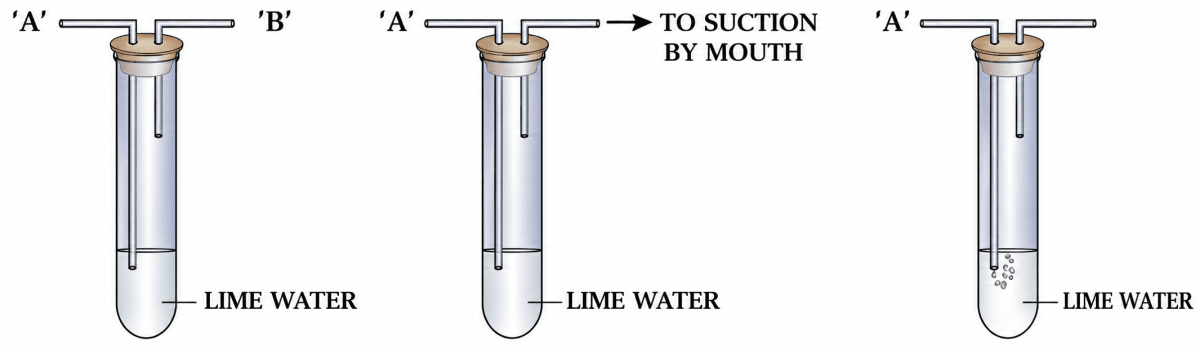
The diagrams below represents an experiment to show the presence of a - component of air.
(i) State why air is sucked from outlet 'B' and not from outlet 'A'.
(ii) State why the air is sucked 'slowly' from the outlet 'B'.
(iii) State the observation seen after completion of the experiment.
(iv) State the reason for the above observation seen.
(v) Name another component which if present in air as a pollutant - would have given a similar observation.
Answer
(i) Air is sucked from outlet 'B' and not from outlet 'A' because outlet 'A' reaches down into the lime water. When air is sucked out from 'B', fresh atmospheric air is drawn in through end 'A' and bubbles through the lime water, allowing the carbon dioxide of the air to react with it. (If air were sucked from 'A', the air would not pass through the lime water.)
(ii) The air is sucked slowly so that the incoming air stays in contact with the lime water for a longer time, allowing the carbon dioxide present in the air to react completely with the lime water and turn it milky.
(iii) Observation: The lime water turns milky.
(iv) Reason: The air drawn in contains carbon dioxide, which reacts with the lime water (calcium hydroxide) to form insoluble calcium carbonate, turning the lime water milky.
(v) Sulphur dioxide — if present in air as a pollutant, it would also turn the lime water milky, giving a similar observation.
Complete the statements given below by filling in the blanks with the correct word/s from the word/s in bracket.
(i) The ............... [atmosphere/troposphere/stratosphere] is a layer which extends upto about 10-50 kms. above the earth.
(ii) ............... [helium/hydrogen sulphide] is an example of a pollutant present in air.
(iii) The component of air used in photosynthesis is ............... and the product of photosynthesis is ............... [oxygen/carbon dioxide/nitrogen].
(iv) The product formed which is common to both combustion and respiration is ............... [oxygen/carbon dioxide/nitrogen dioxide].
(v) The component of air which is variable in air above sea level & in air in general ............... [oxygen, nitrogen, water vapour].
Answer
(i) The stratosphere is a layer which extends from about 10 to 50 km above the earth.
(ii) Hydrogen sulphide is an example of a pollutant present in air.
(iii) The component of air used in photosynthesis is carbon dioxide and the product of photosynthesis is oxygen.
(iv) The product formed which is common to both combustion and respiration is carbon dioxide.
(v) The component of air which is variable in air above sea level & in air in general is water vapour.
Name the following.
(i) The product formed when phosphorus burns in oxygen.
(ii) The layer of atmosphere which contains the ozone layer.
(iii) The active component of air which supports combustion and is used up in burning.
(iv) The main, rare [inert] gas present in air.
(v) The component of air which is present more in industrial areas.
(vi) The type of bacteria which directly absorb nitrogen from the air and convert it into soluble nitrates in the soil.
(vii) The product of respiration released in exhaled air, other than carbon dioxide.
(viii) An inert gas which has a low boiling point and is used for producing very low temperatures.
(ix) A process which removes carbon dioxide from the air.
(x) The component of air which does not support combustion.
Answer
(i) Phosphorus pentoxide (P2O5)
(ii) Stratosphere
(iii) Oxygen
(iv) Argon
(v) Impurities (such as sulphur dioxide)
(vi) Symbiotic bacteria
(vii) Water vapour
(viii) Helium
(ix) Photosynthesis
(x) Nitrogen
State whether the following statements are 'true' or 'false'. If false write the correct statement.
(i) The mesosphere in the atmosphere, contains most of the air, fit for respiration.
(ii) The percentage of carbon dioxide in the air is - between 0.2 to 0.4%.
(iii) Carbon dioxide, water vapour and energy in the form of heat are evolved during respiration.
(iv) Photosynthesis is a process by which green plants prepare their own food in the presence of sunlight & chlorophyll.
(v) Air is a mixture and not a compound since the components of air - cannot be separated by physical methods.
Answer
(i) False
Correct Statement — The troposphere in the atmosphere contains most of the air, fit for respiration.
(ii) False
Correct Statement — The percentage of carbon dioxide in the air is between 0.02% and 0.04%.
(iii) True
(iv) True
(v) False
Correct Statement — Air is a mixture and not a compound since the components of air can be separated by physical methods.
Give word equations for the following conversions.
(i) Nitrogen of the air to nitric oxide.
(ii) Nitric oxide to nitrogen dioxide.
(iii) Nitrogen dioxide to nitric acid.
(iv) Nitric acid to soluble nitrates in the soil.
(v) Carbon dioxide in air to carbohydrates in plants.
Answer
(i) Nitrogen + Oxygen Nitric oxide
(ii) Nitric oxide + Oxygen → Nitrogen dioxide
(iii) Nitrogen dioxide + Oxygen + Water → Nitric acid
(iv) Nitric acid + Calcium carbonate → Calcium nitrate + Carbon dioxide + Water
(v) Carbon dioxide + Water Carbohydrates (glucose) + Oxygen