
Which of the following minerals is used to manufacture aircraft and automobile bodies?
- iron ore
- bauxite
- copper
- uranium
Answer
bauxite
Which of the following are poor conductors of heat and electricity?
- metallic minerals
- non-ferrous minerals
- non-metallic minerals
- none of the above
Answer
non-metallic minerals
Choose from the following the incorrect statement regarding mineral conservation:
- The meaning of 3Rs is to reduce, recycle and reuse minerals.
- There is more use of alternative sources of energy.
- There is maximum use of petroleum as it is the main source of energy.
- There is dependence on hydroelectricity.
Answer
There is maximum use of petroleum as it is the main source of energy.
Which of the following minerals is mined by sifting through the sand and mud in the river beds?
- coal
- gold
- copper
- petroleum
Answer
gold
Burning of coal and petroleum leads to which one of the following harmful events for the entire world?
- results in global warming
- produces smoke
- produces energy
- runs industries
Answer
results in global warming
Choose the correct combination.
| Minerals | Important feature |
|---|---|
| A. mica | 1. used to produce nuclear energy |
| B. natural gas | 2. burns with less smoke |
| C. limestone | 3. used for making cement |
| D. copper | 4. used for making steel and machines |
- only A1 and B2 are correct.
- only B2 and C3 are correct.
- only A1 and D4 are correct.
- only B2 and D4 are correct.
Answer
only B2 and C3 are correct.
Silver and gold are malleable and ............... .
- heavy metals
- conductors of electricity
- found in sedimentary rocks
- ductile
Answer
ductile
Choose from the following the right combination of ferrous minerals.
- copper and iron ore
- bauxite and iron ore
- manganese and iron ore
- coal and copper
Answer
manganese and iron ore
Two statements are given in the question below as Assertion (A) and Reason (R). Read the statement and choose the appropriate option:
Assertion (A): Minerals such as coal and natural gas are called energy minerals.
Reason (R): They provide heat and electric energy.
- Both (A) and (R) are true and (R) is the correct explanation of (A).
- Both (A) and (R) are true and (R) is not the correct explanation of (A).
- (A) is true but (R) is false.
- (A) is false and (R) is true.
Answer
Both (A) and (R) are true and (R) is the correct explanation of (A).
Explanation — Coal and natural gas are called energy minerals because they are used to generate heat and electricity.
Two statements are given in the question below as Assertion (A) and Reason (R). Read the statement and choose the appropriate option:
Assertion (A): Minerals should be used judiciously.
Reason (R): Minerals are important for our daily needs.
- Both (A) and (R) are true and (R) is the correct explanation of (A).
- Both (A) and (R) are true and (R) is not the correct explanation of (A).
- (A) is true but (R) is false.
- (A) is false and (R) is true.
Answer
Both (A) and (R) are true and (R) is not the correct explanation of (A).
Explanation — Minerals are exhaustible or non-renewable natural resources that take millions of years to form. Hence, by using them judiciously, we can meet our present needs and at the same time keep enough resources for the growth and development of our future generations.
Name the following:
This mineral is called black gold.
Answer
Coal
Name the following:
This mineral is used to produce nuclear energy.
Answer
Uranium
Name the following:
It is the main ore of aluminium.
Answer
Bauxite
Name the following:
This gas causes global warming.
Answer
Greenhouse gases (especially Carbon dioxide)
Name the following:
It is found in association with petroleum in the sedimentary beds.
Answer
Natural Gas
What are rocks?
Answer
Rocks are those solid materials that make up the outer layer or crust of the Earth.
How are rocks different from minerals?
Answer
Difference between Rocks and Minerals —
| Rocks | Minerals |
|---|---|
| A rock is made of minerals; either entirely of one mineral as in limestone, or more commonly of two or more minerals as in granite. | Minerals are naturally occurring useful substances with definite physical properties and chemical compositions. |
What are ores? Give two examples.
Answer
Ores are those rocks that contain metallic minerals only. Manganese ore and iron ore are so called as we derive metals from them.
What are metallic and non-metallic minerals?
Answer
Metallic minerals — These minerals contain metals and thus have a shine of their own. For example, manganese, copper and gold.
Non-metallic minerals — These minerals do not contain metals and have a dull appearance. For example, mica, chalk and limestone.
Differentiate between ferrous and non-ferrous minerals.
Answer
Difference between ferrous and non-ferrous minerals —
| Ferrous Minerals | Non-ferrous Minerals |
|---|---|
| They contain iron and are thus heavier in weight. They are reddish in colour. | These minerals do not have iron content. They do not have magnetic properties. |
| For example, iron ore and manganese. | For example, copper and bauxite. |
What are fossil fuels? Why are they also known as energy minerals?
Answer
Fossil fuels are formed from the dead and decomposed remains of plants and animals. Coal, petroleum and natural gas are the examples of 'fossil fuels'. These are energy minerals because energy can be generated from these.
Name the major producers of copper in the world. What are its uses?
Answer
The major producers of copper in the world are — China, Mexico, Chile, Peru, Congo and Zambia.
Uses of Copper —
- It is a good conductor of heat and electricity.
- It is used in electrical wires, and alloys like bronze and brass.
Mention any two uses of coal.
Answer
Two uses of Coal are as follows:
- Coal is used to generate thermal power.
- A large amount of coal is required in the cement, chemical and steel industries.
Explain, with examples, the two important methods of mining.
Answer
Mining means extraction of useful minerals. Two important methods of mining are given below:
- Opencast mining — This is a type of surface mining that is carried out when minerals occur close to the surface. The top layer of the rock and soil is stripped, and the mineral deposit is mined by strip-mining or the open pit method. Manganese, copper and bauxite are mined mostly by this method.
- Shaft mining — This is a type of underground mining carried out on a large scale, usually for minerals such as coal, which lie at great depths below the ground. Coal mines are dug deep into the earth and a long vertical tunnel or shaft is dug to bring out the minerals to the surface. Miners go deeper into the underground in pulleys to extract the mineral and bring it to the surface.
Mention any three hazards of mining.
Answer
Three hazards of mining are as follows:
- Mine dust creates air pollution and its inhalation leads to respiratory diseases.
- Mine tailings, the mud-like waste material released from mines, may cause water pollution as they are toxic in nature.
- Heavy metal pollution by harmful minerals such as arsenic, lead and mercury can cause severe health hazards to human beings and marine creatures.
State any three methods of conservation of minerals.
Answer
Three methods of conservation of minerals are as follows:
- The principle of three Rs—Recycle, Reuse and Reduce—should be followed. It means reducing wastage of resources by recycling and reusing them.
- Use renewable substitutes, wherever possible. For example, using hydroelectricity or solar power to reduce consumption of fossil fuels.
- We need to use minerals judiciously so that we can meet our present needs and at the same time keep enough resources for the growth and development of our future generations.
Read the passage given below and answer the questions that follow:
Coal is formed from the decomposed remains of plants that remained buried under high heat and pressure over millions of years under beds of sedimentary rocks. This inflammable organic substance is rich in carbon. It produces huge quantities of heat when burnt. Coal has been therefore the source of power in steam engines for long. Since the Industrial Revolution in the 18th century, coal is also used in the generation of electric power. In the early 20th century, as the steel industries were run on coal fired furnaces, they were, therefore, primarily located near coal mines. The thermal power stations used coal to generate electricity, which was supplied to domestic and industrial sectors. Thus, coal, also called the black gold, came to be the backbone of industrial growth.
- How is coal formed?
- Which property of coal is very useful in running steam engines?
- Why were steel industries located near coal mines?
- What is coal also known as? Why do you think it was so called?
Answer
Coal is formed from the decomposed remains of plants that remained buried under high heat and pressure over millions of years under beds of sedimentary rocks.
Coal is an inflammable organic substance which is rich in carbon. It produces huge quantities of heat when burnt. Coal has been therefore the source of power in steam engines for long.
In the early 20th century, as the steel industries were run on coal fired furnaces, they were, therefore, primarily located near coal mines.
Coal is also known as black gold as it became the backbone of industrial growth. Its importance in powering steam engines, producing a lot of heat energy when burnt, generating electricity, and supporting industries like steel gave it great economic value, just like gold.
Can we live without coal and petroleum? How would it be possible, in the future, to run industries or put fuel in our cars?
Answer
Living without coal and petroleum is challenging today but possible in the future with the development and adoption of sustainable alternatives, such as:
Renewable Energy Sources — Solar, wind, hydroelectric, and geothermal energy can replace coal and petroleum for electricity generation and heating.
Electric Vehicles (EVs) — Cars and other vehicles can run on electricity stored in batteries charged from renewable sources, reducing the need for petrol or diesel.
Hydrogen Fuel — Hydrogen is a clean fuel that can power vehicles and industries without emitting pollutants.
Biofuels — Derived from plants and organic waste, biofuels can serve as alternatives to petrol and diesel.
Energy-efficient Technology — Industries can shift to greener technologies that consume less power and depend on cleaner energy sources.
Coal and petroleum are not essential forever—with planning, innovation, and investment in green technology, we can build a future that doesn't depend on them.
Observe and describe the ways rocks are used in your neighbourhood. Do you think there could be misuse of rocks, rock powder, gravel stones and sand?
Answer
In our neighbourhood, rocks are used in many ways. Granite and marble are used for making kitchen slabs, floors, and tiles. Sandstone and limestone are used in the construction of buildings and walls. Gravel stones and sand are mixed with cement to make concrete for roads and houses. Sometimes, rock powder is used in making cement or as fertiliser in farms.
Yes, there can be misuse of rocks and minerals. If people dig out too much sand or gravel from rivers and hills, it can lead to soil erosion, damage the land, and harm nature. Rocks and minerals take millions of years to form, so we must use them carefully and only when needed.
Look at the pictures given here and name the mineral resources used in these objects:

Answer
Picture (i) — Gold
Picture (ii) — Limestone
Picture (iii) — Iron ore
Picture (iv) — Petroleum
Look at this picture and answer the questions that follow.
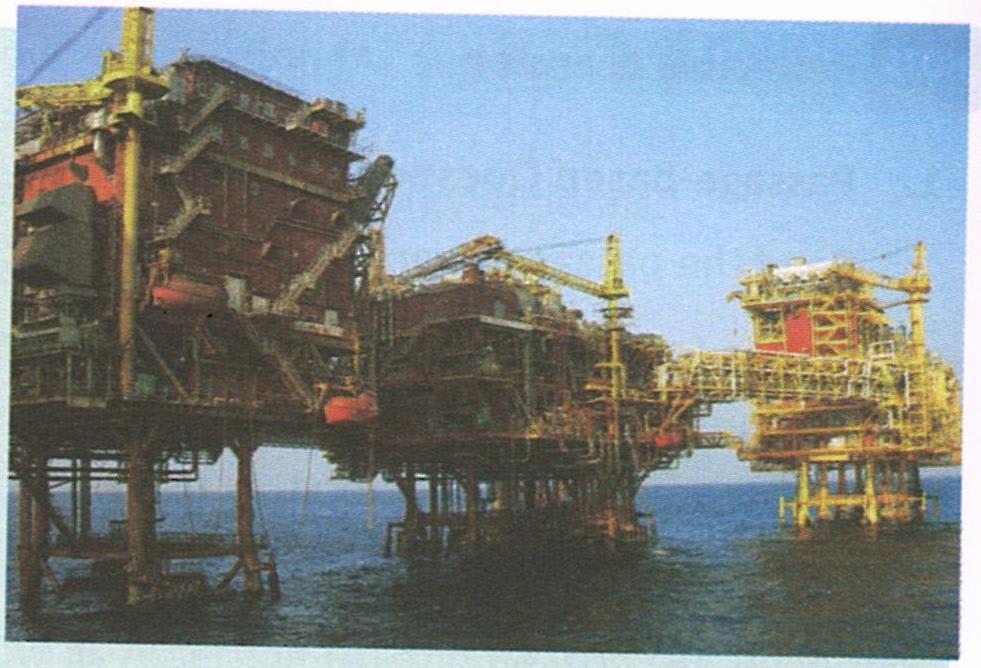
- Which mineral is mined by the method shown in the picture? Name the method.
- Write two uses of this mineral.
- Where can this mineral be found in India?
Answer
In the given picture, Petroleum is being mined by Offshore Drilling (extraction of oil from beneath the ocean floor) method.
Two uses of Petroleum are:
- Petroleum is an indispensable source of transportation fuel for locomotives, automobiles, aircraft as well as ships.
- It is used in the manufacture of petrochemical products such as plastics, polyester fabric and paraffin wax.
In India, highest production of Petroleum comes from the Mumbai High offshore oilfield located in the Arabian Sea.