Which of the following was not the result of Alexander's invasion?
- New trade routes between Europe and India were opened.
- Nanda dynasty established their rule over Magadha.
- It helped in the chronological reconstruction of ancient Indian history.
Answer
Nanda dynasty established their rule over Magadha.
The structure of government followed by the people of Vrijji can most appropriately be termed as ............... .
- monarchical.
- democratic.
- republican.
Answer
republican.
The last Nanda King was overthrown in the year ............... BCE.
- 320
- 321
- 323
Answer
321
Two statements are given in the question below as Assertion (A) and Reasoning (R). Read the statements and choose the correct option.
Assertion (A): The Gupta Dynasty is considered to be the 'Golden Age' of Indian history.
Reasoning (R): The Gupta Kings made and distributed coins made of gold.
- Both (A) and (R) are true and (R) is the correct explanation for (A).
- Both (A) and (R) are true but (R) is not the correct explanation for (A).
- Only (A) is true and (R) is false.
Answer
Both (A) and (R) are true but (R) is not the correct explanation for (A).
Explanation — The Gupta period was a 'Golden Age' due to advancements in science, literature, art, and administration not just because of gold coins.
Whom did the Guptas not defend their territories against?
- Hunas
- Sakas
- Mughals
Answer
Hunas
............... is known as the 'Napoleon of India'.
- Samudragupta
- Chandragupta II
- Skandagupta
Answer
Samudragupta
Which of the following departments is not looked after by the State government?
- Defence
- Transport
- Law and order
Answer
Defence
The ............... elects members of the Gram Panchayat.
- Governor
- Gram Sabha
- Panchayat samiti
Answer
Gram Sabha
Members of the Municipal Corporation are elected for a period of ............... years.
- 3
- 5
- 7
Answer
5
The governance of big cities in India is divided into:
- colonies.
- blocks.
- wards.
Answer
wards.
The Nanda dynasty established their rule over the kingdom of Magadha during the fourth century BCE. Mahapadma Nanda seized the throne of Magadha. He was the founder of the Nanda dynasty. At the time of Alexander's invasion, Magadha was ruled by Dhana Nanda. Greek sources state that he had a vast army consisting of infantry, cavalry, chariots and war elephants.
- Who was the founder of the Nanda dynasty?
- Who was the ruler of Magadha during the time of Alexander's invasion?
- What do the Greek sources say about Dhana Nanda?
Answer
Mahapadma Nanda was the founder of the Nanda dynasty.
At the time of Alexander's invasion, Magadha was ruled by Dhana Nanda.
Greek sources state that Dhana Nanda had a vast army consisting of infantry, cavalry, chariots and war elephants.
When he had been consecrated eight years the Beloved of the Gods, the king Piyadassi, conquered Kalinga. A hundred and fifty thousand people were deported, a hundred thousand were killed and many times that number perished. Afterwards, now that Kalinga was annexed, the Beloved of the Gods very earnestly practiced Dhamma, desired Dhamma and taught Dhamma. On conquering Kalinga the Beloved of the Gods felt remorse, for when an independent country is conquered the slaughter, death and deportation of the people is extremely grievous to the Beloved of the Gods and weighs heavily on his mind.
- Who is called the Beloved of Gods?
- What did the Beloved of Gods witness in the Kalinga War?
- What did he do after the Kalinga war?
Answer
Emperor Ashoka is called the Beloved of Gods.
'A hundred and fifty thousand people were deported, a hundred thousand were killed and many times that number perished.'
Emperor Ashoka witnessed the slaughter, death and deportation of the people caused by the Kalinga War.After the Kalinga War, Emperor Ashoka decided to give up violence, and spread the message of peace. He very earnestly practiced Dhamma, desired Dhamma and taught Dhamma, which was mainly based on the policy of non-violence.
With reference to Chandragupta I, answer the following questions:
- Who was the father of Chandragupta I?
- Whom did Chandragupta I marry?
- Which title did he assume?
Answer
The father of Chandragupta I was Ghatotkacha.
Chandragupta I married Kumaradevi, a princess of the Lichchhavi tribe.
Chandragupta I assumed the title of Maharajadhiraja.
With reference to the 73rd and 74th amendments of the Constitution of India, answer the following questions:
- How many subjects can be transferred to the Panchayati Raj Institutions?
- Which subjects are to be transferred to Panchayati Raj Institutions? Name any five.
- How many new tasks are to be catered to by urban local bodies?
- Name any five tasks that are to be catered to by urban local bodies
Answer
The Eleventh Schedule of the Constitution of India mentioned twenty-nine subjects in the State list. According to the 73rd Amendment, 29 subjects are to be transferred to the Panchayati Raj Institutions. However, the individual States can decide how many of these subjects will be transferred to the local bodies.
Twenty-nine subjects from the State list are to be transferred to the Panchayati Raj Institutions. Out of these, five subjects are listed as follows:
- Agriculture, including agricultural extension
- Minor irrigation, water management and watershed development
- Animal husbandry, dairying and poultry
- Fisheries
- Social forestry and farm forestry
Eighteen new tasks are to be catered to by the urban local bodies.
Five important tasks to be catered to by urban local bodies as listed in the 12th Schedule of the 74th Constitutional Amendment Act of India are:
- Regulation of land use and construction of building
- Planning for economic and social development
- Water supply for domestic, industrial and commercial purposes
- Public health, sanitation conservancy and solid waste management
- Urban forestry, protection of the environment and promotion of ecological aspects.
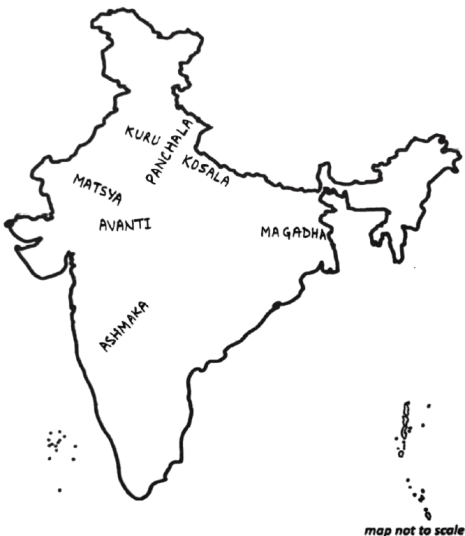
On the outline map of India given below, mark any seven of the mahajanapadas.
Answer
Seven mahajanapadas are marked on the outline map of India below: