
'Mesopotamia' in Greek means the land:
- across rivers.
- beyond rivers.
- between the rivers.
Answer
between the rivers.
The earliest Mesopotamian culture to develop in the area was:
- Babylonian.
- Sumerian.
- Assyrian.
Answer
Sumerian.
The Mesopotamian cities were divided into ............... parts.
- two
- three
- four
Answer
three
The main occupation of the Mesopotamians was:
- agriculture.
- trade.
- domestication of animals.
Answer
agriculture.
Before coinage was introduced, one of the basic mediums of exchange in Mesopotamia was grain. This was measured:
- by weight.
- by volume.
- by intensity of colour.
Answer
by volume.
'The Mesopotamians believed in many gods.' This statement is:
- false.
- true.
- partially false.
Answer
true.
Choose one option to match the items given in Column I with those in Column II.
| Column I: Empires | Column II: Cities |
|---|---|
| i. Sumer | a. Assur and Nineveh |
| ii. Babylonia | b. Kish, Uruk, Ur, Lagash |
| iii. Assyria | c. Babylon |
- i-b, ii-a, iii-c
- i-b, ii-c, iii-a
- i-a, ii-b, iii-c
Answer
i-b, ii-c, iii-a
You have to write an article about the society in ancient Mesopotamia. Which of the following primary sources will you use to write your article?
- the Epic of Gilgamesh
- the Standard of Ur
- Both 1 and 2
Answer
Both 1 and 2
Reason — The Epic of Gilgamesh shows Mesopotamian beliefs about gods, kings, and life. The Standard of Ur gives a picture of war, peace, social life, and culture. Together, they help us understand Mesopotamian society, its values, and way of life.
Which of the following options best describes the reason for the decline of Mesopotamian Civilisation? Give at least one reason for your answer.
- The soil became less fertile and people lost their means of livelihood and moved away.
- There was an invasion by the Hittites of Anatolia.
- Both 1 and 2
Answer
Both 1 and 2
Reason — The Mesopotamian Civilisation declined because of natural forces. The soil became less fertile, and people lost their means of livelihood and moved away. Some historians also mention invasions by the Hittites of Anatolia. In the end, sandstorms buried the civilisation under the desert.
Name the theory of kingship followed in ancient Mesopotamia.
Answer
The Mesopotamians believed in the Divine Right Theory of Kingship, i.e, kings and queens descended from the gods.
Describe the social structure of ancient Mesopotamia.
Answer
Mesopotamian society was broadly divided into three parts.
- The upper-end of the society consisted of the king and members of the royal family, the priests and high officials.
- The middle level consisted of the farmers, artisans and traders.
- At the lower-end were the slaves.
How did the Mesopotamians do their town planning?
Answer
The Mesopotamian cities were divided into three parts — the sacred area, the walled city on a mound and the outer town. In the center of a town, a sacred area called the ziggurat was built. At the top of a ziggurat was a temple, dedicated to the patron god of the city. Offices and storehouses were built in the sacred area. The walled city and the outer town were residential areas. Houses of different sizes were built. Some houses had a central courtyard with rooms around it.
Name the various occupations practised by the Mesopotamians.
Answer
Agriculture, fishing and domesticating animals were the occupations practised by the Mesopotamians.
Mention two architectural structures built by the Mesopotamians.
Answer
Two architectural structures built by the Mesopotamians are — Ziggurats and Hanging Gardens of Babylon.
There are unique specimens of art and architecture from the Mesopotamian Civilisation. In this context, answer the following questions:
- Write a note on the Standard of Ur.
- Describe a ziggurat in detail.
Answer
- One of the remarkable surviving pieces of Mesopotamian art is the Standard of Ur. This comprises an ornate box, the panels of which have a mosaic depicting life during the time of war and peace in Mesopotamia. This mosaic is made with pieces of shell, lapis lazuli and red limestone set into bitumen.
The 'War Side' panel of the box shows chariots charging over fallen enemies, prisoners escorted before the leader and so on. The 'Peace Side' panel shows a banquet being celebrated and people carrying the produce of the land such as fish and bags of what is probably grain. The celebration is marked by a musician playing the lyre. - The ziggurats or temple towers were massive pyramid-like structures made from sunbaked bricks. They looked like human-made mountains soaring high above the Earth. Each ziggurat had several stories and apart from the temple at the top, they were used as schools, observatories, granaries and centres for trade.
The Mesopotamians were probably the first to write on soft-clay tablets using a wedge-shaped stylus or pen made from reed, bone or metal. In this context, answer the following questions:
- What do you mean by the cuneiform script?
- What is the Code of Hammurabi?
Answer
- The Mesopotamians' script is known as the cuneiform script. The word 'cuneiform' literally means wedge-shaped, due to the triangular tip of the stylus used for impressing signs on wet clay.
- The Code of Hammurabi (developed during the reign of Hammurabi) is one of the earliest set of laws found. It is also one of the best preserved documents of ancient Mesopotamia. Through these codes, the king could look after the weak, the poor and the needy. The code is carved on a nearly eight-feet high stone column. It lists 282 case laws dealing with family, economy, civil and criminal cases. Moreover, it prescribes different punishments depending upon the severity of the offence.
Study the picture given here. Answer the questions that follow.
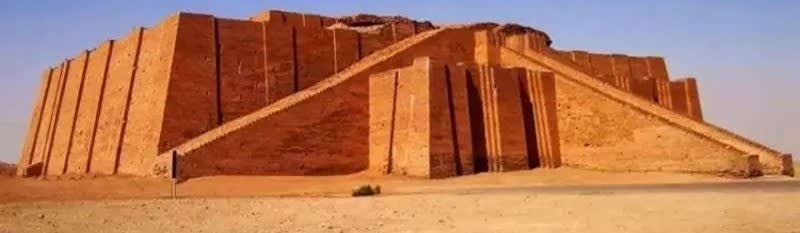
- Which land feature does a ziggurat look like?
- What were the ziggurats used for?
Answer
- A Ziggurat resembles a human-made mountain soaring high above the Earth.
- Each ziggurat had several stories and apart from the temple at the top, they were used as schools, observatories, granaries and centres for trade.