
These dynasties rose to prominence in the Bronze Age China:
- Shang and Zhou
- Shang and Qin
- Qin and Han
Answer
Shang and Zhou
Porcelain features in the production of:
- silk.
- bronze articles.
- pottery.
Answer
pottery.
Members of the royal family were buried with objects of value in their tombs in ancient China. The most appropriate reason for this was:
- It was the custom in those days.
- There was a belief that these objects were meant for use in the afterlife.
- The royal family gave orders for this ritual to be carried out.
Answer
There was a belief that these objects were meant for use in the afterlife.
The zheng, xiao and erhu were:
- ancient Chinese architectural forms.
- ancient Chinese musical instruments.
- alphabet of the ancient Chinese script.
Answer
ancient Chinese musical instruments.
Contributions of the ancient Chinese Civilisation:
- block printing, seismograph, paper
- Buddhism, cotton, silk
- tea, coffee, mariner's compass
Answer
block printing, seismograph, paper
1. Tick on 'Yes' or 'No' as per your understanding of why the Chinese Civilisation flourished.
| Is this a significant factor in the development of the ancient civilisation of China? | Yes | No |
|---|---|---|
| the two main rivers of China—the Huang He and the Yangtze | ||
| sericulture or silk production | ||
| trade along the Silk Route |
2. Give one reason justifying your answer for each point given in the table above.
Answer
The completed table is shown below:
| Is this a significant factor in the development of the ancient civilisation of China? | Yes | No |
|---|---|---|
| the two main rivers of China—the Huang He and the Yangtze | ✓ | |
| sericulture or silk production | ✓ | |
| trade along the Silk Route | ✓ |
One reason justifying each point:
- The Ancient Chinese Civilisation grew along the Huang He and Yangtze rivers. The civilisation was based on agriculture, hunting, and animal husbandry. These rivers provided fertile soil through flooding and supported trade and communication.
- The Chinese were the first to rear silkworms on mulberry trees, and the art of silk-making was a closely guarded secret. Silk was a major export and played a key role in China’s economy and cultural influence.
- The Silk Route enabled the exchange of silk, goods, ideas, and culture between China and civilisations like Egypt, Mesopotamia, Persia, Indian subcontinent, and Rome, boosting China’s economic and cultural growth.
Read the paragraph and answer the questions that follow.
The Chinese exported silk, tea, porcelain pottery and paper to Japan, India, Egypt, Mesopotamia and even parts of Europe. They used both land and sea routes. Trade along the Silk Route was a significant factor in the development of the great civilisations of China, Egypt, Mesopotamia, Persia, the Indian subcontinent and Rome.
- Which civilisations of the world did the Silk Route benefit?
- Why do you think this trade route was called the Silk Route?
Answer
- Trade along the Silk Route was a significant factor in the development of the great civilisations of China, Egypt, Mesopotamia, Persia, the Indian subcontinent and Rome.
- The trade route was called the Silk Route primarily because silk was the most valuable and prominent commodity of export by the Chinese during the ancient period.
Describe the social life in ancient China.
Answer
Important aspects of the social life in ancient China were:
- The king or emperor was both the secular and religious head of society.
- Society was hierarchical: Under the king or emperor were the nobles and merchants, craftspeople and farmers, then slaves in the descending order.
- The army was important, with warrior-nobles holding high status.
- Families were close-knit; elders and ancestors were deeply respected.
- Multiple families lived together in groups called clans.
What were the religious beliefs of the early Chinese?
Answer
The religious beliefs of the early Chinese were:
- Early Chinese people worshipped the high god Di (Shangdi), believed to control rain, wind, and thunder.
- They also worshipped ancestors and natural forces like the Yellow River and the Sun.
- The king or emperor was seen as Di’s descendant and served as the high priest.
- Oracle bones, inscribed with texts, were used for divination.
- Royal tombs show valuable objects buried with royals, likely for use in the afterlife.
Why did the Chinese rulers build The Great Wall?
Answer
The Great Wall of China was built for defense against northern invaders. Spanning over 20,000 km, it had watchtowers to store weapons, house troops, and send smoke signals, forming ancient China’s northern boundary.
What did the ancient Chinese use to make paper?
Answer
The ancient Chinese created paper from mulberry and other fibres, fishnets, old rags and hemp waste.
Mention any two scientific developments of the Chinese Civilisation.
Answer
Two scientific developments of the Chinese Civilisation are:
- The Chinese introduced block printing with carved wooden blocks. The blocks were dipped in ink and pressed on paper.
- The first known seismograph to record earthquakes was made in China.
The picture depicts a famous Chinese invention often used by sailors to navigate the seas.
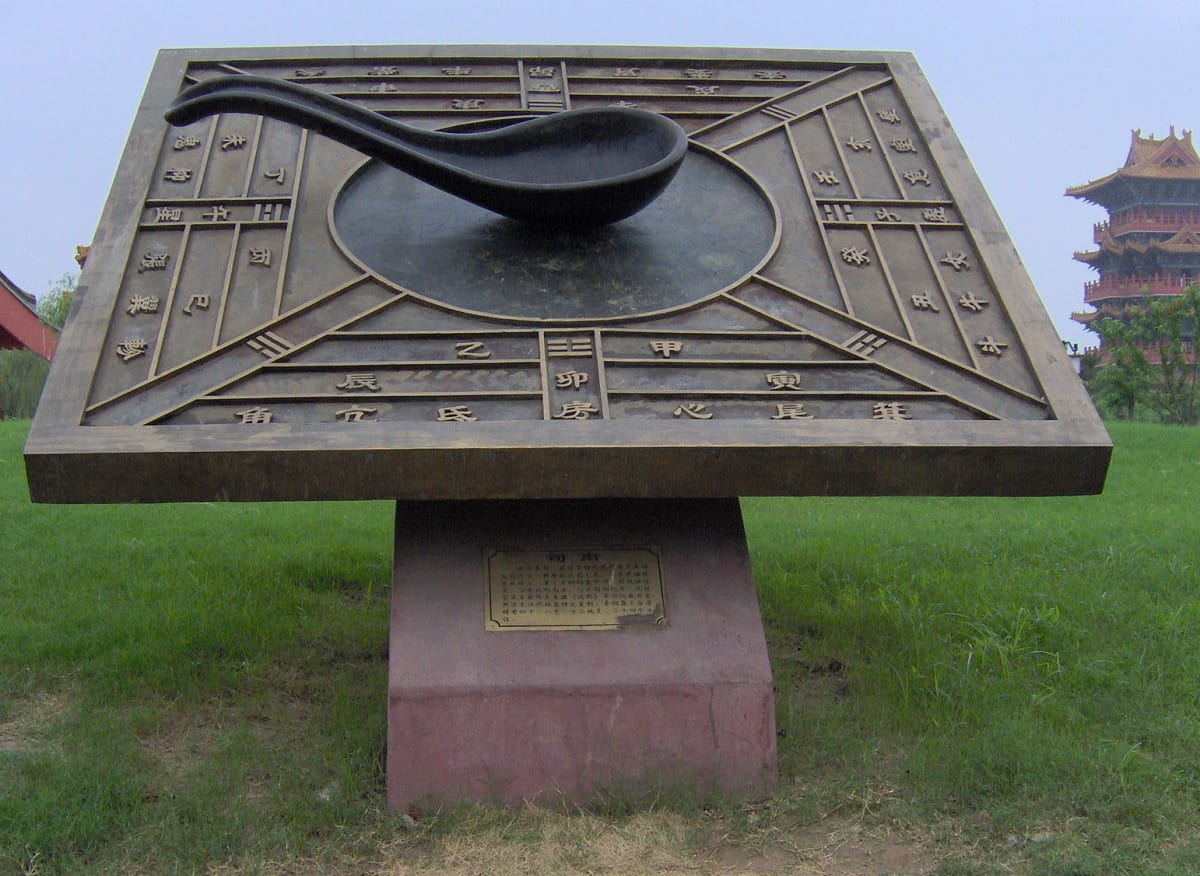
(a) Identify the invention.
(b) What was it used for?
(c) In what ways did this invention bring the people of the world closer?
Answer
(a) The picture depicts a mariner's compass.
(b) It was used for navigation. The spoon shaped lodestone would align with Earth's magnetic field, pointing south. Sailors used it to determine direction while traveling across land and seas.
(c) The invention of compass brought the people of the world closer in the following ways:
- Facilitated Exploration: Enabled safer and longer sea voyages, helping sailors reach distant lands.
- Boosted Trade: Helped establish and maintain trade routes like the Silk Road and maritime trade networks.
- Cultural Exchange: Allowed ideas, religions, inventions, and goods to move between regions, connecting various civilizations together.