
Assertion (A): The sum of two fractions is always a fraction.
Reason (R): For two fractions , we have
Both Assertion (A) and Reason (R) are true and Reason (R) is the correct explanation of Assertion (A).
Both Assertion (A) and Reason (R) are true but Reason (R) is not the correct explanation of Assertion (A).
Assertion (A) is true but Reason (R) is false.
Assertion (A) is false but Reason (R) is true.
Answer
According to assertion; the sum of two fractions is always a fraction.
Example - the two fractions are and
Now,
∴ Assertion (A) is false.
For two fractions , we have
LCM of b and d = bd
∴ Reason (R) is true.
Hence, option 4 is the correct option.
Assertion (A): Half of a number is obtained by dividing it by 2.
Reason (R): The fractions and are multiplicative inverse of each other.
Both Assertion (A) and Reason (R) are true and Reason (R) is the correct explanation of Assertion (A).
Both Assertion (A) and Reason (R) are true but Reason (R) is not the correct explanation of Assertion (A).
Assertion (A) is true but Reason (R) is false.
Assertion (A) is false but Reason (R) is true.
Answer
According to assertion, half of a number is obtained by dividing it by 2.
half of n is , which is exactly dividing by 2.
∴ Assertion (A) is true.
According to reason, the fractions and are multiplicative inverse of each other.
∴ Reason (R) is true.
∴ Both Assertion (A) and Reason (R) are true but Reason (R) is not the correct explanation of Assertion (A).
Hence, option 2 is the correct option.
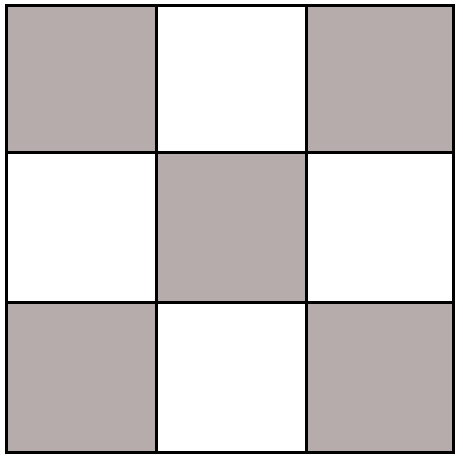
Assertion (A): The sum of the fractions represented by the shaded and unshaded portion is 1.
Reason (R): We can only add like fractions.
Both Assertion (A) and Reason (R) are true and Reason (R) is the correct explanation of Assertion (A).
Both Assertion (A) and Reason (R) are true but Reason (R) is not the correct explanation of Assertion (A).
Assertion (A) is true but Reason (R) is false.
Assertion (A) is false but Reason (R) is true.
Answer
According to assertion, the sum of the fractions represented by the shaded and unshaded portion is 1.
Fraction of shaded portion =
Fraction of unshaded portion =
Sum of fraction of shaded portion + unshaded portion = .
∴ Assertion (A) is true.
According to reason, we can only add like fractions.
We can add any fractions (like or unlike), but if they are unlike fractions we first convert them to like fractions (common denominator) and then add.
∴ Reason (R) is false.
Hence, option 3 is the correct option.