
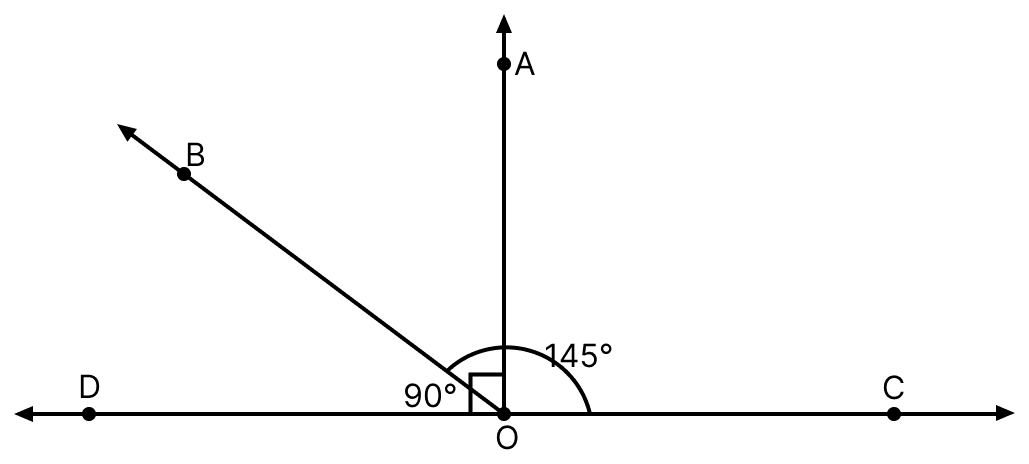
The measure of ∠BOD and ∠AOB in the following figure is:
65°, 25°
35°, 55°
50°, 45°
45°, 30°
Answer
From the figure, D, O and C lie on a straight line, so ∠DOC = 180°. Also ∠AOD = 90° and ∠BOC = 145°.
Since ∠BOD and ∠BOC lie on the straight line DOC,
⇒ ∠BOD + ∠BOC = 180°
⇒ ∠BOD = 180° − 145° = 35°
The ray OB lies between OD and OA, so
⇒ ∠AOB = ∠AOD − ∠BOD = 90° − 35° = 55°.
So, ∠BOD = 35° and ∠AOB = 55°.
Hence, option 2 is the correct option.
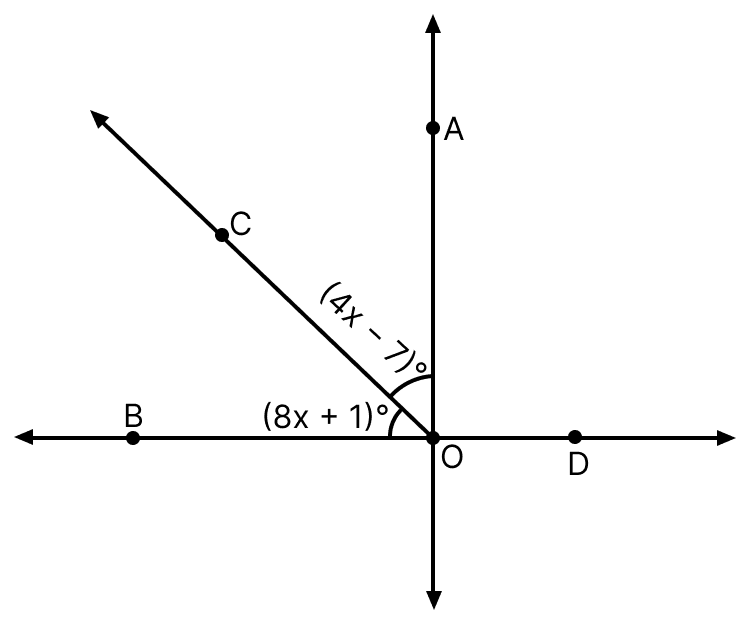
The value of x in the given figure, where ∠AOB = 90° is:
10
8
11
12
Answer
From the figure, the ray OC lies between OA and OB, so ∠AOB is divided into ∠AOC = (4x − 7)° and ∠BOC = (8x + 1)°.
Since ∠AOC + ∠BOC = ∠AOB = 90°,
⇒ (4x − 7)° + (8x + 1)° = 90°
⇒ 4x° - 7° + 8x° + 1° = 90°
⇒ 12x° − 6° = 90°
⇒ 12x° = 96°
⇒ x° = 8°
⇒ x = 8.
Hence, option 2 is the correct option.
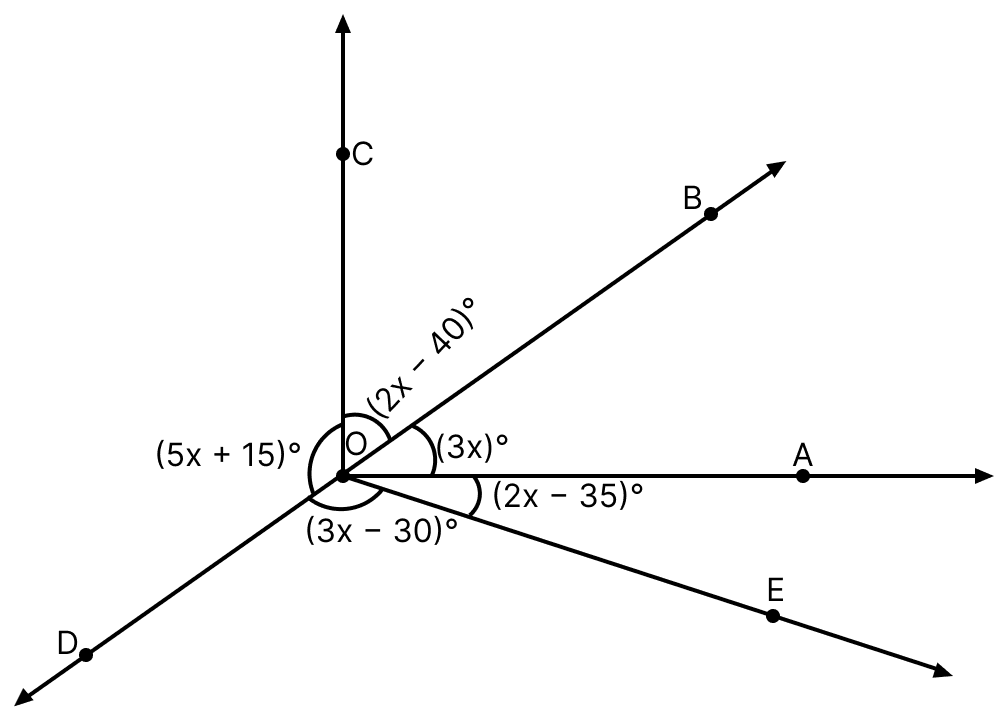
The value of x in the given figure is:
65°
20°
35°
30°
Answer
The rays drawn from point O divide the full angle around O into several angles. Since the angles around a point add up to 360°, their sum is 360°.
⇒ (2x − 40)° + (3x)° + (5x + 15)° + (3x − 30)° + (2x − 35)° = 360°
⇒ 2x° - 40° + 3x° + 5x° + 15° + 3x° - 30° + 2x° - 35° = 360°
⇒ 15x° − 90° = 360°
⇒ 15x° = 450°
⇒ x° = 30°
⇒ x = 30.
Hence, option 4 is the correct option.
How many right angles will you make, if you face South and turn clockwise to East?
Two
Three
One
Five
Answer
Turning clockwise from South, we pass through:
South → West → North → East
That is three turns of 90° each (South to West, West to North, North to East), i.e. three right angles.
Hence, option 2 is the correct option.
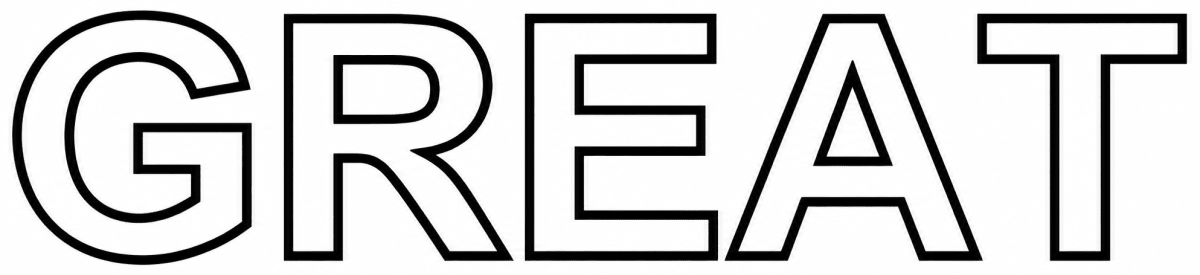
How many letters have the perpendicular lines in the given word?
2
3
4
5
Answer
In the word GREAT, the letters made up of lines meeting at right angles (perpendicular lines) are E and T. So there are 2 such letters.
Hence, option 1 is the correct option.
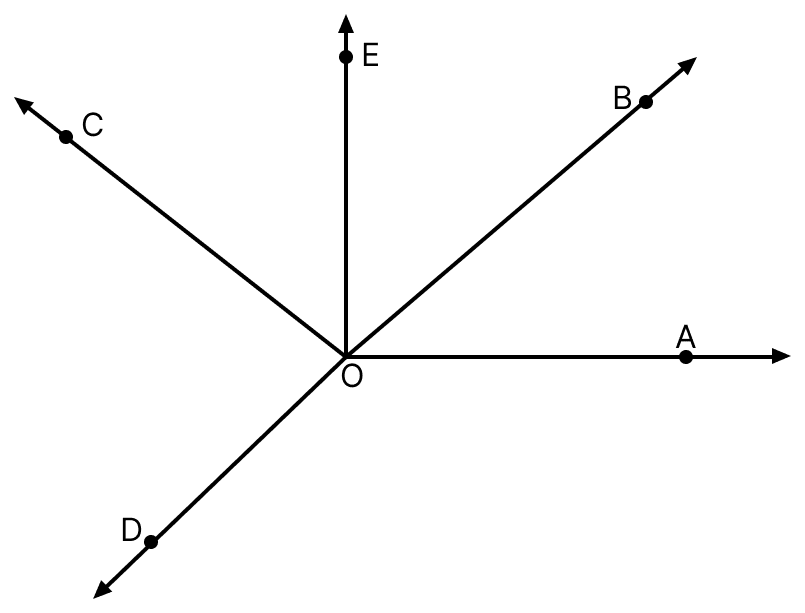
Study the given figure carefully and match the following:
| Column I | Column II |
|---|---|
| (A) ∠AOB | (i) Straight angle |
| (B) ∠AOE | (ii) Acute angle |
| (C) ∠AOC | (iii) Right angle |
| (D) ∠BOD | (iv) Obtuse angle |
(A) → (i); (B) → (iv); (C) → (ii); (D) → (iii)
(A) → (ii); (B) → (i); (C) → (iii); (D) → (iv)
(A) → (ii); (B) → (iii); (C) → (iv); (D) → (i)
(A) → (i); (B) → (ii); (C) → (iii); (D) → (iv)
Answer
From the figure:
⇒ ∠AOB is less than 90°, so it is an acute angle → (ii)
⇒ ∠AOE measures 90°, so it is a right angle → (iii)
⇒ ∠AOC is more than 90° but less than 180°, so it is an obtuse angle → (iv)
⇒ ∠BOD measures 180°, so it is a straight angle → (i)
Thus, the correct matching is:
| Column I | Column II |
|---|---|
| (A) ∠AOB | (ii) Acute angle |
| (B) ∠AOE | (iii) Right angle |
| (C) ∠AOC | (iv) Obtuse angle |
| (D) ∠BOD | (i) Straight angle |
Hence, option 3 is the correct option.
Read the given statements carefully and select the correct option.
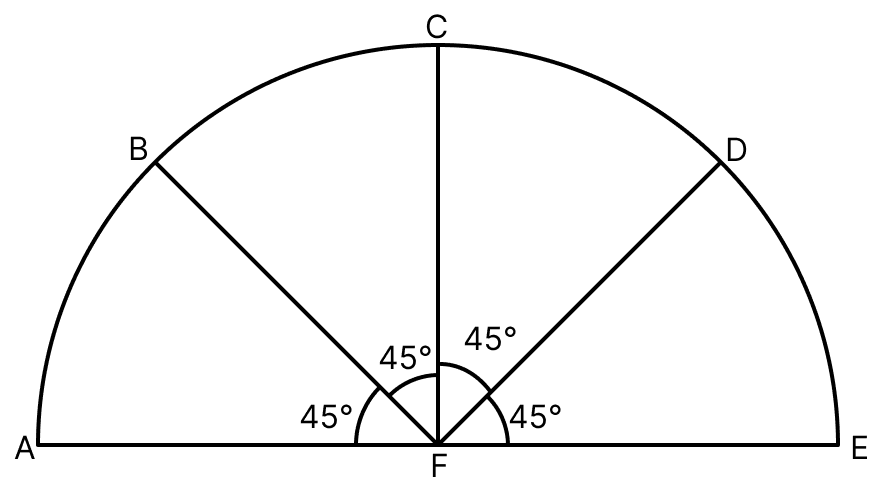
Statement–I: In the given figure, the number of obtuse angles is 4.
Statement–II: If the angle between two intersecting lines is a right angle, then the lines are parallel.
Both the statements are true
Both the statements are false
Statement–I is true but statement–II is false
Statement–I is false but statement–II is true
Answer
Statement–I: In the figure, A, F and E lie on a straight line and the rays FB, FC and FD are drawn from F so that
⇒ ∠AFB = ∠BFC = ∠CFD = ∠DFE = 45°
Taking these rays two at a time, the angles formed at F are:
⇒ ∠AFB = 45°, ∠BFC = 45°, ∠CFD = 45° and ∠DFE = 45° — each an acute angle
⇒ ∠AFC = 45° + 45° = 90°, ∠BFD = 45° + 45° = 90° and ∠CFE = 45° + 45° = 90° — each a right angle
⇒ ∠AFD = 45° + 45° + 45° = 135° and ∠BFE = 45° + 45° + 45° = 135° — each an obtuse angle
⇒ ∠AFE = 45° + 45° + 45° + 45° = 180° — a straight angle
So the angles measuring 135° are ∠AFD (made up of ∠AFB, ∠BFC and ∠CFD) and ∠BFE (made up of ∠BFC, ∠CFD and ∠DFE). Since an obtuse angle is more than 90° but less than 180°, only these two angles are obtuse.
∴ The number of obtuse angles is 2, not 4. So Statement–I is false.
Statement–II: If the angle between two intersecting lines is a right angle, the lines are perpendicular, not parallel. So Statement–II is false.
Hence, option 2 is the correct option.
Which of the following statements is correct?
A right angle is of a revolution.
A straight angle is of a revolution.
The measure of a reflex angle is greater than that of a straight angle.
The angle formed in one revolution is a reflex angle.
Answer
One revolution (complete angle) = 360°.
Option 1: A right angle = 90° = of a revolution, not .
So option 1 is false.
Option 2: A straight angle = 180° = of a revolution, not .
So option 2 is false.
Option 3: A reflex angle is more than 180° and a straight angle is exactly 180°, so a reflex angle is greater than a straight angle.
So option 3 is correct.
Option 4: The angle formed in one revolution is 360°, which is a complete angle, not a reflex angle.
So option 4 is false.
Hence, option 3 is the correct option.