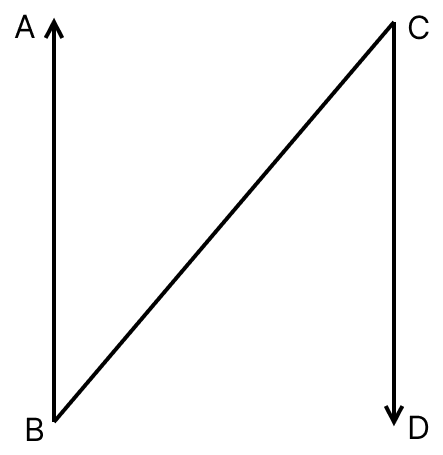
Identify and name the line segments and rays in the following figure:
Answer
A line segment has two end points and a definite length, whereas a ray has one end point (its initial point) and extends endlessly in one direction.
The diagonal path joining B and C is a line segment, while the parts starting from B towards A and from C towards D extend endlessly.
∴ Line segment — ; Rays — .
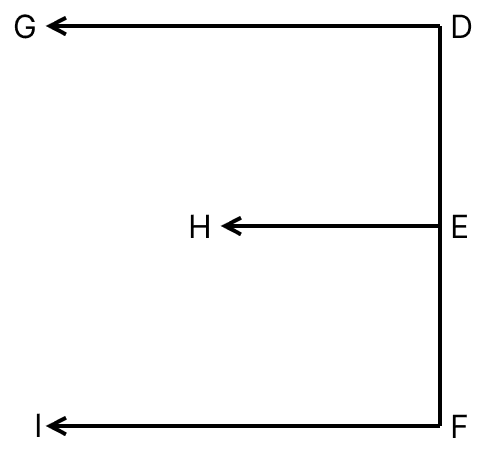
Identify and name the line segments and rays in the following figure:
Answer
On the right the points D, E and F are joined to give line segments, while three arms extend endlessly towards the left.
∴ Line segments — ; Rays — .
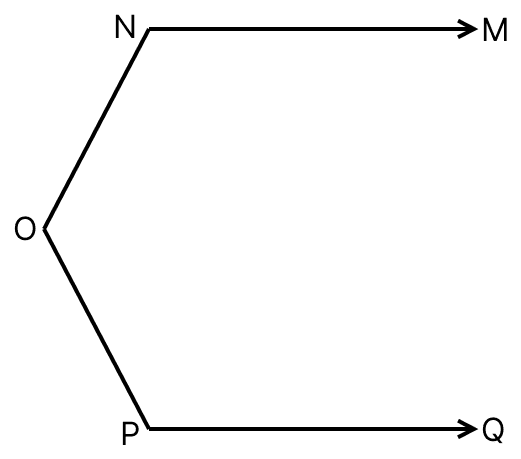
Identify and name the line segments and rays in the following figure:
Answer
The point O is joined to N and P giving line segments, while the arms from N towards M and from P towards Q extend endlessly.
∴ Line segments — ; Rays — .
What do you mean by collinear points?
(i) Mark three points which are collinear.
(ii) Mark three points which are non-collinear. Draw lines through these points taking two at a time and name these lines. How many such different lines can be drawn?
Answer
Three or more points in a plane are said to be collinear if all of them lie on the same straight line.
(i) Points A, B and C marked on a single straight line are collinear.

(ii) Points A, B and C which do not lie on the same straight line are non-collinear. Taking the points two at a time, we get the pairs (A, B), (B, C) and (C, A). Through each pair exactly one line can be drawn, giving the lines AB, BC and CA.
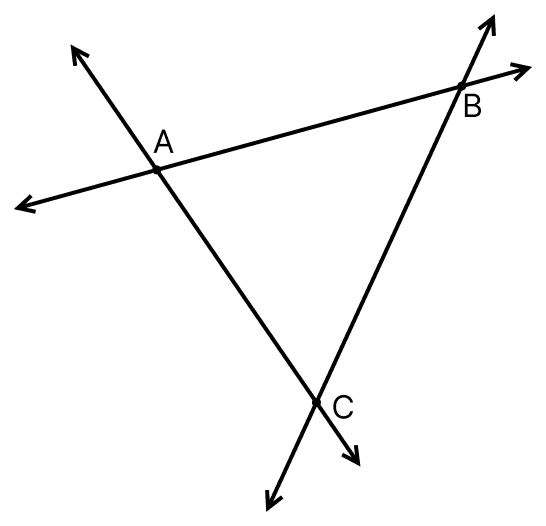
Hence, three different lines can be drawn through three non-collinear points, namely line AB, line BC and line CA.
(i) How many lines can be drawn passing through three collinear points?
(ii) Given three collinear points A, B, C. How many line segments do they determine? Name them.
Answer
(i) Collinear points lie on the same straight line, so a single line already passes through all three of them.
Hence, only one line can be drawn passing through three collinear points.
(ii) Taking the three collinear points A, B and C two at a time, we get the pairs (A, B), (B, C) and (A, C). Each pair determines one line segment.

Hence, three line segments are determined, namely .
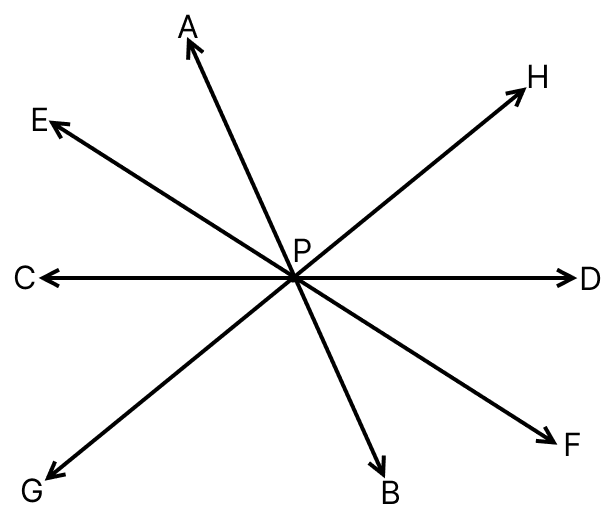
What do you mean by concurrent lines? Draw four concurrent lines.
Answer
Three or more lines in a plane are said to be concurrent if all of them pass through the same point. This common point is called the point of concurrence of the given lines.
In the figure below, the four lines all pass through the point P, so are concurrent and P is their point of concurrence.
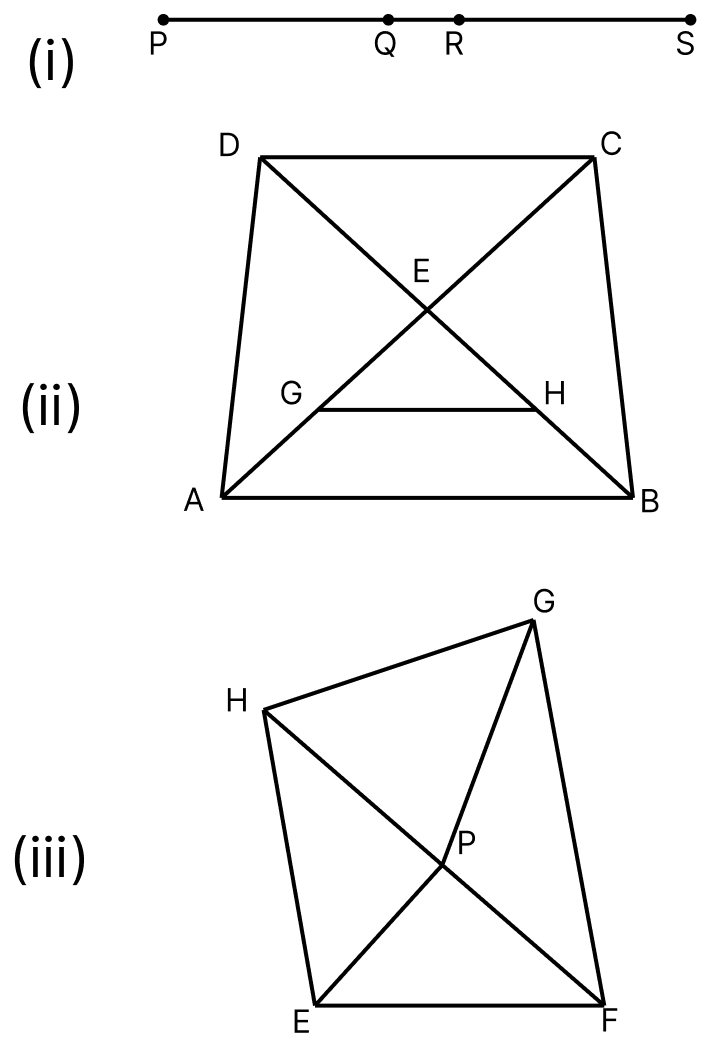
Count the number of line segments drawn in each of the following figures and name them:
Answer
(i) The figure has four collinear points P, Q, R and S. Taking them two at a time, the line segments are .
∴ Number of line segments = 6.
(ii) The line segments in the figure are:
.
∴ Number of line segments = 17.
(iii) The line segments in the figure are:
.
∴ Number of line segments = 8.
Fill in the blanks:
(i) A line segment has ............... end points.
(ii) A line has ............... end points.
(iii) A ray has ............... end point.
(iv) A line segment has a ............... length.
(v) A line AB is represented by ...............
(vi) A ray AB is represented by ...............
(vii) A point shows a definite ...............
(viii) Two lines intersect in a ...............
(ix) Two planes intersect in a ...............
(x) The minimum number of points of intersection of three lines in a plane is ...............
(xi) The maximum number of points of intersection of three lines in a plane is ...............
Answer
(i) A line segment has two end points.
(ii) A line has no end points.
(iii) A ray has one end point.
(iv) A line segment has a definite length.
(v) A line AB is represented by .
(vi) A ray AB is represented by .
(vii) A point shows a definite position.
(viii) Two lines intersect in a point.
(ix) Two planes intersect in a line.
(x) The minimum number of points of intersection of three lines in a plane is 0.
(xi) The maximum number of points of intersection of three lines in a plane is 3.
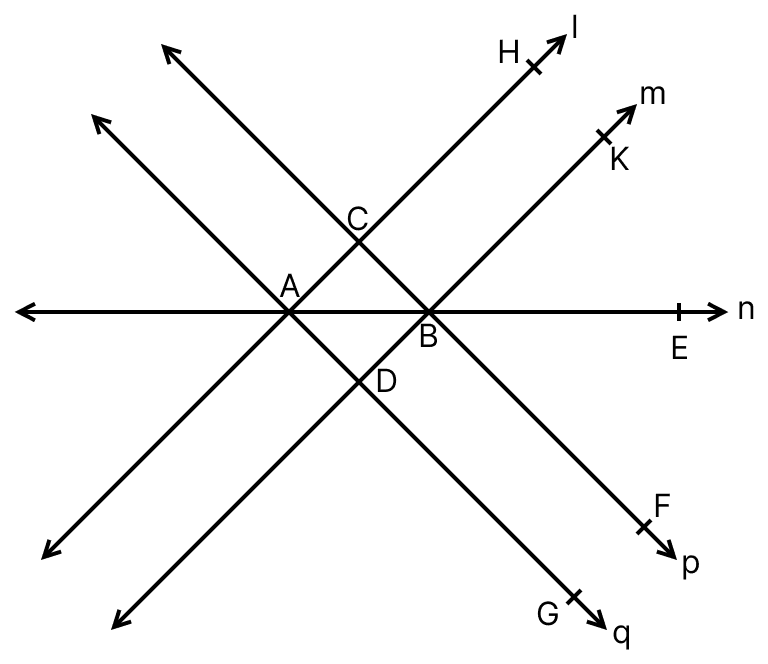
Look at the adjoining figure carefully and name:
(i) all pairs of parallel lines;
(ii) all pairs of intersecting lines and their points of intersection;
(iii) all sets of collinear points;
(iv) concurrent lines and their points of concurrence;
(v) one set of three non-collinear points.
Answer
(i) Parallel lines are lines which do not intersect even when produced.
∴ The pairs of parallel lines are (l, m) and (p, q).
(ii) Intersecting lines are lines which cross each other, and the common point is their point of intersection.
∴ The pairs of intersecting lines and their points of intersection are:
l and p at C; l and q at A; l and n at A; m and n at B; m and p at B; m and q at D; n and p at B; n and q at A.
(iii) Collinear points are three or more points lying on the same straight line.
∴ The sets of collinear points are (A, B, E), (A, C, H), (D, B, K), (C, B, F) and (A, D, G).
(iv) Concurrent lines are three or more lines passing through the same point.
∴ Lines l, n and q are concurrent at A; lines m, n and p are concurrent at B.
(v) Three non-collinear points are three points which do not lie on the same straight line.
∴ One set of three non-collinear points is A, C and D.
Which shape do the following have?
(i) The wheel of a bicycle
(ii) A blackboard
(iii) A page of a book
(iv) The face of the full moon
(v) A set-square in a geometry box
(vi) A face of a dice
Answer
(i) The wheel of a bicycle has the shape of a circle.
(ii) A blackboard has the shape of a rectangle.
(iii) A page of a book has the shape of a rectangle.
(iv) The face of the full moon has the shape of a circle.
(v) A set-square in a geometry box has the shape of a triangle.
(vi) A face of a dice has the shape of a square.
Fill in the blanks:
(i) A triangle has ............... sides and ............... vertices.
(ii) A rectangle has ............... sides and ............... vertices.
(iii) All the sides of a square are ...............
(iv) The ............... sides of a rectangle are equal.
(v) A circle has ............... side and ............... vertex.
Answer
(i) A triangle has 3 sides and 3 vertices.
(ii) A rectangle has 4 sides and 4 vertices.
(iii) All the sides of a square are equal.
(iv) The opposite sides of a rectangle are equal.
(v) A circle has no side and no vertex.
Consider the line shown herewith and find whether the statements given below are true or false:
(i) D is a point on ray EB.
(ii) C is a point on ray DA.
(iii) Ray DB is different from ray EB.
(iv) C, D, E are points on line segment CE.
(v) Ray CA is different from ray CB.

Answer
From the figure, the points lie on the line in the order A, C, D, E, B.
(i) False — Ray EB starts at E and extends in the direction of B. The point D lies on the opposite side of E, so D is not a point on ray EB.
(ii) True — Ray DA starts at D and extends in the direction of A. Since C lies between D and A, the point C is on ray DA.
(iii) True — Ray DB has initial point D while ray EB has initial point E. As their initial points differ, the two rays are different.
(iv) True — The line segment CE has end points C and E, and D lies between them, so C, D and E all lie on segment CE.
(v) True — Ray CA starts at C towards A while ray CB starts at C towards B (opposite direction). They are opposite rays, hence different.
State whether the given statements are true or false:
(i) Every ray has a finite length.
(ii) Ray AB is the same as ray BA.
(iii) Line AB is the same as line BA.
(iv) Two points A and B in a plane determine a unique line segment.
(v) One and only one line can be drawn to pass through a given point.
(vi) If points A, B, C are collinear and points C, D, E are collinear, then the points A, B, C, D, E, are collinear.
Answer
(i) False — A ray extends endlessly in one direction, so it does not have a finite length.
(ii) False — Ray AB has initial point A and ray BA has initial point B, and they extend in opposite directions, so they are different rays.
(iii) True — A line has no end points and can be named from either direction, so line AB is the same as line BA.
(iv) True — Two distinct points fix the two end points, and hence determine exactly one line segment.
(v) False — An unlimited (infinite) number of lines can be drawn through a single given point.
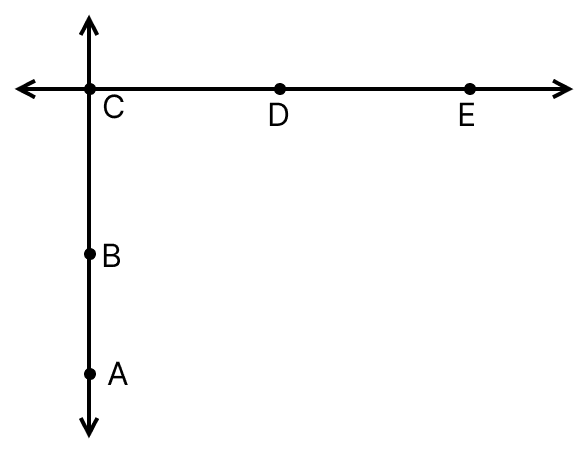
(vi) False — The points A, B and C lie on one straight line and the points C, D and E lie on one straight line, but the two sets have only the single point C in common. Two straight lines can meet in at most one point, so they need not be the same line.
For example, let A, B and C lie on a vertical line and let C, D and E lie on the horizontal line drawn through C. Each set is collinear, yet A, B, D and E do not all lie on one straight line.