
If and cm, then the value of is:

12 cm
18 cm
6 cm
24 cm
Answer
Since cm.
The points lie in order A, B, C, D, E, so:
cm.
Calculating,
Hence, option 1 is the correct option.
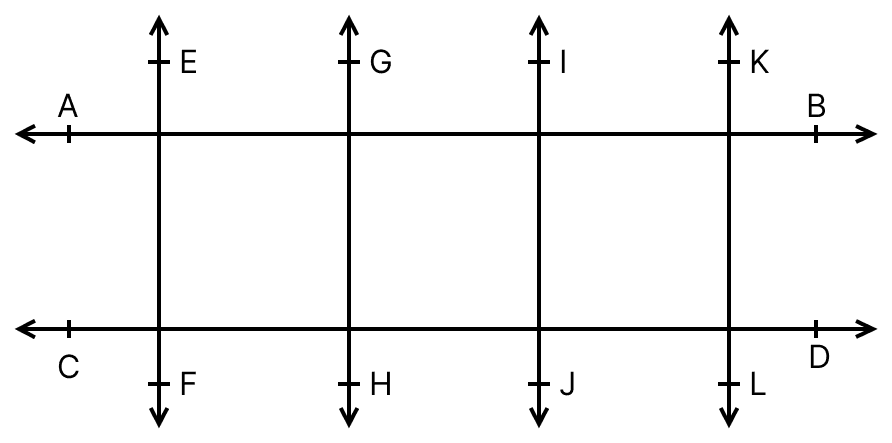
How many pairs of parallel lines are there in the given figure?
4
5
7
8
Answer
Two lines are parallel if they never meet, however far they are produced. So we look for lines running in the same direction and count them two at a time.
In the given figure there are two horizontal lines AB and CD, and four vertical lines EF, GH, IJ and KL.
The two horizontal lines AB and CD are parallel to each other. Taking them together, we get:
(AB, CD) → 1 pair
The four vertical lines EF, GH, IJ and KL are all parallel to one another. Taking them two at a time, we get:
(EF, GH), (EF, IJ), (EF, KL), (GH, IJ), (GH, KL), (IJ, KL) → 6 pairs
A horizontal line and a vertical line cut each other, so they are not parallel. Such pairs are not counted.
∴ Total pairs of parallel lines = 1 + 6 = 7.
Hence, option 3 is the correct option.
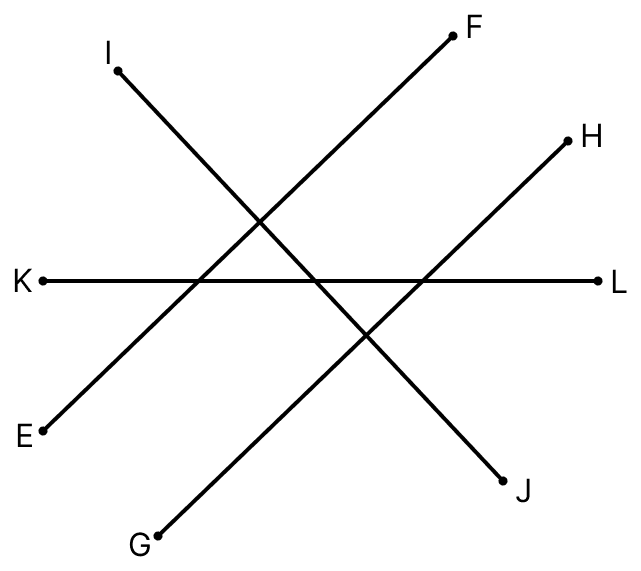
Raghav drew the line segments shown here on a piece of paper. How many pairs of intersecting lines does he draw?
3
4
5
More than 5
Answer
The four line segments shown in the figure are EF, IJ, KL and GH.
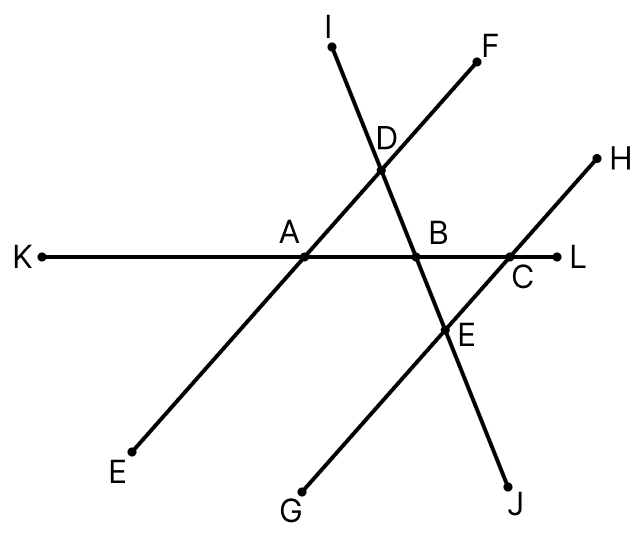
The pairs of intersecting line segments are:
EF and KL intersect at A. EF and IJ intersect at D. KL and IJ intersect at B. KL and GH intersect at C. GH and IJ intersect at E.
Thus, there are 5 pairs of intersecting line segments.
Hence, option 3 is the correct option.