
Two angles of a triangle are 72° and 63°. Find the third angle.
Answer
Let the third angle be x.
By the angle sum property of a triangle, the sum of all the angles of a triangle is 180°.
⇒ 72° + 63° + x = 180°
⇒ 135° + x = 180°
⇒ x = 180° − 135° = 45°
Hence, the third angle is 45°.
The angles of a triangle are in the ratio 2 : 3 : 5. Find the measure of each angle of the triangle.
Answer
Given,
The angles of a triangle are in the ratio 2 : 3 : 5.
Let the angles of the triangle be 2x, 3x and 5x.
By the angle sum property of a triangle, the sum of all the angles of a triangle is 180°.
⇒ 2x + 3x + 5x = 180°
⇒ 10x = 180°
⇒ x =
⇒ x = 18°
So, the angles are 2x = 2 × 18° = 36°, 3x = 3 × 18° = 54° and 5x = 5 × 18° = 90°.
Hence, the angles of the triangle are 36°, 54° and 90°.
The acute angles of a right triangle are in the ratio 1 : 2. Find the angles of the triangle.
Answer
Given,
The acute angles of a right triangle are in the ratio 1 : 2.
Let the two acute angles be x and 2x.
One angle of a right triangle measures 90°.
By the angle sum property of a triangle, the sum of all the angles of a triangle is 180°.
⇒ x + 2x + 90° = 180°
⇒ 3x + 90° = 180°
⇒ 3x = 180° − 90°
⇒ 3x = 90°
⇒ x =
⇒ x = 30°
So, the two acute angles are x = 30° and 2x = 2 × 30° = 60°.
Hence, the angles of the triangle are 30°, 60° and 90°.
One of the acute angles of a right triangle is 36°. Find the other acute angle.
Answer
Let the other acute angle be x.
One angle of a right triangle measures 90° and one of its acute angles is 36°.
By the angle sum property of a triangle, the sum of all the angles of a triangle is 180°.
⇒ 90° + 36° + x = 180°
⇒ 126° + x = 180°
⇒ x = 180° − 126°
⇒ x = 54°
Hence, the other acute angle is 54°.
One of the angles of a triangle is 106° and the other two angles are equal. Find each of the equal angles.
Answer
Let each of the two equal angles be x.
By the angle sum property of a triangle,
⇒ 106° + x + x = 180°
⇒ 2x = 180° − 106° = 74°
⇒ x =
⇒ x = 37°
Hence, each of the equal angles is 37°.
Each of the two equal angles of an isosceles triangle is half the third angle. Find the angles of the triangle.
Answer
Given,
Each of the two equal angles of an isosceles triangle is half the third angle.
Let the angles of the triangle be x, x and 2x.
By the angle sum property of a triangle,
⇒ x + x + 2x = 180°
⇒ 4x = 180°
⇒ x =
⇒ x = 45°
So, the angles are x = 45°, x = 45° and 2x = 2 × 45° = 90°.
Hence, the angles of the triangle are 45°, 45° and 90°.
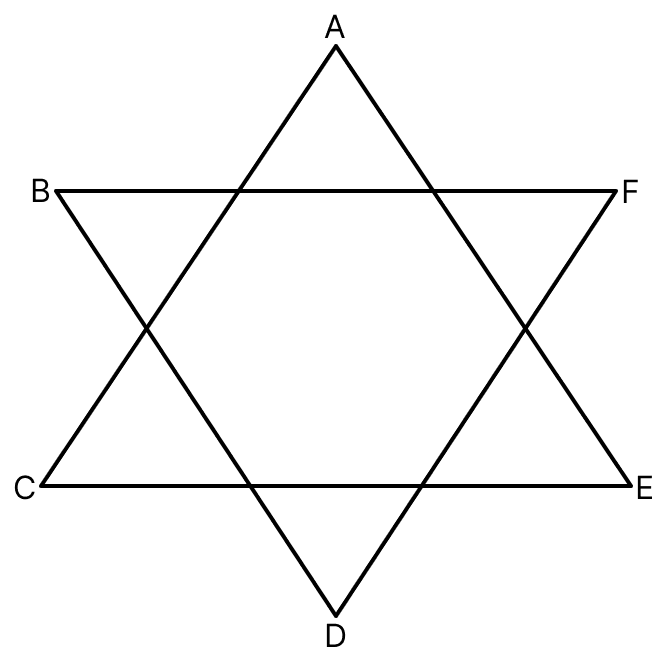
In the given figure, find ∠A + ∠B + ∠C + ∠D + ∠E + ∠F.
Answer
The given figure is a six-pointed star, which is made up of two triangles, △ACE and △BDF.
∠A, ∠C and ∠E are the three angles of △ACE, so by the angle sum property,
⇒ ∠A + ∠C + ∠E = 180° ... (1)
∠B, ∠D and ∠F are the three angles of △BDF, so by the angle sum property,
⇒ ∠B + ∠D + ∠F = 180° ...(2)
Adding (1) and (2),
⇒ (∠A + ∠C + ∠E) + (∠B + ∠D + ∠F) = 180° + 180°
⇒ ∠A + ∠B + ∠C + ∠D + ∠E + ∠F = 360°
Hence, ∠A + ∠B + ∠C + ∠D + ∠E + ∠F = 360°.
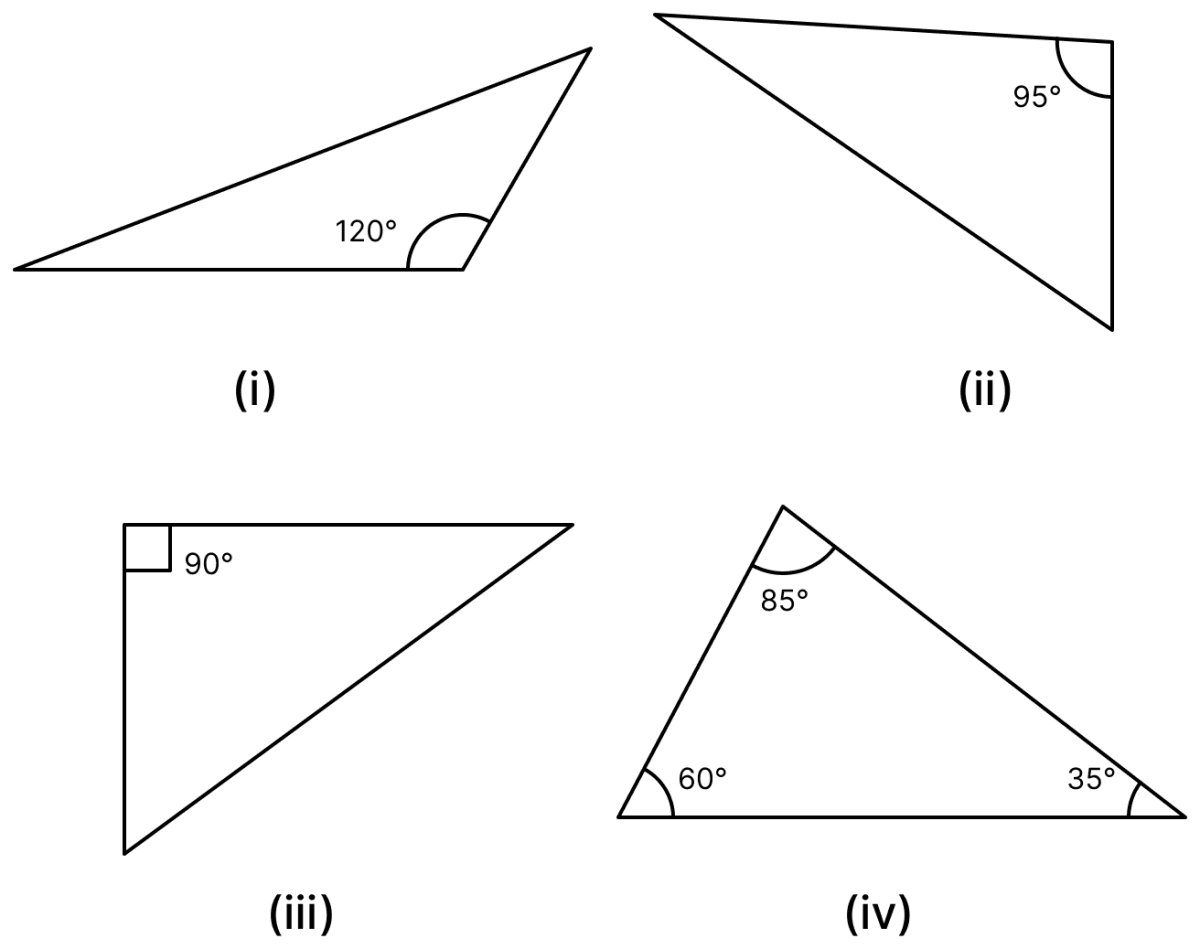
In each of the figures given below state whether the given triangle is acute-angled, right-angled or obtuse-angled:
Answer
A triangle is acute-angled if each angle is less than 90°, right-angled if one angle is 90°, and obtuse-angled if one angle is more than 90°.
(i) One angle is 120°, which is more than 90°, so it is an obtuse-angled triangle.
(ii) One angle is 95°, which is more than 90°, so it is an obtuse-angled triangle.
(iii) One angle is 90°, so it is a right-angled triangle.
(iv) The angles are 85°, 60° and 35°, each less than 90°, so it is an acute-angled triangle.
Can a triangle have:
(i) each angle less than 60°?
(ii) each angle greater than 60°?
(iii) two obtuse angles?
(iv) two right angles?
(v) two acute angles?
Answer
(i) No. If each angle were less than 60°, the sum of the three angles would be less than 180°, which is not possible.
(ii) No. If each angle were greater than 60°, the sum of the three angles would be greater than 180°, which is not possible.
(iii) No. Two obtuse angles would each be more than 90°, so their sum alone would be more than 180°, which is not possible.
(iv) No. Two right angles would add up to 180°, leaving nothing for the third angle, which is not possible.
(v) Yes. Every triangle has at least two acute angles.
Which of the following can possibly be the angles of a triangle?
(i) 50°, 30°, 100°
(ii) 90°, 50°, 50°
(iii) 20°, 70°, 90°
(iv) 45°, 90°, 45°
(v) 65°, 65°, 65°
(vi) 120°, 50°, 10°
Answer
Three angles can be the angles of a triangle only if their sum is 180°.
(i) 50° + 30° + 100° = 180°. Yes.
(ii) 90° + 50° + 50° = 190° ≠ 180°. No.
(iii) 20° + 70° + 90° = 180°. Yes.
(iv) 45° + 90° + 45° = 180°. Yes.
(v) 65° + 65° + 65° = 195° ≠ 180°. No.
(vi) 120° + 50° + 10° = 180°. Yes.
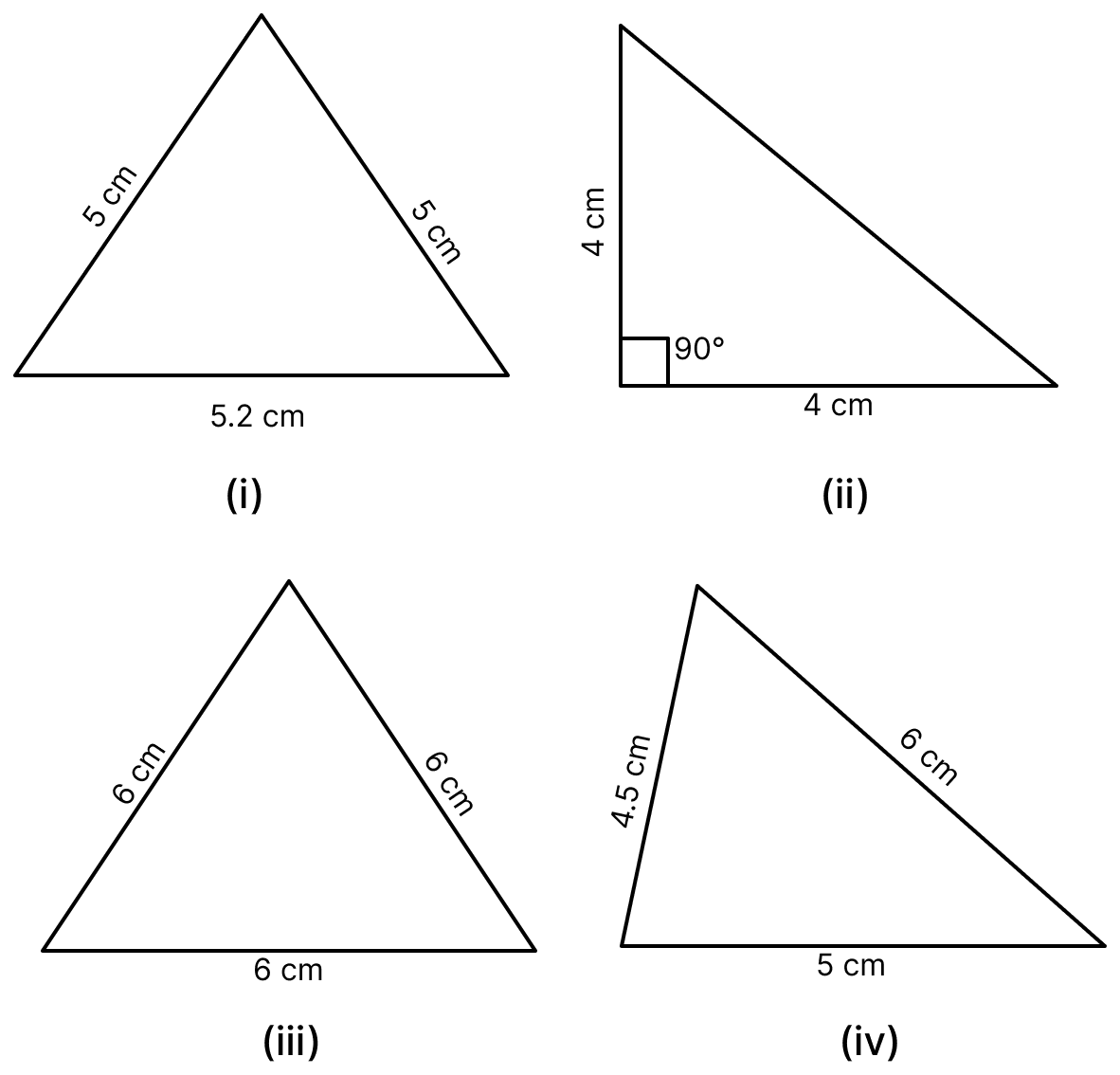
In each of the figures given below state whether the given triangle is equilateral, isosceles or scalene:
Answer
A triangle is equilateral if all three sides are equal, isosceles if two sides are equal, and scalene if all sides are of different lengths.
(i) Two sides are equal (5 cm and 5 cm), so it is an isosceles triangle.
(ii) Two sides are equal (4 cm and 4 cm), so it is an isosceles triangle.
(iii) All three sides are equal (6 cm each), so it is an equilateral triangle.
(iv) All three sides are of different lengths (4.5 cm, 5 cm and 6 cm), so it is a scalene triangle.
Which of the following lengths of three line segments can be the lengths of the sides of a triangle?
(i) 5 cm, 4 cm, 9 cm
(ii) 8 cm, 6 cm, 15 cm
(iii) 5 cm, 5 cm, 5 cm
(iv) 3.5 cm, 4.5 cm, 6.5 cm
(v) 6 cm, 8 cm, 10 cm
(vi) 3 cm, 7 cm, 3 cm
Answer
Three line segments can form a triangle only if the sum of any two sides is greater than the third side.
(i) 5 + 4 = 9, which is not greater than 9. No.
(ii) 8 + 6 = 14 < 15. No.
(iii) 5 + 5 = 10 > 5 (and this holds for every pair). Yes.
(iv) 3.5 + 4.5 = 8 > 6.5, and every other pair also has a sum greater than the third side. Yes.
(v) 6 + 8 = 14 > 10, and every other pair also has a sum greater than the third side. Yes.
(vi) 3 + 3 = 6 < 7. No.
(i) Can a right triangle be equilateral?
(ii) Can an isosceles triangle be right-angled?
(iii) Can a right triangle be scalene?
(iv) Can a right triangle have an obtuse angle?
Answer
(i) No. Each angle of an equilateral triangle is 60°, so it can never have a 90° angle.
(ii) Yes. A triangle with angles 45°, 45° and 90° is both isosceles and right-angled.
(iii) Yes. A right triangle can have all three sides of different lengths, for example 3 cm, 4 cm and 5 cm.
(iv) No. A right triangle already has one 90° angle; an obtuse angle would make the sum of the angles exceed 180°.
Fill in the blanks:
(i) A triangle has ...... vertices, ...... sides and ...... angles.
(ii) The sum of the angles of a triangle is ...... .
(iii) Each angle of an equilateral triangle measures ...... .
(iv) The sum of any two sides of a triangle is ...... than the third side.
(v) A right triangle cannot have an ...... angle.
Answer
(i) A triangle has 3 vertices, 3 sides and 3 angles.
(ii) The sum of the angles of a triangle is 180°.
(iii) Each angle of an equilateral triangle measures 60°.
(iv) The sum of any two sides of a triangle is greater than the third side.
(v) A right triangle cannot have an obtuse angle.