
In the given figure, the curve is

an open curve
a closed curve
a simple closed curve
none of these
Answer
From the figure, the curve begins and ends at the same point, so it is a closed curve.
However, the curve intersects itself at a point, so it is not a simple closed curve.
Hence, option 2 is the correct option.
The region of a curve is its
interior
exterior
boundary
interior together with its boundary
Answer
The region of a curve is made up of the interior of the curve together with its boundary.
Hence, option 4 is the correct option.
Which of the following is a polygon?
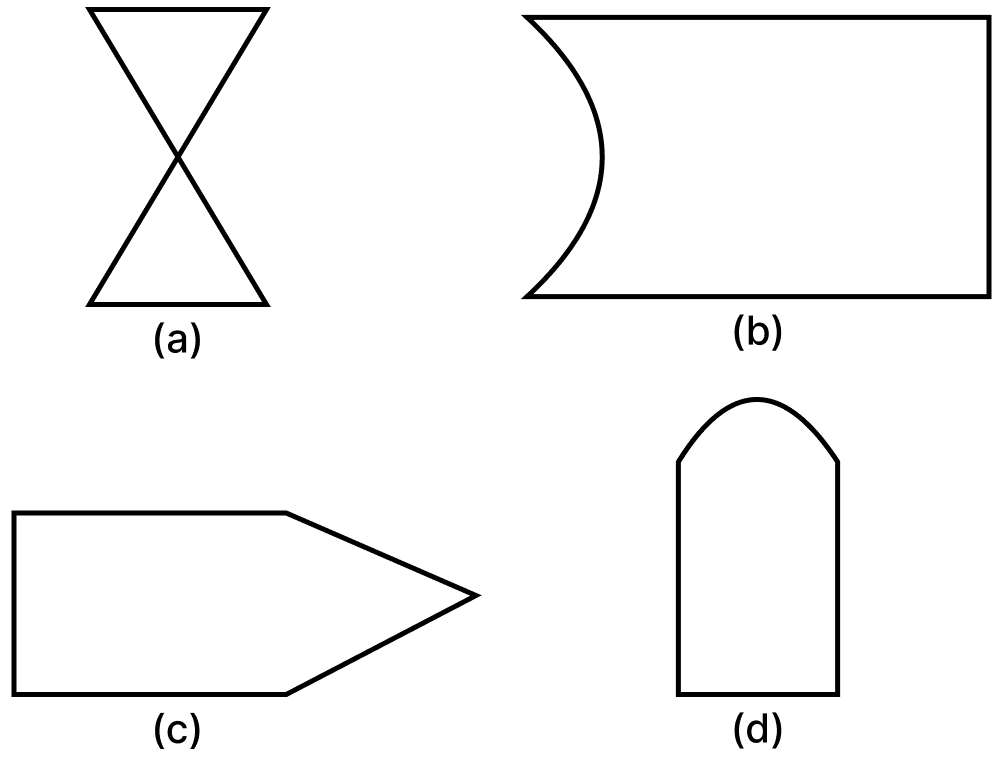
Answer
A simple closed figure bounded by three or more line segments is called a polygon.
In option 1, the figure intersects itself, so it is not a simple closed figure. Hence, it is not a polygon.
In option 2, one side of the figure is a curved line, so it is not a polygon.
In option 3, the figure is a simple closed figure bounded by 5 line segments, so it is a polygon.
In option 4, the top of the figure is a curved line, so it is not a polygon.
Hence, option 3 is the correct option.
If each interior angle of a regular polygon is 135°, how many sides does it have?
6
7
8
9
Answer
It is given that each interior angle of a regular polygon is 135°.
Let the number of sides of the polygon be .
Then, sum of its interior angles = right angles = × 90°.
So, the polygon has 8 sides.
Hence, option 3 is the correct option.
If each exterior angle of a regular polygon is 36°, how many sides does it have?
9
10
8
12
Answer
It is given that each exterior angle of a regular polygon is 36°.
As an exterior angle and the adjacent interior angle together form a linear pair,
Each interior angle = 180° - 36° = 144°
Let the number of sides of the polygon be .
Then, sum of its interior angles = right angles = × 90°.
So, the polygon has 10 sides.
Hence, option 2 is the correct option.
Each interior angle of a regular decagon is
124°
120°
144°
140°
Answer
We know that the sum of the exterior angles of a polygon = 360°, so each exterior angle of a regular polygon of sides = .
A decagon has 10 sides.
Each exterior angle =
= 36°
As an exterior angle and the adjacent interior angle together form a linear pair,
Each interior angle = 180° - 36°
= 144°
Hence, option 3 is the correct option.
Each interior angle of a regular polygon of 18 sides, is
144°
160°
60°
120°
Answer
We know that the sum of the interior angles of a polygon of sides = right angles.
Here, .
Sum of interior angles of an 18-sided polygon = (2 × 18 - 4) right angles
= 32 × 90°
= 2880°
Since the interior angles of a regular polygon are of the same measure,
Each interior angle =
= 160°
Hence, option 2 is the correct option.
The angles of a heptagon are and . The value of is
59
58
60
61
Answer
It is given that the angles of a heptagon are and .
We know that the sum of the interior angles of a polygon of sides = right angles.
A heptagon has 7 sides, so .
Sum of interior angles of a heptagon = (2 × 7 - 4) right angles
= 10 × 90°
= 900°
So,
Hence, option 1 is the correct option.
Five of the angles of a hexagon are 115° each. The 6th angle is
130°
145°
160°
125°
Answer
We know that the sum of the interior angles of a polygon of sides = right angles.
A hexagon has 6 sides, so .
Sum of the angles = {(2 × 6 - 4) × 90}°
= (8 × 90)°
= 720°
Sum of the five given angles = 5 × 115° = 575°
So,
6th angle = 720° - 575°
= 145°
Hence, option 2 is the correct option.
Each interior angle of a regular polygon is 150°. How many sides does it have?
10
11
12
8
Answer
It is given that each interior angle of a regular polygon is 150°.
Let the number of sides of the polygon be .
Then, sum of its interior angles = right angles = × 90°.
So, the polygon has 12 sides.
Hence, option 3 is the correct option.