
A square has
one line of symmetry
two lines of symmetry
three lines of symmetry
four lines of symmetry
Answer
A square has four lines of symmetry, which are its two diagonals and the two lines joining the mid-points of its opposite sides.
Hence, option 4 is the correct option.
A rectangle is symmetrical about
the line joining the mid-points of its adjacent sides
each one of its diagonals
perpendicular bisector of each of its sides
none of these
Answer
A rectangle has two lines of symmetry, which are the lines joining the mid-points of its opposite sides.
The line joining the mid-points of a pair of opposite sides of a rectangle is perpendicular to both these sides and bisects each of them. So, each line of symmetry of a rectangle is the perpendicular bisector of a pair of its opposite sides, i.e., a rectangle is symmetrical about the perpendicular bisector of each of its sides.
On folding a rectangle about the line joining the mid-points of its adjacent sides or about a diagonal, the two parts of the figure do not coincide.
Hence, option 3 is the correct option.
An isosceles triangle is symmetrical about
each of its equal sides
the bisector of the angle included between equal sides
its base
none of these
Answer
The line of symmetry of an isosceles triangle is the bisector of the angle included between the equal sides.
Hence, option 2 is the correct option.
A scalene triangle has
no line of symmetry
three lines of symmetry
two lines of symmetry
none of these
Answer
In whatever manner we fold a scalene triangle, the two parts of the figure do not coincide. So, a scalene triangle has no line of symmetry.
Hence, option 1 is the correct option.
An equilateral triangle is symmetrical about
each of its equal sides
each of the bisectors of its angles
its base
none of these
Answer
An equilateral triangle has three lines of symmetry, which are the bisectors of the angles of the triangle.
Hence, option 2 is the correct option.
A square is symmetrical about
each of its sides
each of its diagonal and each of the lines joining the mid-points of its opposite sides
its base
none of these
Answer
A square has four lines of symmetry, which are its diagonals and the lines joining the mid-points of its opposite sides.
Hence, option 2 is the correct option.
A rhombus is symmetrical about
each of its diagonals
each of its sides
each of the line joining the mid-points of the opposite sides
none of these
Answer
A rhombus has two lines of symmetry, which are the diagonals of the rhombus.
Hence, option 1 is the correct option.
A circle has
one line of symmetry
two lines of symmetry
an unlimited number of lines of symmetry
none of these
Answer
A circle has an infinite number of lines of symmetry. In fact, each diameter of a circle is its line of symmetry.
Hence, option 3 is the correct option.
ABCD is a kite in which AB = AD and BC = DC.
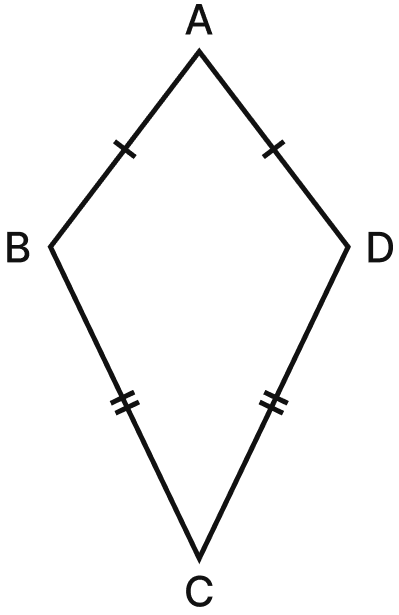
The kite is symmetrical about
the diagonal AC
the diagonal BD
both AC and BD
none of these
Answer
In the kite ABCD, AB = AD and BC = DC. On folding it about the diagonal AC, the vertex B coincides with the vertex D, side AB coincides with side AD and side CB coincides with side CD.
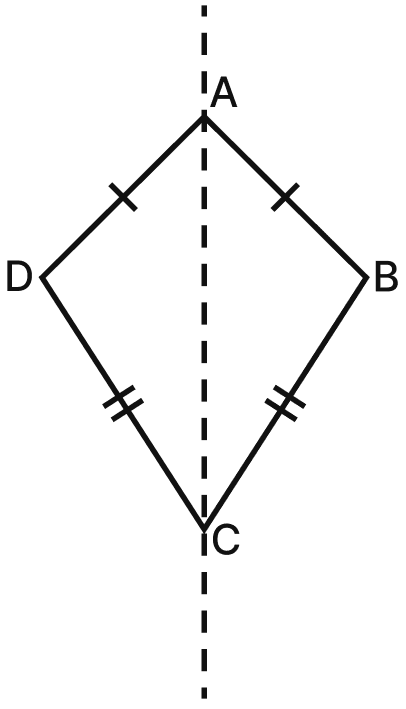
So, the kite is symmetrical about the diagonal AC. On folding it about the diagonal BD, the two parts do not coincide, as AB ≠ CB.
Hence, option 1 is the correct option.
The letter O of the English alphabet has
no line of symmetry
one line of symmetry
two lines of symmetry
none of these
Answer
The letter O can be folded into two coincident parts about the vertical line through its middle and about the horizontal line through its middle. So, it has two lines of symmetry.
Hence, option 3 is the correct option.
The letter Z of the English alphabet has
no line of symmetry
one line of symmetry
two lines of symmetry
none of these
Answer
In whatever manner we fold the letter Z, the two parts do not coincide. So, it has no line of symmetry.
Hence, option 1 is the correct option.