KnowledgeBoat Logo
|
OPEN IN APP

Chapter 4

Fractions

Class - 6 RS Aggarwal Mathematics Solutions


Exercise 4(A)

Question 1

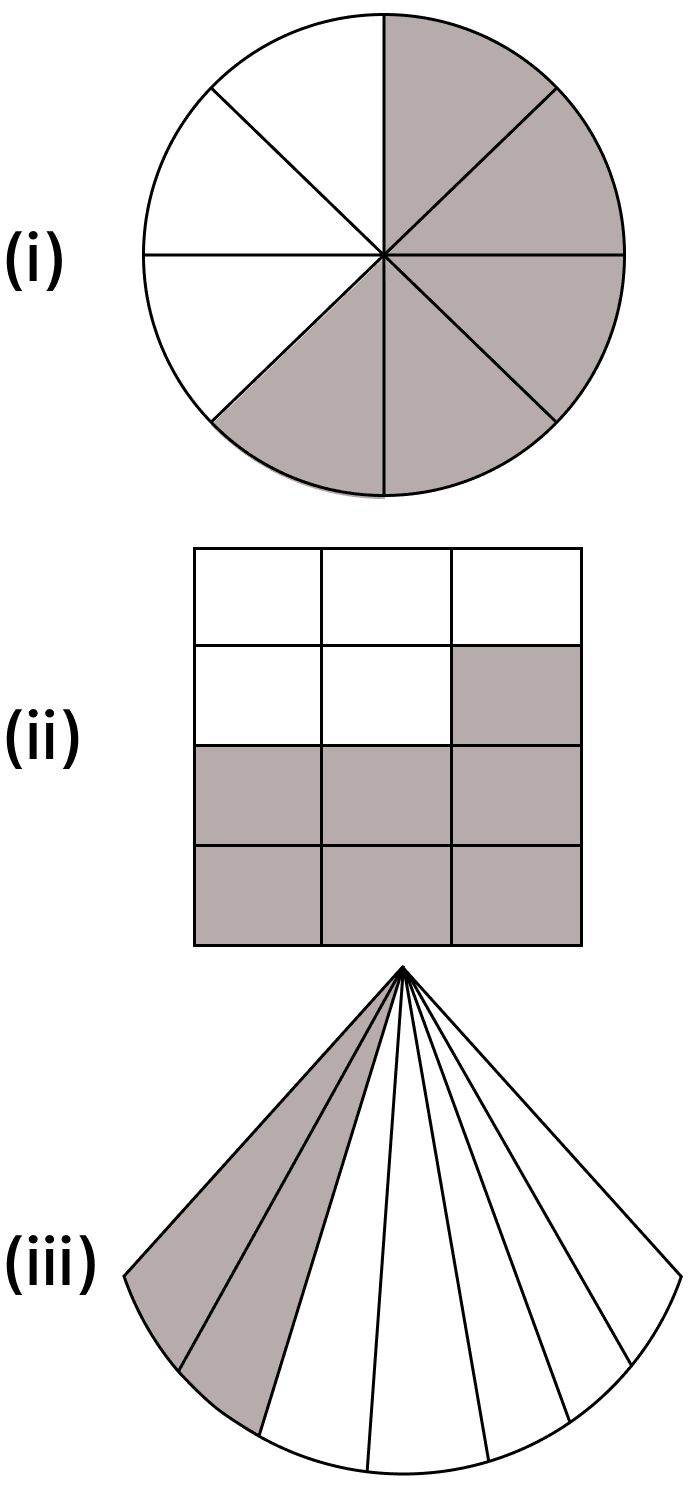
What fractions do the shaded parts in each of the following figures represent?

What fractions do the shaded parts in each of the following figures represent? Fractions, R.S. Aggarwal Mathematics Solutions ICSE Class 6.

Answer

(i) Total parts = 8

Shaded parts = 5

Fraction = Shaded partsTotal parts\dfrac{\text{Shaded parts}}{\text{Total parts}}

= 58\dfrac{5}{8}.

Hence, fraction = 58\dfrac{5}{8}.

(ii) Total parts = 12

Shaded parts = 7

Fraction = Shaded partsTotal parts\dfrac{\text{Shaded parts}}{\text{Total parts}}

= 712\dfrac{7}{12}.

Hence, fraction = 712\dfrac{7}{12}.

(iii) Total parts = 7

Shaded parts = 2

Fraction = Shaded partsTotal parts\dfrac{\text{Shaded parts}}{\text{Total parts}}

= 27\dfrac{2}{7}

Hence, fraction = 27\dfrac{2}{7}.

Question 2

Write a fraction for each of the following :

(i) 4 parts out of 9 equal parts

(ii) 5 parts out of 11 equal parts

(iii) two-fifths

(iv) four-sevenths

(v) seven-tenths

(vi) six-eighths

Answer

(i) Total parts = 9

Given parts = 4

Fraction = Given partsTotal parts\dfrac{\text{Given parts}}{\text{Total parts}}

= 49\dfrac{4}{9}

Hence, fraction = 49\dfrac{4}{9}.

(ii) Total parts = 11

Given parts = 5

Fraction = Given partsTotal parts\dfrac{\text{Given parts}}{\text{Total parts}}

= 511\dfrac{5}{11}

Hence, fraction = 511\dfrac{5}{11}.

(iii) Total parts = 5

Given parts = 2

Fraction = Given partsTotal parts\dfrac{\text{Given parts}}{\text{Total parts}}

= 25\dfrac{2}{5}

Hence, fraction = 25\dfrac{2}{5}.

(iv) Total parts = 7

Given parts = 4

Fraction = Given partsTotal parts\dfrac{\text{Given parts}}{\text{Total parts}}

= 47\dfrac{4}{7}

Hence, fraction = 47\dfrac{4}{7}.

(v) Total parts = 10

Given parts = 7

Fraction = Given partsTotal parts\dfrac{\text{Given parts}}{\text{Total parts}}

= 710\dfrac{7}{10}

Hence, fraction = 710\dfrac{7}{10}.

(vi) Total parts = 8

Given parts = 6

Fraction = Given partsTotal parts\dfrac{\text{Given parts}}{\text{Total parts}}

= 68\dfrac{6}{8}

Hence, fraction = 68\dfrac{6}{8}.

Question 3

Point out the numerator and denominator in each of the following fractions :

(i) 56\dfrac{5}{6}

(ii) 37\dfrac{3}{7}

(iii) 914\dfrac{9}{14}

(iv) 120\dfrac{1}{20}

(v) 1225\dfrac{12}{25}

Answer

(i) 56\dfrac{5}{6}

Hence, numerator = 5 and denominator = 6.

(ii) 37\dfrac{3}{7}

Hence, numerator = 3 and denominator = 7.

(iii) 914\dfrac{9}{14}

Hence, numerator = 9 and denominator = 14.

(iv) 120\dfrac{1}{20}

Hence, numerator = 1 and denominator = 20.

(v) 1225\dfrac{12}{25}

Hence, numerator = 12 and denominator = 25.

Question 4

Write five fractions equivalent to each of the following :

(i) 23\dfrac{2}{3}

(ii) 34\dfrac{3}{4}

(iii) 56\dfrac{5}{6}

(iv) 79\dfrac{7}{9}

(v) 314\dfrac{3}{14}

Answer

(i) 23\dfrac{2}{3}

To find equivalent fractions, we multiply the numerator and denominator by a sequence of numbers (e.g., 2, 3, 4, 5, 6).

Multiply by 2: 2×23×2=46\dfrac{2 \times 2}{3 \times 2} = \dfrac{4}{6}

Multiply by 3: 2×33×3=69\dfrac{2 \times 3}{3 \times 3} = \dfrac{6}{9}

Multiply by 4: 2×43×4=812\dfrac{2 \times 4}{3 \times 4} = \dfrac{8}{12}

Multiply by 5: 2×53×5=1015\dfrac{2 \times 5}{3 \times 5} = \dfrac{10}{15}

Multiply by 6: 2×63×6=1218\dfrac{2 \times 6}{3 \times 6} = \dfrac{12}{18}

Hence, the equivalent fractions are : 46,69,812,1015,1218\dfrac{4}{6}, \dfrac{6}{9}, \dfrac{8}{12}, \dfrac{10}{15}, \dfrac{12}{18}.

(ii) 34\dfrac{3}{4}

To find equivalent fractions, we multiply the numerator and denominator by a sequence of numbers (e.g., 2, 3, 4, 5, 6).

Multiply by 2: 3×24×2=68\dfrac{3 \times 2}{4 \times 2} = \dfrac{6}{8}

Multiply by 3: 3×34×3=912\dfrac{3 \times 3}{4 \times 3} = \dfrac{9}{12}

Multiply by 4: 3×44×4=1216\dfrac{3 \times 4}{4 \times 4} = \dfrac{12}{16}

Multiply by 5: 3×54×5=1520\dfrac{3 \times 5}{4 \times 5} = \dfrac{15}{20}

Multiply by 6: 3×64×6=1824\dfrac{3 \times 6}{4 \times 6} = \dfrac{18}{24}

Hence, the equivalent fractions are: 68,912,1216,1520,1824\dfrac{6}{8}, \dfrac{9}{12}, \dfrac{12}{16}, \dfrac{15}{20}, \dfrac{18}{24}.

(iii) 56\dfrac{5}{6}

To find equivalent fractions, we multiply the numerator and denominator by a sequence of numbers (e.g., 2, 3, 4, 5, 6).

Multiply by 2: 5×26×2=1012\dfrac{5 \times 2}{6 \times 2} = \dfrac{10}{12}

Multiply by 3: 5×36×3=1518\dfrac{5 \times 3}{6 \times 3} = \dfrac{15}{18}

Multiply by 4: 5×46×4=2024\dfrac{5 \times 4}{6 \times 4} = \dfrac{20}{24}

Multiply by 5: 5×56×5=2530\dfrac{5 \times 5}{6 \times 5} = \dfrac{25}{30}

Multiply by 6: 5×66×6=3036\dfrac{5 \times 6}{6 \times 6} = \dfrac{30}{36}

Hence, the equivalent fractions are: 1012,1518,2024,2530,3036\dfrac{10}{12}, \dfrac{15}{18}, \dfrac{20}{24}, \dfrac{25}{30}, \dfrac{30}{36}.

(iv) 79\dfrac{7}{9}

To find equivalent fractions, we multiply the numerator and denominator by a sequence of numbers (e.g., 2, 3, 4, 5, 6).

Multiply by 2: 7×29×2=1418\dfrac{7 \times 2}{9 \times 2} = \dfrac{14}{18}

Multiply by 3: 7×39×3=2127\dfrac{7 \times 3}{9 \times 3} = \dfrac{21}{27}

Multiply by 4: 7×49×4=2836\dfrac{7 \times 4}{9 \times 4} = \dfrac{28}{36}

Multiply by 5: 7×59×5=3545\dfrac{7 \times 5}{9 \times 5} = \dfrac{35}{45}

Multiply by 6: 7×69×6=4254\dfrac{7 \times 6}{9 \times 6} = \dfrac{42}{54}

Hence, the equivalent fractions are: 1418,2127,2836,3545,4254\dfrac{14}{18}, \dfrac{21}{27}, \dfrac{28}{36}, \dfrac{35}{45}, \dfrac{42}{54}.

(v) 314\dfrac{3}{14}

To find equivalent fractions, we multiply the numerator and denominator by a sequence of numbers (e.g., 2, 3, 4, 5, 6).

Multiply by 2: 3×214×2=628\dfrac{3 \times 2}{14 \times 2} = \dfrac{6}{28}

Multiply by 3: 3×314×3=942\dfrac{3 \times 3}{14 \times 3} = \dfrac{9}{42}

Multiply by 4: 3×414×4=1256\dfrac{3 \times 4}{14 \times 4} = \dfrac{12}{56}

Multiply by 5: 3×514×5=1570\dfrac{3 \times 5}{14 \times 5} = \dfrac{15}{70}

Multiply by 6: 3×614×6=1884\dfrac{3 \times 6}{14 \times 6} = \dfrac{18}{84}

Hence, the equivalent fractions are: 628,942,1256,1570,1884\dfrac{6}{28}, \dfrac{9}{42}, \dfrac{12}{56}, \dfrac{15}{70}, \dfrac{18}{84}.

Question 5

Which of the following are the pairs of equivalent fractions?

(i) 45\dfrac{4}{5} and 2430\dfrac{24}{30}

(ii) 68\dfrac{6}{8} and 1824\dfrac{18}{24}

(iii) 916\dfrac{9}{16} and 34\dfrac{3}{4}

(iv) 812\dfrac{8}{12} and 1421\dfrac{14}{21}

(v) 711\dfrac{7}{11} and 2132\dfrac{21}{32}

(vi) 512\dfrac{5}{12} and 3584\dfrac{35}{84}

Answer

(i) 45\dfrac{4}{5} and 2430\dfrac{24}{30}

By cross multiplication,

So, 4 x 30 = 120 and 5 x 24 = 120

Here, the cross products are equal.

Hence, 45 and 2430\dfrac{4}{5} \text{ and } \dfrac{24}{30} are equivalent fractions.

(ii) 68\dfrac{6}{8} and 1824\dfrac{18}{24}

By cross multiplication,

So, 6 x 24 = 144 and 8 x 18 = 144

Here, the cross products are equal.

Hence, 68 and 1824\dfrac{6}{8}\text{ and } \dfrac{18}{24} are equivalent fractions.

(iii) 916\dfrac{9}{16} and 34\dfrac{3}{4}

By cross multiplication,

So, 9 x 4 = 36 and 16 x 3 = 48

Here, the cross products are not equal.

Hence, 916 and 34\dfrac{9}{16}\text{ and } \dfrac{3}{4} are not equivalent fractions.

(iv) 812\dfrac{8}{12} and 1421\dfrac{14}{21}

By cross multiplication,

So, 8 x 21 = 168 and 12 x 14 = 168

Here, the cross products are equal.

Hence, 812 and 1421\dfrac{8}{12}\text{ and } \dfrac{14}{21} are equivalent fractions.

(v) 711\dfrac{7}{11} and 2132\dfrac{21}{32}

By cross multiplication,

So, 7 x 32 = 224 and 11 x 21 = 231

Here, the cross products are not equal.

Hence, 711 and 2132\dfrac{7}{11}\text{ and } \dfrac{21}{32} are not equivalent fractions.

(vi) 512\dfrac{5}{12} and 3584\dfrac{35}{84}

By cross multiplication,

So, 5 x 84 = 420 and 12 x 35 = 420

Here, the cross products are equal.

Hence, 512 and 3584\dfrac{5}{12}\text{ and } \dfrac{35}{84} are equivalent fractions.

Question 6

Write an equivalent fraction of :

(i) 45\dfrac{4}{5} with numerator 32

(ii) 79\dfrac{7}{9} with numerator 42

(iii) 37\dfrac{3}{7} with denominator 63

(iv) 1013\dfrac{10}{13} with denominator 78

Answer

(i) 45\dfrac{4}{5} with numerator 32

To find an equivalent fraction whose numerator is 32, we multiply the fraction 45\dfrac{4}{5} with 8,

45=4×85×8=3240\dfrac{4}{5} = \dfrac{4 \times 8}{5 \times 8} = \dfrac{32}{40}.

Hence, an equivalent fraction of 45=3240\dfrac{4}{5} = \dfrac{32}{40}.

(ii) 79\dfrac{7}{9} with numerator 42

To find an equivalent fraction whose numerator is 42, we multiply the fraction 79\dfrac{7}{9} with 6,

79=7×69×6=4254\dfrac{7}{9} = \dfrac{7 \times 6}{9 \times 6} = \dfrac{42}{54}.

Hence, an equivalent fraction of 79=4254\dfrac{7}{9} = \dfrac{42}{54}.

(iii) 37\dfrac{3}{7} with denominator 63

To find an equivalent fraction whose denominator is 63, we multiply the fraction 37\dfrac{3}{7} with 9,

37=3×97×9=2763\dfrac{3}{7} = \dfrac{3 \times 9}{7 \times 9} = \dfrac{27}{63}.

Hence, an equivalent fraction of 37=2763\dfrac{3}{7} = \dfrac{27}{63}.

(iv) 1013\dfrac{10}{13} with denominator 78

To find an equivalent fraction whose denominator is 78, we multiply the fraction 1013\dfrac{10}{13} with 6,

1013=10×613×6=6078\dfrac{10}{13} = \dfrac{10 \times 6}{13 \times 6} = \dfrac{60}{78}.

Hence, an equivalent fraction of 1013=6078\dfrac{10}{13} = \dfrac{60}{78}.

Question 7

Write an equivalent fraction of :

(i) 3248\dfrac{32}{48} with numerator 2

(ii) 2128\dfrac{21}{28} with numerator 3

(iii) 2456\dfrac{24}{56} with denominator 7

(iv) 121132\dfrac{121}{132} with denominator 12

Answer

(i) 3248\dfrac{32}{48} with numerator 2

The H.C.F. of 32 and 48 is 16. Thus,

To find an equivalent fraction whose numerator is 2, we divide the numerator and denominator of the given fraction by 16,

3248=32÷1648÷16=23\dfrac{32}{48} = \dfrac{32 ÷ 16}{48 ÷ 16} = \dfrac{2}{3}.

Hence, an equivalent fraction of 3248=23\dfrac{32}{48} = \dfrac{2}{3}.

(ii) 2128\dfrac{21}{28} with numerator 3

The H.C.F. of 21 and 28 is 7. Thus,

To find an equivalent fraction whose numerator is 3, we divide the numerator and denominator of the given fraction by 7,

2128=21÷728÷7=34\dfrac{21}{28} = \dfrac{21 ÷ 7}{28 ÷ 7} = \dfrac{3}{4}.

Hence, an equivalent fraction of 2128=34\dfrac{21}{28} = \dfrac{3}{4}.

(iii) 2456\dfrac{24}{56} with denominator 7

The H.C.F. of 24 and 56 is 8. Thus,

To find an equivalent fraction whose denominator is 7, we divide the numerator and denominator of the given fraction by 8,

2456=24÷856÷8=37\dfrac{24}{56} = \dfrac{24 ÷ 8}{56 ÷ 8} = \dfrac{3}{7}.

Hence, an equivalent fraction of 2456=37\dfrac{24}{56} = \dfrac{3}{7}.

(iv) 121132\dfrac{121}{132} with denominator 12

The H.C.F. of 121 and 132 is 11. Thus,

To find an equivalent fraction whose denominator is 12, we divide the numerator and denominator of the given fraction by 11,

121132=121÷11132÷11=1112\dfrac{121}{132} = \dfrac{121 ÷ 11}{132 ÷ 11} = \dfrac{11}{12}.

Hence, an equivalent fraction of 121132=1112\dfrac{121}{132} = \dfrac{11}{12}.

Question 8

Write an equivalent fraction of :

(i) 4554\dfrac{45}{54} with numerator 20.

(ii) 7590\dfrac{75}{90} with denominator 42.

Answer

(i) 4554\dfrac{45}{54} with numerator 20.

The H.C.F. of 45 and 54 is 9. Thus,

To find an equivalent fraction whose numerator is 20,

We divide the numerator and denominator of the given fraction by 9,

4554=45÷954÷9=56\dfrac{45}{54} = \dfrac{45 ÷ 9}{54 ÷ 9} = \dfrac{5}{6}.

Now, to get a fraction with numerator 20, we multiply both the numerator and denominator by 4,

56=5×46×4=2024\dfrac{5}{6} = \dfrac{5 \times 4}{6 \times 4} = \dfrac{20}{24}.

Hence, the equivalent fraction = 2024\dfrac{20}{24}.

(ii) 7590\dfrac{75}{90} with denominator 42.

The H.C.F. of 75 and 90 is 15. Thus,

To find an equivalent fraction whose denominator is 42,

We divide the numerator and denominator of the given fraction by 15,

7590=75÷1590÷15=56\dfrac{75}{90} = \dfrac{75 ÷ 15}{90 ÷ 15} = \dfrac{5}{6}.

Now, to get a fraction with denominator 42, we multiply both the numerator and denominator by 7,

56=5×76×7=3542\dfrac{5}{6} = \dfrac{5 \times 7}{6 \times 7} = \dfrac{35}{42}.

Hence, the equivalent fraction = 3542\dfrac{35}{42}.

Question 9

Write the missing numerals in the place-holders :

(i) 49\dfrac{4}{9} = 6363\dfrac{\boxed{\phantom{63}}}{63}

(ii) 34\dfrac{3}{4} = 1863\dfrac{18}{\boxed{\phantom{63}}}

(iii) 4270\dfrac{42}{70} = 363\dfrac{3}{\boxed{\phantom{63}}}

(iv) 5278\dfrac{52}{78} = 636\dfrac{\boxed{\phantom{63}}}{6}

Answer

(i) 49\dfrac{4}{9} = 6363\dfrac{\boxed{\phantom{63}}}{63}

49=4×79×7=2863\dfrac{4}{9} = \dfrac{4 \times 7}{9 \times 7} = \dfrac{28}{63}

Hence, 49\dfrac{4}{9} = 2863\dfrac{\boxed{28}}{63}.

(ii) 34\dfrac{3}{4} = 1863\dfrac{18}{\boxed{\phantom{63}}}

34=3×64×6=1824\dfrac{3}{4} = \dfrac{3 \times 6}{4 \times 6} = \dfrac{18}{24}

Hence, 34\dfrac{3}{4} = 1824\dfrac{18}{\boxed{24}}.

(iii) 4270\dfrac{42}{70} = 363\dfrac{3}{\boxed{\phantom{63}}}

Simplifying the fraction,

4270=42÷1470÷14=35\dfrac{42}{70} = \dfrac{42 ÷ 14}{70 ÷ 14} = \dfrac{3}{5}

Hence, 4270\dfrac{42}{70} = 35\dfrac{3}{\boxed{5}}.

(iv) 5278\dfrac{52}{78} = 636\dfrac{\boxed{\phantom{63}}}{6}

Simplifying the fraction,

5278=52÷1378÷13=46\dfrac{52}{78} = \dfrac{52 ÷ 13}{78 ÷ 13} = \dfrac{4}{6}

Hence, 5278\dfrac{52}{78} = 46\dfrac{\boxed{4}}{6}.

Question 10

What fraction of an hour is 25 minutes?

Answer

Given minutes = 25 minutes

Total minutes = 60 minutes

Fraction = Given minutesTotal minutes=2560\dfrac{\text{Given minutes}}{\text{Total minutes}} = \dfrac{25}{60}.

Hence, required fraction = 2560\dfrac{25}{60}.

Question 11

What fraction of a day is 9 hours?

Answer

Given hours = 9 hours

Total hours = 24 hours

Fraction = Given hoursTotal hours=924\dfrac{\text{Given hours}}{\text{Total hours}} = \dfrac{9}{24}.

Hence, required fraction = 924\dfrac{9}{24}.

Exercise 4(B)

Question 1

Which of the following fractions are in simplest form?

(i) 2140\dfrac{21}{40}

(ii) 3549\dfrac{35}{49}

(iii) 4254\dfrac{42}{54}

(iv) 6481\dfrac{64}{81}

(v) 5665\dfrac{56}{65}

(vi) 2392\dfrac{23}{92}

(vii) 102119\dfrac{102}{119}

(viii) 91114\dfrac{91}{114}

Answer

A fraction is in its simplest form when the highest common factor (HCF) of its numerator and denominator is 1.

(i) 2140\dfrac{21}{40}

First, we find the H.C.F. of 21 and 40.

21)40(1ac))21x2=)19)21(1ac=sc))19x2)+2x=2)19(9ac=sc+sa))18x2)+2x=+dca1)2(2ac=sc+sa+sa))2x2+3x54)+2x)×\begin{array}{l} 21\overline{\smash{\big)}\quad 40\smash{\big(}} 1 \\ \phantom{ac)}\phantom{)}\underline{-21} \\ \phantom{{x^2 =)}} 19 \overline{\smash{\big)}\quad 21\smash{\big(}} 1 \\ \phantom{ac = sc)}\phantom{)}\underline{-19} \\ \phantom{{x^2 )} + 2x =}2\overline{\smash{\big)}\quad 19 \smash{\big(}} 9 \\ \phantom{ac = sc + sa)}\phantom{)}\underline{-18} \\ \phantom{{x^2 )} + 2x = + dca}1\overline{\smash{\big)}\quad 2 \smash{\big(}} 2 \\ \phantom{ac = sc + sa + sa)}\phantom{)}\underline{-2} \\ \phantom{{x^2 + 3x - 54)} + 2x)}\times \\ \end{array}

So, HCF of 21 and 40 = 1.

Hence, 2140\dfrac{21}{40} is in simplest form.

(ii) 3549\dfrac{35}{49}

35)49(1ac))35x2=)14)35(2ac=sc))28x2)+2x=7)14(2ac=sc+sa))14x2+3x54)+×\begin{array}{l} 35\overline{\smash{\big)}\quad 49\smash{\big(}} 1 \\ \phantom{ac)}\phantom{)}\underline{-35} \\ \phantom{{x^2 =)}} 14 \overline{\smash{\big)}\quad 35\smash{\big(}} 2 \\ \phantom{ac = sc)}\phantom{)}\underline{-28} \\ \phantom{{x^2 )} + 2x =}7\overline{\smash{\big)}\quad 14 \smash{\big(}} 2 \\ \phantom{ac = sc + sa)}\phantom{)}\underline{-14} \\ \phantom{{x^2 + 3x - 54)} + }\times \\ \end{array}

So, HCF of 35 and 49 = 7.

Hence, 3549\dfrac{35}{49} is not in simplest form.

(iii) 4254\dfrac{42}{54}

42)54(1ac))42x2=)12)42(3ac=sc)))36x2)+2x=6)12(2ac=sc+sa))12x2+3x54)+×\begin{array}{l} 42\overline{\smash{\big)}\quad 54\smash{\big(}} 1 \\ \phantom{ac)}\phantom{)}\underline{-42} \\ \phantom{{x^2 =)}} 12 \overline{\smash{\big)}\quad 42\smash{\big(}} 3 \\ \phantom{ac = sc))}\phantom{)}\underline{-36} \\ \phantom{{x^2 )} + 2x =}6\overline{\smash{\big)}\quad 12 \smash{\big(}} 2 \\ \phantom{ac = sc + sa)}\phantom{)}\underline{-12} \\ \phantom{{x^2 + 3x - 54)} + }\times \\ \end{array}

So, HCF of 42 and 54 = 6.

Hence, 4254\dfrac{42}{54} is not in simplest form.

(iv) 6481\dfrac{64}{81}

64)81(1ac))64x2=)17)64(3ac=sc)))51x2)+2x=13)17(1ac=sc+sa))))13x2)+2x=acdvu4)13(3ac=sc+sa+df))12x2)+2x=acdv+df1)4(4ac=sc+sa+df+dc))4x2+3x54)+advnscj×\begin{array}{l} 64\overline{\smash{\big)}\quad 81\smash{\big(}} 1 \\ \phantom{ac)}\phantom{)}\underline{-64} \\ \phantom{{x^2 =)}} 17 \overline{\smash{\big)}\quad 64\smash{\big(}} 3 \\ \phantom{ac = sc))}\phantom{)}\underline{-51} \\ \phantom{{x^2 )} + 2x =}13\overline{\smash{\big)}\quad 17 \smash{\big(}} 1 \\ \phantom{ac = sc + sa)))}\phantom{)}\underline{-13} \\ \phantom{{x^2 )} + 2x = acdvu}4\overline{\smash{\big)}\quad 13 \smash{\big(}} 3 \\ \phantom{ac = sc + sa+ df)}\phantom{)}\underline{-12} \\ \phantom{{x^2 )} + 2x = acdv + df}1\overline{\smash{\big)}\quad 4 \smash{\big(}} 4 \\ \phantom{ac = sc + sa+ df + dc)}\phantom{)}\underline{-4} \\ \phantom{{x^2 + 3x - 54)} + advnscj }\times \\ \end{array}

So, HCF of 64 and 81 = 1.

Hence, 6481\dfrac{64}{81} is in simplest form.

(v) 5665\dfrac{56}{65}

56)65(1ac))56x2=)9)56(6ac=sc))54x2)+2x=2)9(4ac=sc+sa)))8x2)+2x=acdv1)2(2ac=sc+sa+df))2x2+3x54)+aax×\begin{array}{l} 56\overline{\smash{\big)}\quad 65\smash{\big(}} 1 \\ \phantom{ac)}\phantom{)}\underline{-56} \\ \phantom{{x^2 =)}} 9 \overline{\smash{\big)}\quad 56\smash{\big(}} 6 \\ \phantom{ac = sc)}\phantom{)}\underline{-54} \\ \phantom{{x^2 )} + 2x =}2\overline{\smash{\big)}\quad 9 \smash{\big(}} 4 \\ \phantom{ac = sc + sa))}\phantom{)}\underline{-8} \\ \phantom{{x^2 )} + 2x = acdv}1\overline{\smash{\big)}\quad 2 \smash{\big(}} 2 \\ \phantom{ac = sc + sa+ df)}\phantom{)}\underline{-2} \\ \phantom{{x^2 + 3x - 54)} + aax}\times \\ \end{array}

So, HCF of 56 and 65 = 1.

Hence, 5665\dfrac{56}{65} is in simplest form.

(vi) 2392\dfrac{23}{92}

23)92(4ac))92x2+3×\begin{array}{l} 23\overline{\smash{\big)}\quad 92\smash{\big(}} 4 \\ \phantom{ac)}\phantom{)}\underline{-92} \\ \phantom{{x^2 + 3}}\times \\ \end{array}

So, HCF of 23 and 92 = 23.

Hence, 2392\dfrac{23}{92} is not in simplest form.

(vii) 102119\dfrac{102}{119}

102)119(1ac=)102x2=aa)17)102(6ac=sc=s))102x2+3x54)x×\begin{array}{l} 102\overline{\smash{\big)}\quad 119\smash{\big(}} 1 \\ \phantom{ac =)}\phantom{}\underline{-102} \\ \phantom{{x^2 = aa)}} 17 \overline{\smash{\big)}\quad 102\smash{\big(}} 6 \\ \phantom{ac = sc =s)}\phantom{)}\underline{-102} \\ \phantom{{x^2 + 3x - 54)} x}\times \\ \end{array}

So, HCF of 102 and 119 = 17.

Hence, 102119\dfrac{102}{119} is not in simplest form.

(viii) 91114\dfrac{91}{114}

91)114(1ac+))91x2=)))23)91(3ac=sc)))69x2)+2x=22)23(1ac=sc+sa=))22x2)+2x=ac+ad1)22(22ac=sc+sa+df))22x2+3x54)+aax+s×\begin{array}{l} 91\overline{\smash{\big)}\quad 114\smash{\big(}} 1 \\ \phantom{ac +)}\phantom{)}\underline{-91} \\ \phantom{{x^2 =)))}} 23 \overline{\smash{\big)}\quad 91\smash{\big(}} 3 \\ \phantom{ac = sc))}\phantom{)}\underline{-69} \\ \phantom{{x^2 )} + 2x =}22\overline{\smash{\big)}\quad 23 \smash{\big(}} 1 \\ \phantom{ac = sc + sa =)}\phantom{)}\underline{-22} \\ \phantom{{x^2 )} + 2x = ac + ad}1\overline{\smash{\big)}\quad 22 \smash{\big(}} 22 \\ \phantom{ac = sc + sa+ df -)}\phantom{)}\underline{-22} \\ \phantom{{x^2 + 3x - 54)} + aax+ s} \times \\ \end{array}

So, HCF of 91 and 114 = 1.

Hence, 91114\dfrac{91}{114} is in simplest form.

Question 2

Reduce each of the following fraction to its lowest terms :

(i) 2736\dfrac{27}{36}

(ii) 4554\dfrac{45}{54}

(iii) 3895\dfrac{38}{95}

(iv) 5887\dfrac{58}{87}

(v) 85153\dfrac{85}{153}

(vi) 105168\dfrac{105}{168}

(vii) 117143\dfrac{117}{143}

(viii) 135150\dfrac{135}{150}

Answer

(i) Prime factorizing,

2736=3×3×32×2×3×3=34\dfrac{27}{36} = \dfrac{3 \times 3 \times 3}{2 \times 2 \times 3 \times 3} = \dfrac{3}{4}.

Hence, 2736\dfrac{27}{36} in lowest terms is 34\dfrac{3}{4}.

(ii) Prime factorizing,

4554=3×3×53×3×3×2=56\dfrac{45}{54} = \dfrac{3 \times 3 \times 5}{3 \times 3 \times 3 \times 2} = \dfrac{5}{6}.

Hence, 4554\dfrac{45}{54} in lowest terms is 56\dfrac{5}{6}.

(iii) Prime factorizing,

3895=2×195×19=25\dfrac{38}{95} = \dfrac{2 \times 19}{5 \times 19} = \dfrac{2}{5}.

Hence, 3895\dfrac{38}{95} in lowest terms is 25\dfrac{2}{5}.

(iv) Prime factorizing,

5887=2×293×29=23\dfrac{58}{87} = \dfrac{2 \times 29}{3 \times 29} = \dfrac{2}{3}.

Hence, 5887\dfrac{58}{87} in lowest terms is 23\dfrac{2}{3}.

(v) Prime factorizing,

85153=5×173×3×17=59\dfrac{85}{153} = \dfrac{5 \times 17}{3 \times 3 \times 17} = \dfrac{5}{9}.

Hence, 85153\dfrac{85}{153} in lowest terms is 59\dfrac{5}{9}.

(vi) Prime factorizing,

105168=3×5×72×2×2×3×7=58\dfrac{105}{168} = \dfrac{3 \times 5 \times 7}{2 \times 2 \times 2\times 3 \times 7} = \dfrac{5}{8}.

Hence, 105168\dfrac{105}{168} in lowest terms is 58\dfrac{5}{8}.

(vii) Prime factorizing,

117143=3×3×1311×13=911\dfrac{117}{143} = \dfrac{3 \times 3 \times 13}{11 \times 13} = \dfrac{9}{11}.

Hence, 117143\dfrac{117}{143} in lowest terms is 911\dfrac{9}{11}.

(viii) Prime factorizing,

135150=3×3×3×52×3×5×5=910\dfrac{135}{150} = \dfrac{3 \times 3 \times 3 \times 5}{2 \times 3 \times 5 \times 5} = \dfrac{9}{10}.

Hence, 135150\dfrac{135}{150} in lowest terms is 910\dfrac{9}{10}.

Exercise 4(C)

Question 1

Point out the proper and improper fractions from the following :

(i) 79\dfrac{7}{9}

(ii) 1611\dfrac{16}{11}

(iii) 1825\dfrac{18}{25}

(iv) 1010\dfrac{10}{10}

(v) 3723\dfrac{37}{23}

(vi) 218\dfrac{21}{8}

(vii) 5657\dfrac{56}{57}

(viii) 137105\dfrac{137}{105}

(ix) 21\dfrac{2}{1}

(x) 100101\dfrac{100}{101}

Answer

(i) 79\dfrac{7}{9}

A proper fraction is a fraction where the numerator (the top number) is less than the denominator (the bottom number).

Here, 7 < 9

Hence, 79\dfrac{7}{9} is a proper fraction.

(ii) 1611\dfrac{16}{11}

An improper fraction is a fraction where the numerator is greater than or equal to the denominator.

Here, 16 > 11

Hence, 1611\dfrac{16}{11} is an improper fraction.

(iii) 1825\dfrac{18}{25}

A proper fraction is a fraction where the numerator (the top number) is less than the denominator (the bottom number).

Here, 18 < 25

Hence, 1825\dfrac{18}{25} is a proper fraction.

(iv) 1010\dfrac{10}{10}

An improper fraction is a fraction where the numerator is greater than or equal to the denominator.

Here, 10 = 10

Hence, 1010\dfrac{10}{10} is an improper fraction.

(v) 3723\dfrac{37}{23}

An improper fraction is a fraction where the numerator is greater than or equal to the denominator.

Here, 37 > 23

Hence, 3723\dfrac{37}{23} is an improper fraction.

(vi) 218\dfrac{21}{8}

An improper fraction is a fraction where the numerator is greater than or equal to the denominator.

Here, 21 > 8

Hence, 218\dfrac{21}{8} is an improper fraction.

(vii) 5657\dfrac{56}{57}

A proper fraction is a fraction where the numerator (the top number) is less than the denominator (the bottom number).

Here, 56 < 57

Hence, 5657\dfrac{56}{57} is a proper fraction.

(viii) 137105\dfrac{137}{105}

An improper fraction is a fraction where the numerator is greater than or equal to the denominator.

Here, 137 > 105

Hence, 137105\dfrac{137}{105} is an improper fraction.

(ix) 21\dfrac{2}{1}

An improper fraction is a fraction where the numerator is greater than or equal to the denominator.

Here, 2 > 1

Hence, 21\dfrac{2}{1} is an improper fraction.

(x) 100101\dfrac{100}{101}

A proper fraction is a fraction where the numerator (the top number) is less than the denominator (the bottom number).

Here, 100 < 101

Hence, 100101\dfrac{100}{101} is a proper fraction.

Question 2

Convert each of the following mixed fractions into an improper fraction :

(i) 8348\dfrac{3}{4}

(ii) 511135\dfrac{11}{13}

(iii) 107910\dfrac{7}{9}

(iv) 331333\dfrac{1}{3}

(v) 97169\dfrac{7}{16}

Answer

(i) 8348\dfrac{3}{4}

834=8×4+34=3548\dfrac{3}{4} = \dfrac{8 \times 4 + 3}{4} = \dfrac{35}{4}

Hence, the improper fraction = 354\dfrac{35}{4}.

(ii) 511135\dfrac{11}{13}

51113=5×13+1113=76135\dfrac{11}{13} = \dfrac{5 \times 13 + 11}{13} = \dfrac{76}{13}

Hence, the improper fraction = 7613\dfrac{76}{13}.

(iii) 107910\dfrac{7}{9}

1079=10×9+79=97910\dfrac{7}{9} = \dfrac{10 \times 9 + 7}{9} = \dfrac{97}{9}

Hence, the improper fraction = 979\dfrac{97}{9}.

(iv) 331333\dfrac{1}{3}

3313=33×3+13=100333\dfrac{1}{3} = \dfrac{33 \times 3 + 1}{3} = \dfrac{100}{3}

Hence, the improper fraction = 1003\dfrac{100}{3}.

(v) 97169\dfrac{7}{16}

9716=9×16+716=151169\dfrac{7}{16} = \dfrac{9 \times 16 + 7}{16} = \dfrac{151}{16}

Hence, the improper fraction = 15116\dfrac{151}{16}.

Question 3

Convert each of the following improper fractions into a mixed fraction :

(i) 315\dfrac{31}{5}

(ii) 807\dfrac{80}{7}

(iii) 1073\dfrac{107}{3}

(iv) 11513\dfrac{115}{13}

(v) 2009\dfrac{200}{9}

Answer

(i) 315\dfrac{31}{5}

On dividing 31 by 5, we get quotient = 6 and remainder = 1.

315=6+15=615\therefore \dfrac{31}{5} = 6 + \dfrac{1}{5} = 6\dfrac{1}{5}.

Hence, the mixed fraction is 6156\dfrac{1}{5}.

(ii) 807\dfrac{80}{7}

On dividing 80 by 7, we get quotient = 11 and remainder = 3.

807=11+37=1137\therefore \dfrac{80}{7} = 11 + \dfrac{3}{7} = 11\dfrac{3}{7}.

Hence, the mixed fraction is 113711\dfrac{3}{7}.

(iii) 1073\dfrac{107}{3}

On dividing 107 by 3, we get quotient = 35 and remainder = 2.

1073=35+23=3523\therefore \dfrac{107}{3} = 35 + \dfrac{2}{3} = 35\dfrac{2}{3}.

Hence, the mixed fraction is 352335\dfrac{2}{3}.

(iv) 11513\dfrac{115}{13}

On dividing 115 by 13, we get quotient = 8 and remainder = 11.

11513=8+1113=81113\therefore \dfrac{115}{13} = 8 + \dfrac{11}{13} = 8\dfrac{11}{13}.

Hence, the mixed fraction is 811138\dfrac{11}{13}.

(v) 2009\dfrac{200}{9}

On dividing 200 by 9, we get quotient = 22 and remainder = 2.

2009=22+29=2229.\therefore \dfrac{200}{9} = 22 + \dfrac{2}{9} = 22\dfrac{2}{9}.

Hence, the mixed fraction is 222922\dfrac{2}{9}.

Question 4

Convert each of the following sets of unlike fractions into that of like fractions :

(i) 45,710,1115,1320\dfrac{4}{5}, \dfrac{7}{10}, \dfrac{11}{15}, \dfrac{13}{20}

(ii) 23,14,56,78,1112\dfrac{2}{3}, \dfrac{1}{4}, \dfrac{5}{6}, \dfrac{7}{8}, \dfrac{11}{12}

(iii) 13,34,512,916,1724\dfrac{1}{3}, \dfrac{3}{4}, \dfrac{5}{12}, \dfrac{9}{16}, \dfrac{17}{24}

(iv) 23,16,59,712,1318\dfrac{2}{3}, \dfrac{1}{6}, \dfrac{5}{9}, \dfrac{7}{12}, \dfrac{13}{18}

(v) 12,47,914,1121,3742\dfrac{1}{2}, \dfrac{4}{7}, \dfrac{9}{14}, \dfrac{11}{21}, \dfrac{37}{42}

(vi) 27,58,1114,916,34\dfrac{2}{7}, \dfrac{5}{8}, \dfrac{11}{14}, \dfrac{9}{16}, \dfrac{3}{4}

Answer

(i) 45,710,1115,1320\dfrac{4}{5}, \dfrac{7}{10}, \dfrac{11}{15}, \dfrac{13}{20}

Denominators: 5, 10, 15, 20

LCM = 60.

Equivalent fractions:

4×125×12,7×610×6,11×415×4,13×320×34860,4260,4460,3960\Rightarrow \dfrac{4 \times 12}{5 \times 12}, \dfrac{7 \times 6}{10 \times 6}, \dfrac{11 \times 4}{15 \times 4}, \dfrac{13 \times 3}{20 \times 3}\\[1em] \Rightarrow \dfrac{48}{60}, \dfrac{42}{60}, \dfrac{44}{60}, \dfrac{39}{60}

Hence, the like fractions are 4860,4260,4460,3960\dfrac{48}{60}, \dfrac{42}{60}, \dfrac{44}{60}, \dfrac{39}{60}.

(ii) 23,14,56,78,1112\dfrac{2}{3}, \dfrac{1}{4}, \dfrac{5}{6}, \dfrac{7}{8}, \dfrac{11}{12}

Denominators: 3, 4, 6, 8 and 12

LCM = 24.

Equivalent fractions:

2×83×8,1×64×6,5×46×4,7×38×3,11×212×21624,624,2024,2124,2224\Rightarrow \dfrac{2 \times 8}{3 \times 8}, \dfrac{1 \times 6}{4 \times 6}, \dfrac{5 \times 4}{6 \times 4}, \dfrac{7 \times 3}{8 \times 3}, \dfrac{11 \times 2}{12 \times 2}\\[1em] \Rightarrow \dfrac{16}{24}, \dfrac{6}{24}, \dfrac{20}{24}, \dfrac{21}{24}, \dfrac{22}{24}

Hence, the like fractions are 1624,624,2024,2124,2224\dfrac{16}{24}, \dfrac{6}{24}, \dfrac{20}{24}, \dfrac{21}{24}, \dfrac{22}{24}.

(iii) 13,34,512,916,1724\dfrac{1}{3}, \dfrac{3}{4}, \dfrac{5}{12}, \dfrac{9}{16}, \dfrac{17}{24}

Denominators: 3, 4, 12, 16, 24

LCM = 48.

Equivalent fractions:

1×163×16,3×124×12,5×412×4,9×316×3,17×224×21648,3648,2048,2748,3448\Rightarrow \dfrac{1 \times 16}{3 \times 16}, \dfrac{3 \times 12}{4 \times 12}, \dfrac{5 \times 4}{12 \times 4}, \dfrac{9 \times 3}{16 \times 3}, \dfrac{17 \times 2}{24 \times 2}\\[1em] \Rightarrow \dfrac{16}{48}, \dfrac{36}{48}, \dfrac{20}{48}, \dfrac{27}{48}, \dfrac{34}{48}

Hence, the like fractions are 1648,3648,2048,2748,3448\dfrac{16}{48}, \dfrac{36}{48}, \dfrac{20}{48}, \dfrac{27}{48}, \dfrac{34}{48}.

(iv) 23,16,59,712,1318\dfrac{2}{3}, \dfrac{1}{6}, \dfrac{5}{9}, \dfrac{7}{12}, \dfrac{13}{18}

Denominators: 3, 6, 9, 12, 18

LCM = 36.

Equivalent fractions:

2×123×12,1×66×6,5×49×4,7×312×3,13×218×22436,636,2036,2136,2636\Rightarrow \dfrac{2 \times 12}{3 \times 12}, \dfrac{1 \times 6}{6 \times 6}, \dfrac{5 \times 4}{9 \times 4}, \dfrac{7 \times 3}{12 \times 3}, \dfrac{13 \times 2}{18 \times 2}\\[1em] \Rightarrow \dfrac{24}{36}, \dfrac{6}{36}, \dfrac{20}{36}, \dfrac{21}{36}, \dfrac{26}{36}

Hence, the like fractions are 2436,636,2036,2136,2636\dfrac{24}{36}, \dfrac{6}{36}, \dfrac{20}{36}, \dfrac{21}{36}, \dfrac{26}{36}.

(v) 12,47,914,1121,3742\dfrac{1}{2}, \dfrac{4}{7}, \dfrac{9}{14}, \dfrac{11}{21}, \dfrac{37}{42}

Denominators: 2, 7, 14, 21, 42

LCM = 42.

Equivalent fractions:

1×212×21,4×67×6,9×314×3,11×221×2,37×142×12142,2442,2742,2242,3742\Rightarrow \dfrac{1 \times 21}{2 \times 21}, \dfrac{4 \times 6}{7 \times 6}, \dfrac{9 \times 3}{14 \times 3}, \dfrac{11 \times 2}{21 \times 2}, \dfrac{37 \times 1}{42 \times 1}\\[1em] \Rightarrow \dfrac{21}{42}, \dfrac{24}{42}, \dfrac{27}{42}, \dfrac{22}{42}, \dfrac{37}{42}

Hence, the like fractions are 2142,2442,2742,2242,3742\dfrac{21}{42}, \dfrac{24}{42}, \dfrac{27}{42}, \dfrac{22}{42}, \dfrac{37}{42}.

(vi) 27,58,1114,916,34\dfrac{2}{7}, \dfrac{5}{8}, \dfrac{11}{14}, \dfrac{9}{16}, \dfrac{3}{4}

Denominators: 7, 8, 14, 16, 4

LCM = 112.

Equivalent fractions:

2×167×16,5×148×14,11×814×8,9×716×7,3×284×2832112,70112,88112,63112,84112\Rightarrow \dfrac{2 \times 16}{7 \times 16}, \dfrac{5 \times 14}{8 \times 14}, \dfrac{11 \times 8}{14 \times 8}, \dfrac{9 \times 7}{16 \times 7}, \dfrac{3 \times 28}{4 \times 28}\\[1em] \Rightarrow \dfrac{32}{112}, \dfrac{70}{112}, \dfrac{88}{112}, \dfrac{63}{112}, \dfrac{84}{112}

Hence, the like fractions are 32112,70112,88112,63112,84112\dfrac{32}{112}, \dfrac{70}{112}, \dfrac{88}{112}, \dfrac{63}{112}, \dfrac{84}{112}.

Question 5

Fill in the placeholders with > or < :

(i) 796359\dfrac{7}{9} {\boxed{\phantom{63}}} \dfrac{5}{9}

(ii) 913631113\dfrac{9}{13} {\boxed{\phantom{63}}} \dfrac{11}{13}

(iii) 356334\dfrac{3}{5} {\boxed{\phantom{63}}} \dfrac{3}{4}

(iv) 7963711\dfrac{7}{9} {\boxed{\phantom{63}}} \dfrac{7}{11}

(v) 586356\dfrac{5}{8} {\boxed{\phantom{63}}} \dfrac{5}{6}

(vi) 7963611\dfrac{7}{9} {\boxed{\phantom{63}}} \dfrac{6}{11}

(vii) 656354\dfrac{6}{5} {\boxed{\phantom{63}}} \dfrac{5}{4}

(viii) 71163813\dfrac{7}{11} {\boxed{\phantom{63}}} \dfrac{8}{13}

(ix) 1013631316\dfrac{10}{13} {\boxed{\phantom{63}}} \dfrac{13}{16}

(x) 2963314\dfrac{2}{9} {\boxed{\phantom{63}}} \dfrac{3}{14}

(xi) 7126359\dfrac{7}{12} {\boxed{\phantom{63}}} \dfrac{5}{9}

(xii) 15196334\dfrac{15}{19} {\boxed{\phantom{63}}} \dfrac{3}{4}

Answer

(i) 796359\dfrac{7}{9} {\boxed{\phantom{63}}} \dfrac{5}{9}

Among two fractions with same denominator, the one with greater numerator is greater of the two.

Hence, 79>59\dfrac{7}{9} {\boxed{\gt}} \dfrac{5}{9}.

(ii) 913631113\dfrac{9}{13} {\boxed{\phantom{63}}} \dfrac{11}{13}

Among two fractions with same denominator, the one with greater numerator is greater of the two.

Hence, 913<1113\dfrac{9}{13} {\boxed \lt} \dfrac{11}{13}.

(iii) 356334\dfrac{3}{5} {\boxed{\phantom{63}}} \dfrac{3}{4}

Among two fractions with same numerator, the one with smaller denominator is greater of the two.

Hence, 35<34\dfrac{3}{5} {\boxed{\lt}} \dfrac{3}{4}.

(iv) 79\dfrac{7}{9} 63{\boxed{\phantom{63}}} 711\dfrac{7}{11}

Among two fractions with same numerator, the one with smaller denominator is greater of the two.

Hence, 79\dfrac{7}{9} >{\boxed{\gt}} 711\dfrac{7}{11}

(v) 586356\dfrac{5}{8} {\boxed{\phantom{63}}} \dfrac{5}{6}

Among two fractions with same numerator, the one with smaller denominator is greater of the two.

Hence, 58<56\dfrac{5}{8} {\boxed{\lt}} \dfrac{5}{6}.

(vi) 7963611\dfrac{7}{9} {\boxed{\phantom{63}}} \dfrac{6}{11}

Cross multiply; 7 x 11 and 6 x 9

⇒ 77 and 54

Now, comparing both numbers;

⇒ 77 > 54

Hence, 79>611\dfrac{7}{9} {\boxed{\gt}} \dfrac{6}{11}.

(vii) 656354\dfrac{6}{5} {\boxed{\phantom{63}}} \dfrac{5}{4}

Cross multiply; 6 x 4 and 5 x 5

⇒ 24 and 25

Now, comparing both numbers;

⇒ 24 < 25

Hence, 65<54\dfrac{6}{5} {\boxed{\lt}} \dfrac{5}{4}.

(viii) 71163813\dfrac{7}{11} {\boxed{\phantom{63}}} \dfrac{8}{13}

Cross multiply; 7 x 13 and 8 x 11

⇒ 91 and 88

Now, comparing both numbers;

⇒ 91 > 88

Hence, 711>813\dfrac{7}{11} {\boxed{\gt}} \dfrac{8}{13}.

(ix) 1013631316\dfrac{10}{13} {\boxed{\phantom{63}}} \dfrac{13}{16}

Cross multiply; 10 x 16 and 13 x 13

⇒ 160 and 169

Now, comparing both numbers;

⇒ 160 < 169

Hence, 1013<1316\dfrac{10}{13} {\boxed{\lt}} \dfrac{13}{16}.

(x) 2963314\dfrac{2}{9} {\boxed{\phantom{63}}} \dfrac{3}{14}

Cross multiply; 2 x 14 and 3 x 9

⇒ 28 and 27

Now, comparing both numbers;

⇒ 28 > 27

Hence, 29>314\dfrac{2}{9} {\boxed{\gt}} \dfrac{3}{14}.

(xi) 7126359\dfrac{7}{12} {\boxed{\phantom{63}}} \dfrac{5}{9}

Cross multiply; 7 x 9 and 12 x 5

⇒ 63 and 60

Now, comparing both numbers;

⇒ 63 > 60

Hence, 712>59\dfrac{7}{12} {\boxed{\gt}} \dfrac{5}{9}.

(xii) 15196334\dfrac{15}{19} {\boxed{\phantom{63}}} \dfrac{3}{4}

Cross multiply; 15 x 4 and 3 x 19

⇒ 60 and 57

Now, comparing both numbers;

⇒ 60 > 57

Hence, 1519>34\dfrac{15}{19} {\boxed{\gt}} \dfrac{3}{4}.

Question 6

Arrange the following fractions in ascending order :

(i) 311,911,411,511,111\dfrac{3}{11}, \dfrac{9}{11}, \dfrac{4}{11}, \dfrac{5}{11}, \dfrac{1}{11}

(ii) 213,29,215,27,25\dfrac{2}{13}, \dfrac{2}{9}, \dfrac{2}{15}, \dfrac{2}{7}, \dfrac{2}{5}

(iii) 23,56,79,1112,1318\dfrac{2}{3}, \dfrac{5}{6}, \dfrac{7}{9}, \dfrac{11}{12}, \dfrac{13}{18}

(iv) 23,14,56,38,712\dfrac{2}{3}, \dfrac{1}{4}, \dfrac{5}{6}, \dfrac{3}{8}, \dfrac{7}{12}

Answer

(i) 311,911,411,511,111\dfrac{3}{11}, \dfrac{9}{11}, \dfrac{4}{11}, \dfrac{5}{11}, \dfrac{1}{11}

Among two fractions with same denominator, the one with greater numerator is greater of the two.

Hence, 111<311<411<511<911\dfrac{1}{11} \lt \dfrac{3}{11} \lt \dfrac{4}{11} \lt \dfrac{5}{11} \lt \dfrac{9}{11}

(ii) 213,29,215,27,25\dfrac{2}{13}, \dfrac{2}{9}, \dfrac{2}{15}, \dfrac{2}{7}, \dfrac{2}{5}

Among two fractions with same numerator, the one with smaller denominator is greater of the two.

Hence, 215<213<29<27<25\dfrac{2}{15} \lt \dfrac{2}{13} \lt \dfrac{2}{9} \lt \dfrac{2}{7} \lt \dfrac{2}{5}

(iii) 23,56,79,1112,1318\dfrac{2}{3}, \dfrac{5}{6}, \dfrac{7}{9}, \dfrac{11}{12}, \dfrac{13}{18}

LCM of the denominators (3, 6, 9, 12, 18) = 36

2×123×12,5×66×6,7×49×4,11×312×3,13×218×22436,3036,2836,3336,2636\Rightarrow \dfrac{2 \times 12}{3 \times 12}, \dfrac{5 \times 6}{6 \times 6}, \dfrac{7 \times 4}{9 \times 4}, \dfrac{11 \times 3}{12 \times 3}, \dfrac{13 \times 2}{18 \times 2}\\[1em] \Rightarrow \dfrac{24}{36}, \dfrac{30}{36}, \dfrac{28}{36}, \dfrac{33}{36}, \dfrac{26}{36}

Among two fractions with same denominator, the one with greater numerator is greater of the two.

2436<2636<2836<3036<3336\dfrac{24}{36} \lt \dfrac{26}{36} \lt \dfrac{28}{36} \lt \dfrac{30}{36} \lt \dfrac{33}{36}

Hence, 23<1318<79<56<1112\dfrac{2}{3} \lt \dfrac{13}{18} \lt \dfrac{7}{9} \lt \dfrac{5}{6} \lt \dfrac{11}{12}

(iv) 23,14,56,38,712\dfrac{2}{3}, \dfrac{1}{4}, \dfrac{5}{6}, \dfrac{3}{8}, \dfrac{7}{12}

LCM of the denominators (3, 4, 6, 8, 12) = 24

2×83×8,1×64×6,5×46×4,3×38×3,7×212×21624,624,2024,924,1424\Rightarrow \dfrac{2 \times 8}{3 \times 8}, \dfrac{1 \times 6}{4 \times 6}, \dfrac{5 \times 4}{6 \times 4}, \dfrac{3 \times 3}{8 \times 3}, \dfrac{7 \times 2}{12 \times 2}\\[1em] \Rightarrow \dfrac{16}{24}, \dfrac{6}{24}, \dfrac{20}{24}, \dfrac{9}{24}, \dfrac{14}{24}

Among two fractions with same denominator, the one with greater numerator is greater of the two.

624<924<1424<1624<2024\dfrac{6}{24} \lt \dfrac{9}{24} \lt \dfrac{14}{24} \lt \dfrac{16}{24} \lt \dfrac{20}{24}

Hence, 14<38<712<23<56\dfrac{1}{4} \lt \dfrac{3}{8} \lt \dfrac{7}{12} \lt \dfrac{2}{3} \lt \dfrac{5}{6}

Question 7

Arrange the following fractions in descending order :

(i) 512,112,712,1112,912\dfrac{5}{12}, \dfrac{1}{12}, \dfrac{7}{12}, \dfrac{11}{12}, \dfrac{9}{12}

(ii) 47,43,49,45,411\dfrac{4}{7}, \dfrac{4}{3}, \dfrac{4}{9}, \dfrac{4}{5}, \dfrac{4}{11}

(iii) 23,56,79,34,12\dfrac{2}{3}, \dfrac{5}{6}, \dfrac{7}{9}, \dfrac{3}{4}, \dfrac{1}{2}

(iv) 23,35,710,815,1120\dfrac{2}{3}, \dfrac{3}{5}, \dfrac{7}{10}, \dfrac{8}{15}, \dfrac{11}{20}

(v) 1732,712,1948,1324,916\dfrac{17}{32}, \dfrac{7}{12}, \dfrac{19}{48}, \dfrac{13}{24}, \dfrac{9}{16}

(vi) 56,79,1724,34,2336\dfrac{5}{6}, \dfrac{7}{9}, \dfrac{17}{24}, \dfrac{3}{4}, \dfrac{23}{36}

Answer

(i) 512,112,712,1112,912\dfrac{5}{12}, \dfrac{1}{12}, \dfrac{7}{12}, \dfrac{11}{12}, \dfrac{9}{12}

Among two fractions with same denominator, the one with greater numerator is greater of the two.

1112>912>712>512>112\dfrac{11}{12} \gt \dfrac{9}{12} \gt \dfrac{7}{12} \gt \dfrac{5}{12} \gt \dfrac{1}{12}

Hence, 1112>912>712>512>112\dfrac{11}{12} \gt \dfrac{9}{12} \gt \dfrac{7}{12} \gt \dfrac{5}{12} \gt \dfrac{1}{12}.

(ii) 47,43,49,45,411\dfrac{4}{7}, \dfrac{4}{3}, \dfrac{4}{9}, \dfrac{4}{5}, \dfrac{4}{11}

Among two fractions with same numerator, the one with smaller denominator is greater of the two.

43>45>47>49>411\dfrac{4}{3} \gt \dfrac{4}{5} \gt \dfrac{4}{7} \gt \dfrac{4}{9} \gt \dfrac{4}{11}

Hence, 43>45>47>49>411\dfrac{4}{3} \gt \dfrac{4}{5} \gt \dfrac{4}{7} \gt \dfrac{4}{9} \gt \dfrac{4}{11}.

(iii) 23,56,79,34,12\dfrac{2}{3}, \dfrac{5}{6}, \dfrac{7}{9}, \dfrac{3}{4}, \dfrac{1}{2}

LCM of the denominators (3, 6, 9, 4, 2) = 36

2×123×12,5×66×6,7×49×4,3×94×9,1×182×182436,3036,2836,2736,1836\Rightarrow \dfrac{2 \times 12}{3 \times 12}, \dfrac{5 \times 6}{6 \times 6}, \dfrac{7 \times 4}{9 \times 4}, \dfrac{3 \times 9}{4 \times 9}, \dfrac{1 \times 18}{2 \times 18}\\[1em] \Rightarrow \dfrac{24}{36}, \dfrac{30}{36}, \dfrac{28}{36}, \dfrac{27}{36}, \dfrac{18}{36}

Among two fractions with same denominator, the one with greater numerator is greater of the two.

3036>2836>2736>2436>1836\dfrac{30}{36} \gt \dfrac{28}{36} \gt \dfrac{27}{36} \gt \dfrac{24}{36} \gt \dfrac{18}{36}

Hence, 56>79>34>23>12\dfrac{5}{6} \gt \dfrac{7}{9} \gt \dfrac{3}{4} \gt \dfrac{2}{3} \gt \dfrac{1}{2}

(iv) 23,35,710,815,1120\dfrac{2}{3}, \dfrac{3}{5}, \dfrac{7}{10}, \dfrac{8}{15}, \dfrac{11}{20}

LCM of the denominators (3, 5, 10, 15, 20) = 60

2×203×20,3×125×12,7×610×6,8×415×4,11×320×34060,3660,4260,3260,3360\Rightarrow \dfrac{2 \times 20}{3 \times 20}, \dfrac{3 \times 12}{5 \times 12}, \dfrac{7 \times 6}{10 \times 6}, \dfrac{8 \times 4}{15 \times 4}, \dfrac{11 \times 3}{20 \times 3}\\[1em] \Rightarrow \dfrac{40}{60}, \dfrac{36}{60}, \dfrac{42}{60}, \dfrac{32}{60}, \dfrac{33}{60}

Among two fractions with same denominator, the one with greater numerator is greater of the two.

4260>4060>3660>3360>3260\dfrac{42}{60} \gt \dfrac{40}{60} \gt \dfrac{36}{60} \gt \dfrac{33}{60} \gt \dfrac{32}{60}

Hence, 710>23>35>1120>815\dfrac{7}{10} \gt \dfrac{2}{3} \gt \dfrac{3}{5} \gt \dfrac{11}{20} \gt \dfrac{8}{15}

(v) 1732,712,1948,1324,916\dfrac{17}{32}, \dfrac{7}{12}, \dfrac{19}{48}, \dfrac{13}{24}, \dfrac{9}{16}

LCM of the denominators (32, 12, 48, 24, 16) = 96

17×332×3,7×812×8,19×248×2,13×424×4,9×616×65196,5696,3896,5296,5496\Rightarrow \dfrac{17 \times 3}{32 \times 3}, \dfrac{7 \times 8}{12 \times 8}, \dfrac{19 \times 2}{48 \times 2}, \dfrac{13 \times 4}{24 \times 4}, \dfrac{9 \times 6}{16 \times 6}\\[1em] \Rightarrow \dfrac{51}{96}, \dfrac{56}{96}, \dfrac{38}{96}, \dfrac{52}{96}, \dfrac{54}{96}

Among two fractions with same denominator, the one with greater numerator is greater of the two.

5696>5496>5296>5196>3896\dfrac{56}{96} \gt \dfrac{54}{96} \gt \dfrac{52}{96} \gt \dfrac{51}{96} \gt \dfrac{38}{96}

Hence, 712>916>1324>1732>1948\dfrac{7}{12} \gt \dfrac{9}{16} \gt \dfrac{13}{24} \gt \dfrac{17}{32} \gt \dfrac{19}{48}

(vi) 56,79,1724,34,2336\dfrac{5}{6}, \dfrac{7}{9}, \dfrac{17}{24}, \dfrac{3}{4}, \dfrac{23}{36}

LCM of the denominators (6, 9, 24, 4, 36) = 72

5×126×12,7×89×8,17×324×3,3×184×18,23×236×26072,5672,5172,5472,4672\Rightarrow \dfrac{5 \times 12}{6 \times 12}, \dfrac{7 \times 8}{9 \times 8}, \dfrac{17 \times 3}{24 \times 3}, \dfrac{3 \times 18}{4 \times 18}, \dfrac{23 \times 2}{36 \times 2}\\[1em] \Rightarrow \dfrac{60}{72}, \dfrac{56}{72}, \dfrac{51}{72}, \dfrac{54}{72}, \dfrac{46}{72}

Among two fractions with same denominator, the one with greater numerator is greater of the two.

6072>5672>5472>5172>4672\dfrac{60}{72} \gt \dfrac{56}{72} \gt \dfrac{54}{72} \gt \dfrac{51}{72} \gt \dfrac{46}{72}

Hence, 56>79>34>1724>2336\dfrac{5}{6} \gt \dfrac{7}{9} \gt \dfrac{3}{4} \gt \dfrac{17}{24} \gt \dfrac{23}{36}

Exercise 4(D)

Question 1

Find the sum :

(i) 27+37\dfrac{2}{7} + \dfrac{3}{7}

(ii) 58+18\dfrac{5}{8} + \dfrac{1}{8}

(iii) 79+49\dfrac{7}{9} + \dfrac{4}{9}

(iv) 156+161\dfrac{5}{6} + \dfrac{1}{6}

Answer

(i) 27+37\dfrac{2}{7} + \dfrac{3}{7}

2+3757\Rightarrow \dfrac{2 + 3}{7}\\[1em] \Rightarrow \dfrac{5}{7}\\[1em]

Hence, 27+37=57\dfrac{2}{7} + \dfrac{3}{7} = \dfrac{5}{7}.

(ii) 58+18\dfrac{5}{8} + \dfrac{1}{8}

5+186834\Rightarrow \dfrac{5 + 1}{8}\\[1em] \Rightarrow \dfrac{6}{8}\\[1em] \Rightarrow \dfrac{3}{4}\\[1em]

Hence, 58+18=34\dfrac{5}{8} + \dfrac{1}{8} = \dfrac{3}{4}.

(iii) 79+49\dfrac{7}{9} + \dfrac{4}{9}

7+49119129\Rightarrow \dfrac{7 + 4}{9}\\[1em] \Rightarrow \dfrac{11}{9}\\[1em] \Rightarrow 1\dfrac{2}{9}\\[1em]

Hence, 79+49=129\dfrac{7}{9} + \dfrac{4}{9} = 1\dfrac{2}{9}.

(iv) 156+161\dfrac{5}{6} + \dfrac{1}{6}

116+1611+161262\Rightarrow \dfrac{11}{6} + \dfrac{1}{6}\\[1em] \Rightarrow \dfrac{11 + 1}{6}\\[1em] \Rightarrow \dfrac{12}{6}\\[1em] \Rightarrow 2

Hence, 156+161\dfrac{5}{6} + \dfrac{1}{6} = 2.

Question 2

Find the sum :

(i) 514+314+114\dfrac{5}{14} + \dfrac{3}{14} + \dfrac{1}{14}

(ii) 712+512+1112\dfrac{7}{12} + \dfrac{5}{12} + \dfrac{11}{12}

(iii) 178+38+1581\dfrac{7}{8} + \dfrac{3}{8} + 1\dfrac{5}{8}

Answer

(i) 514+314+114\dfrac{5}{14} + \dfrac{3}{14} + \dfrac{1}{14}

5+3+114914\Rightarrow \dfrac{5 + 3 + 1}{14}\\[1em] \Rightarrow \dfrac{9}{14}\\[1em]

Hence, 514+314+114=914\dfrac{5}{14} + \dfrac{3}{14} + \dfrac{1}{14} = \dfrac{9}{14}.

(ii) 712+512+1112\dfrac{7}{12} + \dfrac{5}{12} + \dfrac{11}{12}

7+5+1112231211112\Rightarrow \dfrac{7 + 5 + 11}{12}\\[1em] \Rightarrow \dfrac{23}{12}\\[1em] \Rightarrow 1\dfrac{11}{12}\\[1em]

Hence, 712+512+1112=11112\dfrac{7}{12} + \dfrac{5}{12} + \dfrac{11}{12} = 1\dfrac{11}{12}.

(iii) 178+38+1581\dfrac{7}{8} + \dfrac{3}{8} + 1\dfrac{5}{8}

158+38+13815+3+138318378\Rightarrow \dfrac{15}{8} + \dfrac{3}{8} + \dfrac{13}{8}\\[1em] \Rightarrow \dfrac{15 + 3 + 13}{8}\\[1em] \Rightarrow \dfrac{31}{8}\\[1em] \Rightarrow 3\dfrac{7}{8}\\[1em]

Hence, 178+38+158=3781\dfrac{7}{8} + \dfrac{3}{8} + 1\dfrac{5}{8} = 3\dfrac{7}{8}.

Question 3

Find the sum :

(i) 49+56\dfrac{4}{9} + \dfrac{5}{6}

(ii) 512+916\dfrac{5}{12} + \dfrac{9}{16}

(iii) 712+1318\dfrac{7}{12} + \dfrac{13}{18}

Answer

(i) 49+56\dfrac{4}{9} + \dfrac{5}{6}

LCM of 9 and 6 = 18

4×29×2+5×36×3818+15188+151823181518\Rightarrow \dfrac{4 \times 2}{9 \times 2} + \dfrac{5 \times 3}{6 \times 3}\\[1em] \Rightarrow \dfrac{8}{18} + \dfrac{15}{18}\\[1em] \Rightarrow \dfrac{8 + 15}{18}\\[1em] \Rightarrow \dfrac{23}{18}\\[1em] \Rightarrow 1\dfrac{5}{18}

Hence, 49+56=1518\dfrac{4}{9} + \dfrac{5}{6} = 1\dfrac{5}{18}

(ii) 512+916\dfrac{5}{12} + \dfrac{9}{16}

LCM of 12 and 16 = 48

5×412×4+9×316×32048+274820+27484748\Rightarrow \dfrac{5 \times 4}{12 \times 4} + \dfrac{9 \times 3}{16 \times 3}\\[1em] \Rightarrow \dfrac{20}{48} + \dfrac{27}{48}\\[1em] \Rightarrow \dfrac{20 + 27}{48}\\[1em] \Rightarrow \dfrac{47}{48}

Hence, 512+916=4748\dfrac{5}{12} + \dfrac{9}{16} = \dfrac{47}{48}

(iii) 712+1318\dfrac{7}{12} + \dfrac{13}{18}

LCM of 12 and 18 = 36

7×312×3+13×218×22136+263621+2636473611136\Rightarrow \dfrac{7 \times 3}{12 \times 3} + \dfrac{13 \times 2}{18 \times 2}\\[1em] \Rightarrow \dfrac{21}{36} + \dfrac{26}{36}\\[1em] \Rightarrow \dfrac{21 + 26}{36}\\[1em] \Rightarrow \dfrac{47}{36}\\[1em] \Rightarrow 1\dfrac{11}{36}

Hence, 712+1318=11136\dfrac{7}{12} + \dfrac{13}{18} = 1\dfrac{11}{36}

Question 4

Find the sum :

(i) 310+815+720\dfrac{3}{10} + \dfrac{8}{15} + \dfrac{7}{20}

(ii) 78+916+1724\dfrac{7}{8} + \dfrac{9}{16} + \dfrac{17}{24}

(iii) 56+89+1118+1327\dfrac{5}{6} + \dfrac{8}{9} + \dfrac{11}{18} + \dfrac{13}{27}

Answer

(i) 310+815+720\dfrac{3}{10} + \dfrac{8}{15} + \dfrac{7}{20}

LCM of 10, 15 and 20 = 60

3×610×6+8×415×4+7×320×31860+3260+216018+32+2160716011160\Rightarrow \dfrac{3 \times 6}{10 \times 6} + \dfrac{8 \times 4}{15 \times 4} + \dfrac{7 \times 3}{20 \times 3}\\[1em] \Rightarrow \dfrac{18}{60} + \dfrac{32}{60} + \dfrac{21}{60}\\[1em] \Rightarrow \dfrac{18 + 32 + 21}{60}\\[1em] \Rightarrow \dfrac{71}{60}\\[1em] \Rightarrow 1\dfrac{11}{60}

Hence, 310+815+720=11160\dfrac{3}{10} + \dfrac{8}{15} + \dfrac{7}{20} = 1\dfrac{11}{60}

(ii) 78+916+1724\dfrac{7}{8} + \dfrac{9}{16} + \dfrac{17}{24}

LCM of 8, 16 and 24 = 48

7×68×6+9×316×3+17×224×24248+2748+344842+27+3448103482748\Rightarrow \dfrac{7 \times 6}{8 \times 6} + \dfrac{9 \times 3}{16 \times 3} + \dfrac{17 \times 2}{24 \times 2}\\[1em] \Rightarrow \dfrac{42}{48} + \dfrac{27}{48} + \dfrac{34}{48}\\[1em] \Rightarrow \dfrac{42 + 27 + 34}{48}\\[1em] \Rightarrow \dfrac{103}{48}\\[1em] \Rightarrow 2\dfrac{7}{48}

Hence, 78+916+1724=2748\dfrac{7}{8} + \dfrac{9}{16} + \dfrac{17}{24} = 2\dfrac{7}{48}

(iii) 56+89+1118+1327\dfrac{5}{6} + \dfrac{8}{9} + \dfrac{11}{18} + \dfrac{13}{27}

LCM of 6, 9, 18 and 27 = 54

5×96×9+8×69×6+11×318×3+13×227×24554+4854+3354+265445+48+33+265415254762722227\Rightarrow \dfrac{5 \times 9}{6 \times 9} + \dfrac{8 \times 6}{9 \times 6} + \dfrac{11 \times 3}{18 \times 3} + \dfrac{13 \times 2}{27 \times 2}\\[1em] \Rightarrow \dfrac{45}{54} + \dfrac{48}{54} + \dfrac{33}{54} + \dfrac{26}{54}\\[1em] \Rightarrow \dfrac{45 + 48 + 33 + 26}{54}\\[1em] \Rightarrow \dfrac{152}{54}\\[1em] \Rightarrow \dfrac{76}{27}\\[1em] \Rightarrow 2\dfrac{22}{27}

Hence, 56+89+1118+1327=22227\dfrac{5}{6} + \dfrac{8}{9} + \dfrac{11}{18} + \dfrac{13}{27} = 2\dfrac{22}{27}

Question 5

Find the sum :

(i) 416+258+37124\dfrac{1}{6} + 2\dfrac{5}{8} + 3\dfrac{7}{12}

(ii) 112+223+334+4451\dfrac{1}{2} + 2\dfrac{2}{3} + 3\dfrac{3}{4} + 4\dfrac{4}{5}

(iii) 313+229+412+113183\dfrac{1}{3} + 2\dfrac{2}{9} + 4\dfrac{1}{2} + 1\dfrac{13}{18}

Answer

(i) 416+258+37124\dfrac{1}{6} + 2\dfrac{5}{8} + 3\dfrac{7}{12}

LCM of 6, 8 and 12 = 24

256+218+431225×46×4+21×38×3+43×212×210024+6324+8624100+63+8624249248381038\Rightarrow \dfrac{25}{6} + \dfrac{21}{8} + \dfrac{43}{12}\\[1em] \Rightarrow \dfrac{25 \times 4}{6 \times 4} + \dfrac{21 \times 3}{8 \times 3} + \dfrac{43 \times 2}{12 \times 2}\\[1em] \Rightarrow \dfrac{100}{24} + \dfrac{63}{24} + \dfrac{86}{24}\\[1em] \Rightarrow \dfrac{100 + 63 + 86}{24}\\[1em] \Rightarrow \dfrac{249}{24}\\[1em] \Rightarrow \dfrac{83}{8}\\[1em] \Rightarrow 10\dfrac{3}{8}

Hence, 416+258+3712=10384\dfrac{1}{6} + 2\dfrac{5}{8} + 3\dfrac{7}{12} = 10\dfrac{3}{8}

(ii) 112+223+334+4451\dfrac{1}{2} + 2\dfrac{2}{3} + 3\dfrac{3}{4} + 4\dfrac{4}{5}

LCM of 2, 3, 4 and 5 = 60

32+83+154+2453×302×30+8×203×20+15×154×15+24×125×129060+16060+22560+2886090+160+225+2886076360124360\Rightarrow \dfrac{3}{2} + \dfrac{8}{3} + \dfrac{15}{4} + \dfrac{24}{5}\\[1em] \Rightarrow \dfrac{3 \times 30}{2 \times 30} + \dfrac{8 \times 20}{3 \times 20} + \dfrac{15 \times 15}{4 \times 15} + \dfrac{24 \times 12}{5 \times 12}\\[1em] \Rightarrow \dfrac{90}{60} + \dfrac{160}{60} + \dfrac{225}{60} + \dfrac{288}{60}\\[1em] \Rightarrow \dfrac{90 + 160 + 225 + 288}{60}\\[1em] \Rightarrow \dfrac{763}{60}\\[1em] \Rightarrow 12\dfrac{43}{60}

Hence, 112+223+334+445=1243601\dfrac{1}{2} + 2\dfrac{2}{3} + 3\dfrac{3}{4} + 4\dfrac{4}{5} = 12\dfrac{43}{60}

(iii) 313+229+412+113183\dfrac{1}{3} + 2\dfrac{2}{9} + 4\dfrac{1}{2} + 1\dfrac{13}{18}

LCM of 3, 9, 2 and 18 = 18

103+209+92+311810×63×6+20×29×2+9×92×9+31×118×16018+4018+8118+311860+40+81+31182121810691179\Rightarrow \dfrac{10}{3} + \dfrac{20}{9} + \dfrac{9}{2} + \dfrac{31}{18}\\[1em] \Rightarrow \dfrac{10 \times 6}{3 \times 6} + \dfrac{20 \times 2}{9 \times 2} + \dfrac{9 \times 9}{2 \times 9} + \dfrac{31 \times 1}{18 \times 1}\\[1em] \Rightarrow \dfrac{60}{18} + \dfrac{40}{18} + \dfrac{81}{18} + \dfrac{31}{18}\\[1em] \Rightarrow \dfrac{60 + 40 + 81 + 31}{18}\\[1em] \Rightarrow \dfrac{212}{18}\\[1em] \Rightarrow \dfrac{106}{9}\\[1em] \Rightarrow 11\dfrac{7}{9}\\[1em]

Hence, 313+229+412+11318=11793\dfrac{1}{3} + 2\dfrac{2}{9} + 4\dfrac{1}{2} + 1\dfrac{13}{18} = 11\dfrac{7}{9}

Question 6

Find the difference :

(i) 911511\dfrac{9}{11} - \dfrac{5}{11}

(ii) 857678\dfrac{5}{7} - \dfrac{6}{7}

(iii) 3381783\dfrac{3}{8} - 1\dfrac{7}{8}

(iv) 7434\dfrac{7}{4} - \dfrac{3}{4}

Answer

(i) 911511\dfrac{9}{11} - \dfrac{5}{11}

9511411\Rightarrow \dfrac{9 - 5}{11}\\[1em] \Rightarrow \dfrac{4}{11}

Hence, 911511=411\dfrac{9}{11} - \dfrac{5}{11} = \dfrac{4}{11}.

(ii) 857678\dfrac{5}{7} - \dfrac{6}{7}

617676167557=767\Rightarrow \dfrac{61}{7} - \dfrac{6}{7}\\[1em] \Rightarrow \dfrac{61 - 6}{7}\\[1em] \Rightarrow \dfrac{55}{7} = 7\dfrac{6}{7}

Hence, 85767=7678\dfrac{5}{7} - \dfrac{6}{7} = 7\dfrac{6}{7}.

(iii) 3381783\dfrac{3}{8} - 1\dfrac{7}{8}

2781582715812832=112\Rightarrow \dfrac{27}{8} - \dfrac{15}{8}\\[1em] \Rightarrow \dfrac{27 - 15}{8}\\[1em] \Rightarrow \dfrac{12}{8}\\[1em] \Rightarrow \dfrac{3}{2} = 1\dfrac{1}{2}

Hence, 338178=1123\dfrac{3}{8} - 1\dfrac{7}{8} = 1\dfrac{1}{2}.

(iv) 7434\dfrac{7}{4} - \dfrac{3}{4}

734441\Rightarrow \dfrac{7 - 3}{4}\\[1em] \Rightarrow \dfrac{4}{4}\\[1em] \Rightarrow 1

Hence, 7434=1\dfrac{7}{4} - \dfrac{3}{4} = 1.

Question 7

Find the difference :

(i) 715920\dfrac{7}{15} - \dfrac{9}{20}

(ii) 41721144\dfrac{1}{7} - 2\dfrac{1}{14}

(iii) 1785121\dfrac{7}{8} - \dfrac{5}{12}

(iv) 52345 - 2\dfrac{3}{4}

Answer

(i) 715920\dfrac{7}{15} - \dfrac{9}{20}

LCM of 15 and 20 = 60

7×415×49×320×328602760282760160\Rightarrow \dfrac{7 \times 4}{15 \times 4} - \dfrac{9 \times 3}{20 \times 3}\\[1em] \Rightarrow \dfrac{28}{60} - \dfrac{27}{60}\\[1em] \Rightarrow \dfrac{28 - 27}{60}\\[1em] \Rightarrow \dfrac{1}{60}\\[1em]

Hence, 715920=160\dfrac{7}{15} - \dfrac{9}{20} = \dfrac{1}{60}

(ii) 41721144\dfrac{1}{7} - 2\dfrac{1}{14}

LCM of 7 and 14 = 14

297291429×27×229×114×15814291458291429142114\Rightarrow \dfrac{29}{7} - \dfrac{29}{14}\\[1em] \Rightarrow \dfrac{29 \times 2}{7 \times 2} - \dfrac{29 \times 1}{14 \times 1}\\[1em] \Rightarrow \dfrac{58}{14} - \dfrac{29}{14}\\[1em] \Rightarrow \dfrac{58 - 29}{14}\\[1em] \Rightarrow \dfrac{29}{14}\\[1em] \Rightarrow 2\dfrac{1}{14}\\[1em]

Hence, 4172114=21144\dfrac{1}{7} - 2\dfrac{1}{14} = 2\dfrac{1}{14}

(iii) 1785121\dfrac{7}{8} - \dfrac{5}{12}

LCM of 8 and 12 = 24

15851215×38×35×212×245241024451024352411124\Rightarrow \dfrac{15}{8} - \dfrac{5}{12}\\[1em] \Rightarrow \dfrac{15 \times 3}{8 \times 3} - \dfrac{5 \times 2}{12 \times 2}\\[1em] \Rightarrow \dfrac{45}{24} - \dfrac{10}{24}\\[1em] \Rightarrow \dfrac{45 - 10}{24}\\[1em] \Rightarrow \dfrac{35}{24}\\[1em] \Rightarrow 1\dfrac{11}{24}\\[1em]

Hence, 178512=111241\dfrac{7}{8} - \dfrac{5}{12} = 1\dfrac{11}{24}

(iv) 52345 - 2\dfrac{3}{4}

511145×41×41142041142011494214\Rightarrow \dfrac{5}{1} - \dfrac{11}{4}\\[1em] \Rightarrow \dfrac{5 \times 4}{1 \times 4} - \dfrac{11}{4}\\[1em] \Rightarrow \dfrac{20}{4} - \dfrac{11}{4}\\[1em] \Rightarrow \dfrac{20 - 11}{4}\\[1em] \Rightarrow \dfrac{9}{4}\\[1em] \Rightarrow 2\dfrac{1}{4}\\[1em]

Hence, 5234=2145 - 2\dfrac{3}{4} = 2\dfrac{1}{4}

Question 8

Find the difference :

(i) 51841125\dfrac{1}{8} - 4\dfrac{1}{12}

(ii) 61637106\dfrac{1}{6} - 3\dfrac{7}{10}

(iii) 1265812 - 6\dfrac{5}{8}

Answer

(i) 51841125\dfrac{1}{8} - 4\dfrac{1}{12}

LCM of 8 and 12 = 24

418491241×38×349×212×2123249824123982425241124\Rightarrow \dfrac{41}{8} - \dfrac{49}{12}\\[1em] \Rightarrow \dfrac{41 \times 3}{8 \times 3} - \dfrac{49 \times 2}{12 \times 2}\\[1em] \Rightarrow \dfrac{123}{24} - \dfrac{98}{24}\\[1em] \Rightarrow \dfrac{123 - 98}{24}\\[1em] \Rightarrow \dfrac{25}{24}\\[1em] \Rightarrow 1\dfrac{1}{24}

Hence, 5184112=11245\dfrac{1}{8} - 4\dfrac{1}{12} = 1\dfrac{1}{24}

(ii) 61637106\dfrac{1}{6} - 3\dfrac{7}{10}

LCM of 6 and 10 = 30

376371037×56×537×310×3185301113018511130743037152715\Rightarrow \dfrac{37}{6} - \dfrac{37}{10}\\[1em] \Rightarrow \dfrac{37 \times 5}{6 \times 5} - \dfrac{37 \times 3}{10 \times 3}\\[1em] \Rightarrow \dfrac{185}{30} - \dfrac{111}{30}\\[1em] \Rightarrow \dfrac{185 - 111}{30}\\[1em] \Rightarrow \dfrac{74}{30}\\[1em] \Rightarrow \dfrac{37}{15}\\[1em] \Rightarrow 2\dfrac{7}{15}

Hence, 6163710=27156\dfrac{1}{6} - 3\dfrac{7}{10} = 2\dfrac{7}{15}

(iii) 1265812 - 6\dfrac{5}{8}

12153812×81×853×18×196853896538438538\Rightarrow \dfrac{12}{1} - \dfrac{53}{8}\\[1em] \Rightarrow \dfrac{12 \times 8}{1 \times 8} - \dfrac{53 \times 1}{8 \times 1}\\[1em] \Rightarrow \dfrac{96}{8} - \dfrac{53}{8}\\[1em] \Rightarrow \dfrac{96 - 53}{8}\\[1em] \Rightarrow \dfrac{43}{8}\\[1em] \Rightarrow 5\dfrac{3}{8}

Hence, 12658=53812 - 6\dfrac{5}{8} = 5\dfrac{3}{8}

Question 9

Simplify :

49512+14\dfrac{4}{9} - \dfrac{5}{12} + \dfrac{1}{4}

Answer

LCM of 9, 12 and 4 = 36

4×49×45×312×3+1×94×916361536+9361615+936166361036518\Rightarrow \dfrac{4 \times 4}{9 \times 4} - \dfrac{5 \times 3}{12 \times 3} + \dfrac{1 \times 9}{4 \times 9}\\[1em] \Rightarrow \dfrac{16}{36} - \dfrac{15}{36} + \dfrac{9}{36}\\[1em] \Rightarrow \dfrac{16 - 15 + 9}{36}\\[1em] \Rightarrow \dfrac{16 - 6}{36}\\[1em] \Rightarrow \dfrac{10}{36}\\[1em] \Rightarrow \dfrac{5}{18}

Hence, 49512+14=518\dfrac{4}{9} - \dfrac{5}{12} + \dfrac{1}{4} = \dfrac{5}{18}.

Question 10

Simplify :

623+4162296\dfrac{2}{3} + 4\dfrac{1}{6} - 2\dfrac{2}{9}

Answer

Solving,

623+416229203+25620920×63×6+25×36×320×29×212018+75184018120+75401819540181551881118.\Rightarrow 6\dfrac{2}{3} + 4\dfrac{1}{6} - 2\dfrac{2}{9} \\[1em] \Rightarrow \dfrac{20}{3} + \dfrac{25}{6} - \dfrac{20}{9}\\[1em] \Rightarrow \dfrac{20 \times 6}{3 \times 6} + \dfrac{25 \times 3}{6 \times 3} - \dfrac{20 \times 2}{9 \times 2}\\[1em] \Rightarrow \dfrac{120}{18} + \dfrac{75}{18} - \dfrac{40}{18}\\[1em] \Rightarrow \dfrac{120 + 75 - 40}{18}\\[1em] \Rightarrow \dfrac{195 - 40}{18}\\[1em] \Rightarrow \dfrac{155}{18}\\[1em] \Rightarrow 8\dfrac{11}{18}.

Hence, 623+416229=811186\dfrac{2}{3} + 4\dfrac{1}{6} - 2\dfrac{2}{9} = 8\dfrac{11}{18}.

Question 11

Simplify :

94122159 - 4\dfrac{1}{2} - 2\dfrac{1}{5}

Answer

LCM of 2 and 5 = 10

91921159×101×109×52×511×25×29010451022109045221045221023102310\Rightarrow \dfrac{9}{1} - \dfrac{9}{2} - \dfrac{11}{5}\\[1em] \Rightarrow \dfrac{9 \times 10}{1 \times 10} - \dfrac{9 \times 5}{2 \times 5} - \dfrac{11 \times 2}{5 \times 2}\\[1em] \Rightarrow \dfrac{90}{10} - \dfrac{45}{10} - \dfrac{22}{10}\\[1em] \Rightarrow \dfrac{90 - 45 - 22}{10}\\[1em] \Rightarrow \dfrac{45 - 22}{10}\\[1em] \Rightarrow \dfrac{23}{10}\\[1em] \Rightarrow 2\dfrac{3}{10}\\[1em]

Hence, 9412215=23109 - 4\dfrac{1}{2} - 2\dfrac{1}{5} = 2\dfrac{3}{10}.

Question 12

Simplify :

1034518451210\dfrac{3}{4} - 5\dfrac{1}{8} - 4\dfrac{5}{12}

Answer

LCM of 4, 8 and 12 = 24

434418531243×64×641×38×353×212×2258241232410624258123106241351062429241524\Rightarrow \dfrac{43}{4} - \dfrac{41}{8} - \dfrac{53}{12}\\[1em] \Rightarrow \dfrac{43 \times 6}{4 \times 6} - \dfrac{41 \times 3}{8 \times 3} - \dfrac{53 \times 2}{12 \times 2}\\[1em] \Rightarrow \dfrac{258}{24} - \dfrac{123}{24} - \dfrac{106}{24}\\[1em] \Rightarrow \dfrac{258 - 123 - 106}{24}\\[1em] \Rightarrow \dfrac{135 - 106}{24}\\[1em] \Rightarrow \dfrac{29}{24}\\[1em] \Rightarrow 1\dfrac{5}{24}\\[1em]

Hence, 10345184512=152410\dfrac{3}{4} - 5\dfrac{1}{8} - 4\dfrac{5}{12} = 1\dfrac{5}{24}.

Question 13

Simplify :

6453415+43106\dfrac{4}{5} - 3\dfrac{4}{15} + 4\dfrac{3}{10}

Answer

LCM of 5, 15 and 10 = 30

3454915+431034×65×649×215×2+43×310×3204309830+1293020498+12930204+313023530476756\Rightarrow \dfrac{34}{5} - \dfrac{49}{15} + \dfrac{43}{10}\\[1em] \Rightarrow \dfrac{34 \times 6}{5 \times 6} - \dfrac{49 \times 2}{15 \times 2} + \dfrac{43 \times 3}{10 \times 3}\\[1em] \Rightarrow \dfrac{204}{30} - \dfrac{98}{30} + \dfrac{129}{30}\\[1em] \Rightarrow \dfrac{204 - 98 + 129}{30}\\[1em] \Rightarrow \dfrac{204 + 31}{30}\\[1em] \Rightarrow \dfrac{235}{30}\\[1em] \Rightarrow \dfrac{47}{6}\\[1em] \Rightarrow 7\dfrac{5}{6}

Hence, 6453415+4310=7566\dfrac{4}{5} - 3\dfrac{4}{15} + 4\dfrac{3}{10} = 7\dfrac{5}{6}.

Question 14

Simplify :

4512+3111827244\dfrac{5}{12} + 3\dfrac{11}{18} - 2\dfrac{7}{24}

Answer

LCM of 12, 18 and 24 = 72

5312+6518552453×612×6+65×418×455×324×331872+2607216572318+26016572578165724137255372\Rightarrow \dfrac{53}{12} + \dfrac{65}{18} - \dfrac{55}{24}\\[1em] \Rightarrow \dfrac{53 \times 6}{12 \times 6} + \dfrac{65 \times 4}{18 \times 4} - \dfrac{55 \times 3}{24 \times 3}\\[1em] \Rightarrow \dfrac{318}{72} + \dfrac{260}{72} - \dfrac{165}{72}\\[1em] \Rightarrow \dfrac{318 + 260 - 165}{72}\\[1em] \Rightarrow \dfrac{578 - 165}{72}\\[1em] \Rightarrow \dfrac{413}{72}\\[1em] \Rightarrow 5\dfrac{53}{72}

Hence, 4512+311182724=553724\dfrac{5}{12} + 3\dfrac{11}{18} - 2\dfrac{7}{24} = 5\dfrac{53}{72}.

Question 15

Subtract the sum of 9349\dfrac{3}{4} and 3563\dfrac{5}{6} from 1571215\dfrac{7}{12}.

Answer

Sum of 9349\dfrac{3}{4} and 3563\dfrac{5}{6}.

LCM of 4 and 6 = 12

394+23639×34×3+23×26×211712+4612117+461216312\Rightarrow \dfrac{39}{4} + \dfrac{23}{6}\\[1em] \Rightarrow \dfrac{39 \times 3}{4 \times 3} + \dfrac{23 \times 2}{6 \times 2}\\[1em] \Rightarrow \dfrac{117}{12} + \dfrac{46}{12}\\[1em] \Rightarrow \dfrac{117 + 46}{12}\\[1em] \Rightarrow \dfrac{163}{12}\\[1em]

Subtract 16312\dfrac{163}{12} from 1571215\dfrac{7}{12}

18712163121871631224122\Rightarrow \dfrac{187}{12} - \dfrac{163}{12}\\[1em] \Rightarrow \dfrac{187 - 163}{12}\\[1em] \Rightarrow \dfrac{24}{12}\\[1em] \Rightarrow 2

Hence, 15712(934+356)=215\dfrac{7}{12} - (9\dfrac{3}{4} + 3\dfrac{5}{6}) = 2.

Question 16

Subtract the sum of 25122\dfrac{5}{12} and 3343\dfrac{3}{4} from the sum of 7137\dfrac{1}{3} and 5165\dfrac{1}{6}.

Answer

The sum of 25122\dfrac{5}{12} and 3343\dfrac{3}{4}.

LCM of 12 and 4 = 12

2912+1542912+15×34×32912+451229+45127412376\Rightarrow \dfrac{29}{12} + \dfrac{15}{4}\\[1em] \Rightarrow \dfrac{29}{12} + \dfrac{15 \times 3}{4 \times 3}\\[1em] \Rightarrow \dfrac{29}{12} + \dfrac{45}{12}\\[1em] \Rightarrow \dfrac{29 + 45}{12}\\[1em] \Rightarrow \dfrac{74}{12}\\[1em] \Rightarrow \dfrac{37}{6}\\[1em]

The sum of 7137\dfrac{1}{3} and 5165\dfrac{1}{6}.

LCM of 3 and 6 = 6

223+31622×23×2+316446+31644+316756252\Rightarrow \dfrac{22}{3} + \dfrac{31}{6}\\[1em] \Rightarrow \dfrac{22 \times 2}{3 \times 2} + \dfrac{31}{6}\\[1em] \Rightarrow \dfrac{44}{6} + \dfrac{31}{6}\\[1em] \Rightarrow \dfrac{44 + 31}{6}\\[1em] \Rightarrow \dfrac{75}{6}\\[1em] \Rightarrow \dfrac{25}{2}\\[1em]

Subtract 376\dfrac{37}{6} from 252\dfrac{25}{2}

LCM of 6 and 2 = 6

25237625×32×337675637675376386193613\Rightarrow \dfrac{25}{2} - \dfrac{37}{6}\\[1em] \Rightarrow \dfrac{25 \times 3}{2 \times 3} - \dfrac{37}{6} \\[1em] \Rightarrow \dfrac{75}{6} - \dfrac{37}{6} \\[1em] \Rightarrow \dfrac{75 - 37}{6} \\[1em] \Rightarrow \dfrac{38}{6} \\[1em] \Rightarrow \dfrac{19}{3}\\[1em] \Rightarrow 6\dfrac{1}{3}\\[1em]

Hence, final result = 6136\dfrac{1}{3}.

Question 17

What should be added to 9479\dfrac{4}{7} to get 16?

Answer

Let the number that should be added to 9479\dfrac{4}{7} be x.

947+x=16677+x=16x=16677x=16×77677x=1127677x=112677x=457x=637\Rightarrow 9\dfrac{4}{7} + x = 16\\[1em] \Rightarrow \dfrac{67}{7} + x = 16\\[1em] \Rightarrow x = 16 - \dfrac{67}{7}\\[1em] \Rightarrow x = \dfrac{16 \times 7}{7} - \dfrac{67}{7}\\[1em] \Rightarrow x = \dfrac{112}{7} - \dfrac{67}{7}\\[1em] \Rightarrow x = \dfrac{112 - 67}{7} \\[1em] \Rightarrow x = \dfrac{45}{7} \\[1em] \Rightarrow x = 6\dfrac{3}{7}

Hence, the number = 6376\dfrac{3}{7}.

Question 18

What must be subtracted from 9169\dfrac{1}{6} to get 6196\dfrac{1}{9}?

Answer

Let the number that can be subtracted be x.

916x=619556x=559x=556559\Rightarrow 9\dfrac{1}{6} - x = 6\dfrac{1}{9}\\[1em] \Rightarrow \dfrac{55}{6} - x = \dfrac{55}{9}\\[1em] \Rightarrow x = \dfrac{55}{6} - \dfrac{55}{9}\\[1em]

LCM of 6 and 9 = 18

x=55×36×355×29×2x=1651811018x=16511018x=5518x=3118\Rightarrow x = \dfrac{55 \times 3}{6 \times 3} - \dfrac{55 \times 2}{9 \times 2}\\[1em] \Rightarrow x = \dfrac{165}{18} - \dfrac{110}{18}\\[1em] \Rightarrow x = \dfrac{165 - 110}{18}\\[1em] \Rightarrow x = \dfrac{55}{18}\\[1em] \Rightarrow x = 3\dfrac{1}{18}\\[1em]

Hence, the number = 31183\dfrac{1}{18}.

Question 19

Of 1720\dfrac{17}{20} and 2125\dfrac{21}{25}, which is greater and by how much?

Answer

To compare the fractions 1720\dfrac{17}{20} and 2125\dfrac{21}{25} ​, we find a common denominator, which is the LCM of 20 and 25. The LCM = 100.

1720212517×520×521×425×4851008410085841001100\Rightarrow \dfrac{17}{20} - \dfrac{21}{25}\\[1em] \Rightarrow \dfrac{17 \times 5}{20 \times 5} - \dfrac{21 \times 4}{25 \times 4}\\[1em] \Rightarrow \dfrac{85}{100} - \dfrac{84}{100}\\[1em] \Rightarrow \dfrac{85 - 84}{100}\\[1em] \Rightarrow \dfrac{1}{100}

Hence, 1720\dfrac{17}{20} is greater by 1100\dfrac{1}{100}.

Question 20

The sum of two fractions is 1451214\dfrac{5}{12}. If one of them is 7237\dfrac{2}{3}, find the other.

Answer

Given, the sum of two fractions = 1451214\dfrac{5}{12}.

One of them = 7237\dfrac{2}{3}.

Other number

1451272317312233\Rightarrow 14\dfrac{5}{12} - 7\dfrac{2}{3}\\[1em] \Rightarrow \dfrac{173}{12} - \dfrac{23}{3}\\[1em]

LCM of 12 and 3 = 12.

1731223×43×417312921217392128112274634\Rightarrow \dfrac{173}{12} - \dfrac{23\times 4}{3\times 4}\\[1em] \Rightarrow \dfrac{173}{12} - \dfrac{92}{12}\\[1em] \Rightarrow \dfrac{173 - 92}{12}\\[1em] \Rightarrow \dfrac{81}{12}\\[1em] \Rightarrow \dfrac{27}{4}\\[1em] \Rightarrow 6\dfrac{3}{4}

Hence, the other number = 6346\dfrac{3}{4}.

Question 21

From a piece of wire 123412\dfrac{3}{4} m long, a small piece of length 3563\dfrac{5}{6} m has been cut off. What is the length of the remaining piece?

Answer

Given, total length of wire = 123412\dfrac{3}{4} m

Piece of wire that has been cut off = 3563\dfrac{5}{6} m

Remaining piece

1234356514236\Rightarrow 12\dfrac{3}{4} - 3\dfrac{5}{6}\\[1em] \Rightarrow \dfrac{51}{4} - \dfrac{23}{6}\\[1em]

LCM of 4 and 6 = 12

51×34×323×26×215312461215346121071281112\Rightarrow \dfrac{51 \times 3}{4 \times 3} - \dfrac{23 \times 2}{6 \times 2}\\[1em] \Rightarrow \dfrac{153}{12} - \dfrac{46}{12}\\[1em] \Rightarrow \dfrac{153 - 46}{12}\\[1em] \Rightarrow \dfrac{107}{12}\\[1em] \Rightarrow 8\dfrac{11}{12}\\[1em]

Hence, the length of the remaining piece = 811128\dfrac{11}{12} m.

Question 22

Three boxes weigh 9129\dfrac{1}{2} kg, 141514\dfrac{1}{5} kg and 183418\dfrac{3}{4} kg respectively. A porter carries all the three boxes. What is the total weight carried by the porter?

Answer

Given, weight of three boxes = 9129\dfrac{1}{2} kg, 141514\dfrac{1}{5} kg and 183418\dfrac{3}{4} kg

LCM of 2, 5 and 4 = 20

Total weight

912+1415+1834192+715+75419×102×10+71×45×4+75×54×519020+28420+37520190+284+375208492042920\Rightarrow 9\dfrac{1}{2} + 14\dfrac{1}{5} + 18\dfrac{3}{4}\\[1em] \Rightarrow \dfrac{19}{2} + \dfrac{71}{5} + \dfrac{75}{4}\\[1em] \Rightarrow \dfrac{19 \times 10}{2 \times 10} + \dfrac{71 \times 4}{5 \times 4} + \dfrac{75 \times 5}{4 \times 5}\\[1em] \Rightarrow \dfrac{190}{20} + \dfrac{284}{20} + \dfrac{375}{20}\\[1em] \Rightarrow \dfrac{190 + 284 + 375}{20}\\[1em] \Rightarrow \dfrac{849}{20}\\[1em] \Rightarrow 42\dfrac{9}{20}

Hence, the total weight carried by the porter = 4292042\dfrac{9}{20} kg.

Question 23

On one day, a labourer earned ₹ 125. Out of this money, he spent ₹ 681268\dfrac{1}{2} on food, ₹ 203420\dfrac{3}{4} on tea and ₹ 162516\dfrac{2}{5} on other eatables. How much does he save on that day?

Answer

Given, expenses = ₹ 681268\dfrac{1}{2} on food, ₹ 203420\dfrac{3}{4} on tea and ₹ 162516\dfrac{2}{5} on other eatables

Total

6812+2034+16251372+834+825\Rightarrow 68\dfrac{1}{2} + 20\dfrac{3}{4} + 16\dfrac{2}{5}\\[1em] \Rightarrow \dfrac{137}{2} + \dfrac{83}{4} + \dfrac{82}{5}\\[1em]

LCM of 2, 4 and 5 = 20

137×102×10+83×54×5+82×45×4137020+41520+328201370+415+328202113201051320\Rightarrow \dfrac{137 \times 10}{2 \times 10} + \dfrac{83 \times 5}{4 \times 5} + \dfrac{82 \times 4}{5 \times 4}\\[1em] \Rightarrow \dfrac{1370}{20} + \dfrac{415}{20} + \dfrac{328}{20}\\[1em] \Rightarrow \dfrac{1370 + 415 + 328}{20} \\[1em] \Rightarrow \dfrac{2113}{20} \\[1em] \Rightarrow 105\dfrac{13}{20}

Savings = Income − Total expenses

Savings =125211320=125×2020211320=250020211320=2500211320=38720=19720\text{Savings }= 125 - \dfrac{2113}{20}\\[1em] = \dfrac{125 \times 20}{20} - \dfrac{2113}{20}\\[1em] = \dfrac{2500}{20} - \dfrac{2113}{20}\\[1em] = \dfrac{2500 - 2113}{20}\\[1em] = \dfrac{387}{20}\\[1em] = 19\dfrac{7}{20}

Hence, savings = 19720₹19\dfrac{7}{20}.

Exercise 4(E)

Question 1

Find the product :

57×23\dfrac{5}{7} \times \dfrac{2}{3}

Answer

57×235×27×31021\Rightarrow \dfrac{5}{7} \times \dfrac{2}{3}\\[1em] \Rightarrow \dfrac{5 \times 2}{7 \times 3}\\[1em] \Rightarrow \dfrac{10}{21}

Hence, 57×23=1021\dfrac{5}{7} \times \dfrac{2}{3} = \dfrac{10}{21}.

Question 2

Find the product :

35×49\dfrac{3}{5} \times \dfrac{4}{9}

Answer

35×493×45×91245415\Rightarrow \dfrac{3}{5} \times \dfrac{4}{9}\\[1em] \Rightarrow \dfrac{3 \times 4}{5 \times 9}\\[1em] \Rightarrow \dfrac{12}{45}\\[1em] \Rightarrow \dfrac{4}{15}

Hence, 35×49=415\dfrac{3}{5} \times \dfrac{4}{9} = \dfrac{4}{15}.

Question 3

Find the product :

1235×1427\dfrac{12}{35} \times \dfrac{14}{27}

Answer

1235×14271227×143549×25845.\Rightarrow \dfrac{12}{35} \times \dfrac{14}{27}\\[1em] \Rightarrow \dfrac{12}{27} \times \dfrac{14}{35} \\[1em] \Rightarrow \dfrac{4}{9} \times \dfrac{2}{5} \\[1em] \Rightarrow \dfrac{8}{45}.

Hence, 1235×1427=845\dfrac{12}{35} \times \dfrac{14}{27} = \dfrac{8}{45}.

Question 4

Find the product :

3051×1725\dfrac{30}{51} \times \dfrac{17}{25}

Answer

3051×17253025×175165×1325.\Rightarrow \dfrac{30}{51} \times \dfrac{17}{25}\\[1em] \Rightarrow \dfrac{30}{25} \times \dfrac{17}{51} \\[1em] \Rightarrow \dfrac{6}{5} \times \dfrac{1}{3} \\[1em] \Rightarrow \dfrac{2}{5}.

Hence, 3051×1725=25\dfrac{30}{51} \times \dfrac{17}{25} = \dfrac{2}{5}.

Question 5

Find the product :

916×1415\dfrac{9}{16} \times \dfrac{14}{15}

Answer

916×1415915×141635×782140.\Rightarrow \dfrac{9}{16} \times \dfrac{14}{15}\\[1em] \Rightarrow \dfrac{9}{15} \times \dfrac{14}{16} \\[1em] \Rightarrow \dfrac{3}{5} \times \dfrac{7}{8} \\[1em] \Rightarrow \dfrac{21}{40}.

Hence, 916×1415=2140\dfrac{9}{16} \times \dfrac{14}{15} = \dfrac{21}{40}.

Question 6

Find the product :

21127×182\dfrac{11}{27} \times 18

Answer

21127×186527×1865×182765×2313034313.\Rightarrow 2\dfrac{11}{27} \times 18\\[1em] \Rightarrow \dfrac{65}{27} \times 18\\[1em] \Rightarrow 65 \times \dfrac{18}{27} \\[1em] \Rightarrow 65 \times \dfrac{2}{3} \\[1em] \Rightarrow \dfrac{130}{3} \\[1em] \Rightarrow 43\dfrac{1}{3}.

Hence, 21127×18=43132\dfrac{11}{27} \times 18 = 43\dfrac{1}{3}.

Question 7

Find the product :

7112×8177\dfrac{1}{12} \times \dfrac{8}{17}

Answer

7112×8178512×8178517×8125×23103313.\Rightarrow 7\dfrac{1}{12} \times \dfrac{8}{17}\\[1em] \Rightarrow \dfrac{85}{12} \times \dfrac{8}{17}\\[1em] \Rightarrow \dfrac{85}{17} \times \dfrac{8}{12} \\[1em] \Rightarrow 5 \times \dfrac{2}{3} \\[1em] \Rightarrow \dfrac{10}{3}\\[1em] \Rightarrow 3\dfrac{1}{3}.

Hence, 7112×817=3137\dfrac{1}{12} \times \dfrac{8}{17} = 3\dfrac{1}{3}.

Question 8

Find the product :

8121×11138\dfrac{1}{21} \times 1\dfrac{1}{13}

Answer

8121×111316921×141316913×142113×23263823.\Rightarrow 8\dfrac{1}{21} \times 1\dfrac{1}{13}\\[1em] \Rightarrow \dfrac{169}{21} \times \dfrac{14}{13}\\[1em] \Rightarrow \dfrac{169}{13} \times \dfrac{14}{21} \\[1em] \Rightarrow 13 \times \dfrac{2}{3} \\[1em] \Rightarrow \dfrac{26}{3} \\[1em] \Rightarrow 8\dfrac{2}{3}.

Hence, 8121×1113=8238\dfrac{1}{21} \times 1\dfrac{1}{13} = 8\dfrac{2}{3}.

Question 9

Find the product :

7711×63167\dfrac{7}{11} \times 6\dfrac{3}{16}

Answer

7711×63168411×99168416×9911214×918944714.\Rightarrow 7\dfrac{7}{11} \times 6\dfrac{3}{16}\\[1em] \Rightarrow \dfrac{84}{11} \times \dfrac{99}{16}\\[1em] \Rightarrow \dfrac{84}{16} \times \dfrac{99}{11} \\[1em] \Rightarrow \dfrac{21}{4} \times 9 \\[1em] \Rightarrow \dfrac{189}{4} \\[1em] \Rightarrow 47\dfrac{1}{4}.

Hence, 7711×6316=47147\dfrac{7}{11} \times 6\dfrac{3}{16} = 47\dfrac{1}{4}.

Question 10

Find the product :

1114×67911\dfrac{1}{4} \times 6\dfrac{7}{9}

Answer

1114×679454×619459×6145×61430547614.\Rightarrow 11\dfrac{1}{4} \times 6\dfrac{7}{9}\\[1em] \Rightarrow \dfrac{45}{4} \times \dfrac{61}{9}\\[1em] \Rightarrow \dfrac{45}{9} \times \dfrac{61}{4} \\[1em] \Rightarrow 5 \times \dfrac{61}{4} \\[1em] \Rightarrow \dfrac{305}{4} \\[1em] \Rightarrow 76\dfrac{1}{4}.

Hence, 1114×679=761411\dfrac{1}{4} \times 6\dfrac{7}{9} = 76\dfrac{1}{4}.

Question 11

Find the product :

134×217×4451\dfrac{3}{4} \times 2\dfrac{1}{7} \times 4\dfrac{4}{5}

Answer

134×217×44574×157×24577×155×2441×3×618.\Rightarrow 1\dfrac{3}{4} \times 2\dfrac{1}{7} \times 4\dfrac{4}{5}\\[1em] \Rightarrow \dfrac{7}{4} \times \dfrac{15}{7} \times \dfrac{24}{5}\\[1em] \Rightarrow \dfrac{7}{7} \times \dfrac{15}{5} \times \dfrac{24}{4} \\[1em] \Rightarrow 1 \times 3\times 6 \\[1em] \Rightarrow 18.

Hence, 134×217×445=181\dfrac{3}{4} \times 2\dfrac{1}{7} \times 4\dfrac{4}{5} = 18.

Question 12

Find the product :

316×234×24113\dfrac{1}{6} \times 2\dfrac{3}{4} \times 2\dfrac{4}{11}

Answer

316×234×2411196×114×2611196×1111×264196×1×1322471220712.\Rightarrow 3\dfrac{1}{6} \times 2\dfrac{3}{4} \times 2\dfrac{4}{11}\\[1em] \Rightarrow \dfrac{19}{6} \times \dfrac{11}{4} \times \dfrac{26}{11}\\[1em] \Rightarrow \dfrac{19}{6} \times \dfrac{11}{11} \times \dfrac{26}{4} \\[1em] \Rightarrow \dfrac{19}{6} \times 1 \times \dfrac{13}{2} \\[1em] \Rightarrow \dfrac{247}{12} \\[1em] \Rightarrow 20\dfrac{7}{12}.

Hence, 316×234×2411=207123\dfrac{1}{6} \times 2\dfrac{3}{4} \times 2\dfrac{4}{11} = 20\dfrac{7}{12}.

Question 13

Find the reciprocal of :

(i) 59\dfrac{5}{9}

(ii) 713\dfrac{7}{13}

(iii) 8

(iv) 15\dfrac{1}{5}

(v) 3253\dfrac{2}{5}

(vi) 8198\dfrac{1}{9}

(vii) 5385\dfrac{3}{8}

(viii) 23

Answer

The reciprocal of a non-zero fraction is a fraction obtained by swapping its numerator and denominator, so that their product is 1.

(i) 59\dfrac{5}{9}

Hence, the reciprocal of 59=95\dfrac{5}{9} = \dfrac{9}{5}.

(ii) 713\dfrac{7}{13}

Hence, the reciprocal of 713=137\dfrac{7}{13} = \dfrac{13}{7}.

(iii) 88

Hence, the reciprocal of 8=188 = \dfrac{1}{8}.

(iv) 15\dfrac{1}{5}

Hence, the reciprocal of 15=51=5\dfrac{1}{5} = \dfrac{5}{1} = 5.

(v) 3253\dfrac{2}{5}

175\Rightarrow \dfrac{17}{5}

Hence, the reciprocal of 175=517\dfrac{17}{5} = \dfrac{5}{17}.

(vi) 8198\dfrac{1}{9}

739\Rightarrow \dfrac{73}{9}

Hence, the reciprocal of 739=973\dfrac{73}{9} = \dfrac{9}{73}.

(vii) 5385\dfrac{3}{8}

438\Rightarrow \dfrac{43}{8}

Hence, the reciprocal of 438=843\dfrac{43}{8} = \dfrac{8}{43}.

(viii) 23

Hence, the reciprocal of 23=231=12323 = \dfrac{23}{1} = \dfrac{1}{23}.

Question 14

Divide:

1321÷27\dfrac{13}{21} ÷ \dfrac{2}{7}

Answer

1321÷271321×72132×721132×13136216.\Rightarrow \dfrac{13}{21} ÷ \dfrac{2}{7}\\[1em] \Rightarrow \dfrac{13}{21} \times \dfrac{7}{2}\\[1em] \Rightarrow \dfrac{13}{2} \times \dfrac{7}{21} \\[1em] \Rightarrow \dfrac{13}{2} \times \dfrac{1}{3} \\[1em] \Rightarrow \dfrac{13}{6} \\[1em] \Rightarrow 2\dfrac{1}{6}.

Hence, 1321÷27=216\dfrac{13}{21} ÷ \dfrac{2}{7} = 2\dfrac{1}{6}.

Question 15

Divide:

318÷53\dfrac{1}{8} ÷ 5

Answer

318÷5258×1525×18×5254058.\Rightarrow 3\dfrac{1}{8} ÷ 5\\[1em] \Rightarrow \dfrac{25}{8} \times \dfrac{1}{5}\\[1em] \Rightarrow \dfrac{25 \times 1}{8 \times 5}\\[1em] \Rightarrow \dfrac{25}{40}\\[1em] \Rightarrow \dfrac{5}{8}.

Hence, 318÷5=583\dfrac{1}{8} ÷ 5 = \dfrac{5}{8}.

Question 16

Divide:

1÷2351 ÷ 2\dfrac{3}{5}

Answer

1÷2351÷1351×513513.\Rightarrow 1 ÷ 2\dfrac{3}{5}\\[1em] \Rightarrow 1 ÷ \dfrac{13}{5}\\[1em] \Rightarrow 1 \times \dfrac{5}{13}\\[1em] \Rightarrow \dfrac{5}{13}.

Hence, 1÷235=5131 ÷ 2\dfrac{3}{5} = \dfrac{5}{13}.

Question 17

Divide:

759÷347\dfrac{5}{9} ÷ 34

Answer

759÷34689÷34689×1346834×192×1929.\Rightarrow 7\dfrac{5}{9} ÷ 34\\[1em] \Rightarrow \dfrac{68}{9} ÷ 34\\[1em] \Rightarrow \dfrac{68}{9} \times \dfrac{1}{34}\\[1em] \Rightarrow \dfrac{68}{34} \times \dfrac{1}{9} \\[1em] \Rightarrow 2 \times \dfrac{1}{9} \\[1em] \Rightarrow \dfrac{2}{9}.

Hence, 759÷34=297\dfrac{5}{9} ÷ 34 = \dfrac{2}{9}.

Question 18

Divide:

70÷82570 ÷ 8\dfrac{2}{5}

Answer

Solving,

70÷825701÷425701×5427042×553×5253813.\Rightarrow 70 ÷ 8\dfrac{2}{5}\\[1em] \Rightarrow \dfrac{70}{1} ÷ \dfrac{42}{5}\\[1em] \Rightarrow \dfrac{70}{1} \times \dfrac{5}{42}\\[1em] \Rightarrow \dfrac{70}{42} \times 5 \\[1em] \Rightarrow \dfrac{5}{3} \times 5 \\[1em] \Rightarrow \dfrac{25}{3}\\[1em] \Rightarrow 8\dfrac{1}{3}.

Hence, 70÷825=81370 ÷ 8\dfrac{2}{5} = 8\dfrac{1}{3}.

Question 19

Divide:

412÷6124\dfrac{1}{2} ÷ 6\dfrac{1}{2}

Answer

Solving,

412÷61292÷13292×2139×22×13913.\Rightarrow 4\dfrac{1}{2} ÷ 6\dfrac{1}{2}\\[1em] \Rightarrow \dfrac{9}{2} ÷ \dfrac{13}{2}\\[1em] \Rightarrow \dfrac{9}{2} \times \dfrac{2}{13}\\[1em] \Rightarrow \dfrac{9 \times 2}{2 \times 13}\\[1em] \Rightarrow \dfrac{9}{13}.

Hence, 412÷612=9134\dfrac{1}{2} ÷ 6\dfrac{1}{2} = \dfrac{9}{13}.

Question 20

Divide:

5710÷3165\dfrac{7}{10} ÷ 3\dfrac{1}{6}

Answer

Solving,

5710÷3165710÷1965710×6195719×6103×3595145.\Rightarrow 5\dfrac{7}{10} ÷ 3\dfrac{1}{6}\\[1em] \Rightarrow \dfrac{57}{10} ÷ \dfrac{19}{6}\\[1em] \Rightarrow \dfrac{57}{10} \times \dfrac{6}{19}\\[1em] \Rightarrow \dfrac{57}{19} \times \dfrac{6}{10} \\[1em] \Rightarrow 3 \times \dfrac{3}{5}\\[1em] \Rightarrow \dfrac{9}{5}\\[1em] \Rightarrow 1\dfrac{4}{5}.

Hence, 5710÷316=1455\dfrac{7}{10} ÷ 3\dfrac{1}{6} = 1\dfrac{4}{5}.

Question 21

Divide:

1057÷1111410\dfrac{5}{7} ÷ 1\dfrac{11}{14}

Answer

Solving,

1057÷11114757÷2514757×14257525×1473×26.\Rightarrow 10\dfrac{5}{7} ÷ 1\dfrac{11}{14}\\[1em] \Rightarrow \dfrac{75}{7} ÷ \dfrac{25}{14}\\[1em] \Rightarrow \dfrac{75}{7} \times \dfrac{14}{25}\\[1em] \Rightarrow \dfrac{75}{25} \times \dfrac{14}{7}\\[1em] \Rightarrow 3 \times 2 \\[1em] \Rightarrow 6.

Hence, 1057÷11114=610\dfrac{5}{7} ÷ 1\dfrac{11}{14} = 6.

Question 22

Divide:

1589÷32315\dfrac{8}{9} ÷ 3\dfrac{2}{3}

Answer

Solving,

1589÷3231439÷1131439×31114311×3913×13133413.\Rightarrow 15\dfrac{8}{9} ÷ 3\dfrac{2}{3}\\[1em] \Rightarrow \dfrac{143}{9} ÷ \dfrac{11}{3}\\[1em] \Rightarrow \dfrac{143}{9} \times \dfrac{3}{11}\\[1em] \Rightarrow \dfrac{143}{11} \times \dfrac{3}{9} \\[1em] \Rightarrow 13 \times \dfrac{1}{3} \\[1em] \Rightarrow \dfrac{13}{3} \\[1em] \Rightarrow 4\dfrac{1}{3}.

Hence, 1589÷323=41315\dfrac{8}{9} ÷ 3\dfrac{2}{3} = 4\dfrac{1}{3}

Question 23

Divide:

945÷323259\dfrac{4}{5} ÷ 3\dfrac{23}{25}

Answer

Solving,

945÷32325495÷9825495×25984998×25512×552212.\Rightarrow 9\dfrac{4}{5} ÷ 3\dfrac{23}{25}\\[1em] \Rightarrow \dfrac{49}{5} ÷ \dfrac{98}{25}\\[1em] \Rightarrow \dfrac{49}{5} \times \dfrac{25}{98}\\[1em] \Rightarrow \dfrac{49}{98} \times \dfrac{25}{5} \\[1em] \Rightarrow \dfrac{1}{2} \times 5 \\[1em] \Rightarrow \dfrac{5}{2} \\[1em] \Rightarrow 2\dfrac{1}{2}.

Hence, 945÷32325=2129\dfrac{4}{5} ÷ 3\dfrac{23}{25} = 2\dfrac{1}{2}.

Question 24

Divide:

21738÷112192\dfrac{17}{38} ÷ 1\dfrac{12}{19}

Answer

Solving,

21738÷112199338÷31199338×19319331×19383×1232112.\Rightarrow 2\dfrac{17}{38} ÷ 1\dfrac{12}{19}\\[1em] \Rightarrow \dfrac{93}{38} ÷ \dfrac{31}{19}\\[1em] \Rightarrow \dfrac{93}{38} \times \dfrac{19}{31}\\[1em] \Rightarrow \dfrac{93}{31} \times \dfrac{19}{38}\\[1em] \Rightarrow 3 \times \dfrac{1}{2}\\[1em] \Rightarrow \dfrac{3}{2}\\[1em] \Rightarrow 1\dfrac{1}{2}.

Hence, 21738÷11219=1122\dfrac{17}{38} ÷ 1\dfrac{12}{19} = 1\dfrac{1}{2}.

Question 25

Divide:

8725÷31158\dfrac{7}{25} ÷ 3\dfrac{1}{15}

Answer

Solving,

8725÷311520725÷461520725×154620746×152592×3527102710.\Rightarrow 8\dfrac{7}{25} ÷ 3\dfrac{1}{15}\\[1em] \Rightarrow \dfrac{207}{25} ÷ \dfrac{46}{15}\\[1em] \Rightarrow \dfrac{207}{25} \times \dfrac{15}{46}\\[1em] \Rightarrow \dfrac{207}{46} \times \dfrac{15}{25} \\[1em] \Rightarrow \dfrac{9}{2} \times \dfrac{3}{5} \\[1em] \Rightarrow \dfrac{27}{10}\\[1em] \Rightarrow 2\dfrac{7}{10}.

Hence, 8725÷3115=27108\dfrac{7}{25} ÷ 3\dfrac{1}{15} = 2\dfrac{7}{10}.

Question 26

The cost of 1 litre of milk is ₹ 423542\dfrac{3}{5}. Find the cost of 121212\dfrac{1}{2} litres of milk.

Answer

Given, the cost of 1 litre of milk = ₹ 423542\dfrac{3}{5}

The cost of 121212\dfrac{1}{2} litres of milk :

=4235×1212=2135×252=2132×255=2132×5=10652=53212.= ₹42\dfrac{3}{5} \times 12\dfrac{1}{2}\\[1em] = ₹\dfrac{213}{5} \times \dfrac{25}{2}\\[1em] = ₹\dfrac{213}{2} \times \dfrac{25}{5}\\[1em] = ₹\dfrac{213}{2} \times 5 \\[1em] = ₹\dfrac{1065}{2}\\[1em] = ₹ 532\dfrac{1}{2}.

Hence, the cost of 121212\dfrac{1}{2} litres of milk = ₹ 53212532\dfrac{1}{2}.

Question 27

The cost of 1 litre of petrol is ₹ 653465\dfrac{3}{4}. Find the cost of 36 litres of petrol.

Answer

Given, the cost of 1 litre of petrol = ₹ 653465\dfrac{3}{4}

The cost of 36 litres of petrol

=6534×36=2634×36=263×364=94684=2,367= ₹ 65\dfrac{3}{4} \times 36\\[1em] = ₹ \dfrac{263}{4} \times 36\\[1em] = ₹ \dfrac{263 \times 36}{4} \\[1em] = ₹ \dfrac{9468}{4} \\[1em] = ₹ 2,367

Hence, the cost of 36 litres of petrol = ₹ 2,367.

Question 28

The cost of 3123\dfrac{1}{2} metres of cloth is ₹ 54734547\dfrac{3}{4}. Find the cost of 1 metre of cloth.

Answer

Given, the cost of 3123\dfrac{1}{2} metres of cloth = ₹ 54734547\dfrac{3}{4}

The cost of 1 m of cloth :

=54734÷312=2,1914÷72=2,1914×27=2,1917×24=313×12=3132=15612.= 547\dfrac{3}{4} ÷ 3\dfrac{1}{2}\\[1em] = \dfrac{2,191}{4} ÷ \dfrac{7}{2}\\[1em] = \dfrac{2,191}{4} \times \dfrac{2}{7}\\[1em] = \dfrac{2,191}{7} \times \dfrac{2}{4}\\[1em] = 313 \times \dfrac{1}{2}\\[1em] = \dfrac{313}{2}\\[1em] = 156\dfrac{1}{2}.

Hence, the cost of 1 metre of cloth = ₹ 15612156\dfrac{1}{2}.

Question 29

Tanvy cuts 54 m of cloth into pieces, each of length 3383\dfrac{3}{8} m. How many pieces does she get?

Answer

Given, total length of cloth = 54 m

Length of each piece = 3383\dfrac{3}{8} m

Let n be the number of pieces.

By formula,

Total length = Number of pieces x length of each piece

n×338=54n×278=54n=54÷278n=54×827n=5427×8n=2×8n=16.\Rightarrow n \times 3\dfrac{3}{8} = 54\\[1em] \Rightarrow n \times \dfrac{27}{8} = 54\\[1em] \Rightarrow n = 54 ÷ \dfrac{27}{8}\\[1em] \Rightarrow n = 54 \times \dfrac{8}{27}\\[1em] \Rightarrow n = \dfrac{54}{27} \times 8 \\[1em] \Rightarrow n = 2 \times 8 \\[1em] \Rightarrow n = 16.

Hence, the number of pieces = 16.

Question 30

A cord of length 12612126\dfrac{1}{2} m has been cut into 46 pieces of equal length. What is the length of each piece?

Answer

Given, total length of cord = 12612126\dfrac{1}{2} m

Number of pieces = 46

Let x be the length of each piece.

By formula,

Total length = Number of pieces x length of each piece

46×x=1261246×x=2532x=2532÷46x=2532×146x=25346×12x=25392x=23×1123×4x=114x=234.\Rightarrow 46 \times x = 126\dfrac{1}{2}\\[1em] \Rightarrow 46 \times x = \dfrac{253}{2} \\[1em] \Rightarrow x = \dfrac{253}{2} ÷ 46\\[1em] \Rightarrow x = \dfrac{253}{2} \times \dfrac{1}{46} \\[1em] \Rightarrow x = \dfrac{253}{46} \times \dfrac{1}{2} \\[1em] \Rightarrow x = \dfrac{253}{92} \\[1em] \Rightarrow x = \dfrac{23 \times 11}{23 \times 4} \\[1em] \Rightarrow x = \dfrac{11}{4} \\[1em] \Rightarrow x = 2\dfrac{3}{4}.

Hence, the length of each piece = 2342\dfrac{3}{4} m.

Question 31

A car travels 28312283\dfrac{1}{2} km in 4234\dfrac{2}{3} hours. How far does it go in 1 hour?

Answer

Given, total distance = 28312283\dfrac{1}{2} km

Total time = 4234\dfrac{2}{3} hours

Let x be the distance covered in 1 hour.

By formula,

Distance covered in 1 hour x Total time = Total distance

x×423=28312x×143=5672x=5672÷143x=5672×314x=56714×32x=812×32x=2434x=6034.\Rightarrow x \times 4\dfrac{2}{3} = 283\dfrac{1}{2}\\[1em] \Rightarrow x \times \dfrac{14}{3} = \dfrac{567}{2}\\[1em] \Rightarrow x = \dfrac{567}{2} ÷ \dfrac{14}{3}\\[1em] \Rightarrow x = \dfrac{567}{2} \times \dfrac{3}{14}\\[1em] \Rightarrow x = \dfrac{567}{14} \times \dfrac{3}{2} \\[1em] \Rightarrow x = \dfrac{81}{2} \times \dfrac{3}{2} \\[1em] \Rightarrow x = \dfrac{243}{4} \\[1em] \Rightarrow x = 60\dfrac{3}{4}.

Hence, distance covered in 1 hour = 603460\dfrac{3}{4} km.

Question 32

The area of a rectangular plot of land is 462546\dfrac{2}{5} sq.m. If its length is 7147\dfrac{1}{4} m, find its breadth.

Answer

Given, the area of a rectangular plot of land = 462546\dfrac{2}{5} sq. m

Length of rectangular plot = 7147\dfrac{1}{4} m

Let b be the breath of the rectangular plot.

By formula, length x breadth = area

714×b=4625294×b=2325b=2325÷294b=2325×429b=232×45×29b=23229×45b=8×45b=325b=625.\Rightarrow 7\dfrac{1}{4} \times b = 46\dfrac{2}{5}\\[1em] \Rightarrow \dfrac{29}{4} \times b = \dfrac{232}{5}\\[1em] \Rightarrow b = \dfrac{232}{5} ÷ \dfrac{29}{4}\\[1em] \Rightarrow b = \dfrac{232}{5} \times \dfrac{4}{29}\\[1em] \Rightarrow b = \dfrac{232 \times 4}{5 \times 29}\\[1em] \Rightarrow b = \dfrac{232}{29} \times \dfrac{4}{5} \\[1em] \Rightarrow b = 8 \times \dfrac{4}{5} \\[1em] \Rightarrow b = \dfrac{32}{5}\\[1em] \Rightarrow b = 6\dfrac{2}{5}.

Hence, the breadth of the rectangular plot = 6256\dfrac{2}{5} m.

Question 33

The product of two fractions is 153415\dfrac{3}{4}. If one of them is 4124\dfrac{1}{2}, find the other.

Answer

Given, the product of two fractions = 153415\dfrac{3}{4}

One of the fraction = 4124\dfrac{1}{2}

Let x be the other fraction.

x×412=1534x=1534÷412=634÷92=634×29=63×24×9=12636=72=312.\Rightarrow x \times 4\dfrac{1}{2} = 15\dfrac{3}{4} \\[1em] \Rightarrow x = 15\dfrac{3}{4} ÷ 4\dfrac{1}{2}\\[1em] = \dfrac{63}{4} ÷ \dfrac{9}{2}\\[1em] = \dfrac{63}{4} \times \dfrac{2}{9}\\[1em] = \dfrac{63 \times 2}{4 \times 9}\\[1em] = \dfrac{126}{36}\\[1em] = \dfrac{7}{2}\\[1em] = 3\dfrac{1}{2}.

Hence, the other fraction = 3123\dfrac{1}{2}.

Exercise 4(F)

Question 1

Find:

(i) 18\dfrac{1}{8} of 40

(ii) 411\dfrac{4}{11} of 4254\dfrac{2}{5}

(iii) 1351\dfrac{3}{5} of 6146\dfrac{1}{4}

(iv) 34\dfrac{3}{4} of ₹ 1

(v) 58\dfrac{5}{8} of 1 km

(vi) 512\dfrac{5}{12} of 1 hour

Answer

(i) 18\dfrac{1}{8} of 40

18×401×4084085\Rightarrow \dfrac{1}{8} \times 40\\[1em] \Rightarrow \dfrac{1 \times 40}{8}\\[1em] \Rightarrow \dfrac{40}{8}\\[1em] \Rightarrow 5

Hence, 18\dfrac{1}{8} of 40 = 5.

(ii) 411\dfrac{4}{11} of 4254\dfrac{2}{5}

411×425411×22545×221145×285135.\Rightarrow \dfrac{4}{11} \times 4\dfrac{2}{5}\\[1em] \Rightarrow \dfrac{4}{11} \times \dfrac{22}{5}\\[1em] \Rightarrow \dfrac{4}{5} \times \dfrac{22}{11}\\[1em] \Rightarrow \dfrac{4}{5} \times 2 \\[1em] \Rightarrow \dfrac{8}{5}\\[1em] \Rightarrow 1\dfrac{3}{5}.

Hence, 411 of 425=135\dfrac{4}{11} \text{ of } 4\dfrac{2}{5} = 1\dfrac{3}{5}.

(iii) 1351\dfrac{3}{5} of 6146\dfrac{1}{4}

135×61485×2548×255×42002010.\Rightarrow 1\dfrac{3}{5} \times 6\dfrac{1}{4}\\[1em] \Rightarrow \dfrac{8}{5} \times \dfrac{25}{4}\\[1em] \Rightarrow \dfrac{8 \times 25}{5 \times 4}\\[1em] \Rightarrow \dfrac{200}{20}\\[1em] \Rightarrow 10.

Hence, 135 of 614=101\dfrac{3}{5} \text{ of } 6\dfrac{1}{4} = 10.

(iv) 34\dfrac{3}{4} of ₹ 1

34×134×100 paise3×1004 paise3004 paise75 paise\Rightarrow \dfrac{3}{4} \times ₹ 1\\[1em] \Rightarrow \dfrac{3}{4} \times 100 \text{ paise}\\[1em] \Rightarrow \dfrac{3 \times 100}{4}\text{ paise}\\[1em] \Rightarrow \dfrac{300}{4}\text{ paise}\\[1em] \Rightarrow 75\text{ paise}

Hence, 34\dfrac{3}{4} of ₹ 1 = 75 paise.

(v) 58\dfrac{5}{8} of 1 km

58×1 km58×1000 m5×10008 m50008 m625 m\Rightarrow \dfrac{5}{8} \times 1\text{ km}\\[1em] \Rightarrow \dfrac{5}{8} \times 1000\text{ m}\\[1em] \Rightarrow \dfrac{5 \times 1000}{8}\text{ m}\\[1em] \Rightarrow \dfrac{5000}{8}\text{ m}\\[1em] \Rightarrow 625\text{ m}\\[1em]

Hence, 58\dfrac{5}{8} of 1 km = 625 m.

(vi) 512\dfrac{5}{12} of 1 hour

512×1 hour512×60 min5×6012 min30012 min25 min\Rightarrow \dfrac{5}{12} \times 1 \text{ hour}\\[1em] \Rightarrow \dfrac{5}{12} \times 60 \text{ min}\\[1em] \Rightarrow \dfrac{5 \times 60}{12} \text{ min}\\[1em] \Rightarrow \dfrac{300}{12} \text{ min}\\[1em] \Rightarrow 25 \text{ min}\\[1em]

Hence, 512\dfrac{5}{12} of 1 hour = 25 min.

Question 2

Simplify :

116÷159×3131\dfrac{1}{6} ÷ 1\dfrac{5}{9} \times 3\dfrac{1}{3}

Answer

Solving,

116÷159×31376÷149×10376×914×103714×93×10612×3×5352212.\Rightarrow 1\dfrac{1}{6} ÷ 1\dfrac{5}{9} \times 3\dfrac{1}{3}\\[1em] \Rightarrow \dfrac{7}{6} ÷ \dfrac{14}{9} \times \dfrac{10}{3}\\[1em] \Rightarrow \dfrac{7}{6} \times \dfrac{9}{14} \times \dfrac{10}{3}\\[1em] \Rightarrow \dfrac{7}{14} \times \dfrac{9}{3} \times \dfrac{10}{6}\\[1em] \Rightarrow \dfrac{1}{2} \times 3 \times \dfrac{5}{3}\\[1em] \Rightarrow \dfrac{5}{2}\\[1em] \Rightarrow 2\dfrac{1}{2}.

Hence, 116÷159×313=2121\dfrac{1}{6} ÷ 1\dfrac{5}{9} \times 3\dfrac{1}{3} = 2\dfrac{1}{2}.

Question 3

Simplify :

113÷371\dfrac{1}{3} ÷ \dfrac{3}{7} of 258+1192\dfrac{5}{8} + 1\dfrac{1}{9}

Answer

Solving,

113÷37 of 258+11943÷(37×218)+10943÷3×217×8+10943÷6356+10943÷98+10943×89+1094×83×9+1093227+1093227+10×39×33227+302732+302762272827\Rightarrow 1\dfrac{1}{3} ÷ \dfrac{3}{7} \text{ of } 2\dfrac{5}{8} + 1\dfrac{1}{9}\\[1em] \Rightarrow \dfrac{4}{3} ÷ \Big(\dfrac{3}{7} \times \dfrac{21}{8}\Big) + \dfrac{10}{9}\\[1em] \Rightarrow \dfrac{4}{3} ÷ \dfrac{3 \times 21}{7 \times 8} + \dfrac{10}{9}\\[1em] \Rightarrow \dfrac{4}{3} ÷ \dfrac{63}{56} + \dfrac{10}{9}\\[1em] \Rightarrow \dfrac{4}{3} ÷ \dfrac{9}{8} + \dfrac{10}{9}\\[1em] \Rightarrow \dfrac{4}{3} \times \dfrac{8}{9} + \dfrac{10}{9}\\[1em] \Rightarrow \dfrac{4 \times 8}{3 \times 9} + \dfrac{10}{9}\\[1em] \Rightarrow \dfrac{32}{27} + \dfrac{10}{9}\\[1em] \Rightarrow \dfrac{32}{27} + \dfrac{10 \times 3}{9 \times 3}\\[1em] \Rightarrow \dfrac{32}{27} + \dfrac{30}{27}\\[1em] \Rightarrow \dfrac{32 + 30}{27}\\[1em] \Rightarrow \dfrac{62}{27}\\[1em] \Rightarrow 2\dfrac{8}{27}

Hence, 113÷371\dfrac{1}{3} ÷ \dfrac{3}{7} of 258+119=28272\dfrac{5}{8} + 1\dfrac{1}{9} = 2\dfrac{8}{27}.

Question 4

Simplify :

615÷31106\dfrac{1}{5} ÷ 3\dfrac{1}{10} of 212÷142\dfrac{1}{2} ÷ \dfrac{1}{4}

Answer

615÷3110 of 212÷14615÷(3110×52)÷14615÷31×510×2÷14615÷15520÷14(615÷314)÷14(315÷314)÷14(315×431)÷1445÷1445×4165315.\Rightarrow 6\dfrac{1}{5} ÷ 3\dfrac{1}{10} \text{ of } 2\dfrac{1}{2} ÷ \dfrac{1}{4}\\[1em] \Rightarrow 6\dfrac{1}{5} ÷ \Big(\dfrac{31}{10} \times \dfrac{5}{2}\Big) ÷ \dfrac{1}{4}\\[1em] \Rightarrow 6\dfrac{1}{5} ÷ \dfrac{31 \times 5}{10 \times 2} ÷ \dfrac{1}{4}\\[1em] \Rightarrow 6\dfrac{1}{5} ÷ \dfrac{155}{20} ÷ \dfrac{1}{4}\\[1em] \Rightarrow \Big(6\dfrac{1}{5} ÷ \dfrac{31}{4}\Big) ÷ \dfrac{1}{4}\\[1em] \Rightarrow \Big(\dfrac{31}{5} ÷ \dfrac{31}{4}\Big) ÷ \dfrac{1}{4}\\[1em] \Rightarrow \Big(\dfrac{31}{5} \times \dfrac{4}{31}\Big) ÷ \dfrac{1}{4}\\[1em] \Rightarrow \dfrac{4}{5} ÷ \dfrac{1}{4} \\[1em] \Rightarrow \dfrac{4}{5} \times 4 \\[1em] \Rightarrow \dfrac{16}{5}\\[1em] \Rightarrow 3\dfrac{1}{5}.

Hence, 615÷31106\dfrac{1}{5} ÷ 3\dfrac{1}{10} of 212÷14=3152\dfrac{1}{2} ÷ \dfrac{1}{4} = 3\dfrac{1}{5}.

Question 5

Simplify :

3233113\dfrac{2}{3} - \dfrac{3}{11} of 234÷114×123+132\dfrac{3}{4} ÷ 1\dfrac{1}{4} \times 1\dfrac{2}{3} + \dfrac{1}{3}

Answer

323311 of 234÷114×123+13323311×234÷114×123+13323311×114÷114×123+133233×1111×4÷114×123+133233×1111×4÷114×123+1332334÷114×123+1332334÷54×123+1332334×45×53+133233×4×54×5×3+133231+13113+13111+1311231413\Rightarrow 3\dfrac{2}{3} - \dfrac{3}{11} \text{ of } 2\dfrac{3}{4} ÷ 1\dfrac{1}{4} \times 1\dfrac{2}{3} + \dfrac{1}{3}\\[1em] \Rightarrow 3\dfrac{2}{3} - \dfrac{3}{11} \times 2\dfrac{3}{4} ÷ 1\dfrac{1}{4} \times 1\dfrac{2}{3} + \dfrac{1}{3}\\[1em] \Rightarrow 3\dfrac{2}{3} - \dfrac{3}{11} \times \dfrac{11}{4} ÷ 1\dfrac{1}{4} \times 1\dfrac{2}{3} + \dfrac{1}{3}\\[1em] \Rightarrow 3\dfrac{2}{3} - \dfrac{3 \times 11}{11 \times 4} ÷ 1\dfrac{1}{4} \times 1\dfrac{2}{3} + \dfrac{1}{3}\\[1em] \Rightarrow 3\dfrac{2}{3} - \dfrac{3 \times 11}{11 \times 4} ÷ 1\dfrac{1}{4} \times 1\dfrac{2}{3} + \dfrac{1}{3}\\[1em] \Rightarrow 3\dfrac{2}{3} - \dfrac{3}{4} ÷ 1\dfrac{1}{4} \times 1\dfrac{2}{3} + \dfrac{1}{3}\\[1em] \Rightarrow 3\dfrac{2}{3} - \dfrac{3}{4} ÷ \dfrac{5}{4} \times 1\dfrac{2}{3} + \dfrac{1}{3}\\[1em] \Rightarrow 3\dfrac{2}{3} - \dfrac{3}{4} \times \dfrac{4}{5} \times \dfrac{5}{3} + \dfrac{1}{3}\\[1em] \Rightarrow 3\dfrac{2}{3} - \dfrac{3 \times 4 \times 5}{4 \times 5 \times 3} + \dfrac{1}{3}\\[1em] \Rightarrow 3\dfrac{2}{3} - 1 + \dfrac{1}{3}\\[1em] \Rightarrow \dfrac{11}{3} + \dfrac{1}{3} - 1\\[1em] \Rightarrow \dfrac{11 + 1}{3} - 1\\[1em] \Rightarrow \dfrac{12}{3} - 1\\[1em] \Rightarrow 4 - 1\\[1em] \Rightarrow 3

Hence, 3233113\dfrac{2}{3} - \dfrac{3}{11} of 234÷114×123+13=32\dfrac{3}{4} ÷ 1\dfrac{1}{4} \times 1\dfrac{2}{3} + \dfrac{1}{3} = 3.

Question 6

Simplify :

2272\dfrac{2}{7} of 1534×214÷4715\dfrac{3}{4} \times 2\dfrac{1}{4} ÷ \dfrac{4}{7} of 2582\dfrac{5}{8}

Answer

(227 of 1534)×214÷(47 of 258)167×634×214÷47×21816×637×4×214÷4×217×84×9×214÷3236×214÷3236×214×2336×94×2336×3218×354.\Rightarrow \Big(2\dfrac{2}{7} \text{ of } 15\dfrac{3}{4}\Big) \times 2\dfrac{1}{4} ÷ \Big(\dfrac{4}{7} \text{ of } 2\dfrac{5}{8}\Big)\\[1em] \Rightarrow \dfrac{16}{7} \times \dfrac{63}{4} \times 2\dfrac{1}{4} ÷ \dfrac{4}{7} \times \dfrac{21}{8}\\[1em] \Rightarrow \dfrac{16 \times 63}{7 \times 4} \times 2\dfrac{1}{4} ÷ \dfrac{4 \times 21}{7 \times 8} \\[1em] \Rightarrow 4 \times 9 \times 2\dfrac{1}{4} ÷ \dfrac{3}{2} \\[1em] \Rightarrow 36 \times 2\dfrac{1}{4} ÷ \dfrac{3}{2} \\[1em] \Rightarrow 36 \times 2\dfrac{1}{4} \times \dfrac{2}{3} \\[1em] \Rightarrow 36 \times \dfrac{9}{4} \times \dfrac{2}{3} \\[1em] \Rightarrow 36 \times \dfrac{3}{2} \\[1em] \Rightarrow 18 \times 3 \\[1em] \Rightarrow 54.

Hence, 2272\dfrac{2}{7} of 1534×214÷4715\dfrac{3}{4} \times 2\dfrac{1}{4} ÷ \dfrac{4}{7} of 258=542\dfrac{5}{8} = 54.

Question 7

Simplify :

1÷47131 ÷ \dfrac{4}{7} - \dfrac{1}{3} of 334+12÷33\dfrac{3}{4} + \dfrac{1}{2} ÷ 3

Answer

1÷47(13 of 334)+12÷31÷47(13×334)+12÷31÷4713×154+12÷31÷471×153×4+12÷31÷471512+12÷31÷4754+12÷31×7454+12×137454+1×12×37454+167×34×35×34×3+1×26×221121512+2122115+21221131281223\Rightarrow 1 ÷ \dfrac{4}{7} - \Big(\dfrac{1}{3} \text{ of } 3\dfrac{3}{4}\Big) + \dfrac{1}{2} ÷ 3\\[1em] \Rightarrow 1 ÷ \dfrac{4}{7} - \Big(\dfrac{1}{3} \times 3\dfrac{3}{4}\Big) + \dfrac{1}{2} ÷ 3\\[1em] \Rightarrow 1 ÷ \dfrac{4}{7} - \dfrac{1}{3} \times \dfrac{15}{4} + \dfrac{1}{2} ÷ 3\\[1em] \Rightarrow 1 ÷ \dfrac{4}{7} - \dfrac{1 \times 15}{3 \times 4} + \dfrac{1}{2} ÷ 3\\[1em] \Rightarrow 1 ÷ \dfrac{4}{7} - \dfrac{15}{12} + \dfrac{1}{2} ÷ 3\\[1em] \Rightarrow 1 ÷ \dfrac{4}{7} - \dfrac{5}{4} + \dfrac{1}{2} ÷ 3\\[1em] \Rightarrow 1 \times \dfrac{7}{4} - \dfrac{5}{4} + \dfrac{1}{2} \times \dfrac{1}{3}\\[1em] \Rightarrow \dfrac{7}{4} - \dfrac{5}{4} + \dfrac{1 \times 1}{2 \times 3}\\[1em] \Rightarrow \dfrac{7}{4} - \dfrac{5}{4} + \dfrac{1}{6}\\[1em] \Rightarrow \dfrac{7 \times 3}{4 \times 3} - \dfrac{5 \times 3}{4 \times 3} + \dfrac{1 \times 2}{6 \times 2}\\[1em] \Rightarrow \dfrac{21}{12} - \dfrac{15}{12} + \dfrac{2}{12}\\[1em] \Rightarrow \dfrac{21 - 15 + 2}{12}\\[1em] \Rightarrow \dfrac{21 - 13}{12}\\[1em] \Rightarrow \dfrac{8}{12}\\[1em] \Rightarrow \dfrac{2}{3}

Hence, 1÷47131 ÷ \dfrac{4}{7} - \dfrac{1}{3} of 334+12÷3=233\dfrac{3}{4} + \dfrac{1}{2} ÷ 3 = \dfrac{2}{3}.

Question 8

Simplify :

(23+49)\Big(\dfrac{2}{3} + \dfrac{4}{9}\Big) of 35÷123×11413\dfrac{3}{5} ÷ 1\dfrac{2}{3} \times 1\dfrac{1}{4} - \dfrac{1}{3}

Answer

(23+49) of 35÷123×11413(2×33×3+49) of 35÷123×11413(69+49) of 35÷123×11413(6+49) of 35÷123×11413109×35÷123×1141310×39×5÷123×114133045÷123×1141323÷123×1141323÷53×541323×35×54132×3×53×5×4132×3×53×5×413241312131×32×31×23×2362632616\Rightarrow \Big(\dfrac{2}{3} + \dfrac{4}{9}\Big) \text{ of } \dfrac{3}{5} ÷ 1\dfrac{2}{3} \times 1\dfrac{1}{4} - \dfrac{1}{3}\\[1em] \Rightarrow \Big(\dfrac{2 \times 3}{3 \times 3} + \dfrac{4}{9}\Big) \text{ of } \dfrac{3}{5} ÷ 1\dfrac{2}{3} \times 1\dfrac{1}{4} - \dfrac{1}{3}\\[1em] \Rightarrow \Big(\dfrac{6}{9} + \dfrac{4}{9}\Big) \text{ of } \dfrac{3}{5} ÷ 1\dfrac{2}{3} \times 1\dfrac{1}{4} - \dfrac{1}{3}\\[1em] \Rightarrow \Big(\dfrac{6 + 4}{9}\Big) \text{ of } \dfrac{3}{5} ÷ 1\dfrac{2}{3} \times 1\dfrac{1}{4} - \dfrac{1}{3}\\[1em] \Rightarrow \dfrac{10}{9} \times \dfrac{3}{5} ÷ 1\dfrac{2}{3} \times 1\dfrac{1}{4} - \dfrac{1}{3}\\[1em] \Rightarrow \dfrac{10 \times 3}{9 \times 5} ÷ 1\dfrac{2}{3} \times 1\dfrac{1}{4} - \dfrac{1}{3}\\[1em] \Rightarrow \dfrac{30}{45} ÷ 1\dfrac{2}{3} \times 1\dfrac{1}{4} - \dfrac{1}{3}\\[1em] \Rightarrow \dfrac{2}{3} ÷ 1\dfrac{2}{3} \times 1\dfrac{1}{4} - \dfrac{1}{3}\\[1em] \Rightarrow \dfrac{2}{3} ÷ \dfrac{5}{3} \times \dfrac{5}{4} - \dfrac{1}{3}\\[1em] \Rightarrow \dfrac{2}{3} \times \dfrac{3}{5} \times \dfrac{5}{4} - \dfrac{1}{3}\\[1em] \Rightarrow \dfrac{2 \times 3 \times 5}{3 \times 5 \times 4} - \dfrac{1}{3}\\[1em] \Rightarrow \dfrac{2 \times \cancel{3} \times \cancel{5}}{\cancel{3} \times \cancel{5} \times 4} - \dfrac{1}{3}\\[1em] \Rightarrow \dfrac{2}{4} - \dfrac{1}{3}\\[1em] \Rightarrow \dfrac{1}{2} - \dfrac{1}{3}\\[1em] \Rightarrow \dfrac{1 \times 3}{2 \times 3} - \dfrac{1 \times 2}{3 \times 2}\\[1em] \Rightarrow \dfrac{3}{6} - \dfrac{2}{6}\\[1em] \Rightarrow \dfrac{3 - 2}{6}\\[1em] \Rightarrow \dfrac{1}{6}

Hence, (23+49)\Big(\dfrac{2}{3} + \dfrac{4}{9}\Big) of 35÷123×11413=16\dfrac{3}{5} ÷ 1\dfrac{2}{3} \times 1\dfrac{1}{4} - \dfrac{1}{3} = \dfrac{1}{6}

Question 9

Simplify :

(1415÷116+710)×34\Big(\dfrac{14}{15} ÷ 1\dfrac{1}{6} + \dfrac{7}{10}\Big) \times \dfrac{3}{4}

Answer

(1415÷116+710)×34(1415÷76+710)×34(1415×67+710)×34(14×615×7+710)×34(84105+710)×34(45+710)×34(4×25×2+710)×34(810+710)×34(8+710)×341510×3415×310×4454098118\Rightarrow \Big(\dfrac{14}{15} ÷ 1\dfrac{1}{6} + \dfrac{7}{10}\Big) \times \dfrac{3}{4}\\[1em] \Rightarrow \Big(\dfrac{14}{15} ÷ \dfrac{7}{6} + \dfrac{7}{10}\Big) \times \dfrac{3}{4}\\[1em] \Rightarrow \Big(\dfrac{14}{15} \times \dfrac{6}{7} + \dfrac{7}{10}\Big) \times \dfrac{3}{4}\\[1em] \Rightarrow \Big(\dfrac{14 \times 6}{15 \times 7} + \dfrac{7}{10}\Big) \times \dfrac{3}{4}\\[1em] \Rightarrow \Big(\dfrac{84}{105} + \dfrac{7}{10}\Big) \times \dfrac{3}{4}\\[1em] \Rightarrow \Big(\dfrac{4}{5} + \dfrac{7}{10}\Big) \times \dfrac{3}{4}\\[1em] \Rightarrow \Big(\dfrac{4 \times 2}{5 \times 2} + \dfrac{7}{10}\Big) \times \dfrac{3}{4}\\[1em] \Rightarrow \Big(\dfrac{8}{10} + \dfrac{7}{10}\Big) \times \dfrac{3}{4}\\[1em] \Rightarrow \Big(\dfrac{8 + 7}{10}\Big) \times \dfrac{3}{4}\\[1em] \Rightarrow \dfrac{15}{10} \times \dfrac{3}{4}\\[1em] \Rightarrow \dfrac{15 \times 3}{10 \times 4}\\[1em] \Rightarrow \dfrac{45}{40}\\[1em] \Rightarrow \dfrac{9}{8}\\[1em] \Rightarrow 1\dfrac{1}{8}

Hence, (1415÷116+710)×34=118\Big(\dfrac{14}{15} ÷ 1\dfrac{1}{6} + \dfrac{7}{10}\Big) \times \dfrac{3}{4} = 1\dfrac{1}{8}

Question 10

Simplify :

13(212+313)÷29(3181112)\dfrac{1}{3}\Big(2\dfrac{1}{2} + 3\dfrac{1}{3}\Big) ÷ \dfrac{2}{9}\Big(3\dfrac{1}{8} - 1\dfrac{1}{12}\Big)

Answer

13(212+313)÷29(3181112)13(52+103)÷29(2581312)13(5×32×3+10×23×2)÷29(25×38×313×212×2)13(156+206)÷29(75242624)13(15+206)÷29(752624)13(356)÷29(4924)35×16×3÷49×224×93518÷982163518×216983598×21618514×126014307427\Rightarrow \dfrac{1}{3}\Big(2\dfrac{1}{2} + 3\dfrac{1}{3}\Big) ÷ \dfrac{2}{9}\Big(3\dfrac{1}{8} - 1\dfrac{1}{12}\Big)\\[1em] \Rightarrow \dfrac{1}{3}\Big(\dfrac{5}{2} + \dfrac{10}{3}\Big) ÷ \dfrac{2}{9}\Big(\dfrac{25}{8} - \dfrac{13}{12}\Big)\\[1em] \Rightarrow \dfrac{1}{3}\Big(\dfrac{5 \times 3}{2 \times 3} + \dfrac{10 \times 2}{3 \times 2}\Big) ÷ \dfrac{2}{9}\Big(\dfrac{25 \times 3}{8 \times 3} - \dfrac{13 \times 2}{12 \times 2}\Big)\\[1em] \Rightarrow \dfrac{1}{3}\Big(\dfrac{15}{6} + \dfrac{20}{6}\Big) ÷ \dfrac{2}{9}\Big(\dfrac{75}{24} - \dfrac{26}{24}\Big)\\[1em] \Rightarrow \dfrac{1}{3}\Big(\dfrac{15 + 20}{6}\Big) ÷ \dfrac{2}{9}\Big(\dfrac{75 - 26}{24}\Big)\\[1em] \Rightarrow \dfrac{1}{3}\Big(\dfrac{35}{6}\Big) ÷ \dfrac{2}{9}\Big(\dfrac{49}{24}\Big)\\[1em] \Rightarrow \dfrac{35 \times 1}{6 \times 3} ÷ \dfrac{49 \times 2}{24 \times 9}\\[1em] \Rightarrow \dfrac{35}{18} ÷ \dfrac{98}{216}\\[1em] \Rightarrow \dfrac{35}{18} \times \dfrac{216}{98}\\[1em] \Rightarrow \dfrac{35}{98} \times \dfrac{216}{18} \\[1em] \Rightarrow \dfrac{5}{14} \times 12 \\[1em] \Rightarrow \dfrac{60}{14}\\[1em] \Rightarrow \dfrac{30}{7} \\[1em] \Rightarrow 4\dfrac{2}{7}

Hence, 13(212+313)÷29(3181112)=427\dfrac{1}{3}\Big(2\dfrac{1}{2} + 3\dfrac{1}{3}\Big) ÷ \dfrac{2}{9}\Big(3\dfrac{1}{8} - 1\dfrac{1}{12}\Big) = 4\dfrac{2}{7}.

Question 11

Simplify :

(1419)÷(12+14÷13)\Big(\dfrac{1}{4} - \dfrac{1}{9}\Big) ÷ \Big(\dfrac{1}{2} + \dfrac{1}{4} ÷ \dfrac{1}{3}\Big)

Answer

(1419)÷(12+14÷13)(1×94×91×49×4)÷(12+14×31)(936436)÷(12+1×34×1)(9436)÷(12+34)(536)÷(12+34)(536)÷(1×22×2+34)(536)÷(24+34)(536)÷(2+34)(536)÷(54)536×455×436×543619.\Rightarrow \Big(\dfrac{1}{4} - \dfrac{1}{9}\Big) ÷ \Big(\dfrac{1}{2} + \dfrac{1}{4} ÷ \dfrac{1}{3}\Big)\\[1em] \Rightarrow \Big(\dfrac{1 \times 9}{4 \times 9} - \dfrac{1 \times 4}{9 \times 4}\Big) ÷ \Big(\dfrac{1}{2} + \dfrac{1}{4} \times \dfrac{3}{1}\Big)\\[1em] \Rightarrow \Big(\dfrac{9}{36} - \dfrac{4}{36}\Big) ÷ \Big(\dfrac{1}{2} + \dfrac{1 \times 3}{4 \times 1}\Big)\\[1em] \Rightarrow \Big(\dfrac{9 - 4}{36}\Big) ÷ \Big(\dfrac{1}{2} + \dfrac{3}{4}\Big)\\[1em] \Rightarrow \Big(\dfrac{5}{36}\Big) ÷ \Big(\dfrac{1}{2} + \dfrac{3}{4}\Big)\\[1em] \Rightarrow \Big(\dfrac{5}{36}\Big) ÷ \Big(\dfrac{1 \times 2}{2\times 2} + \dfrac{3}{4}\Big)\\[1em] \Rightarrow \Big(\dfrac{5}{36}\Big) ÷ \Big(\dfrac{2}{4} + \dfrac{3}{4}\Big)\\[1em] \Rightarrow \Big(\dfrac{5}{36}\Big) ÷ \Big(\dfrac{2 + 3}{4}\Big)\\[1em] \Rightarrow \Big(\dfrac{5}{36}\Big) ÷ \Big(\dfrac{5}{4}\Big)\\[1em] \Rightarrow \dfrac{5}{36} \times \dfrac{4}{5}\\[1em] \Rightarrow \dfrac{5 \times 4}{36 \times 5}\\[1em] \Rightarrow \dfrac{4}{36}\\[1em] \Rightarrow \dfrac{1}{9}.

Hence, (1419)÷(12+14÷13)=19\Big(\dfrac{1}{4} - \dfrac{1}{9}\Big) ÷ \Big(\dfrac{1}{2} + \dfrac{1}{4} ÷ \dfrac{1}{3}\Big) = \dfrac{1}{9}.

Question 12

Simplify :

378{138÷(2451710)}3\dfrac{7}{8} - \left\lbrace1\dfrac{3}{8} \div \Big(2\dfrac{4}{5} - 1\dfrac{7}{10}\Big)\right\rbrace

Answer

378{138÷(2451710)}378{138÷(1451710)}378{138÷(14×25×21710)}378{138÷(28101710)}378{138÷(281710)}378{138÷(1110)}378{118÷1110}378{118×1011}37810831810831108218258\Rightarrow 3\dfrac{7}{8} - \left\lbrace1\dfrac{3}{8} \div \Big(2\dfrac{4}{5} - 1\dfrac{7}{10}\Big)\right\rbrace\\[1em] \Rightarrow 3\dfrac{7}{8} - \left\lbrace1\dfrac{3}{8} \div \Big(\dfrac{14}{5} - \dfrac{17}{10}\Big)\right\rbrace\\[1em] \Rightarrow 3\dfrac{7}{8} - \left\lbrace1\dfrac{3}{8} \div \Big(\dfrac{14 \times 2}{5 \times 2} - \dfrac{17}{10}\Big)\right\rbrace\\[1em] \Rightarrow 3\dfrac{7}{8} - \left\lbrace1\dfrac{3}{8} \div \Big(\dfrac{28}{10} - \dfrac{17}{10}\Big)\right\rbrace\\[1em] \Rightarrow 3\dfrac{7}{8} - \left\lbrace1\dfrac{3}{8} \div \Big(\dfrac{28 - 17}{10}\Big)\right\rbrace\\[1em] \Rightarrow 3\dfrac{7}{8} - \left\lbrace1\dfrac{3}{8} \div \Big(\dfrac{11}{10}\Big)\right\rbrace\\[1em] \Rightarrow 3\dfrac{7}{8} - \left\lbrace\dfrac{11}{8} \div \dfrac{11}{10}\right\rbrace\\[1em] \Rightarrow 3\dfrac{7}{8} - \left\lbrace\dfrac{11}{8} \times \dfrac{10}{11}\right\rbrace\\[1em] \Rightarrow 3\dfrac{7}{8} - \dfrac{10}{8}\\[1em] \Rightarrow \dfrac{31}{8} - \dfrac{10}{8}\\[1em] \Rightarrow \dfrac{31 - 10}{8}\\[1em] \Rightarrow \dfrac{21}{8}\\[1em] \Rightarrow 2\dfrac{5}{8}

Hence, 378{138÷(2451710)}=2583\dfrac{7}{8} - \left\lbrace1\dfrac{3}{8} \div \Big(2\dfrac{4}{5} - 1\dfrac{7}{10}\Big)\right\rbrace = 2\dfrac{5}{8}.

Question 13

Simplify :

3÷[3×{3(314)}]3 \div \Big[3\times \left\lbrace3 - \Big(3 - \dfrac{1}{4}\Big)\right\rbrace \Big]

Answer

3÷[3×{3(314)}]3÷[3×{3(3114)}]3÷[3×{3(3×41×414)}]3÷[3×{3(12414)}]3÷[3×{3(1214)}]3÷[3×{3(114)}]3÷[3×{31114}]3÷[3×{3×41×4114}]3÷[3×{124114}]3÷[3×{12114}]3÷[3×{14}]3÷[3×14]3÷343×434×334\Rightarrow 3 \div \Big[3\times \left\lbrace3 - \Big(3 - \dfrac{1}{4}\Big)\right\rbrace \Big]\\[1em] \Rightarrow 3 \div \Big[3\times \left\lbrace3 - \Big(\dfrac{3}{1} - \dfrac{1}{4}\Big)\right\rbrace \Big]\\[1em] \Rightarrow 3 \div \Big[3\times \left\lbrace3 - \Big(\dfrac{3 \times 4}{1 \times 4} - \dfrac{1}{4}\Big)\right\rbrace \Big]\\[1em] \Rightarrow 3 \div \Big[3\times \left\lbrace3 - \Big(\dfrac{12}{4} - \dfrac{1}{4}\Big)\right\rbrace \Big]\\[1em] \Rightarrow 3 \div \Big[3\times \left\lbrace3 - \Big(\dfrac{12 - 1}{4}\Big)\right\rbrace \Big]\\[1em] \Rightarrow 3 \div \Big[3\times \left\lbrace3 - \Big(\dfrac{11}{4}\Big)\right\rbrace \Big]\\[1em] \Rightarrow 3 \div \Big[3\times \left\lbrace\dfrac{3}{1} - \dfrac{11}{4}\right\rbrace \Big]\\[1em] \Rightarrow 3 \div \Big[3\times \left\lbrace\dfrac{3 \times 4}{1 \times 4} - \dfrac{11}{4}\right\rbrace \Big]\\[1em] \Rightarrow 3 \div \Big[3\times \left\lbrace\dfrac{12}{4} - \dfrac{11}{4}\right\rbrace \Big]\\[1em] \Rightarrow 3 \div \Big[3\times \left\lbrace\dfrac{12 - 11}{4}\right\rbrace \Big]\\[1em] \Rightarrow 3 \div \Big[3\times \left\lbrace\dfrac{1}{4}\right\rbrace \Big]\\[1em] \Rightarrow 3 \div \Big[\dfrac{3 \times 1}{4} \Big]\\[1em] \Rightarrow 3 \div \dfrac{3}{4}\\[1em] \Rightarrow 3 \times \dfrac{4}{3}\\[1em] \Rightarrow \dfrac{4 \times 3}{3}\\[1em] \Rightarrow 4

Hence, 3÷[3×{3(314)}]=43 \div \Big[3\times \left\lbrace3 - \Big(3 - \dfrac{1}{4}\Big)\right\rbrace \Big] = 4.

Question 14

Simplify :

513[213÷{3412×(71035)}]5\dfrac{1}{3} - \Big[2\dfrac{1}{3} \div \left\lbrace\dfrac{3}{4} - \dfrac{1}{2} \times \Big(\dfrac{7}{10} - \dfrac{3}{5}\Big)\right\rbrace\Big]

Answer

513[213÷{3412×(71035)}]513[213÷{3412×(7103×25×2)}]513[213÷{3412×(710610)}]513[213÷{3412×(7610)}]513[213÷{3412×110}]513[213÷{341×12×10}]513[213÷{34120}]513[213÷{3×54×5120}]513[213÷{1520120}]513[213÷{15120}]513[213÷{1420}]513[73÷1420]513[73×2014]513[7×203×14]513[14042]16310316103632\Rightarrow 5\dfrac{1}{3} - \Big[2\dfrac{1}{3} \div \left\lbrace\dfrac{3}{4} - \dfrac{1}{2} \times \Big(\dfrac{7}{10} - \dfrac{3}{5}\Big)\right\rbrace\Big]\\[1em] \Rightarrow 5\dfrac{1}{3} - \Big[2\dfrac{1}{3} \div \left\lbrace\dfrac{3}{4} - \dfrac{1}{2} \times \Big(\dfrac{7}{10} - \dfrac{3 \times 2}{5 \times 2}\Big)\right\rbrace\Big]\\[1em] \Rightarrow 5\dfrac{1}{3} - \Big[2\dfrac{1}{3} \div \left\lbrace\dfrac{3}{4} - \dfrac{1}{2} \times \Big(\dfrac{7}{10} - \dfrac{6}{10}\Big)\right\rbrace\Big]\\[1em] \Rightarrow 5\dfrac{1}{3} - \Big[2\dfrac{1}{3} \div \left\lbrace\dfrac{3}{4} - \dfrac{1}{2} \times \Big(\dfrac{7 - 6}{10}\Big)\right\rbrace\Big]\\[1em] \Rightarrow 5\dfrac{1}{3} - \Big[2\dfrac{1}{3} \div \left\lbrace\dfrac{3}{4} - \dfrac{1}{2} \times \dfrac{1}{10}\right\rbrace\Big]\\[1em] \Rightarrow 5\dfrac{1}{3} - \Big[2\dfrac{1}{3} \div \left\lbrace\dfrac{3}{4} - \dfrac{1 \times 1}{2 \times 10}\right\rbrace\Big]\\[1em] \Rightarrow 5\dfrac{1}{3} - \Big[2\dfrac{1}{3} \div \left\lbrace\dfrac{3}{4} - \dfrac{1}{20}\right\rbrace\Big]\\[1em] \Rightarrow 5\dfrac{1}{3} - \Big[2\dfrac{1}{3} \div \left\lbrace\dfrac{3 \times 5}{4 \times 5} - \dfrac{1}{20}\right\rbrace\Big]\\[1em] \Rightarrow 5\dfrac{1}{3} - \Big[2\dfrac{1}{3} \div \left\lbrace\dfrac{15}{20} - \dfrac{1}{20}\right\rbrace\Big]\\[1em] \Rightarrow 5\dfrac{1}{3} - \Big[2\dfrac{1}{3} \div \left\lbrace\dfrac{15 - 1}{20}\right\rbrace\Big]\\[1em] \Rightarrow 5\dfrac{1}{3} - \Big[2\dfrac{1}{3} \div \left\lbrace\dfrac{14}{20}\right\rbrace\Big]\\[1em] \Rightarrow 5\dfrac{1}{3} - \Big[\dfrac{7}{3} \div \dfrac{14}{20}\Big]\\[1em] \Rightarrow 5\dfrac{1}{3} - \Big[\dfrac{7}{3} \times \dfrac{20}{14}\Big]\\[1em] \Rightarrow 5\dfrac{1}{3} - \Big[\dfrac{7 \times 20}{3 \times 14}\Big]\\[1em] \Rightarrow 5\dfrac{1}{3} - \Big[\dfrac{140}{42}\Big]\\[1em] \Rightarrow \dfrac{16}{3} - \dfrac{10}{3}\\[1em] \Rightarrow \dfrac{16 - 10}{3}\\[1em] \Rightarrow \dfrac{6}{3}\\[1em] \Rightarrow 2

Hence, 513[213÷{3412×(71035)}]=25\dfrac{1}{3} - \Big[2\dfrac{1}{3} \div \left\lbrace\dfrac{3}{4} - \dfrac{1}{2} \times \Big(\dfrac{7}{10} - \dfrac{3}{5}\Big)\right\rbrace\Big] = 2.

Exercise 4(G)

Question 1

A man earns ₹ 18,720 per month and spends 56\dfrac{5}{6} of his income. Find his monthly

(i) expenditure

(ii) saving.

Answer

(i) Given, a man earns = ₹ 18,720 per month

Expenditure =56 of his income=56×18720=5×187206=5×3120=15,600.\text{Expenditure }= \dfrac{5}{6} \text{ of his income}\\[1em] = \dfrac{5}{6} \times 18720\\[1em] = \dfrac{5 \times 18720}{6}\\[1em] = 5 \times 3120\\[1em] = 15,600.

Hence, expenditure = ₹ 15,600.

(ii) Saving = Income - Expenditure

= 18,720 - 15,600

= ₹ 3,120.

Hence, saving = ₹ 3,120.

Question 2

A water tank can hold 561456\dfrac{1}{4} litres of water. How much water is contained in the tank when it is 815\dfrac{8}{15} full?

Answer

Given,

Total capacity of tank = 561456\dfrac{1}{4} = 2254\dfrac{225}{4} litres

Fraction full = 815\dfrac{8}{15}

Water in the tank =815×2254=8×22515×4=180060=30.\text{Water in the tank }= \dfrac{8}{15} \times \dfrac{225}{4}\\[1em] = \dfrac{8 \times 225}{15 \times 4}\\[1em] = \dfrac{1800}{60}\\[1em] = 30.

Hence, water in the tank = 30 litres.

Question 3

After reading 58\dfrac{5}{8} of a book, 168 pages are left. How many pages are there in all in the book?

Answer

Let the total number of pages be x.

Given, number of pages read = 58\dfrac{5}{8} x

Pages are left = 168

Number of pages left

1x58x=1688x85x8=1688x5x8=1683x8=168x=168×83x=13443x=448\Rightarrow 1x - \dfrac{5}{8}x = 168\\[1em] \Rightarrow \dfrac{8x}{8} - \dfrac{5x}{8} = 168\\[1em] \Rightarrow \dfrac{8x - 5x}{8} = 168\\[1em] \Rightarrow \dfrac{3x}{8} = 168\\[1em] \Rightarrow x = \dfrac{168 \times 8}{3}\\[1em] \Rightarrow x = \dfrac{1344}{3}\\[1em] \Rightarrow x = 448

Hence, total number of pages = 448.

Question 4

23\dfrac{2}{3} of the students in a class are boys and the rest are 17 girls.

(i) How many boys are there in the class?

(ii) What is the total strength of the class?

Answer

(i) Given,

Number of boys in a class = 23\dfrac{2}{3} of the students

Number of girls in a class = 17

Let the number of the students in the class be x.

Number of girls = Total students - number of boys

x23x=1733x23x=17323x=1713x=17x=17×3x=51\Rightarrow x - \dfrac{2}{3}x = 17\\[1em] \Rightarrow \dfrac{3}{3}x - \dfrac{2}{3}x = 17\\[1em] \Rightarrow \dfrac{3 - 2}{3}x = 17\\[1em] \Rightarrow \dfrac{1}{3}x = 17\\[1em] \Rightarrow x = 17\times 3\\[1em] \Rightarrow x = 51

Number of boys = 23×51=2×513=1023=34\dfrac{2}{3} \times 51 = \dfrac{2 \times 51}{3} = \dfrac{102}{3} = 34

Hence, number of boys in the class = 34.

(ii) Hence, number of students in the class = 51.

Question 5

A man earns ₹ 25,440 per month. He spends 14\dfrac{1}{4} of it on house rent, 38\dfrac{3}{8} on food and clothes, 110\dfrac{1}{10} on insurance and 15\dfrac{1}{5} on other items. The rest he saves. How much does he save each month?

Answer

Given,

Total salary = ₹ 25440

House rent = ​14\dfrac{1}{4} part of the salary

Food & clothes = ​38\dfrac{3}{8} part of the salary

Insurance = 110\dfrac{1}{10} part of the salary

Other items = 15\dfrac{1}{5}​ part of the salary

Total fraction spent =14+38+110+15=1×104×10+3×58×5+1×410×4+1×85×8=1040+1540+440+840=10+15+4+840=3740\text{Total fraction spent } = \dfrac{1}{4} + \dfrac{3}{8} + \dfrac{1}{10} + \dfrac{1}{5}\\[1em] = \dfrac{1 \times 10}{4 \times 10} + \dfrac{3 \times 5}{8 \times 5} + \dfrac{1 \times 4}{10 \times 4} + \dfrac{1 \times 8}{5 \times 8}\\[1em] = \dfrac{10}{40} + \dfrac{15}{40} + \dfrac{4}{40} + \dfrac{8}{40}\\[1em] = \dfrac{10 + 15 + 4 + 8}{40}\\[1em] = \dfrac{37}{40}\\[1em]

Saving fraction = 1 - Total spent fraction

Saving fraction =13740=40403740=403740=340\Rightarrow \text{Saving fraction } = 1 - \dfrac{37}{40} \\[1em] = \dfrac{40}{40} - \dfrac{37}{40} \\[1em] = \dfrac{40 - 37}{40} \\[1em] = \dfrac{3}{40} \\[1em]

Saving amount = Saving fraction × Salary

= 340×25,440=3×25,44040=76,32040=1,908\dfrac{3}{40} \times 25,440 = \dfrac{3 \times 25,440}{40} = \dfrac{76,320}{40} = 1,908.

Hence, saving per month = ₹ 1,908.

Question 6

An objective test was given to a group of 168 students. It was found that 56\dfrac{5}{6} of the students gave all correct answers. How many students made 1 or more mistakes?

Answer

Given,

Total students = 168

Part of students who gave all correct answers = 56\dfrac{5}{6}

Part of students who made 1 or more mistakes = 156=656=161 - \dfrac{5}{6} = \dfrac{6 - 5}{6} = \dfrac{1}{6}.

Students who made 1 or more mistakes = 16\dfrac{1}{6} × Total number of students

= 16×168\dfrac{1}{6} \times 168

= 28.

Hence, no. of students who made 1 or more mistakes = 28.

Question 7

In an orchard, 13\dfrac{1}{3} of the trees are guava trees, 18\dfrac{1}{8} are banana trees and the rest are mango trees. If there are 117 mango trees in the orchard, how many trees in all are there?

Answer

Given,

Part of guava trees = 13\dfrac{1}{3}

Part of banana trees = 18\dfrac{1}{8}

Part of mango trees = 1 - (part of guava trees + part of banana trees)

=1(13+18)=1(8+324)=11124=241124=1324.= 1 - \Big(\dfrac{1}{3} + \dfrac{1}{8}\Big) \\[1em] = 1 - \Big(\dfrac{8 + 3}{24}\Big) \\[1em] = 1 - \dfrac{11}{24} \\[1em] = \dfrac{24 - 11}{24} \\[1em] = \dfrac{13}{24}.

No. of mango trees = Part of mango trees × Total number of trees

117=1324×Total number of treesTotal number of trees=117×2413Total number of trees=9×24=216.117 = \dfrac{13}{24} \times \text{Total number of trees} \\[1em] \text{Total number of trees} = 117 \times \dfrac{24}{13} \\[1em] \text{Total number of trees} = 9 \times 24 = 216.

Hence, total number of trees = 216.

Question 8

In a school, 125\dfrac{1}{25} of the students were absent on a certain day. If 720 students were present on that day, what is the total number of students in the school?

Answer

Given,

Total students present on a certain day = 720

Part of students absent on a certain day = 125\dfrac{1}{25}

Part of students present on a certain day = 11251 - \dfrac{1}{25}

=25125=2425.= \dfrac{25 - 1}{25} \\[1em] = \dfrac{24}{25}.

Number of students present on a certain day = Part of students present on a certain day × Total number of students

720=2425× Total number of students Total number of students=720×2524 Total number of students=30×25=750.\Rightarrow 720 = \dfrac{24}{25} \times \text{ Total number of students} \\[1em] \Rightarrow \text{ Total number of students} = 720 \times \dfrac{25}{24} \\[1em] \Rightarrow \text{ Total number of students} = 30 \times 25 = 750.

Hence, total number of students in the school = 750.

Question 9

The product of three numbers is 7127\dfrac{1}{2}. If two of them are 1171\dfrac{1}{7} and 3343\dfrac{3}{4}, find the third number.

Answer

Given, product of three numbers = 7127\dfrac{1}{2}

Two numbers = 1171\dfrac{1}{7} and 3343\dfrac{3}{4}

Let the other number be x.

117×334×x=71287×154×x=1528×157×4×x=15212028×x=152x=15×282×120x=420240x=74x=134.\Rightarrow 1\dfrac{1}{7} \times 3\dfrac{3}{4} \times x = 7\dfrac{1}{2}\\[1em] \Rightarrow \dfrac{8}{7} \times \dfrac{15}{4} \times x = \dfrac{15}{2}\\[1em] \Rightarrow \dfrac{8 \times 15}{7 \times 4} \times x = \dfrac{15}{2}\\[1em] \Rightarrow \dfrac{120}{28} \times x = \dfrac{15}{2}\\[1em] \Rightarrow x = \dfrac{15 \times 28}{2 \times 120}\\[1em] \Rightarrow x = \dfrac{420}{240}\\[1em] \Rightarrow x = \dfrac{7}{4}\\[1em] \Rightarrow x = 1\dfrac{3}{4}.

Hence, the third number = 1341\dfrac{3}{4}.

Exercise 4(H)

Question 1

Represent each of the following on the number line :

23\dfrac{2}{3}

Answer

Draw a line. Take a point O in the middle. From O, set off equal distances on right as well as on the left. Mark them, as shown. Now, distance OA = 1 unit.

Divide OA into 3 equal parts. Take 2 parts out of it to reach the point P.

Represent each of the following on the number line. Fractions, R.S. Aggarwal Mathematics Solutions ICSE Class 6.

This point P represents 23\dfrac{2}{3} on the number line.

Question 2

Represent each of the following on the number line :

58\dfrac{5}{8}

Answer

Draw a line. Take a point O in the middle. From O, set off equal distances on right as well as on the left. Mark them, as shown. Now, distance OA = 1 unit.

Divide OA into 8 equal parts. Take 5 parts out of it to reach the point P.

Represent each of the following on the number line. Fractions, R.S. Aggarwal Mathematics Solutions ICSE Class 6.

This point P represents 58\dfrac{5}{8} on the number line.

Question 3

Represent each of the following on the number line :

12\dfrac{1}{2}

Answer

Draw a line. Take a point O in the middle. From O, set off equal distances on right as well as on the left. Mark them, as shown. Now, distance OA = 1 unit.

Divide OA into 2 equal parts. Take 1 part out of it to reach the point P.

Represent each of the following on the number line. Fractions, R.S. Aggarwal Mathematics Solutions ICSE Class 6.

This point P represents 12\dfrac{1}{2} on the number line.

Question 4

Represent each of the following on the number line :

3343\dfrac{3}{4}

Answer

Let O be the origin. Set off equal distances OA, AB, BC, etc., on right hand side of O, denoting 1, 2, 3, etc.

Take 3 full distances and divide CD into 4 equal parts and take 3 parts out of it to reach the point P.

Represent each of the following on the number line. Fractions, R.S. Aggarwal Mathematics Solutions ICSE Class 6.

Hence, the point P represents 3343\dfrac{3}{4}.

Question 5

Represent each of the following on the number line :

1471\dfrac{4}{7}

Answer

Let O be the origin. Set off equal distances OA, AB, BC, etc., on right hand side of O, denoting 1, 2, 3, etc.

Take 1 full distance and divide AB into 7 equal parts. Then, take 4 parts out of it to reach point P.

Represent each of the following on the number line. Fractions, R.S. Aggarwal Mathematics Solutions ICSE Class 6.

Hence, the point P represents 1471\dfrac{4}{7}.

Question 6

Represent each of the following on the number line :

2252\dfrac{2}{5}

Answer

Let O be the origin. Set off equal distances OA, AB, BC, etc., on right hand side of O, denoting 1, 2, 3, etc.

Take 2 full distances and divide BC into 5 equal parts and take 2 parts out of it to reach the point P.

Represent each of the following on the number line. Fractions, R.S. Aggarwal Mathematics Solutions ICSE Class 6.

Hence, the point P represents 2252\dfrac{2}{5}.

Question 7

Represent each of the following on the number line :

12+14\dfrac{1}{2} + \dfrac{1}{4}

Answer

We know that the L.C.M. of 2 and 4 is 4.

Now, 12=24\dfrac{1}{2} = \dfrac{2}{4} and 14=14\dfrac{1}{4} = \dfrac{1}{4}.

Divide the unit length OA from 0 to 1 into 4 equal parts. Then, each part represents 14\dfrac{1}{4}.

From 0 move 2 steps to the the right and then 1 step to the right to reach 34\dfrac{3}{4}.

12+14=24+14=34\therefore \dfrac{1}{2} + \dfrac{1}{4} = \dfrac{2}{4} + \dfrac{1}{4} = \dfrac{3}{4}, as shown below.

Represent each of the following on the number line. Fractions, R.S. Aggarwal Mathematics Solutions ICSE Class 6.

Question 8

Represent each of the following on the number line :

13+14\dfrac{1}{3} + \dfrac{1}{4}

Answer

We know that the L.C.M. of 3 and 4 is 12.

Now, 13=412\dfrac{1}{3} = \dfrac{4}{12} and 14=312\dfrac{1}{4} = \dfrac{3}{12}

Divide the unit length OA from 0 to 1 into 12 equal parts. Then, each part represents 112\dfrac{1}{12}.

From 0 move 4 steps to the the right and then 3 steps to the right to reach 712\dfrac{7}{12}.

13+14=412+312=712\therefore \dfrac{1}{3} + \dfrac{1}{4} = \dfrac{4}{12} + \dfrac{3}{12} = \dfrac{7}{12}, as shown below.

Represent each of the following on the number line. Fractions, R.S. Aggarwal Mathematics Solutions ICSE Class 6.

Question 9

Represent each of the following on the number line :

5616\dfrac{5}{6} - \dfrac{1}{6}

Answer

Divide the unit length OA from 0 to 1 into 6 equal parts. Then, each part represents 16\dfrac{1}{6}.

From 0 move 5 steps to the the right and then 1 step to the left to reach 46\dfrac{4}{6}.

5616=46\therefore \dfrac{5}{6} - \dfrac{1}{6} = \dfrac{4}{6}, as shown below.

Represent each of the following on the number line. Fractions, R.S. Aggarwal Mathematics Solutions ICSE Class 6.

Question 10

Represent each of the following on the number line :

4929\dfrac{4}{9} - \dfrac{2}{9}

Answer

Divide the unit length OA from 0 to 1 into 9 equal parts. Then, each part represents 19\dfrac{1}{9}.

From 0 move 4 steps to the the right and then 2 steps to the left to reach 29\dfrac{2}{9}.

4929=29\therefore \dfrac{4}{9} - \dfrac{2}{9} = \dfrac{2}{9}, as shown below.

Represent each of the following on the number line. Fractions, R.S. Aggarwal Mathematics Solutions ICSE Class 6.

Exercise 4(I) — Multiple Choice Questions

Question 1

4872\dfrac{48}{72} in simplest form is

  1. 89\dfrac{8}{9}

  2. 34\dfrac{3}{4}

  3. 23\dfrac{2}{3}

  4. none of these

Answer

By prime factorization,

48722×2×2×2×32×2×2×3×323.\Rightarrow \dfrac{48}{72} \\[1em] \Rightarrow \dfrac{2 \times 2 \times 2 \times 2 \times 3}{2 \times 2 \times 2 \times 3 \times 3} \\[1em] \Rightarrow \dfrac{2}{3}.

Hence, option 3 is the correct option.

Question 2

4254\dfrac{42}{54} in simplest form is

  1. 34\dfrac{3}{4}

  2. 23\dfrac{2}{3}

  3. 37\dfrac{3}{7}

  4. 79\dfrac{7}{9}

Answer

By prime factorization,

42542×3×72×3×3×379.\Rightarrow \dfrac{42}{54} \\[1em] \Rightarrow \dfrac{2 \times 3 \times 7}{2 \times 3 \times 3 \times 3} \\[1em] \Rightarrow \dfrac{7}{9}.

Hence, option 4 is the correct option.

Question 3

91114\dfrac{91}{114} in simplest form is

  1. 138\dfrac{13}{8}

  2. 78\dfrac{7}{8}

  3. 91114\dfrac{91}{114}

  4. 913\dfrac{9}{13}

Answer

HCF of 91 and 114 = 1.

Thus,

91114\dfrac{91}{114} in simplest form is 91114\dfrac{91}{114}.

Hence, option 3 is the correct option.

Question 4

117143\dfrac{117}{143} in simplest form is

  1. 117143\dfrac{117}{143}

  2. 911\dfrac{9}{11}

  3. 1311\dfrac{13}{11}

  4. 913\dfrac{9}{13}

Answer

By prime factorization,

11714313×913×11911.\Rightarrow \dfrac{117}{143} \\[1em] \Rightarrow \dfrac{13 \times 9}{13 \times 11} \\[1em] \Rightarrow \dfrac{9}{11}.

Hence, option 2 is the correct option.

Question 5

If 34\dfrac{3}{4} is equivalent to x20\dfrac{x}{20}, then x = ?

  1. 12

  2. 15

  3. 18

  4. 16

Answer

Given, 34\dfrac{3}{4} is equivalent to x20\dfrac{x}{20}

34=3×54×5=1520\dfrac{3}{4} = \dfrac{3 \times 5}{4 \times 5} = \dfrac{15}{20}

Comparing,

x20\dfrac{x}{20} and 1520\dfrac{15}{20}

Thus, x = 15.

Hence, option 2 is the correct option.

Question 6

If 3x\dfrac{3}{x} is equivalent to 4560\dfrac{45}{60}, then the value of x is

  1. 4

  2. 5

  3. 6

  4. 20

Answer

Given, 3x\dfrac{3}{x} is equivalent to 4560\dfrac{45}{60}

3x=4560x=3×6045x=6015=4.\Rightarrow \dfrac{3}{x} = \dfrac{45}{60} \\[1em] \Rightarrow x = \dfrac{3 \times 60}{45} \\[1em] \Rightarrow x = \dfrac{60}{15} = 4.

Hence, option 1 is the correct option.

Question 7

Which of the following are the like fractions?

  1. 23,25,27,29\dfrac{2}{3}, \dfrac{2}{5}, \dfrac{2}{7}, \dfrac{2}{9}

  2. 23,34,45,56\dfrac{2}{3}, \dfrac{3}{4}, \dfrac{4}{5}, \dfrac{5}{6}

  3. 15,25,35,45\dfrac{1}{5}, \dfrac{2}{5}, \dfrac{3}{5}, \dfrac{4}{5}

  4. none of these

Answer

Like fractions are fractions that have the same denominator.

In option 3,

15,25,35,45\dfrac{1}{5}, \dfrac{2}{5}, \dfrac{3}{5}, \dfrac{4}{5}

Denominators = 5, 5, 5 and 5

All denominators are same.

So, they are like fractions.

Hence, option 3 is the correct option.

Question 8

Which of the following is an improper fraction?

  1. 57\dfrac{5}{7}

  2. 47\dfrac{4}{7}

  3. 77\dfrac{7}{7}

  4. 23\dfrac{2}{3}

Answer

An improper fraction is a fraction in which the numerator is greater than or equal to the denominator.

In option 3, 77\dfrac{7}{7}; numerator = denominator = 7

Hence, option 3 is the correct option.

Question 9

Which of the following is a proper fraction ?

  1. 55\dfrac{5}{5}

  2. 65\dfrac{6}{5}

  3. 43\dfrac{4}{3}

  4. 34\dfrac{3}{4}

Answer

A proper fraction is a fraction in which the numerator is less than the denominator.

In option 4, 34\dfrac{3}{4}; numerator < denominator

Hence, option 4 is the correct option.

Question 10

Which of the following statements is correct ?

  1. 23>35\dfrac{2}{3} \gt \dfrac{3}{5}

  2. 23<35\dfrac{2}{3} \lt \dfrac{3}{5}

  3. 23=35\dfrac{2}{3} = \dfrac{3}{5}

  4. 23\dfrac{2}{3} and 35\dfrac{3}{5} cannot be compared

Answer

Comparing both fractions; 23\dfrac{2}{3} and 35\dfrac{3}{5}

Cross multiply: 2 x 5 and 3 x 3

⇒ 10 and 9

Now, comparing both numbers;

⇒ 10 > 9

23>35\dfrac{2}{3} \gt \dfrac{3}{5}

Hence, option 1 is the correct option.

Question 11

The smallest of the fractions 35,56,710,23\dfrac{3}{5}, \dfrac{5}{6}, \dfrac{7}{10}, \dfrac{2}{3} is

  1. 23\dfrac{2}{3}

  2. 35\dfrac{3}{5}

  3. 56\dfrac{5}{6}

  4. 710\dfrac{7}{10}

Answer

Given fractions: 35,56,710,23\dfrac{3}{5}, \dfrac{5}{6}, \dfrac{7}{10}, \dfrac{2}{3}

LCM of the denominators (5, 6, 10, 3) = 30

3×65×6,5×56×5,7×310×3,2×103×101830,2530,2130,2030\Rightarrow \dfrac{3 \times 6}{5 \times 6}, \dfrac{5 \times 5}{6 \times 5}, \dfrac{7 \times 3}{10 \times 3}, \dfrac{2 \times 10}{3 \times 10}\\[1em] \Rightarrow \dfrac{18}{30}, \dfrac{25}{30}, \dfrac{21}{30}, \dfrac{20}{30}

Among fractions with the same denominator, the one with the smaller numerator is smaller.

So, 1830<2030<2130<2530\dfrac{18}{30} \lt \dfrac{20}{30} \lt \dfrac{21}{30} \lt \dfrac{25}{30}

35<23<710<56\dfrac{3}{5} \lt \dfrac{2}{3} \lt \dfrac{7}{10} \lt \dfrac{5}{6}

Hence, option 2 is the correct option.

Question 12

The largest of the fractions 56,57,59,511\dfrac{5}{6}, \dfrac{5}{7}, \dfrac{5}{9}, \dfrac{5}{11} is

  1. 511\dfrac{5}{11}

  2. 59\dfrac{5}{9}

  3. 57\dfrac{5}{7}

  4. 56\dfrac{5}{6}

Answer

Given fractions: 56,57,59,511\dfrac{5}{6}, \dfrac{5}{7}, \dfrac{5}{9}, \dfrac{5}{11}

LCM of the denominators (6, 7, 9, 11) = 1,386

5×2316×231,5×1987×198,5×1549×154,5×12611×12611551386,9901386,7701386,6301386\Rightarrow \dfrac{5 \times 231}{6 \times 231}, \dfrac{5 \times 198}{7 \times 198}, \dfrac{5 \times 154}{9 \times 154}, \dfrac{5 \times 126}{11 \times 126}\\[1em] \Rightarrow \dfrac{1155}{1386}, \dfrac{990}{1386}, \dfrac{770}{1386}, \dfrac{630}{1386}

Among fractions with the same denominator, the one with the smaller numerator is smaller.

So, 6301386<7701386<9901386<11551386\dfrac{630}{1386} \lt \dfrac{770}{1386} \lt \dfrac{990}{1386} \lt \dfrac{1155}{1386}

511<59<57<56\dfrac{5}{11} \lt \dfrac{5}{9} \lt \dfrac{5}{7} \lt \dfrac{5}{6}

Hence, option 4 is the correct option.

Question 13

The smallest of the fractions 813,913,1013,1113\dfrac{8}{13}, \dfrac{9}{13}, \dfrac{10}{13}, \dfrac{11}{13} is

  1. 1113\dfrac{11}{13}

  2. 1013\dfrac{10}{13}

  3. 813\dfrac{8}{13}

  4. 913\dfrac{9}{13}

Answer

Given fractions: 813,913,1013,1113\dfrac{8}{13}, \dfrac{9}{13}, \dfrac{10}{13}, \dfrac{11}{13}

Among fractions with same denominator, the one with greater numerator is greater of the two.

So, 813<913<1013<1113\dfrac{8}{13} \lt \dfrac{9}{13} \lt \dfrac{10}{13} \lt \dfrac{11}{13}

Hence, option 3 is the correct option.

Question 14

The smallest of the fractions 34,56,712,23\dfrac{3}{4}, \dfrac{5}{6}, \dfrac{7}{12}, \dfrac{2}{3} is

  1. 23\dfrac{2}{3}

  2. 34\dfrac{3}{4}

  3. 56\dfrac{5}{6}

  4. 712\dfrac{7}{12}

Answer

Given fractions: 34,56,712,23\dfrac{3}{4}, \dfrac{5}{6}, \dfrac{7}{12}, \dfrac{2}{3}

LCM of the denominators (4, 6, 12, 3) = 12

3×34×3,5×26×2,7×112×1,2×43×4912,1012,712,812\Rightarrow \dfrac{3 \times 3}{4 \times 3}, \dfrac{5 \times 2}{6 \times 2}, \dfrac{7 \times 1}{12 \times 1}, \dfrac{2 \times 4}{3 \times 4}\\[1em] \Rightarrow \dfrac{9}{12}, \dfrac{10}{12}, \dfrac{7}{12}, \dfrac{8}{12}

Among two fractions with same denominator, the one with greater numerator is greater of the two.

So, 712<812<912<1012\dfrac{7}{12} \lt \dfrac{8}{12} \lt \dfrac{9}{12} \lt \dfrac{10}{12}

712<23<34<56\dfrac{7}{12} \lt \dfrac{2}{3} \lt \dfrac{3}{4} \lt \dfrac{5}{6}

Hence, option 4 is the correct option.

Question 15

375=?\dfrac{37}{5} = ?

  1. 7157\dfrac{1}{5}

  2. 7257\dfrac{2}{5}

  3. 7357\dfrac{3}{5}

  4. 7457\dfrac{4}{5}

Answer

Given; 375\dfrac{37}{5}

Divide 37 by 5: 37 ÷ 5 = 7 with a remainder of 2.

The quotient is 7 and the remainder 2 becomes the numerator.

375=725\dfrac{37}{5} = 7\dfrac{2}{5}

Hence, option 2 is the correct option.

Question 16

The reciprocal of 1571\dfrac{5}{7} is

  1. 127\dfrac{12}{7}

  2. 1751\dfrac{7}{5}

  3. 712\dfrac{7}{12}

  4. none of these

Answer

157=7×1+57=1271\dfrac{5}{7} = \dfrac{7 \times 1 + 5}{7} = \dfrac{12}{7}.

The reciprocal of 127\dfrac{12}{7} is 712\dfrac{7}{12}.

Hence, option 3 is the correct option.

Question 17

1 ÷ 57=?\dfrac{5}{7} = ?

  1. 25\dfrac{2}{5}

  2. 52\dfrac{5}{2}

  3. 72\dfrac{7}{2}

  4. none of these

Answer

Given,

1÷571×751×7575.\Rightarrow 1 ÷ \dfrac{5}{7}\\[1em] \Rightarrow 1 \times \dfrac{7}{5}\\[1em] \Rightarrow \dfrac{1 \times 7}{5}\\[1em] \Rightarrow \dfrac{7}{5}.

Hence, option 4 is the correct option.

Question 18

45\dfrac{4}{5} of a number is 64. Half of that number is

  1. 32

  2. 40

  3. 80

  4. 16

Answer

Given, 45\dfrac{4}{5} of a number is 64.

Let the number be x.

45×x=64x=64÷45x=64×54x=64×54x=16×5x=80.\Rightarrow \dfrac{4}{5} \times x = 64\\[1em] \Rightarrow x = 64 ÷ \dfrac{4}{5} \\[1em] \Rightarrow x = 64 \times \dfrac{5}{4} \\[1em] \Rightarrow x = \dfrac{64 \times 5}{4} \\[1em] \Rightarrow x = 16 \times 5 \\[1em] \Rightarrow x = 80.

Half of the number = 12×80=802=40\dfrac{1}{2} \times 80 = \dfrac{80}{2} = 40.

Hence, option 2 is the correct option.

Exercise 4(I) — Mental Maths

Question 1

Fill in the blanks :

(i) 711\dfrac{7}{11} ............... 58\dfrac{5}{8}

(ii) 37\dfrac{3}{7} ............... 35\dfrac{3}{5}

(iii) 49\dfrac{4}{9} ............... 47\dfrac{4}{7}

(iv) 154×\dfrac{15}{4} \times ............... = 32\dfrac{3}{2}

(v) 1415\dfrac{14}{15} ÷ ............... = 23\dfrac{2}{3}

(vi) Reciprocal of 2342\dfrac{3}{4} is ...............

Answer

(i) 711\dfrac{7}{11} ............... 58\dfrac{5}{8}

Cross multiply; 7 x 8 and 5 x 11

⇒ 56 and 55

Now, comparing both numbers;

⇒ 56 > 55

Hence, 711\dfrac{7}{11} >{\boxed{\gt}} 58\dfrac{5}{8}

(ii) 37\dfrac{3}{7} ............... 35\dfrac{3}{5}

Cross multiply; 3 x 5 and 3 x 7

⇒ 15 and 35

Now, comparing both numbers;

⇒ 15 < 35

Hence, 37\dfrac{3}{7} <{\boxed{\lt}} 35\dfrac{3}{5}

(iii) 49\dfrac{4}{9} ............... 47\dfrac{4}{7}

Cross multiply; 4 x 7 and 4 x 9

⇒ 28 and 36

Now, comparing both numbers;

⇒ 28 < 36

Hence, 49\dfrac{4}{9} <{\boxed{\lt}} 47\dfrac{4}{7}

(iv) 154×\dfrac{15}{4} \times ............... = 32\dfrac{3}{2}

Let 154×x=32\dfrac{15}{4} \times x = \dfrac{3}{2}

Solving,

x=32÷154x=32×415x=3×42×15x=1230x=25\Rightarrow x = \dfrac{3}{2} ÷ \dfrac{15}{4}\\[1em] \Rightarrow x = \dfrac{3}{2} \times \dfrac{4}{15}\\[1em] \Rightarrow x = \dfrac{3 \times 4}{2 \times 15}\\[1em] \Rightarrow x = \dfrac{12}{30}\\[1em] \Rightarrow x = \dfrac{2}{5}

Hence, 154×25=32\dfrac{15}{4} \times \dfrac{2}{5} = \dfrac{3}{2}

(v) 1415\dfrac{14}{15} ÷ ............... = 23\dfrac{2}{3}

Let 1415÷x=23\dfrac{14}{15} \div x = \dfrac{2}{3}

Solving,

1415÷x=23x=1415÷23x=1415×32x=14×315×2x=4230x=75.\Rightarrow \dfrac{14}{15} ÷ x = \dfrac{2}{3}\\[1em] \Rightarrow x = \dfrac{14}{15} ÷ \dfrac{2}{3} \\[1em] \Rightarrow x = \dfrac{14}{15} \times \dfrac{3}{2} \\[1em] \Rightarrow x = \dfrac{14 \times 3}{15 \times 2}\\[1em] \Rightarrow x = \dfrac{42}{30}\\[1em] \Rightarrow x = \dfrac{7}{5}.

Hence, 1415÷75=23\dfrac{14}{15} ÷ \dfrac{7}{5} = \dfrac{2}{3}

(vi) Reciprocal of 2342\dfrac{3}{4} is ...............

Reciprocal of 234=1142\dfrac{3}{4} = \dfrac{11}{4} is 411\dfrac{4}{11}

Hence, reciprocal of 2342\dfrac{3}{4} is 411\dfrac{4}{11}.

Question 2

Fill in the blanks :

(i) 85\dfrac{8}{5} ÷ 1 = ...............

(ii) 1381\dfrac{3}{8} of 45\dfrac{4}{5} = ...............

(iii) (56 of 1 hour)\Big(\dfrac{5}{6} \text{ of 1 hour}\Big) = ............... minutes

(iv) (38 of 1 km)\Big(\dfrac{3}{8} \text{ of 1 km}\Big) = ............... metre

(v) (35 of ₹ 1)\Big(\dfrac{3}{5} \text{ of ₹ 1}\Big) = ............... paise

Answer

(i) 85\dfrac{8}{5} ÷ 1 = ...............

85÷185×118×15×185135\Rightarrow \dfrac{8}{5} ÷ 1\\[1em] \Rightarrow \dfrac{8}{5} \times \dfrac{1}{1}\\[1em] \Rightarrow \dfrac{8 \times 1}{5 \times 1}\\[1em] \Rightarrow \dfrac{8}{5}\\[1em] \Rightarrow 1\dfrac{3}{5}

Hence, 85÷1=135\dfrac{8}{5} ÷ 1 = 1\dfrac{3}{5}.

(ii) 1381\dfrac{3}{8} of 45\dfrac{4}{5} ...............

138×45118×4511×48×5444011101110\Rightarrow 1\dfrac{3}{8} \times \dfrac{4}{5}\\[1em] \Rightarrow \dfrac{11}{8} \times \dfrac{4}{5}\\[1em] \Rightarrow \dfrac{11 \times 4}{8 \times 5}\\[1em] \Rightarrow \dfrac{44}{40}\\[1em] \Rightarrow \dfrac{11}{10}\\[1em] \Rightarrow 1\dfrac{1}{10}\\[1em]

Hence, 1381\dfrac{3}{8} of 45=1110\dfrac{4}{5} = \dfrac{11}{10}.

(iii) (56 of 1 hour)\Big(\dfrac{5}{6} \text{ of 1 hour}\Big) = ............... minutes

56 of 1 hour56 of 60 minutes56×605×606300650\Rightarrow \dfrac{5}{6} \text{ of 1 hour}\\[1em] \Rightarrow \dfrac{5}{6} \text{ of 60 minutes}\\[1em] \Rightarrow \dfrac{5}{6} \times 60 \\[1em] \Rightarrow \dfrac{5 \times 60}{6} \\[1em] \Rightarrow \dfrac{300}{6} \\[1em] \Rightarrow 50

Hence, (56 of 1 hour)\Big(\dfrac{5}{6} \text{ of 1 hour}\Big) = 50 minutes.

(iv) (38 of 1 km)\Big(\dfrac{3}{8} \text{ of 1 km}\Big) = ............... metre

38 of 1 km38 of 1,000 m38×1,0003×1,00083,0008375\Rightarrow \dfrac{3}{8} \text{ of 1 km}\\[1em] \Rightarrow \dfrac{3}{8} \text{ of 1,000 m}\\[1em] \Rightarrow \dfrac{3}{8} \times 1,000\\[1em] \Rightarrow \dfrac{3 \times 1,000}{8}\\[1em] \Rightarrow \dfrac{3,000}{8}\\[1em] \Rightarrow 375

Hence, (38 of 1 km)\Big(\dfrac{3}{8} \text{ of 1 km}\Big) = 375 metres.

(v) (35 of ₹ 1)\Big(\dfrac{3}{5} \text{ of ₹ 1}\Big) = ............... paise

(35 of ₹ 1)(35 of 100 paise)35×1003×1005300560\Rightarrow \Big(\dfrac{3}{5} \text{ of ₹ 1}\Big)\\[1em] \Rightarrow \Big(\dfrac{3}{5} \text{ of 100 paise}\Big)\\[1em] \Rightarrow \dfrac{3}{5} \times 100 \\[1em] \Rightarrow \dfrac{3 \times 100}{5}\\[1em] \Rightarrow \dfrac{300}{5}\\[1em] \Rightarrow 60

Hence, (35 of ₹ 1)\Big(\dfrac{3}{5} \text{ of ₹ 1}\Big) = 60 paise.

Question 3(i)

Write T for true and F for false statement :

1 ÷ 32\dfrac{3}{2} = 23\dfrac{2}{3}.

Answer

True

Reason

Given, 1 ÷ 32\dfrac{3}{2} = 23\dfrac{2}{3}.

Taking L.H.S.

1÷321×231×2323\Rightarrow 1 ÷ \dfrac{3}{2}\\[1em] \Rightarrow 1 \times \dfrac{2}{3}\\[1em] \Rightarrow \dfrac{1 \times 2}{3}\\[1em] \Rightarrow \dfrac{2}{3}

Taking R.H.S. = 23\dfrac{2}{3}.

Since, L.H.S. = R.H.S.

Question 3(ii)

Write T for true and F for false statement :

1231\dfrac{2}{3} ÷ 34\dfrac{3}{4} = 1121\dfrac{1}{2}.

Answer

False

Reason

Given, 1231\dfrac{2}{3} ÷ 34\dfrac{3}{4} = 1121\dfrac{1}{2}.

Taking L.H.S.

123÷3453÷3453×435×43×3209229\Rightarrow 1\dfrac{2}{3} ÷ \dfrac{3}{4}\\[1em] \Rightarrow \dfrac{5}{3} ÷ \dfrac{3}{4}\\[1em] \Rightarrow \dfrac{5}{3} \times \dfrac{4}{3}\\[1em] \Rightarrow \dfrac{5 \times 4}{3 \times 3}\\[1em] \Rightarrow \dfrac{20}{9}\\[1em] \Rightarrow 2\dfrac{2}{9}\\[1em]

Taking R.H.S. = 1121\dfrac{1}{2}

Since, L.H.S. ≠ R.H.S.

Question 3(iii)

Write T for true and F for false statement :

35\dfrac{3}{5} of 1 kg = 600 g.

Answer

True

Reason

Given, 35\dfrac{3}{5} of 1 kg = 600 g.

Taking L.H.S.

35 of 1 kg35 of 1000 g35×10003×1000530005600\Rightarrow \dfrac{3}{5} \text{ of 1 kg}\\[1em] \Rightarrow \dfrac{3}{5} \text{ of 1000 g}\\[1em] \Rightarrow \dfrac{3}{5} \times 1000\\[1em] \Rightarrow \dfrac{3 \times 1000}{5}\\[1em] \Rightarrow \dfrac{3000}{5}\\[1em] \Rightarrow 600

Taking R.H.S. = 600 g

Since, L.H.S. = R.H.S.

Question 3(iv)

Write T for true and F for false statement :

34\dfrac{3}{4} of ₹ 1 = 65 paise.

Answer

False

Reason

Given, 34\dfrac{3}{4} of ₹ 1 = 65 paise.

Taking L.H.S.

34 of ₹ 134 of 100 paise3×1004300475\Rightarrow \dfrac{3}{4} \text{ of ₹ 1}\\[1em] \Rightarrow \dfrac{3}{4} \text{ of 100 paise}\\[1em] \Rightarrow \dfrac{3 \times 100}{4} \\[1em] \Rightarrow \dfrac{300}{4} \\[1em] \Rightarrow 75

Taking R.H.S. = 65 paise

Since, L.H.S. ≠ R.H.S.

Question 3(v)

Write T for true and F for false statement :

710\dfrac{7}{10} of 1 hour = 42 minutes.

Answer

True

Reason

Given, 710\dfrac{7}{10} of 1 hour = 42 minutes.

Taking L.H.S.

710 of 1 hour710 of 60 minutes710×607×60104201042\Rightarrow \dfrac{7}{10} \text{ of 1 hour}\\[1em] \Rightarrow \dfrac{7}{10} \text{ of 60 minutes}\\[1em] \Rightarrow \dfrac{7}{10} \times 60 \\[1em] \Rightarrow \dfrac{7 \times 60}{10}\\[1em] \Rightarrow \dfrac{420}{10}\\[1em] \Rightarrow 42

Taking R.H.S. = 42 minutes

Since, L.H.S. = R.H.S.

Question 3(vi)

Write T for true and F for false statement :

56\dfrac{5}{6} and 57\dfrac{5}{7} are like fractions.

Answer

False

Reason

Given, 56\dfrac{5}{6} and 57\dfrac{5}{7}

Since denominator of both fractions are different. So, these are unlike fractions.

Question 3(vii)

Write T for true and F for false statement :

14\dfrac{1}{4} and 15\dfrac{1}{5} are unlike fractions.

Answer

True

Reason

Given, 14\dfrac{1}{4} and 15\dfrac{1}{5}

Since denominator of both fractions are different. So, these are unlike fraction.

Exercise 4(I) — Case Study Based Questions

Question 1

A man spends 25\dfrac{2}{5} of his salary on house-rent, 310\dfrac{3}{10} of his salary on food and 18\dfrac{1}{8} of his salary on conveyance. He saves the remaining ₹ 10,500.

  1. The total salary of the man is :
    (a) ₹ 52,500
    (b) ₹ 55,000
    (c) ₹ 57,500
    (d) ₹ 60,000

  2. The amount spent on house-rent is :
    (a) ₹ 30,000
    (b) ₹ 26,000
    (c) ₹ 24,000
    (d) ₹ 28,000

  3. The amount spent on food is :
    (a) ₹ 18,000
    (b) ₹ 20,000
    (c) ₹ 22,500
    (d) ₹ 24,000

  4. The amount spent on conveyance is :
    (a) ₹ 12,000
    (b) ₹ 10,500
    (c) ₹ 7,500
    (d) ₹ 15,000

Answer

1. Given,

Part spent on house-rent = 25\dfrac{2}{5}

Part spent on food = 310\dfrac{3}{10}

Part spent on conveyance = 18\dfrac{1}{8}

Savings = ₹ 10,500.

Total fraction spent =25+310+182×85×8+3×410×4+1×58×51640+1240+54016+12+5403340\Rightarrow \text{Total fraction spent } = \dfrac{2}{5} + \dfrac{3}{10} + \dfrac{1}{8}\\[1em] \Rightarrow \dfrac{2 \times 8}{5 \times 8} + \dfrac{3 \times 4}{10 \times 4} + \dfrac{1 \times 5}{8 \times 5}\\[1em] \Rightarrow \dfrac{16}{40} + \dfrac{12}{40} + \dfrac{5}{40}\\[1em] \Rightarrow \dfrac{16 + 12 + 5}{40}\\[1em] \Rightarrow \dfrac{33}{40}\\[1em]

Savings fraction = 13340=403340=7401 - \dfrac{33}{40} = \dfrac{40 - 33}{40} = \dfrac{7}{40}.

Savings = Savings fraction × Total salary

10500=740×Total salaryTotal salary=10500×407Total salary=1500×40=60,000.\Rightarrow 10500 = \dfrac{7}{40} \times \text{Total salary} \\[1em] \Rightarrow \text{Total salary} = \dfrac{10500 \times 40}{7} \\[1em] \Rightarrow \text{Total salary} = 1500 \times 40 = ₹60,000.

Hence, option (d) is the correct option.

2. Amount spent on house rent = 25\dfrac{2}{5} of the salary

=25×60,000=2×60,0005=1,20,0005=24,000.= \dfrac{2}{5} \times 60,000 \\[1em] = \dfrac{2 \times 60,000}{5}\\[1em] = \dfrac{1,20,000}{5}\\[1em] = ₹24,000.

Hence, option (c) is the correct option.

3. Amount spent on food = 310\dfrac{3}{10} of the salary

=310×60,000=3×60,00010=1,80,00010=18,000= \dfrac{3}{10} \times 60,000 \\[1em] = \dfrac{3 \times 60,000}{10}\\[1em] = \dfrac{1,80,000}{10}\\[1em] = ₹18,000

Hence, option (a) is the correct option.

4. Amount spent on conveyance = 18\dfrac{1}{8} of the salary

=18×60,000=1×60,0008=60,0008=7,500.= \dfrac{1}{8} \times 60,000 \\[1em] = \dfrac{1 \times 60,000}{8}\\[1em] = \dfrac{60,000}{8}\\[1em] = ₹7,500.

Hence, option (c) is the correct option.

Question 2

A drum of kerosene is 34\dfrac{3}{4} full. When 30 litres of kerosene is drawn from it, it remains 712\dfrac{7}{12} full.

  1. The capacity of the drum is :
    (a) 120 l
    (b) 150 l
    (c) 180 l
    (d) 168 l

  2. The quantity of kerosene in the drum is :
    (a) 135 l
    (b) 115 l
    (c) 125 l
    (d) 108 l

  3. If 15 l of kerosene is added to the drum, what fraction of the capacity would be filled?

(a) 12\dfrac{1}{2}

(b) 23\dfrac{2}{3}

(c) 56\dfrac{5}{6}

(d) 512\dfrac{5}{12}

  1. If 35 l of kerosene is drawn from the drum, what fraction of the capacity would be filled?

(a) 59\dfrac{5}{9}

(b) 79\dfrac{7}{9}

(c) 1118\dfrac{11}{18}

(d) 1318\dfrac{13}{18}

Answer

1. Given,

Initial capacity of drum = 34\dfrac{3}{4} full

After removing 30 litres: Capacity of drum = 712\dfrac{7}{12} full

Let the total capacity of drum be x litres.

34x30=712x34x712x=303×34×3x712x=30912x712x=309712x=30212x=3016x=30x=30×6x=180 l.\Rightarrow \dfrac{3}{4}x - 30 = \dfrac{7}{12}x\\[1em] \Rightarrow \dfrac{3}{4}x - \dfrac{7}{12}x = 30\\[1em] \Rightarrow \dfrac{3 \times 3}{4 \times 3}x - \dfrac{7}{12}x = 30\\[1em] \Rightarrow \dfrac{9}{12}x - \dfrac{7}{12}x = 30\\[1em] \Rightarrow \dfrac{9 - 7}{12}x = 30\\[1em] \Rightarrow \dfrac{2}{12}x = 30\\[1em] \Rightarrow \dfrac{1}{6}x = 30\\[1em] \Rightarrow x = 30 \times 6\\[1em] \Rightarrow x = 180 \text{ l}.

Hence, option (c) is the correct option.

2. Initial quantity of kerosene = 34\dfrac{3}{4} of the capacity of drum

34×1803×18045404135\Rightarrow \dfrac{3}{4} \times 180\\[1em] \Rightarrow \dfrac{3 \times 180}{4}\\[1em] \Rightarrow \dfrac{540}{4}\\[1em] \Rightarrow 135

Hence, option (a) is the correct option.

3. If 15 l of kerosene is added to the drum.

So, final quantity of kerosene = 135 + 15 = 150

Fraction of drum filled = 150180=56\dfrac{150}{180} = \dfrac{5}{6}

Hence, option (c) is the correct option.

4. If 35 l of kerosene is drawn from the drum.

So, final quantity of kerosene = 135 - 35 = 100

Fraction of drum filled = 100180=59\dfrac{100}{180} = \dfrac{5}{9}.

Hence, option (a) is the correct option.

Exercise 4(I) — Assertion-Reason Questions

Question 1

Assertion (A): The sum of two fractions is always a fraction.

Reason (R): For two fractions ab and cd\dfrac{a}{b} \text{ and } \dfrac{c}{d}, we have ab+cd=ad+bcbd\dfrac{a}{b} + \dfrac{c}{d} = \dfrac{ad + bc}{bd}

  1. Both Assertion (A) and Reason (R) are true and Reason (R) is the correct explanation of Assertion (A).

  2. Both Assertion (A) and Reason (R) are true but Reason (R) is not the correct explanation of Assertion (A).

  3. Assertion (A) is true but Reason (R) is false.

  4. Assertion (A) is false but Reason (R) is true.

Answer

According to assertion; the sum of two fractions is always a fraction.

Example - the two fractions are 12\dfrac{1}{2} and 32\dfrac{3}{2}

Now, 12+32=42=2\dfrac{1}{2} + \dfrac{3}{2} = \dfrac{4}{2} = 2

∴ Assertion (A) is false.

For two fractions abandcd\dfrac{a}{b} \text{and} \dfrac{c}{d}, we have ab+cd\dfrac{a}{b} + \dfrac{c}{d}

LCM of b and d = bd

a×db×d+c×bd×b=adbd+cbbd=ad+cbbd\dfrac{a \times d}{b \times d} + \dfrac{c \times b}{d \times b} = \dfrac{ad}{bd} + \dfrac{cb}{bd} = \dfrac{ad + cb}{bd}

∴ Reason (R) is true.

Hence, option 4 is the correct option.

Question 2

Assertion (A): Half of a number is obtained by dividing it by 2.

Reason (R): The fractions xy\dfrac{x}{y} and yx\dfrac{y}{x} are multiplicative inverse of each other.

  1. Both Assertion (A) and Reason (R) are true and Reason (R) is the correct explanation of Assertion (A).

  2. Both Assertion (A) and Reason (R) are true but Reason (R) is not the correct explanation of Assertion (A).

  3. Assertion (A) is true but Reason (R) is false.

  4. Assertion (A) is false but Reason (R) is true.

Answer

According to assertion, half of a number is obtained by dividing it by 2.

half of n is n2\dfrac{n}{2}, which is exactly dividing by 2.

∴ Assertion (A) is true.

According to reason, the fractions xy\dfrac{x}{y} and yx\dfrac{y}{x} are multiplicative inverse of each other.

xy×yxx×yy×xx×yy×x1.\Rightarrow \dfrac{x}{y} \times \dfrac{y}{x}\\[1em] \Rightarrow \dfrac{x \times y}{y \times x}\\[1em] \Rightarrow \dfrac{x \times y}{y \times x}\\[1em] \Rightarrow 1.

∴ Reason (R) is true.

∴ Both Assertion (A) and Reason (R) are true but Reason (R) is not the correct explanation of Assertion (A).

Hence, option 2 is the correct option.

Question 3

Assertion (A): The sum of the fractions represented by the shaded and unshaded portion is 1.

The sum of the fractions represented by the shaded and unshaded portion is 1. Fractions, R.S. Aggarwal Mathematics Solutions ICSE Class 6.

Reason (R): We can only add like fractions.

  1. Both Assertion (A) and Reason (R) are true and Reason (R) is the correct explanation of Assertion (A).

  2. Both Assertion (A) and Reason (R) are true but Reason (R) is not the correct explanation of Assertion (A).

  3. Assertion (A) is true but Reason (R) is false.

  4. Assertion (A) is false but Reason (R) is true.

Answer

According to assertion, the sum of the fractions represented by the shaded and unshaded portion is 1.

Fraction of shaded portion = 59\dfrac{5}{9}

Fraction of unshaded portion = 49\dfrac{4}{9}

Sum of fraction of shaded portion + unshaded portion = 59+49=5+49=99=1\dfrac{5}{9} + \dfrac{4}{9} = \dfrac{5 + 4}{9} = \dfrac{9}{9} = 1.

∴ Assertion (A) is true.

According to reason, we can only add like fractions.

We can add any fractions (like or unlike), but if they are unlike fractions we first convert them to like fractions (common denominator) and then add.

∴ Reason (R) is false.

Hence, option 3 is the correct option.

PrevNext