
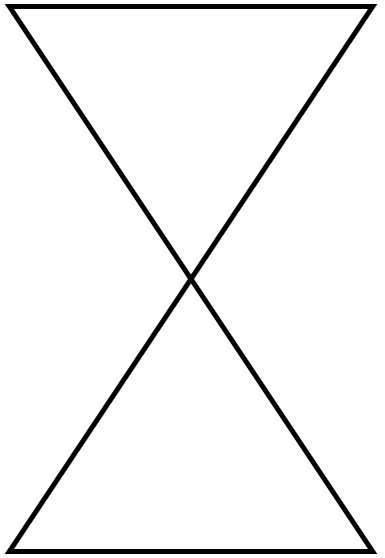
Is the figure shown here a quadrilateral? State, giving reasons.
Answer
A quadrilateral is a simple closed figure bounded by four line segments. In a simple closed figure, the sides meet only at their end points and do not cross one another. In the given figure, the line segments intersect (cross) each other, so it is not a simple closed figure.
Hence, the given figure is not a quadrilateral.
In the adjoining figure, PQRS is a quadrilateral.
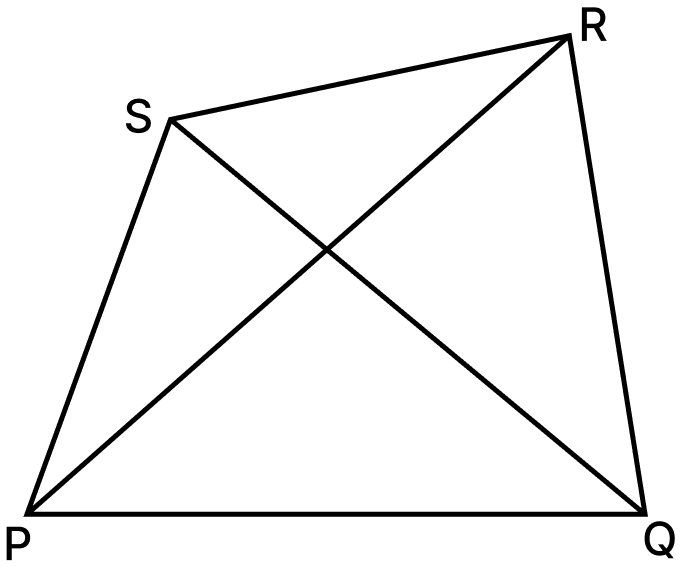
(i) Name a pair of its adjacent sides.
(ii) Name a pair of its opposite sides.
(iii) Name a pair of its adjacent angles.
(iv) Name a pair of its opposite angles.
(v) Name its diagonals.
Answer
In the quadrilateral PQRS:
(i) A pair of adjacent sides (sides having a common end point) is PQ and PS.
(ii) A pair of opposite sides (sides having no common end point) is PQ and SR.
(iii) A pair of adjacent angles (angles having a common side) is ∠P and ∠Q.
(iv) A pair of opposite angles (angles which are not adjacent) is ∠P and ∠R.
(v) The diagonals (line segments joining opposite vertices) are PR and SQ.
How many pairs of adjacent sides does a quadrilateral have?
Answer
A quadrilateral has 4 pairs of adjacent sides.
How many pairs of opposite sides does a quadrilateral have?
Answer
A quadrilateral has 2 pairs of opposite sides.
How many pairs of adjacent angles does a quadrilateral have?
Answer
A quadrilateral has 4 pairs of adjacent angles.
How many pairs of opposite angles does a quadrilateral have?
Answer
A quadrilateral has 2 pairs of opposite angles.
How many diagonals does a quadrilateral have?
Answer
A quadrilateral has 2 diagonals.
For each of the statements given below, indicate whether it is true or false:
(i) A rectangle is a parallelogram.
(ii) A trapezium is a parallelogram.
(iii) A parallelogram is a trapezium.
(iv) A square is a rectangle.
(v) A square is a rhombus.
(vi) A rhombus is a square.
(vii) A parallelogram is a rhombus.
(viii) A kite is a parallelogram.
Answer
(i) True
Reason — A rectangle has both pairs of opposite sides parallel, which is the defining property of a parallelogram. So a rectangle is a parallelogram.
(ii) False
Reason — A trapezium has only one pair of opposite sides parallel, whereas a parallelogram has both pairs of opposite sides parallel. So a trapezium is not a parallelogram.
(iii) True
Reason — A trapezium is a quadrilateral having a pair of opposite sides parallel. In a parallelogram, both pairs of opposite sides are parallel, so it certainly has a pair of opposite sides parallel. Thus, a parallelogram satisfies the condition of a trapezium and can be regarded as a special trapezium.
(iv) True
Reason — A square is a parallelogram in which each angle is a right angle, which is the defining property of a rectangle. So a square is a rectangle.
(v) True
Reason — A square is a parallelogram in which all sides are equal, which is the defining property of a rhombus. So a square is a rhombus.
(vi) False
Reason — A rhombus has all sides equal, but its angles need not be right angles. A square needs all angles to be right angles. So a rhombus is not always a square.
(vii) False
Reason — A parallelogram has opposite sides equal, but its adjacent sides need not be equal. A rhombus needs all sides equal. So a parallelogram is not always a rhombus.
(viii) False
Reason — In a kite, opposite sides are unequal, whereas in a parallelogram opposite sides are equal and parallel. So a kite is not a parallelogram.
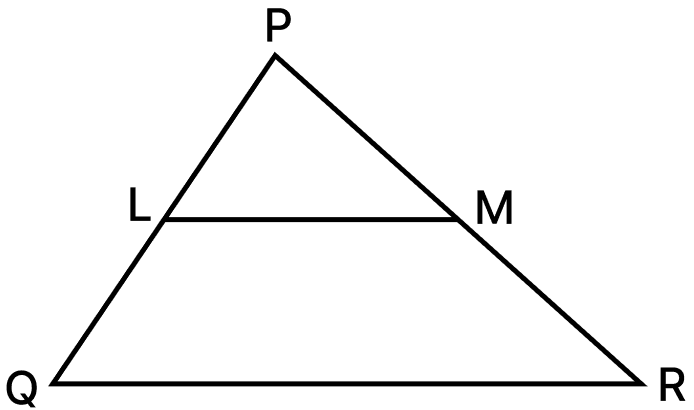
In the adjoining figure, L and M are points on the sides PQ and PR respectively, of ΔPQR such that LM ∥ QR. What special name would you give to the quadrilateral LQRM?
Answer
In the quadrilateral LQRM:
LM ∥ QR (given), so LQRM has one pair of opposite sides parallel.
The other pair of opposite sides, LQ and MR, are not parallel, because they meet at P when produced.
A quadrilateral having one pair of opposite sides parallel is called a trapezium.
Hence, the quadrilateral LQRM is a trapezium.
Let ABCD be a parallelogram. What special name would you give it, when:
(i) AB = AD?
(ii) ∠ABC = 90°?
(iii) AB = AD and ∠ABC = 90°?
Answer
ABCD is a parallelogram, so its opposite sides are equal, i.e. AB = DC and AD = BC.
(i) If AB = AD, then the two adjacent sides are equal. Together with AB = DC and AD = BC, all four sides become equal. A parallelogram with all sides equal is a rhombus.
Hence, ABCD is a rhombus.
(ii) Given ∠ABC = 90°.
In a parallelogram, opposite angles are equal, so ∠ADC = ∠ABC = 90°.
In a parallelogram, adjacent angles are supplementary, so ∠BAD + ∠ABC = 180°, i.e. ∠BAD = 180° − 90° = 90°.
Also, ∠BCD = ∠BAD = 90° (opposite angles).
So, each angle of the parallelogram is a right angle. A parallelogram in which each angle is a right angle is a rectangle.
Hence, ABCD is a rectangle.
(iii) If AB = AD and ∠ABC = 90°, then all four sides are equal and each angle is a right angle. A parallelogram with all sides equal and each angle a right angle is a square.
Hence, ABCD is a square.
How does a trapezium differ from a parallelogram?
Answer
A trapezium has only one pair of opposite sides parallel, whereas a parallelogram has both pairs of opposite sides parallel.
How does a rhombus differ from a square?
Answer
A rhombus has all sides equal but its angles need not be right angles, whereas a square has all sides equal and each of its angles is a right angle (90°).
How does a kite differ from a parallelogram?
Answer
In a kite, two pairs of adjacent sides are equal while the opposite sides are unequal; in a parallelogram, the opposite sides are equal and parallel.
Three angles of a quadrilateral measure 36°, 78° and 116° respectively. Find the measure of the fourth angle.
Answer
We know that the sum of all the four angles of a quadrilateral is 360°.
Let the fourth angle be x.
∴ 36° + 78° + 116° + x = 360°
⇒ 230° + x = 360°
⇒ x = 360° − 230° = 130°
Hence, the measure of the fourth angle is 130°.
The measures of the angles of a quadrilateral are in the ratio 2 : 4 : 5 : 7. Find the measure of each of its angles.
Answer
Let the measures of the angles be 2x, 4x, 5x and 7x.
We know that the sum of all the four angles of a quadrilateral is 360°.
∴ 2x + 4x + 5x + 7x = 360°
⇒ 18x = 360°
⇒ x = = 20°
∴ The angles are:
First angle = 2x = 2 × 20° = 40°
Second angle = 4x = 4 × 20° = 80°
Third angle = 5x = 5 × 20° = 100°
Fourth angle = 7x = 7 × 20° = 140°
Hence, the angles of the quadrilateral are 40°, 80°, 100° and 140°.
Three angles of a quadrilateral are equal and the fourth angle measures 120°. What is the measure of each of the equal angles?
Answer
Let each of the three equal angles be x.
We know that the sum of all the four angles of a quadrilateral is 360°.
∴ x + x + x + 120° = 360°
⇒ 3x + 120° = 360°
⇒ 3x = 360° − 120° = 240°
⇒ x = = 80°
Hence, the measure of each of the equal angles is 80°.
Two angles of a quadrilateral are of measures 75° and 117° respectively and the other two angles are equal. Find the measure of each of the equal angles.
Answer
Let each of the two equal angles be x.
We know that the sum of all the four angles of a quadrilateral is 360°.
∴ 75° + 117° + x + x = 360°
⇒ 192° + 2x = 360°
⇒ 2x = 360° − 192°
⇒ 2x = 168°
⇒ x = = 84°
Hence, the measure of each of the equal angles is 84°.
A quadrilateral has three acute angles, each measuring 75°. What is the measure of its fourth angle?
Answer
The three equal acute angles measure 75° each.
Sum of the three acute angles = 3 × 75° = 225°
We know that the sum of all the four angles of a quadrilateral is 360°.
Let the fourth angle be x.
∴ 225° + x = 360°
⇒ x = 360° − 225° = 135°
Hence, the measure of the fourth angle is 135°.
The lengths of two adjacent sides of a parallelogram are 7 cm and 5 cm respectively. Find the perimeter of the parallelogram.
Answer
Let ABCD be the parallelogram in which AB = 7 cm and BC = 5 cm.
The opposite sides of a parallelogram are equal.
∴ CD = AB = 7 cm and DA = BC = 5 cm
Perimeter of quad. ABCD = AB + BC + CD + DA
= 7 cm + 5 cm + 7 cm + 5 cm
= 24 cm
Hence, the perimeter of the parallelogram is 24 cm.
Two sides of a parallelogram are in the ratio 5 : 3 and its perimeter is 48 cm. Find the length of each of its sides.
Answer
Let the two adjacent sides be 5x cm and 3x cm.
The opposite sides of a parallelogram are equal, so the four sides are 5x, 3x, 5x and 3x cm.
Perimeter = sum of the lengths of all the four sides
∴ 5x + 3x + 5x + 3x = 48
⇒ 16x = 48
⇒ x = = 3
∴ The sides are:
5x = 5 × 3 = 15 cm
3x = 3 × 3 = 9 cm
Hence, the lengths of the sides of the parallelogram are 15 cm, 9 cm, 15 cm and 9 cm.
The perimeter of a parallelogram is 88 cm and one of its adjacent sides is longer than the other by 10 cm. Find the length of each of its sides.
Answer
Let the shorter side be x cm.
Then the longer side = (x + 10) cm.
The opposite sides of a parallelogram are equal, so the four sides are x, (x + 10), x and (x + 10) cm.
Perimeter = sum of the lengths of all the four sides
∴ x + (x + 10) + x + (x + 10) = 88
⇒ 4x + 20 = 88
⇒ 4x = 88 − 20 = 68
⇒ x = = 17
∴ Shorter side = 17 cm
Longer side = 17 + 10 = 27 cm
Hence, the lengths of the sides of the parallelogram are 27 cm, 17 cm, 27 cm and 17 cm.
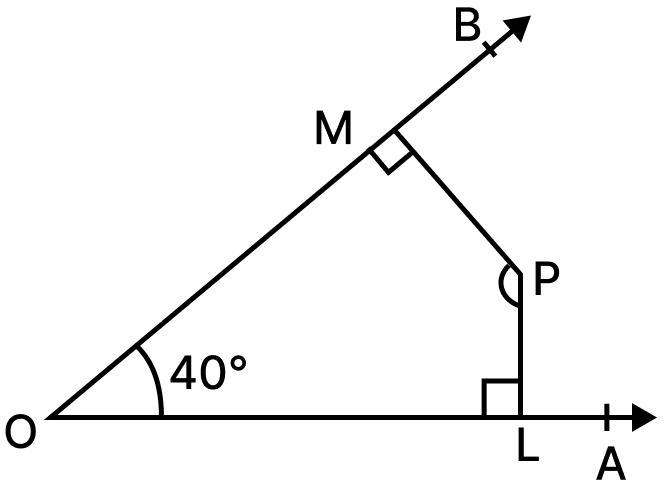
In the adjoining figure, P is a point in the interior of ∠AOB. If PL ⊥ OA and PM ⊥ OB and ∠AOB = 40°, find the measure of ∠LPM.
Answer
Consider the quadrilateral OLPM.
Since PL ⊥ OA, ∠OLP = 90°.
Since PM ⊥ OB, ∠OMP = 90°.
Also, ∠LOM = ∠AOB = 40°.
We know that the sum of all the four angles of a quadrilateral is 360°.
∴ ∠LOM + ∠OLP + ∠LPM + ∠OMP = 360°
⇒ 40° + 90° + ∠LPM + 90° = 360°
⇒ 220° + ∠LPM = 360°
⇒ ∠LPM = 360° − 220° = 140°
Hence, the measure of ∠LPM is 140°.
Give reasons for the following:
(i) A square can be thought of as a special rectangle.
(ii) A square can be thought of as a special rhombus.
(iii) A rectangle can be thought of as a special parallelogram.
Answer
(i) A rectangle is a parallelogram in which each angle is a right angle. A square also has each angle a right angle, together with all sides equal. So a rectangle whose adjacent sides are equal becomes a square.
Hence, a square can be thought of as a special rectangle (a rectangle with all sides equal).
(ii) A rhombus is a parallelogram in which all sides are equal. A square also has all sides equal, together with each angle a right angle. So a rhombus in which each angle is a right angle becomes a square.
Hence, a square can be thought of as a special rhombus (a rhombus with each angle a right angle).
(iii) A parallelogram has both pairs of opposite sides parallel. A rectangle is a parallelogram in which each angle is a right angle. So a parallelogram in which each angle is a right angle becomes a rectangle.
Hence, a rectangle can be thought of as a special parallelogram (a parallelogram with each angle a right angle).
A figure is said to be regular if its sides are equal in length and angles are equal in measure. What do you mean by a regular quadrilateral?
Answer
A regular quadrilateral is a quadrilateral in which all the four sides are equal in length and all the four angles are equal in measure.
Since the sum of the four angles of a quadrilateral is 360°, each equal angle = = 90°.
A quadrilateral with all sides equal and each angle 90° is a square.
Hence, a regular quadrilateral is a square.