
The length of three sides of a triangle are 14 cm, 17 cm and 25 cm. Find the perimeter of the triangle.
Answer
Given:
Sides of the triangle are 14 cm, 17 cm and 25 cm.
As we know, perimeter of a triangle = sum of the lengths of its three sides
∴ Perimeter of the triangle = (14 + 17 + 25) cm
= 56 cm
Hence, the perimeter of the triangle is 56 cm.
The perimeter of a triangle is 40 cm. Two of its sides measure 12.9 cm and 14.6 cm. Find the length of its third side.
Answer
Given:
Perimeter of the triangle = 40 cm
Two sides of the triangle are 12.9 cm and 14.6 cm.
As we know, perimeter of a triangle = sum of the lengths of its three sides
Let the length of the third side be cm. Then,
Hence, the length of the third side is 12.5 cm.
Find the perimeter and area of a rectangle whose length = 25 cm and breadth = 18 cm.
Answer
Given:
Length () = 25 cm and breadth () = 18 cm
Perimeter of the rectangle =
= 2 (25 + 18) cm
= 2 x 43 cm
= 86 cm
Area of the rectangle =
= 25 cm x 18 cm
= 450 cm2
Hence, the perimeter of the rectangle is 86 cm and its area is 450 cm2.
Find the perimeter and area of a rectangle whose length = 27 cm and breadth = 17 cm.
Answer
Given:
Length () = 27 cm and breadth () = 17 cm
Perimeter of the rectangle =
= 2 (27 + 17) cm
= 2 x 44 cm
= 88 cm
Area of the rectangle =
= 27 cm x 17 cm
= 459 cm2
Hence, the perimeter of the rectangle is 88 cm and its area is 459 cm2.
Find the perimeter and area of a rectangle whose length = 7.2 m and breadth = 80 cm.
Answer
Given:
Length () = 7.2 m = 7.2 x 100 cm = 720 cm [1 m = 100 cm]
Breadth () = 80 cm
Perimeter of the rectangle =
= 2 (720 + 80) cm
= 2 x 800 cm
= 1600 cm
= m
= 16 m
Area of the rectangle =
= 720 cm x 80 cm
= 57600 cm2
Hence, the perimeter of the rectangle is 16 m and its area is 57600 cm2.
Each side of a square field is 9 m. Find:
(i) its perimeter
(ii) its area.
Answer
Given:
Side of the square field = 9 m
(i) Perimeter of the square field = 4 x side
= 4 x 9 m
= 36 m
Hence, the perimeter of the field is 36 m.
(ii) Area of the square field = (side)2
= 9 m x 9 m
= 81 m2
Hence, the area of the field is 81 m2.
The area of a square is 256 cm2. Find:
(i) the length of each side of the square
(ii) the perimeter of the square.
Answer
Given:
Area of the square = 256 cm2
(i) As we know, area of a square = (side)2
⇒ (side)2 = 256 cm2 = 16 cm x 16 cm
⇒ side = 16 cm
Hence, the length of each side of the square is 16 cm.
(ii) Perimeter of the square = 4 x side
= 4 x 16 cm
= 64 cm
Hence, the perimeter of the square is 64 cm.
The area of a rectangular field is 768 m2 and its length is 32 m. Find
(i) the breadth of the field
(ii) the cost of fencing it at ₹20 per metre.
Answer
Given:
Area of the field = 768 m2
Length of the field () = 32 m
Rate of fencing = ₹ 20 per metre
(i) Breadth of the field () =
m
= 24 m
Hence, the breadth of the field is 24 m.
(ii) Perimeter of the field =
= 2 (32 + 24) m
= 2 x 56 m
= 112 m
Cost of fencing the field = Perimeter x rate of fencing
= 112 x ₹ 20
= ₹ 2,240
Hence, the cost of fencing the field is ₹ 2,240.
The area of a rectangular field is 3400 m2 and its length is 68 m. Find
(i) its breadth
(ii) the distance covered by a man in going 5 times around the field.
Answer
Given:
Area of the field = 3400 m2
Length of the field () = 68 m
(i) Breadth of the field () =
m
= 50 m
Hence, the breadth of the field is 50 m.
(ii) Perimeter of the field =
= 2 (68 + 50) m
= 2 x 118 m
= 236 m
Distance covered by the man in going 1 time around the field = 236 m
∴ Distance covered by the man in going 5 times around the field = 5 x 236 m = 1180 m
Hence, the distance covered by the man in going 5 times around the field is 1180 m.
The area of a rectangular park is 4100 m2 and its breadth is 50 m. Find the cost of fencing it at ₹ 30 per metre.
Answer
Given:
Area of the park = 4100 m2
Breadth of the park () = 50 m
Rate of fencing = ₹ 30 per metre
Length of the park () =
m
= 82 m
Perimeter of the park =
= 2 (82 + 50) m
= 2 x 132 m
= 264 m
Cost of fencing the park = Perimeter x rate of fencing
= 264 x ₹ 30
= ₹ 7,920
Hence, the cost of fencing the park is ₹ 7,920.
Find the cost of cultivating a rectangular field 35 m long and 18 m wide at ₹ 20 per square metre. Also, find the cost of fencing the field at ₹ 15 per metre.
Answer
Given:
Length of the field () = 35 m
Breadth of the field () = 18 m
Rate of cultivating = ₹ 20 per m2
Rate of fencing = ₹ 15 per metre
Area of the field =
= 35 m x 18 m
= 630 m2
Cost of cultivating the field = Area x rate of cultivating
= 630 x ₹ 20
= ₹ 12,600
Perimeter of the field =
= 2 (35 + 18) m
= 2 x 53 m
= 106 m
Cost of fencing the field = Perimeter x rate of fencing
= 106 x ₹ 15
= ₹ 1,590
Hence, the cost of cultivating the field is ₹ 12,600 and the cost of fencing the field is ₹ 1,590.
The perimeter of a rectangular plot is 174 m and its breadth is 35 m. Find the length and the area of the plot.
Answer
Given:
Perimeter of the plot = 174 m
Breadth of the plot () = 35 m
Let the length of the plot be m.
As we know, perimeter of a rectangle =
∴ Length of the plot = 52 m
Area of the plot =
= 52 m x 35 m
= 1820 m2
Hence, the length of the plot is 52 m and its area is 1820 m2.
A square and a rectangle have equal areas. If each side of the square is 18 cm and the width of the rectangle is 12 cm, find the length of the rectangle.
Answer
Given:
Side of the square = 18 cm
Width of the rectangle = 12 cm
Area of the square = (side)2
= 18 cm x 18 cm
= 324 cm2
As the area of the rectangle = area of the square
⇒ area of the rectangle = 324 cm2
∴ Length of the rectangle =
cm
= 27 cm
Hence, the length of the rectangle is 27 cm.
A rectangular hall is 16 m long and 12 m wide. How many marble slabs of size 25 cm × 15 cm are needed to cover the floor of the hall?
Answer
Given:
Length of the hall = 16 m = 16 x 100 cm = 1600 cm
Breadth of the hall = 12 m = 12 x 100 cm = 1200 cm
Length of each slab = 25 cm
Breadth of each slab = 15 cm
Area of the floor of the hall = length x breadth
= 1600 cm x 1200 cm
= 1920000 cm2
Area of each slab = 25 cm x 15 cm = 375 cm2
∴ Number of slabs required =
= 5120
Hence, 5120 marble slabs are needed to cover the floor of the hall.
A room is 13 m long and 9 m broad. Find the cost of carpeting the room with a carpet 75 cm broad at ₹ 50 per metre.
Answer
Given:
Length of the room = 13 m
Breadth of the room = 9 m
Breadth of the carpet = 75 cm = m = 0.75 m
Rate of the carpet = ₹ 50 per metre
Area of the floor of the room = length x breadth = 13 m x 9 m = 117 m2
Area of the carpet required = area of the floor = 117 m2
∴ Length of the carpet required =
m
= 156 m
Cost of carpeting the room = Length of the carpet x rate
= 156 x ₹ 50
= ₹ 7,800
Hence, the cost of carpeting the room is ₹ 7,800.
How many envelopes can be made out of a sheet of paper 384 cm by 172 cm, if each envelope requires a piece of paper of size 16 cm by 12 cm?
Answer
Given:
Length of the sheet = 384 cm
Breadth of the sheet = 172 cm
Size of paper required for each envelope = 16 cm by 12 cm
Area of the sheet = length x breadth
= 384 cm x 172 cm
= 66048 cm2
Area of paper required for each envelope = 16 cm x 12 cm = 192 cm2
∴ Number of envelopes =
= 344
Hence, 344 envelopes can be made out of the sheet of paper.
The total cost of cultivating a rectangular field at ₹ 15 per m2 is ₹ 18,330. If the breadth of the field is 26 m, find the cost of fencing the field at ₹ 20 per metre.
Answer
Given:
Total cost of cultivating the field = ₹ 18,330
Rate of cultivating = ₹ 15 per m2
Breadth of the field () = 26 m
Rate of fencing = ₹ 20 per metre
Area of the field =
m2
= 1222 m2
Length of the field () =
m
= 47 m
Perimeter of the field =
= 2 (47 + 26) m
= 2 x 73 m
= 146 m
Cost of fencing the field = Perimeter x rate of fencing
= 146 x ₹ 20
= ₹ 2,920
Hence, the cost of fencing the field is ₹ 2,920.
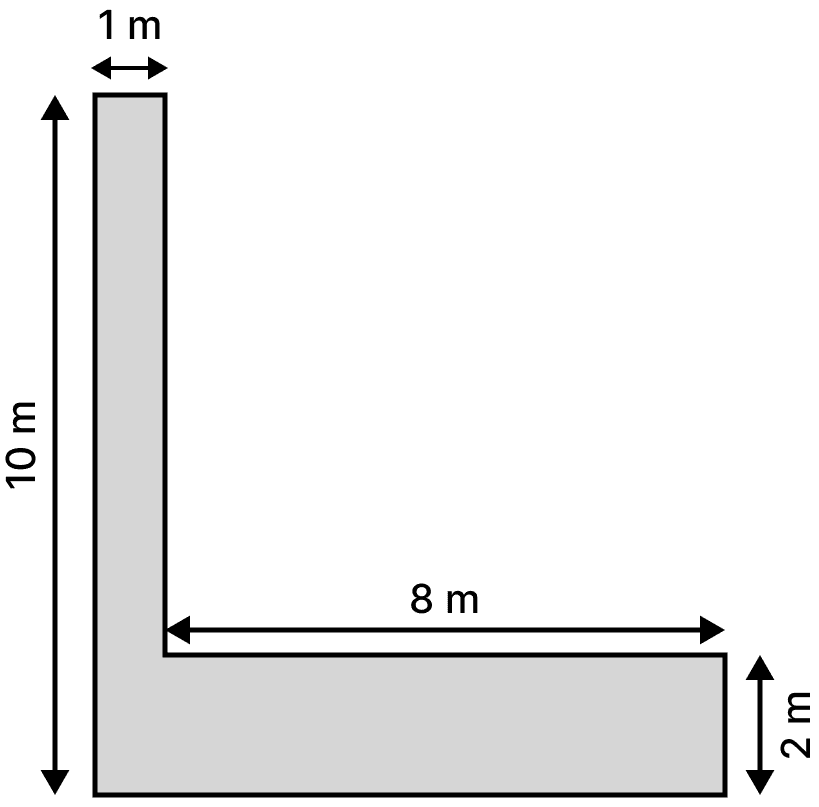
Calculate the area of the shaded region given below:
Answer
Draw a dotted line, as shown in the figure below, to divide the shaded region into two rectangles I and II.
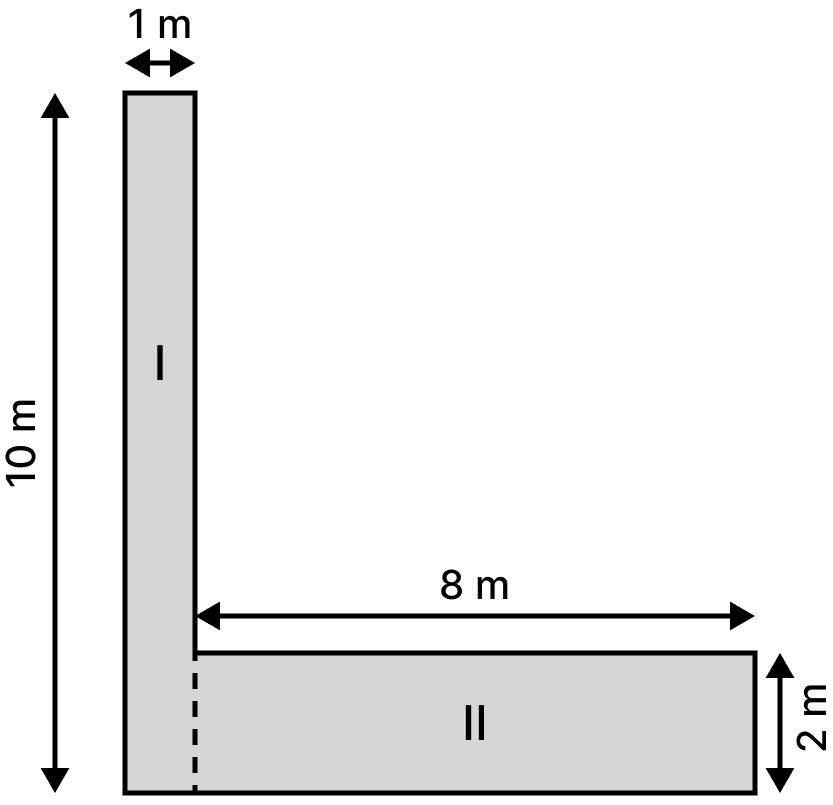
From the figure,
Rectangle I (vertical) is 10 m long and 1 m wide.
Rectangle II (horizontal) is 8 m long and 2 m wide.
As we know, area of a rectangle = length x breadth
∴ Area of the shaded region = area of rectangle I + area of rectangle II
= (10 x 1 + 8 x 2) m2
= (10 + 16) m2
= 26 m2
Hence, the area of the shaded region is 26 m2.
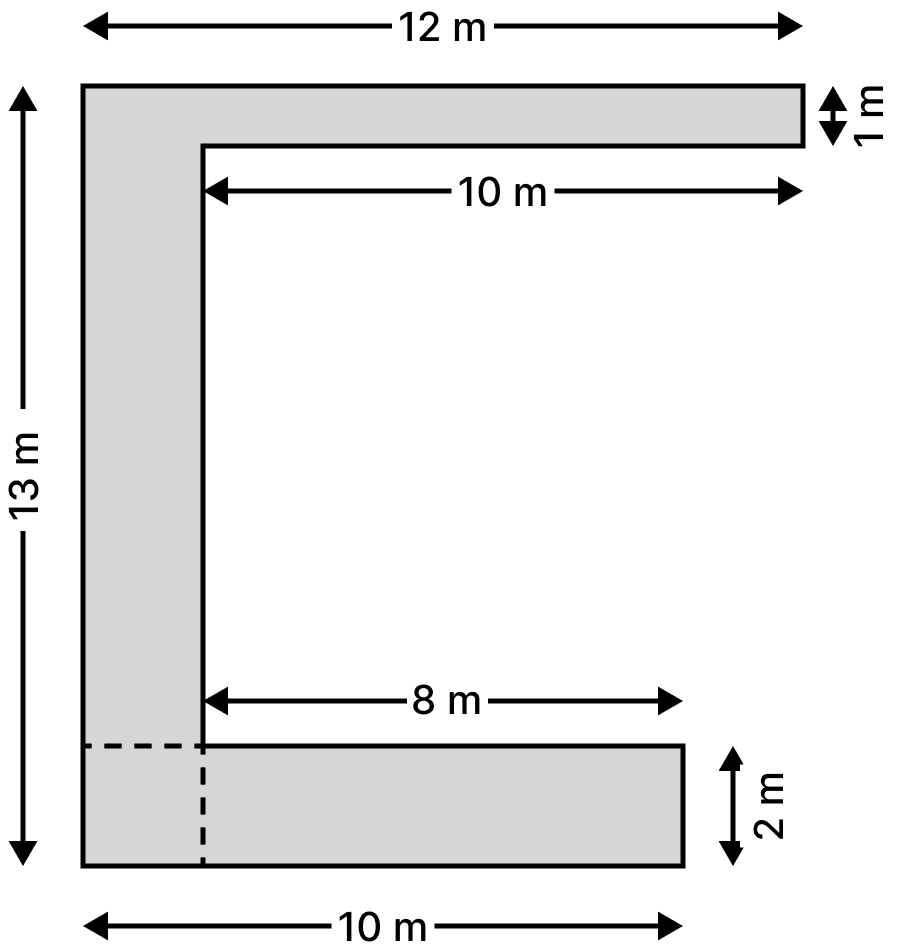
Calculate the area of the shaded region given below:
Answer
Draw dotted lines, as shown in the figure below, to divide the shaded region into three rectangles I, II and III.
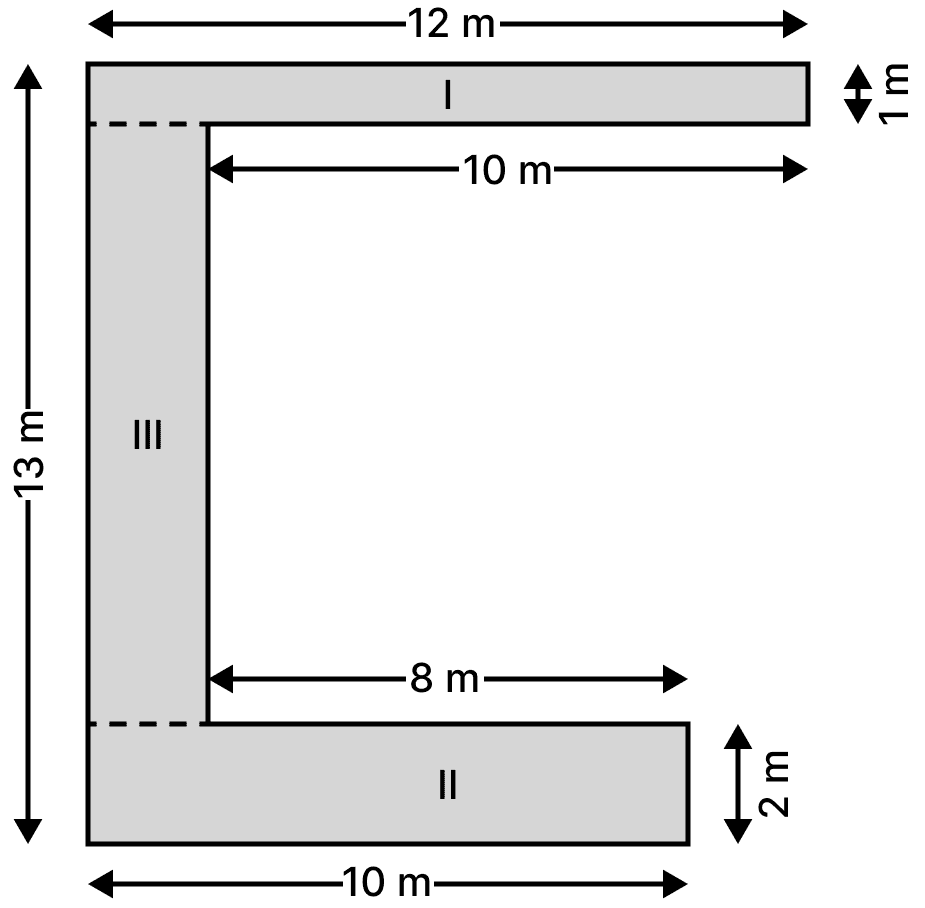
From the figure,
Rectangle I (top) is 12 m long and 1 m wide.
Rectangle II (bottom) is 10 m long and 2 m wide.
Width of rectangle III (middle vertical) = 12 m - 10 m = 2 m
Height of rectangle III (middle vertical) = 13 m - 1 m - 2 m = 10 m
As we know, area of a rectangle = length x breadth
∴ Area of the shaded region = area of rectangle I + area of rectangle II + area of rectangle III
= (12 x 1 + 10 x 2 + 2 x 10) m2
= (12 + 20 + 20) m2
= 52 m2
Hence, the area of the shaded region is 52 m2.
Calculate the area of the shaded region given below:
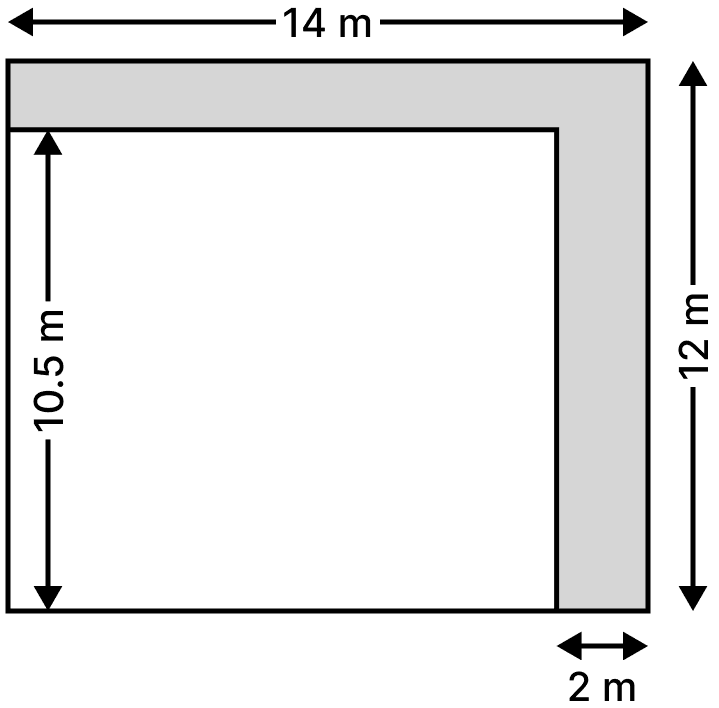
Answer
From the figure,
Length of the outer rectangle = 14 m and breadth = 12 m
Length of the inner (unshaded) rectangle = 14 m - 2 m = 12 m and breadth = 10.5 m
Area of the outer rectangle = 14 m x 12 m = 168 m2
Area of the inner rectangle = 12 m x 10.5 m = 126 m2
∴ Area of the shaded region = area of the outer rectangle - area of the inner rectangle
= 168 m2 - 126 m2
= 42 m2
Hence, the area of the shaded region is 42 m2.
Calculate the area of the shaded region given below:
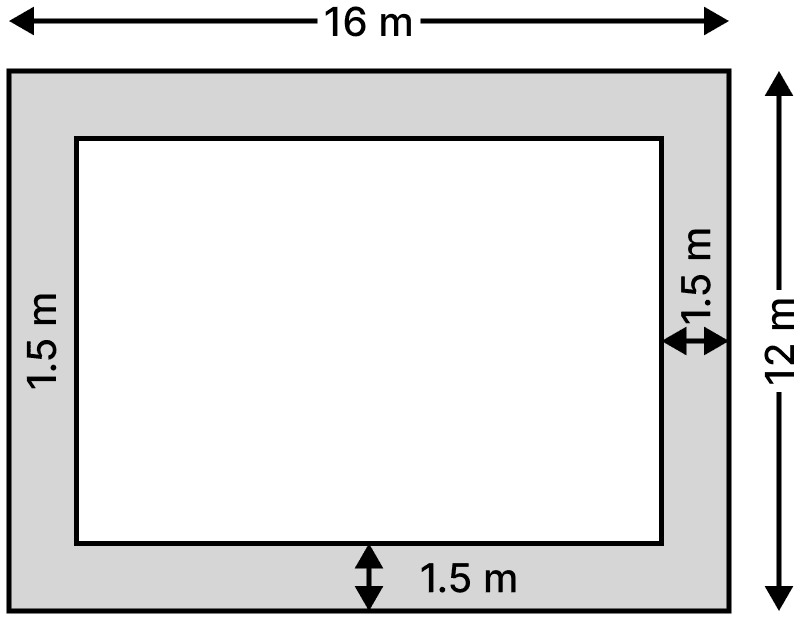
Answer
From the figure,
Length of the outer rectangle = 16 m and breadth = 12 m
Width of the shaded border = 1.5 m
Length of the inner rectangle = 16 m - (1.5 + 1.5) m = 13 m
Breadth of the inner rectangle = 12 m - (1.5 + 1.5) m = 9 m
Area of the outer rectangle = 16 m x 12 m = 192 m2
Area of the inner rectangle = 13 m x 9 m = 117 m2
∴ Area of the shaded region = area of the outer rectangle - area of the inner rectangle
= 192 m2 - 117 m2
= 75 m2
Hence, the area of the shaded region is 75 m2.
Calculate the area of the shaded region given below:
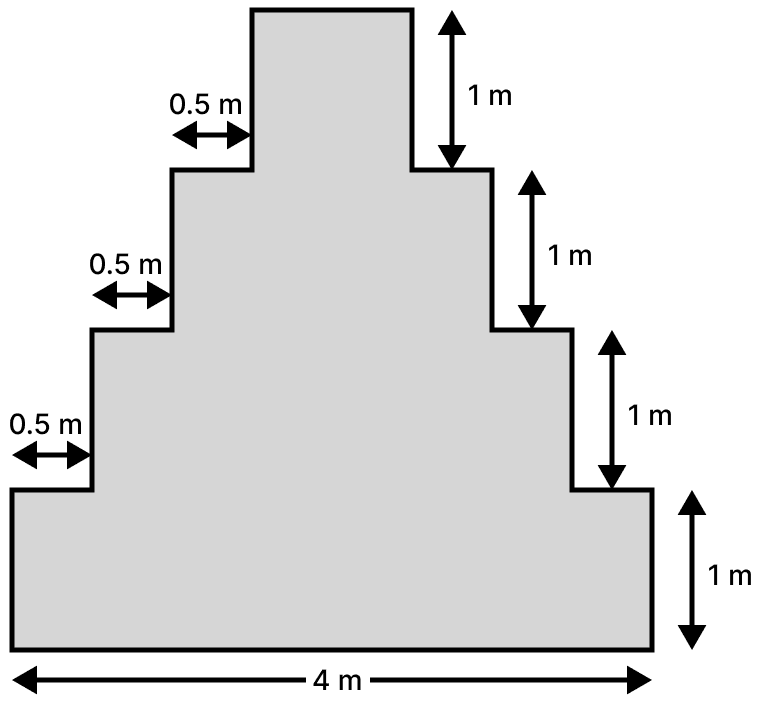
Answer
Draw dotted lines, as shown in the figure below, to divide the shaded region into four rectangles I, II, III and IV placed one above the other.
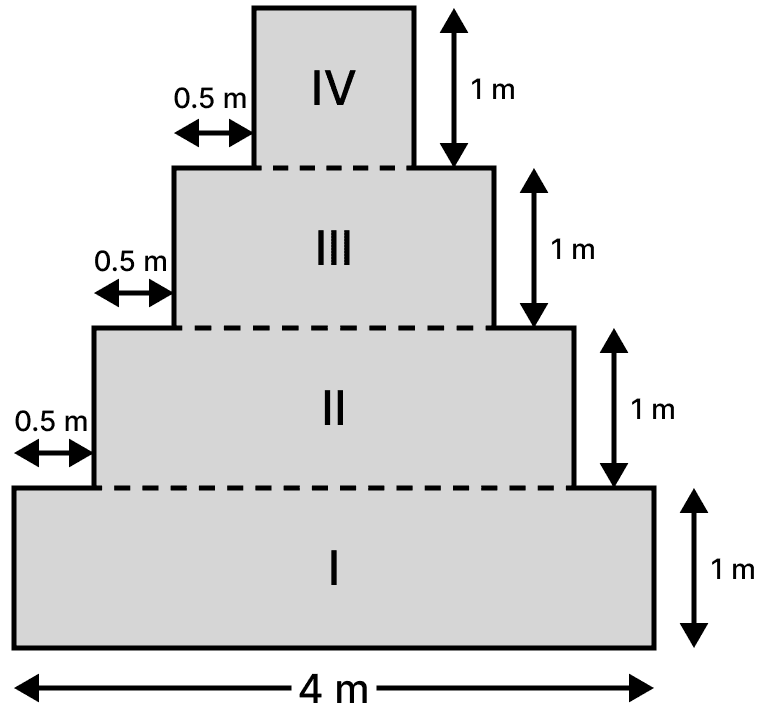
From the figure, each rectangle is of height 1 m, and each upper rectangle is shorter than the one below it by 0.5 m on each side.
Length of rectangle I (bottom) = 4 m
Length of rectangle II = 4 m - (0.5 + 0.5) m = 3 m
Length of rectangle III = 3 m - (0.5 + 0.5) m = 2 m
Length of rectangle IV (top) = 2 m - (0.5 + 0.5) m = 1 m
As we know, area of a rectangle = length x breadth
∴ Area of the shaded region = area of rectangle I + area of rectangle II + area of rectangle III + area of rectangle IV
= (4 x 1 + 3 x 1 + 2 x 1 + 1 x 1) m2
= (4 + 3 + 2 + 1) m2
= 10 m2
Hence, the area of the shaded region is 10 m2.