
A recipe requires ingredients in the ratio 2 : 3 : 4 (sugar : flour : milk). If 12 cups of flour are used, how many total cups of ingredients are required?
9 cups
18 cups
27 cups
36 cups
Answer
Sum of ratio terms = 2 + 3 + 4 = 9.
So, the flour forms of the total quantity.
Total cups = 12
Total cups = = 4 × 9 = 36 cups.
Hence, option 4 is the correct option.
The antecedent and consequent of a ratio ............... changed unless there is a change in the given statements.
Can be
Cannot be
Sometimes
None of these
Answer
A ratio compares two fixed given quantities. The antecedent (first term) and the consequent (second term) are determined by these quantities, so they cannot be changed unless the given statements themselves change.
Hence, option 2 is the correct option.
What is the ratio of the shaded area to the unshaded area?
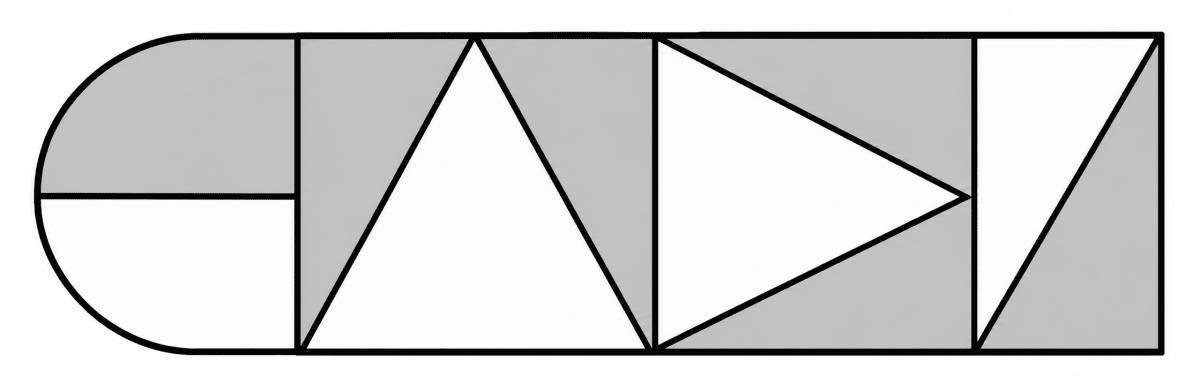
1 : 2
2 : 1
3 : 2
1 : 1
Answer
In the given figure, each shape is divided so that the shaded region and the unshaded region are equal in area. Therefore, the shaded area and the unshaded area are in the ratio 1 : 1.
Hence, option 4 is the correct option.
The ratio of the number of sides of a square and the number of edges of a cube is:
1 : 2
1 : 3
1 : 4
2 : 3
Answer
Number of sides of a square = 4.
Number of edges of a cube = 12.
Ratio = 4 : 12
H.C.F. of 4 and 12 is 4.
Hence, option 2 is the correct option.
On a shelf, the books with green cover and that with brown cover are in the ratio 2 : 3. If there are 18 books with green cover, then the number of books with brown cover is:
12
24
27
36
Answer
Sum of ratio terms = 2 + 3 = 5.
So, the green-cover books form of the total number of books.
Total books = 18
Total books = = 9 × 5 = 45.
Number of brown-cover books = = 3 × 9 = 27.
Hence, option 3 is the correct option.
In a quiz programme, the ratio of correct answers to incorrect answers given by a contestant is 5 : 2. If the contestant gives 16 incorrect answers, then the number of correct answers given is:
80
40
20
30
Answer
Sum of ratio terms = 5 + 2 = 7.
So, the incorrect answers form of the total number of answers.
Total answers = 16
Total answers = = 8 × 7 = 56.
Number of correct answers = = 5 × 8 = 40.
Hence, option 2 is the correct option.
The ratio of the volume of water in bottle I to the volume of water in bottle II is 3 : 4. Rajeev drank 40 ml of the water from bottle I and then the ratio becomes 13 : 20. How much water was there in bottle II at first?
60 ml
80 ml
300 ml
400 ml
Answer
Let the volume of water in bottle I be ml and in bottle II be ml.
After Rajeev drinks 40 ml from bottle I, the ratio becomes:
Volume of water in bottle II at first = 4x = 4 × 100 = 400 ml.
Hence, option 4 is the correct option.
Which of the following are not in proportion?
7, 12, 805, 1380
16, 28, 4, 7
150, 100, 135, 90
51, 85, 57, 98
Answer
Four numbers are in proportion if product of extremes = product of means.
Option 1: 7 × 1380 = 9660 and 12 × 805 = 9660. Equal, so in proportion.
Option 2: 16 × 7 = 112 and 28 × 4 = 112. Equal, so in proportion.
Option 3: 150 × 90 = 13500 and 100 × 135 = 13500. Equal, so in proportion.
Option 4: 51 × 98 = 4998 and 85 × 57 = 4845. Since 4998 ≠ 4845, they are not in proportion.
Hence, option 4 is the correct option.
A profit of ₹3,000 is shared among X, Y and Z in the ratio 2 : 3 : 1. How much more money does Y get than X?
₹1,000
₹1,600
₹500
₹800
Answer
Sum of ratio terms = 2 + 3 + 1 = 6.
X's share = = 2 × ₹500 = ₹1,000.
Y's share = = 3 × ₹500 = ₹1,500.
Difference = ₹1,500 − ₹1,000 = ₹500.
Hence, option 3 is the correct option.
A sum of ₹3,690 is divided among P, Q, R and S such that
.
Then, Q's share is:
₹1,250
₹1,000
₹640
₹800
Answer
Given that each share is of the next one, so:
, and .
Let us express each share in terms of S. Substituting one relation into the next:
So, .
The denominators here are 125, 25, 5 and 1, and their L.C.M. is 125. So S must be a multiple of 125 for all four shares to come out as whole numbers.
Therefore we take S = 125k, where k is a positive number. Putting S = 125k in the above relations:
So, P : Q : R : S = 64k : 80k : 100k : 125k = 64 : 80 : 100 : 125.
Sum of ratio terms = 64 + 80 + 100 + 125 = 369.
Q's share = = 80 × ₹10 = ₹800.
Hence, option 4 is the correct option.
Sam ordered 21 cupcakes. Out of 15 guests that come to the party, 6 guests had two cupcakes each, 3 guests had one cupcake each and remaining guests did not have any, cupcakes. What is the ratio of the number of cupcakes left to the number of cupcakes had by the guests?
2 : 5
2 : 7
5 : 2
5 : 7
Answer
Number of cupcakes had by 6 guests = 6 × 2 = 12.
Number of cupcakes had by 3 guests = 3 × 1 = 3.
Total cupcakes had by the guests = 12 + 3 = 15.
Number of cupcakes left = 21 − 15 = 6.
Ratio of cupcakes left to cupcakes had = 6 : 15
H.C.F. of 6 and 15 is 3.
Hence, option 1 is the correct option.