
If the area of a rectangle is equal to the area of a square of side and length of the rectangle is equal to the perimeter of the square, then the breadth of the rectangle is:
Answer
Given:
Side of the square =
Area of the square = (side)2 =
Perimeter of the square = 4 x side =
∴ Length of the rectangle = perimeter of the square =
And, area of the rectangle = area of the square =
Breadth of the rectangle =
Hence, option 3 is the correct option.
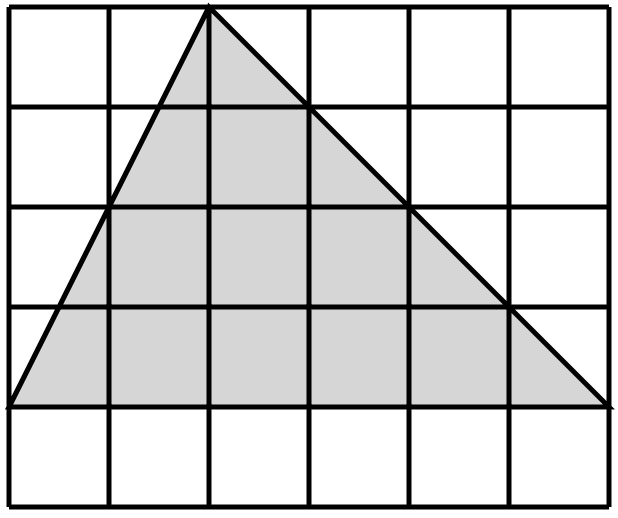
The area of the shaded figure, taking the area of each square as 1 cm2 is:
48 cm2
16 cm2
12 cm2
18 cm2
Answer
From the figure, the base of the shaded triangle covers 6 squares and its height covers 4 squares.
The shaded triangle lies in a rectangle of 6 x 4 = 24 squares and covers exactly half of it.
∴ Area of the rectangle = 24 x 1 cm2 = 24 cm2
∴ Area of the shaded figure = x 24 cm2 = 12 cm2
Hence, option 3 is the correct option.
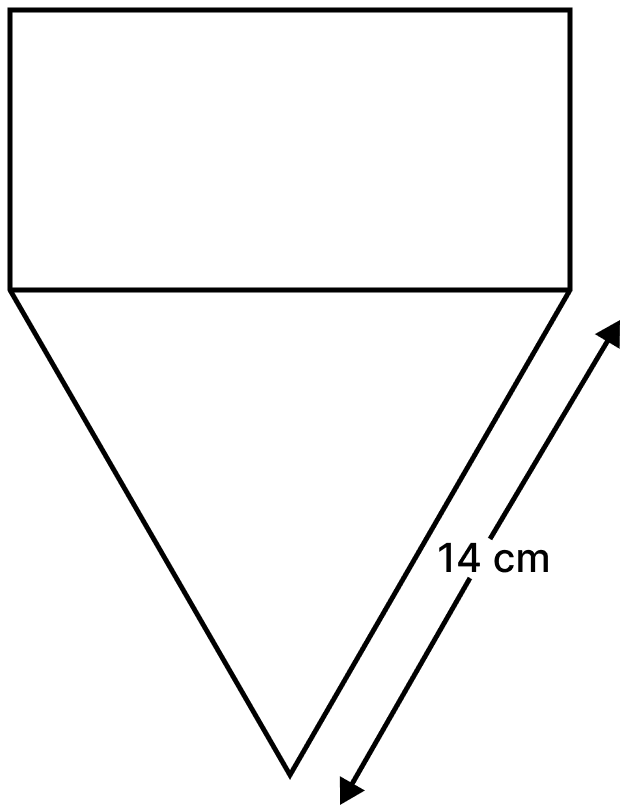
The given figure is made up of a rectangle and an equilateral triangle. The width of the rectangle is half the length of the rectangle. The perimeter of the figure is:
48 cm
56 cm
72 cm
52 cm
Answer
Given:
Side of the equilateral triangle = 14 cm
From the figure, the equilateral triangle is drawn on the length of the rectangle.
∴ Length of the rectangle = side of the equilateral triangle = 14 cm
Width of the rectangle = x length = x 14 cm = 7 cm
The boundary of the figure consists of the top side of the rectangle, its two widths and the two outer sides of the equilateral triangle.
∴ Perimeter of the figure = (14 + 7 + 7 + 14 + 14) cm
= 56 cm
Hence, option 2 is the correct option.
The length of the wooden strip required to frame a photograph having length and breadth as 39.5 cm and 31 cm respectively is:
79 cm
1224.5 cm
141 cm
70.5 cm
Answer
Given:
Length of the photograph () = 39.5 cm
Breadth of the photograph () = 31 cm
Length of the wooden strip required = perimeter of the photograph
=
= 2 (39.5 + 31) cm
= 2 x 70.5 cm
= 141 cm
Hence, option 3 is the correct option.
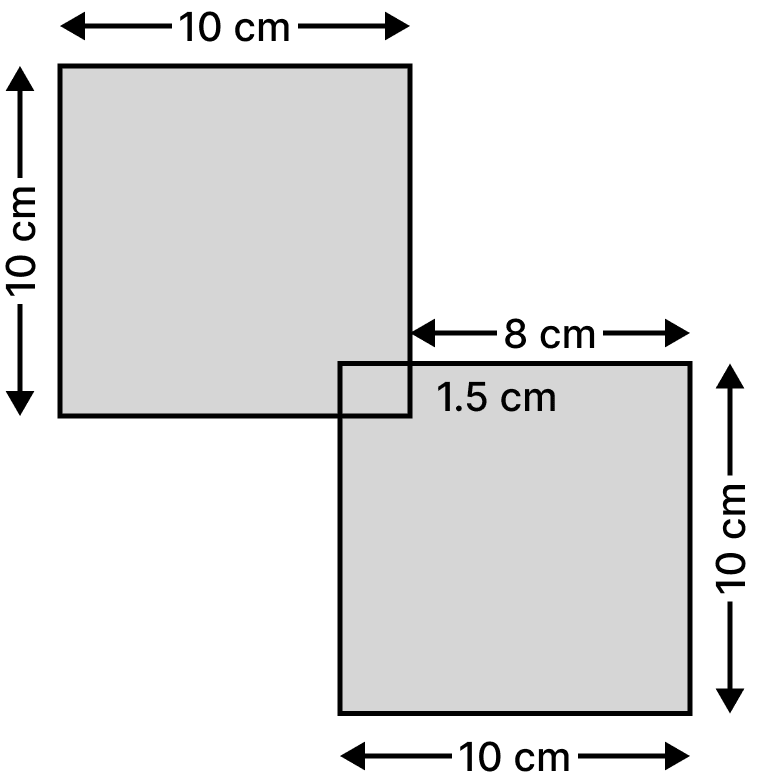
The perimeter of the given figure is:
80 cm
70 cm
72 cm
73 cm
Answer
From the figure, the given figure is made up of two squares of side 10 cm each, overlapping each other.
Width of the overlapping part = 10 cm - 8 cm = 2 cm
Height of the overlapping part = 1.5 cm
Sides of the upper square on the boundary of the figure:
top side = 10 cm, left side = 10 cm, bottom side = 10 cm - 2 cm = 8 cm and right side = 10 cm - 1.5 cm = 8.5 cm
Sides of the lower square on the boundary of the figure:
right side = 10 cm, bottom side = 10 cm, top side = 10 cm - 2 cm = 8 cm and left side = 10 cm - 1.5 cm = 8.5 cm
∴ Perimeter of the figure = (10 + 10 + 8 + 8.5 + 10 + 10 + 8 + 8.5) cm
= 73 cm
Hence, option 4 is the correct option.
A rectangular plot measures 43.15 m by 30.72 m. Which of the following is the best estimate for its perimeter?
146 m
148 m
172 m
None of these
Answer
Given:
Length of the plot () = 43.15 m ≈ 43 m
Breadth of the plot () = 30.72 m ≈ 31 m
Estimated perimeter of the plot =
= 2 (43 + 31) m
= 2 x 74 m
= 148 m
Hence, option 2 is the correct option.
A square and a rectangle have equal areas. If each side of the square is 18 cm and the width of the rectangle is 12 cm, then the perimeter of the rectangle is:
48 cm
56 cm
92 cm
78 cm
Answer
Given:
Side of the square = 18 cm
Width of the rectangle () = 12 cm
Area of the square = (side)2 = 18 cm x 18 cm = 324 cm2
∴ Area of the rectangle = area of the square = 324 cm2
Length of the rectangle () =
cm
= 27 cm
Perimeter of the rectangle =
= 2 (27 + 12) cm
= 2 x 39 cm
= 78 cm
Hence, option 4 is the correct option.
A rectangular piece of land measures 2 m by 3 m. Each side is to be fenced with three rows of wire. The length of wire needed is:
45 m
44 m
30 m
21 m
Answer
Given:
Length of the land () = 3 m
Breadth of the land () = 2 m
Perimeter of the land =
= 2 (3 + 2) m
= 2 x 5 m
= 10 m
Length of wire needed for one row = 10 m
∴ Length of wire needed for three rows = 3 x 10 m = 30 m
Hence, option 3 is the correct option.
The number of envelopes that can be made out of a sheet of paper 384 cm by 168 cm, if each envelope requires a piece of paper of size 16 cm by 12 cm is:
340
344
336
342
Answer
Given:
Length of the sheet = 384 cm
Breadth of the sheet = 168 cm
Size of paper required for each envelope = 16 cm by 12 cm
Area of the sheet = length x breadth
= 384 cm x 168 cm
= 64512 cm2
Area of paper required for each envelope = 16 cm x 12 cm = 192 cm2
∴ Number of envelopes =
= 336
Hence, option 3 is the correct option.
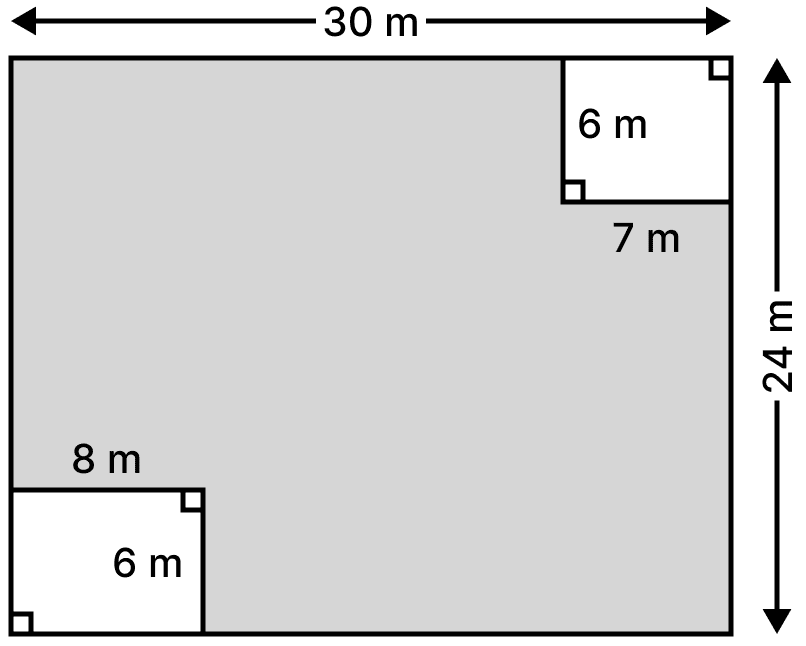
The shaded area of the floor is to be tiled. If tiling costs ₹ 15 per m2, then what will be the total cost?
₹ 9,030
₹ 6,540
₹ 8,464
₹ 9,450
Answer
From the figure,
Length of the floor = 30 m and breadth = 24 m
Unshaded rectangle at the top-right corner = 7 m x 6 m
Unshaded rectangle at the bottom-left corner = 6 m x 8 m
Area of the floor = 30 m x 24 m = 720 m2
Area of the unshaded rectangle at the top-right corner = 7 m x 6 m = 42 m2
Area of the unshaded rectangle at the bottom-left corner = 6 m x 8 m = 48 m2
∴ Area of the shaded region = (720 - 42 - 48) m2
= 630 m2
Cost of tiling = Area x rate of tiling
= 630 x ₹ 15
= ₹ 9,450
Hence, option 4 is the correct option.
If the area of a square is numerically equal to the perimeter of the square, then the side of the square is:
2 units
3 units
4 units
5 units
Answer
Let the side of the square be units.
Area of the square = and perimeter of the square =
Given, area = perimeter (numerically)
Since the side of a square cannot be zero, .
∴ Side of the square = 4 units
Hence, option 3 is the correct option.
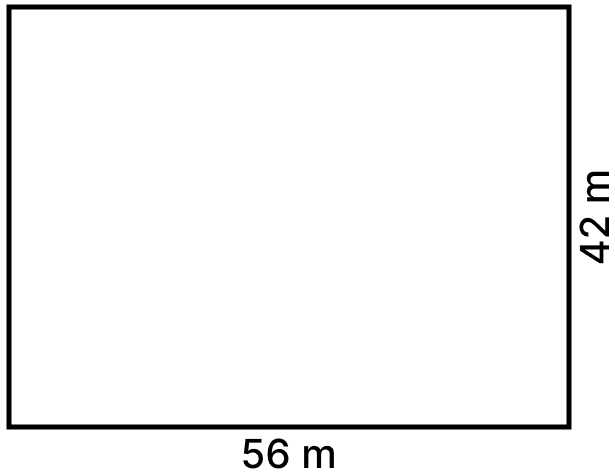
The length of the given rectangular field is decreased by 7 m. Its new width, if its area remains unchanged is:
48 m
42 m
64 m
34 m
Answer
From the figure,
Length of the field = 56 m and width = 42 m
Area of the field = 56 m x 42 m = 2352 m2
New length of the field = 56 m - 7 m = 49 m
As the area remains unchanged,
New width of the field =
m
= 48 m
Hence, option 1 is the correct option.