
Assertion (A): Each letter of the word MODEL has at least one line of symmetry.
Reason (R): A line of symmetry of a figure divides it into two identical parts.
Both Assertion (A) and Reason (R) are true and Reason (R) is the correct explanation of Assertion (A).
Both Assertion (A) and Reason (R) are true but Reason (R) is not the correct explanation of Assertion (A).
Assertion (A) is true but Reason (R) is false.
Assertion (A) is false but Reason (R) is true.
Answer
The letter M has one vertical line of symmetry, the letter O has two lines of symmetry and the letters D and E have one horizontal line of symmetry each.
The letter L cannot be folded into two coincident parts about any line. So, the letter L has no line of symmetry.
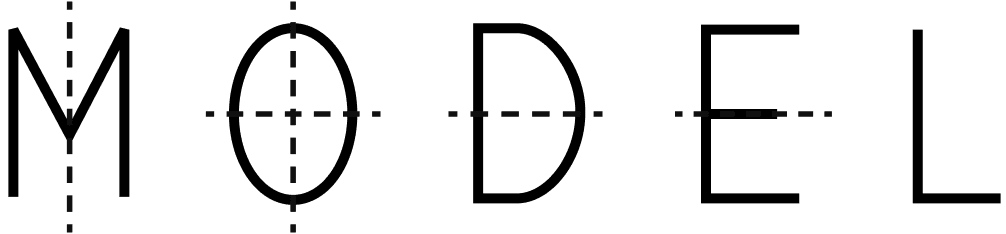
So, Assertion (A) is false.
A line of symmetry of a figure divides it into two identical parts, which coincide on folding the figure about the line.
So, Reason (R) is true.
∴ Assertion (A) is false but Reason (R) is true.
Hence, option 4 is the correct option.
Assertion (A): Each diameter of a circle is its line of symmetry.
Reason (R): A circle has an infinite number of lines of symmetry.
Both Assertion (A) and Reason (R) are true and Reason (R) is the correct explanation of Assertion (A).
Both Assertion (A) and Reason (R) are true but Reason (R) is not the correct explanation of Assertion (A).
Assertion (A) is true but Reason (R) is false.
Assertion (A) is false but Reason (R) is true.
Answer
On folding a circle about any of its diameters, the two semi-circles coincide. So, each diameter of a circle is its line of symmetry.
So, Assertion (A) is true.
A circle has an infinite number of lines of symmetry, as every line passing through its centre, i.e., every diameter, divides it into two identical parts.
So, Reason (R) is true.
∴ Both Assertion (A) and Reason (R) are true and Reason (R) is the correct explanation of Assertion (A).
Hence, option 1 is the correct option.