
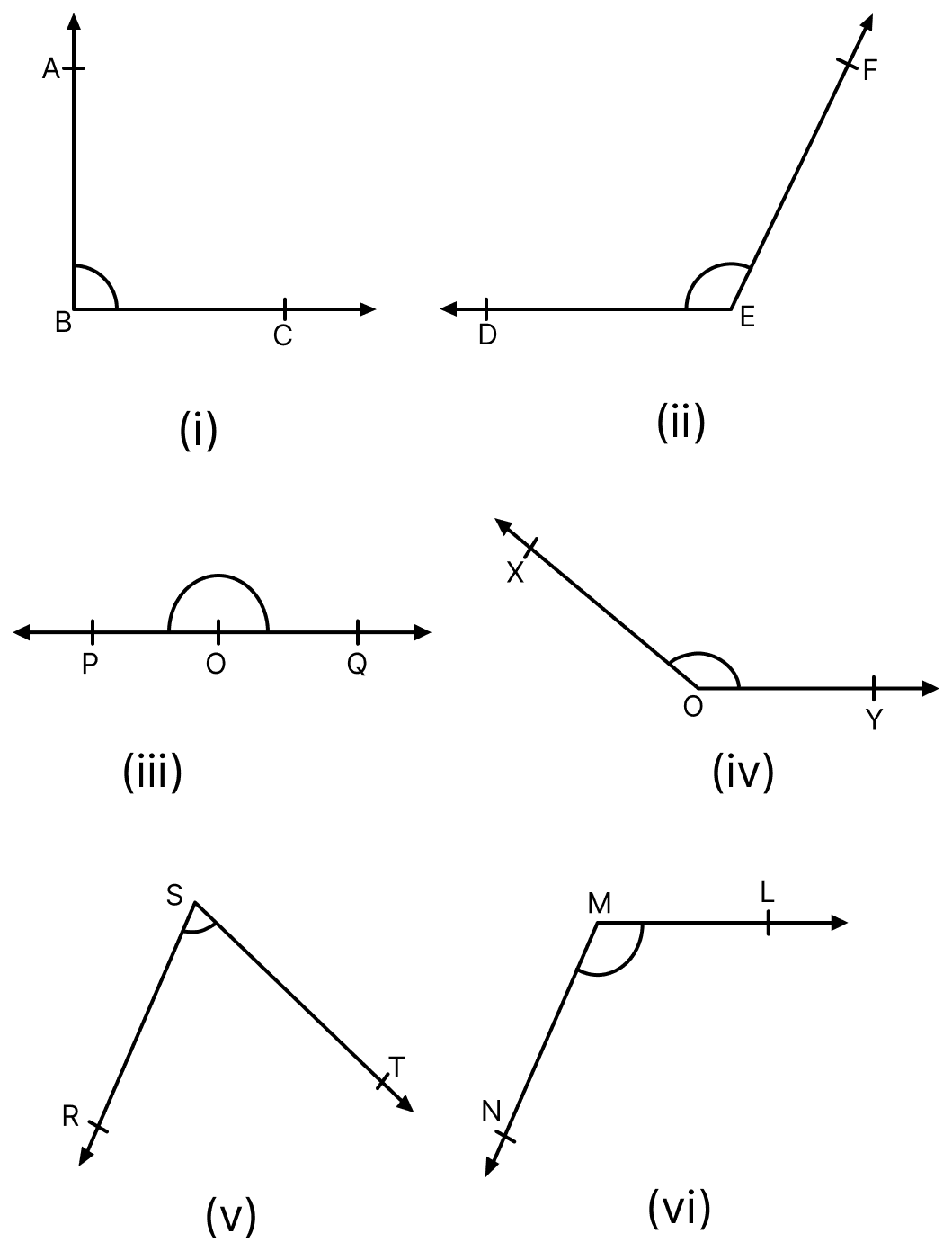
Measure each of the following angles. Write its measure. Write whether it is acute, obtuse, right angle, a straight angle or a reflex angle.
Answer
To measure each angle, place the protractor so that its centre is exactly on the vertex and its base line lies along one arm. Then read off the mark on the scale (starting from 0°) through which the other arm passes.
The angle is then named according to its measure — acute (more than 0° but less than 90°), right (exactly 90°), obtuse (more than 90° but less than 180°), straight (exactly 180°) or reflex (more than 180° but less than 360°).
(i) The arm passes through the 90° mark, and an angle of exactly 90° is a right angle.
90°, a right angle.
(ii) The arm passes through the 115° mark. Since 90° < 115° < 180°, it is an obtuse angle.
115°, an obtuse angle.
(iii) The two arms lie in opposite directions along the same straight line and the arm passes through the 180° mark, so it is a straight angle.
180°, a straight angle.
(iv) The arm passes through the 145° mark. Since 90° < 145° < 180°, it is an obtuse angle.
145°, an obtuse angle.
(v) The arm passes through the 78° mark. Since 0° < 78° < 90°, it is an acute angle.
78°, an acute angle.
(vi) The arm passes through the 120° mark. Since 90° < 120° < 180°, it is an obtuse angle.
120°, an obtuse angle.
Classify the angle whose magnitude is given below:
93°
Answer
An angle whose measure is more than 90° but less than 180° is called an obtuse angle. Since 90° < 93° < 180°, the given angle is an obtuse angle.
Hence, 93° is an obtuse angle.
Classify the angle whose magnitude is given below:
180°
Answer
An angle whose measure is exactly 180° is called a straight angle. The given angle measures 180°, so it is a straight angle.
Hence, 180° is a straight angle.
Classify the angle whose magnitude is given below:
86°
Answer
An angle whose measure is more than 0° but less than 90° is called an acute angle. Since 0° < 86° < 90°, the given angle is an acute angle.
Hence, 86° is an acute angle.
Classify the angle whose magnitude is given below:
125°
Answer
An angle whose measure is more than 90° but less than 180° is called an obtuse angle. Since 90° < 125° < 180°, the given angle is an obtuse angle.
Hence, 125° is an obtuse angle.
Classify the angle whose magnitude is given below:
0°
Answer
An angle whose measure is 0° is called a zero angle. It is formed when the two arms of the angle coincide with each other.
Hence, 0° is a zero angle.
Classify the angle whose magnitude is given below:
90.5°
Answer
An angle whose measure is more than 90° but less than 180° is called an obtuse angle. Since 90° < 90.5° < 180°, the given angle is an obtuse angle.
Hence, 90.5° is an obtuse angle.
Classify the angle whose magnitude is given below:
89.5°
Answer
An angle whose measure is more than 0° but less than 90° is called an acute angle. Since 0° < 89.5° < 90°, the given angle is an acute angle.
Hence, 89.5° is an acute angle.
Classify the angle whose magnitude is given below:
90°
Answer
An angle whose measure is exactly 90° is called a right angle. The given angle measures 90°, so it is a right angle.
Hence, 90° is a right angle.
Classify the angle whose magnitude is given below:
360°
Answer
An angle whose measure is 360° is called a complete angle. It is formed when a ray makes one full rotation about its end point and comes back to its initial position.
Hence, 360° is a complete angle.
Classify the angle whose magnitude is given below:
182°
Answer
An angle whose measure is more than 180° but less than 360° is called a reflex angle. Since 180° < 182° < 360°, the given angle is a reflex angle.
Hence, 182° is a reflex angle.
Classify the angle whose magnitude is given below:
3°
Answer
An angle whose measure is more than 0° but less than 90° is called an acute angle. Since 0° < 3° < 90°, the given angle is an acute angle.
Hence, 3° is an acute angle.
Classify the angle whose magnitude is given below:
25°
Answer
An angle whose measure is more than 0° but less than 90° is called an acute angle. Since 0° < 25° < 90°, the given angle is an acute angle.
Hence, 25° is an acute angle.
How many degrees are there in one right angle ?
Answer
We know that 1 right angle = 90°.
One right angle = 90°.
Hence, one right angle = 90°.
How many degrees are there in two right angles ?
Answer
We know that 1 right angle = 90°.
Two right angles = 2 × 90° = 180°.
Hence, two right angles = 180°.
How many degrees are there in three right angles ?
Answer
We know that 1 right angle = 90°.
Three right angles = 3 × 90° = 270°.
Hence, three right angles = 270°.
How many degrees are there in right angles ?
Answer
We know that 1 right angle = 90°.
right angles = × 90° = 54°.
Hence, right angles = 54°.
How many degrees are there in right angles ?
Answer
We know that 1 right angle = 90°.
right angles = × 90° = 135°.
Hence, right angles = 135°.
How many degrees are there in four right angles ?
Answer
We know that 1 right angle = 90°.
Four right angles = 4 × 90° = 360°.
Hence, four right angles = 360°.