
Which of the following is not a net for a cube?
Answer
A net of a cube is made up of six equal squares, which on folding form the six faces of the cube in such a way that no two squares overlap and no face of the cube is left open.
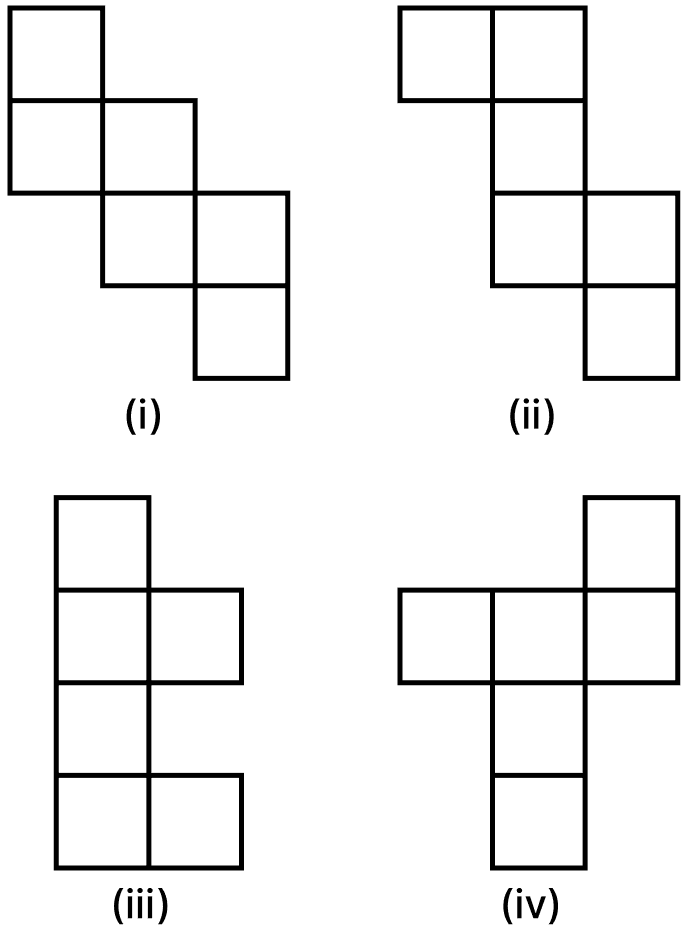
On folding the nets (i), (ii) and (iv), each of the six squares forms a different face of the cube and a cube is obtained.
In net (iii), the two squares attached to the column of four squares lie on the same side of the column. On folding, both these squares form the same face of the cube, so they overlap each other and one face of the cube is left open. So, a cube cannot be formed from it.
Hence, net (iii) is not a net for a cube.
Which of the following is a net for a cube?
Answer
A net of a cube is made up of six equal squares, which on folding form the six faces of the cube in such a way that no two squares overlap and no face of the cube is left open.
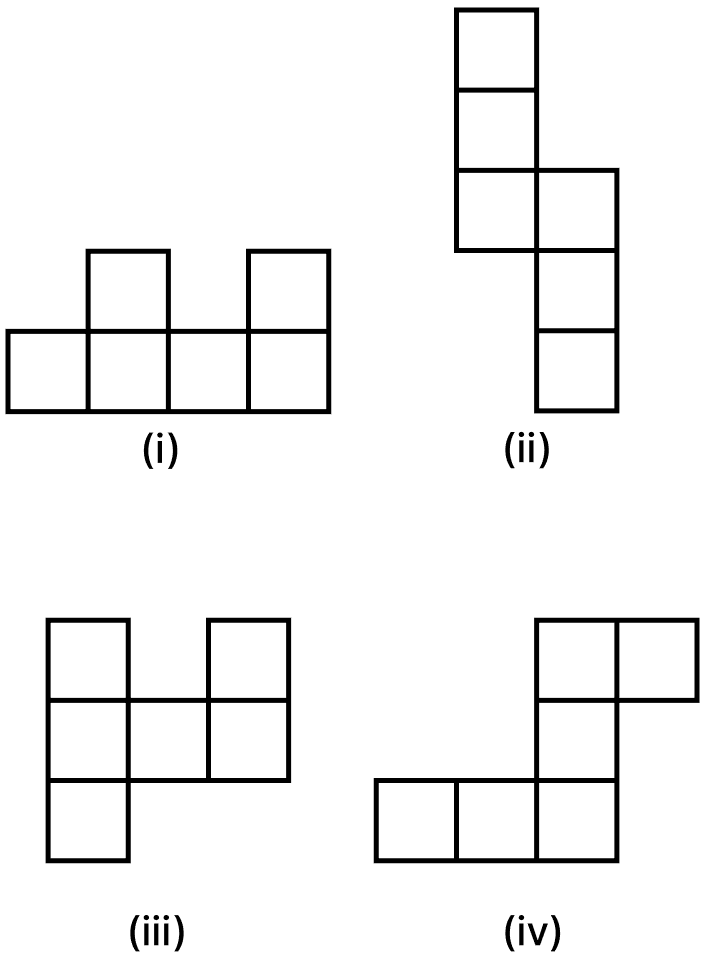
On folding the net (ii), each of the six squares forms a different face of the cube and a cube is obtained.
On folding the nets (i), (iii) and (iv), two of the squares overlap each other and one face of the cube is left open. So, a cube cannot be formed from them.
Hence, net (ii) is a net for a cube.
Which of the following is a net for a cylinder?
Answer
A cylinder has a curved surface and two circular faces at its ends, namely the top and the base.
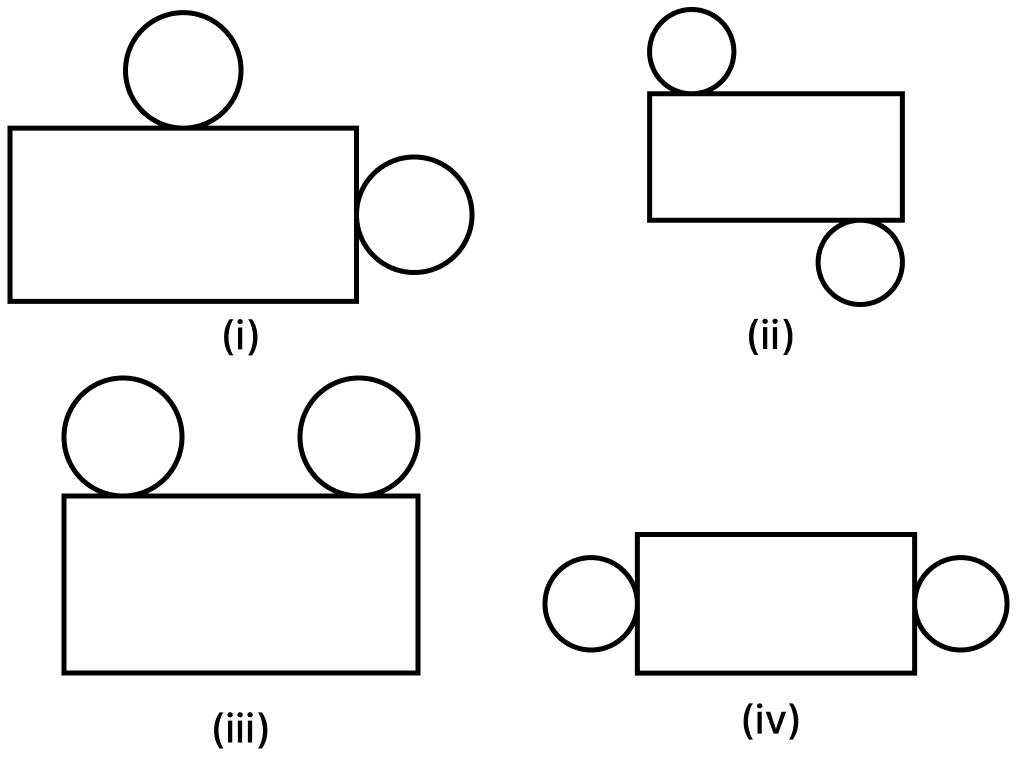
In the net of a cylinder, the rectangle forms the curved surface when rolled. The two circles must be attached to the opposite sides of the rectangle that form the circular rims. In the given figures, these are the two longer sides.
In net (ii), the two circles are attached to the two opposite longer sides of the rectangle. On folding, they form the top and the base of the cylinder.
In net (i), one circle is attached to a shorter side of the rectangle. In net (iii), both the circles are attached to the same side of the rectangle. In net (iv), both the circles are attached to the shorter sides of the rectangle. So, a cylinder cannot be formed from them.
Hence, net (ii) is a net for a cylinder.
Which of the following is not a net for a cuboid?
Answer
A cuboid has 6 rectangular faces, which form three pairs of equal opposite faces.
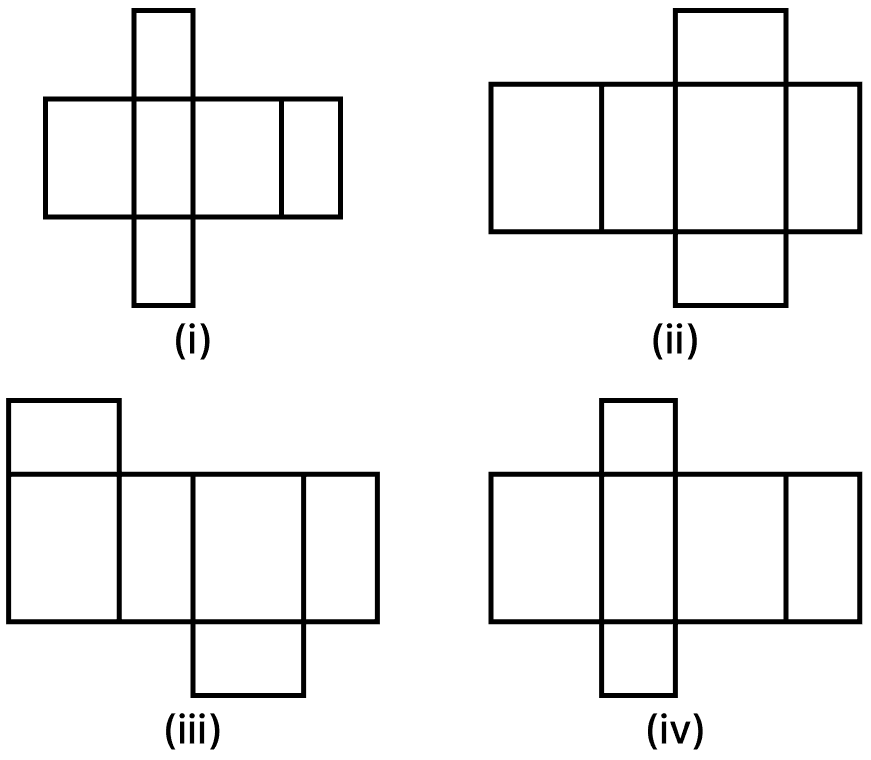
On folding the nets (i), (ii) and (iii), the four rectangles in the row form the four lateral faces and the two rectangles attached above and below the row exactly cover the top and the bottom of the cuboid.
In net (iv), the two rectangles attached above and below the row are too small. On folding, they do not cover the top and the bottom of the cuboid completely, so the cuboid is left open. So, a cuboid cannot be formed from it.
Hence, net (iv) is not a net for a cuboid.
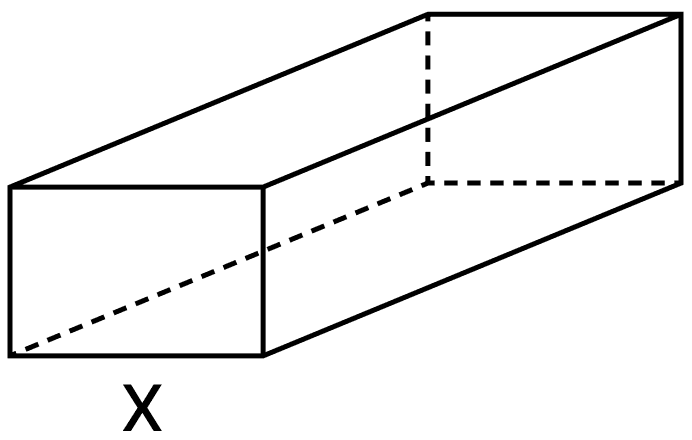
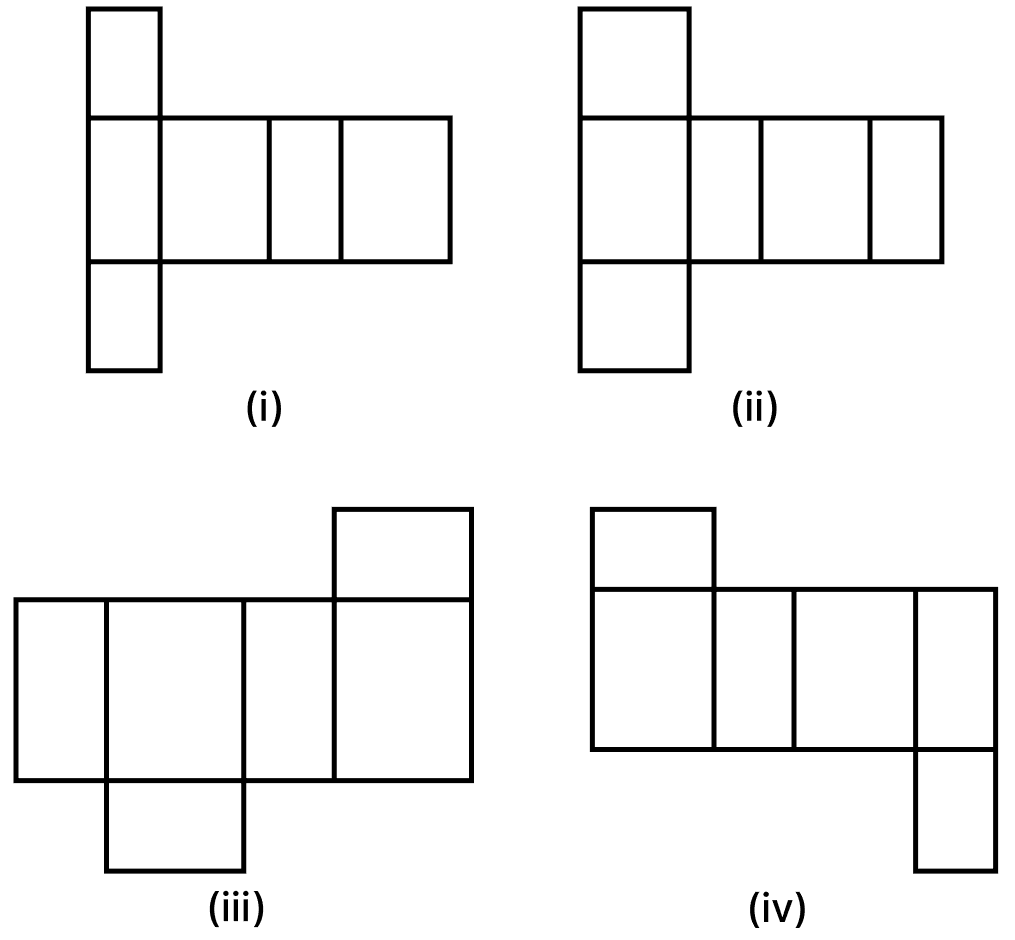
Which of the following is not a net for cuboid X?
Answer
Cuboid X has 6 rectangular faces, which form three pairs of equal opposite faces.
On folding the nets (i), (iii) and (iv), the four rectangles in the row form the four lateral faces and the two remaining rectangles exactly cover the two ends of cuboid X.
In net (ii), the two rectangles attached above and below the row are larger than the end faces of cuboid X. On folding, they do not fit the ends of the cuboid and overlap the adjacent faces. So, cuboid X cannot be formed from it.
Hence, net (ii) is not a net for cuboid X.
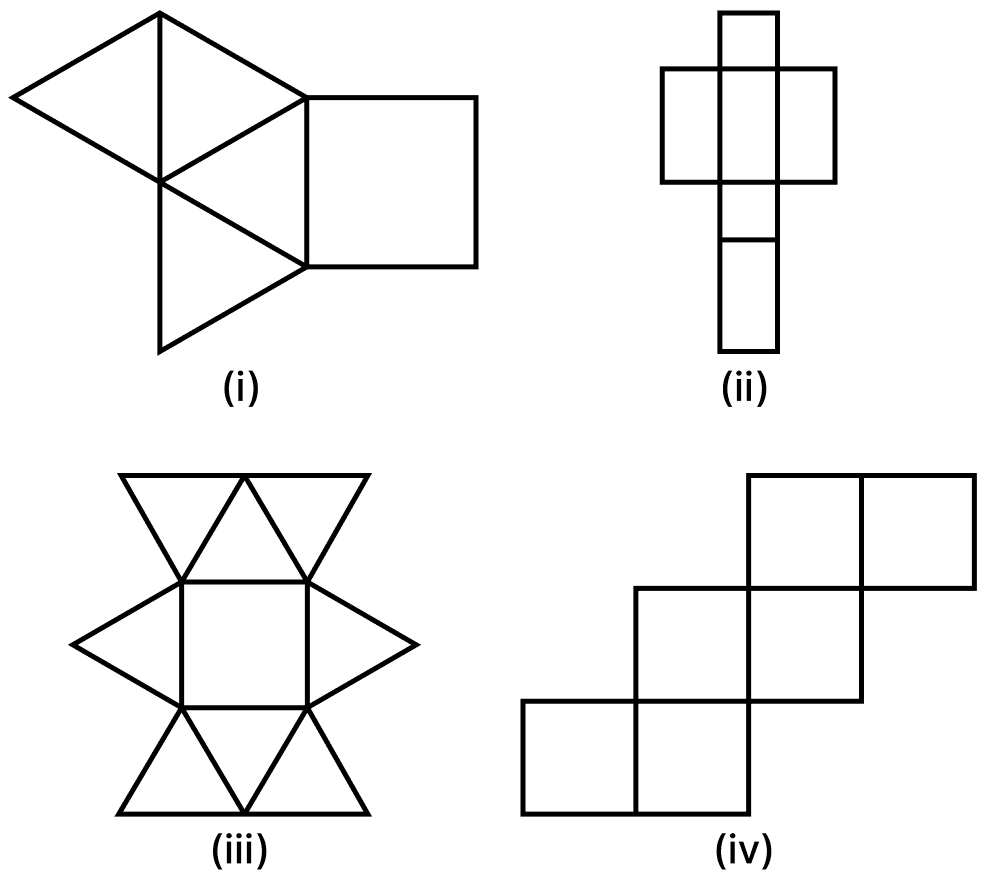
Which of the following is not a net for any polyhedron?
Answer
The net of a 3-dimensional figure is the shape that can be cut out of a plane piece of paper and folded to make the 3-dimensional shape.
On folding net (i), the four triangles meet at a common vertex and the square forms the base. So, it is a net of a square pyramid.
On folding net (ii), the six rectangles form the faces of a cuboid. So, it is a net of a cuboid.
On folding net (iv), the six equal squares form the faces of a cube. So, it is a net of a cube.
In net (iii), four triangles are attached to the four sides of the square and four more triangles are attached to the top and the bottom triangles. On folding, the four triangles attached to the square meet at a common vertex, and the remaining four triangles overlap these faces. So, no polyhedron can be formed from it.
Hence, net (iii) is not a net for any polyhedron.
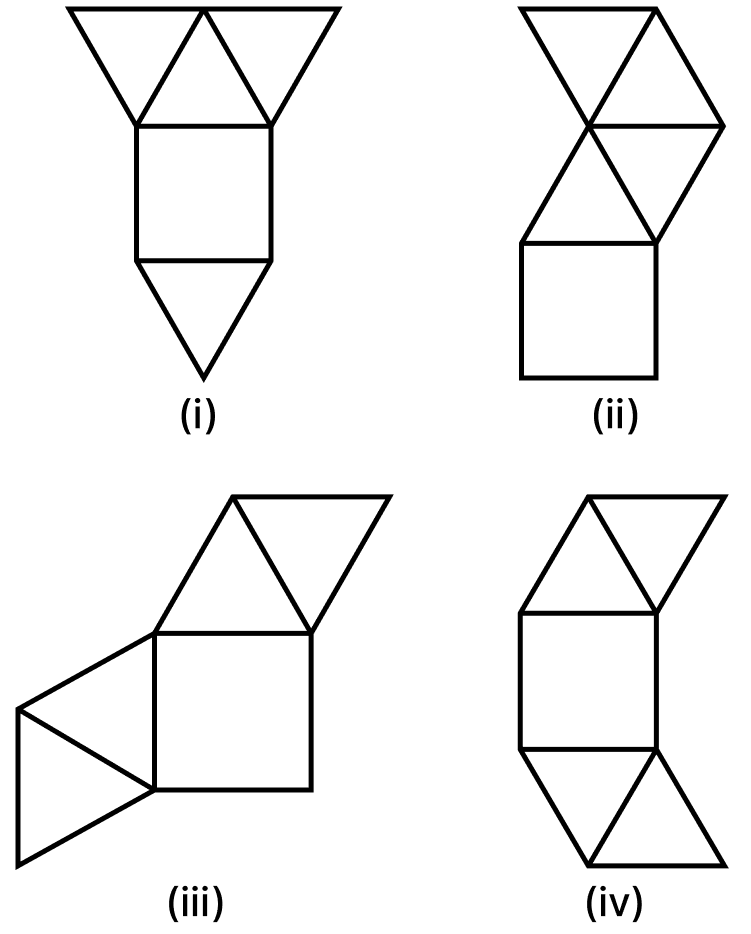
Which of the following is not a net for a square pyramid?
Answer
A square pyramid has 1 square base and 4 triangular lateral faces having a common vertex. So, its net has 1 square and 4 triangles, which on folding form the four sides of the pyramid without overlapping.
On folding the nets (i), (ii) and (iii), each of the four triangles forms a different lateral face and the triangles meet at a common vertex.
In net (iv), only two triangles are attached to the square, at its top and bottom sides. The other two triangles are attached to these triangles on the same (right) side. On folding, both these triangles form the lateral face on the same side of the pyramid, so they overlap each other and the lateral face on the other side is left open. So, a square pyramid cannot be formed from it.
Hence, net (iv) is not a net for a square pyramid.
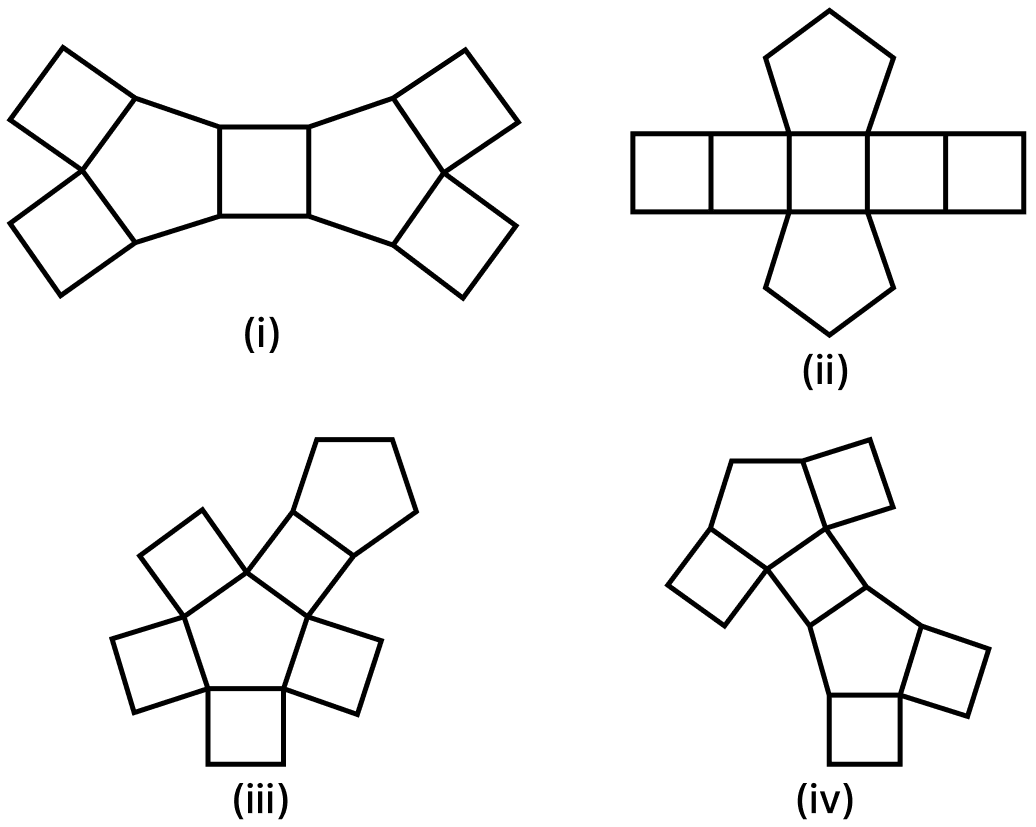
Which of the following is not a net for a pentagonal prism?
Answer
A pentagonal prism has 2 pentagonal faces (top and bottom) and 5 rectangular lateral faces. So, its net has 2 pentagons and 5 rectangles, with each rectangle forming a different lateral face.
On folding the nets (ii), (iii) and (iv), each of the five rectangles forms a different lateral face and the two pentagons form the top and the bottom of the prism.
In net (i), the squares attached to the two pentagons lie on the corresponding sides of the two pentagons. On folding, the squares attached to one pentagon fall on the squares attached to the other pentagon, so they overlap each other and two lateral faces are left open. So, a pentagonal prism cannot be formed from it.
Hence, net (i) is not a net for a pentagonal prism.
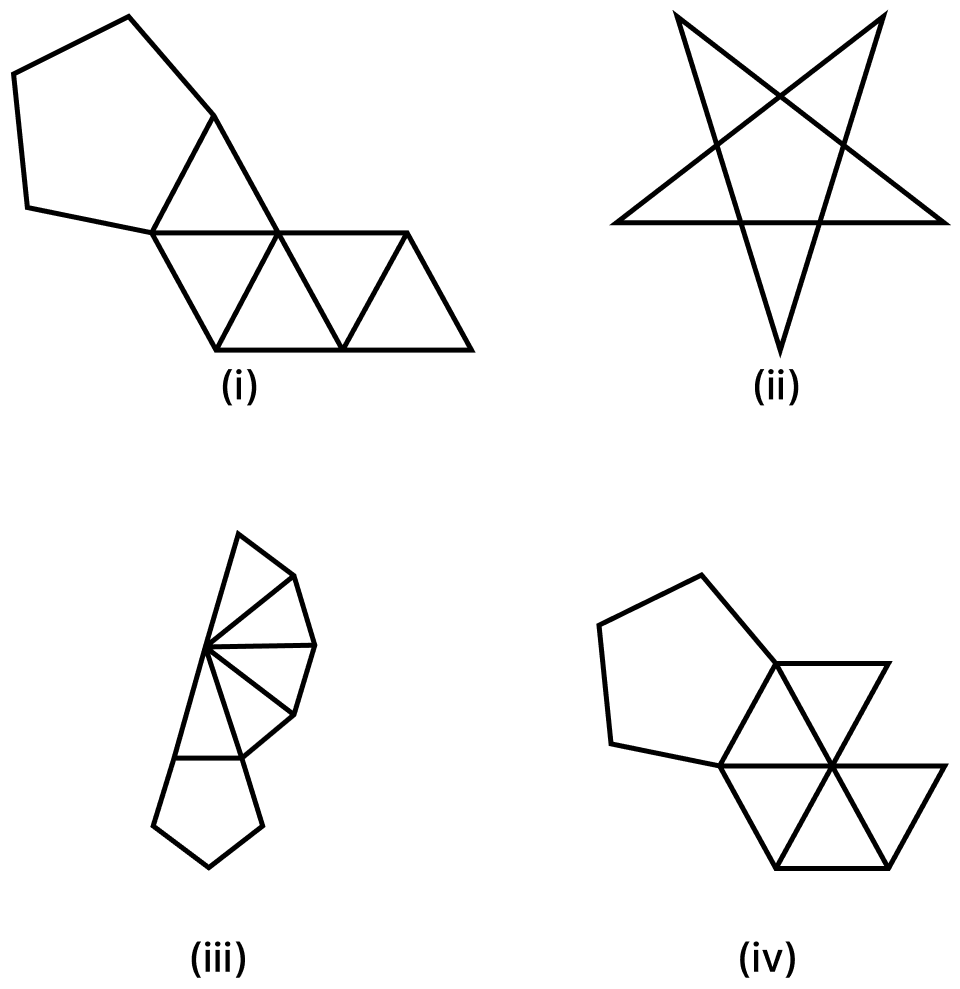
Which of the following is not a net for a pentagonal pyramid?
Answer
A pentagonal pyramid has 1 pentagonal base and 5 triangular lateral faces having a common vertex. So, its net has 1 pentagon and 5 triangles, all of which meet at a common vertex on folding.
On folding the nets (ii), (iii) and (iv), the five triangles form the five lateral faces and meet at a common vertex.
In net (i), only four of the five triangles have a common vertex. The last triangle at the right end is attached to the base side of the fourth triangle, so on folding it does not meet the other triangles at the common vertex. So, one lateral face is left open and a pentagonal pyramid cannot be formed from it.
Hence, net (i) is not a net for a pentagonal pyramid.
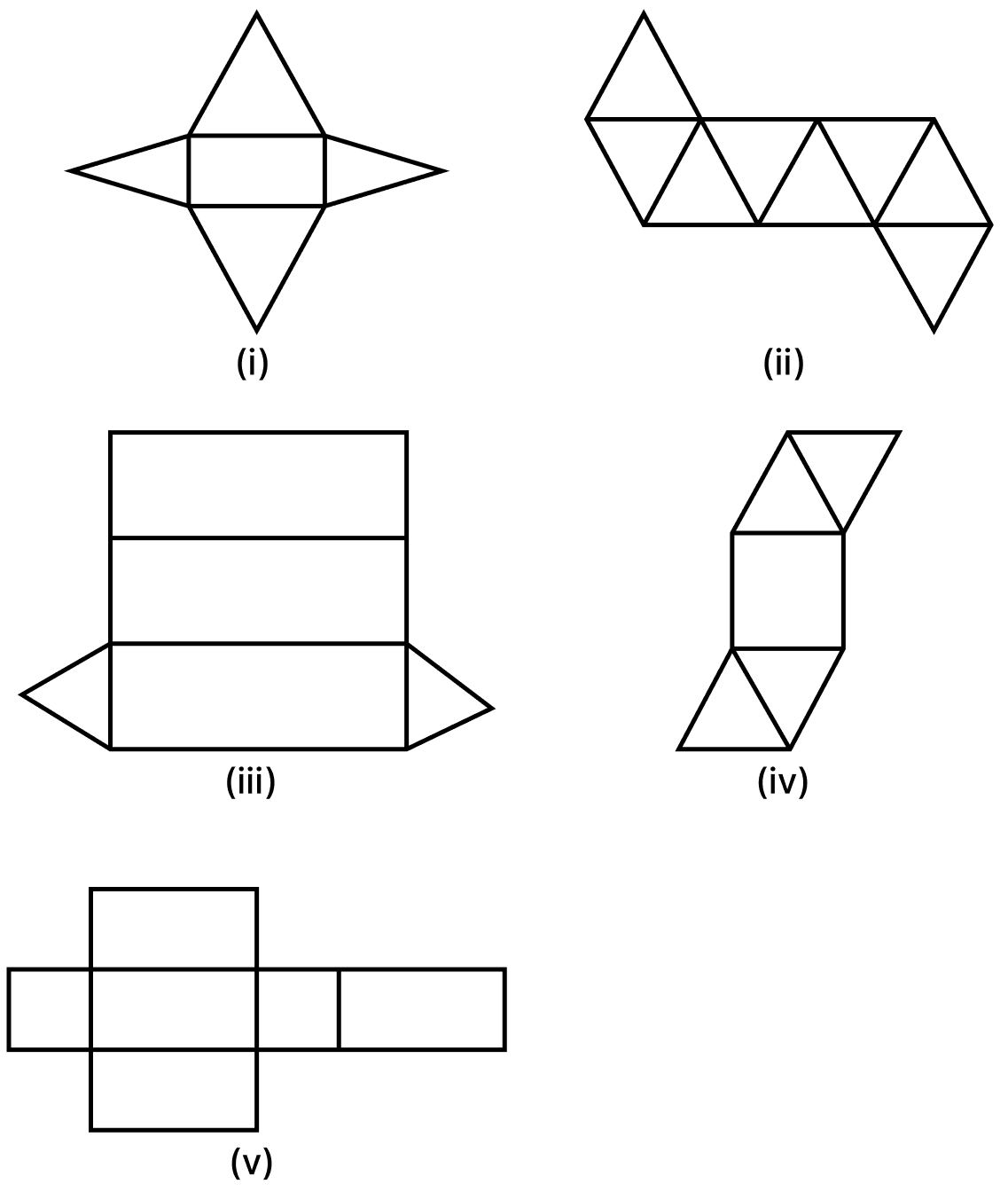
Identify the 3D shape represented by the following nets:
Answer
(i) The given net is made up of one rectangle and four triangles attached to its four sides. On folding, the rectangle forms the base and the four triangles meet at a common vertex.
A pyramid whose base is a rectangle and whose side faces are triangles having a common vertex is a rectangular pyramid.
Hence, the 3D shape is a rectangular pyramid.
(ii) The given net is made up of eight equal triangles. On folding, they form eight triangular faces.
A solid with eight triangular faces is an octahedron.
Hence, the 3D shape is an octahedron.
(iii) The given net is made up of three rectangles and two triangles. On folding, the rectangles form three rectangular lateral faces and the two triangles form the top and the bottom faces.
A triangular prism has two identical and parallel triangular faces and three rectangular faces.
Hence, the 3D shape is a triangular prism.
(iv) The given net is made up of one square and four triangles. On folding, the square forms the base and the four triangles meet at a common vertex.
A solid whose base is a square and side faces are triangles having a common vertex is a square pyramid.
Hence, the 3D shape is a square pyramid.
(v) The given net is made up of six rectangles. On folding, they form six rectangular faces, with the opposite faces being equal.
A solid bounded by 6 rectangular faces is a cuboid.
Hence, the 3D shape is a cuboid.