
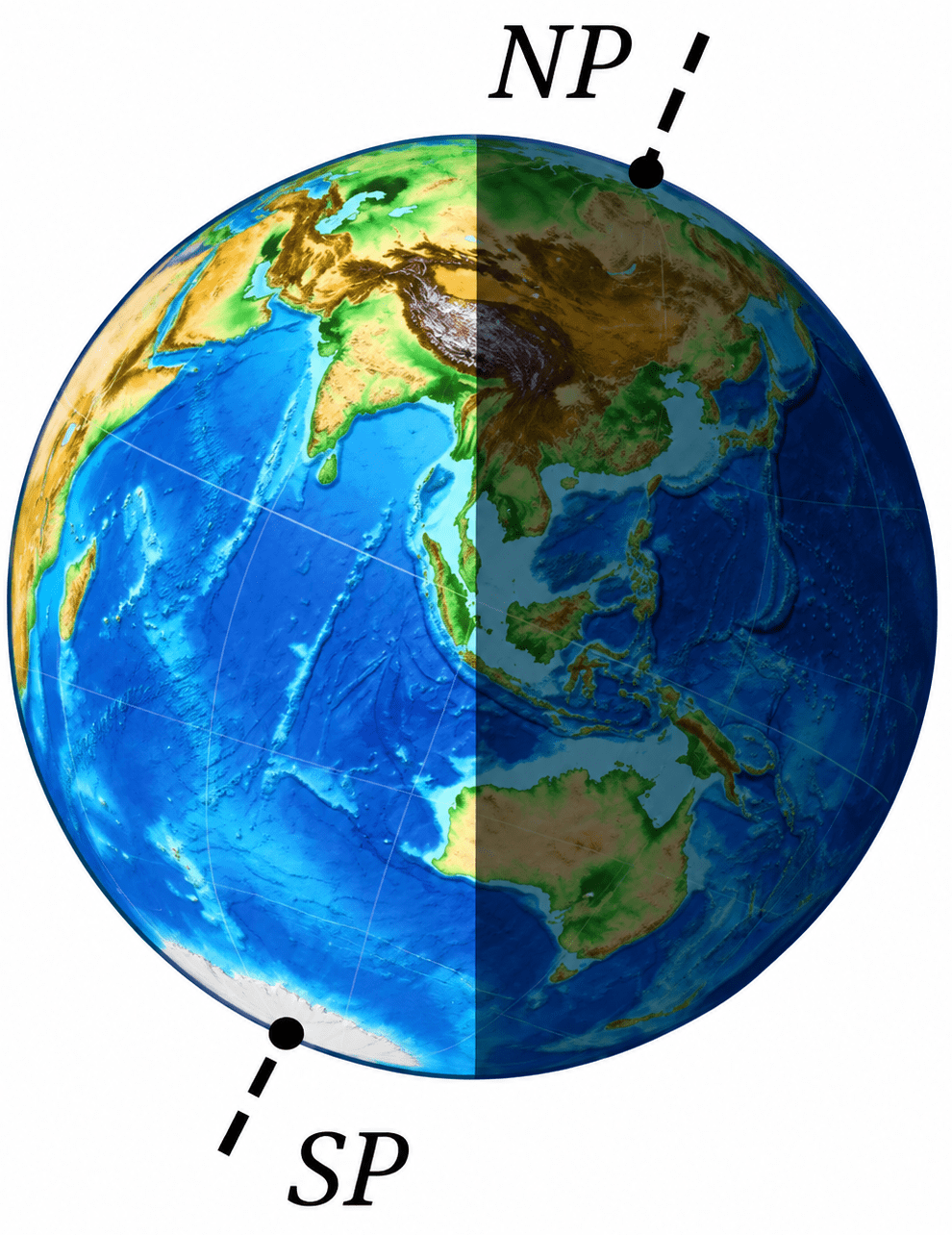
In Fig. 12.17, how many hours of sunlight do the North Pole and the South Pole receive during one rotation of the Earth?
Answer
During one rotation of the Earth:
- The North Pole receives 0 hours of sunlight.
- The South Pole receives 24 hours of sunlight.
This is because, in the position shown, the South Pole is tilted towards the Sun and remains in sunlight throughout the Earth's rotation, while the North Pole is tilted away from the Sun and remains in darkness.
Fill in the blanks
- Stars rise in the ............... and set in the ............... .
- Day and night are caused by the Earth's ............... .
- When the Moon fully covers the Sun from our view, it is called a ............... solar eclipse.
Answer
- Stars rise in the East and set in the West.
- Day and night are caused by the Earth's rotation.
- When the Moon fully covers the Sun from our view, it is called a total solar eclipse.
State whether True or False
- Lunar eclipse occurs when the Sun comes between the Earth and the Moon.
- Sunrise happens earlier in Gujarat than in Jharkhand.
- In Chennai, the longest day occurs on the summer solstice.
- We should watch the solar eclipse directly with our naked eye.
- Seasons occur due to the tilt of Earth's axis of rotation and its spherical shape.
- The Earth's revolution around the Sun causes day and night.
Answer
i. False
Corrected statement — A lunar eclipse occurs when the Earth comes in between the Sun and the Moon, blocking sunlight from reaching the Moon.
ii. False
Corrected statement — Jharkhand lies to the east of Gujarat, and since the Earth rotates from West to East, sunrise happens earlier in Jharkhand than in Gujarat.
iii. True
iv. False
Corrected statement — The Sun is intense enough to damage the eyes and cause blindness, so a solar eclipse must never be viewed directly with the naked eye.
v. True
vi. False
Corrected statement — Day and night are caused by the Earth's rotation on its own axis, not by its revolution around the Sun.
Padmashree saw the Orion constellation nearly overhead at 8 pm yesterday. When will she see Orion overhead today?
Answer
She will see Orion overhead a little earlier today, at about 7:56 pm (roughly 4 minutes before 8 pm).
This is because the Earth also revolves around the Sun. Due to this, a particular star or constellation appears to rise and reach the same position about 4 minutes earlier each day.
Nandhini saw a group of stars rising at midnight on 21 June. When will she see the same group of stars rising at midnight next year?
Answer
She will see the same group of stars rising at midnight again on 21 June next year.
As the Earth completes one revolution around the Sun in about one year, the same group of stars appears in nearly the same position in the night sky at the same time of year.
Abhay noticed that when it was daytime in India, his uncle who was in the USA was generally sleeping as it was night-time there. What is the reason behind this difference?
Answer
The Earth is spherical and rotates on its axis. At any moment, the half of the Earth facing the Sun experiences day, while the other half experiences night.
India and the USA are located on different parts of the Earth. Therefore, when India is facing the Sun and has daytime, the USA may be turned away from the Sun and have night-time.
Four friends used the following ways to see the solar eclipse. Who among them was being careless?
- Ravikiran used a solar eclipse goggle.
- Jyothi used a mirror to project the Sun's image.
- Adithya saw the Sun directly with his eyes.
- Aruna attended a programme arranged by a planetarium.
Answer
Adithya was being careless, as he saw the Sun directly with his eyes.
Even during a solar eclipse, the Sun is intense enough to damage the eyes and cause blindness. Therefore, viewing a solar eclipse directly with the naked eye must be strictly avoided. The other three friends used safe methods of observation.
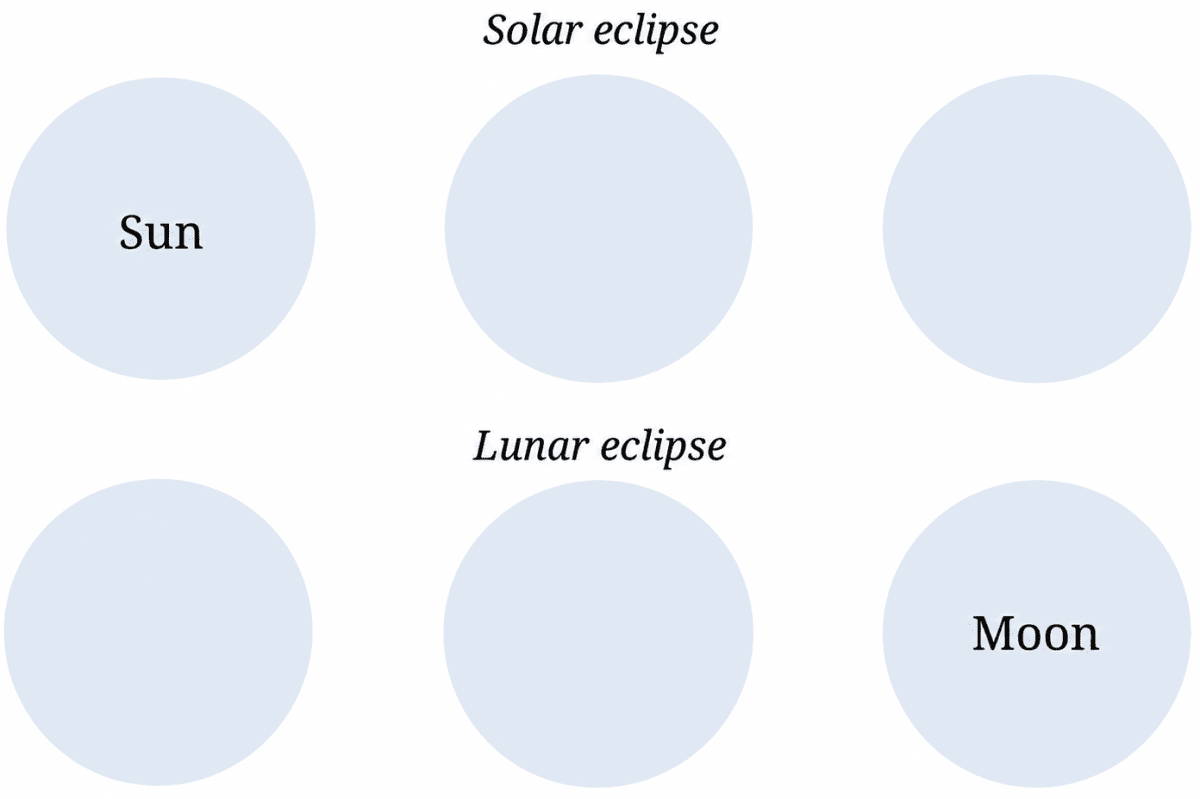
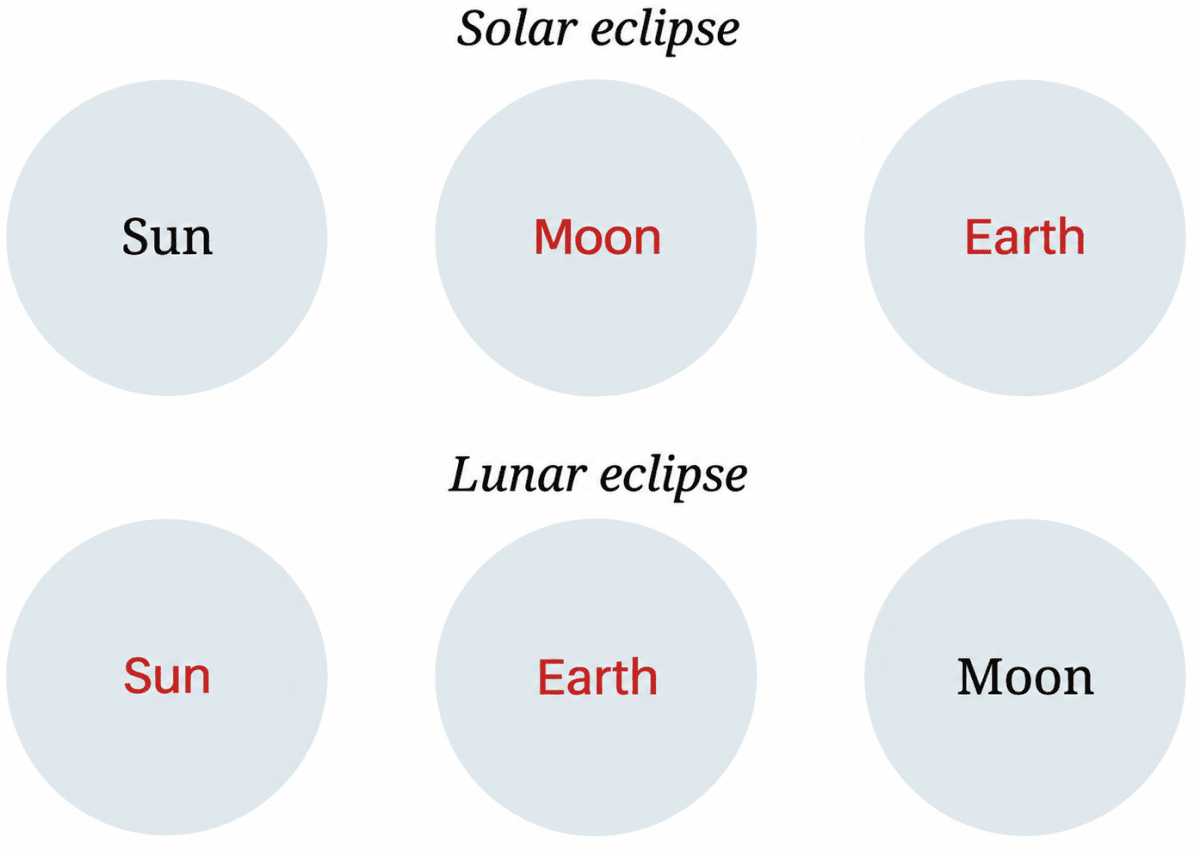
Fill in the circles in Fig. 12.18 appropriately with one of the following: Sun, Moon, Earth.
Answer
The filled figure is given below:
The Moon is much smaller than the Sun, yet it can block the Sun completely from our view during a total solar eclipse. Why is it possible?
Answer
The apparent size of an object depends on its actual size and its distance from us.
Although the Moon is much smaller than the Sun, it is much closer to the Earth. Therefore, the Moon and the Sun have nearly the same apparent size when viewed from the Earth. Hence, the Moon can completely cover the Sun during a total solar eclipse.
The Indian cricket team matches in Australia are often held in December. Should they pack winter or summer clothes for their trip?
Answer
They should pack summer clothes.
Australia lies in the Southern Hemisphere, where the seasons are opposite to those in the Northern Hemisphere. In December, the Southern Hemisphere is tilted towards the Sun and experiences the summer season, so the weather in Australia would be warm at that time.
Why do you think lunar eclipses can be seen from a large part of the Earth when they happen, but total solar eclipse can be seen by only a small part of the Earth?
Answer
During a lunar eclipse, the Earth's shadow falls on the Moon. Since the eclipsed Moon is high in the sky, it can be seen from the entire night side of the Earth, which is a large part of the Earth.
During a total solar eclipse, the Moon's shadow falls only on a small area on the surface of the Earth. Only the observers present in this small area can witness the total solar eclipse, while people outside this area cannot. This is why a total solar eclipse is seen by only a small part of the Earth.
If the Earth's axis were not tilted with respect to the axis of revolution, explain what would be the effect on seasons?
Answer
If the Earth's axis were not tilted, there would be no regular seasonal changes caused by the Earth's revolution around the Sun.
At a given place, the angle and duration of sunlight would remain nearly the same throughout the year. Therefore, there would be no summer and winter caused by the tilt of the Earth's axis.