
Complete the following table.
| S.No. | Feature | Photosynthesis | Respiration |
|---|---|---|---|
| 1. | Raw materials | ||
| 2. | Products | ||
| 3. | Word equation | ||
| 4. | Importance |
Answer
| S.No. | Feature | Photosynthesis | Respiration |
|---|---|---|---|
| 1. | Raw materials | Carbon dioxide and water | Glucose and oxygen |
| 2. | Products | Glucose and oxygen | Carbon dioxide, water and energy |
| 3. | Word equation | Carbon dioxide + Water Glucose + Oxygen | Glucose + Oxygen Carbon dioxide + Water + Energy |
| 4. | Importance | It synthesises food (glucose) for the plant and releases oxygen into the air. | It breaks down glucose to release energy required for the growth and development of the plant. |
Imagine a situation where all the organisms that carry out photosynthesis on the earth have disappeared. What would be the impact of this on living organisms?
Answer
If all the organisms that carry out photosynthesis disappeared, it would affect every living organism on the earth in the following ways:
- Food would no longer be synthesised, so animals that depend on plants directly or indirectly for food would eventually die.
- Oxygen would no longer be released into the air, so the oxygen needed by living organisms for respiration would gradually get used up.
- Carbon dioxide released during respiration would keep accumulating in the air, as it would not be used up by photosynthesis.
As a result, life on the earth could not survive.
A potato slice shows the presence of starch with iodine solution. Where does the starch in potatoes come from? Where is the food synthesised in the plant, and how does it reach the potato?
Answer
The starch present in the potato comes from the food prepared by the plant during photosynthesis. During photosynthesis, glucose is produced, which later gets converted into starch for storage.
Food is mainly synthesised in the leaves, which are the primary site of photosynthesis and are called the 'food factories' of the plant. It is then transported from the leaves to the potato through the phloem.
Does the broad and flat structure of leaves make plants more efficient for photosynthesis? Justify your answer.
Answer
Yes, the broad and flat structure of leaves makes plants more efficient for photosynthesis.
- The broad and flat shape provides a large surface area to receive sunlight.
- Chlorophyll present in the leaves captures sunlight needed for photosynthesis.
- The large leaf surface also facilitates the exchange of gases through stomata.
Thus, broad and flat leaves are well suited for photosynthesis.
X is broken down using Y to release carbon dioxide, Z, and energy.
X, Y, and Z are three different components of the process. What do X, Y, and Z stand for?
Answer
The given equation represents the process of respiration:
Glucose + Oxygen Carbon dioxide + Water + Energy
On comparing, we get:
- X stands for Glucose.
- Y stands for Oxygen.
- Z stands for Water.
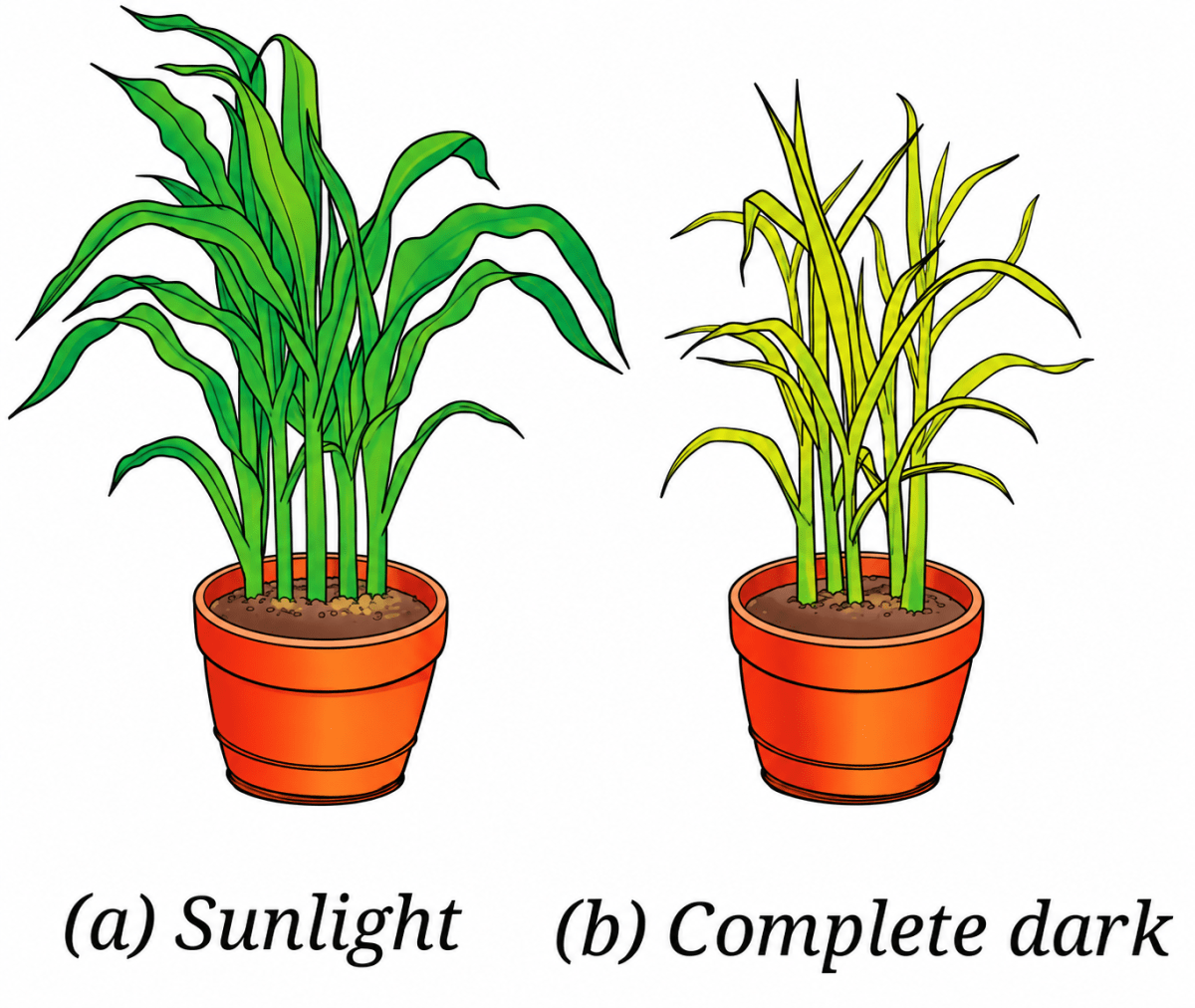
Krishna set-up an experiment with two potted plants of same size and placed one of them in sunlight and the other in a dark room, as shown in Fig. 10.10.
Answer the following questions —
- What idea might she be testing through this experiment?
- What are the visible differences in plants in both the conditions?
- According to you, leaves of which plants confirm the iodine test for the presence of starch?
Answer
- She might be testing whether sunlight is essential for the production of food (starch) in plants by photosynthesis.
- The plant kept in sunlight remains healthy with green leaves, while the plant kept in the dark turns pale or yellowish and appears weak.
- The leaves of the plant kept in sunlight confirm the iodine test for the presence of starch, as they turn blue-black. This is because starch is produced only in the presence of sunlight.
Vani believes that 'carbon dioxide is essential for photosynthesis'. She puts an experimental set-up, as shown in Fig. 10.11, to collect evidence to support or reject her idea.
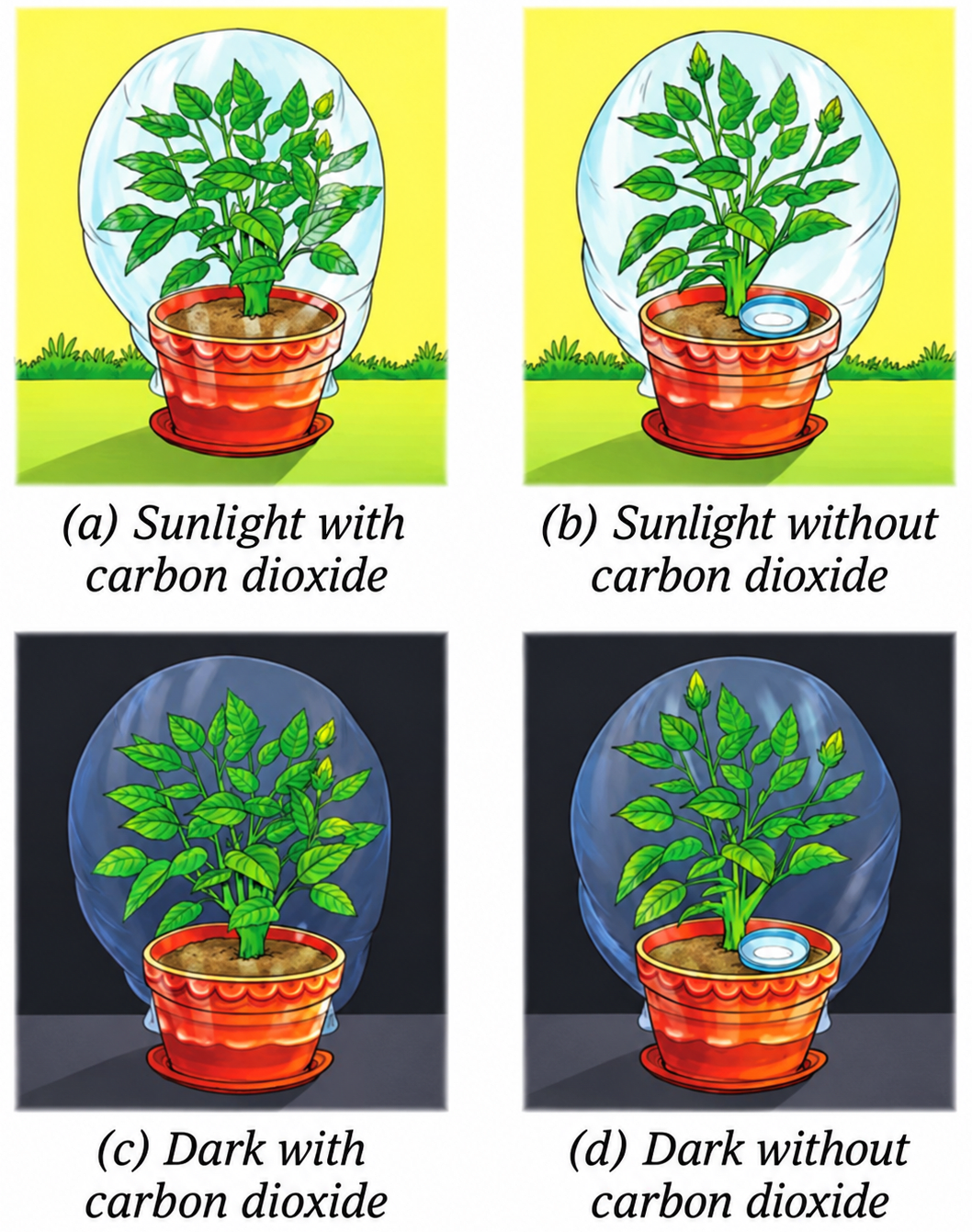
- Sunlight with carbon dioxide
- Sunlight without carbon dioxide
- Dark with carbon dioxide
- Dark without carbon dioxide
Answer the following questions —
- In which plant(s) in the above set-up(s) will starch be formed?
- In which plant(s) in the above set-up(s) will starch not be formed?
- In which plant(s) in the above set-up(s) will oxygen be generated?
- In which plant(s) in the above set-up(s) will oxygen not be generated?
Answer
Starch is formed and oxygen is generated only when both sunlight and carbon dioxide are available, as photosynthesis needs both of them.
- Starch will be formed in plant (a) Sunlight with carbon dioxide.
- Starch will not be formed in plants (b) Sunlight without carbon dioxide, (c) Dark with carbon dioxide, and (d) Dark without carbon dioxide.
- Oxygen will be generated in plant (a) Sunlight with carbon dioxide.
- Oxygen will not be generated in plants (b) Sunlight without carbon dioxide, (c) Dark with carbon dioxide, and (d) Dark without carbon dioxide.
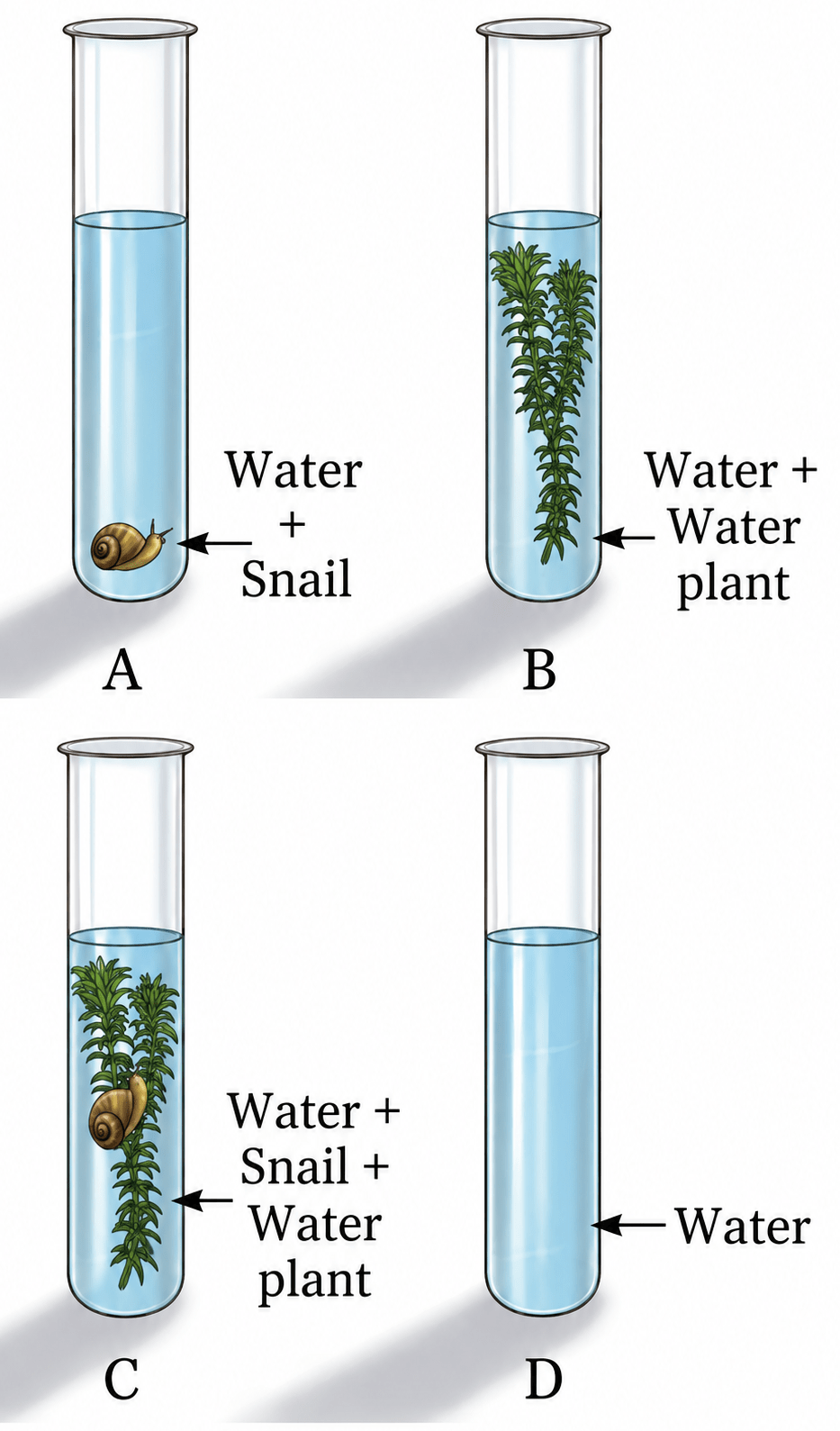
Ananya took four test tubes and filled three-fourth of each test tube with water. She labelled them A, B, C, and D (Fig. 10.12). In test tube A, she kept a snail; in test tube B, she kept a water plant; in test tube C, she kept both a snail and a plant. In test tube D, she kept only water. Ananya added a carbon dioxide indicator to all the test tubes. She recorded the initial colour of water and observed if there are any colour changes in the test tubes after 2–3 hours. What do you think she wants to find out? How will she know if she is correct?
Answer
Ananya wants to find out how a plant and an animal depend on each other for the exchange of gases, that is, how the carbon dioxide released by the snail during respiration and used up by the plant during photosynthesis affect each other.
She will know if she is correct by observing the change in colour of the carbon dioxide indicator in each test tube:
- In test tube A (snail only), the snail respires and releases carbon dioxide, so the carbon dioxide level rises and the indicator shows a change in colour.
- In test tube B (water plant only), the plant uses up carbon dioxide for photosynthesis, so the carbon dioxide level falls and the indicator shows a change in colour.
- In test tube C (snail and plant together), the carbon dioxide released by the snail is used by the plant, and the oxygen released by the plant is used by the snail. So the carbon dioxide level remains nearly balanced and the indicator shows little or no change.
- In test tube D (water only), there is no living organism, so the carbon dioxide level does not change. This acts as a control.
By comparing these colour changes, she can confirm that plants and animals depend on each other for the exchange of carbon dioxide and oxygen.
Design an experiment to observe if water transportation in plants is quicker in warm or cold conditions.
Answer
The experiment can be designed as follows:
- Take two similar tender plant twigs, preferably with white-coloured flowers, such as white sadabahar or balsam.
- Take two glass tumblers and fill each with an equal amount of water. Add a few drops of red ink to both tumblers.
- Obliquely cut the base of both stems while keeping them in water, and place one twig in each tumbler.
- Keep one tumbler in a warm place and the other in a cold place.
- After some time, observe in which twig the red colour rises faster and reaches the stem, leaves, and flowers quicker.
The twig in which the red colour spreads faster shows that water transportation is quicker in that condition. In this way, we can find out whether water transportation in plants is quicker in warm or cold conditions.
Photosynthesis and respiration are essential to maintain balance in nature. Discuss.
Answer
Photosynthesis and respiration are two complementary processes that help maintain balance in nature in the following ways:
- During photosynthesis, plants take in carbon dioxide and release oxygen.
- During respiration, living organisms use oxygen and release carbon dioxide.
- The oxygen released during photosynthesis is used in respiration, while the carbon dioxide released during respiration is used by plants for photosynthesis.
- Photosynthesis also produces food, which supports living organisms directly or indirectly.
Thus, photosynthesis and respiration together maintain the balance of gases and food in nature.