
Choose the correct option.
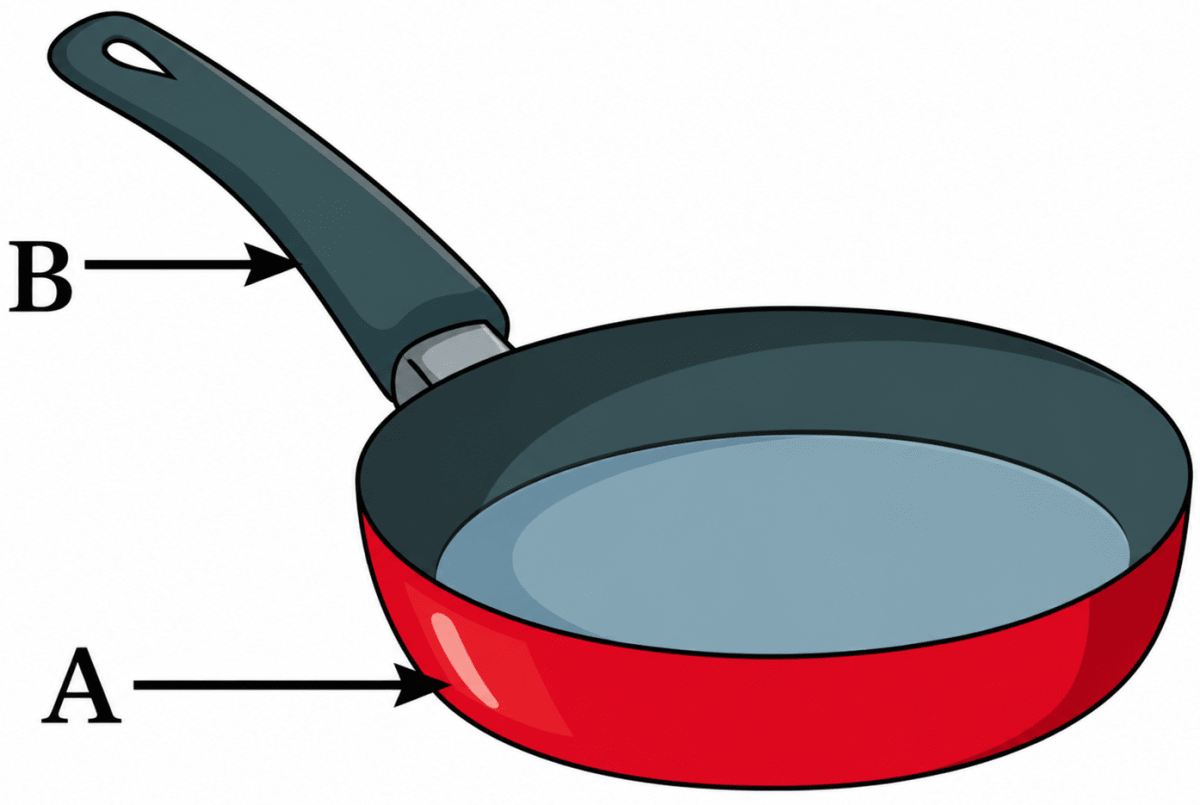
Your father bought a saucepan made of two different materials, A and B, as shown in Fig. 7.14. The materials A and B have the following properties —
- Both A and B are good conductors of heat
- Both A and B are poor conductors of heat
- A is a good conductor and B is a poor conductor of heat
- A is a poor conductor and B is a good conductor of heat
Answer
A is a good conductor and B is a poor conductor of heat.
Reason — In a saucepan, A is the body of the pan and B is the handle. The body should be a good conductor of heat so that heat passes through it quickly and cooks the food, while the handle should be a poor conductor of heat so that it does not become hot and can be held safely.
Choose the correct option.
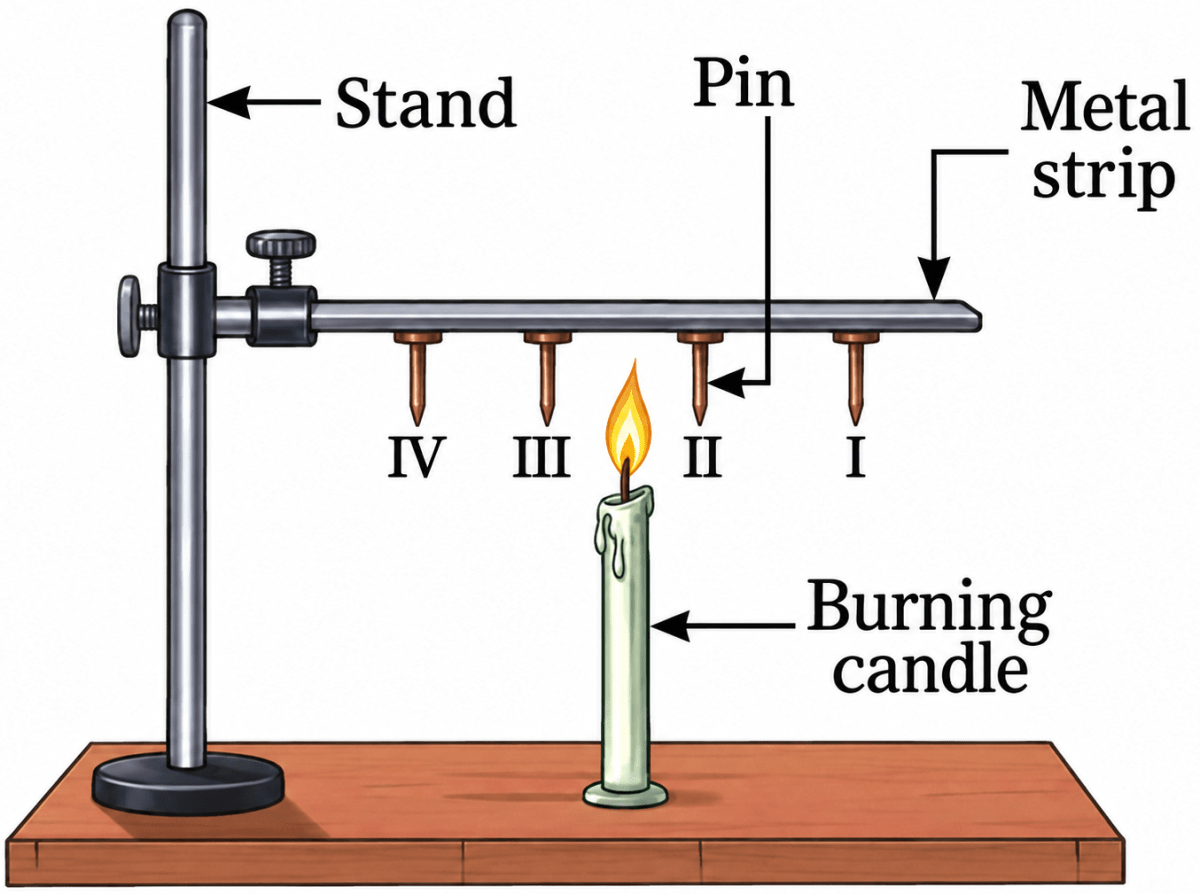
Pins are stuck to a metal strip with wax and a burning candle is kept below the rod, as shown in Fig. 7.15. Which of the following will happen?
- All the pins will fall almost at the same time
- Pins I and II will fall earlier than pins III and IV
- Pins I and II will fall later than pins III and IV
- Pins II and III will fall almost at the same time
Answer
Pins II and III will fall almost at the same time
Reason — The metal strip conducts heat from the region heated by the candle. Since pins II and III are nearly at equal distances from the heated region, the wax holding them melts first and they fall almost at the same time. Pins I and IV, being farther away, fall later.
Choose the correct option.
A smoke detector is a device that detects smoke and sounds an alarm. Suppose you are fitting a smoke detector in your room. The most suitable place for this device will be:
- Near the floor
- In the middle of a wall
- On the ceiling
- Anywhere in the room
Answer
On the ceiling.
Reason — Smoke is a mixture of hot gases and tiny solid particles. The hot gases are warmer and lighter than the surrounding air, so the smoke rises upward by convection. Therefore, a smoke detector placed on the ceiling can detect smoke quickly.
A shopkeeper serves you cold lassi in a tumbler. By chance, the tumbler had a small leak. You were given another tumbler by the shopkeeper to put the leaky tumbler in it. Will this arrangement help to keep the lassi cold for a longer time? Explain.
Answer
Yes, this arrangement will help to keep the lassi cold for a longer time. When the leaky tumbler is placed inside another tumbler, a layer of air gets trapped between the two tumblers. Air is a poor conductor of heat, so it does not allow the heat from the surroundings to reach the cold lassi easily. As a result, the lassi remains cold for a longer time.
State with reason(s) whether the following statements are True [T] or False [F].
- Heat transfer takes place in solids through convection. [ ]
- Heat transfer through convection takes place by the actual movement of particles. [ ]
- Areas with clay materials allow more seepage of water than those with sandy materials. [ ]
- The movement of cooler air from land to sea is called land breeze. [ ]
Answer
(i) False
Corrected statement — In solids, heat transfer takes place mainly through conduction. Convection requires the actual movement of particles, which is not possible in solids, as their particles do not move from their fixed positions.
(ii) True
(iii) False
Corrected statement — Sandy materials allow more seepage of water than clay materials because the spaces between sand particles are wider than those between clay particles.
(iv) True
Some ice cubes placed in a dish melt into water after sometime. Where do the ice cubes get heat for this transformation?
Answer
The ice cubes get heat from their surroundings, such as the surrounding air and the dish in which they are kept. Since the surroundings are warmer than the ice, heat flows from the warmer surroundings to the colder ice cubes. This heat causes the ice to melt and change into water.
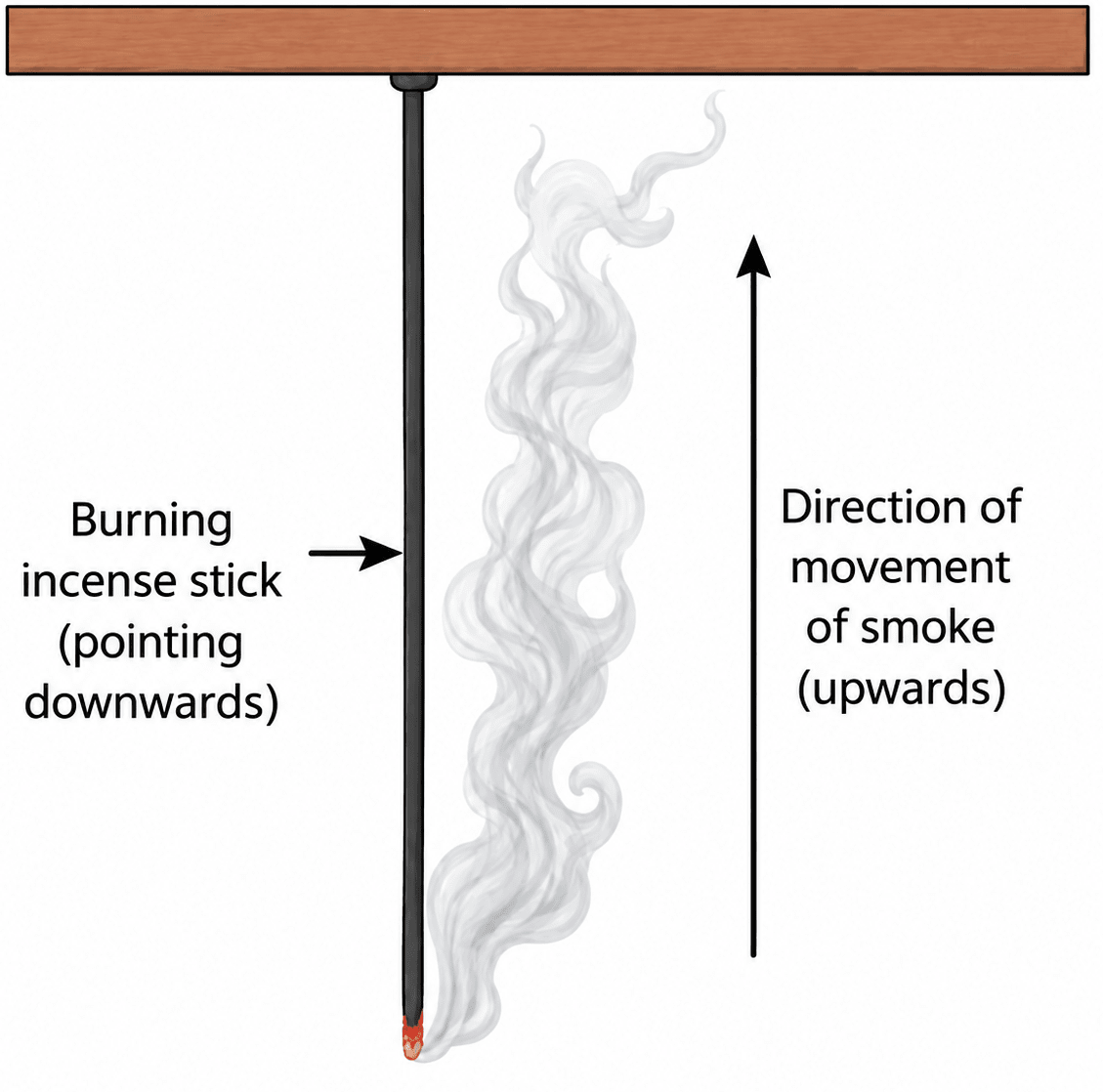
A burning incense stick is fixed, pointing downwards. In which direction would the smoke from the incense stick move? Show the movement of smoke with a diagram.
Answer
The smoke will move upwards. Smoke is a mixture of hot gases and tiny solid particles. The hot gases are warmer and lighter than the surrounding air, so the smoke rises upward by convection, even though the incense stick is pointing downwards.
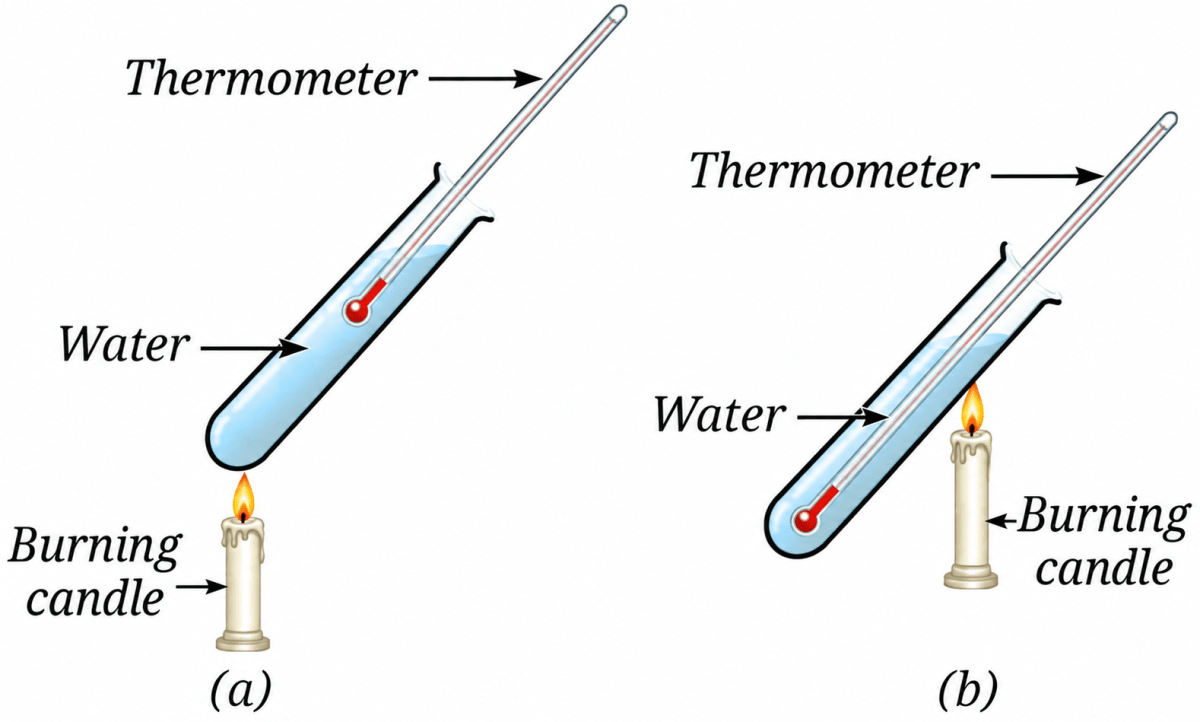
Two test tubes with water are heated by a candle flame as shown in Fig. 7.16. Which thermometers (Fig. 7.16a or Fig. 7.16b) will record a higher temperature? Explain.
Answer
The thermometer in Fig. 7.16(a) will record a higher temperature.
In Fig. 7.16(a), the candle heats the water at the bottom of the test tube. The water at the bottom gets heated, becomes lighter and rises, while the cooler water from above comes down to take its place. These convection currents heat the whole of the water, so the thermometer records a higher temperature.
In Fig. 7.16(b), the candle heats the water near the top. Since hot water is lighter, it stays at the top and convection currents are not set up to heat the water below. As water is a poor conductor of heat, heat does not travel downwards easily. Hence, the water heats up less and the thermometer records a lower temperature.
Why are hollow bricks used to construct the outer walls of houses in hot regions?
Answer
Hollow bricks are used to construct the outer walls of houses in hot regions because the air trapped inside the hollow bricks is a poor conductor of heat. This trapped air does not allow the heat from outside to pass easily through the walls into the house. As a result, the houses remain cool in summers (and warm in winters).
Explain how large water bodies prevent extreme temperature in areas around them.
Answer
Large water bodies prevent extreme temperatures in the areas around them because water heats up and cools down more slowly than land.
- During the day, the water absorbs heat and warms up slowly, so the surrounding areas do not become too hot.
- At night, the water cools down slowly and gives out the stored heat, so the surrounding areas do not become too cold.
- Also, the sea breeze and land breeze that are set up due to the uneven heating of land and water keep the climate of nearby areas moderate.
As a result, the areas around large water bodies do not experience extreme heat or cold.
Explain how water seeps through the surface of the Earth and gets stored as groundwater.
Answer
- Rainwater that falls on the surface of the Earth either flows into ponds, lakes and rivers or seeps into the ground.
- The water seeps down through the soil and rocks. This process of surface water seeping through soil and rocks is called infiltration.
- Water infiltrates more readily where the spaces between the soil and rock particles are wider, open and interconnected. For example, water seeps fastest through gravel, slower through sand and slowest through clay.
- The water that seeps through gets stored in the pore spaces of sediments and the openings in rocks beneath the surface as groundwater.
- The underground layers of sediments and rocks that store this water in their pore spaces are called aquifers. This is the water we obtain by digging wells or drilling bore wells.
The water cycle helps in the redistribution and replenishment of water on the Earth. Justify the statement.
Answer
The water cycle is the continuous movement of water — upward as water vapour and downward through precipitation, passing through soil, rocks and plants, and finally returning to water bodies. It helps in the redistribution and replenishment of water in the following ways.
- Redistribution — Water evaporates from oceans, rivers and lakes and rises up as water vapour. Water also enters the air from plants through transpiration. This vapour cools and condenses to form clouds, which bring rain, snow and hail (precipitation) over different regions, including areas far from water bodies. In this way, water is distributed from the water bodies to various parts of the Earth and back again.
- Replenishment — The rain and snow refill the rivers, lakes, ponds and oceans. Some of the rainwater seeps into the ground and recharges the groundwater stored in aquifers. The snow and ice that melt in summers are replenished by fresh snowfall in winters. Thus, the water sources keep getting refilled.
Since the water cycle keeps moving water between water bodies, the atmosphere and the ground, and also conserves the total amount of water on the Earth, it helps in the redistribution and replenishment of water on the Earth.