
Find the unknown weights in the following case:
Answer
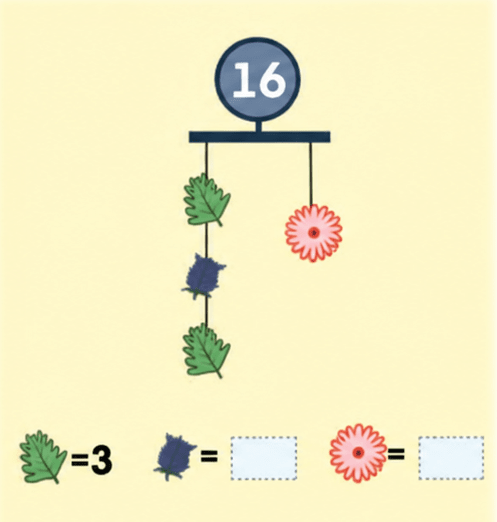
Total weight = 16
⇒ Weight on each plate =
The right plate carries only the flower.
∴ Weight of the flower = 8
The left plate carries 2 leaves and 1 rose, and the weight of one leaf is 3.
∴ 2 × Leaf + Rose = 8
⇒ 2 × 3 + Rose = 8
⇒ 6 + Rose = 8
⇒ Rose = 8 – 6
⇒ Rose = 2
Hence, the flower weighs 8 units and the rose weighs 2 units.
Find the unknown weights in the following case:
Answer
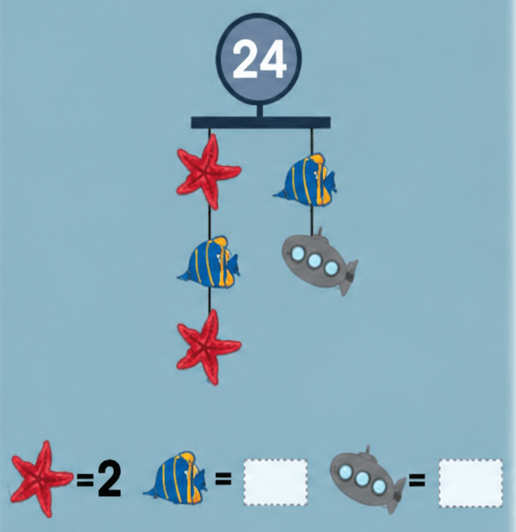
Total weight = 24
⇒ Weight on each plate =
The left plate carries 2 starfish and 1 blue fish, and the weight of one starfish is 2.
∴ 2 × Starfish + Blue fish = 12
⇒ 2 × 2 + Blue fish = 12
⇒ 4 + Blue fish = 12
⇒ Blue fish = 12 – 4 = 8
The right plate carries 1 blue fish and 1 grey fish.
∴ Blue fish + Grey fish = 12
⇒ 8 + Grey fish = 12
⇒ Grey fish = 12 – 8
⇒ Grey fish = 4
Hence, the blue fish weighs 8 units and the grey fish weighs 4 units.
Find the unknown weights in the following case:
Answer
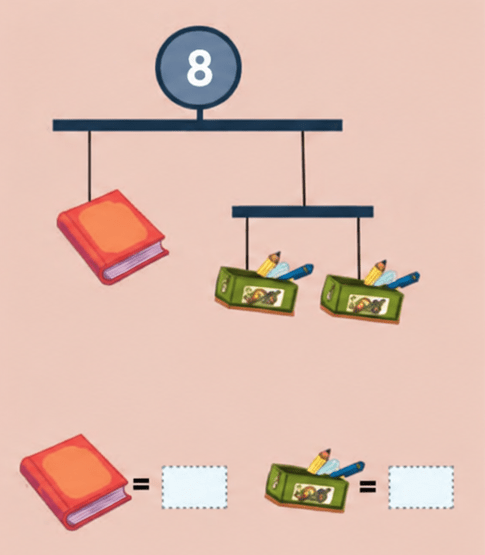
Total weight = 8
⇒ Weight on each plate =
The left plate carries only the book.
∴ Weight of the book = 4
The right plate carries 2 pencil boxes, one on each side of a smaller balanced beam.
∴ 2 × Pencil box = 4
⇒ Pencil box =
⇒ Pencil box = 2
Hence, the book weighs 4 units and each pencil box weighs 2 units.
Find the unknown weights in the following case:
Answer
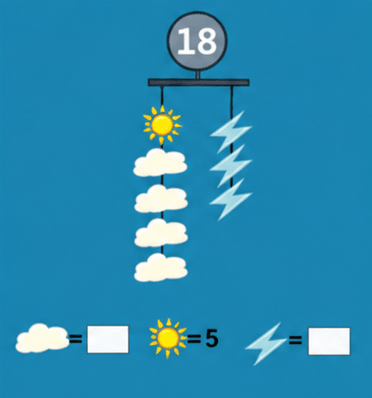
Total weight = 18
⇒ Weight on each plate =
The left plate carries 1 sun and 4 clouds, and the weight of the sun is 5.
∴ Sun + 4 × Cloud = 9
⇒ 5 + 4 × Cloud = 9
⇒ 4 × Cloud = 9 – 5
⇒ 4 × Cloud = 4
⇒ Cloud =
The right plate carries 3 lightning bolts.
∴ 3 × Lightning = 9
⇒ Lightning =
⇒ Lightning = 3
Hence, each cloud weighs 1 unit and each lightning bolt weighs 3 units.
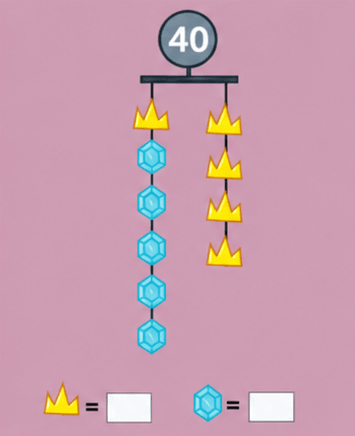
Find the unknown weights in the following case:
Answer
Total weight = 40
⇒ Weight on each plate =
The right plate carries 4 crowns.
∴ 4 × Crown = 20
⇒ Crown =
The left plate carries 1 crown and 5 blue stones.
∴ Crown + 5 × Blue stone = 20
⇒ 5 + 5 × Blue stone = 20
⇒ 5 × Blue stone = 20 – 5
⇒ 5 × Blue stone = 15
⇒ Blue stone =
⇒ Blue stone = 3
Hence, each crown weighs 5 units and each blue stone weighs 3 units.
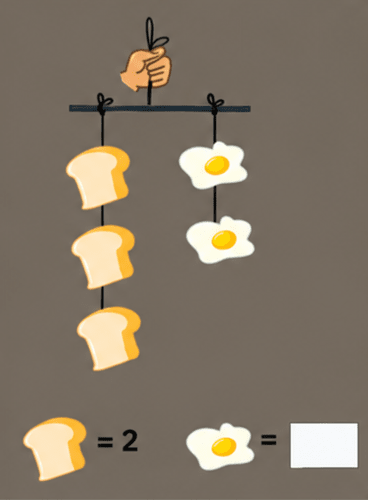
Find the unknown weights in the following case:
Answer
Here no total is shown on top, but the scale is balanced.
∴ Weight on the left plate = Weight on the right plate
The left plate carries 3 slices of bread, each of weight 2, and the right plate carries 2 fried eggs.
∴ 3 × Bread = 2 × Egg
⇒ 3 × 2 = 2 × Egg
⇒ 6 = 2 × Egg
⇒ Egg =
⇒ Egg = 3
Hence, each fried egg weighs 3 units.
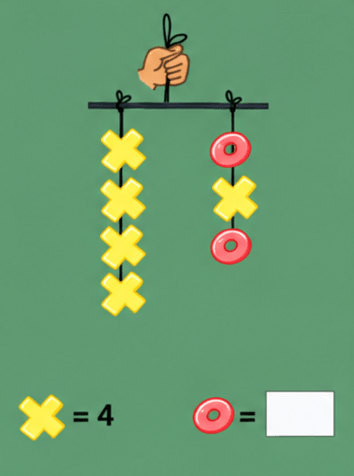
Find the unknown weights in the following case:
Answer
Here also no total is shown, but the scale is balanced.
The left plate carries 4 stars, each of weight 4, and the right plate carries 2 donuts and 1 star.
∴ 4 × Star = 2 × Donut + Star
⇒ 4 × 4 = 2 × Donut + 4
⇒ 16 = 2 × Donut + 4
⇒ 2 × Donut = 16 – 4
⇒ 2 × Donut = 12
⇒ Donut =
⇒ Donut = 6
Hence, each donut weighs 6 units.
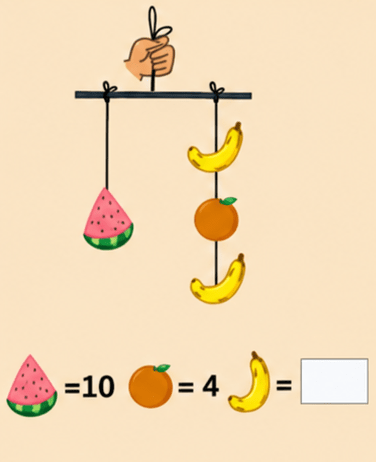
Find the unknown weights in the following case:
Answer
Here also no total is shown, but the scale is balanced.
The left plate carries 1 slice of watermelon of weight 10, and the right plate carries 2 bananas and 1 orange of weight 4.
∴ Watermelon = 2 × Banana + Orange
⇒ 10 = 2 × Banana + 4
⇒ 2 × Banana = 10 – 4
⇒ 2 × Banana = 6
⇒ Banana =
⇒ Banana = 3
Hence, each banana weighs 3 units.
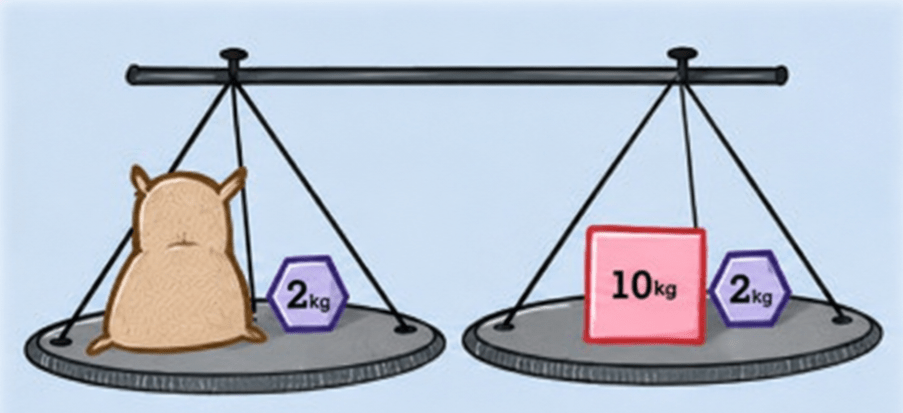
Find the unknown weight of the sack in the following case.
Answer
If equal weights are removed from both the plates of a balanced weighing scale, the scale stays balanced. We use this idea in each case.
The left plate carries 1 sack and a 2 kg weight, and the right plate carries a 10 kg weight and a 2 kg weight.
Since the scale is balanced,
Sack + 2 kg = 10 kg + 2 kg
Removing the 2 kg weight from both the plates, the scale remains balanced.
∴ Sack = 10 kg
Hence, the weight of the sack is 10 kg.
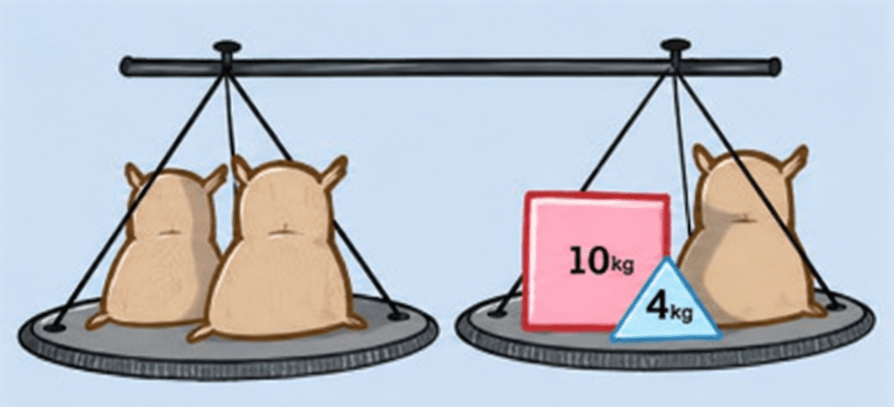
Find the unknown weight of the sack in the following case. All the sacks have the same weight.
Answer
The left plate carries 2 sacks, and the right plate carries 1 sack, a 10 kg weight and a 4 kg weight. All the sacks have the same weight.
Since the scale is balanced,
2 × Sack = Sack + 10 kg + 4 kg
⇒ 2 × Sack = Sack + 14 kg
Removing 1 sack from both the plates, the scale remains balanced.
∴ Sack = 14 kg
Hence, the weight of each sack is 14 kg.
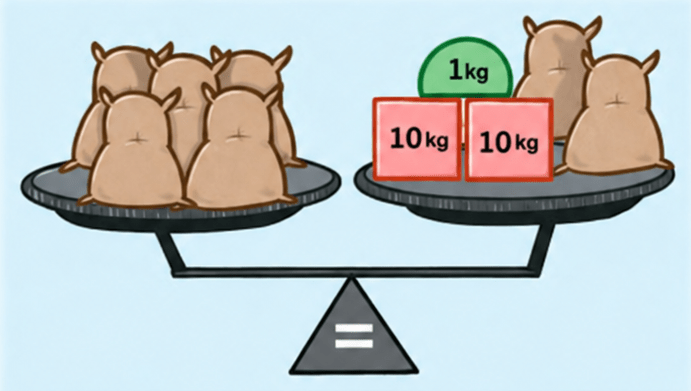
Find the unknown weight of the sack in the following case. All the sacks have the same weight.
Answer
The left plate carries 5 sacks, and the right plate carries 2 sacks together with weights of 10 kg, 10 kg and 1 kg. All the sacks have the same weight.
Weight of the given weights = 10 kg + 10 kg + 1 kg = 21 kg
Since the scale is balanced,
5 × Sack = 2 × Sack + 21 kg
Removing 2 sacks from both the plates, the scale remains balanced.
⇒ 3 × Sack = 21 kg
⇒ Sack = kg
⇒ Sack = 7 kg
Hence, the weight of each sack is 7 kg.
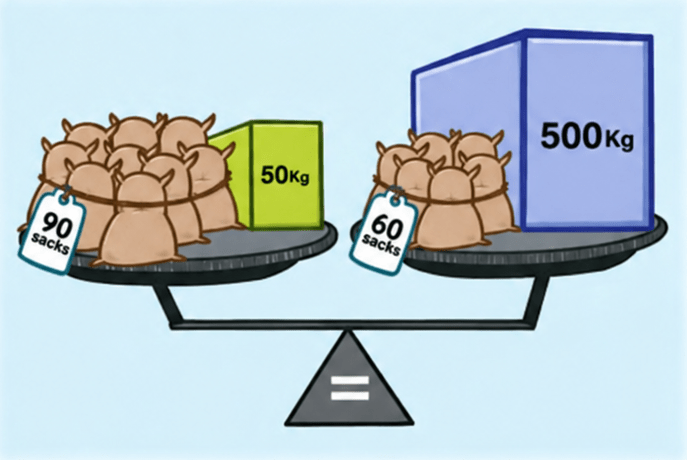
Find the unknown weight of the sack in the following case. All the sacks have the same weight.
Answer
The left plate carries 90 sacks and a 50 kg weight, and the right plate carries 60 sacks and a 500 kg weight. All the sacks have the same weight.
Since the scale is balanced,
90 × Sack + 50 kg = 60 × Sack + 500 kg
Removing 60 sacks and a 50 kg weight from both the plates, the scale remains balanced.
⇒ 30 × Sack = 450 kg
⇒ Sack = kg
⇒ Sack = 15 kg
Hence, the weight of each sack is 15 kg.
Can you find ways to get the value of n, such that 2n + 1 = 99?
Answer
Method 1 (Trial and error):
We substitute different values for n and check which one makes the LHS equal to 99.
For n = 10, LHS = 2 × 10 + 1 = 21, which is much less than 99.
For n = 30, LHS = 2 × 30 + 1 = 61, which is still less than 99.
For n = 40, LHS = 2 × 40 + 1 = 81, which is closer to 99.
For n = 50, LHS = 2 × 50 + 1 = 101, which is a little more than 99.
For n = 49, LHS = 2 × 49 + 1 = 99, which is equal to the RHS.
∴ n = 49
Method 2 (Undoing the operations):
In the expression 2n + 1, the number n is first multiplied by 2 and then 1 is added to it. To get back to n, we undo these operations in the reverse order.
Subtracting 1 from 99, we get 99 – 1 = 98.
Dividing 98 by 2, we get .
∴ n = 49
Method 3 (Operating on both sides):
We have:
2n + 1 = 99
⇒ 2n = 99 – 1 [Subtracting 1 from both sides]
⇒ 2n = 98
⇒ n = [Dividing both sides by 2]
∴ n = 49
So, the arrangement made with exactly 99 matchsticks is at position number 49 in the sequence.
Is it possible to make a matchstick arrangement that appears in this sequence using exactly 200 sticks?

Answer
The arrangement at position n uses 2n + 1 matchsticks, where n is a counting number.
Here, n is multiplied by 2, so 2n is always an even number. Adding 1 to an even number always gives an odd number.
∴ 2n + 1 is always odd, for every counting number n.
But 200 is an even number, so it can never be equal to 2n + 1.
We can also see this by solving the equation:
2n + 1 = 200
⇒ 2n = 200 – 1 [Subtracting 1 from both sides]
⇒ 2n = 199
⇒ n = [Dividing both sides by 2]
⇒ n =
Since is not a counting number, there is no position in the sequence that uses exactly 200 matchsticks.
Hence, it is not possible to make an arrangement of this sequence using exactly 200 matchsticks.
For the weighing scale problems in figures 7.6, 7.7, 7.8, 7.9, 7.10, and 7.11, frame equations by using letter-numbers to denote the unknown weight.
Solve the equations that you frame and check if you get the same value for the unknown weight as you got previously.
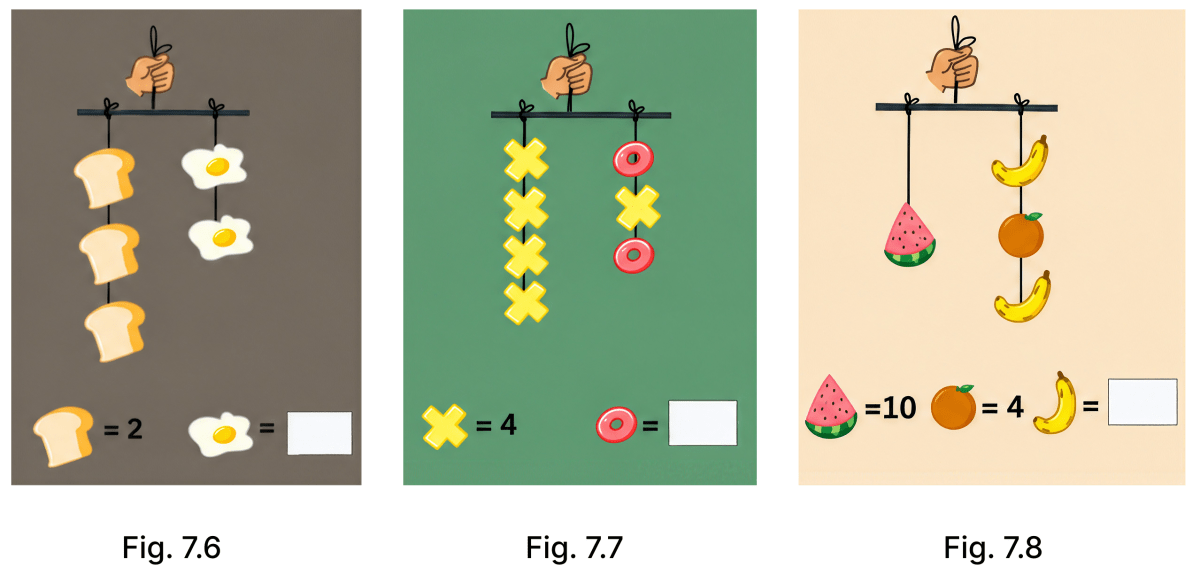
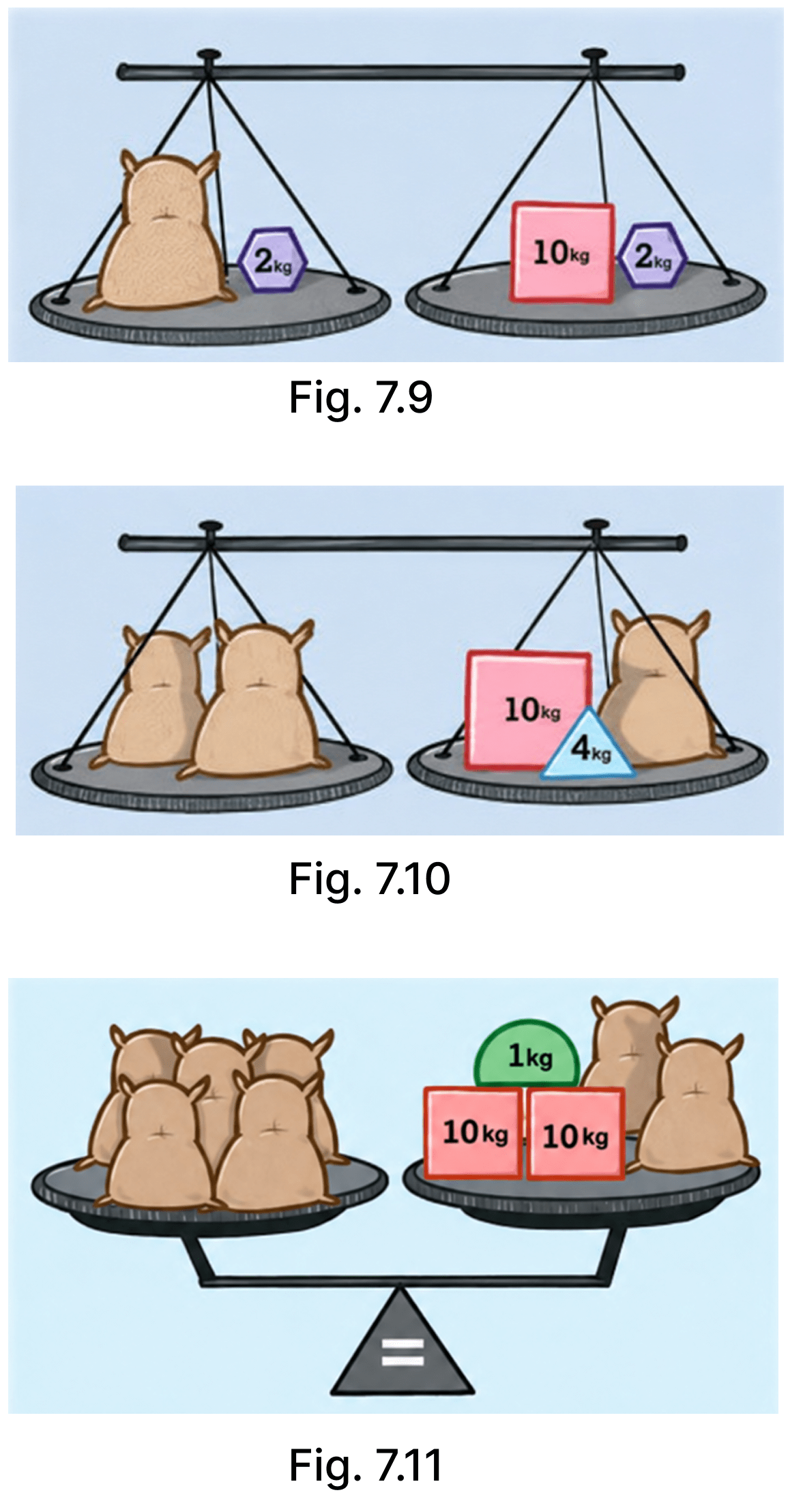
Answer
In each case we denote the unknown weight by a letter-number and use the fact that a balanced scale has equal weights on its two plates.
For Fig. 7.6:
Let the weight of one fried egg be e.
Each slice of bread weighs 2, so the left plate carries 2 + 2 + 2 = 6 and the right plate carries e + e.
∴ The required equation is 2e = 6
⇒ e = [Dividing both sides by 2]
∴ e = 3
For Fig. 7.7:
Let the weight of one donut be y.
Each star weighs 4, so the left plate carries 4 × 4 = 16 and the right plate carries 4 + 2y.
∴ The required equation is 4 + 2y = 16
⇒ 2y = 16 – 4 [Transposing +4 to RHS]
⇒ 2y = 12
⇒ y = [Dividing both sides by 2]
∴ y = 6
For Fig. 7.8:
Let the weight of one banana be b.
The left plate carries the watermelon of weight 10 and the right plate carries 2b together with the orange of weight 4.
∴ The required equation is 2b + 4 = 10
⇒ 2b = 10 – 4 [Transposing +4 to RHS]
⇒ 2b = 6
⇒ b = [Dividing both sides by 2]
∴ b = 3
For Fig. 7.9:
Let the weight of the sack be s kg.
The left plate carries s + 2 and the right plate carries 10 + 2 = 12.
∴ The required equation is s + 2 = 12
⇒ s = 12 – 2 [Transposing +2 to RHS]
∴ s = 10
For Fig. 7.10:
Let the weight of each sack be s kg.
The left plate carries 2s and the right plate carries s + 10 + 4 = s + 14.
∴ The required equation is 2s = s + 14
⇒ 2s – s = 14 [Transposing +s to LHS]
∴ s = 14
For Fig. 7.11:
Let the weight of each sack be s kg.
The left plate carries 5s and the right plate carries 2s together with 10 + 10 + 1 = 21.
∴ The required equation is 5s = 2s + 21
⇒ 5s – 2s = 21 [Transposing +2s to LHS]
⇒ 3s = 21
⇒ s = [Dividing both sides by 3]
∴ s = 7
The solution to the equation 2n + 1 = 99 is n = 49. Can this equation have any other solution?
Answer
No, this equation cannot have any other solution.
As the value of n increases, the value of 2n also increases, and so the value of 2n + 1 increases as well.
So, if n is greater than 49, then 2n + 1 is greater than 99, and if n is less than 49, then 2n + 1 is less than 99.
For example, for n = 50, LHS = 2 × 50 + 1 = 101, which is greater than 99, and for n = 48, LHS = 2 × 48 + 1 = 97, which is less than 99.
∴ The LHS becomes equal to 99 for n = 49 only.
Hence, n = 49 is the only solution of the equation 2n + 1 = 99.
Try solving 5x – 4 = 7 using trial and error.
Answer
We substitute different values for x and check which one makes the LHS equal to 7.
For x = 1, LHS = 5 × 1 – 4 = 5 – 4 = 1, which is less than 7.
For x = 2, LHS = 5 × 2 – 4 = 10 – 4 = 6, which is a little less than 7.
For x = 3, LHS = 5 × 3 – 4 = 15 – 4 = 11, which is more than 7.
So the value of x lies between 2 and 3, and it is not a whole number. This means trial and error will now need us to try fractions, which makes the method very slow.
Solving the equation systematically instead, we have:
5x – 4 = 7
⇒ 5x = 7 + 4 [Adding 4 to both sides]
⇒ 5x = 11
⇒ x = [Dividing both sides by 5]
∴ , that is,
Check:
LHS = 5x – 4
=
= 11 – 4
= 7
RHS = 7
Hence, LHS = RHS.
So, trial and error works, but it is inefficient here because the solution is not a whole number.
Consider an equation 15 + 8 = 23. If we add, subtract, multiply or divide the same number on both sides, will it still preserve the equality of LHS and RHS?
Answer
Yes. Addition, subtraction and multiplication by the same number preserve equality. Division also preserves equality provided the divisor is non-zero.
Since the LHS and the RHS of an equation have the same value, performing the same valid operation on both sides gives equal results.
We have LHS = 15 + 8 = 23 and RHS = 23.
Adding 10 to both sides:
LHS = 15 + 8 + 10 = 33 and RHS = 23 + 10 = 33
∴ LHS = RHS
Subtracting 3 from both sides:
LHS = 15 + 8 – 3 = 20 and RHS = 23 – 3 = 20
∴ LHS = RHS
Multiplying both sides by 4:
LHS = (15 + 8) × 4 = 23 × 4 = 92 and RHS = 23 × 4 = 92
∴ LHS = RHS
Dividing both sides by 2:
LHS = and RHS =
∴ LHS = RHS
Hence, performing the same operation on both sides of an equation preserves equality; when dividing, the common divisor must be non-zero.
It is known that 23 × 41 × 11 × 8 × 7 = 5,80,888. What is the value of the expression 23 × 41 × 11 × 8? Is this the same as dividing both sides by 7, which removes the factor 7 and leaves only the expression to be evaluated on the LHS?
Answer
The value of the expression 23 × 41 × 11 × 8 is 82,984.
Yes, the two are exactly the same.
We have:
23 × 41 × 11 × 8 × 7 = 5,80,888
Dividing both sides by 7:
(23 × 41 × 11 × 8 × 7) ÷ 7 = 5,80,888 ÷ 7
On the LHS, multiplication and division are inverse operations. So dividing by 7 simply removes the factor 7 and leaves behind only the expression that has to be evaluated.
⇒ 23 × 41 × 11 × 8 = 5,80,888 ÷ 7
⇒ 23 × 41 × 11 × 8 = 82,984
Thus, dividing only the RHS by 7 is not a separate shortcut — it is precisely what remains after both sides are divided by 7, because the division on the LHS does no arithmetic work other than cancelling the factor 7. Since the same operation has been performed on both sides, the equality is preserved.
Hence, 23 × 41 × 11 × 8 = 82,984, and dividing 5,80,888 by 7 is the same as dividing both sides of the equation by 7.
Solve these equations and check the solutions.
(a) 3x – 10 = 35
(b) 5s = 3s
(c) 3u – 7 = 2u + 3
(d) 4 (m + 6) – 8 = 2m – 4
(e) = 6
Answer
(a) We have:
3x – 10 = 35
⇒ 3x = 35 + 10 [Transposing –10 to RHS]
⇒ 3x = 45
⇒ x =
∴ x = 15
Check:
LHS = 3x – 10
= 3 × 15 – 10
= 45 – 10
= 35
RHS = 35
Hence, LHS = RHS.
(b) We have:
5s = 3s
⇒ 5s – 3s = 0 [Transposing 3s to LHS]
⇒ 2s = 0
⇒
∴ s = 0
Check:
LHS = 5s
= 5 × 0
= 0
RHS = 3s
= 3 × 0
= 0
Hence, LHS = RHS.
(c) We have:
3u – 7 = 2u + 3
⇒ 3u – 2u = 3 + 7 [Transposing –7 to RHS and +2u to LHS]
∴ u = 10
Check:
LHS = 3u – 7
= 3 × 10 – 7
= 30 – 7
= 23
RHS = 2u + 3
= 2 × 10 + 3
= 20 + 3
= 23
Hence, LHS = RHS.
(d) We have:
4 (m + 6) – 8 = 2m – 4
⇒ 4m + 24 – 8 = 2m – 4 [Expanding the bracket]
⇒ 4m + 16 = 2m – 4
⇒ 4m – 2m = – 4 – 16 [Transposing +16 to RHS and +2m to LHS]
⇒ 2m = – 20
⇒ m =
∴ m = – 10
Check:
LHS = 4 (m + 6) – 8
= 4 (– 10 + 6) – 8
= 4 × (– 4) – 8
= – 16 – 8
= – 24
RHS = 2m – 4
= 2 × (– 10) – 4
= – 20 – 4
= – 24
Hence, LHS = RHS.
(e) We have:
⇒ u = 6 × 15 [Multiplying both sides by 15]
∴ u = 90
Check:
LHS =
=
= 6
RHS = 6
Hence, LHS = RHS.
Frame an equation that has no solution.
[Hint: 4 more than a number, and 5 more than a number can never be equal!]
Answer
Let the number be x.
Then, 4 more than the number = x + 4
and 5 more than the number = x + 5
A number that is 5 more than x is always greater than the number that is 4 more than x, whatever value x may take. So these two expressions can never be equal.
Equating them gives the required equation:
x + 4 = x + 5
Why it has no solution:
x + 4 = x + 5
⇒ x – x = 5 – 4 [Transposing +4 to RHS and x to LHS]
⇒ 0 = 1, which is false.
Since the LHS can never become equal to the RHS for any value of x, the equation has no solution.
Hence, x + 4 = x + 5 is an equation that has no solution.
Ranjana creates a sequence of arrangements with square tiles as shown below. Can she extend the sequence and make an arrangement using 100 tiles? If yes, which step in the sequence will it be?
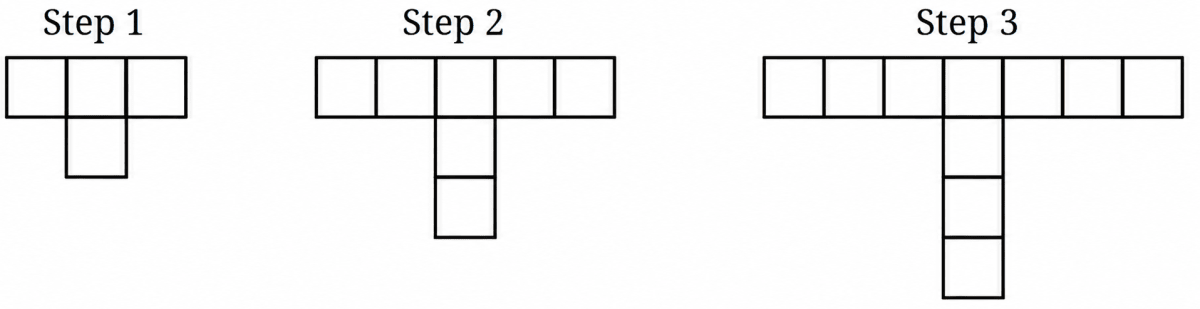
Answer
Let us count the number of tiles used at each step.
Step 1 uses 1 + 1 + 1 + 1 = 4 tiles
Step 2 uses 2 + 2 + 2 + 1 = 7 tiles
Step 3 uses 3 + 3 + 3 + 1 = 10 tiles
At each step, three arms of the arrangement grow by one tile each, and one corner tile is always present.
∴ Number of tiles needed at Step k = k + k + k + 1 = 3k + 1
Ranjana can make an arrangement using 100 tiles only if 3k + 1 has the value 100 for some step number k.
So, we solve the equation:
3k + 1 = 100
⇒ 3k = 100 – 1 [Transposing +1 to RHS]
⇒ 3k = 99
⇒ k =
⇒ k = 33
Since 33 is a whole number, such a step exists in the sequence.
Check: Number of tiles at Step 33 = 3 × 33 + 1 = 99 + 1 = 100.
Hence, yes — Ranjana can make an arrangement using 100 tiles, and it will be Step 33 of the sequence.
Riyaz created a math trick, which he tries out on his friend Akash. Riyaz asked Akash to perform the following steps without revealing the answer to any of the intermediate steps.
- Think of a number.
- Subtract 3 from the number.
- Multiply the result by 4.
- Add 8 to the product.
- Reveal the final answer.
The final answer revealed by Akash was 24. Using this, Riyaz correctly figured out the starting number that Akash had thought of. Find this number.
Try the steps using different numbers as the starting number. Do you see any relation between the starting number and final answer?
(i) Can you think of a simple rule that you can use to get the starting number from the final answer?
Answer
Let the number that Akash thought of be x.
Writing the expression obtained after each step:
| Steps | Expression |
|---|---|
| Think of a number. | x |
| Subtract 3 from the number. | x – 3 |
| Multiply the result by 4. | 4 (x – 3) = 4x – 12 |
| Add 8 to the product. | 4x – 12 + 8 = 4x – 4 |
Since the final answer revealed by Akash was 24, we get the equation:
4x – 4 = 24
⇒ 4x = 24 + 4 [Transposing – 4 to RHS]
⇒ 4x = 28
⇒ x =
∴ x = 7, i.e. Akash had thought of the number 7.
Relation between the starting number and the final answer:
Trying the steps with a few different starting numbers:
| Starting number | Working | Final answer |
|---|---|---|
| 1 | (1 – 3) × 4 + 8 | 0 |
| 2 | (2 – 3) × 4 + 8 | 4 |
| 5 | (5 – 3) × 4 + 8 | 16 |
| 10 | (10 – 3) × 4 + 8 | 36 |
| – 3 | (– 3 – 3) × 4 + 8 | – 16 |
In every case the final answer is 4 less than 4 times the starting number, which is exactly the expression 4x – 4 obtained above.
Hence, Final answer = 4 × (Starting number) – 4 = 4 (Starting number – 1).
(i)
From the previous question we know that
Final answer = 4 × (Starting number) – 4
Let the starting number be x and the final answer be a.
Then, 4x – 4 = a
⇒ 4x = a + 4 [Transposing – 4 to RHS]
⇒ x =
⇒ x =
So the rule is: add 4 to the final answer and divide the result by 4; equivalently, divide the final answer by 4 and then add 1.
Hence, Starting number .
Ramesh and Suresh have 60 marbles between them. Ramesh has 30 more marbles than Suresh. How many marbles does each boy have?
Answer
Let the number of marbles with Suresh be y.
Since Ramesh has 30 marbles more than Suresh,
number of marbles with Ramesh = y + 30
Since the total number of marbles is 60, we get the equation:
y + (y + 30) = 60
⇒ 2y + 30 = 60
⇒ 2y = 60 – 30 [Transposing +30 to RHS]
⇒ 2y = 30
⇒ y =
⇒ y = 15
∴ Number of marbles with Suresh = 15
and number of marbles with Ramesh = y + 30 = 15 + 30 = 45
Hence, Ramesh has 45 marbles and Suresh has 15 marbles.
Write equations whose solution is y = 5. Share the equations you made with each other and discuss the methods used.
Answer
We can build such equations by starting from y = 5 and performing the same operation on both sides, since this keeps the equality — and hence the solution — unchanged.
Method 1 (adding the same number to both sides):
y = 5
⇒ y + 1 = 5 + 1
⇒ y + 1 = 6
Method 2 (multiplying both sides by the same number):
y = 5
⇒ 3y = 3 × 5
⇒ 3y = 15
Method 3 (multiplying and then subtracting):
y = 5
⇒ 2y = 10 [Multiplying both sides by 2]
⇒ 2y – 3 = 10 – 3 [Subtracting 3 from both sides]
⇒ 2y – 3 = 7
Method 4 (dividing both sides by the same number):
y = 5
⇒
⇒
Method 5 (an equation with the unknown on both sides):
y = 5
⇒ 4y = 20 [Multiplying both sides by 4]
⇒ 4y – y = 20 – y [Subtracting y from both sides]
⇒ 3y = 20 – y
Check (for 2y – 3 = 7): LHS = 2 × 5 – 3 = 10 – 3 = 7 = RHS.
Hence, y + 1 = 6, 3y = 15, 2y – 3 = 7, and 3y = 20 – y are five equations whose solution is y = 5.
Consider the following chains of equations, where one is obtained from the previous one by performing the same operation on both sides.
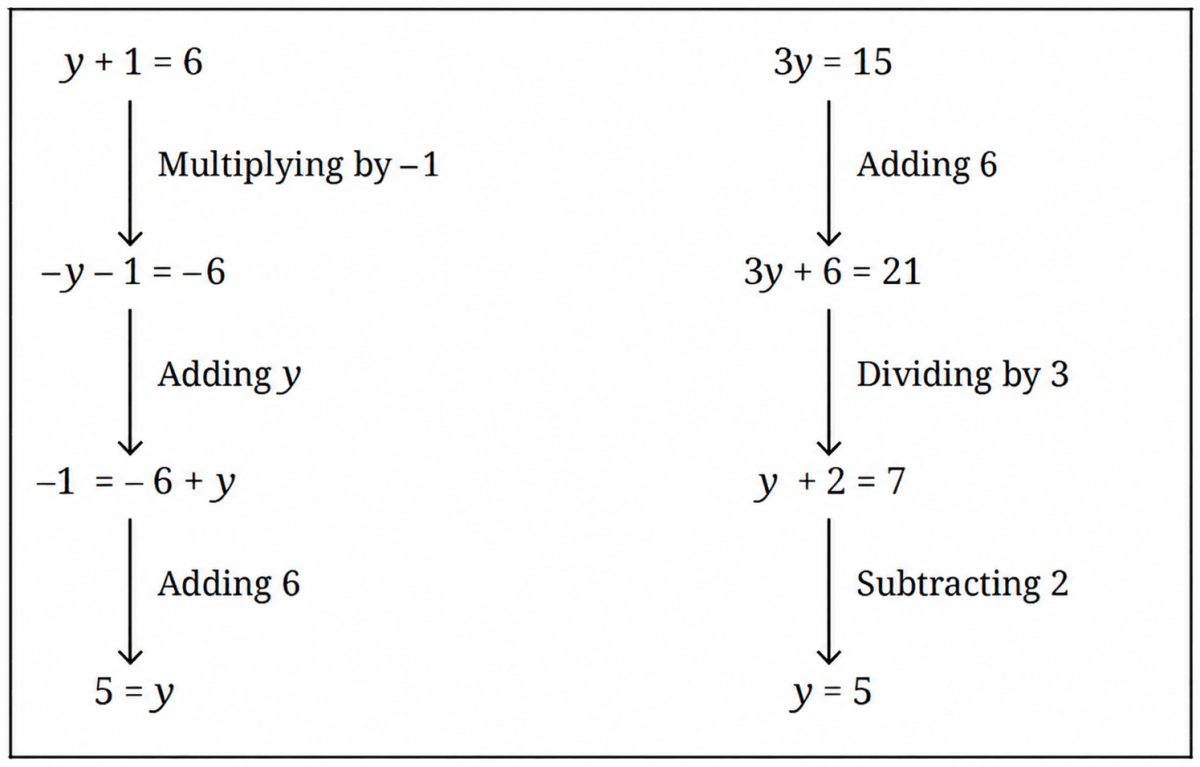
(i) Can you form a chain going from the bottom equation to the top? Compare the operations used when going from the top to the bottom and from the bottom to the top.
(ii) Without calculating, can you find the value of the unknown in each equation in the chains above?
[Hint: We have seen that the value that satisfies an equation also satisfies the new equation obtained by performing the same operation on both sides of the original equation.]
Answer
(i)
Yes, a chain can be formed going upwards as well. We only have to undo, one at a time, the operations that were used while coming down.
Chain 1 — going from the bottom equation to the top:
5 = y
⇒ 5 – 6 = y – 6 [Subtracting 6 from both sides]
⇒ – 1 = – 6 + y
⇒ – 1 – y = – 6 + y – y [Subtracting y from both sides]
⇒ – 1 – y = – 6
⇒ (– 1 – y) × (– 1) = (– 6) × (– 1) [Multiplying both sides by – 1]
⇒ y + 1 = 6
Chain 2 — going from the bottom equation to the top:
y = 5
⇒ y + 2 = 5 + 2 [Adding 2 to both sides]
⇒ y + 2 = 7
⇒ 3 (y + 2) = 3 × 7 [Multiplying both sides by 3]
⇒ 3y + 6 = 21
⇒ 3y + 6 – 6 = 21 – 6 [Subtracting 6 from both sides]
⇒ 3y = 15
Comparing the two directions:
| Chain | Top to bottom | Bottom to top |
|---|---|---|
| 1 | Multiplying by – 1, then adding y, then adding 6 | Subtracting 6, then subtracting y, then multiplying by – 1 |
| 2 | Adding 6, then dividing by 3, then subtracting 2 | Adding 2, then multiplying by 3, then subtracting 6 |
We observe two things:
- Each operation used while going up is the inverse of the corresponding operation used while coming down — addition is undone by subtraction, and multiplication is undone by division. (Multiplying by – 1 is its own inverse, so it appears in both directions.)
- These inverse operations are applied in the reverse order, i.e. the operation used last while coming down is undone first while going up.
Hence, the chain can be traced in either direction, the upward operations being the inverse operations of the downward ones, applied in the reverse order.
(ii)
Yes. Within a chain, every equation is obtained from the previous one by performing the same operation on both sides. Such an operation does not disturb the equality, so a value of the unknown that satisfies one equation of the chain must satisfy every other equation of that chain.
In each chain, the last equation directly states the value of the unknown — it is 5 = y in Chain 1 and y = 5 in Chain 2.
∴ Without doing any calculation, the unknown in every equation of both chains must be y = 5.
Chain 1
| Equation | Value of the unknown |
|---|---|
| y + 1 = 6 | y = 5 |
| – y – 1 = – 6 | y = 5 |
| – 1 = – 6 + y | y = 5 |
| 5 = y | y = 5 |
Chain 2
| Equation | Value of the unknown |
|---|---|
| 3y = 15 | y = 5 |
| 3y + 6 = 21 | y = 5 |
| y + 2 = 7 | y = 5 |
| y = 5 | y = 5 |
Hence, the unknown has the value y = 5 in every equation of both the chains.
Write 5 equations whose solution is x = – 2.
Answer
We start with the equation x = – 2 and perform the same operation on both sides. Since performing the same operation on both sides of an equation keeps the equality, every new equation formed in this way will also have the solution x = – 2.
x = -2
⇒ x + 2 = -2 + 2 [Adding 2 to both sides]
⇒ x + 2 = 0
Proceeding in this manner, five such equations are:
x + 2 = 0 [Adding 2 to both sides]
3x = – 6 [Multiplying both sides by 3]
5x + 7 = – 3 [Multiplying both sides by 5, then adding 7 to both sides]
2x – 1 = x – 3 [Adding x to both sides of 2x – 1 = – 5]
[Dividing both sides by 2]
Check:
Substituting x = – 2 in each equation:
LHS = – 2 + 2 = 0 = RHS
LHS = 3 × (– 2) = – 6 = RHS
LHS = 5 × (– 2) + 7 = – 10 + 7 = – 3 = RHS
LHS = 2 × (– 2) – 1 = – 4 – 1 = – 5 and RHS = – 2 – 3 = – 5, so LHS = RHS
LHS = = – 1 = RHS
Hence, x + 2 = 0, 3x = – 6, 5x + 7 = – 3, 2x – 1 = x – 3 and are five equations whose solution is x = – 2.
Find the value of each unknown:
(a) 2y = 60
(b) – 8 = 5x – 3
(c) – 53w = –15
(d) 13 – z = 8
(e) k + 8 = 12 – k
(f) 7m = m – 3
(g) 3n = 10 + n
Answer
(a) We have:
2y = 60
⇒ y = [Dividing both sides by 2]
∴ y = 30
(b) We have:
– 8 = 5x – 3
⇒ – 8 + 3 = 5x [Transposing – 3 to LHS]
⇒ – 5 = 5x
⇒ x = [Dividing both sides by 5]
∴ x = – 1
(c) We have:
– 53w = –15
⇒ w = [Dividing both sides by – 53]
∴ w =
(d) We have:
13 – z = 8
⇒ 13 – 8 = z [Transposing – z to RHS and 8 to LHS]
∴ z = 5
(e) We have:
k + 8 = 12 – k
⇒ k + k = 12 – 8 [Transposing – k to LHS and + 8 to RHS]
⇒ 2k = 4
⇒ [Dividing both sides by 2]
∴ k = 2
(f) We have:
7m = m – 3
⇒ 7m – m = –3 [Transposing m to LHS]
⇒ 6m = –3
⇒ m = [Dividing both sides by 6]
∴ m =
(g) We have:
3n = 10 + n
⇒ 3n – n = 10 [Transposing n to LHS]
⇒ 2n = 10
⇒ n = [Dividing both sides by 2]
∴ n = 5
I am a 3-digit number. My hundred's digit is 3 less than my ten's digit. My ten's digit is 3 less than my unit's digit. The sum of all the three digits is 15. Who am I?
Answer
Let the unit's digit of the number be x.
Then, ten's digit is 3 less than the unit's digit,
∴ Ten's digit = x – 3
Also, the hundred's digit is 3 less than the ten's digit,
∴ Hundred's digit = (x – 3) – 3 = x – 6
Since the sum of all the three digits is 15, we have:
(x – 6) + (x – 3) + x = 15
⇒ 3x – 9 = 15
⇒ 3x = 15 + 9 [Transposing – 9 to RHS]
⇒ 3x = 24
⇒ x = [Dividing both sides by 3]
⇒ x = 8
∴ Unit's digit = 8
Ten's digit = 8 – 3 = 5
Hundred's digit = 5 – 3 = 2
Hence, the required number is 258.
The weight of a brick is 1 kg more than half its weight. What is the weight of the brick?
Answer
Let the weight of the brick be x kg.
Then, half its weight = kg
Since the weight of the brick is 1 kg more than half its weight, we have:
Hence, the weight of the brick is 2 kg.
One quarter of a number increased by 9 gives the same number. What is the number?
Answer
Let the required number be x.
Then, one quarter of the number =
Since one quarter of the number increased by 9 gives the same number, we have:
Hence, the required number is 12.
Given 4k + 1 = 13, find the values of:
(a) 8k + 2
(b) 4k
(c) k
(d) 4k – 1
(e) – k – 2
Answer
Given:
4k + 1 = 13
⇒ 4k = 13 - 1
⇒ 4k = 12
⇒ k =
⇒ k = 3
Substitute k = 3 in the below equation:
(a) 8k + 2
⇒ 8(3) + 2
⇒ 24 + 2
⇒ 26
∴ 8k + 2 = 26
(b) 4k
⇒ 4(3) = 12
∴ 4k = 12
(c) k
k = 3
(d) 4k – 1
⇒ 4(3) - 1
⇒ 12 - 1
⇒ 11
∴ 4k – 1 = 11
(e) – k – 2
⇒ - 3 - 2
⇒ - 5
∴ – k – 2 = – 5
The following is an equation along with the steps used to solve it to find the value of the letter-number. Go through the solution and decide whether the steps are correct. If there is a mistake, describe the mistake, correct it and solve the equation.
Answer
Mistake: In the second step, the term + 6 has been removed from the LHS but written as + 6 on the RHS. When a term that is added on one side is removed, its additive inverse must appear on the other side. So it should be written as – 6 on the RHS.
Correct solution:
4x + 6 = 10
⇒ 4x = 10 – 6 [Transposing + 6 to RHS]
⇒ 4x = 4
⇒ x = [Dividing both sides by 4]
∴ x = 1
The following is an equation along with the steps used to solve it to find the value of the letter-number. Go through the solution and decide whether the steps are correct. If there is a mistake, describe the mistake, correct it and solve the equation.
Answer
Mistake: The first two steps are correct, and 8z = 2 is right. The mistake is in the last step. To remove the factor 8 from the LHS, both sides must be divided by 8, which gives z = . Instead, 8 has been divided by 2.
Correct solution:
7 – 8z = 5
⇒ 7 – 5 = 8z [Transposing – 8z to RHS and 5 to LHS]
⇒ 8z = 2
⇒ z = [Dividing both sides by 8]
∴ z =
The following is an equation along with the steps used to solve it to find the value of the letter-number. Go through the solution and decide whether the steps are correct. If there is a mistake, describe the mistake, correct it and solve the equation.
Answer
Mistake: In the second step, the factor 2 has been removed from the term 2v and subtracted from the RHS. To remove the factor 2, both sides must be divided by 2, and every term of the LHS must be divided, not just 2v.
Correct solution:
2v – 4 = 6
⇒ 2v = 6 + 4 [Transposing – 4 to RHS]
⇒ 2v = 10
⇒ v = [Dividing both sides by 2]
∴ v = 5
The following is an equation along with the steps used to solve it to find the value of the letter-number. Go through the solution and decide whether the steps are correct. If there is a mistake, describe the mistake, correct it and solve the equation.
Answer
Mistake: In the second step, the signs have not been changed while transposing. When 3z is removed from the RHS it must appear as – 3z on the LHS, and when + 2 is removed from the LHS it must appear as – 2 on the RHS.
Correct solution:
5z + 2 = 3z – 4
⇒ 5z – 3z = – 4 – 2 [Transposing 3z to LHS and + 2 to RHS]
⇒ 2z = – 6
⇒ z = [Dividing both sides by 2]
∴ z = – 3
The following is an equation along with the steps used to solve it to find the value of the letter-number. Go through the solution and decide whether the steps are correct. If there is a mistake, describe the mistake, correct it and solve the equation.
Answer
Mistake: The second step, 15w = 26 + 4w, is correct in itself, but it does not help since the unknown is now on both sides. The real mistake is in the third step, where the term 4w on the RHS has been replaced by 4 — that is, w has been assumed to be 1, which is not given. The LHS has two like terms, so they should simply be combined.
Correct solution:
15w – 4w = 26
⇒ 11w = 26 [Combining like terms]
⇒ w = [Dividing both sides by 11]
∴ w =
The following is an equation along with the steps used to solve it to find the value of the letter-number. Go through the solution and decide whether the steps are correct. If there is a mistake, describe the mistake, correct it and solve the equation.
Answer
Mistake: In the second step, both sides have been divided by 3, but on the LHS only the term 3x has been divided. The term + 1 has been left as it is. When the LHS is divided by 3, every term of it must be divided by 3.
Correct solution:
3x + 1 = – 12
⇒ 3x = – 12 – 1 [Transposing + 1 to RHS]
⇒ 3x = – 13
⇒ x = [Dividing both sides by 3]
∴ x =
The following is an equation along with the steps used to solve it to find the value of the letter-number. Go through the solution and decide whether the steps are correct. If there is a mistake, describe the mistake, correct it and solve the equation.
Answer
Mistake: In the second step, only 2 has been subtracted from the RHS. But the 2 lies inside the bracket, and the whole bracket is multiplied by 4, so the LHS is 16q + 8. To remove this term, 8 must be subtracted from both sides, not 2.
Correct solution:
4(4q + 2) = 50
⇒ 16q + 8 = 50 [Expanding the bracket]
⇒ 16q = 50 – 8 [Transposing + 8 to RHS]
⇒ 16q = 42
⇒ q = [Dividing both sides by 16]
∴ q =
The following is an equation along with the steps used to solve it to find the value of the letter-number. Go through the solution and decide whether the steps are correct. If there is a mistake, describe the mistake, correct it and solve the equation.
Answer
Mistake: There are two mistakes in the second step. First, the letter-number in this equation is x, but the term has been written as – 6v; the product – 2 × 3 is the number – 6, so the step should read – 6 + 8x = 14. Second, – 2 × (– 4x) = + 8x, and not – 8x, because the product of two negative numbers is positive.
Correct solution:
– 2(3 – 4x) = 14
⇒ – 6 + 8x = 14 [Expanding the bracket]
⇒ 8x = 14 + 6 [Transposing – 6 to RHS]
⇒ 8x = 20
⇒ x = [Dividing both sides by 8]
∴ x =
The following is an equation along with the steps used to solve it to find the value of the letter-number. Go through the solution and decide whether the steps are correct. If there is a mistake, describe the mistake, correct it and solve the equation.
Answer
Mistake: In the second step, both sides have been divided by 3, but on the RHS only the term 9 has been divided. The term 5y has been left as it is. Every term of the RHS must be divided by 3, giving . It is simpler here to expand the bracket instead of dividing. (Because of this error, the steps that follow also give a wrong value.)
Correct solution:
3(7y + 4) = 9 + 5y
⇒ 21y + 12 = 9 + 5y [Expanding the bracket]
⇒ 21y – 5y = 9 – 12 [Transposing 5y to LHS and + 12 to RHS]
⇒ 16y = –3
∴ y =
Let us look at a few equations of the following form:
5x + 4 = 3x + 8, or 3x – 6 = 2x + 4.
Can we come up with a formula to solve these equations? That is, for the first equation, can we perform some operations using 5, 4, 3, and 8 that will directly give us the solution? Using a similar method, can you solve the second equation using the numbers 3, – 6, 2 and 4?
Answer
Let us solve 5x + 4 = 3x + 8 step by step, keeping the four numbers 5, 4, 3 and 8 visible.
5x + 4 = 3x + 8
⇒ 5x – 3x = 8 – 4 [Transposing 3x to LHS and + 4 to RHS]
⇒ (5 – 3)x = 8 – 4 [Taking x common on the LHS]
⇒ x = [Dividing both sides by (5 – 3)]
⇒ x =
∴ x = 2
So the operations needed are: subtract the constant on the LHS from the constant on the RHS, subtract the coefficient of x on the RHS from the coefficient of x on the LHS, and then divide the first result by the second.
Hence, the solutions are x = 2 and x = 10 respectively.
Brahmagupta gives the solution to equations of the form Ax + B = Cx + D with the formula x = . Using this formula can you solve this equation 2x + 3 = 4x + 5?
Answer
Comparing 2x + 3 = 4x + 5 with Ax + B = Cx + D, we get:
A = 2, B = 3, C = 4 and D = 5
Substituting these values in Brahmagupta's formula:
∴ x = – 1
Fill in the blanks with integers.
(a) 5 × ........ – 8 = 37
(b) 37 – (33 – ........) = 35
(c) – 3 × (– 11 + ........) = 45
Answer
(a) Let the number in the blank be x.
We have:
5x - 8 = 37
⇒ 5x = 37 + 8 [Transposing -8 to RHS]
⇒ 5x = 45
⇒ x =
⇒ x = 9
∴ 5 × 9 – 8 = 37
(b) Let the number in the blank be x.
We have:
37 - (33 - x) = 35
⇒ 37 - 33 + x = 35
⇒ 4 + x = 35
⇒ x = 35 - 4 [Transposing +4 to RHS]
⇒ x = 31
∴ 37 – (33 – 31) = 35
(c) Let the number in the blank be x.
We have:
-3 × (-11 + x) = 45
⇒ -11 + x = [Dividing both sides by -3]
⇒ -11 + x = -15
⇒ x = -15 + 11 [Transposing -11 to RHS]
⇒ x = -4
– 3 × (– 11 + -4) = 45
Ranju is a daily wage labourer. She earns ₹750 a day. Her employer pays her in 50 and 100 rupee notes. If Ranju gets an equal number of 50 and 100 rupee notes, how many notes of each does she have?
Answer
Let the number of 50 rupee notes be n.
Since Ranju gets an equal number of notes of both kinds,
number of 100 rupee notes = n
Value of the 50 rupee notes = ₹50n
Value of the 100 rupee notes = ₹100n
Total amount earned in a day = ₹750
∴ 50n + 100n = 750
⇒ 150n = 750
⇒ n =
⇒ n = 5
Hence, Ranju has 5 notes of ₹50 and 5 notes of ₹100.
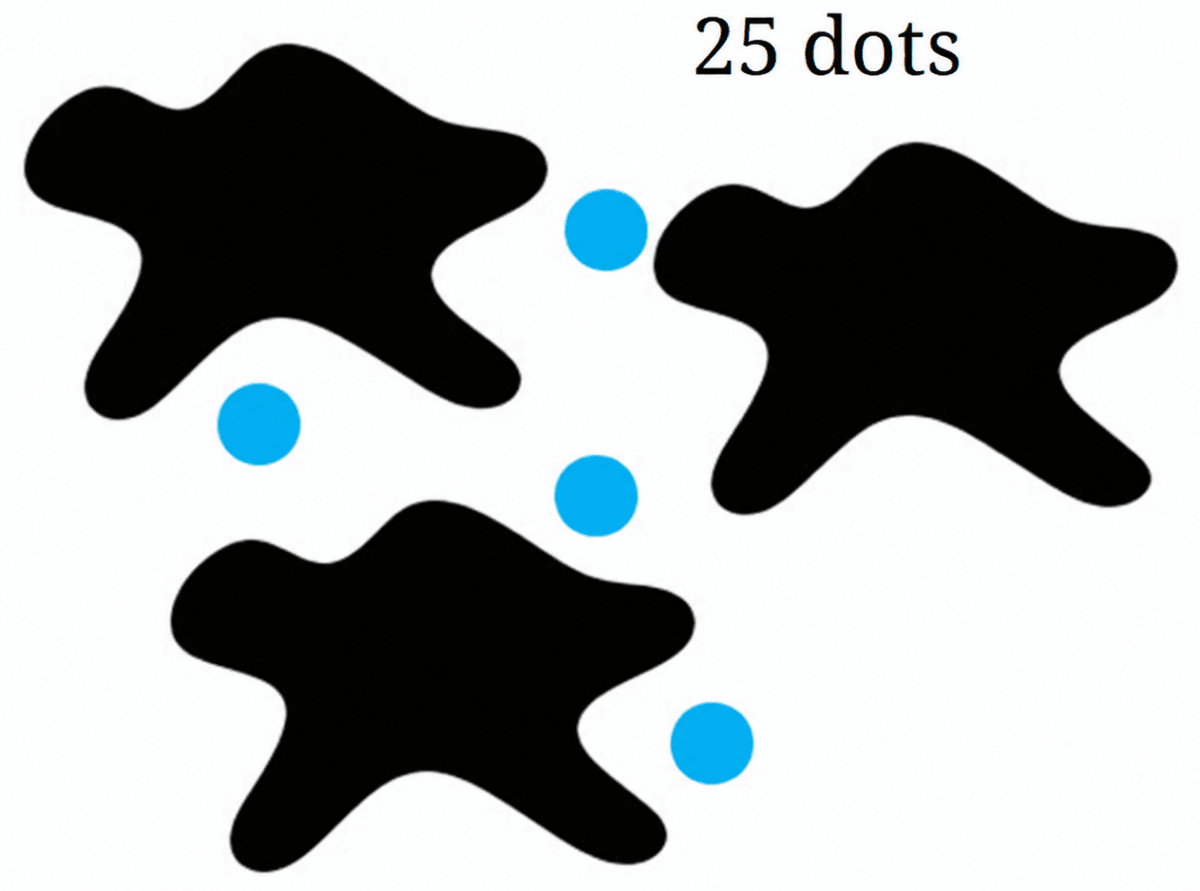
In the given picture, each black blob hides an equal number of blue dots. If there are 25 dots in total, how many dots are covered by one blob? Write an equation to describe this problem.
Answer
From the picture, there are 3 black blobs and 4 blue dots that are visible.
Let the number of dots covered by one blob be x.
Then, the number of dots covered by the 3 blobs = 3x
Total number of dots = dots covered by the blobs + visible dots
So, the required equation is:
3x + 4 = 25
⇒ 3x = 25 - 4 [Transposing +4 to RHS]
⇒ 3x = 21
⇒ x =
⇒ x = 7
Hence, the equation is 3x + 4 = 25 and one blob covers 7 dots.
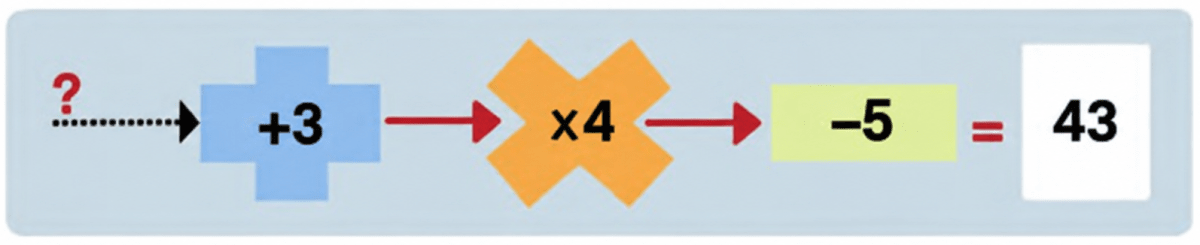
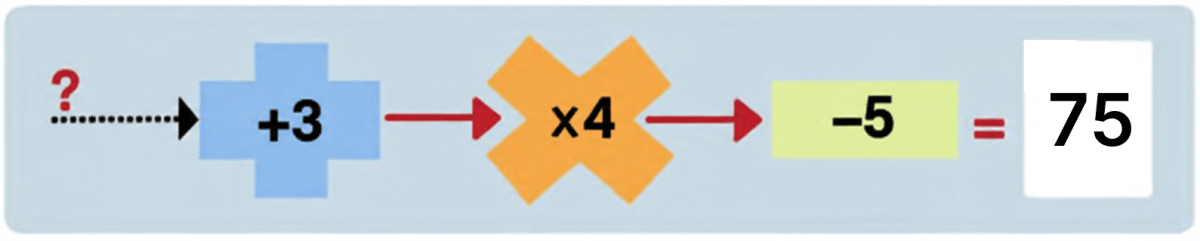
Here are machines that take an input, perform an operation on it and send out the result as an output.

Find the inputs in the following cases:
Answer
The machine first adds 3 to the input, then multiplies the result by 4 and finally subtracts 5 from it.
Let the input be x.
Then, output = 4(x + 3) - 5
(i) When the output is 43:
4(x + 3) - 5 = 43
⇒ 4(x + 3) = 43 + 5 [Transposing -5 to RHS]
⇒ 4(x + 3) = 48
⇒ x + 3 = [Dividing both sides by 4]
⇒ x + 3 = 12
⇒ x = 12 - 3
⇒ x = 9
Hence, the input is 9.
(ii) When the output is 75:
4(x + 3) - 5 = 75
⇒ 4(x + 3) = 75 + 5 [Transposing -5 to RHS]
⇒ 4(x + 3) = 80
⇒ x + 3 = [Dividing both sides by 4]
⇒ x + 3 = 20
⇒ x = 20 - 3
⇒ x = 17
Hence, the input is 17.
Here are machines that take an input, perform an operation on it and send out the result as an output.
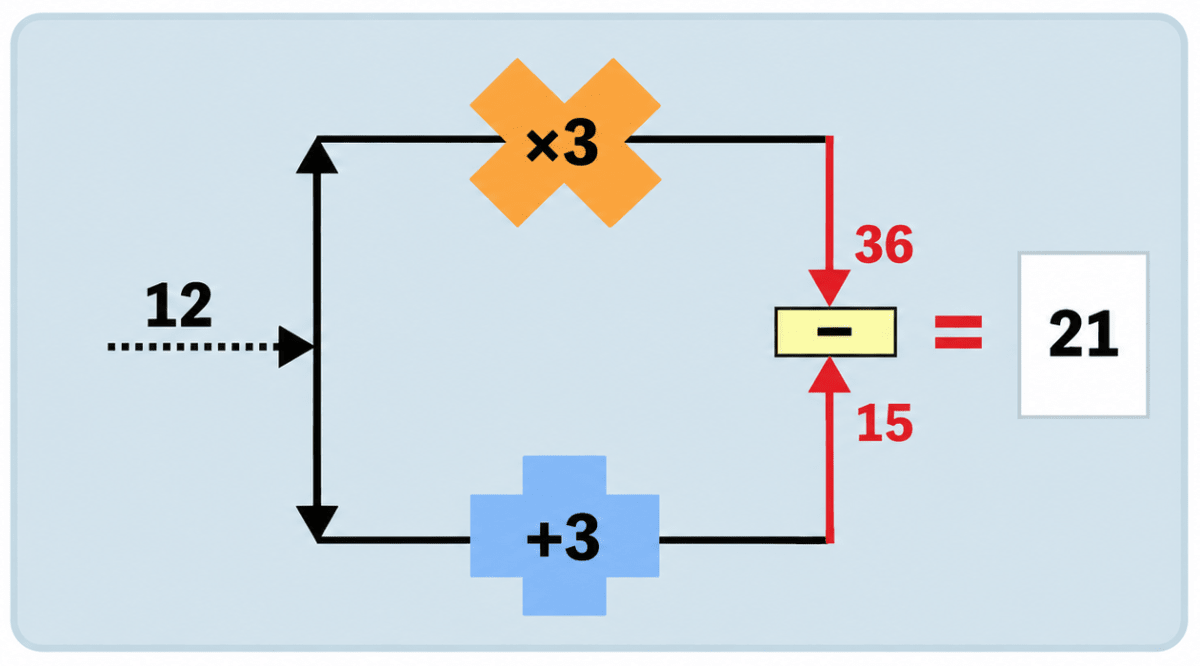
Find the inputs in the following cases:
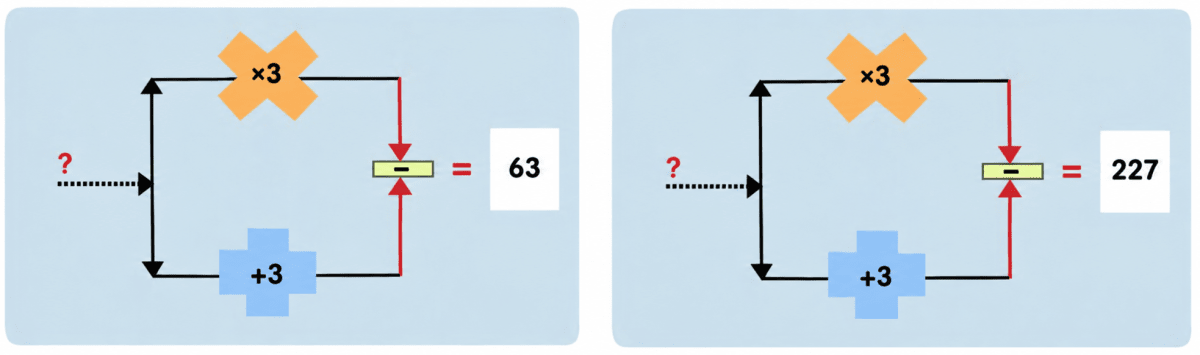
Answer
Here the input travels along two paths. Along the upper path it is multiplied by 3 and along the lower path 3 is added to it. The output is obtained by subtracting the result of the lower path from the result of the upper path.
Let the input be x.
Then, output = 3x - (x + 3)
= 3x - x - 3
= 2x - 3
(i) When the output is 63:
2x - 3 = 63
⇒ 2x = 63 + 3 [Transposing -3 to RHS]
⇒ 2x = 66
⇒ x =
⇒ x = 33
Hence, the input is 33.
(ii) When the output is 227:
2x - 3 = 227
⇒ 2x = 227 + 3 [Transposing -3 to RHS]
⇒ 2x = 230
⇒ x =
⇒ x = 115
Hence, the input is 115.
What is the input to this machine?
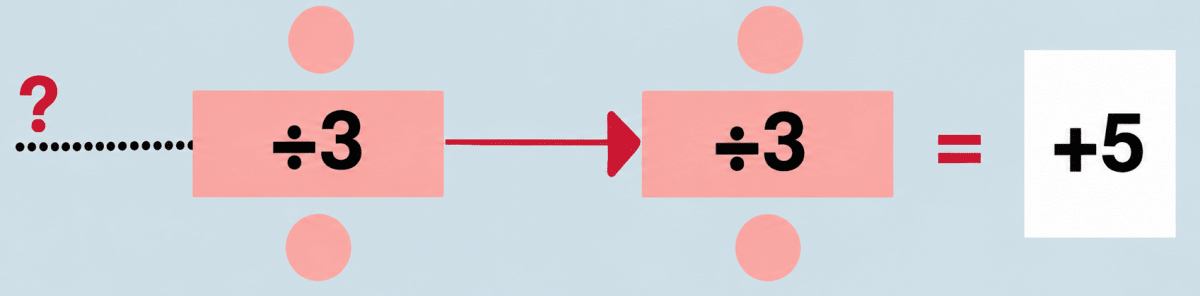
Answer
The machine divides the input by 3 and then divides the result again by 3. The output is 5.
Let the input be x.
Hence, the input is 45.
What is the input to this machine?
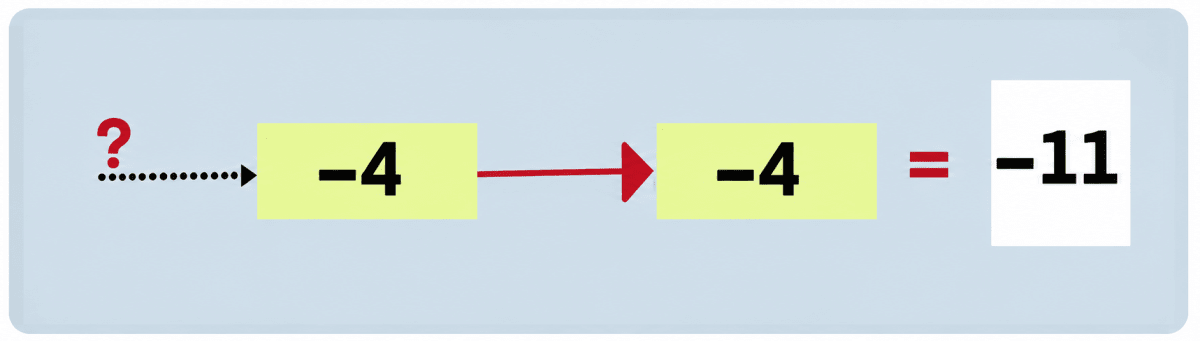
Answer
The machine subtracts 4 from the input and then subtracts 4 again from the result. The output is -11.
Let the input be x.
x - 4 - 4 = -11
⇒ x - 8 = -11
⇒ x = -11 + 8 [Transposing -8 to RHS]
⇒ x = -3
Hence, the input is -3.
A taxi driver charges a fixed fee of ₹800 per day plus ₹20 for each kilometer traveled. If the total cost for a taxi ride is ₹2200, determine the number of kilometres traveled.
Answer
Let the number of kilometres travelled be k.
Charge for k kilometres = ₹20k
Fixed fee = ₹800
Total cost = ₹2200
∴ 800 + 20k = 2200
⇒ 20k = 2200 - 800 [Transposing +800 to RHS]
⇒ 20k = 1400
⇒ k =
⇒ k = 70
Hence, the taxi travelled 70 kilometres.
The sum of two numbers is 76. One number is three times the other number. What are the numbers?
Answer
Let the smaller number be x.
Then, the other number = 3x
Sum of the two numbers = 76
∴ x + 3x = 76
⇒ 4x = 76
⇒ x =
⇒ x = 19
So, the smaller number = 19
and the other number = 3 × 19 = 57
Hence, the two numbers are 19 and 57.
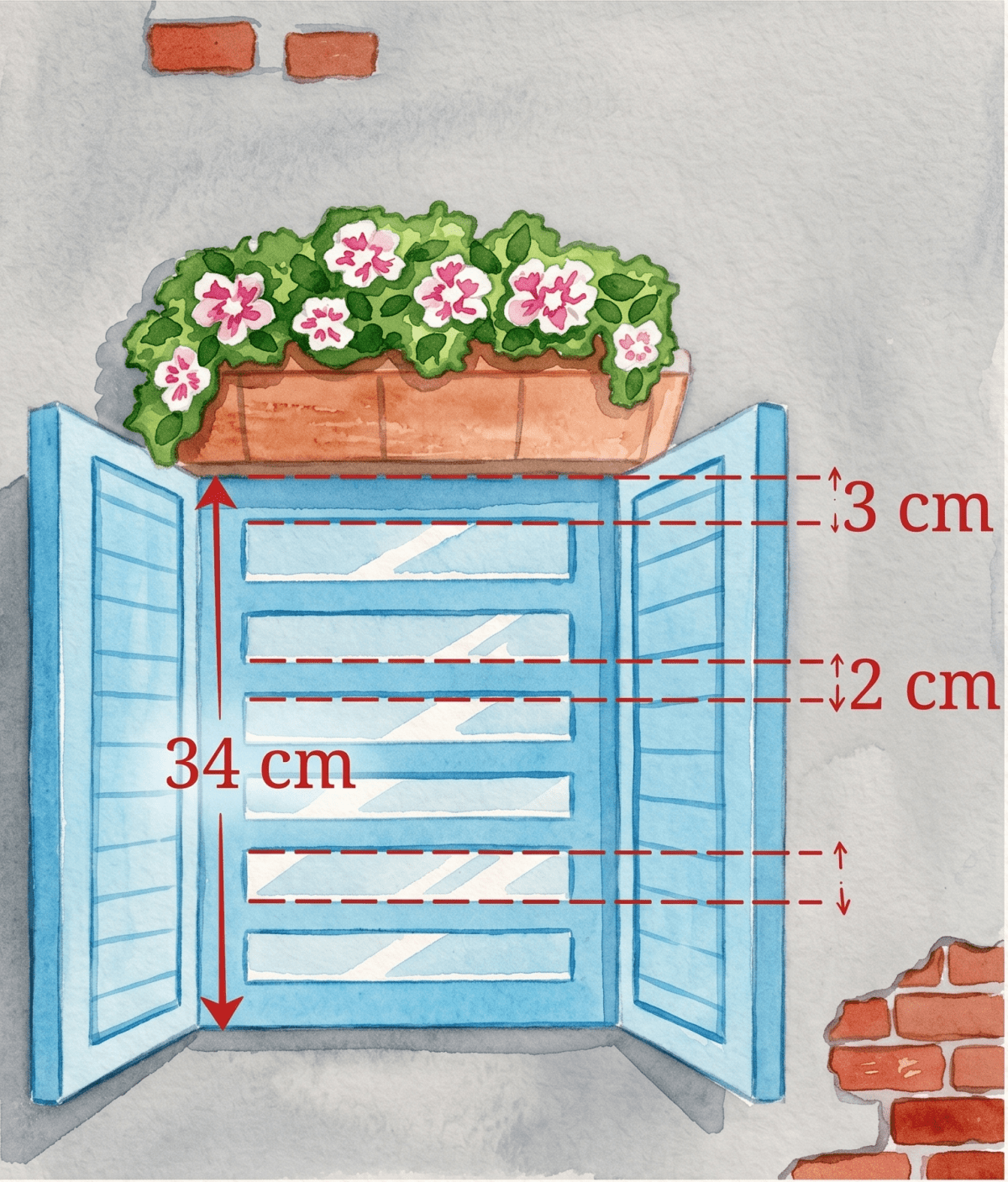
The figure shows the diagram for a window with a grill. What is the gap between two rods in the grill?
Answer
From the figure:
Height of the window = 34 cm
Width of the border at the top = 3 cm
Width of the border at the bottom = 3 cm
Width of each rod = 2 cm
Number of rods in the grill = 5
Number of gaps = 6
Let the gap between two rods be x cm.
Height of the window = top border + bottom border + width of 5 rods + width of 6 gaps
∴ 3 + 3 + 5 × 2 + 6x = 34
⇒ 6 + 10 + 6x = 34
⇒ 16 + 6x = 34
⇒ 6x = 34 - 16 [Transposing +16 to RHS]
⇒ 6x = 18
⇒ x =
⇒ x = 3
Hence, the gap between two rods in the grill is 3 cm.
In a restaurant, a fruit juice costs ₹15 less than a chocolate milkshake. If 4 fruit juices and 7 chocolate milkshakes cost ₹600, find the cost of the fruit juice and milkshake.
Answer
Let the cost of one chocolate milkshake be ₹x.
Then, the cost of one fruit juice = ₹(x - 15)
Cost of 4 fruit juices = ₹4(x - 15)
Cost of 7 chocolate milkshakes = ₹7x
Total cost = ₹600
∴ 4(x - 15) + 7x = 600
⇒ 4x - 60 + 7x = 600
⇒ 11x - 60 = 600
⇒ 11x = 600 + 60 [Transposing -60 to RHS]
⇒ 11x = 660
⇒ x =
⇒ x = 60
So, the cost of one chocolate milkshake = ₹60
and the cost of one fruit juice = ₹(60 - 15) = ₹45
Hence, a fruit juice costs ₹45 and a chocolate milkshake costs ₹60.
Given 28p – 36 = 98, find the value of 14p – 19 and 28p – 38.
Answer
We have:
28p - 36 = 98
⇒ 28p = 98 + 36 [Transposing -36 to RHS]
⇒ 28p = 134
Dividing both sides by 2, we get
⇒ 14p = 67
Value of 14p – 19:
14p - 19 = 67 - 19
= 48
Value of 28p – 38:
28p - 38 = 134 - 38
= 96
Hence, 14p - 19 = 48 and 28p - 38 = 96.
The steps to solve three equations are shown below. Identify and correct any mistakes.
(a)
(b)
(c)
Answer
(a)
The mistake is in the second step.
To remove the factor 6 from 6x, both sides of the equation must be divided by 6. On the LHS, this division has to be applied to the whole expression 6x + 9, and not to the term 6x alone. Writing x + 9 = 11 divides only 6x and 66 by 6, while the term 9 is left unchanged.
The corrected steps are:
6x + 9 = 66
⇒ 6x = 66 - 9 [Transposing +9 to RHS]
⇒ 6x = 57
⇒ x =
∴ x =
(b)
There is no mistake in these steps.
14y + 24 = 36
⇒ 7y + 12 = 18 [Dividing both sides by 2]
⇒ 7y = 18 - 12 [Transposing +12 to the RHS]
⇒ 7y = 6
∴ y =
(c)
There are two mistakes in these steps.
The first mistake is in the second step. When the term -5 is transposed from the LHS to the RHS, its additive inverse +5 should appear on the RHS. So the RHS should be 9x + 8 + 5 and not 9x + 8 - 5.
The second mistake is in the last step. When the factor -5 is removed from -5x, the other side must be divided by -5. So we should get x = and not x = .
The corrected steps are:
4x - 5 = 9x + 8
⇒ 4x - 9x = 8 + 5 [Transposing 9x to LHS and -5 to RHS]
⇒ -5x = 13
⇒ x =
∴ x =
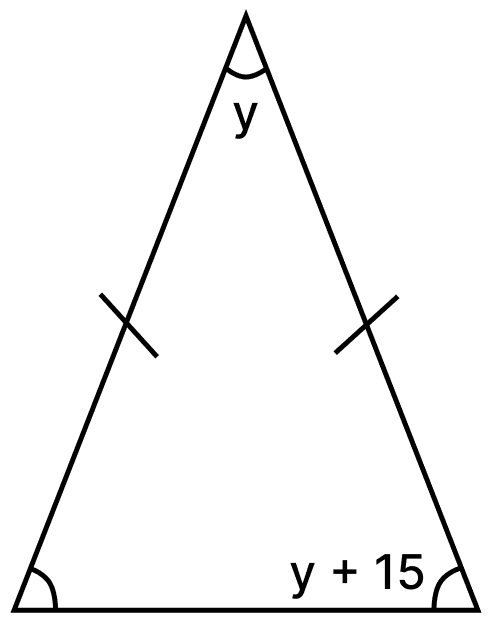
Find the measures of the angles of this triangle.
Answer
In the first triangle, the two slanting sides are marked as equal. So it is an isosceles triangle, and therefore the two base angles are equal.
Since one base angle is y + 15, the other base angle is also y + 15, and the third angle is y.
We know that the sum of the angles of a triangle is 180°.
∴ y + (y + 15) + (y + 15) = 180
⇒ 3y + 30 = 180
⇒ 3y = 180 - 30 [Transposing +30 to RHS]
⇒ 3y = 150
⇒ y =
⇒ y = 50
So, the angles are:
y = 50°
y + 15 = 50 + 15 = 65°
Hence, the angles of the triangle are 50°, 65° and 65°.
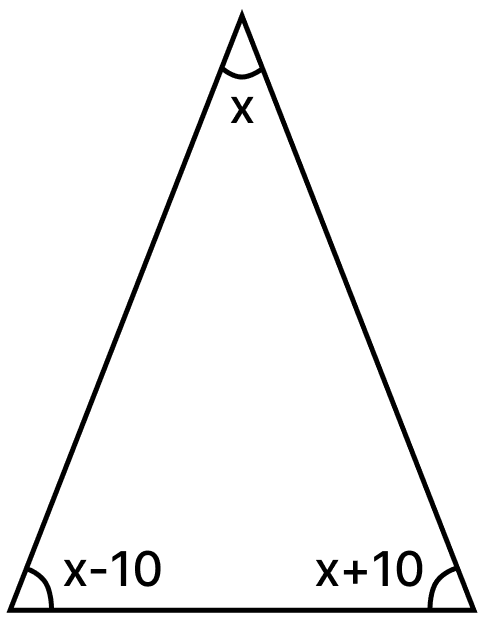
Find the measures of the angles of this triangle.
Answer
In the second triangle, the three angles are x, x - 10 and x + 10.
We know that the sum of the angles of a triangle is 180°.
∴ x + (x - 10) + (x + 10) = 180
⇒ 3x = 180
⇒ x =
⇒ x = 60
So, the angles are:
x = 60°
x - 10 = 60 - 10 = 50°
x + 10 = 60 + 10 = 70°
Hence, the angles of the triangle are 60°, 50° and 70°.
Write 4 equations whose solution is u = 6.
Answer
We can start with the equation u = 6 and perform the same operation on both sides. Since the same operation is performed on both sides, equality is maintained, and so u = 6 remains the solution of every equation obtained.
Equation 1: Adding 5 to both sides of u = 6, we get
u + 5 = 11
Equation 2: Multiplying both sides of u = 6 by 3, we get
3u = 18
Equation 3: Multiplying both sides of u = 6 by 2 and then subtracting 7 from both sides, we get
2u - 7 = 5
Equation 4: Dividing both sides of u = 6 by 2 and then adding u to both sides, we get
Each of these four equations has u = 6 as its solution.
The Bakhśhāli Manuscript (300 CE) mentions the following problem. The amount given to the first person is not known. The second person is given twice as much as the first. The third person is given thrice as much as the second; and the fourth person four times as much as the third. The total amount distributed is 132. What is the amount given to the first person?
Answer
Let the amount given to the first person be x.
Then, the amount given to the second person = 2 × x = 2x
The amount given to the third person = 3 × 2x = 6x
The amount given to the fourth person = 4 × 6x = 24x
Since the total amount distributed is 132, we have:
x + 2x + 6x + 24x = 132
⇒ 33x = 132
⇒ x =
⇒ x = 4
Hence, the amount given to the first person is 4.
The height of a giraffe is two and a half metres more than half its height. How tall is the giraffe?
Answer
Let the height of the giraffe be h metres.
Then, half its height = metres
According to the question, the height is metres more than half its height.
∴ h =
Hence, the height of the giraffe is 5 metres.
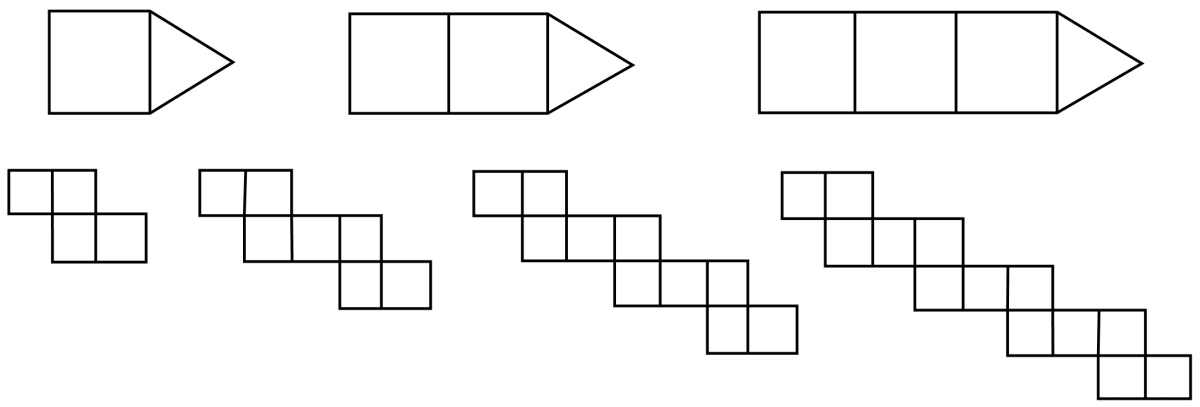
Two separate figures are given below. Each figure shows the first few positions in a sequence of arrangements made with sticks. Identify the pattern and answer the following questions for each figure:
(a) How many squares are in position number 11 of the sequence?
(b) How many sticks are needed to make the arrangement in position number 11 of the sequence?
(c) Can an arrangement in this sequence be made using exactly 85 sticks? If yes, which position number will it correspond to?
(d) Can an arrangement in this sequence be made using exactly 150 sticks? If yes, which position number will it correspond to?
Answer
First Figure
In this sequence, each arrangement is a row of squares followed by an arrow head made of 2 sticks.
Position 1 has 1 square, position 2 has 2 squares, position 3 has 3 squares, and so on.
So, the arrangement at position n has n squares.
Counting the sticks:
The first square needs 4 sticks.
Each of the remaining (n - 1) squares shares one stick with the square before it, and so needs only 3 more sticks.
The arrow head shares the last side of the last square, and so needs 2 more sticks.
∴ Number of sticks at position n = 4 + 3(n - 1) + 2
⇒ Number of sticks at position n = 4 + 3n - 3 + 2
⇒ Number of sticks at position n = 3n + 3
Let us verify this for the first three positions:
Position 1: 3 × 1 + 3 = 6 sticks
Position 2: 3 × 2 + 3 = 9 sticks
Position 3: 3 × 3 + 3 = 12 sticks
(a) The arrangement at position n has n squares.
∴ Number of squares at position 11 = 11
Hence, there are 11 squares in position number 11.
(b) Number of sticks at position 11 = 3 × 11 + 3
= 33 + 3
= 36
Hence, 36 sticks are needed for position number 11.
(c) Let the arrangement at position n use exactly 85 sticks.
Then, 3n + 3 = 85
⇒ 3n = 85 - 3 [Transposing +3 to RHS]
⇒ 3n = 82
⇒ n =
Since is not a whole number, there is no position number in this sequence that uses exactly 85 sticks.
Hence, no arrangement in this sequence can be made using exactly 85 sticks.
(d) Let the arrangement at position n use exactly 150 sticks.
Then, 3n + 3 = 150
⇒ 3n = 150 - 3 [Transposing +3 to RHS]
⇒ 3n = 147
⇒ n =
⇒ n = 49
Hence, an arrangement using exactly 150 sticks is possible, and it corresponds to position number 49.
Second Figure
In this sequence, each arrangement is a staircase made of steps, and every step is a pair of squares placed side by side. Each new step starts at the last column of the step above it.
Position 1 has 2 steps, position 2 has 3 steps, position 3 has 4 steps, and so on.
So, the arrangement at position n has (n + 1) steps, that is, 2(n + 1) squares.
∴ Number of squares at position n = 2n + 2
Counting the sticks:
Position 1 has 4 squares and needs 13 sticks.
Every time we move to the next position, one more step of 2 squares is added. This new step shares one stick with the step above it, so it needs 7 - 1 = 6 extra sticks.
∴ Number of sticks at position n = 13 + 6(n - 1)
⇒ Number of sticks at position n = 13 + 6n - 6
⇒ Number of sticks at position n = 6n + 7
Let us verify this for the first three positions:
Position 1: 6 × 1 + 7 = 13 sticks
Position 2: 6 × 2 + 7 = 19 sticks
Position 3: 6 × 3 + 7 = 25 sticks
(a) Number of squares at position 11 = 2 × 11 + 2
= 22 + 2
= 24
Hence, there are 24 squares in position number 11.
(b) Number of sticks at position 11 = 6 × 11 + 7
= 66 + 7
= 73
Hence, 73 sticks are needed for position number 11.
(c) Let the arrangement at position n use exactly 85 sticks.
Then, 6n + 7 = 85
⇒ 6n = 85 - 7 [Transposing +7 to RHS]
⇒ 6n = 78
⇒ n =
⇒ n = 13
Hence, an arrangement using exactly 85 sticks is possible, and it corresponds to position number 13.
(d) Let the arrangement at position n use exactly 150 sticks.
Then, 6n + 7 = 150
⇒ 6n = 150 - 7 [Transposing +7 to RHS]
⇒ 6n = 143
⇒ n =
Since is not a whole number, there is no position number in this sequence that uses exactly 150 sticks.
Hence, no arrangement in this sequence can be made using exactly 150 sticks.
A number increased by 36 is equal to ten times itself. What is the number?
Answer
Let the required number be x.
Then, the number increased by 36 = x + 36
Ten times the number = 10x
According to the question:
x + 36 = 10x
⇒ 36 = 10x - x [Transposing x to RHS]
⇒ 36 = 9x
⇒ x =
⇒ x = 4
Hence, the required number is 4.
Solve these equations:
(a) 5(r + 2) = 10
(b) – 3(u + 2) = 2(u – 1)
(c) 2(7 – 2n) = – 6
(d) 2(x – 4) = – 16
(e) 6(x – 1) = 2(x – 1) – 4
(f) 3 – 7s = 7 – 3s
(g) 2x + 1 = 6 – (2x – 3)
(h) 10 – 5x = 3(x – 4) – 2(x – 7)
Answer
(a)
5(r + 2) = 10
⇒ r + 2 = [Dividing both sides by 5]
⇒ r + 2 = 2
⇒ r = 2 - 2 [Transposing +2 to RHS]
∴ r = 0
(b)
–3(u + 2) = 2(u – 1)
⇒ -3u - 6 = 2u - 2
⇒ -3u - 2u = -2 + 6 [Transposing 2u to LHS and -6 to RHS]
⇒ -5u = 4
⇒ u =
∴ u =
(c)
2(7 - 2n) = -6
⇒ 7 - 2n = [Dividing both sides by 2]
⇒ 7 - 2n = -3
⇒ -2n = -3 - 7 [Transposing +7 to RHS]
⇒ -2n = -10
⇒ n =
∴ n = 5
(d)
2(x - 4) = -16
⇒ x - 4 = [Dividing both sides by 2]
⇒ x - 4 = -8
⇒ x = -8 + 4 [Transposing -4 to RHS]
∴ x = -4
(e)
6(x - 1) = 2(x - 1) - 4
⇒ 6x - 6 = 2x - 2 - 4
⇒ 6x - 6 = 2x - 6
⇒ 6x - 2x = -6 + 6 [Transposing 2x to LHS and -6 to RHS]
⇒ 4x = 0
⇒ x =
∴ x = 0
(f)
3 - 7s = 7 - 3s
⇒ -7s + 3s = 7 - 3 [Transposing -3s to LHS and +3 to RHS]
⇒ -4s = 4
⇒ s =
∴ s = -1
(g)
2x + 1 = 6 - (2x - 3)
⇒ 2x + 1 = 6 - 2x + 3
⇒ 2x + 1 = 9 - 2x
⇒ 2x + 2x = 9 - 1 [Transposing -2x to LHS and +1 to RHS]
⇒ 4x = 8
⇒ x =
∴ x = 2
(h)
10 - 5x = 3(x - 4) - 2(x - 7)
⇒ 10 - 5x = 3x - 12 - 2x + 14
⇒ 10 - 5x = x + 2
⇒ -5x - x = 2 - 10 [Transposing x to LHS and +10 to RHS]
⇒ -6x = -8
⇒ x =
∴ x =
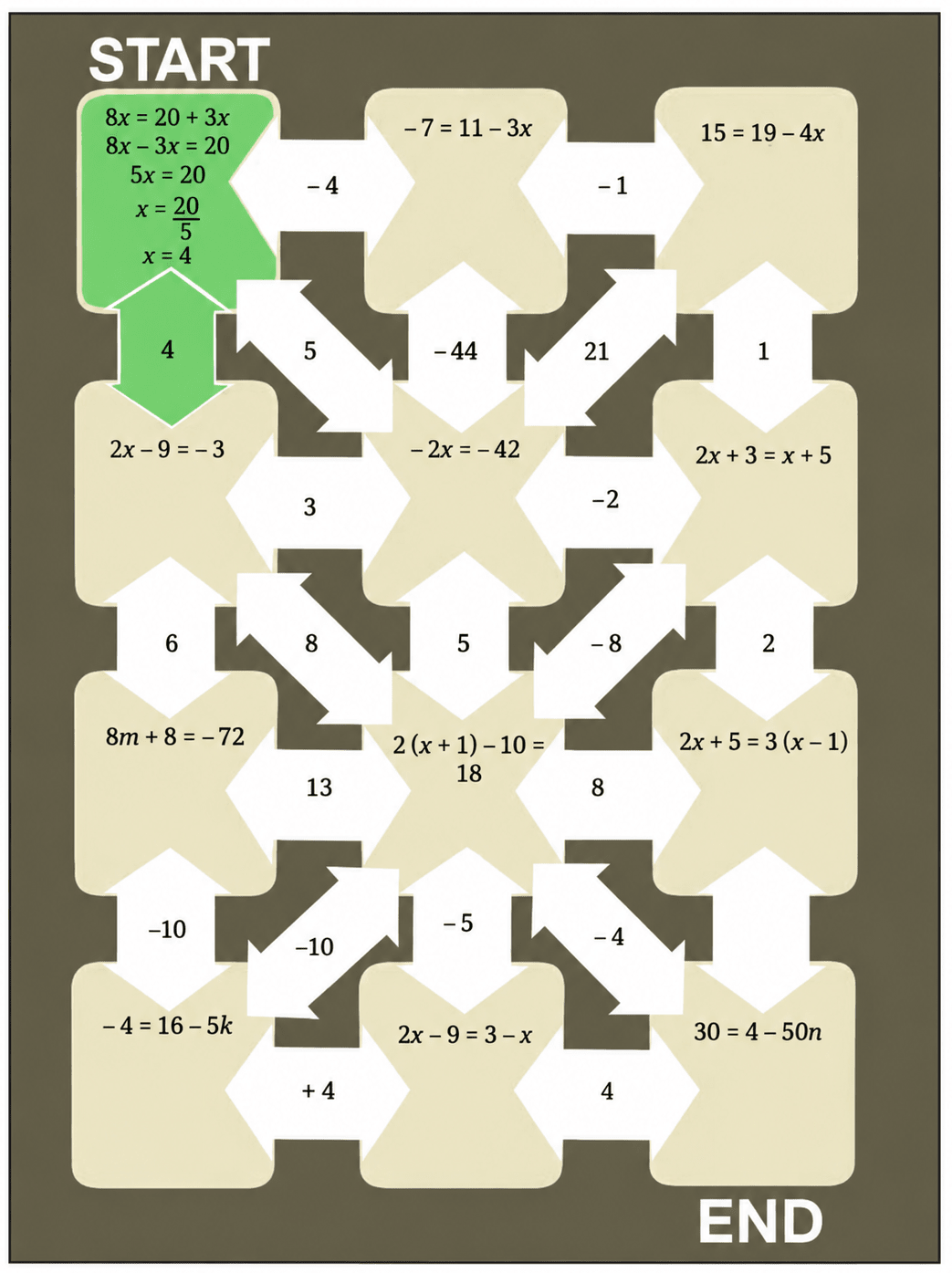
Solve the equations to find a path from Start to the End. Show your work in the given boxes provided and colour your path as you proceed.
Answer
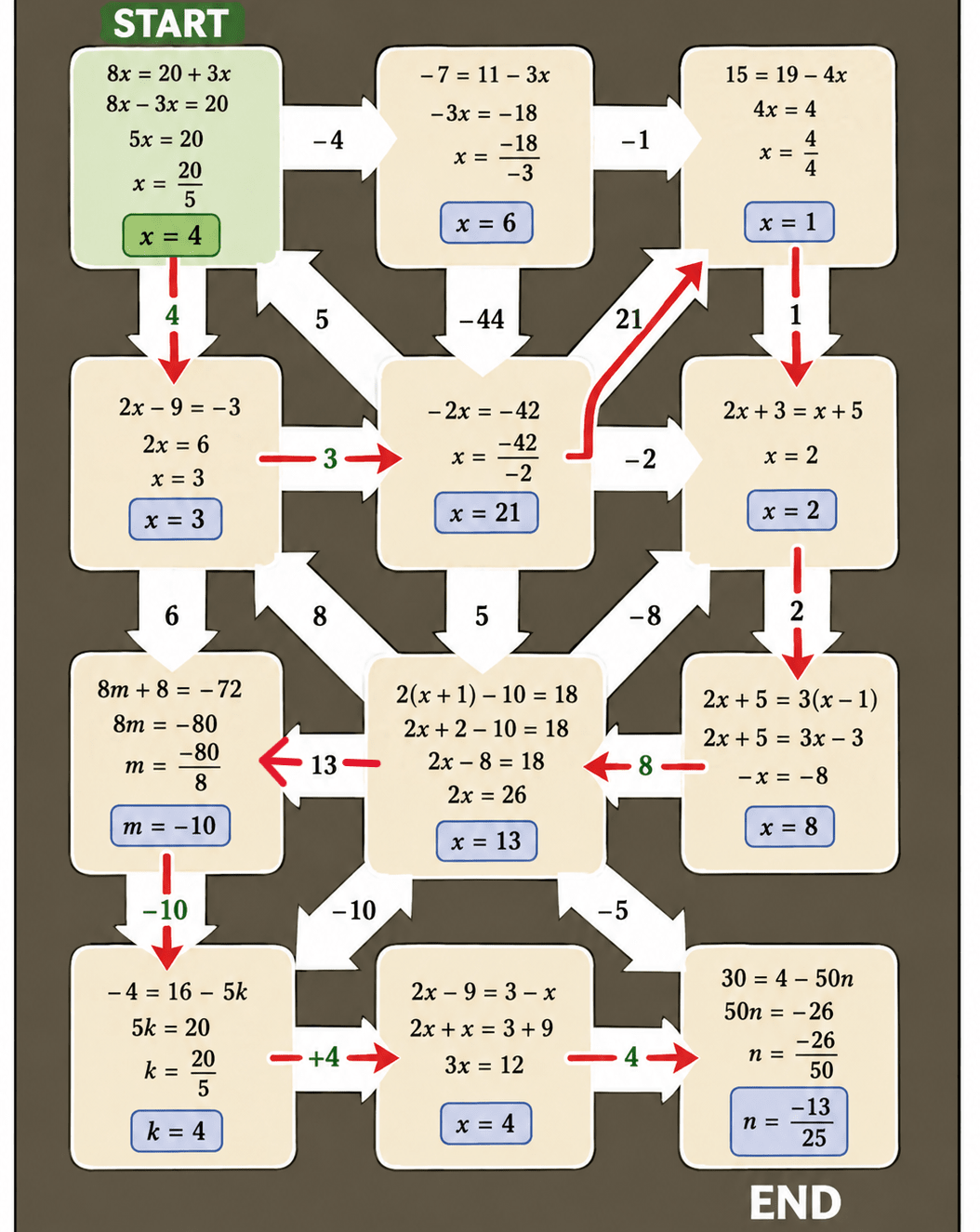
Explanation:
In this maze, each box contains an equation. We solve the equation in a box and then move along the arrow whose label is equal to the solution we have obtained. Starting from the box marked Start, we proceed as follows.
Step 1: The Start box is already solved for us.
8x = 20 + 3x
⇒ 8x - 3x = 20
⇒ 5x = 20
⇒ x =
⇒ x = 4
So, we move along the arrow marked 4, which leads to the box 2x - 9 = -3.
Step 2: 2x - 9 = -3
⇒ 2x = -3 + 9 [Transposing -9 to RHS]
⇒ 2x = 6
⇒ x =
⇒ x = 3
So, we move along the arrow marked 3, which leads to the box -2x = -42.
Step 3: -2x = -42
⇒ x = [Dividing both sides by -2]
⇒ x = 21
So, we move along the arrow marked 21, which leads to the box 15 = 19 - 4x.
Step 4: 15 = 19 - 4x
⇒ 4x = 19 - 15 [Transposing -4x to LHS and 15 to RHS]
⇒ 4x = 4
⇒ x =
⇒ x = 1
So, we move along the arrow marked 1, which leads to the box 2x + 3 = x + 5.
Step 5: 2x + 3 = x + 5
⇒ 2x - x = 5 - 3 [Transposing x to LHS and +3 to RHS]
⇒ x = 2
So, we move along the arrow marked 2, which leads to the box 2x + 5 = 3(x - 1).
Step 6: 2x + 5 = 3(x - 1)
⇒ 2x + 5 = 3x - 3
⇒ 2x - 3x = -3 - 5 [Transposing 3x to LHS and +5 to RHS]
⇒ -x = -8
⇒ x = 8
So, we move along the arrow marked 8, which leads to the box 2(x + 1) - 10 = 18.
Step 7: 2(x + 1) - 10 = 18
⇒ 2x + 2 - 10 = 18
⇒ 2x - 8 = 18
⇒ 2x = 18 + 8 [Transposing -8 to RHS]
⇒ 2x = 26
⇒ x =
⇒ x = 13
So, we move along the arrow marked 13, which leads to the box 8m + 8 = -72.
Step 8: 8m + 8 = -72
⇒ 8m = -72 - 8 [Transposing +8 to RHS]
⇒ 8m = -80
⇒ m =
⇒ m = -10
So, we move along the arrow marked -10, which leads to the box -4 = 16 - 5k.
Step 9: -4 = 16 - 5k
⇒ 5k = 16 + 4 [Transposing -5k to LHS and -4 to RHS]
⇒ 5k = 20
⇒ k =
⇒ k = 4
So, we move along the arrow marked +4, which leads to the box 2x - 9 = 3 - x.
Step 10: 2x - 9 = 3 - x
⇒ 2x + x = 3 + 9 [Transposing -x to LHS and -9 to RHS]
⇒ 3x = 12
⇒ x =
⇒ x = 4
So, we move along the arrow marked 4, which leads to the box 30 = 4 - 50n. This box lies at the End of the maze.
Step 11: 30 = 4 - 50n
⇒ 50n = 4 - 30 [Transposing -50n to LHS and 30 to RHS]
⇒ 50n = -26
⇒ n =
⇒ n =
There are some children and donkeys on a beach. Together they have 28 heads and 80 feet. How many donkeys are there? How many children are there?
Answer
Let the number of donkeys be d.
Each child and each donkey has one head, and the total number of heads is 28.
∴ Number of children = 28 - d
A donkey has 4 feet and a child has 2 feet.
∴ Number of feet of the donkeys = 4d
Number of feet of the children = 2(28 - d)
Since the total number of feet is 80, we have:
4d + 2(28 - d) = 80
⇒ 4d + 56 - 2d = 80
⇒ 2d + 56 = 80
⇒ 2d = 80 - 56 [Transposing +56 to RHS]
⇒ 2d = 24
⇒ d =
⇒ d = 12
∴ Number of children = 28 - 12 = 16
Hence, there are 12 donkeys and 16 children on the beach.
A Magic Trick
Think of any number.
Now multiply it by 2.
Add 10.
Divide by 2.
Now subtract the original number you thought of.
Finally, add 3.
I predict that you now have 8. Am I correct?
Try the trick on your friends and family!
Can you explain why the trick works?
[Hint: Denote the first number thought of by x.]
Answer
Yes, the prediction is correct. Whatever number we start with, the final answer is always 8.
Let the number first thought of be x.
Let us write down the expression obtained after each step.
| Steps | Expression |
|---|---|
| Think of any number. | x |
| Now multiply it by 2. | 2x |
| Add 10. | 2x + 10 |
| Divide by 2. | |
| Now subtract the original number you thought of. | x + 5 - x = 5 |
| Finally, add 3. | 5 + 3 = 8 |
The key step is the subtraction of the original number.
After multiplying by 2 and adding 10, the expression is 2x + 10. Dividing this by 2 gives x + 5, in which the unknown x appears exactly once. Subtracting the original number x now removes the unknown completely, leaving only the number 5. Adding 3 to it gives 8.
Since the unknown x is cancelled out, the final value does not depend on the number first thought of.
Hence, the final answer is always 8, whatever number is chosen at the start.