
A group of similar cells to perform a specific function forms a:
- Organ
- Species
- Organ system
- Tissue
Answer
Tissue
Reason — Similar cells organise to form tissue and perform a specific function.
An organ is made up of different types of tissues working together to perform a specific function (e.g., heart, lungs). So it is a higher level than cells. A species refers to a group of organisms that can interbreed and produce fertile offspring. It is not related to cell organization. An organ system consists of multiple organs working together.
The small fine branches given out from the cell body of a nerve cell are:
- Dendrites
- Cyton
- Axon
- Neurons
Answer
Dendrites
Reason — Dendrites are fine hair-like extensions from cyton. The cyton is the cell body of the neuron. It contains the nucleus and is not a branch. The axon is a single, long projection that carries impulses away from the cell body. It is not small or highly branched like dendrites (except at the terminal end). A neuron is the entire nerve cell itself, not a specific part of it.
Fluid connective tissue of humans is:
- Blood and cartilage
- Lymph and plasma
- Blood and lymph
- Stroma and matrix
Answer
blood and lymph
Reason — Blood (cells+plasma) and Lymph are the fluid connective tissue. Blood is concerned with transportation of oxygen, glucose and amino acids etc. Lymph helps in immunity and returns excess tissue fluid to the bloodstream. Cartilage is a solid (supporting) connective tissue, not fluid. Plasma is just the liquid part of blood, not a separate tissue by itself. Stroma and matrix are structural components of tissues, not types of fluid connective tissue.
Tissues organise to form :
- Organ system
- Organs
- Organism
- Cells
Answer
Organs
Reason — Tissues organise to form organs.
An organ system is formed when multiple organs work together to perform a major function (e.g., digestive system). So this is a higher level than organs. An organism is the complete living individual, made up of many organ systems working together. Cells are the basic unit of life and come before tissues in the level of organization.
In which of the plant tissues, cells actively divide to form new cells ?
- Parenchyma
- Sclerenchyma
- Meristematic tissue
- Protective tissue
Answer
Meristematic tissue
Reason — Meristematic tissues are made up of actively dividing cells. Their only function is to produce more cells leading to the growth of the plant body.
Parenchyma is a permanent tissue made of living cells that mainly store food and help in photosynthesis. Its cells are non-dividing in mature regions. Sclerenchyma provides mechanical support. Its cells are dead at maturity and do not divide. Protective tissue includes epidermis and cork. It mainly protects the plant surface and its cells do not actively divide.
Which of the following tissues consists of dead cells ?
- Collenchyma
- Meristems
- Parenchyma
- Sclerenchyma
Answer
Sclerenchyma
Reason — Sclerenchyma is composed of long, narrow and thick-walled dead cells to provide strength to the plant parts.
Collenchyma is a living tissue found in young stems and leaves. It provides flexible support to the plant. Meristematic tissues consist of actively dividing living cells that help in plant growth. Parenchyma is a living tissue involved in storage, photosynthesis, and other basic functions.
Which of the following tissues is found in the lining of the trachea ?
- Ciliated epithelium
- Cuboidal epithelium
- Columnar epithelium
- Squamous epithelium
Answer
Ciliated epithelium
Reason — In the lining of the trachea, the columnar epithelium has developed cilia. Such an epithelium is called ciliated epithelium.
Cuboidal epithelium is found in organs like the kidneys and glands, where it helps in secretion and absorption, not in the trachea. Simple columnar epithelium is found in the intestine for absorption. In the trachea, it is specifically ciliated columnar epithelium, so this option is incomplete. Squamous epithelium is a thin, flat layer of cells found in areas like the alveoli of lungs for diffusion. It is not found in the trachea lining.
Which of the following is not a kind of a fibrous connective tissue ?
- Areolar tissue
- Cartilage
- Tendons
- Ligaments
Answer
Cartilage
Reason — Cartilage is a Supportive connective tissue. It covers the ends of bones, and gives support to certain organs.
Areolar tissue is a loose connective tissue. It supports organs, fills spaces, and helps in repair of tissues. Tendons are fibrous connective tissues that connect muscles to bones. They are strong and slightly elastic. Ligaments are fibrous connective tissues that connect bone to bone. They are flexible and provide joint stability.
The non-cellular part of blood is :
- Lymph
- Serum
- Plasma
- Tissue fluid
Answer
Plasma
Reason — Plasma is the non-cellular (liquid) part of the blood.
Lymph is a clear fluid tissue that circulates in the lymphatic system. It contains cells like lymphocytes, so it is not non-cellular blood part. Serum is the fluid obtained after blood clots and blood cells and clotting factors are removed. It is derived from plasma but is not the main circulating non-cellular component. Tissue fluid (interstitial fluid) surrounds body cells and is formed from plasma, but it is not part of blood itself.
The tissue in which the cells are filled with fat globules is :
- Epithelial tissue
- Adipose tissue
- Nervous tissue
- Areolar tissue
Answer
Adipose tissue
Reason — Adipose tissue contains cells filled with fat globules.
This tissue forms the covering and lining of body surfaces and organs (like skin and lining of the gut). Its cells are not filled with fat globules. Nervous tissue is made of neurons and is responsible for transmitting nerve impulses. Areolar tissue is a loose connective tissue that supports organs and fills spaces between them. It contains various cells but not fat-filled ones like adipose tissue.
Assertion (A): Meristematic tissues consist of undifferentiated, actively dividing cells.
Reason (R): Meristems are undifferentiated as they divide and redivide and produce a large number of cells. They are not specialized for any particular function.
- Both A and R are true and R is the correct explanation of A.
- Both A and R are true but R is not the correct explanation of A.
- A is true but R is false.
- A is false but R is true.
Answer
Both A and R are true and R is the correct explanation of A.
Reason — A is true as meristematic tissue consists of undifferentiated cells that actively divide to produce new cells for plant growth.
R is true as meristematic cells are called undifferentiated because they continuously divide and redivide, forming a large number of new cells. They do not specialize into a particular function.
The continuous division and lack of specialization is exactly why meristematic tissues are undifferentiated and actively dividing.
Therefore, Both A and R are true and R is the correct explanation of A is the correct option.
Assertion (A): Permanent tissues form the bulk of the plant body and they do not divide.
Reason (R): Permanent tissues mature into fixed, specialised cells that carry out specific functions, so they no longer retain the ability to divide.
- Both A and R are true and R is the correct explanation of A.
- Both A and R are true but R is not the correct explanation of A.
- A is true but R is false.
- A is false but R is true.
Answer
Both A and R are true and R is the correct explanation of A.
Reason — A is true as permanent tissues make up most of the plant body and generally do not divide.
Permanent tissues consist of mature, specialised cells that have lost their ability to divide because they are differentiated for specific functions.
R is true as loss of the ability to divide due to specialization directly explains why permanent tissues do not divide.
Therefore, Both A and R are true and R is the correct explanation of A is the correct option.
Assertion (A): All organisms, whether unicellular or multicellular, start their life from a single celled structure called the zygote.
Reason (R): Zygote is formed by the fusion of two unicellular structures (gametes) during the process of fertilization among higher plants and animals.
- Both A and R are true and R is the correct explanation of A.
- Both A and R are true but R is not the correct explanation of A.
- A is true but R is false.
- A is false but R is true.
Answer
Both A and R are true and R is the correct explanation of A.
Reason — A is true as in sexual reproduction, both unicellular and multicellular organisms begin development from a single cell called the zygote.
R is true as a zygote is formed when two gametes (sperm and egg), which are unicellular structures, fuse during fertilization in higher plants and animals.
The formation of a single-celled zygote through fertilization explains why organisms start life from a single cell.
Therefore, Both A and R are true and R is the correct explanation of A is the correct option.
Assertion (A): Blood and lymph, both contain the same fluid (plasma) but they differ from each other in their cellular contents.
Reason (R): Blood contains red blood cells and platelets whereas lymph contains only white blood cells.
- Both A and R are true and R is the correct explanation of A.
- Both A and R are true but R is not the correct explanation of A.
- A is true but R is false.
- A is false but R is true.
Answer
Both A and R are true and R is the correct explanation of A.
Reason — A is true as blood and lymph both contain a fluid component (plasma in blood and lymph fluid derived from plasma), but they differ in cellular composition.
R is true as blood contains RBCs, WBCs, and platelets, whereas lymph mainly contains WBCs (especially lymphocytes) and lacks RBCs and platelets.
The difference in cellular contents directly explains why blood and lymph are distinct despite having similar fluid origins.
Therefore, Both A and R are true and R is the correct explanation of A is the correct option.
Assertion (A): Epithelial tissues form a protective covering of cells, found only on the outer surface of the body.
Reason (R): Epithelial tissues are also found around internal organs, line inner body surfaces and perform various functions like absorption, secretion, etc.
- Both A and R are true and R is the correct explanation of A.
- Both A and R are true but R is not the correct explanation of A.
- A is true but R is false.
- A is false but R is true.
Answer
A is false but R is true.
Reason — A is false as epithelial tissue is not found only on the outer surface of the body. While it does form the outer skin layer, it is also present internally.
R is true as epithelial tissues also line internal organs and cavities (like lungs, intestine, blood vessels) and perform functions such as absorption, secretion, protection, and filtration.
Therefore, A is false but R is true is the correct option.
State whether the following statement are True or False.
- A tissue is formed of only one type of cells.
- Only one type of tissue forms an organ.
- Permanent tissue is made up of undifferentiated and dividing cells.
- Meristematic tissue is found at the growing tips of a plant.
- Phloem is formed of dead tubular cells.
Answer
True
True
False
Corrected statement — Permanent tissue is made up of differentiated and non-dividing cells.True
False
Corrected statement — Phloem is formed of living tubular cells.
Fill in the blanks by selecting suitable words from the list given below:
[thin-walled, collenchyma, vascular, tissues, conducting]
- A group of different ............... working together to perform a function is called an organ.
- Xylem and phloem form the ............... tissue.
- Conducting tissue is also called ............... tissue.
- Cells are elongated and thick at the corners in ............... tissue.
- Parenchyma is composed of large ............... cells.
Answer
- tissues
- conducting
- vascular
- collenchyma
- thin-walled
Match the items given in Column A with those given in Column B:
| Column A | Column B |
|---|---|
| (i) Fibrous connective tissue | (a) blood |
| (ii) Fluid connective tissue | (b) cartilage |
| (iii) Supportive connective tissue | (c) connects a bone to another bone |
| (iv) Ligament | (d) areolar tissue |
| (v) Tendon | (e) connects a muscle with a bone |
Answer
| Column A | Column B |
|---|---|
| (i) Fibrous connective tissue | (d) areolar tissue |
| (ii) Fluid connective tissue | (a) blood |
| (iii) Supportive connective tissue | (b) cartilage |
| (iv) Ligament | (c) connects a bone to another bone |
| (v) Tendon | (e) connects a muscle with a bone |
Each of the tissues listed in Column A is related to one of the functions given in Column B. Match the correct pairs by drawing lines.
| Column A (Tissue) | Column B (Function) |
|---|---|
| (i) Epithelial tissue | (a) movement |
| (ii) Connective tissue | (b) protection |
| (iii) Vascular tissue | (c) messages |
| (iv) Nervous tissue | (d) support |
| (v) Muscular tissue | (e) transport |
Answer
| Column A (Tissue) | Column B (Function) |
|---|---|
| (i) Epithelial tissue | (b) protection |
| (ii) Connective tissue | (d) support |
| (iii) Vascular tissue | (e) transport |
| (iv) Nervous tissue | (c) messages |
| (v) Muscular tissue | (a) movement |
Name the kind of tissue that
Carries oxygen around your body
Brings about movement in animals
Transports food to different parts of a plant
Transports water in plants
Supports an animal's body
Binds different tissues together
Conducts messages from one part of the body to another
is found on the surface of roots, stems and leaves.
is composed of elongated cells, that are thick at the corners.
is composed of dead cells, that provides strength to the plant parts.
is richly located in the brain and spinal cord.
is striated and branched.
Answer
Carries oxygen around your body — Fluid connective tissue
Brings about movement in animals — Muscular tissue
Transports food to different parts of a plant — Phloem
Transports water in plants — Xylem
Supports an animal's body — Supportive connective tissue
Binds different tissues together — Fibrous connective tissue
Conducts messages from one part of the body to another — Nervous tissue
is found on the surface of roots, stems and leaves — Protective Tissue
is composed of elongated cells, that are thick at the corners — Collenchyma
is composed of dead cells, that provides strength to the plant parts — Sclerenchyma
is richly located in the brain and spinal cord — Nervous tissue
is striated and branched — Cardiac muscular tissue
Based on the following information, identify the three types of epithelial tissue in the figures given below:
(i) Cuboidal epithelium: It consists of a single layer of cuboidal cells.
(ii) Columnar epithelium: It is composed of tall, cylindrical cells with oval nuclei usually placed at the base of the cells.
(iii) Ciliated epithelium: It consists of cells bearing hair-like cilia on their free surface.

(a) ..............

(b) ..............

(c) ..............
Answer
(a) Cuboidal epithelium
(b) Columnar epithelium
(c) Ciliated epithelium
Given below are sets of four terms. Choose the odd one and write the category for the remaining terms :
- Ligaments, Cardiac muscles, Tendons, Areolar tissue.
- Collenchyma, Protective tissue, Sclerenchyma, Parenchyma.
- Cuboidal tissue, Connective tissue, Columnar tissue, Ciliated tissue.
- Striated, Cartilage, Cardiac, Unstriated muscle.
- Cytons, Axons, Tendons, Dendrons.
Answer
Odd one — Cardiac muscles
Category of the remaining terms — Fibrous Connective tissuesOdd one — Protective tissue
Category of the remaining terms — Supporting tissuesOdd one — Connective tissue
Category of the remaining terms — Epithelial tissuesOdd one — Cartilage
Category of the remaining terms — Muscular tissuesOdd one — Tendons
Category of the remaining terms — Parts of a Nerve cell/Neuron
Arrange the following terms in a proper logical sequence :
- Organ system, Tissues, Cells, Organisms, Organs.
- Cambium layer, Pith, Outer Bark, Inner bark.
Answer
- Cells, Tissues, Organs, Organ system, Organisms.
- Pith, Cambium layer, Inner bark, Outer bark.
Note the relationship between the first two words and suggest a suitable word/words for the fourth place:
- Bones : Skull :: Cartilage : ............... .
- Covering : Epithelial :: Contractile : ............... .
- Xylem : Vessels :: Phloem : ............... .
- Cuboidal epithelium : Absorption :: Columnar epithelium : ............... .
- Parenchyma : Stores starch :: Chlorenchyma : ............... .
Answer
- Bones : Skull :: Cartilage : Trachea.
- Covering : Epithelial :: Contractile : Muscular.
- Xylem : Vessels :: Phloem : Sieve tubes.
- Cuboidal epithelium : Absorption :: Columnar epithelium : Secretion.
- Parenchyma : Stores starch :: Chlorenchyma : Performs photosynthesis.
Define the terms given below:
- Tissue
- Organ
- Organ system
- Sclerenchyma
- Cartilage
Answer
Tissue — A group of similar cells which are specialised to perform specific function is known as tissue. For example muscle tissue, skin tissue.
Organ — A differentiated structure formed by group of similar tissues, which is specialised to perform a specific function is called an organ.
Organ system — An organ system is a group of organs that work together to perform a specific function or set of functions in the body. For example, the digestive system.
Sclerenchyma — Sclerenchyma is a simple supportive permanent tissue composed of long, narrow and thick-walled dead cells. It provides strength to the plant parts.
Cartilage — Cartilage is a supportive connective tissue that covers the ends of bones, and gives support to certain organs like the nose, ear, and trachea. It consists of a clear ground substance (matrix), which contains a large number of spaces, each occupied by one or more cells.
Name the following:
- 3 kinds of supporting tissues in plants.
- 2 kinds of supportive connective tissues in animals.
- 2 kinds of complex permanent tissues.
- 4 kinds of fibrous connective tissues.
- 3 kinds of muscular tissues.
Answer
- Parenchyma, Collenchyma, Sclerenchyma
- Cartilage and Bone
- Xylem and Phloem
- Areolar tissue, Adipose tissue, Tendons, and Ligaments
- Striated muscles, Unstriated muscles, and Cardiac muscles
Write the exact location of each of the following tissues :
- Collenchyma
- Meristematic tissue
- Squamous epithelium
- Cardiac muscles
- Nervous tissue
Answer
Collenchyma is found in the leaf stalks and below the epidermis of stems.
Meristematic tissues are found at all growing points in a plant, like the tip of roots, stems and branches, where growth in length occurs.
Squamous epithelium is found in the cells of the outer layer of skin.
Cardiac muscles are found only in the walls of the heart.
Nervous tissue constitutes the nervous system.
Mention the specific function of each of the following tissues :
- Areolar tissue
- Parenchyma
- Xylem
- Tendon
- Adipose tissue
Answer
Areolar tissue — Areolar tissue binds our skin to the underlying tissue.
Parenchyma — They store food material and also provide temporary support to the plant.
Xylem — Xylem cells transport water and minerals absorbed by the roots from the soil, upward to the leaves.
Tendon — Tendons connect muscles to bones at joints. They are rich in white fibres.
Adipose tissue — Adipose tissue forms padding under the skin which acts as an insulation for retaining body heat.
How do you rank the following with respect to a cell, tissue, organ or organism?
- Amoeba
- Euglena
- Skin
- Lungs
- Neuron
- Cardiac muscles
Answer
- Amoeba: Organism (unicellular)
- Euglena: Organism (unicellular)
- Skin: Organ
- Lungs: Organ
- Neuron: Cell
- Cardiac muscles: Tissue
Distinguish between the following pairs on the basis of the words indicated in the brackets [].
Simple permanent tissue and complex permanent tissue [cellular organisation]
Answer
Differences between Simple permanent tissue and complex permanent tissue on the basis of cellular organisation:
| Simple Permanent tissue | Complex Permanent tissue |
|---|---|
| Simple permanent tissues are made up of a single type of cell. | Complex permanent tissues are composed of different types of cells working together. |
Distinguish between the following pairs on the basis of the words indicated in the brackets [].
Striated and unstriated muscular tissue [location]
Answer
Differences between Striated and unstriated muscular tissue on the basis of location:
| Striated muscular tissue | Unstriated muscular tissue |
|---|---|
| Striated muscles are found in the arms, legs, face, neck, etc. | Unstriated muscles are located in the walls of the intestine, muscles of the iris of the eye, skin, lining of blood vessels, urinary bladder, uterus, etc. |
Distinguish between the following pairs on the basis of the words indicated in the brackets [].
Xylem and phloem [structural components]
Answer
Differences between Xylem and phloem on the basis of structural components:
| Xylem | Phloem |
|---|---|
| Xylem is formed of thick-walled, tubular and often dead cells. The xylem tissue consists of tracheids, vessels, xylem parenchyma and xylem fibres. | Phloem is formed of living tubular cells. The phloem consists of sieve tubes, companion cells, phloem parenchyma, and phloem fibres. |
Distinguish between the following pairs on the basis of the words indicated in the brackets [].
Bone and cartilage [function]
Answer
Differences between Bone and cartilage on the basis of function:
| Bone | Cartilage |
|---|---|
| Bone provides framework, support and protection to the body and helps in movement. Hence, it is the main supportive structure of vertebrates. | Cartilage covers the ends of bones, and gives support to certain organs such as nose, ear and trachea. It also provides flexibility, and reduces friction between bones at joints. |
Distinguish between the following pairs on the basis of the words indicated in the brackets [].
Blood and lymph [blood corpuscles]
Answer
Differences between Blood and lymph on the basis of blood corpuscles:
| Blood | Lymph |
|---|---|
| The cellular part of the blood includes the red blood corpuscles, white blood corpuscles, and the platelets. | Lymph contains some leukocytes or white blood cells that have oozed out of the blood capillaries. It lacks red blood cells and blood platelets. |
Draw a neat and labelled diagram of the "basic structural and functional unit of Nervous tissue".
Answer
Diagram of the "basic structural and functional unit of Nervous tissue" is given below:

Study the figures given below and answer the following questions :
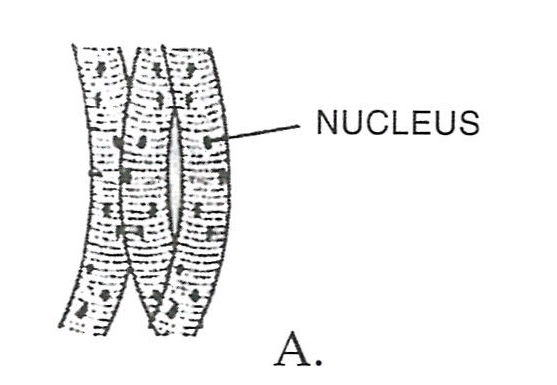
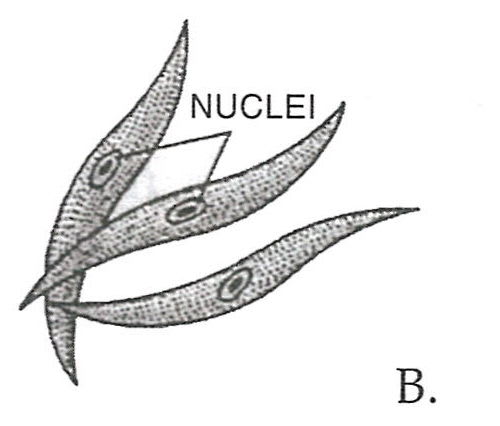
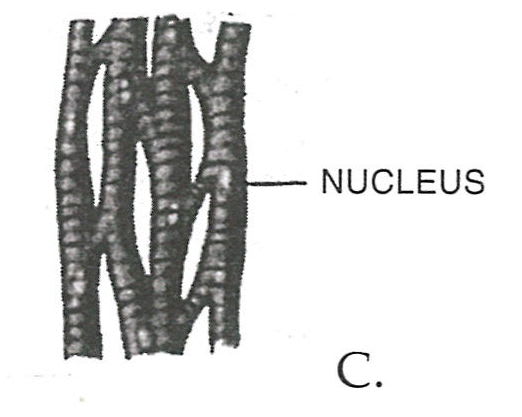
(i) Identify the kind of tissues shown as A, B and C.
(ii) Write one specific location of each in the human body.
(iii) Mention one common function of all.
(iv) Write one structural difference between the tissues A and B.
(v) Which of these two tissues are not under the control of our will ?
Answer
(i) The tissues shown in figures A, B, and C are:
A → Striated muscles
B → Unstriated muscles
C → Cardiac muscles
(ii) One specific location of each in the human body:
- Striated muscles are found in face.
- Unstriated muscles are found in the iris of the eyes.
- Cardiac muscles are found only in the walls of the heart.
(iii) All the muscle types can contract and relax. Thus, they help the body in all its movements and locomotion.
(iv) One structural difference between the tissues A and B:
| Striated muscles | Unstriated muscles |
|---|---|
| Striated muscles are skeletal, and stripped. They are attached to the bones. | Unstriated muscles are smooth, and unstripped. |
(v) Unstriated muscles are not under the control of our will.
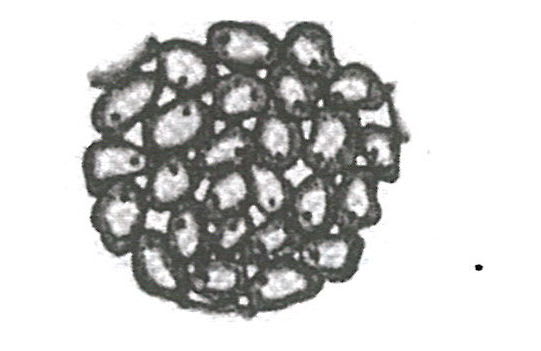
The figures given below represent three kinds of supporting tissues in plants.
A
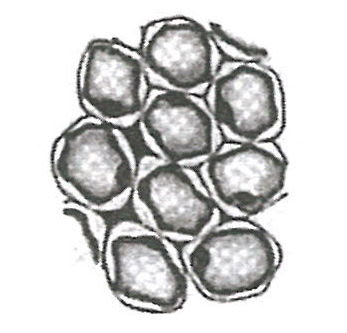
B
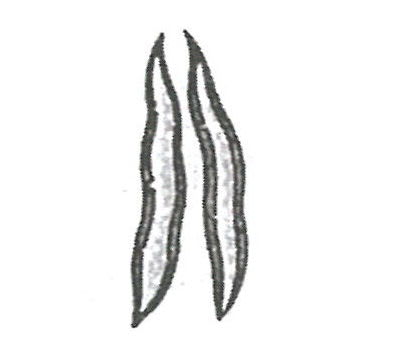
C
(i) Mention the name of tissues (A), (B) and (C).
(ii) Write one structural difference between the tissues A and B.
(iii) Which of these tissues is located in the petiole of a leaf ?
(iv) Write one functional difference between the tissues A and C.
(v) Name the tissue in which the cells are long, narrow, thick-walled and dead.
Answer
(i) The name of tissues (A), (B) and (C) are:
A → Parenchyma
B → Collenchyma
C → Sclerenchyma
(ii) One structural difference between Parenchyma and Collenchyma:
| Parenchyma | Collenchyma |
|---|---|
| Parenchyma is composed of large thin walled cells, usually with intercellular spaces. | Collenchyma is made up of living cells which are elongated and are thick at the corners or edges. |
(iii) Collenchyma is located in the petiole of a leaf.
(iv) One functional difference between Parenchyma and Sclerenchyma:
| Parenchyma | Sclerenchyma |
|---|---|
| Parenchyma stores food material. | Sclerenchyma provides a rigid mechanical and structural support to the plant. |
(v) Sclerenchyma is composed of cells that are long, narrow, thick-walled and dead.
Leesha fell from her bicycle and fractured one bone in her forearm. The X-ray confirmed a crack, so the doctor placed her arm in a plaster cast to keep the bone steady until it healed. While explaining the treatment, the doctor told her that bones are strong because of certain minerals stored in them.
(i) Bones are classified under which type of animal tissue?
(ii) Name two minerals that make bones strong.
(iii) State one important role of bones in vertebrates apart from movement.
(iv) Mention one other tissue in vertebrates that provides support and has a structure similar to bone.
(v) Name one location in the human body where the tissue mentioned in (iv) is found.
Answer
(i) Bones are classified as connective tissue.
(ii) Two minerals that make bones strong are calcium and phosphorus.
(iii) One important role of bones (apart from movement) is protection of internal organs (e.g., skull protects the brain, rib cage protects the heart and lungs).
(iv) Another tissue that provides support and has a structure similar to bone is cartilage.
(v) One location where cartilage is found in the human body is the tip of the nose (it is also found in the ear and joints).