
Convert the following percents into fractions in simplest form:
(i) 25%
(ii) 150%
(iii) %
(iv) %
Answer
To convert a percentage into a fraction, replace the % sign with and reduce the fraction to simplest form.
(i) 25%
Hence, 25% = .
(ii) 150%
Hence, 150% = .
(iii) %
Hence, % .
(iv) %
Hence, % .
Convert the following fractions into percents:
(i)
(ii)
(iii)
(iv)
(v)
(vi)
Answer
To convert a fraction into a percentage, multiply the fraction by 100 and put the % sign.
(i)
%
%
%
Hence, %.
(ii)
%
%
%
Hence, %.
(iii)
%
%
%
%
Hence, %.
(iv)
%
%
%
Hence, %.
(v)
%
%
%
%
Hence, %.
(vi)
%
%
%
%
Hence, %.
6 students out of 40 students in a class are absent. What percentage of the students are absent?
Answer
Number of students absent = 6 and total number of students = 40.
Percentage of students absent = %
%
%
Hence, the percentage of students absent = 15%.
Antony secured 384 marks out of 500 marks. Find the percentage of marks secured by Antony.
Answer
Marks secured by Antony = 384 out of 500.
Percentage of marks = %
%
%
Hence, the percentage of marks secured by Antony = 76.8%.
A shop has 500 shirts, out of which 15 are defective. What percentage of shirts are defective?
Answer
Number of defective shirts = 15 and total number of shirts = 500.
Percentage of defective shirts = %
%
%
Hence, the percentage of defective shirts = 3%.
Vani has a collection of bangles. She has 20 gold bangles and 10 silver bangles. What is the percentage of each type of bangles?
Answer
Number of gold bangles = 20 and number of silver bangles = 10.
Total number of bangles = 20 + 10 = 30.
Percentage of gold bangles = %
%
%
%
Percentage of silver bangles = %
%
%
%
Hence, gold bangles = % and silver bangles = %.
There are 120 voters, 90 of them voted. What percent did not vote?
Answer
Total number of voters = 120 and number who voted = 90.
Number who did not vote = 120 − 90 = 30.
Percentage who did not vote = %
%
%
Hence, the percentage of voters who did not vote = 25%.
Estimate the part of the figure which is shaded and hence find the percentage of the part which is shaded.
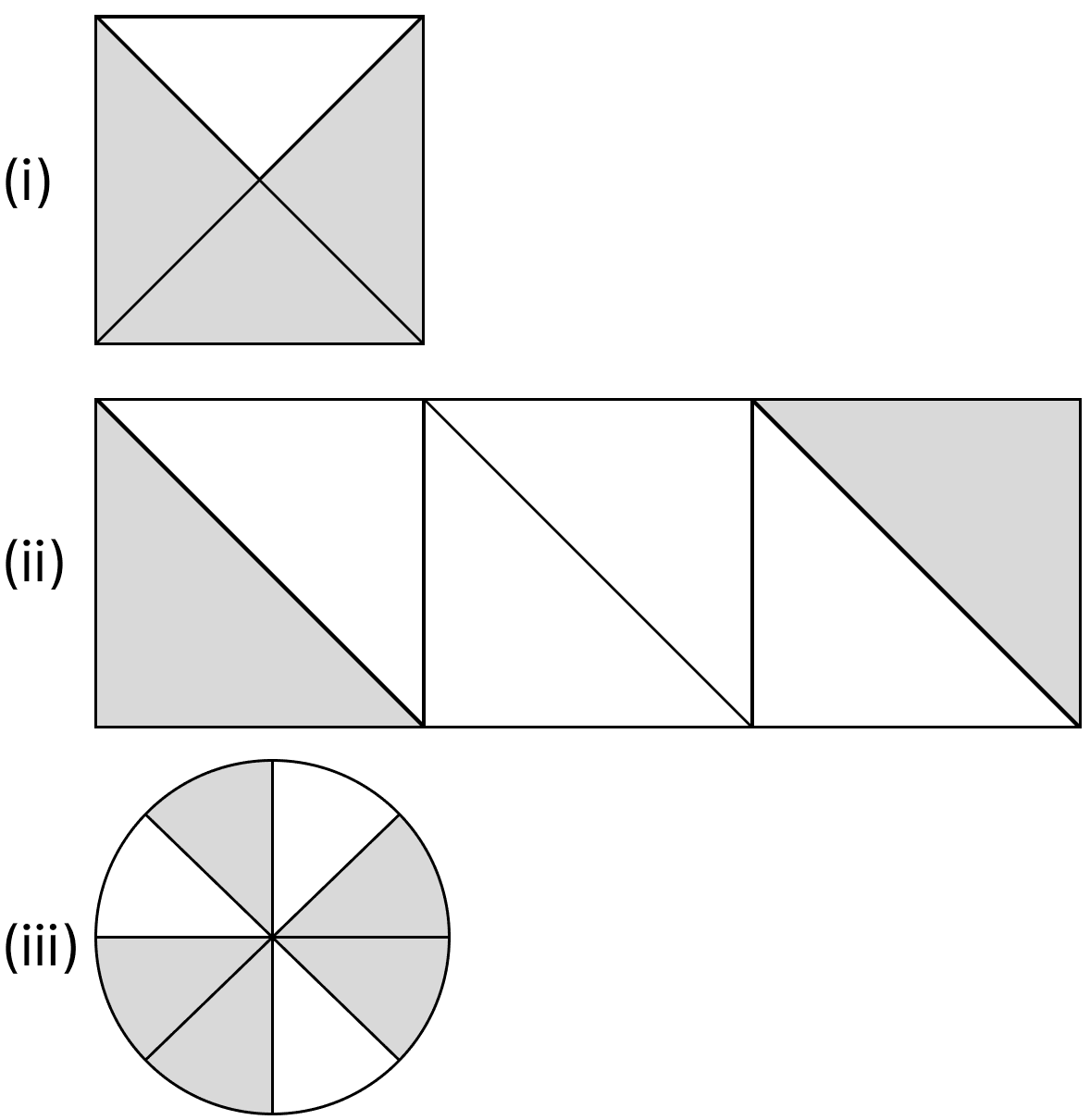
Answer
(i) From the figure, shaded part = .
Percentage of shaded part = % = 75%.
Hence, shaded part = and percentage of shaded part = 75%.
(ii) From the figure, shaded part = .
Percentage of shaded part = % %.
Hence, shaded part = and percentage of shaded part = %.
(iii) From the figure, shaded part = .
Percentage of shaded part = % = 62.5%.
Hence, shaded part = and percentage of shaded part = 62.5%.
Convert the following percentages into ratios in simplest form:
(i) 14%
(ii) %
(iii) %
(iv) 37.5%
Answer
To convert a percentage into a ratio, first convert the percentage into a fraction in simplest form and then write it as a ratio.
(i) 14%
Hence, 14% = 7 : 50.
(ii) %
%
Hence, % = 7 : 400.
(iii) %
%
Hence, % = 1 : 3.
(iv) 37.5%
Hence, 37.5% = 3 : 8.
Express the following ratios as percentages:
(i) 5 : 4
(ii) 1 : 1
(iii) 2 : 3
(iv) 9 : 16
Answer
To convert a ratio into a percentage, first convert the ratio into a fraction and then to a percentage.
(i) 5 : 4
%
%
Hence, 5 : 4 = 125%.
(ii) 1 : 1
%
%
Hence, 1 : 1 = 100%.
(iii) 2 : 3
%
%
%
Hence, 2 : 3 = %.
(iv) 9 : 16
%
%
%
Hence, 9 : 16 = %.
An alloy consists of 7 parts of zinc and 33 parts of copper. Find the percentage of copper in the alloy.
Answer
Parts of zinc = 7 and parts of copper = 33.
Total number of parts = 7 + 33 = 40.
Percentage of copper = %
%
%
Hence, the percentage of copper in the alloy = 82.5%.
Chalk contains calcium, carbon and sand in the ratio 12 : 3 : 10. Find the percentage of carbon in the chalk.
Answer
Ratio of calcium : carbon : sand = 12 : 3 : 10.
Total number of parts = 12 + 3 + 10 = 25.
Percentage of carbon = %
%
%
Hence, the percentage of carbon in the chalk = 12%.
If ₹ 2500 is to be divided among Ravi, Raju and Roy, so that Ravi gets two parts, Raju three parts and Roy five parts. How much money will each get? What will it be in percentages?
Answer
Total amount = ₹ 2500.
Ravi : Raju : Roy = 2 : 3 : 5.
Total number of parts = 2 + 3 + 5 = 10.
Ravi's share = .
Raju's share = .
Roy's share = .
Ravi's percentage = % = 20%.
Raju's percentage = % = 30%.
Roy's percentage = % = 50%.
Hence, Ravi gets ₹ 500 (20%), Raju gets ₹ 750 (30%) and Roy gets ₹ 1250 (50%).
Convert the following percentages to decimals:
(i) 28%
(ii) 3%
(iii) 0.44%
(iv) %
Answer
To convert a percentage into a decimal, replace the % sign with and then express the fraction as a decimal.
(i) 28%
Hence, 28% = 0.28.
(ii) 3%
Hence, 3% = 0.03.
(iii) 0.44%
Hence, 0.44% = 0.0044.
(iv) %
%
Hence, % = 0.375.
Convert the following decimals to percents:
(i) 0.65
(ii) 0.9
(iii) 2.1
(iv) 0.02
Answer
To convert a decimal into a percentage, multiply the decimal by 100 and put the % sign.
(i) 0.65
%
%
Hence, 0.65 = 65%.
(ii) 0.9
%
%
Hence, 0.9 = 90%.
(iii) 2.1
%
%
Hence, 2.1 = 210%.
(iv) 0.02
%
%
Hence, 0.02 = 2%.
Find:
15% of 250
Answer
15% of 250
Hence, 15% of 250 = 37.5.
Find:
25% of 120 litres
Answer
25% of 120 litres
Hence, 25% of 120 litres = 30 litres.
Find:
1% of 1 hour
Answer
1% of 1 hour
We know, 1 hour = 60 minutes.
Hence, 1% of 1 hour = 36 seconds.
Find:
75% of 1 kg
Answer
75% of 1 kg
We know, 1 kg = 1000 g.
Hence, 75% of 1 kg = 750 g.
Find:
120% of ₹ 250
Answer
120% of ₹ 250
Hence, 120% of ₹ 250 = ₹ 300.
Find:
0.6% of 2 km
Answer
0.6% of 2 km
We know, 1 km = 1000 m, so 2 km = 2000 m.
Hence, 0.6% of 2 km = 12 m.
8% children of a class of 25 like getting wet in the rain. How many children like getting wet in the rain?
Answer
Total number of children = 25.
Number of children who like getting wet in the rain = 8% of 25
Hence, 2 children like getting wet in the rain.
Vasundara ate 3 ice cream cups out of 20 kept in the fridge. What percent did she eat?
Answer
Number of ice cream cups eaten = 3 out of 20.
Required percentage = %
%
%
Hence, Vasundara ate 15% of the ice cream cups.
Express:
(i) 20 as a percentage of 50
(ii) 60 litres as a percentage of 40 litres
(iii) 90 cm as a percentage of 4.5 m
(iv) 350 g as a percentage of 5.6 kg
Answer
To express one quantity as a percentage of another quantity, use percentage = %, taking both quantities in the same units.
(i) 20 as a percentage of 50
%
%
%
Hence, 20 is 40% of 50.
(ii) 60 litres as a percentage of 40 litres
%
%
%
Hence, 60 litres is 150% of 40 litres.
(iii) 90 cm as a percentage of 4.5 m
We know, 1 m = 100 cm, so 4.5 m = 450 cm.
%
%
%
Hence, 90 cm is 20% of 4.5 m.
(iv) 350 g as a percentage of 5.6 kg
We know, 1 kg = 1000 g, so 5.6 kg = 5600 g.
%
%
%
%
Hence, 350 g is % of 5.6 kg.
What percent is:
(i) 12 of 80
(ii) 25 paise of 4 rupees
(iii) 300 g of 2 kg
Answer
(i) 12 of 80
%
%
%
Hence, 12 is 15% of 80.
(ii) 25 paise of 4 rupees
We know, 1 rupee = 100 paise, so 4 rupees = 400 paise.
%
%
%
%
Hence, 25 paise is % of 4 rupees.
(iii) 300 g of 2 kg
We know, 1 kg = 1000 g, so 2 kg = 2000 g.
%
%
%
Hence, 300 g is 15% of 2 kg.
A school team won 6 games this year against 4 games won last year. What is the percent increase?
Answer
Games won last year = 4 and games won this year = 6.
Increase in games won = 6 − 4 = 2.
Percentage increase = %
%
%
%
Hence, the percent increase = 50%.
The price of an article decreased from ₹ 80 to ₹ 60, find the percentage of decrease in the price of the article.
Answer
Original price = ₹ 80 and new price = ₹ 60.
Decrease in price = 80 − 60 = ₹ 20.
Percentage decrease = %
%
%
%
Hence, the percentage decrease in price = 25%.
My grandmother says, in her childhood petrol was ₹ 1 per litre. It is ₹ 95 per litre today. By what percentage has the prices of petrol gone up?
Answer
Original price = ₹ 1 per litre and present price = ₹ 95 per litre.
Increase in price = 95 − 1 = ₹ 94.
Percentage increase = %
= 9400%
Hence, the price of petrol has gone up by 9400%.
The price of tomatoes last year was ₹ 40 per kg. This year they are costly by 20%. What is the price this year?
Answer
Last year's price = ₹ 40 per kg.
Increase in price = 20% of 40 = .
Price this year = 40 + 8 = ₹ 48.
Hence, the price of tomatoes this year = ₹ 48 per kg.
300 students took an exam. 28% failed. Calculate the number of students who passed the exam.
Answer
Total number of students = 300.
Percentage of students who failed = 28%.
Percentage of students who passed = (100 − 28)% = 72%.
Number of students who passed = 72% of 300
Hence, 216 students passed the exam.
Out of 15000 voters in a constituency, 60% voted. Find the number of voters who did not vote.
Answer
Total number of voters = 15000.
Percentage of voters who voted = 60%.
Percentage of voters who did not vote = (100 − 60)% = 40%.
Number of voters who did not vote = 40% of 15000
Hence, 6000 voters did not vote.
20% of length of a flagpole is painted green, 45% is painted yellow and the remaining red. If the length of the pole is 18 m, what length of it is painted red?
Answer
Length of the flagpole = 18 m.
Percentage painted green = 20% and percentage painted yellow = 45%.
Percentage painted red = 100% − (20% + 45%) = 100% − 65% = 35%.
Length painted red = 35% of 18 m
Hence, the length painted red = 6.3 m.
Chalk contains 10% calcium, 3% carbon, 12% oxygen and the remaining sand. Find the amount of carbon and calcium (in grams) in kg of chalk. Also find the amount of sand (in kg).
Answer
Total quantity of chalk = kg = 2.5 kg = 2500 g.
Amount of carbon = 3% of 2500 g
Amount of calcium = 10% of 2500 g
Percentage of sand = 100% − (10% + 3% + 12%) = 100% − 25% = 75%.
Amount of sand = 75% of 2500 g
Hence, carbon = 75 g, calcium = 250 g and sand = 1.875 kg.
Find the whole quantity if:
(i) 25% of it is 9
(ii) 75% of it is 15
(iii) 12% of it is ₹ 1080
(iv) 8% of it is 40 litres
Answer
(i) 25% of it is 9
Let the whole quantity be x.
Given,
25% of x = 9
Hence, the whole quantity = 36.
(ii) 75% of it is 15
Let the whole quantity be x.
Hence, the whole quantity = 20.
(iii) 12% of it is ₹ 1080
Let the whole quantity be ₹ x.
Hence, the whole quantity = ₹ 9000.
(iv) 8% of it is 40 litres
Let the whole quantity be x litres.
Hence, the whole quantity = 500 litres.
Mohini saves ₹ 4000 from her salary. If this is 10% of her salary, then what is her salary?
Answer
Let Mohini's salary be ₹ x.
Given, 10% of her salary = ₹ 4000.
Hence, Mohini's salary = ₹ 40,000.
16% of the apples in a basket go bad. If there are 42 good apples in the basket, find the total number of apples in the basket.
Answer
Percentage of apples that go bad = 16%.
Percentage of good apples = (100 − 16)% = 84%.
Let the total number of apples be x.
84% of x = 42
Hence, the total number of apples in the basket = 50.
In an examination, a student has to secure 45% marks to pass the exam. If Varun got 251 marks and failed by 19 marks, what are the maximum marks?
Answer
Marks scored by Varun = 251 and marks needed to pass = 19 more.
Pass marks = 251 + 19 = 270.
Let the maximum marks be x. Since 45% of the maximum marks are needed to pass,
45% of x = 270
Hence, the maximum marks = 600.
On a rainy day, 94% of the students were present in a school. If the number of students absent on that day was 174, find the total strength of the school.
Answer
Percentage of students present = 94%.
Percentage of students absent = (100 − 94)% = 6%.
Let the total strength of the school be x.
6% of x = 174
Hence, the total strength of the school = 2900.
40% of the population of a town are men and 39% are women. If the number of children is 12600, find the number of men.
Answer
Percentage of men = 40% and percentage of women = 39%.
Percentage of children = 100% − (40% + 39%) = 100% − 79% = 21%.
Let the total population be x.
21% of x = 12600
Number of men = 40% of 60000
Hence, the number of men = 24000.
If the price of a watch is increased by 15%, the increase in the price is ₹ 90. What was the price of watch earlier?
Answer
Let the earlier price of the watch be ₹ x.
Given, 15% of the price = ₹ 90.
Hence, the earlier price of the watch = ₹ 600.
(i) Find the number which when increased by 30% becomes 39.
(ii) Find the number which when decreased by 8% becomes 506.
Answer
(i) Let the number be x.
When increased by 30%, the number becomes 130% of x.
130% of x = 39
Hence, the required number = 30.
(ii) Let the number be x.
When decreased by 8%, the number becomes (100 − 8)% = 92% of x.
92% of x = 506
Hence, the required number = 550.
The price of a shirt is reduced by 7% to ₹ 465. What is its original price?
Answer
Let the original price of the shirt be ₹ x.
When reduced by 7%, the price becomes (100 − 7)% = 93% of x.
93% of x = 465
Hence, the original price of the shirt = ₹ 500.
If 15% of 60 is greater than 25% of a number by 3, then find the number.
Answer
15% of 60 = .
Let the number be x.
Given, 15% of 60 is greater than 25% of x by 3.
% of x + 3
% of x = 9 - 3
Hence, the required number = 24.
A 60 litre tank was full of petrol. Peter used 30% of it and poured the rest into a 50 litre tank.
(i) What percent of 50 litre tank was filled with petrol?
(ii) If Peter used 2.8 litres of petrol daily, what percent of petrol in the 50 litre tank would be used in 10 days?
Answer
Petrol in the full tank = 60 litres.
Petrol used = 30% of 60 = litres.
Petrol poured into the 50 litre tank = 60 − 18 = 42 litres.
(i) Percentage of 50 litre tank filled = %
%
%
Hence, 84% of the 50 litre tank was filled with petrol.
(ii) Petrol used in 10 days = 2.8 × 10 = 28 litres.
Petrol present in the 50 litre tank = 42 litres.
Percentage of petrol used = %
%
%
%
Hence, % of the petrol in the 50 litre tank would be used in 10 days.
Rohan bought a calculator for ₹ 760 and sold it for ₹ 874. Find his profit and profit percentage.
Answer
C.P. of the calculator = ₹ 760 and S.P. of the calculator = ₹ 874.
Since S.P. > C.P., there is a profit.
Profit = S.P. − C.P. = 874 − 760 = ₹ 114.
Profit percentage = %
%
%
%
Hence, profit = ₹ 114 and profit percentage = 15%.
Kirti bought a saree for ₹ 2500 and sold it for ₹ 2300. Find her loss and loss percent.
Answer
C.P. of the saree = ₹ 2500 and S.P. of the saree = ₹ 2300.
Since C.P. > S.P., there is a loss.
Loss = C.P. − S.P. = 2500 − 2300 = ₹ 200.
Loss percentage = %
%
%
%
Hence, loss = ₹ 200 and loss percent = 8%.
Calculate the profit or loss in the following transactions. Also find profit percent or loss percent in each case:
(i) Gardening shears bought for ₹ 250 and sold for ₹ 325
(ii) A shirt bought for ₹ 250 and sold at ₹ 150
Answer
(i) C.P. of the shears = ₹ 250 and S.P. of the shears = ₹ 325.
Since S.P. > C.P., there is a profit.
Profit = S.P. − C.P. = 325 − 250 = ₹ 75.
Profit percentage = %
%
%
Hence, profit = ₹ 75 and profit percent = 30%.
(ii) C.P. of the shirt = ₹ 250 and S.P. of the shirt = ₹ 150.
Since C.P. > S.P., there is a loss.
Loss = C.P. − S.P. = 250 − 150 = ₹ 100.
Loss percentage = %
%
%
Hence, loss = ₹ 100 and loss percent = 40%.
Rajinder bought one almirah for ₹ 4800 and the other for ₹ 3640. He sold the first almirah at a gain of % and the other at a loss of 15%. How much did he gain or lose in the whole deal?
Answer
First almirah:
C.P. = ₹ 4800 and gain = % = %.
Gain = % of 4800 = .
S.P. of first almirah = 4800 + 640 = ₹ 5440.
Second almirah:
C.P. = ₹ 3640 and loss = 15%.
Loss = 15% of 3640 = .
S.P. of second almirah = 3640 − 546 = ₹ 3094.
Whole deal:
Total C.P. = 4800 + 3640 = ₹ 8440.
Total S.P. = 5440 + 3094 = ₹ 8534.
Since total S.P. > total C.P., there is a gain.
Gain = 8534 − 8440 = ₹ 94.
Hence, Rajinder gained ₹ 94 in the whole deal.
In a furniture shop, 24 tables were bought at the rate of ₹ 4500 per table. The shopkeeper sold 16 of them at the rate of ₹ 6000 per table and the remaining at the rate of ₹ 4000 per table. Find his gain or loss percent.
Answer
Total C.P. = 24 × 4500 = ₹ 108000.
S.P. of 16 tables = 16 × 6000 = ₹ 96000.
Remaining tables = 24 − 16 = 8.
S.P. of 8 tables = 8 × 4000 = ₹ 32000.
Total S.P. = 96000 + 32000 = ₹ 128000.
Since total S.P. > total C.P., there is a gain.
Gain = 128000 − 108000 = ₹ 20000.
Gain percentage = %
%
%
%
Hence, the shopkeeper has a gain of %.
By selling a lamp for ₹ 810, a dealer makes a profit of ₹ 60. What is the cost price of the lamp? What is his profit percent?
Answer
S.P. of the lamp = ₹ 810 and profit = ₹ 60.
C.P. = S.P. − profit = 810 − 60 = ₹ 750.
Profit percentage = %
%
%
Hence, the cost price of the lamp = ₹ 750 and profit percent = 8%.
By selling a jacket for ₹ 3906, a manufacturer suffers a loss of ₹ 294. Find the cost price of the jacket and his loss percentage.
Answer
S.P. of the jacket = ₹ 3906 and loss = ₹ 294.
C.P. = S.P. + loss = 3906 + 294 = ₹ 4200.
Loss percentage = %
%
%
Hence, the cost price of the jacket = ₹ 4200 and loss percentage = 7%.
The cost price of a vase is ₹ 120. If the shopkeeper sells it at a loss of 10%, find the price at which it was sold.
Answer
C.P. of the vase = ₹ 120 and loss = 10%.
Loss = 10% of 120 = .
S.P. = C.P. − loss = 120 − 12 = ₹ 108.
Hence, the vase was sold for ₹ 108.
I buy a T.V. for ₹ 10000 and sell it at a profit of 20%. How much money do I get for it?
Answer
C.P. of the T.V. = ₹ 10000 and profit = 20%.
Profit = 20% of 10000 = .
S.P. = C.P. + profit = 10000 + 2000 = ₹ 12000.
Hence, I get ₹ 12000 for the T.V.
A shopkeeper sells an article for ₹ 300, thus earning a profit of 20%. Find the cost price of the article.
Answer
S.P. of the article = ₹ 300 and profit = 20%.
Let the C.P. be ₹ x.
S.P. = C.P. + 20% of C.P. = (100 + 20)% of C.P. = 120% of C.P.
Hence, the cost price of the article = ₹ 250.
A shopkeeper sells an article for ₹ 320, thus suffering a loss of 20%. Find the cost price of the article.
Answer
S.P. of the article = ₹ 320 and loss = 20%.
Let the C.P. be ₹ x.
S.P. = C.P. − 20% of C.P. = (100 − 20)% of C.P. = 80% of C.P.
Hence, the cost price of the article = ₹ 400.
By selling a chair for ₹ 522, a shopkeeper makes a profit of 16%. What is its cost price?
Answer
S.P. of the chair = ₹ 522 and profit = 16%.
Let the C.P. be ₹ x.
S.P. = (100 + 16)% of C.P. = 116% of C.P.
Hence, the cost price of the chair = ₹ 450.
A trader sold some damaged garments for ₹ 7360 at a loss of 8%. Find the cost price of the garments.
Answer
S.P. of the garments = ₹ 7360 and loss = 8%.
Let the C.P. be ₹ x.
S.P. = (100 − 8)% of C.P. = 92% of C.P.
Hence, the cost price of the garments = ₹ 8000.
By selling a table for ₹ 3168, Rashid loses 12%. Find its cost price. What percent would he gain or lose by selling the table for ₹ 3870?
Answer
S.P. of the table = ₹ 3168 and loss = 12%.
Let the C.P. be ₹ x.
S.P. = (100 − 12)% of C.P. = 88% of C.P.
So, the cost price of the table = ₹ 3600.
Now, if the table is sold for ₹ 3870:
Since 3870 > 3600, there is a gain.
Gain = 3870 − 3600 = ₹ 270.
Gain percentage = %
%
%
Hence, the cost price = ₹ 3600 and he would gain 7.5% by selling it for ₹ 3870.
By selling an article for ₹ 4550, Tony incurs a loss of 9%. What percent would he gain or lose by selling it for ₹ 4825?
Answer
S.P. of the article = ₹ 4550 and loss = 9%.
Let the C.P. be ₹ x.
S.P. = (100 − 9)% of C.P. = 91% of C.P.
So, the cost price of the article = ₹ 5000.
Now, if the article is sold for ₹ 4825:
Since 5000 > 4825, there is a loss.
Loss = 5000 − 4825 = ₹ 175.
Loss percentage = %
%
%
Hence, he would lose 3.5% by selling it for ₹ 4825.
Arif bought a second hand car for ₹ 80000 and spent 12.5% of the cost of the car on its repairs. At what price should he sell the car to make a profit of 15%?
Answer
Cost of the car = ₹ 80000.
Amount spent on repairs = 12.5% of 80000 = .
Total cost price = 80000 + 10000 = ₹ 90000.
To make a profit of 15%:
S.P. = (100 + 15)% of C.P. = 115% of 90000
Hence, Arif should sell the car for ₹ 103500.
Find the simple interest on:
(i) ₹ 350 for 2 years at 11% per annum
(ii) ₹ 20000 for years at % per annum
(iii) ₹ 648 for 8 months at % per annum
Also find the amount in each case.
Answer
Simple interest is given by the formula and amount = principal + interest.
(i) Here, P = ₹ 350, R = 11% per annum and T = 2 years.
Amount = P + I = 350 + 77 = ₹ 427.
Hence, simple interest = ₹ 77 and amount = ₹ 427.
(ii) Here, P = ₹ 20000, R = % per annum and T = years.
Amount = P + I = 20000 + 7650 = ₹ 27650.
Hence, simple interest = ₹ 7650 and amount = ₹ 27650.
(iii) Here, P = ₹ 648, R = % per annum and T = 8 months = year.
Amount = P + I = 648 + 72 = ₹ 720.
Hence, simple interest = ₹ 72 and amount = ₹ 720.
Find the time when:
(i) simple interest on ₹ 2500 at 4% per annum is ₹ 200
(ii) simple interest on ₹ 12000 at % per annum is ₹ 2730
Answer
Using , we get .
(i) Here, P = ₹ 2500, R = 4% per annum and I = ₹ 200.
Hence, the time = 2 years.
(ii) Here, P = ₹ 12000, R = % per annum and I = ₹ 2730.
Hence, the time = years.
Find the rate of interest when:
(i) simple interest on ₹ 1560 in 3 years is ₹ 585
(ii) simple interest on ₹ 1625 in years is ₹ 325
Answer
Using , we get .
(i) Here, P = ₹ 1560, T = 3 years and I = ₹ 585.
%
%
%
%
Hence, the rate of interest = % per annum.
(ii) Here, P = ₹ 1625, T = years and I = ₹ 325.
%
%
%
%
Hence, the rate of interest = 8% per annum.
Find the principal when:
(i) simple interest at 16% per annum for years is ₹ 3840
(ii) simple interest at % per annum for 2 years 4 months is ₹ 2730
Answer
Using , we get .
(i) Here,
R = 16% per annum,
T = years and
I = ₹ 3840.
Hence, the principal = ₹ 9600.
(ii) Here,
R = % per annum,
T = 2 years 4 months = years and
I = ₹ 2730.
Hence, the principal = ₹ 15600.
Find the rate of interest when:
(i) ₹ 1200 amounts to ₹ 1320 in 2 years
(ii) ₹ 300 amounts to ₹ 400 in 2 years
Answer
(i) Here, P = ₹ 1200, A = ₹ 1320 and T = 2 years.
I = A − P = 1320 − 1200 = ₹ 120.
%
%
%
%
Hence, the rate of interest = 5% per annum.
(ii) Here, P = ₹ 300, A = ₹ 400 and T = 2 years.
I = A − P = 400 − 300 = ₹ 100.
%
%
%
%
Hence, the rate of interest = % per annum.
Find the time when:
(i) ₹ 1250 amounts to ₹ 1950 at 16% per annum
(ii) ₹ 6540 amounts to ₹ 8447.50 at % per annum
Answer
(i) Here,
P = ₹ 1250, A = ₹ 1950 and R = 16% per annum.
I = A − P = 1950 − 1250 = ₹ 700.
Hence, the time = years.
(ii) Here,
P = ₹ 6540, A = ₹ 8447.50 and R = % per annum.
I = A − P = 8447.50 − 6540 = ₹ 1907.50.
Hence, the time = 2 years 4 months.
₹ 14000 is invested at 4% per annum simple interest. How long will it take for the amount to reach ₹ 16240?
Answer
Here,
P = ₹ 14000, A = ₹ 16240 and R = 4% per annum.
I = A − P = 16240 − 14000 = ₹ 2240.
Hence, it will take 4 years.
An amount of money invested trebled in 6 years. Find the rate of interest earned.
Answer
Let the principal be ₹ P.
Since the money trebled, amount A = 3P.
Interest I = A − P = 3P − P = 2P.
Here, T = 6 years.
%
%
%
%
%
Hence, the rate of interest = % per annum.
Find the principal when:
(i) final amount is ₹ 4500 at 20% per annum for 5 years
(ii) final amount is ₹ 2420 at 4% per annum for years
Answer
(i) Here,
A = ₹ 4500, R = 20% per annum and T = 5 years.
Let the principal be ₹ P.
Hence, the principal = ₹ 2250.
(ii) Here,
A = ₹ 2420, R = 4% per annum and T = years.
Let the principal be ₹ P.
Hence, the principal = ₹ 2200.
If the simple interest on a certain sum of money for 3 years is three-tenth of the sum, then find the rate of interest per annum.
Answer
Let the sum (principal) be ₹ P and T = 3 years.
Given, simple interest I = of P = .
%
%
%
%
%
Hence, the rate of interest = 10% per annum.
What sum of money will amount to ₹ 2760 in 3 years at 5% per annum simple interest?
Answer
Here,
A = ₹ 2760, T = 3 years and R = 5% per annum.
Let the sum (principal) be ₹ P.
Hence, the required sum = ₹ 2400.
A sum of ₹ 6000 amounts to ₹ 6900 in 3 years. What will it amount to if the rate of interest is increased by 2%?
Answer
Here,
P = ₹ 6000, A = ₹ 6900 and T = 3 years.
I = A − P = 6900 − 6000 = ₹ 900.
%
%
%
%
New rate of interest = 5% + 2% = 7% per annum.
New interest = .
New amount = P + new interest = 6000 + 1260 = ₹ 7260.
Hence, the sum will amount to ₹ 7260.
Fill in the blanks:
(i) 6% of ₹ 50 = ....
(ii) If 25% of a number is 12, then the number is ....
(iii) The mixed fraction converted to percentage form is ....
(iv) If a number increases from 20 to 28, then the increase percentage is ....
(v) If cost price is ₹ 400 and loss is 15%, then selling price is ....
(vi) The profit or loss percentage is always calculated on .....
(vii) The simple interest on a sum of ₹ 5600 at 8% p.a. for one year is ....
(viii) 135% converted to decimals is ....
(ix) .... is 50% more than 60
(x) 25 mL is .... percent of 5 litres.
Answer
(i) 6% of ₹ 50 = .
Hence, 6% of ₹ 50 = ₹ 3.
(ii) Let the number be x. Then 25% of x = 12, so .
Hence, the number is 48.
(iii) % = 175%.
Hence, = 175%.
(iv) Increase = 28 − 20 = 8. Increase percentage = % = 40%.
Hence, the increase percentage is 40%.
(v) Loss = 15% of 400 = . Selling price = 400 − 60 = ₹ 340.
Hence, the selling price is ₹ 340.
(vi) Hence, the profit or loss percentage is always calculated on cost price (C.P.).
(vii) S.I. = .
Hence, the simple interest is ₹ 448.
(viii) 135% = .
Hence, 135% = 1.35.
(ix) 50% of 60 = 30. So the number = 60 + 30 = 90.
Hence, 90 is 50% more than 60.
(x) 5 litres = 5000 mL. Required percentage = % = 0.5%.
Hence, 25 mL is 0.5 percent of 5 litres.
State whether the following statements are true (T) or false (F):
(i) 20% more than 30 is 36
(ii) The ratio 2 : 5 converted to percentage is 60%
(iii) % expressed as a fraction is
(iv) 80% of 450 m is equal to 360 m
(v) If a number decreases from 20 to 15, then the decrease is 25%
(vi) If Feroz obtains 336 marks out of 600 marks, then percentage of marks obtained by him is 33.6
(vii) 0.018 is equivalent to 8%
(viii) 250 cm is 4% of 1 km
(ix) If S.P. of an article is ₹ 540 and loss is ₹ 40, then its C.P. is ₹ 500
(x) By selling a book for ₹ 500, a shopkeeper suffers a loss of 10%. The cost price of the book is ₹ 600
Answer
(i) 20% of 30 = 6, so 20% more than 30 = 30 + 6 = 36. The statement is correct.
Hence, the statement is True.
(ii) 2 : 5 = % = 40%, not 60%. The statement is incorrect.
Hence, the statement is False.
(iii) Solving,
%
%
.
Thus, the statement is correct.
Hence, the statement is True.
(iv) 80% of 450 m = m. The statement is correct.
Hence, the statement is True.
(v) Decrease = 20 − 15 = 5. Decrease percentage = % = 25%. The statement is correct.
Hence, the statement is True.
(vi) Percentage of marks = % = 56%, not 33.6. The statement is incorrect.
Hence, the statement is False.
(vii) 0.018 = (0.018 × 100)% = 1.8%, not 8%. The statement is incorrect.
Hence, the statement is False.
(viii) 1 km = 100000 cm. Required percentage = % = 0.25%, not 4%. The statement is incorrect.
Hence, the statement is False.
(ix) C.P. = S.P. + loss = 540 + 40 = ₹ 580, not ₹ 500. The statement is incorrect.
Hence, the statement is False.
(x) S.P. = ₹ 500 at a loss of 10% means S.P. = 90% of C.P. So C.P. = (approximately), not ₹ 600. The statement is incorrect.
Hence, the statement is False.
The ratio of Fatima's income to her saving is 4 : 1. The percentage of money saved by her is
20%
25%
40%
80%
Answer
Income : saving = 4 : 1.
Percentage of money saved = %
= %
= 25%.
Hence, Option 2 is the correct option.
225% is equal to
2 : 3
3 : 2
4 : 9
9 : 4
Answer
225% = .
Hence, Option 4 is the correct option.
If 30% of x is 72, then x is equal to
120
240
360
480
Answer
30% of x = 72.
Hence, Option 2 is the correct option.
If x% of 80 = 12, then x is equal to
15
20
25
30
Answer
x% of 80 = 12.
Hence, Option 1 is the correct option.
0.025 when expressed as a percent is
250%
25%
4%
2.5%
Answer
0.025 = (0.025 × 100)% = 2.5%.
Hence, Option 4 is the correct answer.
In a class, 45% of students are girls. If there are 22 boys in the class, then the total number of students in the class is
30
36
40
44
Answer
Percentage of girls = 45%, so percentage of boys = (100 − 45)% = 55%.
Let the total number of students be x.
55% of x = 22
Hence, Option 3 is the correct option.
If a man buys an article for ₹ 80 and sells it for ₹ 100, then gain percentage is
20%
25%
40%
125%
Answer
C.P. = ₹ 80 and S.P. = ₹ 100.
Gain = 100 − 80 = ₹ 20.
Gain percentage = % = 25%.
Hence, Option 2 is the correct option.
If a man buys an article for ₹ 120 and sells it for ₹ 100, then his loss percentage is
10%
20%
25%
%
Answer
C.P. = ₹ 120 and S.P. = ₹ 100.
Loss = 120 − 100 = ₹ 20.
Loss percentage = %
= %
= %.
Hence, Option 4 is the correct answer.
The salary of a man is ₹ 24000 per month. If he gets an increase of 25% in the salary, then the new salary per month is
₹ 2500
₹ 28000
₹ 30000
₹ 36000
Answer
Increase = 25% of 24000 = .
New salary = 24000 + 6000 = ₹ 30000.
Hence, Option 3 is the correct option.
On selling an article for ₹ 100, Renu gains ₹ 20. Her gain percentage is
25%
20%
15%
40%
Answer
S.P. = ₹ 100 and gain = ₹ 20.
C.P. = S.P. − gain = 100 − 20 = ₹ 80.
Gain percentage = % = 25%.
Hence, Option 1 is the correct option.
The simple interest on ₹ 6000 at 8% p.a. for one year is
₹ 600
₹ 480
₹ 400
₹ 240
Answer
S.I. = .
Hence, Option 2 is the correct option.
If Rohit borrows ₹ 4800 at 5% p.a. simple interest, then the amount he has to return at the end of 2 years is
₹ 480
₹ 5040
₹ 5280
₹ 5600
Answer
S.I. = .
Amount = P + S.I. = 4800 + 480 = ₹ 5280.
Hence, Option 3 is the correct option.
Statement I: 125% is equal to 10 : 8
Statement II: 10 : 8 and 4 : 5 are equal ratios.
Statement I is true but statement II is false.
Statement I is false but statement II is true.
Both Statement I and statement II are true.
Both Statement I and statement II are false.
Answer
Statement I: 125% = . So Statement I is true.
Statement II: 10 : 8 = 5 : 4, while 4 : 5 = 4 : 5. Since 5 : 4 ≠ 4 : 5, they are not equal ratios. So Statement II is false.
Hence, Option 1 is the correct option.
Statement I: If Aman buys a table for ₹ 4000 and sells it for ₹ 4400, he has a gain percentage of 10%
Statement II: Profit and loss percentage is calculated on the cost price.
Statement I is true but statement II is false.
Statement I is false but statement II is true.
Both Statement I and statement II are true.
Both Statement I and statement II are false.
Answer
Statement I: C.P. = ₹ 4000, S.P. = ₹ 4400. Gain = 4400 − 4000 = ₹ 400. Gain percentage = % = 10%. So Statement I is true.
Statement II: Profit and loss percentage is always calculated on the cost price. So Statement II is true.
Hence, Option 3 is the correct option.
Statement I: Akash borrowed ₹ 10000 for 3 years at 6% p.a. simple interest. At the end of 3 years, he has to return ₹ 13000
Statement II: Simple interest =
Statement I is true but statement II is false.
Statement I is false but statement II is true.
Both Statement I and statement II are true.
Both Statement I and statement II are false.
Answer
Statement I: S.I. = . Amount = 10000 + 1800 = ₹ 11800, not ₹ 13000. So Statement I is false.
Statement II: The formula for simple interest is , which is correct. So Statement II is true.
Hence, Option 2 is the correct option.
Convert the following percentages into fractions in the simplest form:
(i) %
(ii) %
(iii) %
Answer
To convert a percentage into a fraction, replace the % sign with and reduce to simplest form.
(i) %
%
Hence, % = .
(ii) %
%
Hence, % = .
(iii) %
%
Hence, % = .
Express each of the following fractions as a percentage:
(i)
(ii)
(iii)
Answer
To convert a fraction into a percentage, multiply the fraction by 100 and put the % sign.
(i)
%
%
%
%
Hence, %.
(ii)
%
%
%
%
Hence, %.
(iii)
%
%
%
%
Hence, %.
Express each of the following percentages as a decimal:
(i) 122%
(ii) 2.2%
(iii) %
Answer
To convert a percentage into a decimal, replace the % sign with and express as a decimal.
(i) 122%
Hence, 122% = 1.22.
(ii) 2.2%
Hence, 2.2% = 0.022.
(iii) %
%
Hence, % = 0.03125.
Express 0.0345 as a percentage.
Answer
To convert a decimal into a percentage, multiply by 100 and put the % sign.
⇒ (0.0345 × 100)%
⇒ 3.45%
Hence, 0.0345 = 3.45%.
Convert each part of the ratio 5 : 6 : 9 to a percentage.
Answer
The given ratio is 5 : 6 : 9.
Total number of parts = 5 + 6 + 9 = 20.
Percentage of first part = % = 25%.
Percentage of second part = % = 30%.
Percentage of third part = % = 45%.
Hence, the three parts are 25%, 30% and 45%.
(i) What percent of a day is half an hour?
(ii) What percent is metres of metres?
Answer
(i) We know, 1 day = 24 hours = 24 × 60 = 1440 minutes.
Half an hour = 30 minutes.
Required percentage = %
%
%
%
Hence, half an hour is % of a day.
(ii) Here, m = m.
Required percentage = %
%
%
%
%
%
Hence, metres is % of metres.
The population of a town decreased from 25000 to 24500. Find the percentage decrease.
Answer
Original population = 25000 and new population = 24500.
Decrease in population = 25000 − 24500 = 500.
Percentage decrease = %
%
%
Hence, the percentage decrease = 2%.
Arun bought a car for ₹ 350000. The next year, the price went upto ₹ 370000. What was the percentage increase in the price?
Answer
Original price = ₹ 350000 and new price = ₹ 370000.
Increase in price = 370000 − 350000 = ₹ 20000.
Percentage increase = %
%
%
%
Hence, the percentage increase in price = %.
The population of a village has decreased by 6%. If the original population was 3650, find the population after decrease.
Answer
Original population = 3650.
Decrease = 6% of 3650 = .
Population after decrease = 3650 − 219 = 3431.
Hence, the population after decrease = 3431.
43% of the students in a school are girls. If the number of boys is 1482, find:
(i) the total strength of the school
(ii) number of girls in the school.
Answer
Percentage of girls = 43%, so percentage of boys = (100 − 43)% = 57%.
(i) Let the total strength of the school be x.
57% of x = 1482
Hence, the total strength of the school = 2600.
(ii) Number of girls = total strength − number of boys = 2600 − 1482 = 1118.
Hence, the number of girls in the school = 1118.
On selling an article for ₹ 1027, Meena suffered a loss of ₹ 273. Find her loss percentage.
Answer
S.P. of the article = ₹ 1027 and loss = ₹ 273.
C.P. = S.P. + loss = 1027 + 273 = ₹ 1300.
Loss percentage = %
%
%
Hence, the loss percentage = 21%.
By selling a lamp for ₹ 710, a trader suffers a loss of ₹ 40. Find the cost price of the lamp. At what price this lamp should be sold in order to gain 10%?
Answer
S.P. of the lamp = ₹ 710 and loss = ₹ 40.
C.P. = S.P. + loss = 710 + 40 = ₹ 750.
To gain 10%:
Gain = 10% of 750 = .
New S.P. = C.P. + gain = 750 + 75 = ₹ 825.
Hence, the cost price of the lamp = ₹ 750 and to gain 10% it should be sold for ₹ 825.
If ₹ 6000 is borrowed at 6.5% per annum simple interest, find the interest and the amount to be paid at the end of 3 years.
Answer
Here, P = ₹ 6000, R = 6.5% per annum and T = 3 years.
Amount = P + I = ₹ 6000 + ₹ 1170 = ₹ 7170.
Hence, the interest = ₹ 1170 and the amount = ₹ 7170.
How long will it take for ₹ 1860 invested at the rate of 9.5% per annum simple interest to amount to ₹ 2449?
Answer
Here, P = ₹ 1860, A = ₹ 2449 and R = 9.5% per annum.
I = A − P = 2449 − 1860 = ₹ 589.
Hence, it will take 3 years 4 months.
At what rate will ₹ 7200 fetch a simple interest of ₹ 3024 in 4 years?
Answer
Here, P = ₹ 7200, I = ₹ 3024 and T = 4 years.
%
%
%
%
Hence, the rate of interest = 10.5% p.a.
What sum of money will yield a simple interest of ₹ 1155 in 3 years 6 months at 11% p.a.?
Answer
Here, I = ₹ 1155, R = 11% per annum and T = 3 years 6 months = years.
Hence, the required sum = ₹ 3000.
Medha deposited 20% of her money in a bank. After spending 20% of the remainder, she has ₹ 48000 left with her. How much did she originally have?
Answer
Let the money Medha originally had be ₹ x.
Money deposited in the bank = 20% of x = .
Remainder = .
Amount spent = 20% of the remainder = .
Money left =
Given, money left = ₹ 48000.
Hence, Medha originally had ₹ 75000.
If Mohan's income is 25% more than Raman's income, then by what percent is Raman's income less than Mohan's income?
Answer
Let Raman's income be ₹ 100.
Mohan's income = 100 + 25% of 100 = 100 + 25 = ₹ 125.
Raman's income is less than Mohan's income by = 125 − 100 = ₹ 25.
Required percentage = %
%
%
Hence, Raman's income is 20% less than Mohan's income.
A person preparing medicine wants to convert 15% alcohol solution into 32% alcohol solution. Find how much pure alcohol should he mix with 400 mL of 15% alcohol solution to obtain it.
Answer
Alcohol present in 400 mL of 15% solution = 15% of 400 = mL.
Let the quantity of pure alcohol to be added be x mL.
New total quantity of solution = (400 + x) mL.
New quantity of alcohol = (60 + x) mL.
For a 32% alcohol solution:
Hence, he should mix 100 mL of pure alcohol.
A manufacturer sells an item to an agency at a profit of 25%. The agency sells the item to a shopkeeper at 10% profit and shopkeeper sells the item at a profit of 20%. If the selling price of the item is ₹ 594, find the manufacturing price.
Answer
The shopkeeper sold the item for ₹ 594 at a profit of 20%.
Shopkeeper's C.P. = .
This ₹ 495 is the agency's selling price (at 10% profit).
Agency's C.P. = .
This ₹ 450 is the manufacturer's selling price (at 25% profit).
Manufacturing price = .
Hence, the manufacturing price = ₹ 360.