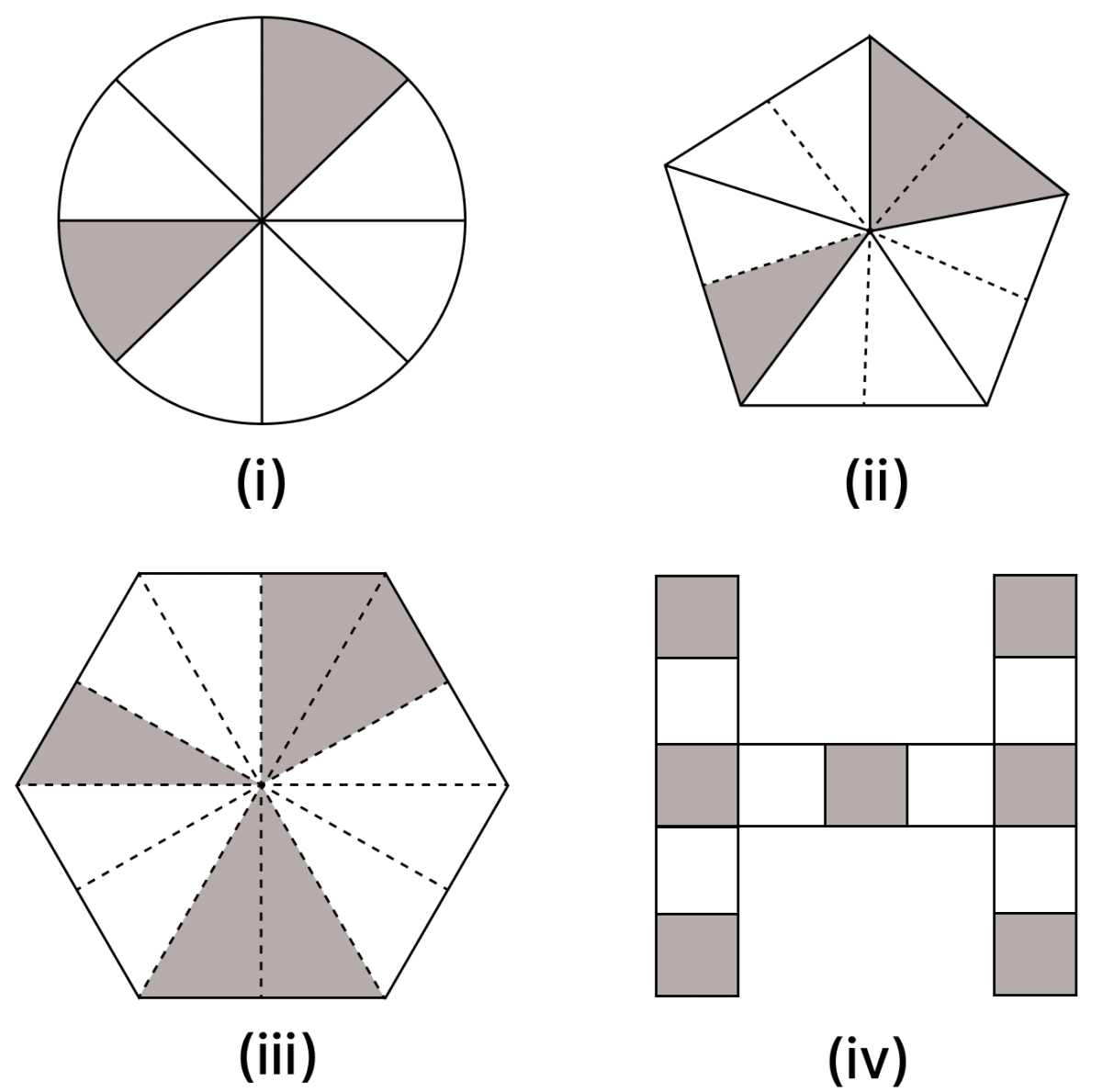
What fraction of each of the following figure is shaded part?
Answer
(i) Total parts = 8
Shaded parts = 2
Fraction = Total partsShaded parts=82.
Hence, fraction = 41.
(ii) Total parts = 10
Shaded parts = 3
Fraction = Total partsShaded parts=103.
Hence, fraction = 103.
(iii) Total parts = 12
Shaded parts = 5
Fraction = Total partsShaded parts=125.
Hence, fraction = 125.
(iv) Total parts = 13
Shaded parts = 7
Fraction = Total partsShaded parts=137.
Hence, fraction = 137.
What fraction of an hour is 35 minutes?
Answer
We know, 1 hour = 60 minutes.
Fraction = 60 minutes35 minutes
⇒6035⇒60÷535÷5⇒127
Hence, the required fraction = 127.
Convert the following fractions into improper fractions:
(i) 297
(ii) 5114
Answer
We use the rule: improper fraction = denominator(natural number×denominator)+numerator.
(i) 297
⇒297=92×9+7=918+7=925.
Hence, the required fraction is 297=925.
(ii) 5114
⇒5114=115×11+4=1155+4=1159.
Hence, the required fraction is 5114=1159.
Convert the following fractions into mixed fractions:
(i) 873
(ii) 1394
Answer
(i) 873
Dividing 73 by 8, we get quotient = 9 and remainder = 1.
⇒873=981.
Hence, 873=981.
(ii) 1394
Dividing 94 by 13, we get quotient = 7 and remainder = 3.
⇒1394=7133.
Hence, 1394=7133.
Fill in the missing numbers in the following equivalent fractions:
(i) 73=35...
(ii) ...5=1830
(iii) 9...=7256
Answer
(i) 73=35...
To get 35 from 7, we have to multiply 7 by 5.
So, multiply both numerator and denominator by 5.
⇒73=7×53×5
= 3515.
Hence, the missing number is 15.
(ii) ...5=1830
To get 5 from 30, we have to divide 30 by 6.
So, divide both numerator and denominator by 6.
⇒1830=18÷630÷6
= 35.
Hence, the missing number is 3.
(iii) 9...=7256
To get 9 from 72, we have to divide 72 by 8.
So, divide both numerator and denominator by 8.
⇒7256=72÷856÷8
= 97.
Hence, the missing number is 7.
Reduce the following fractions to their simplest form:
(i) 7248
(ii) 115276
(iii) 33672
Answer
(i) 7248
By prime factorisation,
⇒7248=2×2×2×3×32×2×2×2×3=32.
Hence, 7248 in simplest form is 32.
(ii) 115276
By prime factorisation,
⇒115276=5×232×2×3×23=52×2×3=512.
Hence, 115276 in simplest form is 512.
(iii) 33672
By prime factorisation,
⇒33672=2×2×2×2×3×72×2×2×3×3=2×73=143.
Hence, 33672 in simplest form is 143.
Convert the following fractions into equivalent like fractions:
(i) 43,65,87
(ii) 257,109,4019
Answer
(i) 43,65,87
L.C.M. of 4, 6 and 8 is :
22234,6,82,3,41,3,21,3,11,1,1
LCM of 4, 6 and 8 = 2 x 2 x 2 x 3 = 24.
⇒43=4×63×6=2418⇒65=6×45×4=2420⇒87=8×37×3=2421
Hence, the equivalent like fractions are 2418,2420 and 2421.
(ii) 257,109,4019
L.C.M. of 25, 10 and 40 is :
2225525,10,4025,5,2025,5,1025,5,55,1,11,1,1
LCM of 25, 10 and 40 = 2 x 2 x 2 x 5 x 5 = 200.
⇒257=25×87×8=20056⇒109=10×209×20=200180⇒4019=40×519×5=20095
Hence, the equivalent like fractions are 20056,200180 and 20095.
Arrange the given fractions in descending order:
(i) 92,32,218
(ii) 51,73,107
Answer
(i) 92,32,218
LCM of 9, 3 and 21:
3379,3,213,1,71,1,71,1,1
LCM of 9, 3 and 21 = 3 x 3 x 7 = 63.
Write the given fractions as equivalent like fractions.
⇒92=9×72×7=6314⇒32=3×212×21=6342⇒218=21×38×3=6324
As 42 > 24 > 14,
6342>6324>6314⇒32>218>92.
Hence, the given fractions in descending order are 32,218,92.
(ii) 51,73,107
LCM of 5, 7 and 10 :
2575,7,105,7,51,7,11,1,1
LCM of 5, 7 and 10 = 2 x 5 x 7 = 70.
Write the given fractions as equivalent like fractions.
⇒51=5×141×14=7014⇒73=7×103×10=7030⇒107=10×77×7=7049
As 49 > 30 > 14,
7049>7030>7014⇒107>73>51.
Hence, the given fractions in descending order are 107,73,51.
Arrange the given fractions in ascending order:
(i) 75,83,149,2120
(ii) 1813,158,2417,127
Answer
(i) 75,83,149,2120
LCM of 7, 8, 14 and 21:
222377,8,14,217,4,7,217,2,7,217,1,7,217,1,7,71,1,1,1
LCM of 7, 8, 14 and 21 = 2 x 2 x 2 x 3 x 7 = 168.
Write the given fractions as equivalent like fractions.
⇒75=7×245×24=168120⇒83=8×213×21=16863⇒149=14×129×12=168108⇒2120=21×820×8=168160
As 63 < 108 < 120 < 160,
16863<168108<168120<168160⇒83<149<75<2120.
Hence, the given fractions in ascending order are 83,149,75,2120.
(ii) 1813,158,2417,127
LCM of 18, 15, 24 and 12:
22233518,15,24,129,15,12,69,15,6,39,15,3,33,5,1,11,5,1,11,1,1,1
LCM of 18, 15, 24 and 12 = 2 x 2 x 2 x 3 x 3 x 5 = 360.
Write the given fractions as equivalent like fractions.
⇒1813=18×2013×20=360260⇒158=15×248×24=360192⇒2417=24×1517×15=360255⇒127=12×307×30=360210
As 192 < 210 < 255 < 260,
360192<360210<360255<360260⇒158<127<2417<1813.
Hence, the given fractions in ascending order are 158,127,2417,1813.
Evaluate the following:
(i) 34+87
(ii) 821−385
(iii) 125+181−92
Answer
(i) 34+87
LCM of 3 and 8
22233,83,43,23,11,1
LCM of 3 and 8 = 2 x 2 x 2 x 3 = 24.
⇒3×84×8+8×37×3⇒2432+2421⇒2432+21⇒2453⇒2245
Hence, 34+87=2245.
(ii) 821−385
LCM of 2 and 8:
2222,82,41,21,1
LCM of 2 and 8 = 2 x 2 x 2 = 8.
⇒821−385⇒217−829⇒2×417×4−829⇒868−829⇒868−29⇒839⇒487
Hence, 821−385=487.
(iii) 125+181−92
LCM of 12, 18 and 9 :
223312,18,96,9,93,9,91,3,31,1,1
LCM of 12, 18 and 9 =2 x 2 x 3 x 3 = 36.
⇒12×35×3+18×21×2−9×42×4⇒3615+362−368⇒3615+2−8⇒369⇒41
Hence, 125+181−92=41.
Simplify the following:
(i) 743−365+87
(ii) 681−2121−5101+3257
Answer
(i) 743−365+87
LCM of 4, 6 and 8 :
22234,6,82,3,41,3,21,3,11,1,1
LCM of 4, 6 and 8 = 2 x 2 x 2 x 3 = 24.
⇒431−623+87⇒4×631×6−6×423×4+8×37×3⇒24186−2492+2421⇒24186−92+21⇒24115⇒42419
Hence, 743−365+87=42419.
(ii) 681−2121−5101+3257
LCM of 8, 12, 10 and 25 :
2223558,12,10,254,6,5,252,3,5,251,3,5,251,1,5,251,1,1,51,1,1,1
LCM of 8, 12, 10 and 25 = 2 x 2 x 2 x 3 x 5 x 5 = 600.
⇒849−1225−1051+2582⇒8×7549×75−12×5025×50−10×6051×60+25×2482×24⇒6003675−6001250−6003060+6001968⇒6003675−1250−3060+1968⇒6001333⇒2600133
Hence, 681−2121−5101+3257=2600133.
Aliyah studies for 532 hours daily. She devotes 254 hours of her time for science and mathematics. How much time does she devote for other subjects?
Answer
Total time Aliyah studies daily = 532 hours.
Time devoted for science and mathematics = 254 hours.
Time devoted for other subjects = 532−254
LCM of 3 and 5:
353,51,51,1
LCM of 3 and 5 = 3 x 5 = 15.
⇒317−514⇒3×517×5−5×314×3⇒1585−1542⇒1585−42⇒1543⇒21513
Hence, Aliyah devotes 21513 hours for other subjects.
Ram solved 72 part of an exercise while Shwetha solved 54 of it. Who solved lesser part? By how much?
Answer
Part of exercise solved by Ram = 72.
Part of exercise solved by Shwetha = 54.
Compare 72 and 54 by cross multiplication:
2 × 5 = 10 and 7 × 4 = 28.
Since 10 < 28, therefore, 72<54.
So, Ram solved the lesser part of the exercise.
Difference = 54−72
LCM of 5 and 7 = 35.
⇒5×74×7−7×52×5⇒3528−3510⇒3528−10⇒3518
Hence, Ram solved the lesser part by 3518 of the exercise.
Sonali had ₹3553. She got ₹16151 from her mother and spent ₹2832 on food. How much money is left with her?
Answer
Money Sonali had = ₹3553.
Money she got from her mother = ₹16151.
Money she spent on food = ₹2832.
Money left = 3553+16151−2832
LCM of 5, 15 and 3 = 15.
⇒5178+15241−386⇒5×3178×3+15241−3×586×5⇒15534+15241−15430⇒15534+241−430⇒15345⇒23
Hence, ₹23 is left with Sonali.
Evaluate the following:
(i) 7×53
(ii) 21×143
(iii) 352×8
(iv) 5×643
Answer
(i) 7×53
⇒57×3⇒521⇒451
Hence, 7×53=451.
(ii) 21×143
⇒1421×3⇒1421×3⇒23×3⇒29⇒421
Hence, 21×143=421.
(iii) 352×8
⇒517×8⇒517×8⇒5136⇒2751
Hence, 352×8=2751.
(iv) 5×643
⇒5×427⇒45×27⇒4135⇒3343
Hence, 5×643=3343.
Find:
(i) 32 of 18
(ii) 21 of 492
(iii) 85 of 932
Answer
(i) 32 of 18
⇒32×18⇒32×18⇒2×6⇒12
Hence, 32 of 18 = 12.
(ii) 21 of 492
⇒21×492⇒21×938⇒2×91×38⇒1838⇒919⇒291
Hence, 21 of 492=291.
(iii) 85 of 932
⇒85×932⇒85×329⇒8×35×29⇒24145⇒6241
Hence, 85 of 932=6241.
Evaluate the following:
(i) 73×95
(ii) 52×541
(iii) 231×5214
(iv) 361×7234
Answer
(i) 73×95
⇒7×93×5⇒93×75⇒31×75⇒215
Hence, 73×95=215.
(ii) 52×541
⇒52×421⇒42×521⇒21×521⇒1021⇒2101
Hence, 52×541=2101.
(iii) 231×5214
⇒37×21109⇒217×3109⇒31×3109⇒9109⇒1291
Hence, 231×5214=1291.
(iv) 361×7234
⇒619×23165⇒2319×6165⇒2319×255⇒23×219×55⇒461045⇒224633
Hence, 361×7234=224633.
Find the value of:
(i) 31 of ₹42
(ii) 73 of 432 kg
(iii) 421 times of 521 metres
Answer
(i) 31 of ₹42
⇒31×42⇒342⇒₹14
Hence, 31 of ₹42 = ₹14.
(ii) 73 of 432 kg
⇒73×432⇒73×314⇒33×714⇒1×2⇒2 kg
Hence, 73 of 432 kg = 2 kg.
(iii) 421 times of 521 metres
⇒421×521⇒29×211⇒2×29×11⇒499⇒2443 metres
Hence, 421 times of 521 metres = 2443 metres.
Which is greater:
(i) 72 of 43 or 53 of 85
(ii) 21 of 76 or 32 of 73
Answer
(i) 72 of 43 or 53 of 85
First, find 72 of 43:
⇒72×43⇒42×73⇒21×73⇒143
Next, find 53 of 85:
⇒53×85⇒83×55⇒83×1⇒83
Now compare 143 and 83.
These are fractions with same numerator 3.
In fractions with same numerator, the fraction with smaller denominator is greater.
Since 8 < 14, therefore, 83>143.
Hence, 53 of 85 is greater.
(ii) 21 of 76 or 32 of 73
First, find 21 of 76:
⇒21×76⇒2×71×6⇒146⇒73
Next, find 32 of 73:
⇒32×73⇒72×33⇒72×1⇒72
Now compare 73 and 72.
These are like fractions (same denominator 7).
In like fractions, the fraction with greater numerator is greater.
Since 3 > 2, therefore, 73>72.
Hence, 21 of 76 is greater.
If 1 metre cloth costs ₹13143, find the cost of 521 metres cloth.
Answer
Cost of 1 metre cloth = ₹13143.
Cost of 521 metres cloth = 13143×521
⇒4527×211⇒4×2527×11⇒85797⇒72485
Hence, the cost of 521 metres cloth = ₹72485.
If the speed of a car is 10551 km/h, find the distance covered by it in 353 hours.
Answer
Speed of the car = 10551 km/h.
Time taken = 353 hours.
Distance covered = Speed × Time = 10551×353
⇒5526×518⇒5×5526×18⇒259468⇒3782518
Hence, the distance covered by the car = 3782518 km.
A car runs 16 km using 1 litre of petrol. How much distance will it cover in 243 litres of petrol?
Answer
Distance covered in 1 litre of petrol = 16 km.
Distance covered in 243 litres of petrol = 16×243
⇒16×411⇒416×11⇒4×11⇒44 km
Hence, the car will cover 44 km in 243 litres of petrol.
Sushant reads 31 part of a book in 1 hour. How much part of the book will he read in 251 hours?
Answer
Part of the book read in 1 hour = 31.
Part of the book read in 251 hours = 31×251
⇒31×511⇒3×51×11⇒1511
Hence, Sushant will read 1511 part of the book in 251 hours.
An ornament is made of gold and copper and weighs 52 grams. If 132 of its part is copper, find the weight of pure gold in it.
Answer
Total weight of the ornament = 52 grams.
Fraction of copper = 132.
Weight of copper = 132×52
⇒132×52⇒2×4⇒8 grams
Weight of pure gold = Total weight − Weight of copper
⇒ 52 - 8
⇒ 44 grams
Hence, the weight of pure gold in the ornament = 44 grams.
In a class of 40 students, 51 of the total number of students like to study English and 52 of the total number of students like to study Mathematics and the remaining like to study Science.
(i) How many students like to study English?
(ii) How many students like to study Mathematics?
(iii) What fraction of the total number of students like to study Science?
Answer
Total number of students = 40.
(i) Number of students who like to study English = 51×40
⇒540
⇒ 8
Hence, 8 students like to study English.
(ii) Number of students who like to study Mathematics = 52×40
⇒52×40⇒2×8⇒16
Hence, 16 students like to study Mathematics.
(iii) Fraction of students who like English and Mathematics = 51+52=51+2=53.
Fraction of students who like to study Science = 1−53
⇒55−53⇒55−3⇒52
Hence, 52 of the total number of students like to study Science.
A rectangular sheet of paper is 1221 cm long and 1032 cm wide. Find its
(i) perimeter
(ii) area
Answer
Length of the sheet = 1221 cm = 225 cm.
Width of the sheet = 1032 cm = 332 cm.
(i) Perimeter = 2 × (Length + Width)
⇒2×(225+332)⇒2×(2×325×3+3×232×2)⇒2×(675+664)⇒2×6139⇒3139⇒4631 cm
Hence, the perimeter of the sheet = 4631 cm.
(ii) Area = Length × Width
⇒225×332⇒2×325×32⇒325×16⇒3400⇒13331 sq. cm
Hence, the area of the sheet = 13331 sq. cm.
In a school, 5425 of the students are girls and the rest are boys. If the number of boys is 2030, find the number of girls.
Answer
Fraction of girls = 5425.
Fraction of boys = 1−5425
⇒5454−5425⇒5454−25⇒5429
Let the total number of students be x.
Given, number of boys = 2030.
⇒5429×x=2030⇒x=2030×2954⇒x=70×54⇒x=3780
Number of girls = 5425×3780
⇒ 25 × 70
⇒ 1750
Hence, the number of girls in the school = 1750.
In an orchard, 51 are orange trees, 133 are mango trees and the rest are banana trees. If the banana trees are 148 in number, find the total number of trees in the orchard.
Answer
Fraction of orange trees = 51.
Fraction of mango trees = 133.
Fraction of banana trees = 1−(51+133)
LCM of 5 and 13 = 65.
⇒1−(5×131×13+13×53×5)⇒1−(6513+6515)⇒1−6528⇒6565−6528⇒6537
Let the total number of trees be x.
Given, number of banana trees = 148.
⇒6537×x=148⇒x=148×3765⇒x=4×65⇒x=260
Hence, the total number of trees in the orchard = 260.
Find the reciprocal of each of the following:
(i) 73
(ii) 913
(iii) 8
Answer
The reciprocal of a fraction ba is ab.
(i) 73
The reciprocal of 73 is 37.
Hence, the reciprocal of 73 is 37.
(ii) 913
The reciprocal of 913 is 139.
Hence, the reciprocal of 913 is 139.
(iii) 8
We can write 8 as 18.
The reciprocal of 18 is 81.
Hence, the reciprocal of 8 is 81.
Evaluate the following:
(i) 14÷65
(ii) 5÷374
(iii) 351÷132
(iv) 285÷161
Answer
(i) 14÷65
⇒114×56⇒1×514×6⇒584⇒1654
Hence, 14÷65=1654.
(ii) 5÷374
⇒5÷725⇒15×257⇒255×17⇒51×7⇒57⇒152
Hence, 5÷374=152.
(iii) 351÷132
⇒516÷35⇒516×53⇒5×516×3⇒2548⇒12523
Hence, 351÷132=12523.
(iv) 285÷161
⇒821÷67⇒821×76⇒721×86⇒3×43⇒49⇒241
Hence, 285÷161=241.
How many pieces each 561 metres long can be cut from a cloth 7721 metres long?
Answer
Total length of cloth = 7721 metres.
Length of each piece = 561 metres.
Number of pieces = 7721÷561
⇒2155÷631⇒2155×316⇒31155×26⇒5×3⇒15
Hence, 15 pieces can be cut from the cloth.
By what number should 487 be multiplied to get 8743?
Answer
Let the required number be x.
⇒487×x=8743⇒x=8743÷487⇒x=4351÷839⇒x=4351×398⇒x=39351×48⇒x=9×2⇒x=18
Hence, the required number is 18.
In a hostel's mess, each student gets 31 litre of milk every day. If the total consumption of the milk is 5732 litres per day, how many students are there in the hostel?
Answer
Milk consumed by each student = 31 litre.
Total consumption of milk = 5732 litres.
Number of students = 5732÷31
⇒3173÷31⇒3173×13⇒3173×3⇒173
Hence, there are 173 students in the hostel.
The cost of 541 kg oranges is ₹336. What is the rate of oranges per kg?
Answer
Cost of 541 kg oranges = ₹336.
Rate of oranges per kg = 336÷541
⇒336÷421⇒1336×214⇒21336×4⇒16×4⇒₹64
Hence, the rate of oranges is ₹64 per kg.
The length of a rectangular plot of area 6843 sq. m is 1221 m, find its width.
Answer
Area of the rectangular plot = 6843 sq. m.
Length of the plot = 1221 m.
Width = Area ÷ Length = 6843÷1221
⇒4275÷225⇒4275×252⇒25275×42⇒11×21⇒211⇒521 m
Hence, the width of the plot = 521 m.
If the cost of 521 kg of sugar is ₹20641, then find the cost of 841 kg of sugar.
Answer
Cost of 521 kg of sugar = ₹20641.
Cost of 1 kg of sugar = 20641÷521
⇒4825÷211⇒4825×112⇒11825×42⇒75×21⇒275
Cost of 841 kg of sugar = 275×841
⇒275×433⇒2×475×33⇒82475⇒30983
Hence, the cost of 841 kg of sugar = ₹30983.
Vamika completed 32 part of her homework in 2 hours. How much part of her homework had she completed in 141 hours?
Answer
Part of homework completed in 2 hours = 32.
Part of homework completed in 1 hour = 32÷2
⇒32×21⇒22×31⇒31
Part of homework completed in 141 hours = 31×141
⇒31×45⇒3×41×5⇒125
Hence, Vamika completed 125 part of her homework in 141 hours.
Write the place value of digit 2 in the following decimal numbers:
(i) 2.56
(ii) 21.37
(iii) 10.25
(iv) 63.352
Answer
(i) 2.56
The digit 2 is in the ones (units) place.
Hence, the place value of 2 in 2.56 is 2.
(ii) 21.37
The digit 2 is in the tens place.
Hence, the place value of 2 in 21.37 is 20.
(iii) 10.25
The digit 2 is in the tenths place.
Hence, the place value of 2 in 10.25 is 102.
(iv) 63.352
The digit 2 is in the thousandths place.
Hence, the place value of 2 in 63.352 is 10002.
Convert the following decimal numbers to fractions (in simplest form):
(i) 0.8
(ii) 0.225
(iii) 0.0092
(iv) 3.025
Answer
(i) 0.8
⇒108⇒10÷28÷2⇒54
Hence, 0.8 = 54.
(ii) 0.225
⇒1000225⇒1000÷25225÷25⇒409
Hence, 0.225 = 409.
(iii) 0.0092
⇒1000092⇒10000÷492÷4⇒250023
Hence, 0.0092 = 250023.
(iv) 3.025
⇒10003025⇒1000÷253025÷25⇒40121
Hence, 3.025 = 40121.
Convert the following decimals to mixed fractions:
(i) 5.05
(ii) 63.125
(iii) 17.075
(iv) 317.0006
Answer
(i) 5.05
⇒5+1005⇒5+201⇒5201
Hence, 5.05 = 5201.
(ii) 63.125
⇒63+1000125⇒63+81⇒6381
Hence, 63.125 = 6381.
(iii) 17.075
⇒17+100075⇒17+403⇒17403
Hence, 17.075 = 17403.
(iv) 317.0006
⇒317+100006⇒317+50003⇒31750003
Hence, 317.0006 = 31750003.
Convert the following fractions into decimal numbers:
(i) 53
(ii) 87
(iii) 3165
(iv) 13762513
Answer
(i) 53
⇒5×23×2⇒106⇒0.6
Hence, 53 = 0.6.
(ii) 87
⇒8×1257×125⇒1000875⇒0.875
Hence, 87 = 0.875.
(iii) 3165
⇒3+165⇒3+16×6255×625⇒3+100003125⇒3+0.3125⇒3.3125
Hence, 3165 = 3.3125.
(iv) 13762513
⇒137+62513⇒137+625×1613×16⇒137+10000208⇒137+0.0208⇒137.0208
Hence, 13762513 = 137.0208.
Which is greater?
(i) 0.5 or 0.05
(ii) 7 or 0.7
(iii) 2.03 or 2.30
(iv) 0.8 or 0.88
Answer
(i) 0.5 or 0.05
Expressing as like decimals: 0.50 and 0.05.
Comparing, 50 > 5, so 0.50 > 0.05.
Hence, 0.5 is greater.
(ii) 7 or 0.7
Expressing as like decimals: 7.0 and 0.7.
Comparing the whole number parts, 7 > 0, so 7 > 0.7.
Hence, 7 is greater.
(iii) 2.03 or 2.30
The whole number parts are equal (2 = 2).
Comparing the tenths digits, 3 > 0, so 2.30 > 2.03.
Hence, 2.30 is greater.
(iv) 0.8 or 0.88
Expressing as like decimals: 0.80 and 0.88.
Comparing, 88 > 80, so 0.88 > 0.80.
Hence, 0.88 is greater.
Arrange the following decimal numbers in ascending order:
(i) 38.02, 38.021, 3.802, 83.02, 38.002
(ii) 46.542, 46.452, 46.254, 46.05, 64.542, 46.0542
Answer
(i) 38.02, 38.021, 3.802, 83.02, 38.002
Expressing as like decimals: 38.020, 38.021, 3.802, 83.020, 38.002.
Comparing the numbers, we get :
3.802 < 38.002 < 38.020 < 38.021 < 83.020.
Hence, the numbers in ascending order are 3.802, 38.002, 38.02, 38.021, 83.02 .
(ii) 46.542, 46.452, 46.254, 46.05, 64.542, 46.0542
Expressing as like decimals: 46.5420, 46.4520, 46.2540, 46.0500, 64.5420, 46.0542.
Comparing the numbers, we get :
46.0500 < 46.0542 < 46.2540 < 46.4520 < 46.5420 < 64.5420.
Hence, the numbers in ascending order are 46.05, 46.0542, 46.254, 46.452, 46.542, 64.542.
Arrange the following decimal numbers in descending order:
(i) 5.6, 0.93, 1.87, 1.9, 1.78, 0.39
(ii) 71.201, 20.1, 2.01, 3.1, 2.14, 0.652
Answer
(i) 5.6, 0.93, 1.87, 1.9, 1.78, 0.39
Expressing as like decimals: 5.60, 0.93, 1.87, 1.90, 1.78, 0.39.
Comparing the numbers, we get :
5.60 > 1.90 > 1.87 > 1.78 > 0.93 > 0.39.
Hence, the numbers in descending order are 5.6, 1.9, 1.87, 1.78, 0.93, 0.39.
(ii) 71.201, 20.1, 2.01, 3.1, 2.14, 0.652
Expressing as like decimals: 71.201, 20.100, 2.010, 3.100, 2.140, 0.652.
Comparing the numbers, we get :
71.201 > 20.100 > 3.100 > 2.140 > 2.010 > 0.652.
Hence, the numbers in descending order are 71.201, 20.1, 3.1, 2.14, 2.01, 0.652.
Express as rupees using decimals:
(i) 7 paise
(ii) 77 rupees 77 paise
(iii) 235 paise
Answer
We know, 100 paise = ₹1, so 1 paise = ₹1001 = ₹0.01.
(i) 7 paise
⇒₹1007
⇒ ₹0.07
Hence, 7 paise = ₹0.07.
(ii) 77 rupees 77 paise
⇒₹77+₹10077⇒₹77+₹0.77⇒₹77.77
Hence, 77 rupees 77 paise = ₹77.77.
(iii) 235 paise
⇒₹100235
⇒ ₹2.35
Hence, 235 paise = ₹2.35.
Express 5 cm in metre and kilometre.
Answer
We know, 100 cm = 1 m and 1000 m = 1 km.
In metre:
⇒5 cm=1005 m
⇒ 0.05 m
In kilometre:
⇒0.05 m=10000.05 km
⇒ 0.00005 km
Hence, 5 cm = 0.05 m = 0.00005 km.
Express in kg using decimals:
(i) 200 g
(ii) 3470 g
(iii) 4 kg 8 g
Answer
We know, 1000 g = 1 kg, so 1 g = 10001 kg = 0.001 kg.
(i) 200 g
⇒1000200 kg
⇒ 0.2 kg
Hence, 200 g = 0.2 kg.
(ii) 3470 g
⇒10003470 kg
⇒ 3.470 kg
Hence, 3470 g = 3.470 kg.
(iii) 4 kg 8 g
⇒4 kg+10008 kg⇒4 kg+0.008 kg⇒4.008 kg
Hence, 4 kg 8 g = 4.008 kg.
Add:
(i) 5.765, 9.2, 3.08
(ii) 15.49, 8.3572, 0.903, 7.8
Answer
(i) 5.765, 9.2, 3.08
Writing the numbers as like decimals and adding:
⇒ 5.765 + 9.200 + 3.080
⇒ 18.045
Hence, the sum = 18.045.
(ii) 15.49, 8.3572, 0.903, 7.8
Writing the numbers as like decimals and adding:
⇒ 15.4900 + 8.3572 + 0.9030 + 7.8000
⇒ 32.5502
Hence, the sum = 32.5502.
Calculate the following:
(i) 72.53 - 46.782
(ii) 18.376 - 5.43 - 8.8976
(iii) 28.5 - 9.708 - 6.234
(iv) 8.2 - 4.56 - 0.7912 + 2.67
Answer
(i) 72.53 - 46.782
Writing as like decimals and subtracting:
⇒ 72.530 - 46.782
⇒ 25.748
Hence, 72.53 - 46.782 = 25.748.
(ii) 18.376 - 5.43 - 8.8976
First add the numbers to be subtracted:
⇒ 5.4300 + 8.8976
⇒ 14.3276
Now subtract:
⇒ 18.3760 - 14.3276
⇒ 4.0484
Hence, 18.376 - 5.43 - 8.8976 = 4.0484.
(iii) 28.5 - 9.708 - 6.234
First add the numbers to be subtracted:
⇒ 9.708 + 6.234
⇒ 15.942
Now subtract:
⇒ 28.500 - 15.942
⇒ 12.558
Hence, 28.5 - 9.708 - 6.234 = 12.558.
(iv) 8.2 - 4.56 - 0.7912 + 2.67
Group the positive and negative numbers separately.
Sum of positive numbers = 8.2 + 2.67 = 10.87.
Sum of numbers to be subtracted = 4.56 + 0.7912 = 5.3512.
⇒ 10.8700 - 5.3512
⇒ 5.5188
Hence, 8.2 - 4.56 - 0.7912 + 2.67 = 5.5188.
(i) What number added to 3.56 gives 13.016?
(ii) What number should be subtracted from 30 to get 23.709?
(iii) What is the excess of 20.4 over 9.7403?
Answer
(i) What number added to 3.56 gives 13.016?
Required number = 13.016 - 3.56
⇒ 13.016 - 3.560
⇒ 9.456
Hence, the required number is 9.456.
(ii) What number should be subtracted from 30 to get 23.709?
Required number = 30 - 23.709
⇒ 30.000 - 23.709
⇒ 6.291
Hence, the required number is 6.291.
(iii) What is the excess of 20.4 over 9.7403?
Excess = 20.4 - 9.7403
⇒ 20.4000 - 9.7403
⇒ 10.6597
Hence, the excess of 20.4 over 9.7403 is 10.6597.
Calculate the following:
(i) 2.7 × 4
(ii) 2.71 × 5
(iii) 2.5 × 0.3
(iv) 2.3 × 4.35
(v) 238.06 × 7.5
(vi) 0.79 × 32.4
(vii) 1.07 × 0.02
(viii) 10.05 × 1.05
Answer
(i) 2.7 × 4
Multiplying without the decimal point, 27 × 4 = 108.
The number of decimal places in 2.7 is 1, so the product has 1 decimal place.
⇒ 2.7 × 4
⇒ 10.8
Hence, 2.7 × 4 = 10.8.
(ii) 2.71 × 5
Multiplying without the decimal point, 271 × 5 = 1355.
The number of decimal places in 2.71 is 2, so the product has 2 decimal places.
⇒ 2.71 × 5
⇒ 13.55
Hence, 2.71 × 5 = 13.55.
(iii) 2.5 × 0.3
Multiplying without the decimal points, 25 × 3 = 75.
The number of decimal places in 2.5 and 0.3 together is 1 + 1 = 2, so the product has 2 decimal places.
⇒ 2.5 × 0.3
⇒ 0.75
Hence, 2.5 × 0.3 = 0.75.
(iv) 2.3 × 4.35
Multiplying without the decimal points, 23 × 435 = 10005.
The number of decimal places in 2.3 and 4.35 together is 1 + 2 = 3, so the product has 3 decimal places.
⇒ 2.3 × 4.35
⇒ 10.005
Hence, 2.3 × 4.35 = 10.005.
(v) 238.06 × 7.5
Multiplying without the decimal points, 23806 × 75 = 1785450.
The number of decimal places in 238.06 and 7.5 together is 2 + 1 = 3, so the product has 3 decimal places.
⇒ 238.06 × 7.5
⇒ 1785.45
Hence, 238.06 × 7.5 = 1785.45.
(vi) 0.79 × 32.4
Multiplying without the decimal points, 79 × 324 = 25596.
The number of decimal places in 0.79 and 32.4 together is 2 + 1 = 3, so the product has 3 decimal places.
⇒ 0.79 × 32.4
⇒ 25.596
Hence, 0.79 × 32.4 = 25.596.
(vii) 1.07 × 0.02
Multiplying without the decimal points, 107 × 2 = 214.
The number of decimal places in 1.07 and 0.02 together is 2 + 2 = 4, so the product has 4 decimal places.
⇒ 1.07 × 0.02
⇒ 0.0214
Hence, 1.07 × 0.02 = 0.0214.
(viii) 10.05 × 1.05
Multiplying without the decimal points, 1005 × 105 = 105525.
The number of decimal places in 10.05 and 1.05 together is 2 + 2 = 4, so the product has 4 decimal places.
⇒ 10.05 × 1.05
⇒ 10.5525
Hence, 10.05 × 1.05 = 10.5525.
Calculate the following:
(i) 10.8 ÷ 4
(ii) 126.35 ÷ 7
(iii) 22.5 ÷ 1.5
(iv) 4.28 ÷ 0.02
(v) 3.645 ÷ 1.35
(vi) 0.728 ÷ 0.04
(vii) 13.06 ÷ 0.08
(viii) 58.635 ÷ 4.5
Answer
(i) 10.8 ÷ 4
⇒410.8
⇒ 2.7
Hence, 10.8 ÷ 4 = 2.7.
(ii) 126.35 ÷ 7
⇒7126.35
⇒ 18.05
Hence, 126.35 ÷ 7 = 18.05.
(iii) 22.5 ÷ 1.5
Multiply both the dividend and the divisor by 10 to make the divisor a whole number.
⇒1.522.5⇒1.5×1022.5×10⇒15225⇒15
Hence, 22.5 ÷ 1.5 = 15.
(iv) 4.28 ÷ 0.02
Multiply both the dividend and the divisor by 100 to make the divisor a whole number.
⇒0.024.28⇒0.02×1004.28×100⇒2428⇒214
Hence, 4.28 ÷ 0.02 = 214.
(v) 3.645 ÷ 1.35
Multiply both the dividend and the divisor by 100 to make the divisor a whole number.
⇒1.353.645⇒1.35×1003.645×100⇒135364.5⇒2.7
Hence, 3.645 ÷ 1.35 = 2.7.
(vi) 0.728 ÷ 0.04
Multiply both the dividend and the divisor by 100 to make the divisor a whole number.
⇒0.040.728⇒0.04×1000.728×100⇒472.8⇒18.2
Hence, 0.728 ÷ 0.04 = 18.2.
(vii) 13.06 ÷ 0.08
Multiply both the dividend and the divisor by 100 to make the divisor a whole number.
⇒0.0813.06⇒0.08×10013.06×100⇒81306⇒163.25
Hence, 13.06 ÷ 0.08 = 163.25.
(viii) 58.635 ÷ 4.5
Multiply both the dividend and the divisor by 10 to make the divisor a whole number.
⇒4.558.635⇒4.5×1058.635×10⇒45586.35⇒13.03
Hence, 58.635 ÷ 4.5 = 13.03.
Multiply each of the following numbers by 10, 100 and 1000 (verbally):
(i) 5.9
(ii) 3.76
(iii) 0.549
Answer
While multiplying a decimal by 10, 100 or 1000, the decimal point is shifted to the right by as many places as there are zeros.
(i) 5.9
⇒5.9×10=59⇒5.9×100=590⇒5.9×1000=5900
Hence, 5.9 × 10 = 59, 5.9 × 100 = 590 and 5.9 × 1000 = 5900.
(ii) 3.76
⇒3.76×10=37.6⇒3.76×100=376⇒3.76×1000=3760
Hence, 3.76 × 10 = 37.6, 3.76 × 100 = 376 and 3.76 × 1000 = 3760.
(iii) 0.549
⇒0.549×10=5.49⇒0.549×100=54.9⇒0.549×1000=549
Hence, 0.549 × 10 = 5.49, 0.549 × 100 = 54.9 and 0.549 × 1000 = 549.
Divide each of the following numbers by 10, 100 and 1000 (verbally):
(i) 4.8
(ii) 38.53
(iii) 128.9
Answer
While dividing a decimal by 10, 100 or 1000, the decimal point is shifted to the left by as many places as there are zeros.
(i) 4.8
⇒4.8÷10=0.48⇒4.8÷100=0.048⇒4.8÷1000=0.0048
Hence, 4.8 ÷ 10 = 0.48, 4.8 ÷ 100 = 0.048 and 4.8 ÷ 1000 = 0.0048.
(ii) 38.53
⇒38.53÷10=3.853⇒38.53÷100=0.3853⇒38.53÷1000=0.03853
Hence, 38.53 ÷ 10 = 3.853, 38.53 ÷ 100 = 0.3853 and 38.53 ÷ 1000 = 0.03853.
(iii) 128.9
⇒128.9÷10=12.89⇒128.9÷100=1.289⇒128.9÷1000=0.1289
Hence, 128.9 ÷ 10 = 12.89, 128.9 ÷ 100 = 1.289 and 128.9 ÷ 1000 = 0.1289.
Find the area of a rectangle whose length is 5.7 cm and breadth is 3.5 cm.
Answer
Length of rectangle = 5.7 cm.
Breadth of rectangle = 3.5 cm.
Area of rectangle = length × breadth = 5.7 × 3.5
Multiplying without the decimal points, 57 × 35 = 1995.
The total number of decimal places is 1 + 1 = 2.
⇒ 5.7 × 3.5
⇒ 19.95 sq. cm
Hence, the area of the rectangle = 19.95 sq. cm.
The cost of one metre cloth is ₹38.50. Find the cost of 3.6 m cloth.
Answer
Cost of 1 metre of cloth = ₹38.50.
Cost of 3.6 m of cloth = 38.50 × 3.6
Multiplying without the decimal points, 3850 × 36 = 138600.
The total number of decimal places is 2 + 1 = 3.
⇒ 38.50 × 3.6
⇒ 138.60
Hence, the cost of 3.6 m cloth = ₹138.60.
A two-wheeler covers a distance of 45.3 km in one litre of petrol. How much distance will it cover in 5.9 litres of petrol?
Answer
Distance covered in 1 litre of petrol = 45.3 km.
Distance covered in 5.9 litres of petrol = 45.3 × 5.9
Multiplying without the decimal points, 453 × 59 = 26727.
The total number of decimal places is 1 + 1 = 2.
⇒ 45.3 × 5.9
⇒ 267.27 km
Hence, the two-wheeler will cover 267.27 km in 5.9 litres of petrol.
If 1 kg of pure milk contains 0.245 kg of fat. How much fat is there in 12.8 kg of milk?
Answer
Fat in 1 kg of milk = 0.245 kg.
Fat in 12.8 kg of milk = 0.245 × 12.8
Multiplying without the decimal points, 245 × 128 = 31360.
The total number of decimal places is 3 + 1 = 4.
⇒ 0.245 × 12.8
⇒ 3.136 kg
Hence, there is 3.136 kg of fat in 12.8 kg of milk.
If ₹242.46 are to be distributed among 6 children equally, find the share of each.
Answer
Total amount = ₹242.46.
Number of children = 6.
Share of each child = 6242.46
⇒6242.46
⇒ 40.41
Hence, the share of each child = ₹40.41.
A vehicle covers a distance of 43.2 km in 2.4 litres of petrol. How much distance will it cover in one litre of petrol?
Answer
Distance covered in 2.4 litres of petrol = 43.2 km.
Distance covered in 1 litre of petrol = 2.443.2
Multiply both the dividend and the divisor by 10 to make the divisor a whole number.
⇒2.443.2⇒2.4×1043.2×10⇒24432⇒18 km
Hence, the vehicle will cover 18 km in one litre of petrol.
How many ice cream cones can be filled from 8.4 litres of ice cream, if one cone can be filled with 35 millilitres of ice cream?
Answer
Total ice cream = 8.4 litres = 8.4 × 1000 = 8400 mL. (Since 1 litre = 1000 mL)
Ice cream filled in one cone = 35 mL.
Number of cones = 358400
⇒358400
⇒ 240
Hence, 240 ice cream cones can be filled.
If the product of two decimal numbers is 38.745 and one of the numbers is 2.7, find the other number.
Answer
Product of two numbers = 38.745.
One of the numbers = 2.7.
Other number = 2.738.745
Multiply both the dividend and the divisor by 10 to make the divisor a whole number.
⇒2.738.745⇒2.7×1038.745×10⇒27387.45⇒14.35
Hence, the other number is 14.35.
If 32 of a number is 10, then what is 1.75 times of that number?
Answer
Let the number be x.
⇒32×x=10⇒x=10×23⇒x=15
Now, 1.75 times of the number = 1.75 × 15
⇒1.75×15
⇒ 26.25
Hence, 1.75 times of the number = 26.25.
Simplify the following:
(i) 53 of 191+321
(ii) 54×283−2×53
(iii) (54+2)(3−32)
Answer
(i) 53 of 191+321
Solving 'of' first,
⇒53 of 910+27⇒53×910+27⇒32+27⇒3×22×2+2×37×3⇒64+621⇒64+21⇒625⇒461
Hence, 53 of 191+321=461.
(ii) 54×283−2×53
Solving multiplication first,
⇒54×819−2×53⇒1019−56⇒1019−5×26×2⇒1019−1012⇒1019−12⇒107
Hence, 54×283−2×53=107.
(iii) (54+2)(3−32)
Solving the brackets first,
⇒(54+510)(39−32)⇒(54+10)(39−2)⇒514×37⇒1598⇒6158
Hence, (54+2)(3−32)=6158.
Simplify the following:
(i) (41 of 272)÷53
(ii) (73÷21)÷87
(iii) 85÷43+52
Answer
(i) (41 of 272)÷53
Solving 'of' inside the bracket first,
⇒(41×716)÷53⇒74÷53⇒74×35⇒2120
Hence, (41 of 272)÷53=2120.
(ii) (73÷21)÷87
Solving the bracket first,
⇒(73×12)÷87⇒76÷87⇒76×78⇒4948
Hence, (73÷21)÷87=4948.
(iii) 85÷43+52
Solving division first,
⇒85×34+52⇒65+52⇒6×55×5+5×62×6⇒3025+3012⇒3025+12⇒3037⇒1307
Hence, 85÷43+52=1307.
Simplify the following:
(i) (421−232)÷127+521 of 365
(ii) (21+31)÷(41−61)−[8−{531−(3−221)}]
Answer
(i) (421−232)÷127+521 of 365
Solving the bracket and 'of' first,
⇒(29−38)÷127+211×623⇒(627−616)÷127+12253⇒611÷127+12253⇒611×712+12253⇒722+12253
LCM of 7 and 12 = 84.
⇒7×1222×12+12×7253×7⇒84264+841771⇒84264+1771⇒842035⇒248419
Hence, (421−232)÷127+521 of 365=248419.
(ii) (21+31)÷(41−61)−[8−{531−(3−221)}]
Solving the brackets first,
⇒(63+2)÷(123−2)−[8−{316−(3−25)}]⇒65÷121−[8−{316−21}]⇒65×112−[8−{632−3}]⇒10−[8−629]⇒10−[648−29]⇒10−619⇒660−19⇒641⇒665
Hence, (21+31)÷(41−61)−[8−{531−(3−221)}]=665.
Simplify the following:
(i) 2.3−[1.89−3.6−(2.7−0.8−0.03)]
(ii) 4.5−21 of (7.6 - 3.5) + 2.3 × 4.05
Answer
(i) 2.3−[1.89−3.6−(2.7−0.8−0.03)]
Solving the bar (vinculum) first,
⇒2.3−[1.89−3.6−(2.7−0.77)]⇒2.3−[1.89−3.6−1.93]⇒2.3−[1.89−1.67]⇒2.3−0.22⇒2.08
Hence, 2.3−[1.89−3.6−(2.7−0.8−0.03)]=2.08.
(ii) 4.5−21 of (7.6 - 3.5) + 2.3 × 4.05
Solving the bracket first,
⇒4.5−21 of 4.1+2.3×4.05⇒4.5−21×4.1+2.3×4.05⇒4.5−2.05+9.315⇒2.45+9.315⇒11.765
Hence, 4.5−21 of (7.6 - 3.5) + 2.3 × 4.05 = 11.765.
Simplify the following:
(i) 221÷51221+51
(ii) 0.213.5×0.24−0.037
Answer
(i) 221÷51221+51
Solving the numerator and denominator separately.
Numerator = 221+51=25+51=1025+2=1027.
Denominator = 221÷51=25×15=225.
⇒1027÷225⇒1027×252⇒12527
Hence, 221÷51221+51=12527.
(ii) 0.213.5×0.24−0.037
Solving the numerator first,
⇒0.210.84−0.037⇒0.21×1000.84×100−0.037⇒2184−0.037⇒4−0.037⇒3.963
Hence, 0.213.5×0.24−0.037=3.963.
Fill in the blanks:
(i) In fractions with same numerator, the fraction with greater denominator is ....
(ii) 138114 reduced to simplest form is ....
(iii) 286154=13...
(iv) The reciprocal of the fraction 283 is ....
(v) There are .... minutes in 52 of 2 hours.
(vi) 273×432=....
(vii) 132÷251=....
(viii) If the price of 7 similar pens is ₹37.80, then the price of each pen is ....
(ix) 5.4 × 2.35 = ....
(x) 0.32 ÷ 8 = ....
(xi) 45 mg = .... g
(xii) 5.06 kg = .... kg .... g
(xiii) 7.035 m = .... m .... cm ... mm
(xiv) The product of a proper fraction and an improper fraction is ...... the improper fraction.
(xv) The lowest form of the product 273×97 is ......
(xvi) Ravi ate 72 part of a cake while his sister Rani ate 54 of the remaining. Part of the cake left is ........ .
Answer
(i) In fractions with same numerator, the fraction with greater denominator is smaller.
(ii) 138114
By prime factorisation,
⇒138114=2×3×232×3×19
= 2319.
So, 138114 reduced to simplest form is 2319.
(iii) 286154=13...
To get 13 from 286, we have to divide 286 by 22. So, divide 154 by 22.
286154=286÷22154÷22=137.
So, 286154=137.
(iv) The reciprocal of 283=819 is obtained by interchanging the numerator and denominator.
So, the reciprocal of the fraction 283 is 198.
(v) 2 hours = 2 × 60 = 120 minutes.
52 of 120 = 52×120=48 minutes.
So, there are 48 minutes in 52 of 2 hours.
(vi) 273×432=717×314=317×2=334=1131.
So, 273×432=1131.
(vii) 132÷251=35÷511=35×115=3325.
So, 132÷251=3325.
(viii) Price of each pen = 737.80=5.40.
So, the price of each pen is ₹5.40.
(ix) Multiplying without the decimal points, 54 × 235 = 12690. The total number of decimal places is 1 + 2 = 3.
So, 5.4 × 2.35 = 12.69.
(x) 0.32 ÷ 8 = 0.04.
So, 0.32 ÷ 8 = 0.04.
(xi) Since 1 mg = 10001 g, 45 mg = 100045 = 0.045 g.
So, 45 mg = 0.045 g.
(xii) 5.06 kg = 5 kg + 0.06 kg = 5 kg + (0.06 × 1000) g = 5 kg + 60 g.
So, 5.06 kg = 5 kg 60 g.
(xiii) 7.035 m = 7 m + 0.035 m = 7 m + 3.5 cm = 7 m + 3 cm + 5 mm.
So, 7.035 m = 7 m 3 cm 5 mm.
(xiv) The product of a proper fraction and an improper fraction is less than the improper fraction.
(xv) 273×97=717×97=917.
So, the lowest form of the product is 917.
(xvi) Part of cake eaten by Ravi = 72.
Remaining part = 1−72=75.
Part eaten by Rani = 54 of 75=54×75=74.
Total part eaten = 72+74=76.
Part of cake left = 1−76=71.
So, part of the cake left is 71.
State whether the following statements are true (T) or false (F):
(i) The reciprocal of 1 is 0
(ii) The reciprocal of a proper fraction is a proper fraction.
(iii) The reciprocal of an improper fraction is an improper fraction.
(iv) Product of two fractions = product of their numeratorsproduct of their denominators
(v) 203 of 2 kg = 300 g
(vi) The multiplicative inverse of 375 is 267
(vii) 1511−207=6023
(viii) 32 of 8 is same as 32÷8
(ix) The product of two proper fractions is greater than each of the two fractions.
(x) To multiply a decimal number by 10, move the decimal point to the left by one place.
(xi) To divide a decimal number by 100, move the decimal point to the left by two places.
Answer
(i) False.
Reason: The reciprocal of 1 is 1 itself, since 1 × 1 = 1.
(ii) False.
Reason: The reciprocal of a proper fraction is an improper fraction. For example, the reciprocal of 32 is 23, which is improper.
(iii) False.
Reason: The reciprocal of an improper fraction is a proper fraction. For example, the reciprocal of 25 is 52, which is proper.
(iv) False.
Reason: Product of two fractions = product of their denominatorsproduct of their numerators.
(v) True.
Reason: 203 of 2 kg = 203×2=206=0.3 kg = 300 g.
(vi) True.
Reason: 375=726, and its multiplicative inverse is 267.
(vii) True.
Reason: LCM of 15 and 20 = 60. So, 1511−207=6044−6021=6023.
(viii) False.
Reason: 32 of 8 = 32×8=316, whereas 32÷8=32×81=121. They are not the same.
(ix) False.
Reason: The product of two proper fractions is smaller than each of the two fractions.
(x) False.
Reason: To multiply a decimal number by 10, move the decimal point to the right by one place.
(xi) True.
Reason: To divide a decimal number by 100, the decimal point is moved to the left by two places.
Multiple Choice Questions
65 of 480 is
400
576
480
none of these
Answer
65 of 480 = 65×480=5×80=400.
Hence, option 1 is the correct option.
The reciprocal of 532 is
523
352
253
173
Answer
532=317.
The reciprocal of 317 is 173.
Hence, option 4 is the correct option.
The fraction 711 lies between
11 and 7
1 and 2
0 and 1
2 and 3
Answer
711=174, which is greater than 1 and less than 2.
So, 711 lies between 1 and 2.
Hence, option 2 is the correct option.
If the cost of 1 kg almonds is ₹460, then the cost of 52 kg of almonds is
₹92
₹184
₹230
₹1200
Answer
Cost of 1 kg almonds = ₹460.
Cost of 52 kg almonds = 52×460=2×92=₹184.
Hence, option 2 is the correct option.
251÷151 is equal to
2
151
261
165
Answer
⇒251÷151⇒511÷56⇒511×65⇒611⇒165
Hence, option 4 is the correct option.
561÷421 is equal to
631
271
5271
1274
Answer
⇒561÷421⇒631÷29⇒631×92⇒2731⇒1274
Hence, option 4 is the correct option.
If 43 of a number is 12, then the number is
9
16
18
32
Answer
Let the number be x.
⇒43×x=12⇒x=12×34⇒x=16
Hence, option 2 is the correct option.
Ayaz bought 3 dozen eggs. He found 91 of them were rotten. The number of rotten eggs were
4
3
6
8
Answer
Total eggs = 3 dozen = 3 × 12 = 36.
Number of rotten eggs = 91 of 36 = 91×36=4.
Hence, option 1 is the correct option.
Shruti reads a novel for 143 hours daily. If she reads the entire novel in 6 days, then the time she takes to read the entire novel is
721 hours
921 hours
1021 hours
1121 hours
Answer
Time taken daily = 143 hours.
Total time = 143×6=47×6=442=221=1021 hours.
Hence, option 3 is the correct option.
The place value of the digit 7 in the decimal number 35.0471 is
7
1007
10001
10007
Answer
In 35.0471, the digit 7 is at the thousandths place.
So, its place value = 7×10001=10007.
Hence, option 4 is the correct option.
0.002 × 0.3 is
0.6
0.06
0.006
0.0006
Answer
Multiplying without the decimal points, 2 × 3 = 6.
The total number of decimal places is 3 + 1 = 4.
So, 0.002 × 0.3 = 0.0006.
Hence, option 4 is the correct option.
The value of the mixed fraction 583 is
5.735
5.375
5.625
5.875
Answer
583=5+83=5+0.375=5.375.
Hence, option 2 is the correct option.
0.35 ÷ 0.7 is
50
5
0.5
0.05
Answer
⇒0.70.35⇒0.7×100.35×10⇒73.5⇒0.5
Hence, option 3 is the correct option.
30 m 5 cm is same as
30.5 m
3.05 m
30.05 m
30.005 m
Answer
Since 1 cm = 1001 m, 5 cm = 0.05 m.
So, 30 m 5 cm = 30 m + 0.05 m = 30.05 m.
Hence, option 3 is the correct option.
0.05309 × 1000 is
5.309
53.09
530.9
none of these
Answer
While multiplying by 1000, the decimal point shifts 3 places to the right.
So, 0.05309 × 1000 = 53.09.
Hence, option 2 is the correct option.
2.305 ÷ 1000 is
0.2305
0.02305
0.002305
none of these
Answer
While dividing by 1000, the decimal point shifts 3 places to the left.
So, 2.305 ÷ 1000 = 0.002305.
Hence, option 3 is the correct option.
If each side of a regular hexagon is 3.5 cm, then the perimeter of the hexagon is
17.5 cm
21 cm
18.5 cm
24.5 cm
Answer
A regular hexagon has 6 equal sides.
Perimeter = 6 × side = 6 × 3.5 = 21 cm.
Hence, option 2 is the correct option.
Which of the following numbers has the smallest value?
0.0002
10002
0.02 × 0.001
10002÷0.01
Answer
Evaluating each option:
Option 1: 0.0002
Option 2: 10002=0.002
Option 3: 0.02 × 0.001 = 0.00002
Option 4: 10002÷0.01=0.002÷0.01=0.2
Comparing all the values, 0.00002 is the smallest.
Hence, option 3 is the correct option.
Statement I-II Type Questions
Statement I: The product of a proper fraction and an improper fraction is always an improper fraction.
Statement II: The product of two proper fractions is always a proper fraction.
Statement I is true but statement II is false.
Statement I is false but statement II is true.
Both Statement I and statement II are true.
Both Statement I and statement II are false.
Answer
According to Statement I, consider the proper fraction 21 and the improper fraction 23.
Their product = 21×23=43, which is a proper fraction.
So, the product of a proper fraction and an improper fraction is not always an improper fraction.
∴ Statement I is false.
According to Statement II, the product of two proper fractions is always smaller than each of them, and is therefore a proper fraction. For example, 32×54=158, which is proper.
∴ Statement II is true.
Statement I is false but Statement II is true.
Hence, option 2 is the correct option.
Statement I: We can write any improper fraction as a mixed fraction.
Statement II: All improper fractions consisting of a natural number and a proper fraction are greater than 1.
Statement I is true but statement II is false.
Statement I is false but statement II is true.
Both Statement I and statement II are true.
Both Statement I and statement II are false.
Answer
According to Statement I, any improper fraction can be written as a mixed fraction by dividing the numerator by the denominator. For example, 411=243.
∴ Statement I is true.
According to Statement II, a mixed fraction is made up of a natural number and a proper fraction, so it is always greater than 1. For example, 2\dfrac{3}{4} = 2 + \dfrac{3}{4} > 1.
∴ Statement II is true.
Both Statement I and Statement II are true.
Hence, option 3 is the correct option.
Statement I: If we divide 52 by 25, we get 1
Statement II: 52 and 25 are reciprocals of each other.
Statement I is true but statement II is false.
Statement I is false but statement II is true.
Both Statement I and statement II are true.
Both Statement I and statement II are false.
Answer
According to Statement I, 52÷25=52×52=254, which is not equal to 1.
∴ Statement I is false.
According to Statement II, 52×25=1, so 52 and 25 are reciprocals of each other.
∴ Statement II is true.
Statement I is false but Statement II is true.
Hence, option 2 is the correct option.
Statement I: 2.01 is greater than 1.99
Statement II: The decimal numbers having equal number of decimal points are called like decimal numbers.
Statement I is true but statement II is false.
Statement I is false but statement II is true.
Both Statement I and statement II are true.
Both Statement I and statement II are false.
Answer
According to Statement I, comparing the whole number parts, 2 > 1, so 2.01 > 1.99.
∴ Statement I is true.
According to Statement II, decimal numbers having an equal number of decimal places are called like decimals. For example, 2.01 and 1.99 each have 2 decimal places, so they are like decimals.
∴ Statement II is true.
Both Statement I and Statement II are true.
Hence, option 3 is the correct option.
Statement I: Aryan arranges the following number in descending order:
1.03 + 2.6, 6.75 - 4.879, 3.67 × 0.4, 10.326 ÷ 0.3
The number on the extreme right in the list is 6.75 - 4.879
Statement II: To add two decimal numbers, we add them like whole numbers by ignoring the decimal point. Then we count the number of decimal points in each number and sum it up. Say, it comes to 5. So, we add the decimal point in the result at the 5th place from the right.
Statement I is true but statement II is false.
Statement I is false but statement II is true.
Both Statement I and statement II are true.
Both Statement I and statement II are false.
Answer
According to Statement I, evaluate each number:
⇒1.03+2.6=3.63⇒6.75−4.879=1.871⇒3.67×0.4=1.468⇒10.326÷0.3=34.42
Arranging in descending order: 34.42, 3.63, 1.871, 1.468, i.e. 10.326 ÷ 0.3, 1.03 + 2.6, 6.75 − 4.879, 3.67 × 0.4.
The number on the extreme right is 3.67 × 0.4 (= 1.468), not 6.75 − 4.879.
∴ Statement I is false.
According to Statement II, to add two decimal numbers we write them one below the other so that the decimal points are aligned in the same column, and then add like whole numbers, placing the decimal point of the sum directly below the other decimal points. The rule described (counting and summing the number of decimal places) is the rule for multiplication, not addition.
∴ Statement II is false.
Both Statement I and Statement II are false.
Hence, option 4 is the correct option.
What fraction is 270 gram of 3 kilogram?
Answer
3 kilogram = 3 × 1000 = 3000 gram. (Since 1 kg = 1000 g)
Required fraction = 3000270
⇒3000270
⇒1009
Hence, 270 gram is 1009 of 3 kilogram.
Simplify the following:
(i) 721×2154
(ii) 376×432
(iii) 373÷2116
(iv) 1573÷14923
Answer
(i) 721×2154
⇒215×1534⇒234⇒17
Hence, 721×2154=17.
(ii) 376×432
⇒727×314⇒327×2⇒354⇒18
Hence, 376×432=18.
(iii) 373÷2116
⇒724÷2116⇒724×1621⇒23×3⇒29⇒421
Hence, 373÷2116=421.
(iv) 1573÷14923
⇒7108÷4972⇒7108×7249⇒72108×7⇒72756⇒221⇒1021
Hence, 1573÷14923=1021.
A shirt was marked at ₹540. It was sold at 43 of the marked price. What was the sale price?
Answer
Marked price of shirt = ₹540.
Sale price = 43 of 540 = 43×540
⇒43×540⇒3×135⇒405
Hence, the sale price of the shirt = ₹405.
In a class of 56 students, 41 are in blue house and 143 are in yellow house. Out of the remaining, 31 are in green house and the rest are in red house. Find the number of students in each house.
Answer
Total number of students = 56.
Number of students in blue house = 41×56=14.
Number of students in yellow house = 143×56=3×4=12.
Remaining students = 56 - 14 - 12 = 30.
Number of students in green house = 31×30=10.
Number of students in red house = 30 - 10 = 20.
Hence, blue house = 14, yellow house = 12, green house = 10 and red house = 20 students.
Rohit bought a motor cycle for ₹36000. He paid 61 of the price in cash upfront and the rest in 12 equal monthly installments. Find the amount he had to pay every month.
Answer
Total price of motor cycle = ₹36000.
Amount paid in cash = 61 of 36000 = 61×36000=₹6000.
Remaining amount = 36000 - 6000 = ₹30000.
Amount paid every month = 1230000
⇒1230000
⇒ 2500
Hence, Rohit had to pay ₹2500 every month.
I read 94 of a book on one day and 53 of the remaining next day. If 100 pages of the book were still left unread, how many pages did the book contain?
Answer
Let the total number of pages in the book be 1 (whole).
Part read on first day = 94.
Remaining part = 1−94=95.
Part read on second day = 53 of 95=53×95=31.
Total part read = 94+31=94+93=97.
Part left unread = 1−97=92.
Given, 92 of the book = 100 pages.
⇒92×Total pages=100⇒Total pages=100×29⇒Total pages=450
Hence, the book contained 450 pages.
Find the value of: 4721+113111+951
Answer
Converting the mixed fractions in the denominators to improper fractions,
472=730, 11311=1324.
⇒7301+13241+951⇒307+2413+59
LCM of 30, 24 and 5 = 120.
⇒30×47×4+24×513×5+5×249×24⇒12028+12065+120216⇒12028+65+216⇒120309⇒40103⇒24023
Hence, the value = 24023.
Convert the following numbers to fractions (in simplest form):
(i) 0.025
(ii) 0.876
(iii) 4.3125
Answer
(i) 0.025
⇒100025
⇒401
Hence, 0.025 = 401.
(ii) 0.876
⇒1000876
⇒250219
Hence, 0.876 = 250219.
(iii) 4.3125
⇒1000043125⇒1669⇒4165
Hence, 4.3125 = 4165.
Write the following fractions as decimals:
(i) 183
(ii) 12547
(iii) 2409
Answer
(i) 183
⇒811⇒8×12511×125⇒10001375⇒1.375
Hence, 183=1.375.
(ii) 12547
⇒125×847×8⇒1000376⇒0.376
Hence, 12547=0.376.
(iii) 2409
⇒4089⇒40×2589×25⇒10002225⇒2.225
Hence, 2409=2.225.
By how much does the sum of 17.443 and 29.657 exceed the sum of 13.687 and 18.548?
Answer
Sum of 17.443 and 29.657 = 17.443 + 29.657 = 47.1.
Sum of 13.687 and 18.548 = 13.687 + 18.548 = 32.235.
Required excess = 47.1 - 32.235
⇒ 47.100 - 32.235
⇒ 14.865
Hence, the first sum exceeds the second by 14.865.
Simplify the following:
(i) 4.27 × 0.036
(ii) 0.09 × 1.04
(iii) 1.32 ÷ 0.8
(iv) 0.7038 ÷ 0.34
Answer
(i) 4.27 × 0.036
Multiplying without the decimal points, 427 × 36 = 15372. The total number of decimal places is 2 + 3 = 5.
⇒ 4.27 × 0.036
⇒ 0.15372
Hence, 4.27 × 0.036 = 0.15372.
(ii) 0.09 × 1.04
Multiplying without the decimal points, 9 × 104 = 936. The total number of decimal places is 2 + 2 = 4.
⇒ 0.09 × 1.04
⇒ 0.0936
Hence, 0.09 × 1.04 = 0.0936.
(iii) 1.32 ÷ 0.8
Multiply both the dividend and the divisor by 10 to make the divisor a whole number.
⇒0.81.32⇒0.8×101.32×10⇒813.2⇒1.65
Hence, 1.32 ÷ 0.8 = 1.65.
(iv) 0.7038 ÷ 0.34
Multiply both the dividend and the divisor by 100 to make the divisor a whole number.
⇒0.340.7038⇒0.34×1000.7038×100⇒3470.38⇒2.07
Hence, 0.7038 ÷ 0.34 = 2.07.
If one kg of rice costs ₹52.70, then find the cost of 12.5 kg rice.
Answer
Cost of 1 kg rice = ₹52.70.
Cost of 12.5 kg rice = 52.70 × 12.5
Multiplying without the decimal points, 5270 × 125 = 658750. The total number of decimal places is 2 + 1 = 3.
⇒ 52.70 × 12.5
⇒ 658.75
Hence, the cost of 12.5 kg rice = ₹658.75.
A piece of cloth is 24.5 m long. How many pieces, each of length 1.75 m, can be cut from it?
Answer
Total length of cloth = 24.5 m.
Length of each piece = 1.75 m.
Number of pieces = 1.7524.5
Multiply both the dividend and the divisor by 100 to make the divisor a whole number.
⇒1.7524.5⇒1.75×10024.5×100⇒1752450⇒14
Hence, 14 pieces can be cut from the cloth.
The product of two decimal numbers is 1.599 and one of them is 0.65, find the other number.
Answer
Product of two numbers = 1.599.
One of the numbers = 0.65.
Other number = 0.651.599
Multiply both the dividend and the divisor by 100 to make the divisor a whole number.
⇒0.651.599⇒0.65×1001.599×100⇒65159.9⇒2.46
Hence, the other number is 2.46.
Simplify the following:
(i) (54−31)÷451+32 of (561−483)
(ii) 132 of (83−121)−[432−{6−(232−421−331)}]
Answer
(i) (54−31)÷451+32 of (561−483)
Solving the brackets first,
⇒(1512−5)÷521+32 of (631−835)⇒157÷521+32 of (24124−105)⇒157×215+32×2419⇒91+3619⇒364+3619⇒364+19⇒3623
Hence, (54−31)÷451+32 of (561−483)=3623.
(ii) 132 of (83−121)−[432−{6−(232−421−331)}]
Solving the bar (vinculum) first,
⇒421−331=29−310=627−20=67
Now substituting and solving the innermost bracket,
⇒132 of (83−121)−[432−{6−(38−67)}]⇒132 of (249−2)−[314−{6−(616−7)}]⇒35 of 247−[314−{6−69}]⇒35×247−[314−{636−9}]⇒7235−[314−29]⇒7235−[628−27]⇒7235−61⇒7235−12⇒7223
Hence, 132 of (83−121)−[432−{6−(232−421−331)}]=7223.
What is the least fraction that must be added to (131÷121)÷191 to make the result a natural number?
Answer
First, simplify (131÷121)÷191.
⇒(34÷23)÷910⇒(34×32)÷910⇒98÷910⇒98×109⇒108⇒54
The result is 54, which is a proper fraction. The smallest natural number greater than 54 is 1.
Least fraction to be added = 1−54=55−4=51.
Hence, the least fraction that must be added is 51.
A drum of petrol is 43 full. When 30 litres of oil are drawn from it, it is 127 full. Find the capacity of the drum.
Answer
Let the capacity of the drum be 1 (whole).
Part of drum that is full at first = 43.
Part of drum that is full after drawing oil = 127.
Part of drum corresponding to 30 litres = 43−127
⇒43−127⇒129−7⇒122⇒61
So, 61 of the capacity = 30 litres.
⇒61×Capacity=30⇒Capacity=30×6⇒Capacity=180 litres
Hence, the capacity of the drum is 180 litres.