
(i) Can two right angles be complementary?
(ii) Can two right angles be supplementary?
(iii) Can two adjacent angles be complementary?
(iv) Can two adjacent angles be supplementary?
(v) Can two obtuse angles be adjacent?
(vi) Can an acute angle be adjacent to an obtuse angle?
(vii) Can two right angles form a linear pair?
Answer
(i) No. The sum of two right angles is 90° + 90° = 180°, which is not 90°, so they cannot be complementary.
(ii) Yes. The sum of two right angles is 90° + 90° = 180°, so they are supplementary.
(iii) Yes. Two adjacent angles can have a common vertex and a common arm with their measures adding up to 90° (for example, 40° and 50°).
(iv) Yes. Two adjacent angles can have their measures adding up to 180° (a linear pair).
(v) Yes. Two obtuse angles can have a common vertex and a common arm with their non-common arms on either side, so they can be adjacent.
(vi) Yes. An acute angle and an obtuse angle can have a common vertex and a common arm, so they can be adjacent.
(vii) Yes. Since 90° + 90° = 180° and the non-common arms can be opposite rays, two right angles can form a linear pair.
Find the complement of each of the following angles:
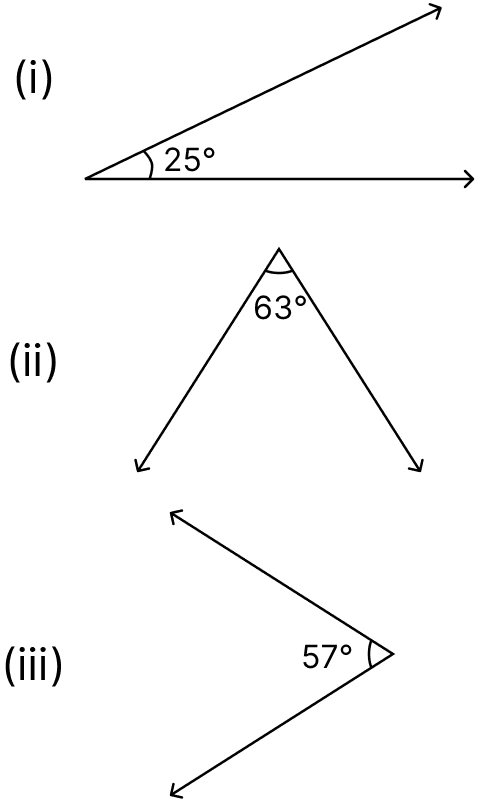
Answer
The complement of an angle = 90° − the angle.
(i) Complement of 25° = 90° − 25° = 65°.
Hence, the complement is 65°.
(ii) Complement of 63° = 90° − 63° = 27°.
Hence, the complement is 27°.
(iii) Complement of 57° = 90° − 57° = 33°.
Hence, the complement is 33°.
Find the supplement of each of the following angles:
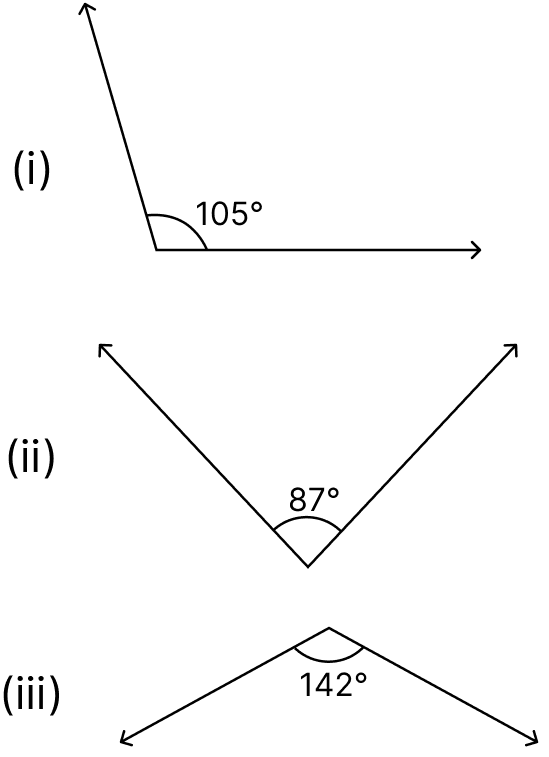
Answer
The supplement of an angle = 180° − the angle.
(i) Supplement of 105° = 180° − 105° = 75°.
Hence, the supplement is 75°.
(ii) Supplement of 87° = 180° − 87° = 93°.
Hence, the supplement is 93°.
(iii) Supplement of 142° = 180° − 142° = 38°.
Hence, the supplement is 38°.
Identify which of the following pairs of angles are complementary and which are supplementary:
(i) 55°, 125°
(ii) 34°, 56°
(iii) 137°, 43°
(iv) 112°, 68°
(v) 45°, 45°
(vi) 72°, 18°
Answer
Two angles are complementary if their sum is 90° and supplementary if their sum is 180°.
(i) 55° + 125° = 180°.
Hence, the angles are supplementary.
(ii) 34° + 56° = 90°.
Hence, the angles are complementary.
(iii) 137° + 43° = 180°.
Hence, the angles are supplementary.
(iv) 112° + 68° = 180°.
Hence, the angles are supplementary.
(v) 45° + 45° = 90°.
Hence, the angles are complementary.
(vi) 72° + 18° = 90°.
Hence, the angles are complementary.
(i) Find the angle which is equal to its complement.
(ii) Find the angle which is equal to its supplement.
Answer
(i) Let the required angle be x. As it is equal to its complement,
⇒ x + x = 90°
⇒ 2x = 90°
⇒ x = 45°.
Hence, the required angle is 45°.
(ii) Let the required angle be x. As it is equal to its supplement,
⇒ x + x = 180°
⇒ 2x = 180°
⇒ x = 90°.
Hence, the required angle is 90°.
Two complementary angles are (x + 4)° and (2x - 7)°, find the value of x.
Answer
As the given angles are complementary, their sum is 90°.
⇒ (x + 4)° + (2x - 7)° = 90°
⇒ 3x° - 3° = 90°
⇒ 3x° = 93°
⇒ x° = 31°
⇒ x = 31.
Hence, x = 31.
Two supplementary angles are in the ratio of 2 : 7, find the angles.
Answer
As the angles are in the ratio 2 : 7, let the angles be 2x and 7x.
As the given angles are supplementary, their sum is 180°.
⇒ 2x + 7x = 180°
⇒ 9x = 180°
⇒ x = 20°.
So, the angles are 2x = 2 × 20° = 40° and 7x = 7 × 20° = 140°.
Hence, the angles are 40° and 140°.
Among two supplementary angles, the measure of the longer angle is 44° more than the measure of the smaller angle. Find their measures.
Answer
Let the smaller angle be x, then the longer angle = x + 44°.
As the given angles are supplementary, their sum is 180°.
⇒ x + (x + 44°) = 180°
⇒ 2x + 44° = 180°
⇒ 2x = 136°
⇒ x = 68°.
So, the smaller angle = 68° and the longer angle = 68° + 44° = 112°.
Hence, the angles are 68° and 112°.
If an angle is half of its complement, find the measure of angles.
Answer
Let the angle be x, then its complement = 90° - x.
As the angle is half of its complement,
⇒
⇒ 2x = 90° - x
⇒ 3x = 90°
⇒ x = 30°.
So, the angle = 30° and its complement = 90° − 30° = 60°.
Hence, the angles are 30° and 60°.
Two adjacent angles are in the ratio 5 : 3 and they together form an angle of 128°, find these angles.
Answer
As the angles are in the ratio 5 : 3, let the angles be 5x and 3x.
As they together form an angle of 128°,
⇒ 5x + 3x = 128°
⇒ 8x = 128°
⇒ x = 16°.
So, the angles are 5x = 5 × 16° = 80° and 3x = 3 × 16° = 48°.
Hence, the angles are 80° and 48°.
Find the value of x in each of the following diagrams:
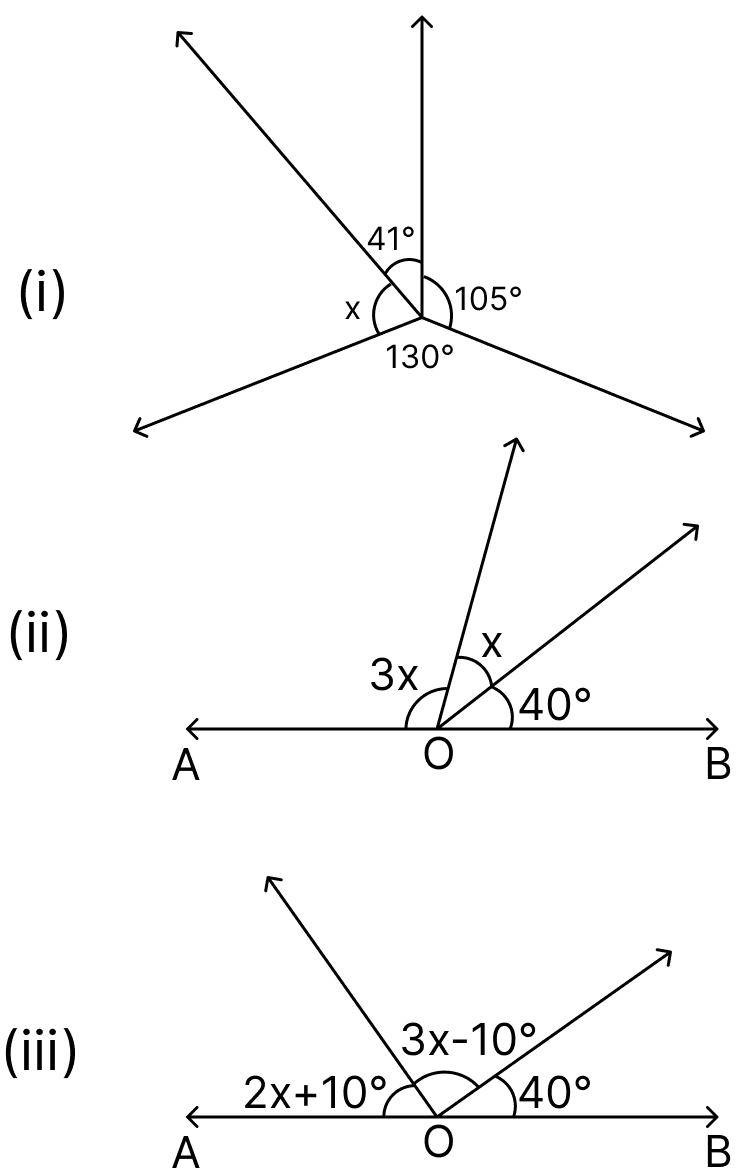
Answer
(i) As the sum of angles at a point is 360°,
⇒ 41° + x + 105° + 130° = 360°
⇒ x + 276° = 360°
⇒ x = 360° − 276° = 84°.
Hence, x = 84°.
(ii) As the sum of angles at a point on one side of a straight line is 180°,
⇒ 3x + x + 40° = 180°
⇒ 4x = 140°
⇒ x = 35°.
Hence, x = 35°.
(iii) As the sum of angles at a point on one side of a straight line is 180°,
⇒ (2x + 10°) + (3x - 10°) + 40° = 180°
⇒ 5x + 40° = 180°
⇒ 5x = 140°
⇒ x = 28°.
Hence, x = 28°.
Find the values of x, y and z in each of the following diagrams:
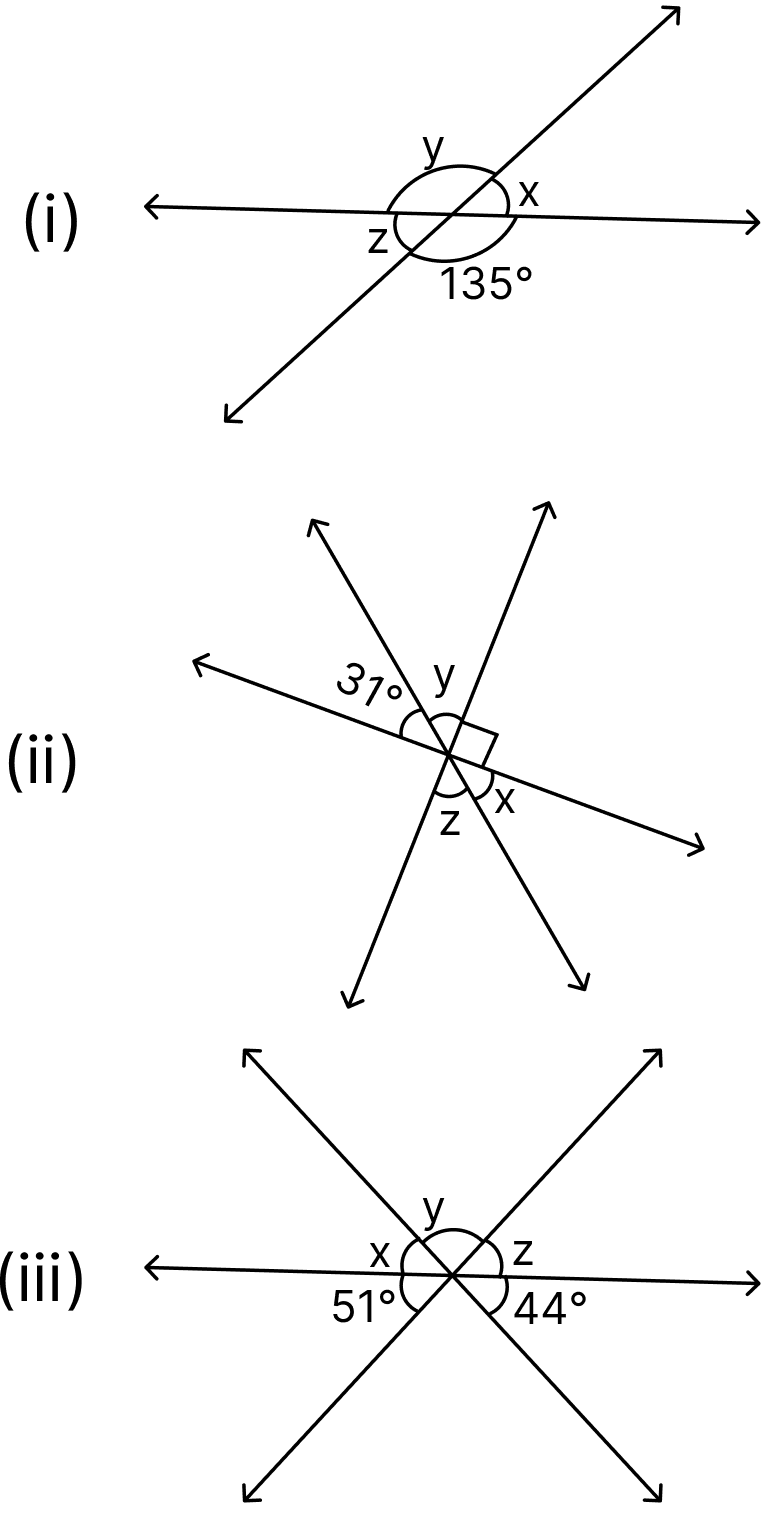
Answer
(i) From figure,
x and 135° lie on a straight line and form a linear pair.
∴ x + 135° = 180°
⇒ x = 180° − 135° = 45° (linear pair with 135°)
We know that,
Vertically opposite angles are equal.
⇒ y = 135° (vertically opposite to 135°)
⇒ z = x = 45° (vertically opposite to x)
Hence, x = 45°, y = 135° and z = 45°.
(ii) From the figure, one of the angles is a right angle (90°).
⇒ x = 31° (vertically opposite to 31°)
⇒ 31° + y + 90° = 180°(linear pair)
⇒ y = 180° - 90° − 31° = 59°
⇒ z = y = 59° (vertically opposite to y)
Hence, x = 31°, y = 59° and z = 59°.
(iii) As we know that,
Vertically opposite angles are equal.
⇒ x = 44° (vertically opposite to 44°)
⇒ z = 51° (vertically opposite to 51°)
Now, x, y and z are on the straight line.
⇒ x + y + z = 180°(linear pair)
⇒ 44° + y + 51° = 180°
⇒ y = 180° − 51° − 44° = 85°
Hence, x = 44°, y = 85° and z = 51°.
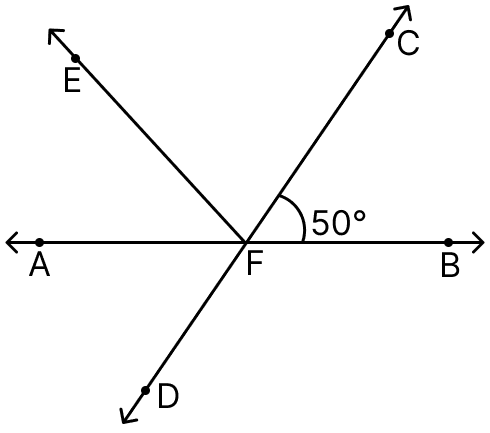
In the adjoining figure, lines AB and CD intersect at F. If ∠EFA = ∠AFD and ∠CFB = 50°, find ∠EFC.
Answer
As lines AB and CD intersect at F,
⇒ ∠AFD = ∠CFB = 50° (vertically opposite angles are equal)
Given, ∠EFA = ∠AFD
⇒ ∠EFA = 50°
As AB is a straight line, ∠AFC and ∠CFB form a linear pair.
⇒ ∠AFC + ∠CFB = 180°
⇒ ∠AFC = 180° − 50° = 130°
Now, ∠EFC = ∠AFC − ∠EFA = 130° − 50° = 80°.
Hence, ∠EFC = 80°.
Identify each of the given pair of angles as alternate interior angles, co-interior angles or corresponding angles or none of these in the given figure:
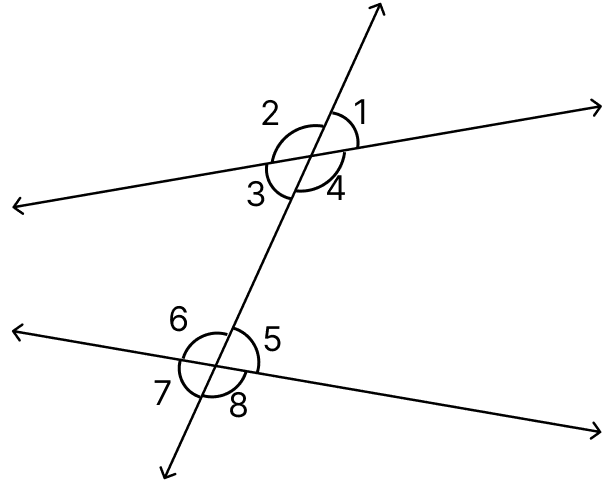
(i) ∠2, ∠6
(ii) ∠1, ∠6
(iii) ∠3, ∠5
(iv) ∠2, ∠7
(v) ∠3, ∠6
(vi) ∠4, ∠8
Answer
(i) ∠2 and ∠6 are in matching positions at the two intersections, so they are corresponding angles.
(ii) ∠1 and ∠6 are not in any of the special positions, so they are none of these.
(iii) ∠3 and ∠5 are interior angles on opposite sides of the transversal, so they are alternate interior angles.
(iv) ∠2 and ∠7 are exterior angles on the same side of the transversal, so they are none of these.
(v) ∠3 and ∠6 are interior angles on the same side of the transversal, so they are co-interior angles.
(vi) ∠4 and ∠8 are in matching positions at the two intersections, so they are corresponding angles.
State the property that is used in each of the following statements:
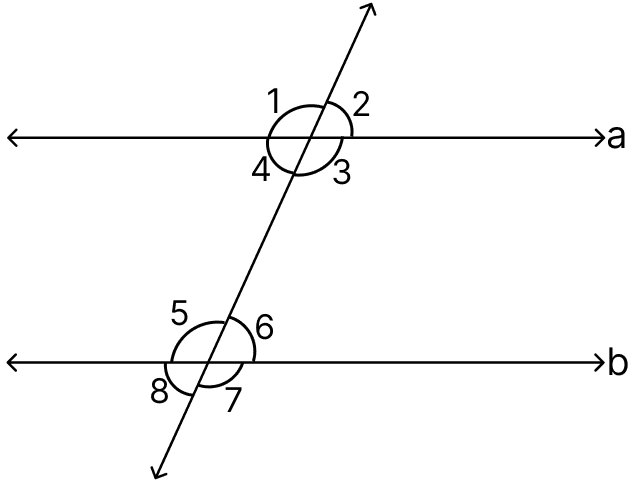
(i) If a ∥ b, then ∠1 = ∠5
(ii) If ∠4 = ∠6, then a ∥ b
(iii) If ∠4 + ∠5 = 180°, then a ∥ b
Answer
(i) Each pair of corresponding angles are equal.
(ii) If a pair of alternate interior angles are equal, then the lines are parallel.
(iii) If a pair of co-interior angles are supplementary, then the lines are parallel.
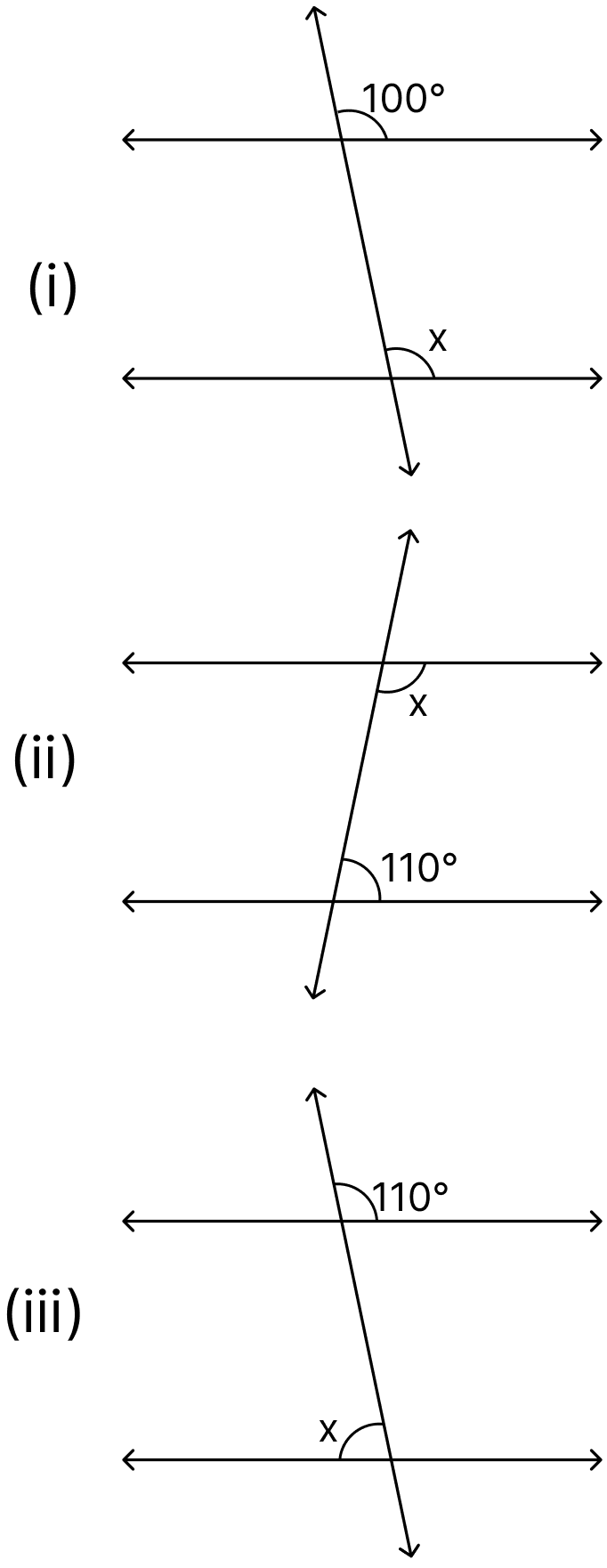
In each of the following figures, a pair of parallel lines is cut by a transversal. Find the value of x:
Answer
(i) The 100° angle and x are corresponding angles.
⇒ x = 100°.
Hence, x = 100°.
(ii) The angle x and 110° are co-interior angles, so they are supplementary.
⇒ x + 110° = 180°
⇒ x = 70°.
Hence, x = 70°.
(iii)
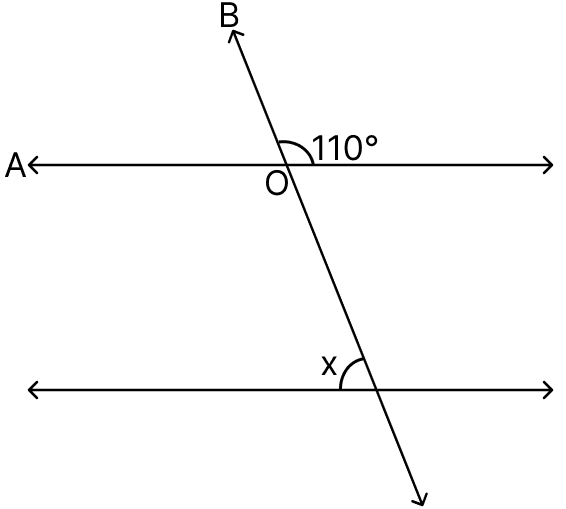
From figure,
⇒ ∠AOB + 110° = 180° (linear pair)
⇒ ∠AOB = 70°
∠AOB and x are corresponding angles,
⇒ x = ∠AOB = 70°. [Corresponding angles are equal]
Hence, x = 70°.
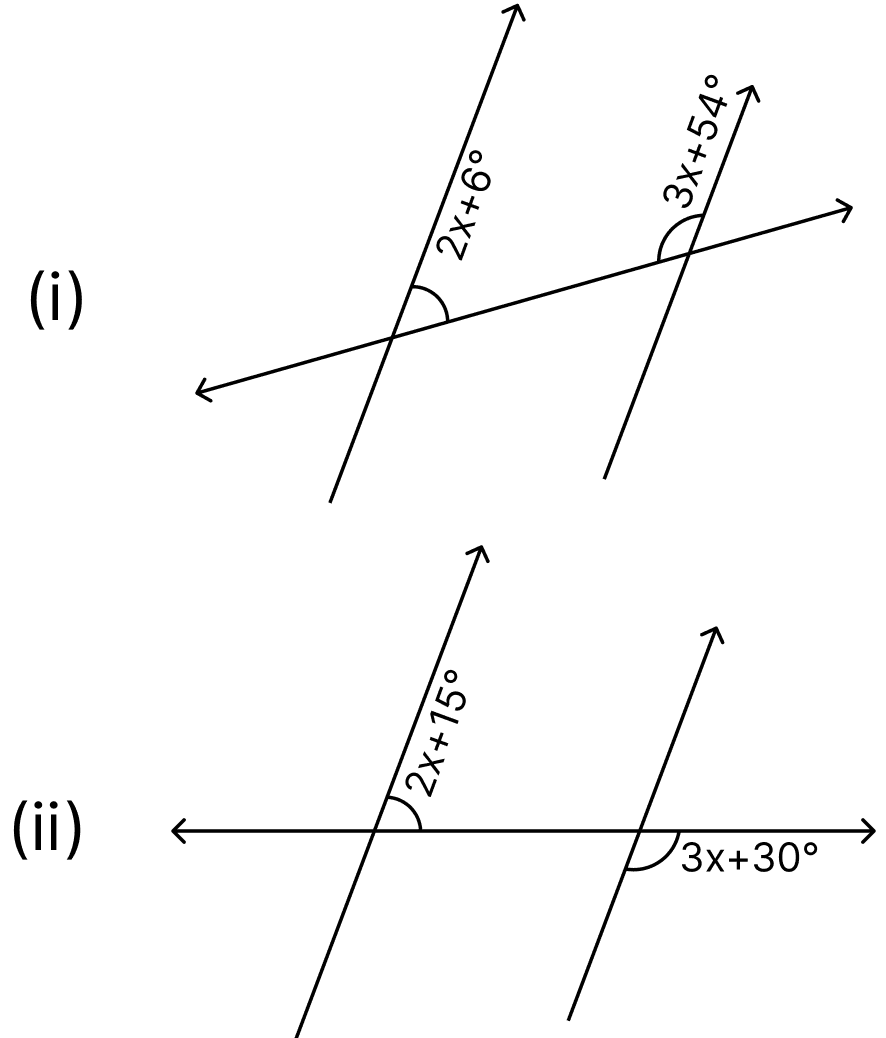
In the following figures, a pair of parallel lines are cut by a transversal. Find the value of x in each figure.
Answer
(i) The angles 2x + 6° and 3x + 54° are co-interior angles, so they are supplementary.
⇒ 2x + 6° + 3x + 54° = 180°
⇒ 5x + 60° = 180°
⇒ 5x = 120°
⇒ x = 24°
Hence, x = 24°.
(ii)
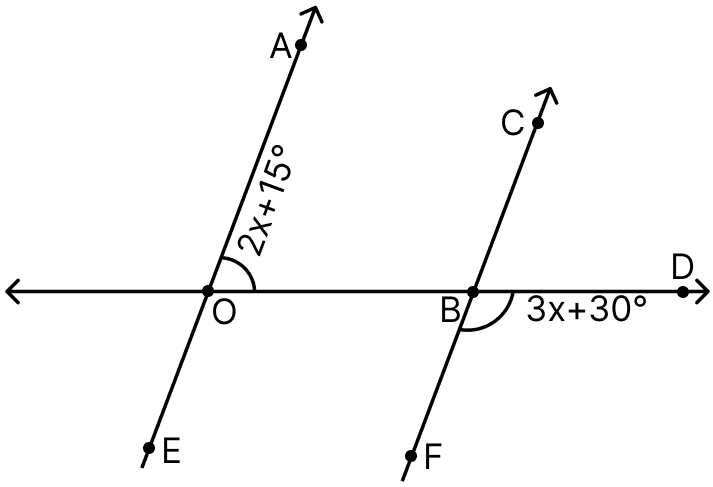
∠DBF = ∠CBO (Vertically opposite angles are equal)
⇒ ∠CBO = 3x + 30°
Now, ∠AOB and ∠CBO are co-interior angles, so they are supplementary.
⇒ (2x + 15°) + (3x + 30°) = 180°
⇒ 5x + 45° = 180°
⇒ 5x = 135°
⇒ x = 27°
Hence, x = 27°.
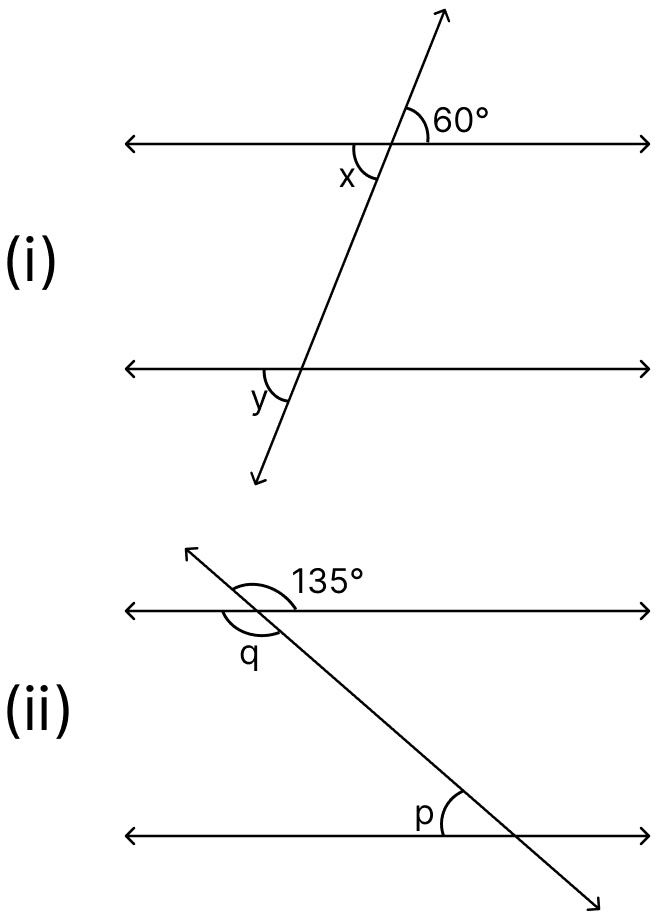
In the following figures (i) to (vi), a pair of parallel lines are cut by a transversal. Find the size of each lettered angle.
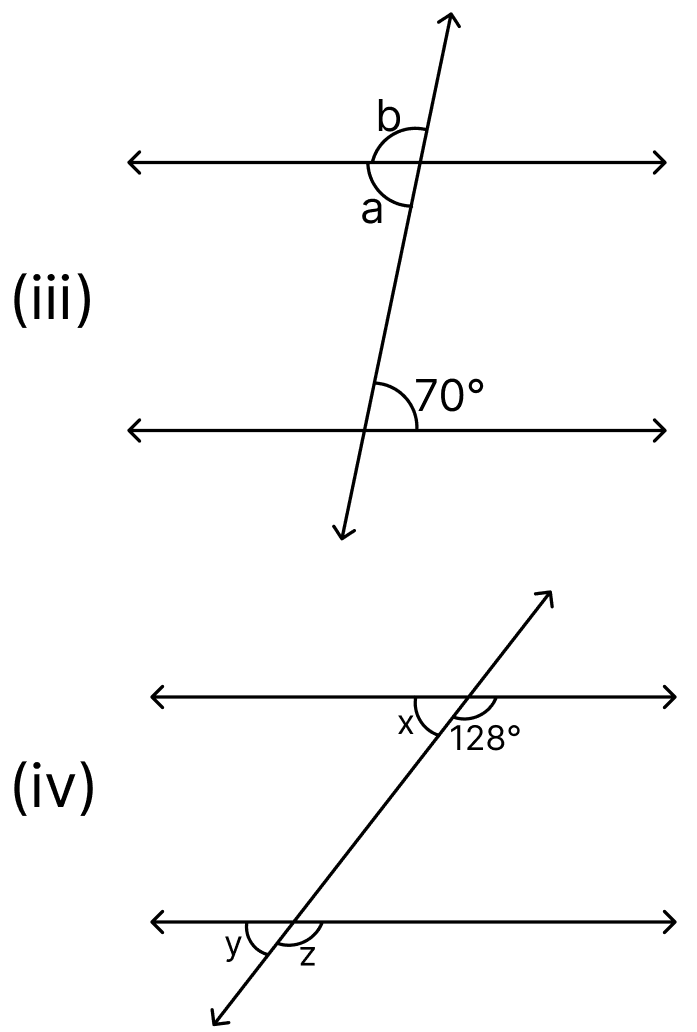
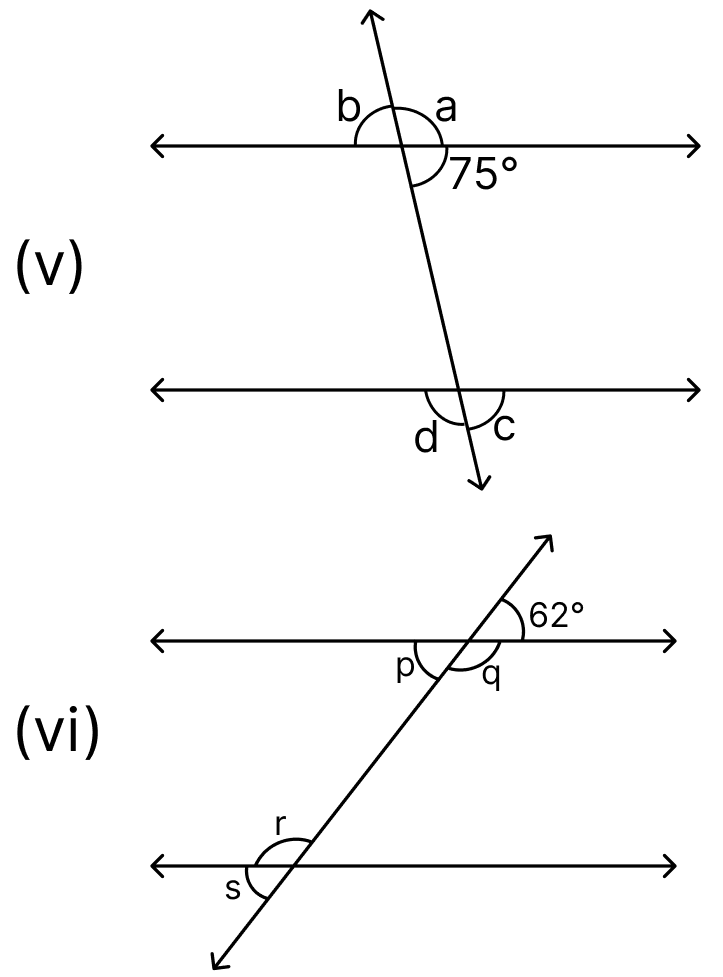
Answer
(i) From figure,
⇒ x = 60° (vertically opposite to 60°)
⇒ y = x = 60° (corresponding angles are equal)
Hence, x = 60° and y = 60°.
(ii) From figure,
⇒ q = 135° (vertically opposite to 135°)
⇒ p + q = 180° (co-interior angles) ⇒ p = 180° − 135° = 45°
Hence, p = 45° and q = 135°.
(iii) From figure,
⇒ a = 70° (alternate interior angles)
⇒ b = 180° − a = 180° − 70° = 110° (linear pair with a)
Hence, a = 70° and b = 110°.
(iv) From figure,
⇒ x = 180° − 128° = 52° (linear pair with 128°)
⇒ z = 128° (corresponding to 128°)
⇒ y = 180° − z = 180° − 128° = 52° (linear pair with z)
Hence, x = 52°, y = 52° and z = 128°.
(v) From figure,
⇒ b = 75° (vertically opposite to 75°)
⇒ a = 180° − b = 180° − 75° = 105° (linear pair with b)
⇒ c = 75° (corresponding to 75°)
⇒ d = 180° − c = 180° − 75° = 105° (linear pair with c)
Hence, a = 105°, b = 75°, c = 75° and d = 105°.
(vi) From figure,
⇒ p = 62° (vertically opposite to 62°)
⇒ q = 180° − p = 180° − 62° = 118° (linear pair with p)
⇒ r = 180° − p = 118° (co-interior angles with p)
⇒ s = 180° − r = 180° − 118° = 62° (linear pair with r)
Hence, p = 62°, q = 118°, r = 118° and s = 62°.
In the adjoining diagram, lines AB, CD and EF are parallel. Calculate the values of x and y. Hence, find the reflex angle ECA.
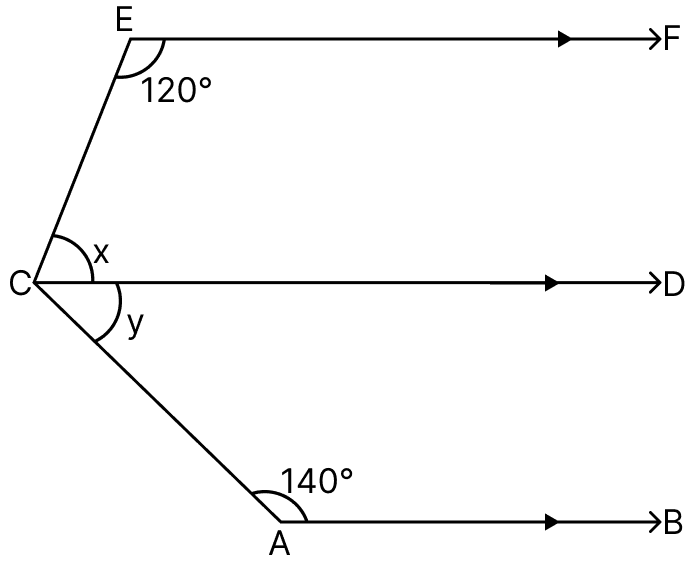
Answer
As EF ∥ CD and EC is a transversal, ∠FEC and ∠ECD (= x) are co-interior angles.
⇒ ∠FEC + x = 180° (Sum of co-interior angles = 180°)
⇒ 120° + x = 180°
⇒ x = 60°.
As CD ∥ AB and CA is a transversal, ∠DCA (= y) and ∠CAB are co-interior angles.
⇒ y + ∠CAB = 180° (Sum of co-interior angles = 180°)
⇒ y + 140° = 180°
⇒ y = 40°.
Now, ∠ECA = x + y = 60° + 40° = 100°.
∴ Reflex ∠ECA = 360° − 100° = 260°.
Hence, x = 60°, y = 40° and the reflex angle ECA = 260°.
In the adjoining figure, l ∥ m. Find the values of x, y and z.
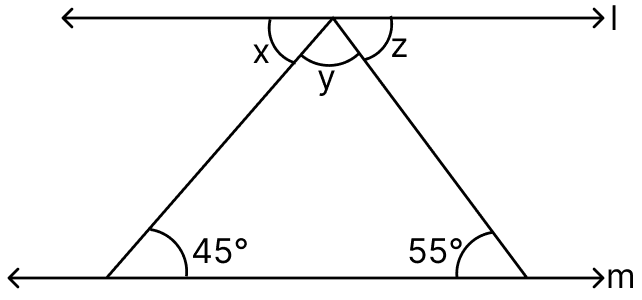
Answer
As l ∥ m,
⇒ x = 45° (alternate interior angles are equal)
⇒ z = 55° (alternate interior angles are equal)
As x, y and z lie on the straight line l,
⇒ x + y + z = 180°
⇒ 45° + y + 55° = 180°
⇒ y + 100° = 180°
⇒ y = 180° − 100° = 80°.
Hence, x = 45°, y = 80° and z = 55°.
Calculate the measure of each lettered angle in the following figure (parallel lines, segment or rays are denoted by thick matching arrows):
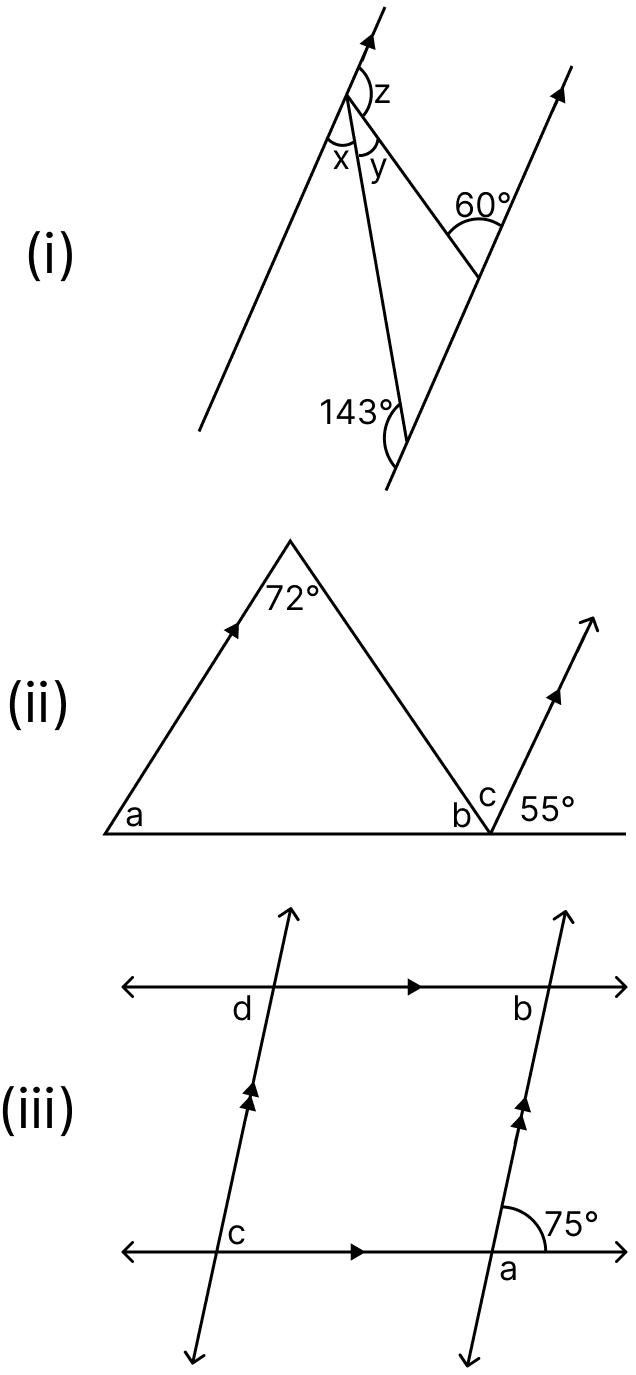
Answer
(i) From figure,
⇒ x + 143° = 180° (co-interior angles)
⇒ x = 37°
⇒ z + 60° = 180° (co-interior angles)
⇒ z = 120°
Since x, y and z form angles at a point on one side of a straight line
⇒ x + y + z = 180°
⇒ 37° + y + 120° = 180°
⇒ y = 180° − 157° = 23°.
Hence, x = 37°, y = 23° and z = 120°.
(ii) From figure,
⇒ a = 55° (corresponding angles)
By the angle sum property of the triangle,
⇒ 72° + a + b = 180°
⇒ 72° + 55° + b = 180°
⇒ b = 180° − 127° = 53°.
As b, c and 55° lie on a straight line,
⇒ b + c + 55° = 180°
⇒ 53° + c + 55° = 180°
⇒ c = 180° − 108° = 72°.
Hence, a = 55°, b = 53° and c = 72°.
(iii) Solving,
⇒ b = 75° (alternate interior angles are equal)
⇒ a + 75° = 180° (linear pair)
⇒ a = 180° − 75° = 105°
⇒ c = 75° (corresponding angles are equal)
⇒ d = b = 75° (corresponding angles are equal)
Hence, a = 105°, b = 75°, c = 75° and d = 75°.
In the figures given below, state whether the lines l and m are parallel or not.
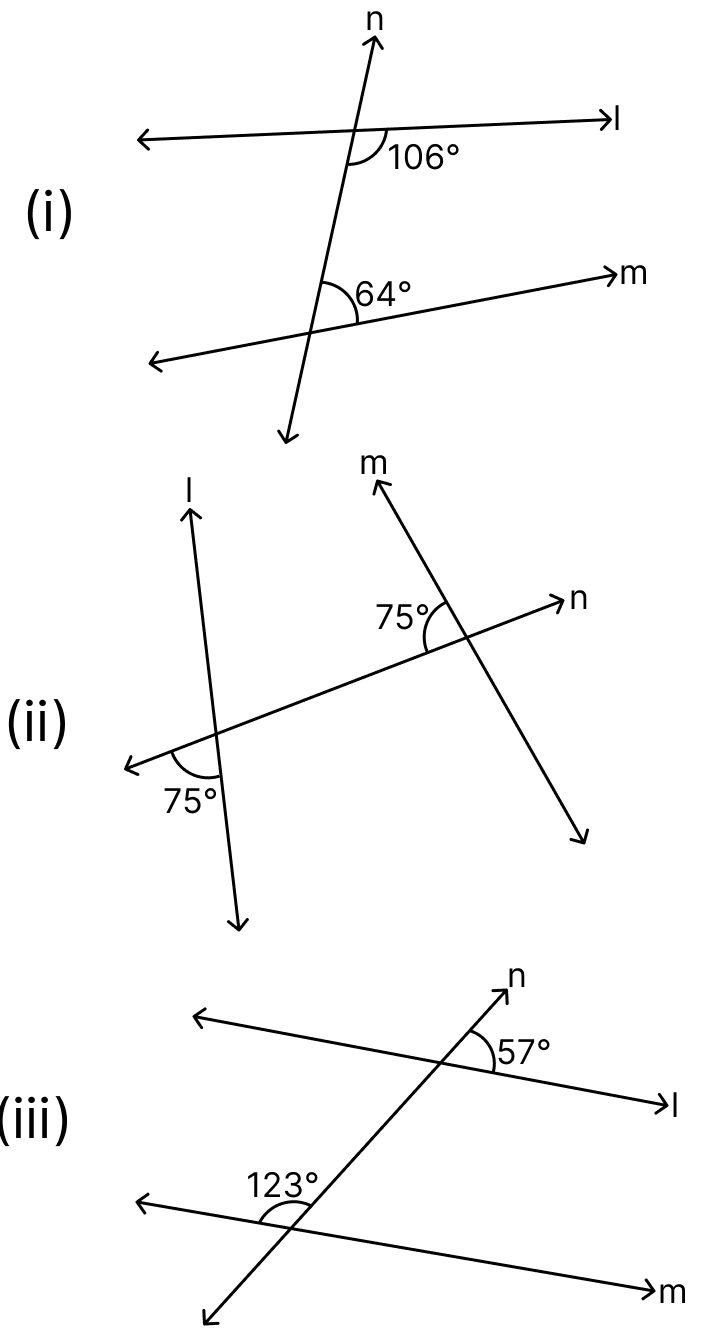
Answer
(i) Here 106° and 64° are co-interior angles. If l ∥ m, then co-interior angles must be supplementary. But 106° + 64° = 170° ≠ 180°.
Hence, l and m are not parallel.
(ii)
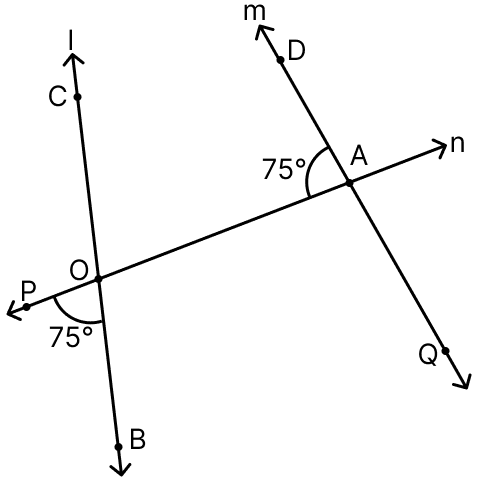
From figure,
∠COA = ∠BOP = 75° (vertically opposite angles are equal)
Now, the two angles ∠COA = 75° and ∠DAO = 75° are co-interior angles. If l ∥ m, then their sum must be 180°. But 75° + 75° = 150° ≠ 180°.
Hence, l and m are not parallel.
(iii)
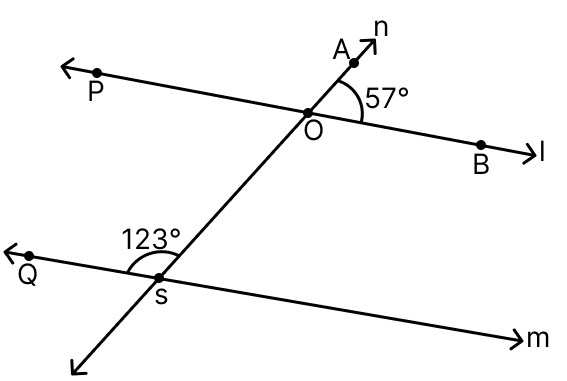
From figure,
∠POS = ∠AOB = 57° (vertically opposite angles are equal)
Now, ∠QSO = 123° and ∠POS = 57° are co-interior angles, and 123° + 57° = 180°, so the co-interior angles are supplementary.
Hence, l and m are parallel.
Fill in the blanks:
(i) If two angles are complementary, then the sum of their measures is ....
(ii) If two angles are supplementary, then the sum of their measures is ....
(iii) Supplement of an obtuse angle is ....
(iv) Two angles forming a linear pair are ....
(v) If two adjacent angles are supplementary, then they form a ....
(vi) Angles of a linear pair are ..... as well as ..... .
(vii) Adjacent angles have a common vertex, a common ..... and no common ..... .
(viii) Angles formed by two intersecting lines having no common arms are called .....
(ix) If two lines intersect and if one pair of vertically opposite angles are acute angles, then the other pair of vertically opposite angles are ....
(x) Two lines in a plane which never meet are called ..... .
(xi) Alternate interior angles have one common ..... .
(xii) Corresponding angles are on the ..... side of transversal.
(xiii) Alternate interior angles are on the ..... side of transversal.
(xiv) If two lines are cut by a transversal such that a pair of corresponding angles are not equal, then the lines are ....
Answer
(i) 90°
(ii) 180°
(iii) an acute angle
(iv) supplementary
(v) linear pair
(vi) adjacent as well as supplementary
(vii) common arm and no common interior points
(viii) vertically opposite angles
(ix) obtuse
(x) parallel lines
(xi) arm
(xii) same
(xiii) opposite
(xiv) not parallel
In the adjoining figure, AB is a straight line and OD ⊥ AB. Observe the figure and fill in the following blanks:
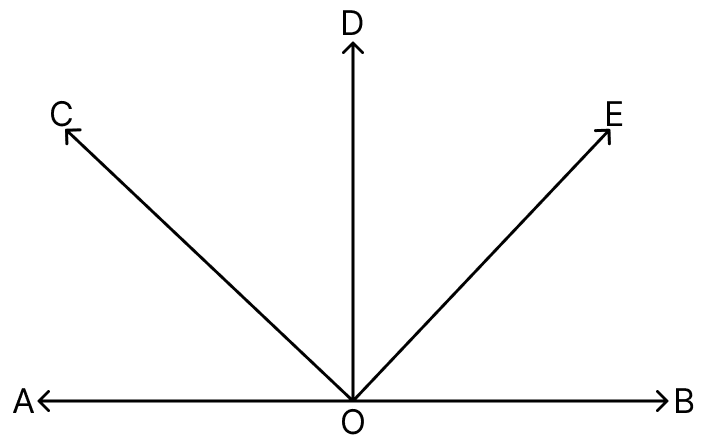
(i) ∠AOC and ∠COE form a pair of .... angles.
(ii) ∠AOC and ∠COB are .... angles.
(iii) ∠AOC is ..... of ∠COD.
(iv) ∠BOE is ..... of ∠EOA.
Answer
(i) adjacent
(ii) supplementary
(iii) complement
(iv) supplement
State whether the following statements are true (T) or false (F):
(i) Two obtuse angles can be supplementary.
(ii) Two acute angles can form a linear pair.
(iii) Two obtuse angles can form a linear pair.
(iv) Two adjacent angles always form a linear pair.
(v) Pair of vertically opposite angles are always supplementary.
(vi) 30° is one-half of its complement.
(vii) If two lines are cut by a transversal, then each pair of corresponding angles are equal.
(viii) If two lines are cut by a transversal, then each pair of alternate interior angles are equal.
Answer
(i) False. Each obtuse angle is greater than 90°, so their sum is greater than 180°.
(ii) False. Each acute angle is less than 90°, so their sum is less than 180° and cannot make a linear pair.
(iii) False. Each obtuse angle is greater than 90°, so their sum is greater than 180°.
(iv) False. Two adjacent angles form a linear pair only when their non-common arms are opposite rays.
(v) False. Vertically opposite angles are always equal, but not necessarily supplementary.
(vi) True. The complement of 30° is 90° − 30° = 60°, and × 60° = 30°.
(vii) False. Corresponding angles are equal only when the two lines are parallel.
(viii) False. Alternate interior angles are equal only when the two lines are parallel.
A pair of complementary angles is
130°, 50°
35°, 55°
25°, 75°
27°, 53°
Answer
A pair of angles is complementary if their sum is 90°.
⇒ 35° + 55° = 90°.
Hence, option 2 is the correct option.
A pair of supplementary angles is
55°, 115°
65°, 125°
47°, 133°
40°, 50°
Answer
A pair of angles is supplementary if their sum is 180°.
⇒ 47° + 133° = 180°.
Hence, option 3 is the correct option.
If an angle is one-third of its supplement, then the measure of the angle is
45°
30°
135°
150°
Answer
Let the angle be x, then its supplement = 180° - x.
As the angle is one-third of its supplement,
⇒
⇒ 3x = 180° - x
⇒ 4x = 180°
⇒ x = 45°.
Hence, option 1 is the correct option.
If an angle measures 10° more than its complement, then the measure of the angle is
40°
55°
35°
50°
Answer
Let the angle be x, then its complement = 90° - x.
As the angle measures 10° more than its complement,
⇒ x = (90° - x) + 10°
⇒ 2x = 100°
⇒ x = 50°.
Hence, option 4 is the correct option.
If one angle of a linear pair is acute, then the other angle is
acute
obtuse
right
straight
Answer
The angles of a linear pair add up to 180°. If one angle is acute (less than 90°), the other must be greater than 90°, i.e. obtuse.
Hence, option 2 is the correct option.
In the adjoining figure, the value of x that will make AOB a straight line is
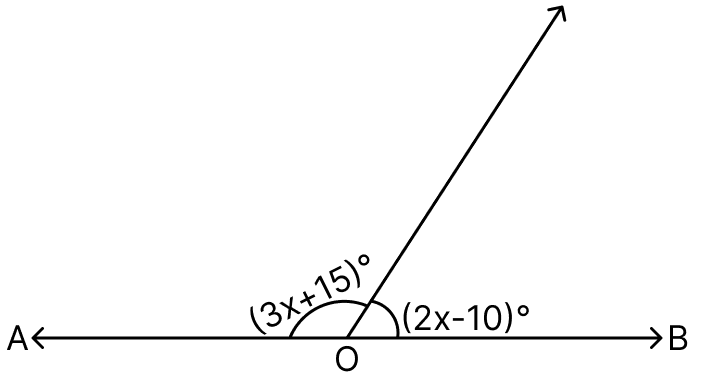
x = 40
x = 35
x = 30
x = 25
Answer
For AOB to be a straight line, the angles at O must add up to 180°.
⇒ (3x + 15)° + (2x - 10)° = 180°
⇒ 5x° + 5° = 180°
⇒ 5x° = 175°
⇒ x° = 35°
⇒ x = 35.
Hence, option 2 is the correct option.
If two lines are intersected by a transversal, then the number of pairs of interior angles on the same side of transversal is
1
2
3
4
Answer
The interior angles on the same side of the transversal (co-interior angles) form 2 pairs.
Hence, option 2 is the correct option.
In the adjoining figure, if l ∥ m then the value of x is
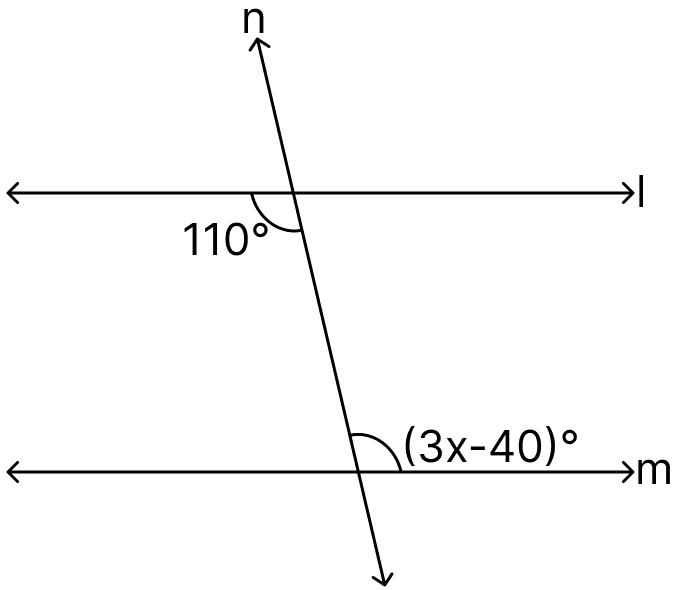
x = 50
x = 60
x = 70
x = 45
Answer
As l ∥ m, the 110° angle and (3x - 40)° are equal (alternate interior angles).
⇒ 3x - 40° = 110°
⇒ 3x = 150°
⇒ x = 50°
Hence, option 1 is the correct option.
In the adjoining figure, if l ∥ m then the value of x is
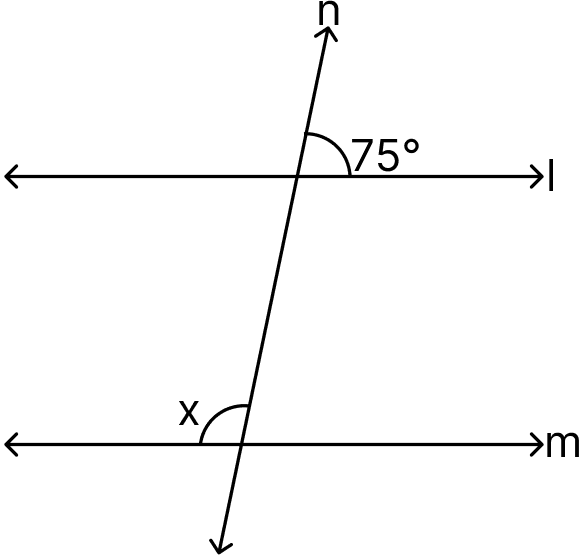
x = 75°
x = 95°
x = 105°
x = 115°
Answer
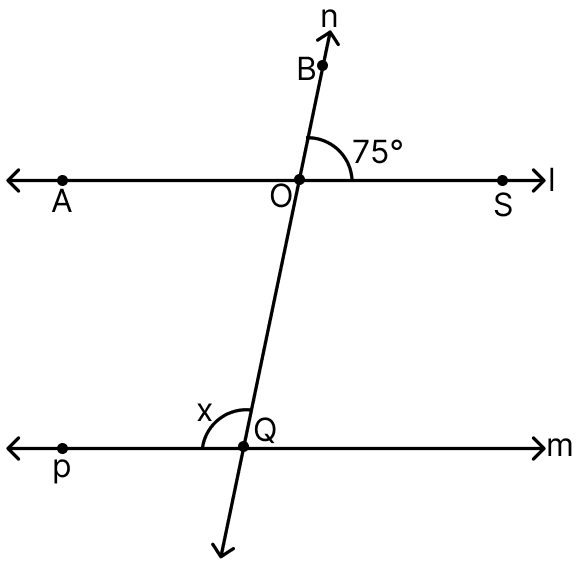
From figure,
∠AOQ = ∠BOS = 75° (vertically opposite angles are equal)
As l ∥ m, the ∠AOQ = 75° and x are co-interior angles, so they are supplementary.
⇒ x + 75° = 180°
⇒ x = 105°.
Hence, option 3 is the correct option.
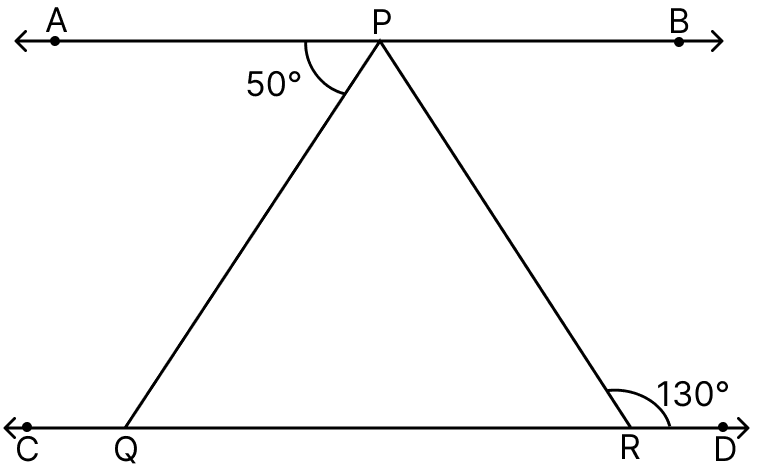
In the adjoining figure, AB ∥ CD. If ∠APQ = 50° and ∠PRD = 130°, then ∠QPR is
30°
50°
80°
130°
Answer
As ∠PRD and ∠PRQ form a linear pair,
⇒ ∠PRQ = 180° − ∠PRD = 180° − 130° = 50°
As AB ∥ CD and PQ is a transversal,
⇒ ∠PQR = ∠APQ = 50° (alternate angles)
By the angle sum property of triangle PQR,
⇒ ∠QPR + ∠PQR + ∠PRQ = 180°
⇒ ∠QPR + 50° + 50° = 180°
⇒ ∠QPR = 80°.
Hence, option 3 is the correct option.
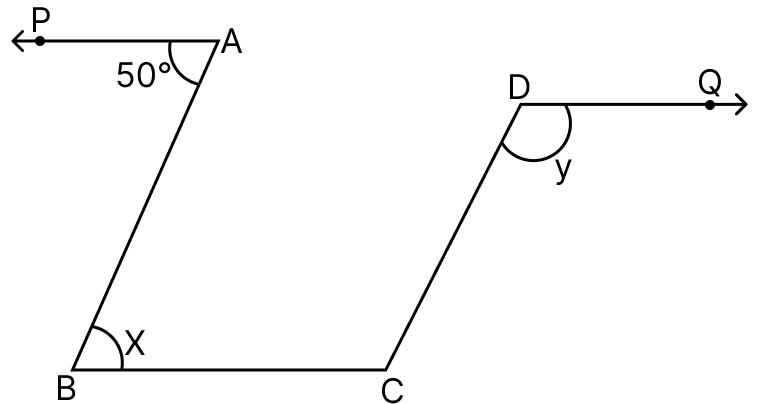
In the adjoining figure, PA ∥ BC ∥ DQ and AB ∥ DC. Then the values of x and y are respectively :
50°, 120°
50°, 130°
60°, 120°
60°, 130°
Answer
As PA ∥ BC and AB is a transversal,
⇒ x = 50° (alternate interior angles are equal)
As AB ∥ DC,
⇒ x and ∠BCD are co-interior angles, so they are supplementary.
⇒ x + ∠BCD = 180°
⇒ 50° + ∠BCD = 180°
⇒ ∠BCD = 130°
Now, BC ∥ DQ
⇒ ∠BCD = y (alternate interior angles are equal)
⇒ y = 130°.
Hence, option 2 is the correct option.
Statement I: Two acute angles can complement each other.
Statement II: Two acute angles can supplement each other.
Statement I is true but statement II is false.
Statement I is false but statement II is true.
Both Statement I and statement II are true.
Both Statement I and statement II are false.
Answer
Statement I: Two acute angles can add up to 90° (for example, 30° and 60°), so they can complement each other. So Statement I is true.
Statement II: Each acute angle is less than 90°, so their sum is always less than 180°. They can never supplement each other. So Statement II is false.
Hence, option 1 is the correct option.
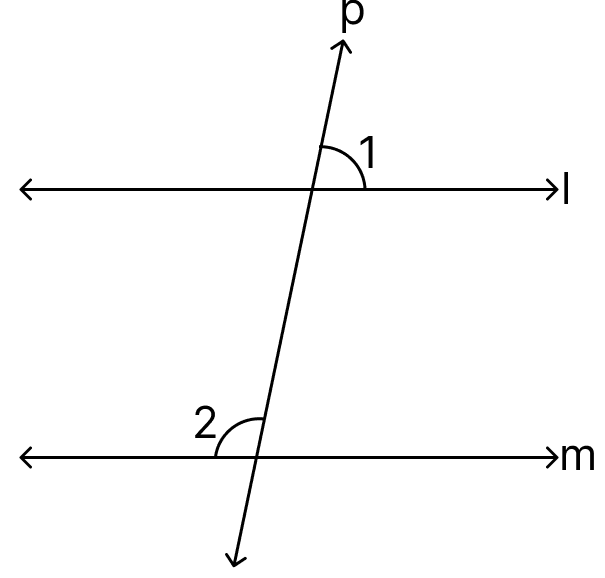
Statement I: In the adjoining figure, l ∥ m and p is a transversal. If ∠1 = 50°, then ∠2 = 150°
Statement II: If a transversal cuts two parallel lines, each pair of corresponding angles are equal.
Statement I is true but statement II is false.
Statement I is false but statement II is true.
Both Statement I and statement II are true.
Both Statement I and statement II are false.
Answer
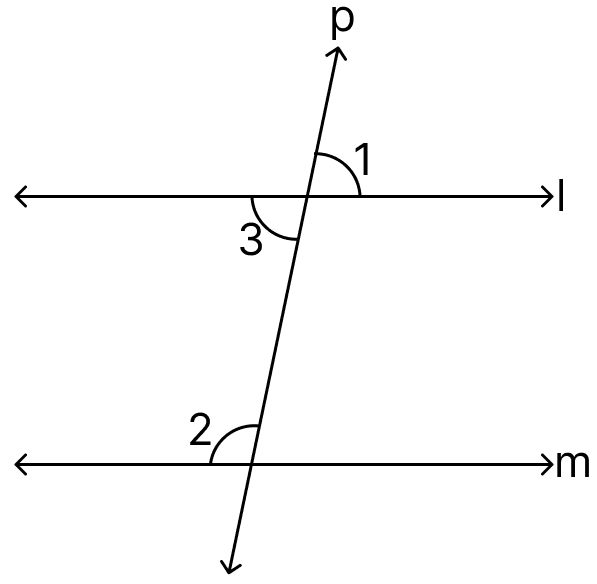
From figure,
∠3 = ∠1 = 50° (vertically opposite angles are equal)
As l ∥ m, ∠3 and ∠2 are co-interior angles, so they must be supplementary.
∠3 + ∠2 = 180°
50° + ∠2 = 180°
∠2 = 130° (not 150°). So Statement I is false.
Statement II: When a transversal cuts two parallel lines, each pair of corresponding angles are equal. So Statement II is true.
Hence, option 2 is the correct option.
Find the supplementary angle of each of the following angles:
(i) of 90°
(ii) of 280°
Answer
(i) The angle = × 90° = 45°.
Supplement = 180° − 45° = 135°.
Hence, the supplementary angle is 135°.
(ii) The angle = × 280° = 120°.
Supplement = 180° − 120° = 60°.
Hence, the supplementary angle is 60°.
How many degrees are there in an angle which is one-fifth of its complement?
Answer
Let the angle be x, then its complement = 90° - x.
As the angle is one-fifth of its complement,
⇒
⇒ 5x = 90° - x
⇒ 6x = 90°
⇒ x = 15°.
Hence, the required angle is 15°.
If two angles are supplementary and one angle is 5° more than four-times the other, find the angles.
Answer
Let the angle be x, then other angle = 4x + 5°.
As the angles are supplementary, their sum is 180°.
⇒ x + (4x + 5°) = 180°
⇒ 5x + 5° = 180°
⇒ 5x = 175°
⇒ x = 35°.
So, the angles are 35° and 4 × 35° + 5° = 145°.
Hence, the angles are 35° and 145°.
The adjoining diagram shows two intersecting straight lines. Find the values of x, y and z.
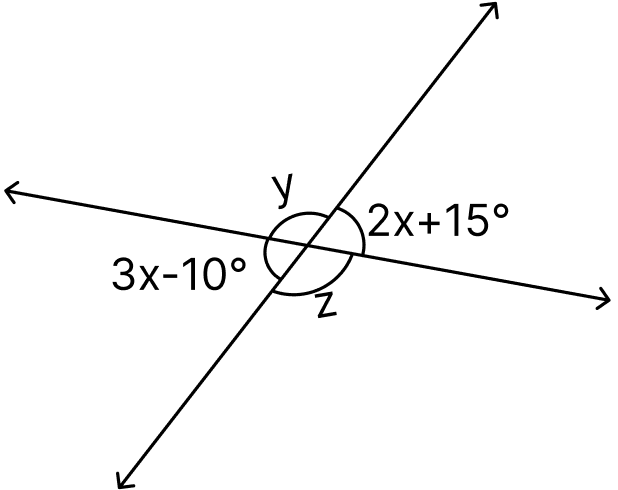
Answer
As (3x - 10)° and (2x + 15)° are vertically opposite angles,
⇒ (3x - 10)° = (2x + 15)°
⇒ 3x - 10 = 2x + 15
⇒ 3x - 2x = 15 + 10
⇒ x = 25.
So, the angle = (2x + 15)° = (2 × 25 + 15)° = 65°.
As y and (2x + 15)° form a linear pair,
⇒ y + 65° = 180°
⇒ y = 115°.
⇒ z = y = 115° (vertically opposite angles are equal)
Hence, x = 25°, y = 115° and z = 115°.
In the adjoining diagram, lines AB and CD intersect at O. If ∠1 + ∠3 = 78°, find the size of ∠2.
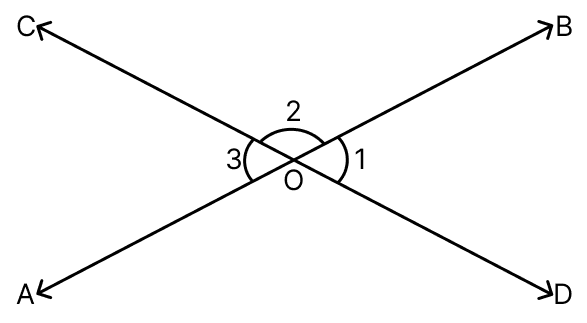
Answer
As ∠1 and ∠3 are vertically opposite angles, they are equal.
⇒ ∠1 = ∠3
Given, ∠1 + ∠3 = 78°
⇒ 2∠1 = 78°
⇒ ∠1 = 39°.
As ∠2 and ∠1 form a linear pair,
⇒ ∠2 + ∠1 = 180°
⇒ ∠2 + 39° = 180°
⇒ ∠2 = 180° − 39° = 141°.
Hence, ∠2 = 141°.
(a) In the fig. (i) given below, PQ ∥ RS. Find the value of x + y.
(b) In the fig. (ii) given below, PQ ∥ RS. Find the value of x + y.
(c) In the fig. (iii) given below, QP ∥ SR and QR ∥ ST. Find the value of x + 2y.
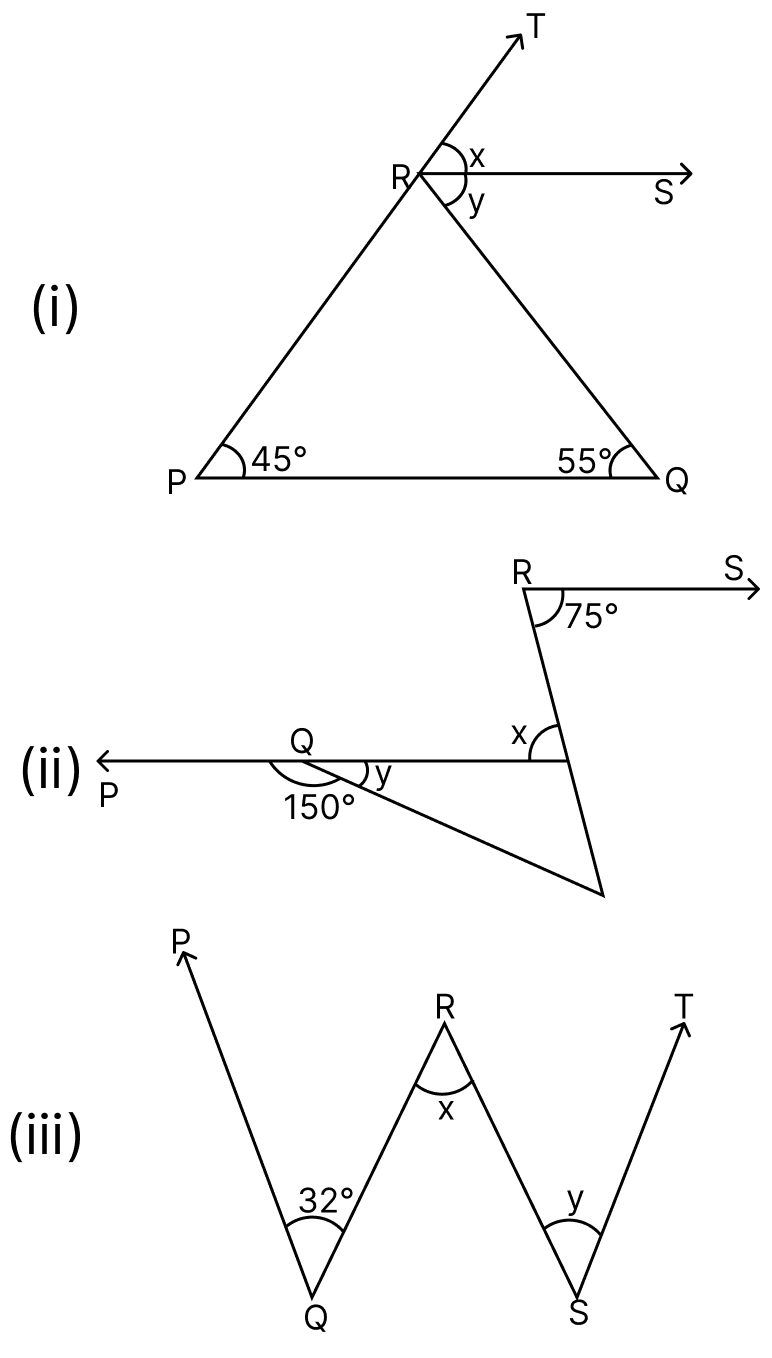
Answer
(a) By the angle sum property of triangle PQR,
⇒ ∠PRQ = 180° − ∠P − ∠Q = 180° − 45° − 55° = 80°
As PRT is a straight line, the angles at R add up to 180°.
⇒ x + y + ∠PRQ = 180°
⇒ x + y + 80° = 180°
⇒ x + y = 180° − 80° = 100°.
Hence, x + y = 100°.
(b) From figure,
y and 150° form a linear pair.
⇒ y = 180° − 150° = 30°
As PQ ∥ RS and the slanting line is a transversal,
⇒ x = 75° (alternate angles are equal)
⇒ x + y = 75° + 30° = 105°.
Hence, x + y = 105°.
(c) As QP ∥ SR and QR is a transversal,
⇒ x = 32° (alternate angles are equal)
As QR ∥ ST and RS is a transversal,
⇒ y = x = 32° (alternate angles are equal)
⇒ x + 2y = 32° + 2 × 32° = 32° + 64° = 96°.
Hence, x + 2y = 96°.
(a) In the fig. (i) given below, l ∥ m. If ∠5 = 65°, find all other angles.
(b) In the fig. (ii) given below, l ∥ m. Find the values of x, y and z.
(c) In the fig. (iii) given below, l ∥ m and p ∥ q. Find the values of x, y and z.
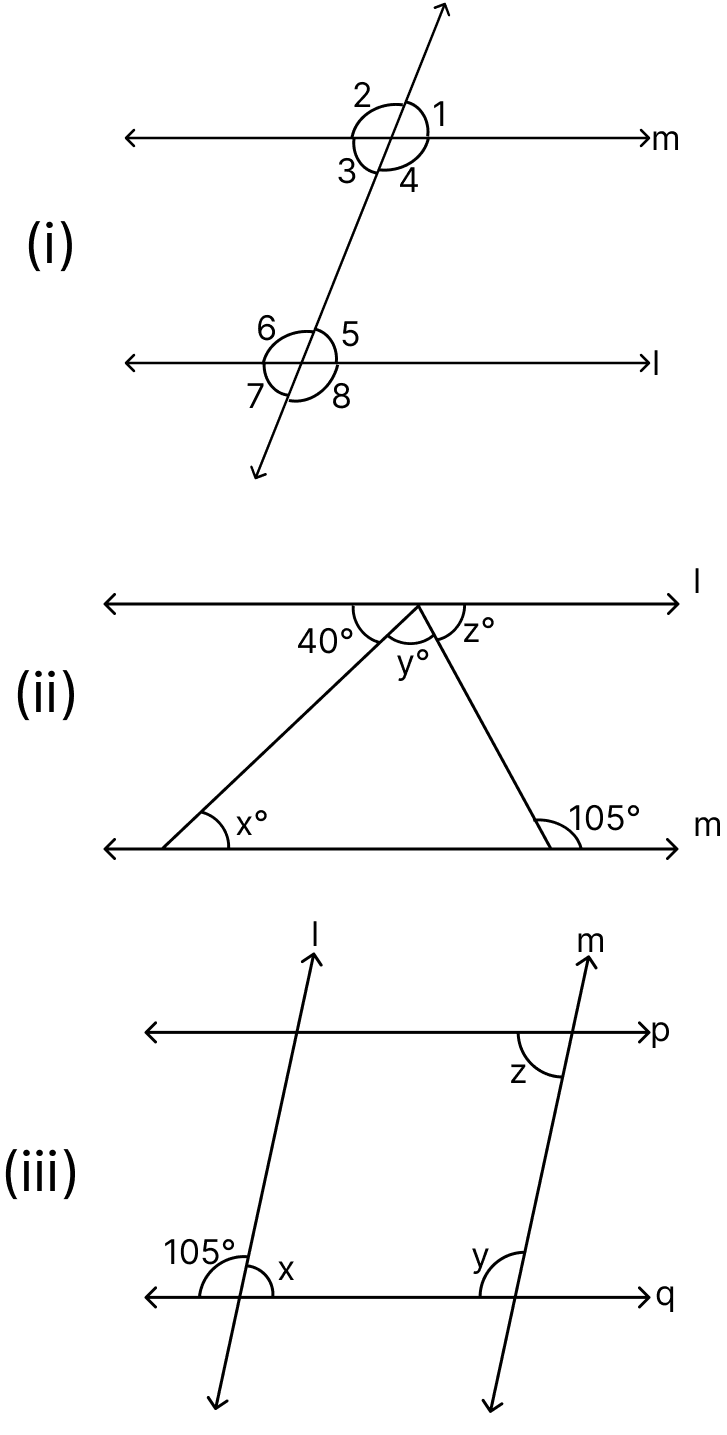
Answer
(a) As l ∥ m and the transversal cuts them, with ∠5 = 65°:
⇒ ∠1 = ∠5 = 65° (corresponding angles)
⇒ ∠3 = ∠1 = 65° (vertically opposite angles)
⇒ ∠7 = ∠5 = 65° (vertically opposite angles)
As, ∠2 = ∠4 (vertically opposite angle)
⇒ ∠2 + ∠3 = 180°(linear pair)
⇒ ∠2 + 65° = 180°
⇒ ∠2 = 115°
Now, ∠6 = ∠8 (vertically opposite angle)
⇒ ∠6 + ∠7 = 180°(linear pair)
⇒ ∠6 + 65° = 180°
⇒ ∠6 = 115°
⇒ ∠2 = ∠4 = ∠6 = ∠8 = 115°
Hence, ∠1 = ∠3 = ∠7 = 65° and ∠2 = ∠4 = ∠6 = ∠8 = 115°.
(b) As l ∥ m,
⇒ x = 40° (alternate interior angles)
⇒ z + 105° = 180° (co-interior angles) ⇒ z = 75°
As, 40° + y + z = 180°(linear pair)
⇒ 40° + y + 75° = 180°
⇒ y = 180° − 115° = 65°.
Hence, x = 40°, y = 65° and z = 75°.
(c) As p ∥ q and l is a transversal,
⇒ x + 105° = 180°(linear pair)
⇒ x = 75°.
As l ∥ m and q is a transversal, the 105° angle and y are corresponding angles.
⇒ y = 105°.
As p ∥ q and m is a transversal, y and z are co-interior angles.
⇒ y + z = 180°
⇒ z = 180° − 105° = 75°.
Hence, x = 75°, y = 105° and z = 75°.
Calculate the measure of each lettered angle in the following figures (parallel line segments/rays are denoted by thick matching arrows):
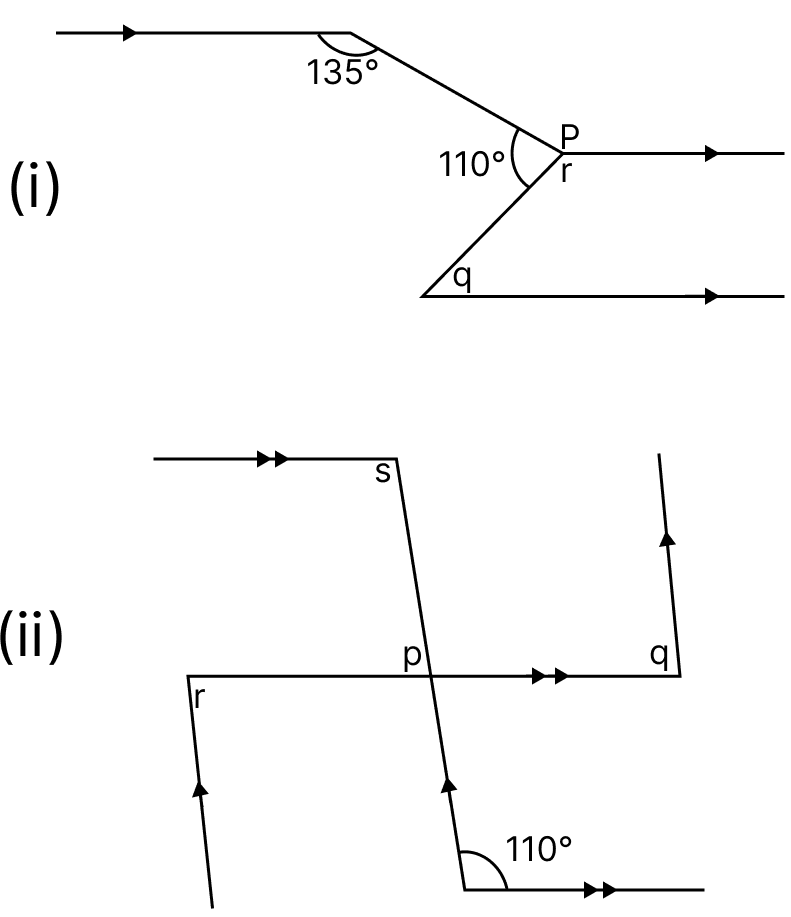
Answer
(i) From figure,
⇒ p = 135° (Alternate angles are equal, as the upper ray is parallel to the ray containing angle p)
As the rays meet at a point, the angles around that point add up to 360°.
⇒ p + r + 110° = 360°
⇒ 135° + r + 110° = 360°
⇒ r = 360° − 245° = 115°
As the ray containing angle r and angle q are parallel, r and q are co-interior angles.
⇒ r + q = 180°
⇒ q = 180° − 115° = 65°.
Hence, p = 135°, q = 65° and r = 115°.
(ii) From figure,
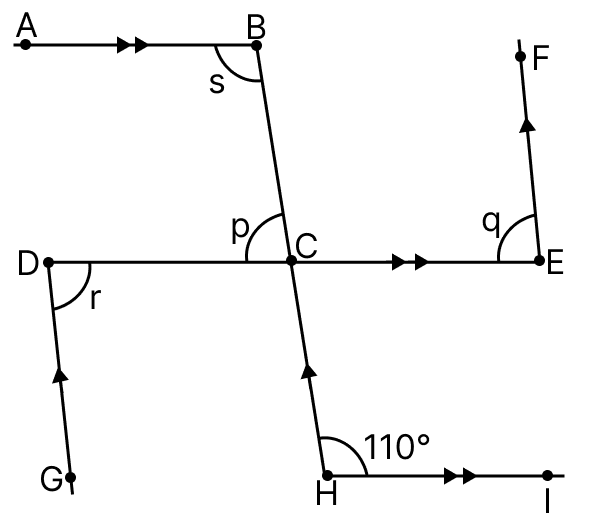
AB || HI and HB is a transversal,
⇒ s = 110° (alternate angles are equal)
⇒ ∠BCD = ∠ECH = p (vertically opposite angles are equal)
⇒ ∠ECH + 110° = 180° (Sum of co-interior angles = 180°)
⇒ p + 110° = 180°
⇒ p = 70°
From figure,
HB || EF, thus CB || EF
⇒ q = p = 70° (corresponding angles are equal)
HB || GD, thus CB || GD
⇒ r = p = 70° (alternate angles are equal)
Hence, p = 70°, q = 70°, r = 70° and s = 110°.