
Which of the following is a literal?
- 0.5
- 0
- s
Answer
A literal is a letter (like x, y, s) used to represent a number.
Here 's' is the literal and remaining are all fixed numerical constants.
Hence, option 3 is the correct option.
The coefficient of x in - 6 xyz2 is
- -6
- -6x
- yz2
- -6 yz2
Answer
The coefficient is the part of the term other than the chosen variable.
In - 6 xyz2, if we remove the x, we are left with -6yz2.
Hence, option 4 is the correct option.
Which of the following is a pair of like terms?
ab, xy
2xz2, -7x2z
4a2b2, -a2bc
0.9 xy, - xy
Answer
Like terms must have the exact same variables raised to the exact same powers.
Only option 4 has the same variable part (xy) in both terms.
Hence, option 4 is the correct option.
The degree of the polynomial ma2b3 + 6ab2 - m is
- 6
- 5
- 3
- 2
Answer
The degree of a term is the sum of the powers of its variables. The degree of the polynomial is the highest degree among its terms.
Term 1 (ma2b3): 1 + 2 + 3 = 6
Term 2 (6ab2): 1 + 2 = 3
Term 3 (m): 1
Here, term 1 has the highest degree i.e., 6
Hence, option 1 is the correct option.
The expression -3h4 + 7(h - 1) is a
- monomial
- binomial
- trinomial
- none of these
Answer
Given:
-3h4 + 7(h - 1)
Let's simplify:
-3h4 + 7(h - 1) = -3h4 + 7h - 7
It has three terms: -3h4, 7h and -7. So, it is a trinomial.
Hence, option 3 is the correct option.
Which of the following is a binomial?
- a2 - 6b2 + 1000
- -7x2y + xy2 + 3x2y
- ma2b - (m + n)a2b2 + nab2
- st2 - st + 1
Answer
A binomial must have exactly two terms after simplification.
Analysis:
- a2 - 6b2 + 1000
There are no like terms to combine. It has 3 terms.
- -7x2y + xy2 + 3x2y
Let's simplify:
-7x2y + 3x2y + xy2 [Grouping like terms]
= (-7 + 3)x2y + xy2
= -4x2y + xy2
It has 2 terms. It is a binomial.
- ma2b - (m + n)a2b2 + nab2
There are no like terms to combine. It has 3 terms.
- st2 - st + 1
There are no like terms to combine. It has 3 terms.
Hence, option 2 is the correct option.
Which of the following is a polynomial?
Answer
In a polynomial, the variables must have whole number exponents (0, 1, 2...). They cannot be in the denominator or under a root.
Analysis:
is x-1 (negative). It is not a polynomial.
is x1/2 (fraction). It is not a polynomial.
has a variable with power 1. The root is only on the constant. So, it is a polynomial.
are fractions. It is not a polynomial.
Hence, option 3 is the correct option.
Which of the following has the highest degree?
Answer
The highest degree of a polynomial is the greatest sum of the exponents of the variables found in any single term of that expression.
Analysis:
→ Degree = 5
→ Constant, Degree = 0
→ Degree = 3 + 2 + 1 = 6
→ Degree = 3 + 1 = 4
Among these, has the highest degree i.e., 6.
Hence, option 3 is the correct option.
The value of the expression 2m2 + 3n2m + , when m = -2 and n = 2 is
- 1
- -4
- 6
- -14
Answer
Given expression = 2m2 + 3n2m +
m = -2, n = 2
Substituting the given values in the expression, we get:
= 2(-2)2 + 3(2)2(-2) +
= 2(4) + 3(4)(-2) +
= 8 + (-24) +
= 8 - 24 + 14 + 8
= 6
Hence, option 3 is the correct option.
The sum of the polynomials bn - 8am - 8cp, 5cp - am + 2bn and 6am + 5bn - 3cp is equal to
- -2am + 2bn - 4cp
- -2am + 8bn - 2cp
- -3am + 2bn - 4cp
- -3am + 8bn - 6cp
Answer
Given polynomials = bn - 8am - 8cp, 5cp - am + 2bn and 6am + 5bn - 3cp
Arranging the expressions so that am is under am, bn is under bn and cp is under cp.
Sum is -3am + 8bn - 6cp
Hence, option 4 is the correct option.
Fill in the blanks :
(i) The highest power of the ............... in a polynomial is called its degree.
(ii) The degree of the polynomial 75 is ............... .
(iii) Several parts of an algebraic expression separated by + or - signs are called the ............... of the expression.
(iv) Any number is a polynomial of degree ............... .
(v) Terms having the same ............... are called like terms.
(vi) The algebraic expression for the statement ‘the number of times b is contained in x' is ............... .
(vii) 1 + x + y + xy is a polynomial having ............... terms and degree .............. .
(viii) The length of a side of a square having perimeter 8x2 - 2y + 16xy is ............... .
(ix) In a polynomial, the exponents of the variables are always ............... .
(x) If the length of a rectangle having perimeter (6 m2 - 2 mn + 2 m2n - 4n2) units, is (3m2 + m2n - 2 mn) units, then its breadth is equal to ............... units.
Answer
(i) The highest power of the variable in a polynomial is called its degree.
(ii) The degree of the polynomial 75 is 0.
(iii) Several parts of an algebraic expression separated by + or - signs are called the terms of the expression.
(iv) Any number is a polynomial of degree 0.
(v) Terms having the same literal coefficients are called like terms.
(vi) The algebraic expression for the statement ‘the number of times b is contained in x' is .
(vii) 1 + x + y + xy is a polynomial having 4 terms and degree 2.
(viii) The length of a side of a square having perimeter 8x2 - 2y + 16xy is .
(ix) In a polynomial, the exponents of the variables are always non-negative integers.
(x) If the length of a rectangle having perimeter (6 m2 - 2 mn + 2 m2n - 4n2) units, is (3m2 + m2n - 2 mn) units, then its breadth is equal to mn - 2n2 units.
Explanation
(i) In algebra, the degree represents the maximum power of the variable present. For example, in x3 + x, the degree is 3.
(ii) The degree refers to the power of the variable. Since 75 is just a constant with no variable, its degree is 0.
(iii) Terms are the individual building blocks of an expression. In 3x + 5y, "3x" and "5y" are the terms.
(iv) Any constant number k can be written as k.x0. Since the variable power is 0, the degree is 0.
(v) Like terms must have the exact same variables raised to the exact same powers, such as 5ab2 and -2ab2.
(vi) To find how many times one number is "contained" in another, we use division. For example, 2 is contained in 10 five times (10 ÷ 2).
(vii) Given polynomial: 1 + x + y + xy
Terms: 1, x, y, xy = 4 terms
Degree: The term xy has degree 1 + 1 = 2.
(viii)
Given:
Perimeter of square = 8x2 - 2y + 16xy
Side = ?
We have the formula:
Perimeter of a square = 4 x (Side)
Substituting the values above, we get:
(ix) Polynomials are defined by having non-negative integer exponents. They cannot have variables with negative powers (x-1) or roots ().
(x)
Given:
Length = (3m2 + m2n - 2 mn)
Perimeter of a rectangle = (6 m2 - 2 mn + 2 m2n - 4n2)
Breadth = ?
We know the formula:
Perimeter of a rectangle = 2(Length + Breadth)
First, find 2 x Length:
2(Length) = 2(3m2 + m2n - 2 mn) = 6m2 + 2m2n - 4 mn
Now, find Perimeter - 2(Length):
Perimeter - 2(Length) = 2mn - 4n2
Now, we have:
Breadth =
Breadth = mn - 2n2
Write true (T) or false (F) :
(i) A literal can take on various numerical values.
(ii) 2a3b - a2b - 3a2b2 + 7ba2 - ba3 is a trinomial.
(iii) 3mn is a factor of -9mn2.
(iv) If we add a monomial and a trinomial, the answer can be a monomial.
(v) The coefficient of a2b in - 9a2b2c is -9bc.
(vi) The degree of the monomial 33 is 3.
Answer
(i) True
Reason — A literal is a letter (like x, a, or b) used in algebra to represent a variable quantity. Unlike a constant (like 5), which has a fixed value, a literal can represent various numerical values depending on the problem or context.
(ii) True
Reason —
Given expression:
2a3b - a2b - 3a2b2 + 7ba2 - ba3
= (2a3b - ba3) + (- a2b + 7ba2) - 3a2b2 [Arranging like terms together]
= (2-1)a3b + (-1 + 7)a2b - 3a2b2 [Combining coefficients]
= a3b + 6a2b - 3a2b2
Since the simplified expression has exactly 3 terms, it is a trinomial.
(iii) True
Reason — A term is a factor if it divides the other term completely without leaving a remainder.
Since 3mn x (-3n) = -9mn2, it is a factor.
(iv) False
Reason — Usually, when we add a monomial (1 term) to a trinomial (3 terms), the maximum number of terms we can get is 4, and the minimum is 2 (if the monomial is a like term that combines with one of the trinomial's terms).
Example:
Add monomial (2x) and trinomial (x2 + 3x + 5):
2x + (x2 + 3x + 5) = x2 + 5x + 5
The result is a trinomial, not a monomial.
(v) True
Reason — To find the coefficient of a2b in the term -9a2b2c, we remove a2b from the term:
(vi) False
Reason — The degree of a polynomial is determined by the power of the variables. Since 33 is a constant number and has no variable attached to it, its degree is 0.
Saket wrote four different algebraic expressions in his notebook. These are .
(1) Which of these expressions is/are binomials ?
- f(x), g(x), h(x) only
- f(x), g(x), k(y) only
- f(x), h(x), k(y) only
- f(x), h(x) only
(2) Which of these expressions is/are not polynomials ?
- f(x), g(x), h(x) only
- f(x), h(x) only
- g(x), h(x) only
- h(x) only
(3) Which of these expressions is/are polynomials in two variables ?
- f(x) only
- k(y) only
- f(x), k(y) only
- None of these
(4) The degree of the polynomial f (x) is :
- 0
- 1
- 2
- 3
Answer
Given:
k(y) = 2y - 1
(1)
f(x): 2 terms (2x3 and ) → Binomial.
g(x): 3 terms (x, , and ) → Trinomial.
h(x): 2 terms (x2 and ) → Binomial.
k(y): 2 terms (2y and -1) → Binomial.
Binomial expressions are f(x), h(x), k(y).
Hence, option 3 is the correct option.
(2) A polynomial cannot have variables in the denominator or under a root (fractional powers).
Analysis:
The powers of x are 3 and 1. Both are whole numbers. It is a polynomial.
The term can be written as -x-1, the exponent -1 which is a negative integer not a whole number. So, it is not a polynomial.
The term can be written as -2x1/2, the exponent is a fraction, not a whole number. So, it is not a polynomial.
k(y) = 2y - 1
The power of y is 1, which is a whole number. So, it is a polynomial.
So, g(x) and h(x) are not polynomials.
Hence, option 3 is the correct option.
(3) A "polynomial in two variables" must contain exactly two different letters (like x and y, or a and b) throughout its terms.
Analysis:
Only x appears in both terms. This is a polynomial in one variable (x).
Only x appears. This is an algebraic expression in one variable (x). It is not a polynomial.
Only x appears. This is an algebraic expression in one variable (x). It is not a polynomial.
k(y) = 2y - 1
Only y appears. This is a polynomial in one variable (y).
No expression is a polynomial in two variables.
Hence, option 4 is the correct option.
(4)
The highest power of x in is 3.
Hence, option 4 is the correct option.
Vasu has a rectangular farmland A. The length of this farmland is x2y - 2xy + 3x2 and its perimeter is 2x2y + 6x2 - 2xy - 4y2. Today he purchased the adjacent farmland B and combined the two farmlands into one. The length of his farmland now increased by x2 + xy, while the breadth remained the same.
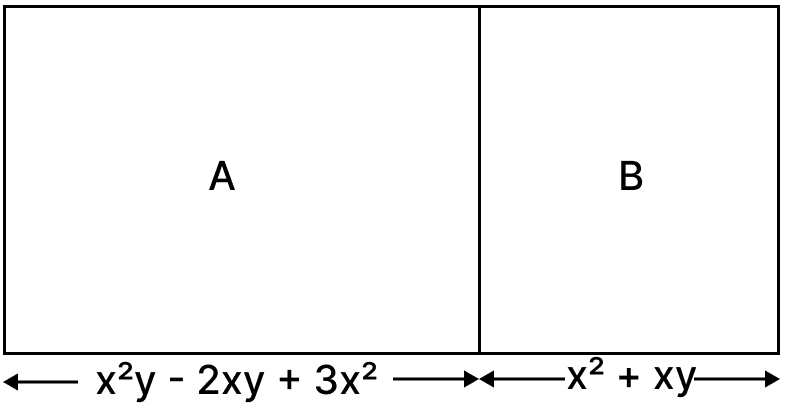
(1) Find the breadth of farmland A :
- x2y + 3x2 - 4y2
- xy - 2y2
- 12x2 - 4xy
- 6x2 + xy - 2y2
(2) Find the length of the combined farmland owned by Vasu :
- x2 + 2xy - 2y2
- 4x2 - 3xy + x2y
- 4x2 - xy + x2y
- 2x2 - 3xy + x2y
(3) The perimeter of Vasu's combined farmland is :
- 8x2 + 2x2y - 4y2
- 4y2 + 4xy + 2x2y + 8x2
- 4x2 - 2x2y + 4y2
- 4x2 + 4xy - 2x2y - 8x2
(4) The change in the perimeter after combining farmlands A and B is :
- 4x2 + 2xy + 4x2y - y2
- 2x2 - 2xy + y2
- 4x2 + 2xy - y2
- 2x2 + 2xy
Answer
Given for Farmland A:
Length (LA) = x2y - 2xy + 3x2
Perimeter (PA) = 2x2y + 6x2 - 2xy - 4y2
(1)
We know the formula:
Perimeter of a rectangle = 2(Length + Breadth)
First, find 2(Length):
2(Length) = 2(x2y - 2xy + 3x2) = 2x2y - 4xy + 6x2
Now, calculate Perimeter - 2(Length):
Perimeter - 2(Length) = 2xy - 4y2
Now we have:
Breadth =
Breadth = xy - 2y2
Hence, option 2 is the correct option.
(2)
Original Length (LA) = x2y - 2xy + 3x2
Increase = x2 + xy
Combined Length = Original Length + Increase
Substituting the values above, we get:
Combined Length = (x2y - 2xy + 3x2) + (x2 + xy)
= (3x2 + x2) + (- 2xy + xy) + x2y [Arranging like terms together]
= (3 + 1)x2 + (-1)xy + x2y
= 4x2 - xy + x2y
Hence, option 3 is the correct option.
(3)
Combined Length = 4x2 - xy + x2y [From step 2]
Breadth = xy - 2y2 [From step 1]
Perimeter of combined farmland = ?
Let's apply the perimeter of a rectangle formula:
Perimeter of combined farmland = 2(Length + Breadth)
Let's first calculate Length + Breadth.
We have:
Length + Breadth = (4x2 - xy + x2y) + (xy - 2y2)
= 4x2 + (- xy + xy) + x2y + (- 2y2) [Arranging like terms together]
= 4x2 + 0xy + x2y - 2y2
= 4x2 + x2y - 2y2
Now we have:
Perimeter of combined farmland = 2 x (4x2 + x2y - 2y2) = 8x2 + 2x2y - 4y2
Hence, option 1 is the correct option.
(4)
Original Perimeter = 2x2y + 6x2 - 2xy - 4y2
Combined Perimeter = 8x2 + 2x2y - 4y2
Change in perimeter = Combined Perimeter - Original Perimeter
Substituting the values above, we get:
Change in perimeter = (8x2 + 2x2y - 4y2) - (2x2y + 6x2 - 2xy - 4y2)
= 8x2 + 2x2y - 4y2 - 2x2y - 6x2 + 2xy + 4y2 [Simplifying brackets]
= (8x2 - 6x2) + (2x2y - 2x2y) + 2xy + (- 4y2 + 4y2) [Arranging like terms together]
= 2x2 + 0x2y + 2xy + 0y2
= 2x2 + 2xy
Hence, option 4 is the correct option.
Assertion: The expression x + y - 2x is a trinomial.
Reason: An algebraic expression containing three terms is called a trinomial.
- Both Assertion (A) and Reason (R) are true and Reason (R) is the correct explanation of Assertion (A).
- Both Assertion (A) and Reason (R) are true but Reason (R) is not the correct explanation of Assertion (A).
- Assertion (A) is true but Reason (R) is false.
- Assertion (A) is false but Reason (R) is true.
Answer
Assertion (A) is false but Reason (R) is true.
Explanation
Given expression:
x + y - 2x
Let's simplify it:
∴ x + y - 2x = (x - 2x) + y [Arranging like terms together]
= -x + y
= y - x
∴ Simplified expression is y - x, which has only two terms. Therefore, it is a binomial, not a trinomial. So, Assertion is incorrect.
Reason is true because it is the correct definition of a trinomial.
Hence, option 4 is the correct option.
Assertion: If we subtract 15x2 - 9x + 1 from 1, then we get -15x2 + 9x.
Reason: The degree of 15x2 - 9x + 1 is 3 as it has three terms and degree of -15x2 + 9x is 2 as it has two terms.
- Both Assertion (A) and Reason (R) are true and Reason (R) is the correct explanation of Assertion (A).
- Both Assertion (A) and Reason (R) are true but Reason (R) is not the correct explanation of Assertion (A).
- Assertion (A) is true but Reason (R) is false.
- Assertion (A) is false but Reason (R) is true.
Answer
Assertion (A) is true but Reason (R) is false.
Explanation
Assertion:
Subtracting 15x2 - 9x + 1 from 1:
1 - (15x2 - 9x + 1)
= 1 - 15x2 + 9x - 1 [Simplifying brackets]
= (1 - 1) - 15x2 + 9x
= 0 - 15x2 + 9x
= - 15x2 + 9x
The result matches the statement exactly.
So, Assertion is true.
Reason is false because, the degree of a polynomial is determined by the highest power of the variable, not by the number of terms.
Degree of 15x2 - 9x + 1 = 2 (because the highest power of x is 2).
Degree of -15x2 + 9x = 2 (because the highest power of x is 2).
The Reason incorrectly claims the degree is 3 based on the number of terms.
Hence, option 3 is the correct option.
Consider the expression. "5 subtracted from the sum of 5 times u squared and 5 times the product of u and −1". Which of these statements is correct?
- All terms of the expression are: 5u2, −5u and −5.
- All terms of the expression are: 5u2 and −5u.
- All factors of the term −5u are: 5 and u.
- All factors of the term 5u2 are: 5 and u.
Answer
Let's translate the statement into an algebraic expression step-by-step:
Step 1: "5 times u squared" = 5u2
Step 2: "the product of u and −1" = u × (−1) = −u
Step 3: "5 times the product of u and −1" = 5 × (−u) = −5u
Step 4: "the sum of 5 times u squared and 5 times the product of u and −1" = 5u2 + (−5u) = 5u2 − 5u
Step 5: "5 subtracted from the sum..." = (5u2 − 5u) − 5 = 5u2 − 5u − 5
So, the expression is 5u2 − 5u − 5.
Now, let's analyse each option:
1. All terms of the expression are 5u2, −5u and −5.
The expression 5u2 − 5u − 5 has three terms separated by '−' signs, namely 5u2, −5u and −5. This statement is correct.
2. All terms of the expression are 5u2 and −5u.
This statement misses the constant term −5. So, it is incorrect.
3. All factors of the term −5u are 5 and u.
The term −5u = (−5) × u. The factors of −5u are −5 and u, not 5 and u. So, this statement is incorrect.
4. All factors of the term 5u2 are 5 and u.
The term 5u2 = 5 × u × u. The factors of 5u2 are 5, u and u2. The statement misses u2. So, it is incorrect.
Hence, option 1 is the correct option.
Study the following statements and select the correct option.
P: The number of unlike terms in 4pq2 − 2q2r + q2p + 3pqr + q2r − 8 is 4.
Q: An expression having three or more terms is called a trinomial.
- Both P and Q are true
- Both P and Q are false
- P is true but Q is false
- P is false but Q is true
Answer
Checking Statement P:
Given expression:
4pq2 − 2q2r + q2p + 3pqr + q2r − 8
Let's group like terms together (recall pq2 = q2p):
= (4pq2 + q2p) + (−2q2r + q2r) + 3pqr − 8 [Arranging like terms together]
= (4 + 1)pq2 + (−2 + 1)q2r + 3pqr − 8 [Combining coefficients]
= 5pq2 − q2r + 3pqr − 8
The simplified expression has 4 unlike terms: 5pq2, −q2r, 3pqr and −8.
∴ Statement P is true.
Checking Statement Q:
A trinomial is an algebraic expression containing exactly 3 terms, not three or more.
An expression containing more than one term is called a multinomial.
∴ Statement Q is false.
So, P is true but Q is false.
Hence, option 3 is the correct option.
The cost of entry tickets to an amusement park are different for men and children. A man's ticket costs ₹800 and a child's ticket costs ₹500.
On Monday, the number of men who visited the amusement park was the square of the number of children who visited. How much money was collected by selling entry tickets on Monday?
- x2
- 800x2 + 500x
- 800x + 500x2
- 1300(x + x2)
Answer
Given:
Cost of a man's ticket = ₹800
Cost of a child's ticket = ₹500
Let the number of children who visited the amusement park = x
According to the question, the number of men = (number of children)2 = x2
Money collected from men's tickets = Cost per man × Number of men
= ₹800 × x2
= ₹800x2
Money collected from children's tickets = Cost per child × Number of children
= ₹500 × x
= ₹500x
Total money collected = Money from men + Money from children
= ₹(800x2 + 500x)
Hence, option 2 is the correct option.
Sonika and Komal are collecting some marbles for their project. Sonika collected 15 red marbles and 6x blue marbles, whereas Komal collected 5y red marbles and 8x blue marbles. After some time Sonika loses 3y marbles and Komal collected 8 more marbles. How many total number of marbles they both have now, if x = 2 and y = 3?
- 54
- 65
- 57
- 62
Answer
Marbles with Sonika:
Initially Sonika had = 15 red marbles + 6x blue marbles = (15 + 6x) marbles
After losing 3y marbles, Sonika has = (15 + 6x) − 3y = 15 + 6x − 3y marbles
Marbles with Komal:
Initially Komal had = 5y red marbles + 8x blue marbles = (5y + 8x) marbles
After collecting 8 more marbles, Komal has = (5y + 8x) + 8 = 5y + 8x + 8 marbles
Total marbles with both:
Total = (15 + 6x − 3y) + (5y + 8x + 8)
= (6x + 8x) + (−3y + 5y) + (15 + 8) [Arranging like terms together]
= 14x + 2y + 23
Substituting x = 2 and y = 3, we get:
Total = 14(2) + 2(3) + 23
= 28 + 6 + 23
= 57
Hence, option 3 is the correct option.
What is sum of the numerical coefficients of the variables m and n in the expression given by the statement? "Circumference of the circle of radius m subtracted from the circumference of the circle of radius ".
- −π
- −1
- 3
- π
Answer
We know the formula:
Circumference of a circle = 2πr, where r is the radius.
Circumference of a circle of radius m = 2πm
Circumference of a circle of radius = = πn
According to the question, circumference of the circle of radius m is subtracted from the circumference of the circle of radius :
Required expression = πn − 2πm
In this expression:
Numerical coefficient of m = −2π
Numerical coefficient of n = π
Sum of the numerical coefficients = −2π + π = −π
Hence, option 1 is the correct option.
Which of the following statement is true about the expression given below?
−14m2l − 17m2 + 4n2 − 15lm2 − (−6m2 − 10n2 + 18l2m2) − 12m2l2
- The simplified form is a trinomial −59m2l − 11m2 + 14n2.
- The simplified form is a trinomial −35m2l − 23m2 + 6n2.
- The simplified form is a polynomial −29m2l − 23m2 − 6n2 + 6l2m2.
- The simplified form is a polynomial −29m2l − 11m2 + 14n2 − 30l2m2.
Answer
Given expression:
−14m2l − 17m2 + 4n2 − 15lm2 − (−6m2 − 10n2 + 18l2m2) − 12m2l2
First, let's open the bracket by changing the sign of each term inside:
= −14m2l − 17m2 + 4n2 − 15lm2 + 6m2 + 10n2 − 18l2m2 − 12m2l2
Now, group the like terms together (recall m2l = lm2 and l2m2 = m2l2):
= (−14m2l − 15lm2) + (−17m2 + 6m2) + (4n2 + 10n2) + (−18l2m2 − 12m2l2)
= (−14 − 15)m2l + (−17 + 6)m2 + (4 + 10)n2 + (−18 − 12)l2m2 [Combining coefficients]
= −29m2l − 11m2 + 14n2 − 30l2m2
The simplified expression has 4 terms, so it is a polynomial (not a trinomial).
Hence, option 4 is the correct option.