
The absolute value of 5 is
- -5
- 0
- 5
Answer
Absolute value of 5 = |5| = 5
Hence, option 4 is the correct option.
The additive inverse of -7 is
- 7
- 1
- 0
Answer
Since -7 + 7 = 0
∴ The additive inverse of -7 is 7
Hence, option 1 is the correct option.
The sum of two integers is -8. If one of them is 5, then the other is
- 3
- 13
- -3
- -13
Answer
Given:
Sum of two integers = -8
One integer = 5
Let the other integer be x
According to the question, the equation can be written as:
5 + x = -8
x = -8 - 5 = -(8 + 5) [Solve for x]
x = -13
∴ The other integer is -13
Hence, option 4 is the correct option.
The successor of -41 is
- -42
- 41
- 40
- -40
Answer
To find the successor, add 1 to the given integer
-41 = -41 + 1 = -40
∴ The successor of -41 is -40
Hence, option 4 is the correct option.
The value of (-7) x 6 + (-7) x 14 is
- 42
- -84
- -140
- -196
Answer
Given expression:
(-7) x 6 + (-7) x 14
= -7 x (6 + 14) [a x (b + c) = (a x b) + (a x c) ⇒ Distributive property]
=-7 x 20 [Simplifying ( )]
= -140
∴ The value of (-7) x 6 + (-7) x 14 is -140
Hence, option 3 is the correct option.
Fill in the blanks :
(i) The absolute value of any integer can never be ............... .
(ii) The sum of any integer and its additive inverse is always ............... .
(iii) a x (b + c) = (a x b) + (a x c) is ............... property of multiplication over addition.
(iv) The product of two integers having unlike signs is always a ............... integer.
(v) The additive inverse of an integer a has the ............... sign as a.
Answer
(i) The absolute value of any integer can never be negative.
(ii) The sum of any integer and its additive inverse is always 0.
(iii) a x (b + c) = (a x b) + (a x c) is distributive property of multiplication over addition.
(iv) The product of two integers having unlike signs is always a negative integer.
(v) The additive inverse of an integer a has the opposite sign as a.
State True or False :
For any integer a, the multiplicative inverse is 1.
Answer
False
Reason
The multiplicative inverse of an integer a is not a (except when a = 1)
State True or False :
The sum of two integers having unlike signs is always a positive integer.
Answer
False
Reason
The sign of the sum depends on the absolute value of the integers. If the negative integer has a greater absolute value, the sum will be negative. If the positive integer has a greater absolute value, the sum will be positive.
State True or False :
The multiplicative inverse of an integer is never an integer.
Answer
False
Reason
The multiplicative inverse of 1 is 1 and of −1 is −1, which are integers. However, for all other integers, the inverse is a fraction. Hence, it is not true for all integers.
State True or False :
Any integer multiplied to its multiplicative inverse always gives the multiplicative identity.
Answer
True
Reason
By definition, Since 1 is the multiplicative identity, this statement is correct.
State True or False :
Every integer has a multiplicative inverse.
Answer
False
Reason
0 does not have a multiplicative inverse because division by zero is not defined.
State True or False :
The quotient of two integers with unlike signs is always negative.
Answer
True
Reason
The rules for division are the same as multiplication. When you divide a positive integer by a negative one (or vice versa), the result is always negative.
Aditya went to Australia during the holidays of his children. They visited the coral reef and they were all excited to go for scuba diving. Aditya dived 36 feet to reach the brain coral as his instructor had directed him. He then rose by 19 feet to travel over a ridge.
(1) What is the depth of the ridge ?
- 57 feet
- 19 feet
- 17 feet
- 45 feet
(2) Aditya again dived 58 feet to reach the base of the reef. What is the depth of the reef ?
- 32 feet
- 41 feet
- 58 feet
- 75 feet
(3) In order to see an underwater cave, Aditya rose 26 feet. What is his location with respect to sea-level ?
- 49 feet
- 101 feet
- 26 feet
- 9 feet
(4) If a whale moving at a depth of 21 feet from the sea level passed over Aditya, what was its distance from Aditya ?
- 64 feet
- 49 feet
- 53 feet
- 28 feet
Answer
(1) Given:
Initial depth = -36 feet (36 feet below sea level)
He rises 19 feet = +19
Depth = -36 + 19 = -17 (17 feet below sea level)
Depth = 17 feet
Hence, option 3 is the correct option.
(2) Starting position = -17 feet (from the previous step)
Again he dives 58 feet = -58 feet (Given)
Depth = -17 + (-58)
= -17 - 58
= -(17 + 58) = -75 feet
Depth = 75 feet
Hence, option 4 is the correct option.
(3) Starting position = -75 feet (from the previous step)
He rises by 26 feet = +26 (Given)
Location = -75 + 26 = -49
Location = 49 feet below the sea level
Hence, option 1 is the correct option.
(4) Given:
Whale's position: -21 feet
Aditya's position: -49 feet (from the previous step)
Distance of Whale from Aditya = -21 - (-49)
= -21 + 49 = 28
Distance of Whale from Aditya = 28 feet
Hence, option 4 is the correct option.
Tanvi had a keen interest to invest in share market. So, she took lessons from an investment coach. The coach told her to watch the fluctuations in the value of share over a period of time. She found that on April 1, the price of a share of XYZ company was ₹2552.
(1) On April 2, the price of this share changed by gaining ₹37. What was the price of each share of XYZ on April 2 ?
- ₹2515
- ₹2589
- ₹2562
- ₹2573
(2) On April 3, the price changed by losing ₹16 by 12 pm and then again losing ₹8 by the end of the day. What was the price of each share of XYZ by the end of the day on April 3 ?
- ₹2528
- ₹2565
- ₹2576
- ₹2603
(3) On April 4, the price of XYZ company's share changed by gaining ₹11 by 12 pm and then again gaining ₹14 by the end of the day. What was the price of each share of XYZ by the end of the day on April 4?
- ₹2540
- ₹2564
- ₹2590
- ₹2614
(4) On April 5, the price of the share changed by losing ₹13 by 12 pm and then gaining ₹4 by the end of the day. What was the price of each share of XYZ by the end of the day on April 5 ?
- ₹2599
- ₹2607
- ₹2612
- ₹2581
Answer
(1) Price on April 2
Given:
Opening price (April 1) = ₹2552
Change = gain of ₹37
Price on April 2 = ₹2552 + ₹37 = ₹2589
Hence, option 2 is the correct option.
(2) Price by the end of April 3
Given:
Change 1 = Loss of ₹16
Change 2 = Loss of ₹8
Total loss = ₹16 + ₹8 = ₹24
Price on April 2 = ₹2589 (from the previous step)
Price by the end of April 3 = Price on April 2 - Total loss
Substituting the values, we get:
Price by the end of April 3 = ₹2589 - ₹24 = ₹2565
Hence, option 2 is the correct option.
(3) Price by the end of April 4
Given:
Change 1 = Gain of ₹11
Change 2 = Gain of ₹14
Total Gain = ₹11 + ₹14 = ₹25
Price on April 3 = ₹2565 (from the previous step)
Price by the end of April 4 = Price on April 3 + Total Gain
Substituting the values, we get:
Price by the end of April 4 = ₹2565 + ₹25 = ₹2590
Hence, option 3 is the correct option.
(4) Price by the end of April 5
Given:
Change 1 = Loss of ₹13
Change 2 = Gain of ₹4
Price on April 4 = ₹2590 (from the previous step)
Price by the end of April 5 = ₹2590 - ₹13 + ₹4 = ₹2581
Hence, option 4 is the correct option.
Assertion: Difference of two negative integers cannot be a positive integer.
Reason: For any two integers a and b, a - b = a + (additive inverse of b)
- Both Assertion (A) and Reason (R) are true and Reason (R) is the correct explanation of Assertion (A).
- Both Assertion (A) and Reason (R) are true but Reason (R) is not the correct explanation of Assertion (A).
- Assertion (A) is true but Reason (R) is false.
- Assertion (A) is false but Reason (R) is true.
Answer
Assertion (A) is false but Reason (R) is true.
Explanation
The assertion is false because the difference of two negative integers can be positive.
Example:
(-3) - (-7) = -3 + 7 = 4
which is positive.
The reason is true because subtraction of integers is defined as adding the additive inverse:
a - b = a + (-b)
Hence, option 4 is the correct option.
Assertion: Product of three negative integers and a positive integer is negative.
Reason: (-1) x (-1) x (-1) x ............... n times = -1, if n is odd.
- Both Assertion (A) and Reason (R) are true and Reason (R) is the correct explanation of Assertion (A).
- Both Assertion (A) and Reason (R) are true but Reason (R) is not the correct explanation of Assertion (A).
- Assertion (A) is true but Reason (R) is false.
- Assertion (A) is false but Reason (R) is true.
Answer
Both Assertion (A) and Reason (R) are true and Reason (R) is the correct explanation of Assertion (A).
Explanation
Product of three negative integers:
(negative x negative x negative) = (negative)
So, product of three negative integers is negative.
Multiplying this by a positive integer keeps it negative:
(negative result x positive) = (negative)
The reason correctly explains that an odd number of negative integers gives a negative result.
Hence, option 1 is the correct option.
In a competition 3 marks are given for every correct answer and (−2) marks are given for every incorrect answer and no marks for not attempting any question.
Sachin scored 24 marks. If he got 14 correct answers, how many questions has he attempted incorrectly?
- 10
- 9
- 8
- 5
Answer
Given:
Marks for each correct answer = 3
Marks for each incorrect answer = −2
Number of correct answers = 14
Total score = 24
Marks scored from correct answers = Number of correct answers × Marks for each correct answer
= 14 × 3
= 42
Since the total score is 24, the marks lost due to incorrect answers:
Marks lost = 42 − 24 = 18
Let the number of incorrect answers be x.
Each incorrect answer deducts 2 marks. Therefore,
x × 2 = 18
x =
x = 9
∴ Sachin attempted 9 questions incorrectly.
Hence, option 2 is the correct option.
A pair of integers whose product is −12 and there lies seven integers between them, is:
- −2, 6
- −12, 1
- −3, 4
- 3, −4
Answer
We need a pair of integers whose product is −12 and which has exactly 7 integers lying between them.
Checking option 1: −2 and 6
Product = (−2) × 6 = −12
Integers between −2 and 6 are: −1, 0, 1, 2, 3, 4, 5
Number of integers between them = 7
Checking option 2: −12 and 1
Product = (−12) × 1 = −12
Integers between −12 and 1 are: -11, -10, -9, -8, -7, -6, -5, -4, -3, -2, -1, 0
Number of integers between them = 12
Checking option 3: −3 and 4
Product = (−3) × 4 = −12
Integers between −3 and 4 are: -2, -1, 0, 1, 2, 3
Number of integers between them = 6
Checking option 4: 3 and -4
Product = 3 × (−4) = −12
Integers between −4 and 3 are: −3, −2, −1, 0, 1, 2
Number of integers between them = 6
Only option 1 satisfies both conditions.
∴ The required pair is −2 and 6.
Hence, option 1 is the correct option.
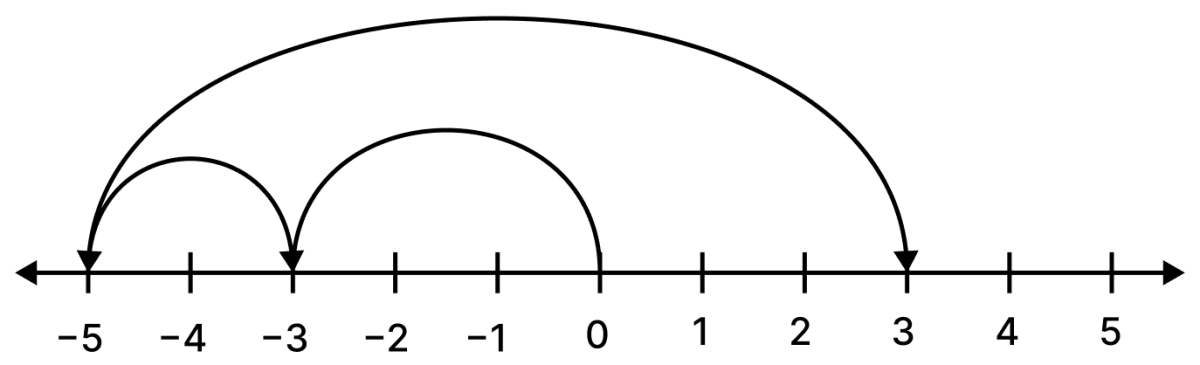
Which of the following number sentences best describes the problem shown on the number line?
- 3 + (−2) + 8
- 3 − (−2) + 8
- −3 + (−2) − 8
- −3 + (−2) + 8
Answer
From the number line:
The first arrow starts from 0 and moves 3 units to the left, reaching −3. [represents −3]
The second arrow starts from −3 and moves 2 units further to the left, reaching −5. [represents + (−2)]
The third arrow starts from −5 and moves 8 units to the right, reaching 3. [represents + 8]
∴ The number sentence is −3 + (−2) + 8.
Hence, option 4 is the correct option.
Compare and fill in the box.
Successor of ((−8) × ((−3) − (−5))) ☐ predecessor of ((−12) × ((36) ÷ (−6))).
- >
- <
- =
- Can't be determined
Answer
Step 1: Evaluate the first expression
(−8) × ((−3) − (−5))
= (−8) × (−3 + 5) [∵ a − (−b) = a + b]
= (−8) × 2
= −16
Successor of −16 = −16 + 1 = −15 [Successor of a is (a + 1)]
Step 2: Evaluate the second expression
(−12) × (36 ÷ (−6))
= (−12) × (−6) [∵ 36 ÷ (−6) = −6]
= 72
Predecessor of 72 = 72 − 1 = 71 [Predecessor of a is (a − 1)]
Step 3: Compare the two values
−15 < 71
∴ Successor of ((−8) × ((−3) − (−5))) < predecessor of ((−12) × ((36) ÷ (−6))).
Hence, option 2 is the correct option.
If we together add 199 negative integers, the resulting number will be:
- Negative
- Positive
- Can't say
- Data is insufficient
Answer
The sum of two negative integers is always a negative integer.
When more negative integers are added, the sum remains negative.
So, the sum of 199 negative integers will also be a negative integer.
∴ The resulting number will be negative.
Hence, option 1 is the correct option.
Find x and y.
(i) The sum of two integers is 71. If one of them is −101, then other integer is x.
(ii) The product of an integer and y is zero.
| x | y | |
|---|---|---|
| 1. | 172 | 0 |
| 2. | 184 | 1 |
| 3. | 172 | 1 |
| 4. | 172 | 2 |
Answer
Finding x:
Given:
Sum of two integers = 71
One integer = −101
According to the question, the equation can be written as:
x + (−101) = 71
x = 71 − (−101)
x = 71 + 101 [∵ a − (−b) = a + b]
x = 172
Finding y:
Given:
Product of an integer and y is zero.
By the multiplicative property of 0, for every integer a, we have a × 0 = 0 × a = 0.
∴ y = 0
So, x = 172 and y = 0.
Hence, option 1 is the correct option.
We have, °C = (°F − 32) × . If °C = −35, then, °F is equal to:
- 31
- −31
- 95
- −95
Answer
Given:
°C = (°F − 32) ×
°C = −35
Substituting the value of °C, we get:
−35 = (°F − 32) ×
(−35) × = °F − 32 [Multiplying both sides by ]
= °F − 32
= °F − 32
−63 = °F − 32
°F = −63 + 32
°F = −31
∴ The value of °F is −31.
Hence, option 2 is the correct option.
A shopkeeper earns a profit of ₹2 by selling a pen and incurs a loss of 50 paise per pencil and loss of 15 paise per eraser while selling pencils and erasers of old stock. On a particular day, he earns a profit of ₹10. If he sold 10 pens and the number of pencils and erasers he sold are in the ratio 7 : 10, then the number of pencils and erasers he sold on the day is:
- Number of pencils = 14, number of erasers = 20
- Number of pencils = 12, number of erasers = 10
- Number of pencils = 18, number of erasers = 10
- Number of pencils = 12, number of erasers = 14
Answer
Given:
Profit per pen = ₹2
Loss per pencil = 50 paise = ₹ = ₹0.50
Loss per eraser = 15 paise = ₹ = ₹0.15
Number of pens sold = 10
Total profit on the day = ₹10
Ratio of pencils to erasers = 7 : 10
Step 1: Find the profit from selling pens
Profit from pens = 10 × 2 = ₹20
Step 2: Set up the equation using the ratio
Let the number of pencils = 7k and the number of erasers = 10k.
Loss from pencils = 7k × 0.50 = ₹3.5k
Loss from erasers = 10k × 0.15 = ₹1.5k
Total loss = 3.5k + 1.5k = ₹5k
Step 3: Apply the net profit condition
Net profit = Profit from pens − Total loss
According to the question, the equation can be written as:
20 − 5k = 10
5k = 20 − 10
5k = 10
k = 2
Step 4: Find the number of pencils and erasers
Number of pencils = 7k = 7 × 2 = 14
Number of erasers = 10k = 10 × 2 = 20
∴ The shopkeeper sold 14 pencils and 20 erasers.
Hence, option 1 is the correct option.
In a magic square, if each row, column and diagonal have the same sum, then the values of x and y respectively are
| 1 | −10 | 0 |
|---|---|---|
| x | −3 | -2 |
| −6 | 4 | y |
- −7, −4
- −4, −7
- −4, −6
- −6, −4
Answer
In a magic square, the sum of the integers in every row, every column and both diagonals is the same.
The given magic square is:
| 1 | −10 | 0 |
|---|---|---|
| x | −3 | -2 |
| −6 | 4 | y |
Step 1: Find the magic sum using a complete row
Using the first row:
1 + (−10) + 0 = −9
So, the sum of each row, column and diagonal is −9.
Step 2: Find x using the middle row
x + (−3) + (−2) = −9
x - 3 - 2 = -9
x − 5 = −9
x = -9 + 5
x = −4
Step 3: Find y using the second row
−6 + 4 + y = −9
−2 + y = -9
y = −9 + 2
y = −7
Verification (using diagonals):
Diagonal 1:
1 + (−3) + (−7) = −9
1 - 3 - 7 = -9
1 - 10 = -9
-9 = - 9
LHS = RHS
∴ x = −4 and y = −7.
Hence, option 2 is the correct option.
The additive inverse of −28 + 12 + 42 − 53 is:
0
27
Answer
Step 1: Simplify the given expression
−28 + 12 + 42 − 53
Grouping positive and negative integers separately:
= (12 + 42) + (−28 − 53)
= 54 + (−81)
= 54 − 81
= −27
Step 2: Find the additive inverse
The additive inverse of an integer a is −a, since a + (−a) = 0.
So, the additive inverse of −27 is 27.
Verification: −27 + 27 = 0
∴ The additive inverse of −28 + 12 + 42 − 53 is 27.
Hence, option 2 is the correct option.