
The decimal 0.55 when expressed as a fraction in the simplest form is
Answer
= [Dividing both by 5]
Hence, option 2 is the correct option.
The fraction converted to decimal is
- 24.125
- 24.625
- 31.375
- 31.675
Answer
Dividing 3 by 8, we get:
31 + 0.375 = 31.375
Hence, option 3 is the correct option.
What is to be subtracted from 5.1 to get 0.51?
- 0.44
- 0.99
- 4.59
- 5.49
Answer
Let the required number be x.
5.1 - x = 0.51
x = 5.1 - 0.51
x = 5.10 - 0.51 = 4.59
Hence, option 3 is the correct option.
92.008 x 100 is equal to
- 0.92008
- 9.2008
- 92008
- 9200.8
Answer
When multiplying by 100, the decimal point shifts two places to the right.
∴ 92.008 x 100 = 9200.8
Hence, option 4 is the correct option.
A batsman scored 574 runs in 8 innings. His average score per innings is
- 72.25
- 71.75
- 72.325
- 71.675
Answer
Given:
Total runs = 574
Total innings = 8
Average score = Total runs ÷ Total innings
Substituting the values in above, we get:
Average score = 574 ÷ 8
By actual division:
574 ÷ 8 = 71.75
Hence, option 2 is the correct option.
The recurring decimal when converted to a vulgar fraction is
Answer
Let x = 0.4555... (i)
Multiplying both sides by 10 (to move the decimal point past the non-repeating digit):
10x = 4.5555... (ii)
Multiplying both sides by 10 (to move the decimal point past the first repeating digit):
100x = 45.5555... (iii)
On subtracting (ii) from (iii), we get:
(100x - 10x) = (45.5555...) - (4.5555...)
90x = 41
Hence, option 3 is the correct option.
The decimal 371.6258 rounded off correct to two decimal places is
- 371.626
- 371.63
- 371.625
- 371.62
Answer
The given number is 371.6258
Up to two decimal places, it is 371.62
The third decimal digit is 5.
So, we increase the second decimal place by 1.
∴ The required number is 371.63.
Hence, option 2 is the correct option.
Fill in the blanks :
(i) For addition or subtraction of decimals, we shall first convert them into ............... .
(ii) When we multiply a decimal by 1000, we move the decimal ............... places to the right.
(iii) When we divide a decimal by 100, we move the decimal two places to the ............... .
(iv) When we multiply two decimals, the number of decimal places in the product is equal to the ............... of the decimal places in the given decimals.
(v) A decimal in which some of the digits in the decimal part are not repeated while all the rest are repeated, is called a ............... decimal.
Answer
(i) For addition or subtraction of decimals, we shall first convert them into like decimals.
(ii) When we multiply a decimal by 1000, we move the decimal three places to the right.
(iii) When we divide a decimal by 100, we move the decimal two places to the left
(iv) When we multiply two decimals, the number of decimal places in the product is equal to the sum of the decimal places in the given decimals.
(v) A decimal in which some of the digits in the decimal part are not repeated while all the rest are repeated, is called a mixed recurring decimal.
State True or False :
(i) Like decimals have the same decimal parts.
(ii) The part of a decimal that lies to the left of the decimal point is called the whole number part.
(iii) When we divide a decimal by another decimal, the number of decimal places in the quotient is equal to the difference in the number of decimal places in the two decimals.
(iv) A decimal is called a terminating decimal if its whole number part is 0.
(v) A recurring decimal is one in which all the digits in the decimal part are repeated.
Answer
(i) False.
Reason — Like decimals have the same number of decimal places, not necessarily the same digits in the decimal parts.
(ii) True.
Reason — The digits to the left of the decimal point represent the whole number part.
(iii) False.
Reason — When dividing decimals, we first make the divisor a whole number. The number of decimal places in the quotient does not depend on the difference in decimal places.
(iv) False.
Reason — A decimal is called terminating if the division ends with a remainder of zero, regardless of what the whole number part is.
(v) False.
Reason — This describes a pure recurring decimal; however, a recurring decimal can also be a mixed recurring decimal where only some digits repeat.
The signboard provided alongside shows the costs for various articles available at the Hamburg Bakery shop. Sanya comes here to buy bakery items for her friends who would be visiting her home tonight. She prepares a list of all the items that she has to buy - 4 pineapple pastries, 5 patties, 2 doughnuts and a box of cookies. Each pineapple pastry costs ₹25.50, each patty costs ₹12.25, each doughnut costs ₹21.75 and the box of cookies costs ₹79.50 Sanya’s father gave her a 500 rupee note.
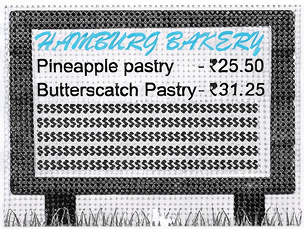
(1) What will be the bakery bill for Sanya?
- ₹192.75
- ₹286.25
- ₹166.50
- ₹225.00
(2) When Sanya gives the 500 rupee note to the bakery owner, what amount will she get in return after paying the bill?
- ₹307.25
- ₹333.50
- ₹275.00
- ₹213.75
(3) On the way back Sanya bought 6 pens, each costing ₹17.75. How much did she spend on pens?
- ₹106.50
- ₹95.25
- ₹124.00
- ₹84.75
(4) She returned all the money left with her to her father. How much did she return?
- ₹129
- ₹89.75
- ₹118.50
- ₹107.25
Answer
(1) Given:
Cost of one pineapple pastry = ₹25.50
Cost of one patty = ₹12.25
Cost of one doughnut = ₹21.75
Cost of a box of cookies = ₹79.50
Sanya buys:
4 pineapple pastries = 4 x ₹25.50 = ₹102.00
5 patties = 5 x ₹12.25 = ₹61.25
2 doughnuts = 2 x ₹21.75 = ₹43.50
A box of cookies = 1 x ₹79.50 = ₹79.50
Total Bill = ₹(102.00 + 61.25 + 43.50 + 79.50) = ₹286.25
Hence, option 2 is the correct option.
(2) Amount given = ₹500.00
Total Bill = ₹286.25 [From previous step]
Amount received back = (Amount given) - (Total Bill)
Substituting the values in above, we get:
Amount received back = ₹500.00 - ₹286.25 = ₹213.75
Hence, option 4 is the correct option.
(3) Given:
No of pens = 6
Cost of one pen = ₹17.75
Cost of 6 pens = No of pens x Cost of one pen
Cost of 6 pens = 6 x ₹17.75 = ₹106.50
Hence, option 1 is the correct option.
(4) Total amount given = ₹500.00
Money spent on bakery = ₹286.25 [From step 1]
Money spent on pens = ₹106.50 [From step 3]
Final balance returned = ?
Total amount spent = Money spent on bakery + Money spent on pens
Total amount spent = ₹286.25 + ₹106.50 = ₹392.75
Final balance returned = Total amount given - Total amount spent
Substituting the values in above, we get:
Final balance returned = ₹500.00 - ₹392.75 = ₹107.25
Hence, option 4 is the correct option.
There is a 0.37 km long jogging track in Laleh Park. Shruti lives 0.42 km away from the track. Every morning Shruti goes jogging to Laleh park. She usually starts jogging from home and after reaching the park, goes jogging 8 times around the track. She then returns home by a friend's car.
(1) How much distance does she jog every morning?
- 0.79 km
- 3.38 km
- 3.73 km
- 6.32 km
(2) How many rounds of the track make a distance of 4.44 km?
- 9
- 10
- 11
- 12
(3) On a particular day, she began jogging from her home and completed 10 rounds of the track. How much did she jog on that day?
- 3.28 km
- 4.12 km
- 4.57 km
- 7.9 km
(4) One day her friend could not come. So, she had to jog back home after completing 8 rounds of the track. How much did she jog on that day?
- 3.8 km
- 4.1 km
- 4.6 km
- 5.1 km
Answer
(1) Given:
Distance from home to park = 0.42 km
Length of track = 0.37 km
8 rounds of the track = 8 x 0.37 = 2.96 km
Total distance = Distance from home to park + 8 rounds of the track
Substituting the values in above, we get:
Total distance = 0.42 + 2.96 = 3.38 km
Hence, option 2 is the correct option.
(2) Number of rounds = ?
Distance = 4.44 km
Track length = 0.37 km
Number of rounds = Total distance ÷ Track length
Substituting the values in above, we get:
Number of rounds = 4.44 km ÷ 0.37 km = 12
Hence, option 4 is the correct option.
(3) Given:
Distance from home to park = 0.42 km
Length of track = 0.37 km
10 rounds of the track = 10 x 0.37 = 3.70 km
Total distance = Distance from home to park + 10 rounds of the track
Substituting the values in above, we get:
Total distance = 0.42 + 3.70 = 4.12 km
Hence, option 2 is the correct option.
(4) Given:
Distance to park = 0.42 km
Length of track = 0.37 km
8 rounds of track = 8 x 0.37 = 2.96 km
Distance back home = 0.42 km
Total distance = Distance to park + 8 rounds of track + Distance back home
Substituting the values in above, we get:
Total distance = 0.42 km + 2.96 km + 0.42 km = 3.8 km
Hence, option 1 is the correct option.
Assertion: To multiply a decimal number by 1000, we move the decimal point in the number to the right by three places.
Reason: To multiply two decimals, we first convert them into fractions.
- Both Assertion (A) and Reason (R) are true and Reason (R) is the correct explanation of Assertion (A).
- Both Assertion (A) and Reason (R) are true but Reason (R) is not the correct explanation of Assertion (A).
- Assertion (A) is true but Reason (R) is false.
- Assertion (A) is false but Reason (R) is true.
Answer
Assertion (A) is true but Reason (R) is false.
Explanation
When we multiply a decimal by 1000, we shift the decimal point three places to the right.
Example:
2.45 × 1000 = 2450
The Reason is false.
To multiply two decimals, we do not need to convert them into fractions. We multiply the numbers normally and then place the decimal point according to the total number of decimal places.
Hence, option 3 is the correct option.
Assertion: 0.2222 ............... is a recurring decimal.
Reason: In a decimal if a digit or a group of digits in the decimal part is repeated, continuously, then such a number is called a recurring decimal.
- Both Assertion (A) and Reason (R) are true and Reason (R) is the correct explanation of Assertion (A).
- Both Assertion (A) and Reason (R) are true but Reason (R) is not the correct explanation of Assertion (A).
- Assertion (A) is true but Reason (R) is false.
- Assertion (A) is false but Reason (R) is true.
Answer
Both Assertion (A) and Reason (R) are true and Reason (R) is the correct explanation of Assertion (A).
Explanation
The Assertion is true.
0.2222...... has the digit 2 repeating continuously.
The Reason is also true.
A decimal in which a digit or group of digits repeats continuously is called a recurring decimal.
Since the digit 2 repeats continuously in 0.2222……, it is a recurring decimal.
Hence, option 1 is the correct option.
Assertion: If we round off 15.406 to the nearest hundredths, we get 15.41.
Reason: To the nearest hundredths means, correct to 3 decimal places.
- Both Assertion (A) and Reason (R) are true and Reason (R) is the correct explanation of Assertion (A).
- Both Assertion (A) and Reason (R) are true but Reason (R) is not the correct explanation of Assertion (A).
- Assertion (A) is true but Reason (R) is false.
- Assertion (A) is false but Reason (R) is true.
Answer
Assertion (A) is true but Reason (R) is false.
Explanation
In 15.406, the hundredths place is 0. The digit in the thousandths place is 6 > 5, so we increase the hundredths digit by 1 to get 15.41.
The Reason is false.
Nearest hundredths means correct to 2 decimal places, not 3 decimal places.
Hence, option 3 is the correct option.
If 46.92 − 89.34 − P = 148.76 − 382.79, then the value of P is:
- 201.51
- 124.31
- 190.42
- 191.61
Answer
Given:
46.92 − 89.34 − P = 148.76 − 382.79
Step 1: Simplify the left-hand side (LHS)
46.92 − 89.34 − P
= −42.42 − P [∵ 46.92 − 89.34 = −42.42]
Step 2: Simplify the right-hand side (RHS)
148.76 − 382.79
= −234.03
Step 3: Equate LHS and RHS
−42.42 − P = −234.03
−P = −234.03 + 42.42 [Transposing −42.42 to RHS]
−P = −191.61
P = 191.61
∴ The value of P is 191.61.
Hence, option 4 is the correct option.
of
- 7.44
- 8.32
- 6.52
- 7.04
Answer
We solve the expression using the BODMAS rule (Brackets, Of, Division, Multiplication, Addition, Subtraction).
Given expression:
1.86 ÷ 0.3 - of (19.3 - 14.5) + 0.3 x 6.8
= 1.86 ÷ 0.3 - of (4.8) + 0.3 x 6.8 [Simplifying ()]
= 1.86 ÷ 0.3 - 0.8 + 0.3 x 6.8 [Simplifying 'Of']
= 6.2 - 0.8 + 0.3 x 6.8 [Solving ÷]
= 6.2 − 0.8 + 2.04 [Solving x]
= 8.24 − 0.8 [Solving +]
= 7.44 [Solving -]
∴ The value of the expression is 7.44.
Hence, option 1 is the correct option.
Answer
Step 1: Simplify the numerator
Converting the mixed fractions into improper fractions:
So, the numerator becomes:
The LCM of 4, 6 and 3 is 12. Taking 12 as the common denominator:
Step 2: Simplify the denominator
0.087 + 0.3717 ÷ 0.9
= 0.087 +
= 0.087 +
= 0.087 + 0.413
= 0.5
Step 3: Divide the numerator by the denominator
∴ The value of the expression is .
Hence, option 1 is the correct option.
The distance travelled by Swati in hours, if she travelled 13.27 km in each hour is:
- 33.187 km
- 59.767 km
- 46.445 km
- 19.912 km
Answer
Given:
Distance travelled in 1 hour = 13.27 km
Total time = hours = hours = 3.5 hours
Total distance = Distance travelled in 1 hour × Total time
= 13.27 km × 3.5 hours
Step 1: Multiply the decimals without the decimal point
1327 × 35 = 46445
Step 2: Place the decimal point
Sum of decimal places in given decimals = (2 + 1) = 3
So, the product contains 3 places of decimal.
∴ 13.27 × 3.5 = 46.445
∴ The distance travelled by Swati is 46.445 km.
Hence, option 3 is the correct option.
If 2494 ÷ 14.5 = 172, then 24.94 ÷ 1.45 =
- 0.172
- 1.72
- 17.2
- 172
Answer
Given:
2494 ÷ 14.5 = 172
We need to find the value of 24.94 ÷ 1.45.
Step 1: Express 24.94 ÷ 1.45 in terms of the given division
24.94 ÷ 1.45
Step 2: Use the given result
= 17.2
∴ The value of 24.94 ÷ 1.45 is 17.2.
Hence, option 3 is the correct option.
What decimal of an hour is a second?
- 0.0025
- 0.0256
- 0.00027
- 0.000126
Answer
We know that:
1 hour = 60 minutes
1 minute = 60 seconds
So, 1 hour = 60 × 60 = 3600 seconds
Therefore, 1 second = hour
Convert into a decimal
On dividing 1 by 3600, we get:
= 0.000277....
Rounded off to 5 decimal places, we get 0.00027.
∴ A second is 0.00027 of an hour (approximately).
Hence, option 3 is the correct option.
A doctor uses this formula to calculate the daily insulin units required for Khushi's body:
Daily insulin requirement (unit) = 0.55 × Total body mass (kilograms)
Khushi's body mass is 96 kg. Her daily insulin requirement is:
- 53 units
- 50 units
- 45 units
- 42 units
Answer
Given:
Daily insulin requirement (unit) = 0.55 × Total body mass (kilograms)
Total body mass of Khushi = 96 kg
Substituting the value of body mass in the formula:
Daily insulin requirement = 0.55 × 96
Step 1: Multiply the decimal without the decimal point
55 × 96 = 5280
Step 2: Place the decimal point
Number of decimal places in 0.55 = 2
So, the product contains 2 places of decimal.
∴ 0.55 × 96 = 52.80
Rounding 52.80 to the nearest whole number, we get 53.
[∵ first digit to the right of decimal is 8 > 5]
∴ Khushi's daily insulin requirement is 53 units.
Hence, option 1 is the correct option.
2.78 × 0.163 is same as:
- 278 × 0.00163
- 27.8 × 1.63
- 278 × 0.0163
- 278 × 16.3
Answer
Step 1: Find the value of the given expression
2.78 × 0.163
Multiplying the decimals without the decimal point:
278 × 163 = 45314
Sum of decimal places in given decimals = (2 + 3) = 5
So, the product contains 5 places of decimal.
∴ 2.78 × 0.163 = 0.45314
Step 2: Check each option
Checking option 1: 278 × 0.00163
Multiplying the decimal without the decimal point:
278 × 163 = 45314
Number of decimal places in 0.00163 = 5
∴ 278 × 0.00163 = 0.45314
Checking option 2: 27.8 × 1.63
Sum of decimal places = (1 + 2) = 3
∴ 27.8 × 1.63 = 45.314
Checking option 3: 278 × 0.0163
Number of decimal places in 0.0163 = 4
∴ 278 × 0.0163 = 4.5314
Checking option 4: 278 × 16.3
Number of decimal places in 16.3 = 1
∴ 278 × 16.3 = 4531.4
Only option 1 gives the same value as 2.78 × 0.163.
∴ 2.78 × 0.163 = 278 × 0.00163 = 0.45314.
Hence, option 1 is the correct option.
is equal to:
- 207
- 0.207
- 2070
- 0.0207
Answer
Step 1: Simplify the numerator
0.23 − 0.023
Converting into like decimals:
= 0.230 − 0.023
= 0.207
Step 2: Simplify the denominator
0.0023 ÷ 23
Step 3: Divide the numerator by the denominator
∴ The value of the expression is 2070.
Hence, option 3 is the correct option.