
The additive inverse of is
Answer
The additive inverse of a number a is -a, such that their sum is 0. Therefore the additive inverse of is .
Hence, option 2 is the correct option.
The rational number expressed in standard form is
Answer
Move the negative sign to the numerator: .
Divide both by their HCF (8): .
Hence, option 4 is the correct option.
What should be added to to get ?
Answer
Let the number be x.
L.C.M of 8 and 16 is 16.
Now, expressing each fraction with denominator 16:
Hence, option 4 is the correct option.
The multiplicative inverse of is
Answer
The multiplicative inverse (reciprocal) of is . Therefore the reciprocal of is , which is .
Hence, option 1 is the correct option.
The sum of and its multiplicative inverse is
0
-3
Answer
Multiplicative inverse of is -3.
Sum =
L.C.M. of 3 and 1 is 3.
Now, expressing each fraction with denominator 3:
Hence, option 4 is the correct option.
The product of and its additive inverse is
0
-3
Answer
Additive inverse of is .
Product =
Hence, option 3 is the correct option.
Which of the following rational numbers is equivalent to ?
Answer
Reduce each option to standard form:
Only option 3 reduces to
Hence, option 3 is the correct option.
If m of cloth is required for one suit, then how many suits can be prepared from 30 m of cloth?
- 4
- 5
- 8
- 9
Answer
Given:
Total length of cloth = 30 m
Required length for one suit = m = m
Total number of suits = ?
Total number of suits = Total length of cloth ÷ Required length for one suit
Substituting the values in above, we get:
Total number of suits = 30 m ÷ m
∴ 8 suits can be prepared from 30 m of cloth.
Hence, option 3 is the correct option.
Fill in the blanks :
(i) The multiplicative inverse of a rational number is also called its ............... .
(ii) Every negative rational number is ............... than 0.
(iii) A rational number is said to be in standard form, if q is ............... and p and q have no common divisor other than 1.
(iv) is a ............... rational number.
(v) The additive inverse of a rational number is ............... .
Answer
(i) The multiplicative inverse of a rational number is also called its reciprocal.
(ii) Every negative rational number is less or smaller than 0.
(iii) A rational number is said to be in standard form, if q is positive and p and q have no common divisor other than 1.
(iv) is a positive rational number.
(v) The additive inverse of a rational number is .
State True or False :
(i) There exists a rational number which is neither positive nor negative.
(ii) Every rational number has a multiplicative inverse.
(iii) Every rational number when expressed in its standard form has its denominator greater than the numerator.
(iv) The sum of a rational number and its additive inverse is always ............... .
(v) The product of a rational number and its multiplicative inverse is always ............... .
(vi) Any two equivalent rational numbers have the same standard form.
(vii) The product of any two rational numbers is also a rational number.
(viii) A rational number when divided by another rational number always gives a rational number.
(ix) Every rational number can be represented on a number line.
(x) The rational numbers smaller than a given rational number lie to the left of .
Answer
(i) True
Reason — Zero (0) is a rational number that is neither positive nor negative.
(ii) False
Reason — While most rational numbers have a multiplicative inverse, zero (0) does not, because division by zero is undefined.
(iii) False
Reason — In standard form, the denominator must be positive, but it can be smaller than the numerator (for example, is in standard form).
(iv) The sum of a rational number and its additive inverse is always 0.
(v) The product of a rational number and its multiplicative inverse is always 1.
(vi) True
Reason — Equivalent rational numbers like and both reduce to the same standard form, which is .
(vii) True
Reason — According to closure property of multiplication for rational numbers, the product of any two rational numbers is also a rational number.
(viii) False
Reason — A rational number divided by zero does not give a rational number, as division by zero is undefined.
(ix) True
Reason — Every rational number corresponds to a unique point on the number line.
(x) True
Reason — On a number line, values decrease as you move to the left; therefore, all numbers smaller than lie to its left.
Assertion: Two rational numbers with different numerators can never be equal.
Reason: A rational number is said to be in standard form if q is positive and p and q have no common factor other than 1.
- Both Assertion (A) and Reason (R) are true and Reason (R) is the correct explanation of Assertion (A).
- Both Assertion (A) and Reason (R) are true but Reason (R) is not the correct explanation of Assertion (A).
- Assertion (A) is true but Reason (R) is false.
- Assertion (A) is false but Reason (R) is true.
Answer
Assertion (A) is false but Reason (R) is true.
Explanation
The assertion is false because rational numbers with different numerators can still be equal. For example, and have different numerators but represent the same value.
The reason is true because it is the correct definition of the standard form of a rational number.
Hence, option 4 is the correct option.
Assertion: The smallest rational number does not exist.
Reason: On the number line, all the rational numbers to the left of 0 are negative.
- Both Assertion (A) and Reason (R) are true and Reason (R) is the correct explanation of Assertion (A).
- Both Assertion (A) and Reason (R) are true but Reason (R) is not the correct explanation of Assertion (A).
- Assertion (A) is true but Reason (R) is false.
- Assertion (A) is false but Reason (R) is true.
Answer
Both Assertion (A) and Reason (R) are true but Reason (R) is not the correct explanation of Assertion (A).
Explanation
The assertion is true because we can always find a smaller rational number by moving further to the left on the number line.
The reason is also true because numbers to the left of 0 are negative, but this does not explain why the smallest rational number does not exist.
Hence, option 2 is the correct option.
Which of the following is incorrect?
Answer
Checking option 1: and
LCM of 7 and 5 = 35
Since −15 > −21, we have , i.e., .
∴ Option 1 is correct.
Checking option 2: and
Compare the fractional parts and .
LCM of 3 and 5 = 15
and
Since , we have .
So,
[Greater fractional part makes the negative mixed number smaller]
∴ Option 2 is correct.
Checking option 3: and
Compare the fractional parts and .
LCM of 4 and 5 = 20
and
Since , we have .
So, .
But the given statement says , which is false.
∴ Option 3 is incorrect.
Checking option 4: and
Compare the fractional parts and .
Since
[Same numerator, smaller denominator gives a greater fraction]
So, .
∴ Option 4 is correct.
Hence, the incorrect statement is in option 3.
Hence, option 3 is the correct option.
If , then the value of equals:
Answer
Given:
So, we can take x = 9 and y = 8.
Step 1: Find the value of
Step 2: Add and
LCM of 7 and 17 = 119
∴ The required value is .
Hence, option 2 is the correct option.
is the rational number between and . Which of the following is not a rational number between and ?
Answer
To compare the given rational numbers, express and with denominator 16.
So, we need rational numbers lying between and , i.e., numerators between 8 and 12.
Checking option 1:
Since 8 < 9 < 12, lies between and .
Checking option 2:
Since 13 > 12, .
So, does not lie between and .
Checking option 3:
Since 8 < 10 < 12, lies between and .
Checking option 4:
Since 8 < 11 < 12, lies between and .
∴ is not a rational number between and .
Hence, option 2 is the correct option.
Answer
Step 1: Convert the mixed fractions into improper fractions
Step 2: Evaluate the numerator
Numerator =
Step 3: Evaluate the denominator
First term:
LCM of 5 and 10 = 10
Second term:
Denominator =
Step 4: Divide the numerator by the denominator
[Dividing by a fraction is the same as multiplying by its reciprocal]
Step 5: Convert into a mixed fraction
610 ÷ 9 = 67 with remainder 7
So,
∴ The required value is .
Hence, option 3 is the correct option.
of a delegation are from India, are from Britain, are from Germany and the rest are Americans. If there are 1200 members in the delegation, then how many Americans are there?
- 460
- 400
- 360
- 300
Answer
Given:
Fraction from India =
Fraction from Britain =
Fraction from Germany =
Total members = 1200
Step 1: Find the fraction of non-American members
Fraction of non-Americans =
LCM of 20, 4 and 10 = 20
Fraction of non-Americans:
Step 2: Find the fraction of Americans
Fraction of Americans =
Step 3: Find the number of Americans
Number of Americans:
∴ There are 360 Americans in the delegation.
Hence, option 3 is the correct option.
In an examination, a student was asked to find of a certain number. By mistake he found of that number. If his answer was more than the correct answer, then the number is:
Answer
Let the number be x.
Correct answer =
Wrong answer =
According to the question, the equation can be written as:
[Wrong answer − Correct answer = Excess]
LCM of 5 and 17 = 85
∴ The required number is .
Hence, option 2 is the correct option.
State 'T' for true and 'F' for false.
(i) Every rational number can be expressed with a positive numerator.
(ii) Rational numbers are arranged in ascending order.
(iii) can be expressed as .
(iv) and are equivalent rational numbers.
| (i) | (ii) | (iii) | (iv) | |
|---|---|---|---|---|
| 1. | F | F | F | T |
| 2. | F | T | F | T |
| 3. | T | T | T | T |
| 4. | T | T | F | T |
Answer
Checking (i):
Any rational number with a negative numerator can be rewritten with a positive numerator by multiplying its numerator and denominator by −1.
For example, .
So, every rational number can be expressed with a positive numerator.
∴ (i) is True.
Checking (ii):
The given numbers are .
is negative, while and are positive.
So is the smallest. Now compare the three positive numbers.
LCM of 6, 10 and 10 = 30
Since , we get .
So the ascending order is , which matches the given order.
∴ (ii) is True.
Checking (iii):
Now, add and .
LCM of 5 and 80 = 80
Converting into a mixed fraction:
159 ÷ 80 = 1 with remainder 79
So, .
∴ (iii) is True.
Checking (iv):
and are equivalent if 15 x 8 = 10 x 12. []
15 x 8 = 120 and 10 x 12 = 120
Since both products are equal, and are equivalent rational numbers.
∴ (iv) is True.
So, the answers are T, T, T, T.
Hence, option 3 is the correct option.
By which number should be divided to get ?
- 0
- −1
- 2
- 1
Answer
Step 1: Simplify
LCM of 5 and 2 = 10
Step 2: Set up the equation
Let the required number be x.
According to the question, the equation can be written as:
∴ The required number is −1.
Hence, option 2 is the correct option.
The value of b for which the two rational numbers are equivalent, is:
−1
1
Answer
Two rational numbers and are equivalent if and only if .
Given:
and are equivalent.
According to the question, the equation can be written as:
2 x b = 9 x 1
2b = 9
Verification:
LHS = RHS
∴ The required value of b is .
Hence, option 4 is the correct option.
For any two rational numbers x and y which of the following is/are correct, if x is positive and y is negative?
(i) x < y
(ii) x = y
(iii) x > y
- Both (i) and (ii)
- Both (ii) and (iii)
- Only (iii)
- (i), (ii) and (iii)
Answer
Given:
x is a positive rational number, so x > 0.
y is a negative rational number, so y < 0.
Combining the two, we get y < 0 < x, i.e., x > y.
Checking (i): x < y
A positive number is always greater than a negative number, not less than. So, x < y is false.
Checking (ii): x = y
A positive number can never be equal to a negative number. So, x = y is false.
Checking (iii): x > y
A positive number is always greater than a negative number. So, x > y is true.
∴ Only (iii) is correct.
Hence, option 3 is the correct option.
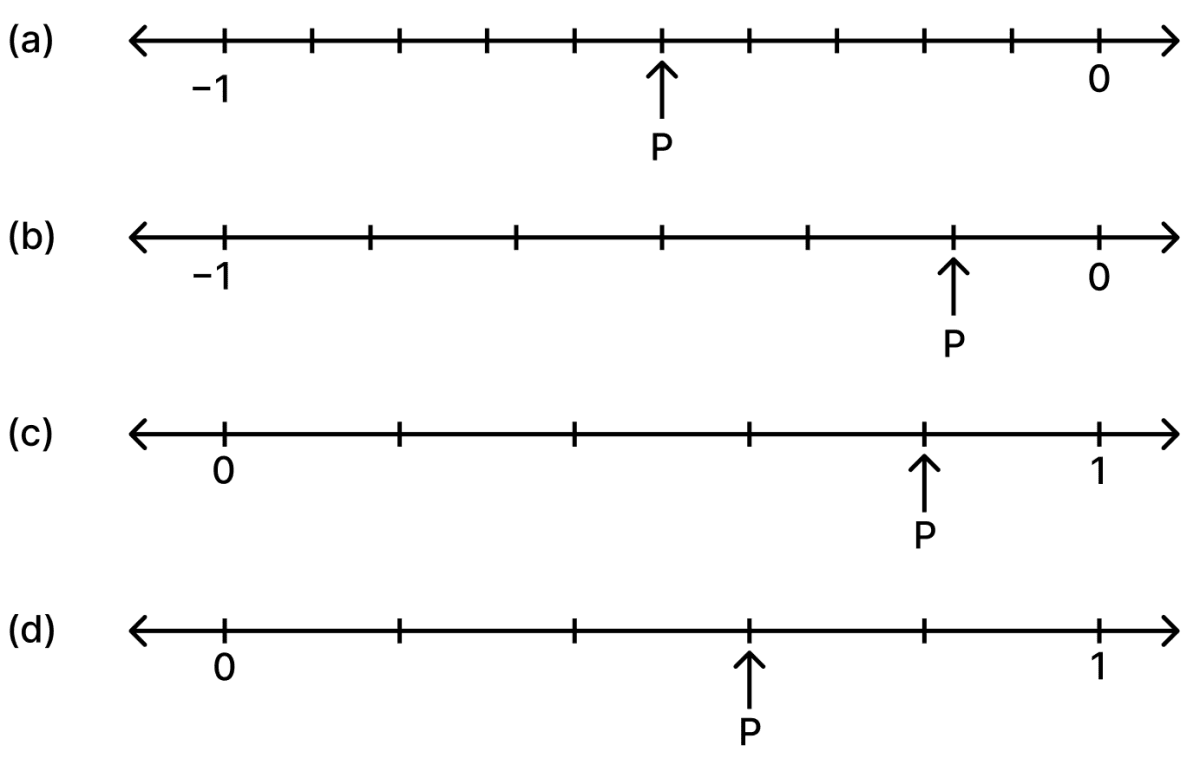
In which of the following options does point P represent on the number line?
Answer
The rational number is a negative number.
So, it must lie to the left of 0 on the number line.
[Every negative rational number is less than 0]
Also, since is the midpoint between -1 and 0, the point P must lie exactly halfway between -1 and 0.
Checking option 1:
The number line shows the segment from -1 to 0, divided into equal parts. The point P is marked exactly at the midpoint between -1 and 0.
So, P represents .
Checking option 2:
The number line shows the segment from -1 to 0, but the point P is marked closer to 0, not at the midpoint.
So, P does not represent .
Checking option 3:
The number line shows the segment from 0 to 1, so the point P lies to the right of 0.
Since is negative, P cannot represent .
Checking option 4:
The number line shows the segment from 0 to 1, so the point P lies to the right of 0.
Since is negative, P cannot represent .
∴ Only option 1 represents correctly.
Hence, option 1 is the correct option.